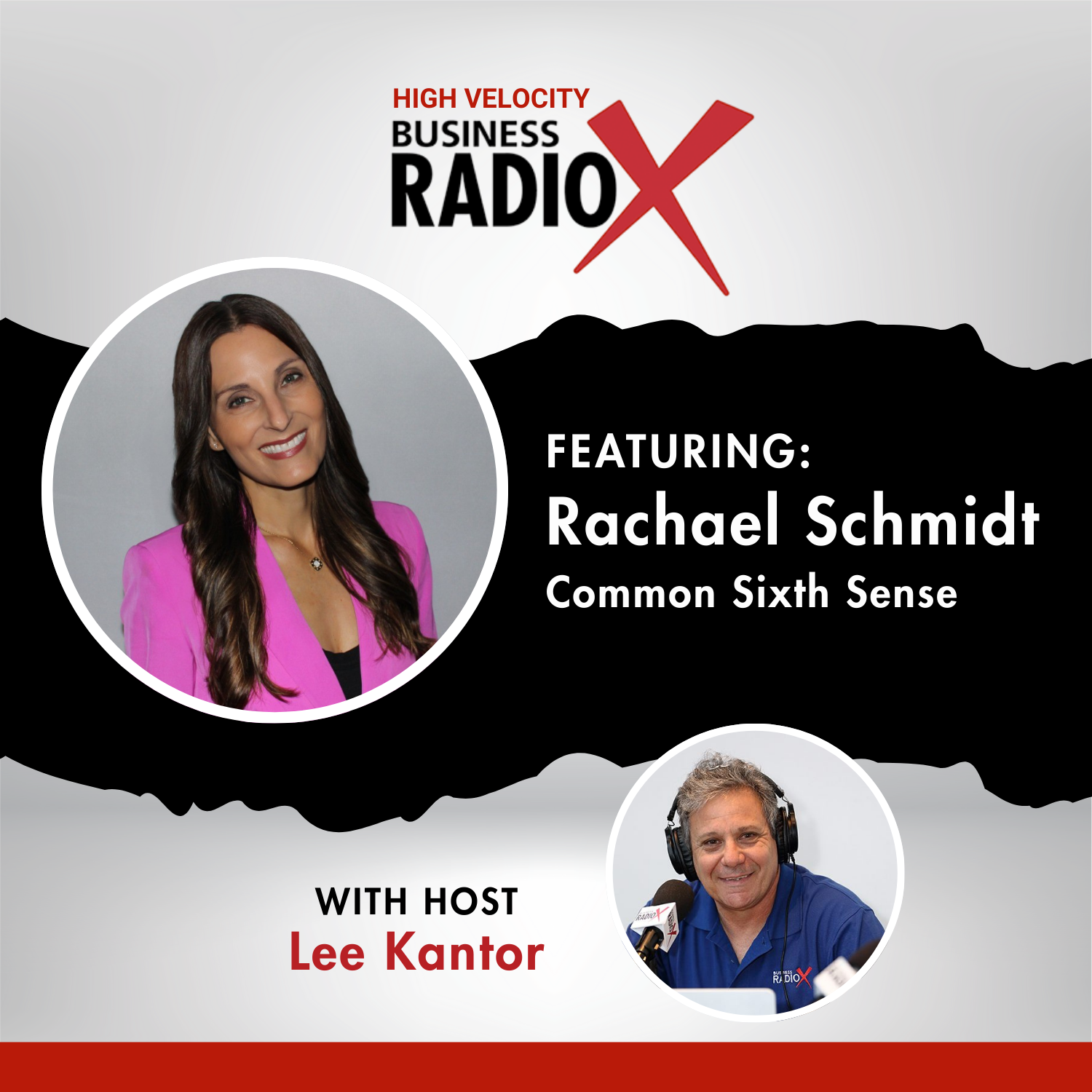

In this episode, Lee Kantor interviews Rachael Schmidt, author of COMMON SIXTH SENSE. She breaks down how simple awareness can transform the way you navigate workplace stress and even spark deeper life shifts. She shares practical micro-actions like intentional planning, strategic energy breaks, and setting healthy boundaries. She discuss how to work with colleagues who have “narrow lenses,” and how tools like the Blue Line Decision-Making method can help you defuse negative energy and make clearer choices. Finally, Rachael explains how developing a “common sixth sense” can strengthen workplace culture and elevate productivity.

 RACHAEL SCHMIDT, author of COMMON SIXTH SENSE, is a mindfulness-based self-development coach, mentor, and educator with more than twenty years of experience helping people awaken to their fullest potential. She has worked with teenagers, Fortune 500 leaders, and everyone in between, guiding them to live more authentic and connected lives. She teaches mindfulness integration at the graduate level and is the founder of the consultancy, Common Sixth.
Connect with Rachel on LinkedIn and Facebook.
What You’ll Learn In This Episode
- Stress emerges as an issue of energy mismanagement, along with practical approaches to correct it
- Greater awareness supports navigating work stressors and can lead to meaningful life shifts
- Mindful micro-actions — such as intentional daily planning, strategic energy breaks, and boundary setting — enhance workplace stress management
- Effective strategies exist for working with team members who operate with “narrow lenses”
- The Blue Line Decision-Making Tool provides guidance for handling negative energy and making clearer choices
- Developing a “common sixth sense” strengthens workplace culture and boosts productivity
 This transcript is machine transcribed by Sonix.
TRANSCRIPT
Intro: Broadcasting live from the Business RadioX studios in Atlanta, Georgia. It’s time for High Velocity Radio.
Lee Kantor: Lee Kantor here. Another episode of High Velocity Radio, and this is gonna be a good one. Today on the show, we have the author of the book Common Sixth Sense, and she is with the company Common Sixth, and she is Rachael Schmidt. Welcome.
Rachael Schmidt: Thank you. Thank you so much, Lee.
Lee Kantor: Well, I’m excited to learn what you’re up to. Let’s start with the company, Common Sixth. How are you serving folks?
Rachael Schmidt: So Common Sixth is a resource for people who want to get back to themselves. So I do a lot of mindfulness integration when it comes to organizations. Or I do a lot of work here with Florida Atlantic University. That is where I take mindfulness concepts and I integrate them into the curriculum. And so I work not only with large organizations like a university, but my true labor of love is one on one clients, people who are feeling disconnected, people who are feeling like they’ve become too dependent on external resources and they need a path back to themselves. So the company itself, I’ve been doing this for over 25 years now, has really evolved and come to bring a much larger platform, which is how the book came about, is from my clients telling me, hey, you really need to bring this message to a much larger audience. So although I wear a lot of different hats, the the main messaging is how do we get back to ourselves?
Lee Kantor: So what’s the origin story? How’d you get involved in this line of work?
Rachael Schmidt: Well, I’ve always been a naturally intuitive person. And so it really organically came about from people asking my advice and perspective on things. So I ran my. My business as a referral business still is solely a referral business. Now I have the book, which just launched last week, but I found a way to leverage my natural abilities and serve others. And so it was the collision of those two things that has kept me on this path for so long.
Lee Kantor: And then when did you kind of turn it into kind of a business where you said, hey, there’s a need out there in the marketplace, and I can fill it with what I know and what I believe.
Rachael Schmidt: Well, that was pretty apparent from the very beginning, Lee, because I saw how people would respond to these personal epiphanies, these aha moments, this this realization that I already have everything I need within me. And I’ve just gotten a little bit off track. So I saw immediately that the need was out there. That was quite obvious. Um, still is, still is. Um, but in terms of creating the business, it was just something that I organically rolled with because I could see the effect that it would have on people in terms of enhancing their lives, opening their mind, creating more awareness.
Lee Kantor: Now, I understand that you saw there was a need, but was the public saying, were they self-aware enough to say, I have a need and I have challenges, and this is the path that I think is going to unlock some of this other angst or suffering that I’m going through.
Rachael Schmidt: I don’t know if they thought ahead of time, this is the path, but what I do know is that they were curious. They were curious enough to say, let me see what this is all about. And when you expose yourself to mindfulness, when you create those present moment experiences, your awareness will grow. And so it wasn’t so much about people saying, hey, mindfulness is the way. And I’m aware of that as much as it was people saying I need something and I am willing. So it was more about a willingness to explore and I would say still is. We are inundated, oversaturated with self-help resources. We’ve got more than we’ve ever had, and yet people still feel disconnected. They still feel too dependent on external influences like other people, technology, environment. So I think that the willingness is there and that is where all the magic happens. So you have people who collectively may feel disconnected, disassociated. They are certainly willing to try and to try something that might be out of their wheelhouse. And of course, a lot of my businesses, well, all of my business really, at this point, except for the book is referral business. So of course then they share with others their experience and that’s what brings in more business.
Lee Kantor: So what are some of the symptoms a person might be having where the path through mindfulness might be the solution?
Rachael Schmidt: They feel like something’s missing and they’ve been searching and they’ve been trying. And yet it still feels like something is missing. And that missing piece is most likely a reconnection with the self. They are feeling the pressures of today’s fast paced culture climate. They are feeling overwhelmed. They are feeling like, uh, they have to pick a side. Polarization. The pressures they are feeling stressed. They are feeling anxious. They are feeling like they have tried many different things and those things have been unsuccessful for them.
Lee Kantor: Now, when a person is working with you as an individual, what is kind of those initial conversations look like where you’re helping them kind of learn about mindfulness? Because I would imagine this is the first time that they’ve ever kind of dug in this deeply. But, um, maybe I’m wrong about that, but what are those? Kind of, uh, what is their pre-work is their homework. You give them, like, how does an onboarding and kind of the early sessions look like with you?
Rachael Schmidt: The early sessions are going to look like me getting a baseline Line A where a group or individual’s mindset might be. Their perspectives, their attitudes. The energy that they put off. So I’m gathering a lot of Intel in my conversations from clients and groups. And for example, I work with a lot of graduate students at Florida Atlantic. And so I’m going in and I’m gathering my own Intel based on many of those factors. Uh, and then I am exposing them to concepts and seeing how they respond. Concepts like breathwork, meditation, energy, awareness, intuition. So I’m introducing these concepts to them to kind of see where where are we, where are we today and where do we need to go? A lot of authentic conversations. Lee.
Lee Kantor: So you’re having a lot of authentic conversations with them, and are they typically quick to be vulnerable and, and, um, share or is this something you have to kind of go layer by layer in order to really get the most value out of the relationship that you’re building?
Rachael Schmidt: I found that generally people feel that the experience is very refreshing. They feel like it’s unique and they feel like there’s a longing that’s being met. They may have never had these kinds of conversations before. Certainly when you look at the work I do with the university, certainly not in education. Have they had these kinds of conversations? So they are very receptive. Now there’s always one that I got to really extract from, but they always come around. That’s what’s so incredible about this type of work because the work is not for me. The work is for you. So those that actively participate really are getting the most benefit from the experience and the work. But I have generally found that people, they have described the experience as just kind of taking that big deep breath and saying, I just needed to be reminded of all these things that I have long forgotten about.
Lee Kantor: So you think some of this is just innately you just know this. Your intuition is kind of directing you in this way, and you just kind of slowly move away from what, you know, at your core.
Rachael Schmidt: It is 100% innate. And this is what I write about and talk about in my book, Common Sixth Sense, is that we have forgotten about our most incredible, valuable tools. We have suppressed them, our intuition, our our breath. My gosh, one of the most powerful tools we have in our toolbox that we’ve just shoved down so deep that we just it’s all but forgotten. Our ability to manage energy. We have so many incredible innate gifts that we are not using to our advantage to create more peace in our life, to strengthen our relationships, to grow professionally. All the things. Absolutely, 100% Percent innate. You came with these tools.
Lee Kantor: But so how do how are we as a human species, um, taking these innate things and then kind of burying them like no one is telling us, breathe more shallow. Don’t take deep breaths. You know, rush, rush, rush. Like no one is kind of formally telling us that. But it seems like that’s the behavior that we’re exhibiting.
Rachael Schmidt: Well, we have to look at the systems that we live in and experience, and we have to take responsibility for those systems. Those systems are not designed for us. Our work environment, our our home dynamic, um, our, our work environment. They’re not designed specifically for the individual. So we have to take energetic Accountability in all of those systems, the systems are going to behave as the systems behave, right. So that’s the the the kind of why is this happening is because we’re participating in systems that are fast paced or negative or unhealthy or whatever it is in your life. You have to take your power back within the systems. And you’re right. Nobody is saying, you know, uh, breathe more shallow. We do here. Hey, take a deep breath. Just breathe. Take a break. Okay, fine. Take a deep breath. Now what? I’m in the now what department over here. We all know that it is so valuable to take to stop and take a breath. Lee, we take 20,000 breaths every day. Have you even been aware of a single breath you’ve taken today? Right. This is for everyone to contemplate. 20. You’re doing something 20,000 times a day, and most of us aren’t even aware. So we need to take our breath. And then what? What comes next after we take a breath? Well, usually we find ourselves taking a deep breath when we’ve been jolted or triggered. We are anxious, stressed out. We take our deep breath.
Rachael Schmidt: We return to our body. Now what? Well, now you’ve got to take the most connected action to keep you in line with your most authentic, connected and peaceful life. So let’s just use a real world example. We get jolted. Somebody says something that is very triggering to you. I called a wave. I called a jolt. You take your breath, you recognize that something did not resonate with you. And what I would recommend is that you do not take any action until you feel like you have returned to yourself, so you’re going to get that out of body feeling. When you get that jolt, you’re going to use your breath to come back into your body, and then you’re going to make a decision from a connected state of mind, because otherwise it is just a reaction, and a reaction is a disconnection. So we hear these things take a deep breath. Are we using them to empower our lives or are they just things we know? Oh yeah, I know. I’m supposed to take a deep breath. I really never do. But I know I’m supposed to. How can we incorporate these tools into our daily life to get ourselves recentered, to get back into the right state of mind, the right state of body, the right state of spirit, so that our next step is more in alignment with who we really are and the life we want to live.
Lee Kantor: Now, when you’re working with your clients, this is though some of the activities that you’re actually doing where you’re making kind of these, um, lessons very actionable. So we’re like where you maybe even get to the point of actually scheduling or you’re going to, um, create habits around these kind of actions built around some of these mindful mindfulness techniques like deep breathing.
Rachael Schmidt: Yeah, we talk a lot about micro habits because those are much easier to integrate into our lives. So maybe a micro habit for somebody would be simply becoming aware of their breath. I’m going to spend the next week just paying attention to my breath, seeing how it works for me, how it works against me. Um. What ignites it? What? What calms it down? Just having that awareness is going to give you information. And information, as we know, is powerful not only for awareness, but for self-awareness. For someone else, it might look like, I just want to sit with myself for five minutes a day. No agenda, no expectation. Just sit with myself for somebody else. They might want to try out a, you know, get on YouTube and try out a meditation of some somebody else might want to journal for five minutes a day. Somebody else might want to set an intention. The micro habits are very, very important because they ultimately create our habits. So start small. The one thing that I would recommend that people do when they are starting micro habits is just to become aware. The first assignment is always just about awareness. We’re not trying to accomplish anything. We’re not trying to make big life shifts. We’re just trying to become aware. Maybe the epiphany for someone after they start implementing their micro habits is to say, wow, I, I really have become so much more aware of my thoughts, my attitude, uh, how I give my energy away to people without my consent, how much energy I waste on things that I don’t want to waste on anymore. The type of care I give myself. There’s so many reflective questions that come about when we just begin to have awareness. So start with a micro action. Think small, think daily. You know, we don’t want to reserve our self-connection and awareness for a yoga class or a Tuesday. We want to incorporate it into our everyday life.
Lee Kantor: Now, when you’re working with organizations when it comes to this type of work, how does that how do they implement this like throughout the company? Or does it start with maybe individuals or teams? And also how do they kind of measure the results or the success of a program like the ones you’re talking about?
Rachael Schmidt: It always starts with the key players, because we know that our mindful leaders and this is research are less stressed and They’re more resilient. They’re more adaptable, uh, less reactive, less impulsive, more intentional. I mean, and this is just the benefits of mindfulness, right? So you incorporate that in to the key leadership and you’ve got more inclusion, more collaboration. Um, we know that our mindful leaders are more self connected. They have higher emotional intelligence. And they are highly skilled at creating corporate and organizational cultures that thrive. So the key leadership is really where I like to put the initial focus because, uh, they’ve got a big responsibility, and that is to set the energetic tone of their organization or for their teams. So in terms of measurability. That is, within the individual. So the feedback that I get from people through self surveys and whatnot are all individually based. So we need our leadership to be mindful. And by the way, for anyone who’s listening and doesn’t know what is mindful, it’s staying present on purpose without judgment. Being fully present. So we all know what it feels like to interact with someone at work, especially a key leader who is present versus one that is not. So the, um, the individual, uh, I always say, like, if you can manage your energy. You benefit and every person and every environment that you come in contact with will benefit as well. It is a beautiful top to bottom trickle down, because those those key leaders that I work with initially are going to set the tone.
Lee Kantor: Now how if you’re an individual contributor, an organization, how do you recommend dealing with somebody who maybe isn’t there yet and is exhibiting some other behaviors that are causing you stress, and that you’re trying to use some of these tools and techniques in order to alleviate some of this stress that you’re feeling.
Rachael Schmidt: You have to manage your energy first. Right. You’ve got to get back in your body. You’ve got to come from a place of connectedness. And when you do interact with people who will call them energy vampires, just as a general term, you really have to decide how much of your energy you’re going to give away to that type of a person. And then you’ve got to make really difficult decisions, because a person like that can really throw off the energetic tone of the entire group. So it’s a tough decision that a leader is in when it comes to these type of scenarios. But they must protect themselves first. So I’m, I am a a big pusher of well-being and self care and all those types of things. So for somebody who is really taking care of themselves and is really connected to themselves, these types of situations are much easier to navigate because they don’t absorb all of that negative energy from the particular person. They have really good boundaries in place, energetically speaking, and there they would. They’re just more highly skilled at determining, um, what they will allow and what they won’t.
Lee Kantor: Now, when you’re, um, going about your work, is there a story you can share that maybe illustrates how impactful the work can be? Is there do you don’t have to name the individual, but maybe share the challenge they came to you with and how you were able to help them get to a new level?
Rachael Schmidt: Well, I would love to tell you about some of the graduate students that I work with. Um, I co-teach capstone, which is a is the last step before they are going to graduate. So for those that don’t know, a thesis is usually a one year research capstones like one semester. And this is in the criminal justice um field. So these, these students, by the time they come to me, they have not done really any public speaking or those types of things, and they are typically petrified about it. Okay. And so they’ve got to spend the whole semester researching and preparing, and then they’ve got to deliver their capstone research presentation to a room full of 60 faculty members. So it’s they’ve got they come to me and they are stressed. They are anxious. Um, they are at the tail end of their education and, uh, they just don’t have a lot of steam in their tank. So in this 13 week period, we do mindful exercises to prepare them for this presentation. So it’s less about how do you give a formal presentation? And it’s more about let’s go back. Let’s go back to the basics and get your breath under control and get your energy under control and reunite you with yourself, your authentic self, so that you can find more passion in the work that you’re doing and the research that you’re exploring.
Rachael Schmidt: And it is really incredible to see this group of people every semester go from those first couple weeks of just being so outside of theirselves, so anxious, so stressed to being so grounded and passionate and confident Because they have taken some time to reunite with themselves. And it’s a beautiful journey to witness, to send off this group of students every semester, to go follow their professional pursuits and see the evolution. It’s not about changing them. The work that I do is never about changing you. There’s nothing about you that needs to be changed. You’re you. Whether you listen to this podcast or don’t, you’re still authentically you, but just to extract it. And so it is. It is just and I feel so blessed that that I can go on this journey with people and see how much they shift and evolve and become empowered just by connecting with themselves.
Lee Kantor: So if somebody wants to learn more about your practice or get Ahold of your book, uh, what’s the website? What’s the best way to connect?
Rachael Schmidt: You can connect with me at common six. That’s six. And please explore Amazon to find my book. Common $0.06.
Lee Kantor: Well, Rachel, thank you so much for sharing your story today. You’re doing such important work and we appreciate you.
Rachael Schmidt: Thank you so much, Lee. I really enjoyed chatting with you. Wishing you all the best.
Lee Kantor: All right, this is Lee Kantor. We’ll see you all next time on High Velocity Radio














