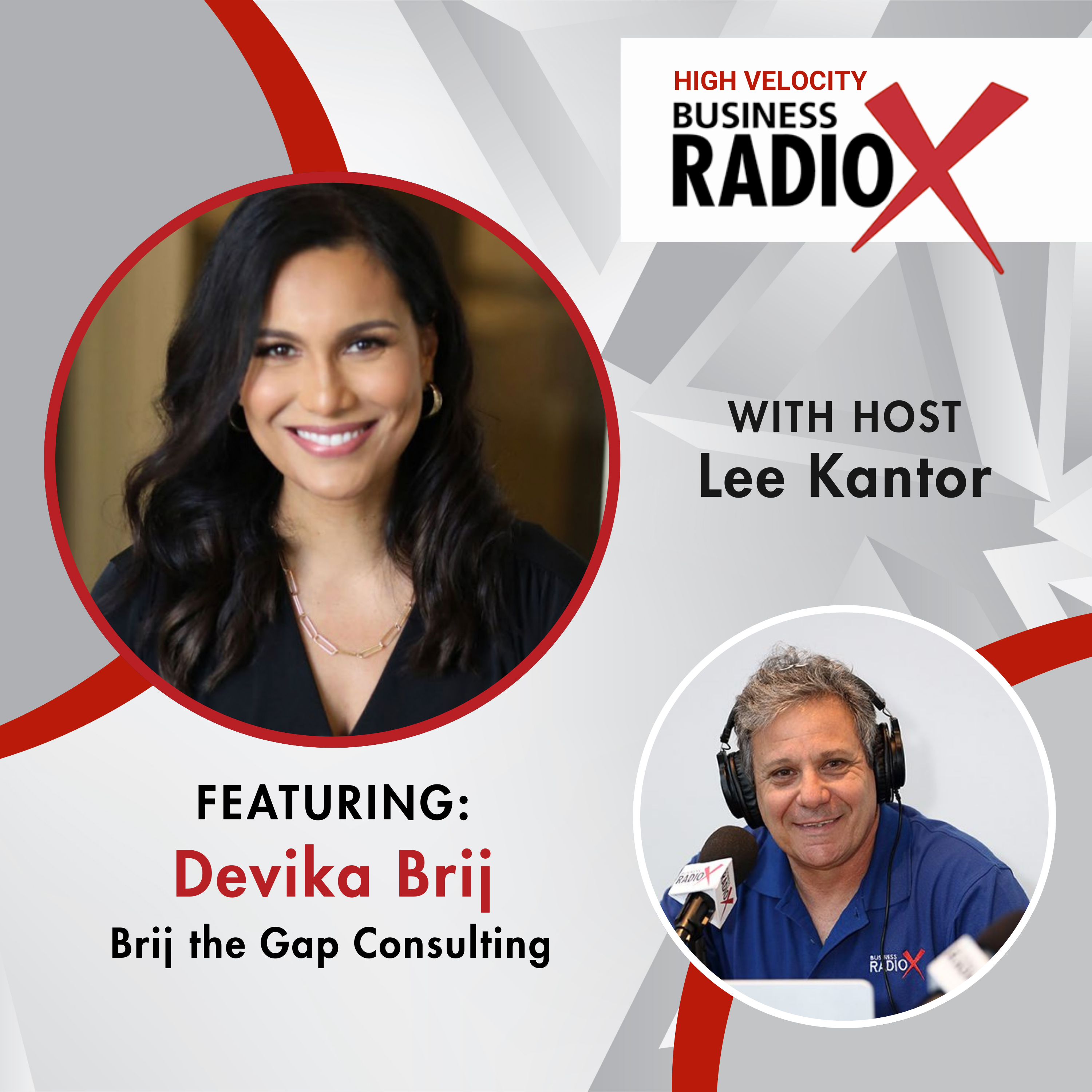

In this episode of High Velocity Radio, Lee interviews Devika Brij, CEO and co-founder of Brij the Gap Consulting. Devika discusses her transition from tech roles at Google and LinkedIn to founding her firm, which partners with global companies to improve leadership and employee development. She shares insights on overcoming career growth challenges, the importance of supportive leadership, and how her company helps organizations retain and empower talent. Devika also highlights her book, Thrive in Color, and invites listeners to connect for knowledge sharing and collaboration.
 Devika Brij Maurice is the founder and CEO of Brij the Gap Consulting and the author of Thrive in Color. Her journey is a powerful testimony of God’s grace, resilience, and the transformative power of faith, demonstrating how life’s deepest challenges can be turned into purpose driven triumphs.
Born into a single parent household, she was shaped by her mother’s unwavering strength as an immigrant in North America. Her mother juggled multiple jobs to provide for her daughters, modeling sacrifice, perseverance, and faith. Watching her mother navigate constant pressure instilled in Devika a strong drive to succeed, while also revealing the quiet cost of living in survival mode, including diminished self advocacy and settling for less than one’s true worth.
She went on to excel at world renowned organizations such as Google and LinkedIn, rising into leadership roles and earning recognition as a high performing professional. However, her corporate journey was not without hardship. Despite her results, she experienced an unjust termination rooted in bias and persistent micromanagement. The loss left her questioning her value and direction, marking one of the most painful chapters of her career.
In that season of rejection, she leaned fully into her faith. Rather than allowing disappointment to define her, she trusted God to redeem the experience and redirect her path. What felt like an ending became the foundation for a greater calling.
She founded Brij the Gap Consulting, a global talent and leadership development firm that partners with brands including Visa, Meta, Nike, Reddit, and Lionsgate. Through customized training and strategic guidance, she equips individuals and organizations to build confidence, develop leaders, and create values driven workplaces.
Today, as a sought after speaker and trusted advisor, she empowers others to transform setbacks into growth, steward their gifts with excellence, and pursue purpose with faith.
Connect with Devika on LinkedIn.
What You’ll Learn In This Episode
- Challenges employees face in career growth and the shortcomings of existing development programs.
- The importance of customized and actionable workshops for employee and leadership development.
- The role of self-advocacy skills in helping employees articulate their value and seek growth opportunities.
- The disconnect between upper management’s growth values and frontline managers’ talent hoarding.
- The significance of fostering a culture of growth and accountability in organizations.
- The impact of empathetic leadership during difficult times, such as layoffs.
- The relationship between employee development investment and organizational retention and innovation.
- Strategies for bridging the gap between employee potential and opportunity in the workplace.
 This transcript is machine transcribed by Sonix.
TRANSCRIPT
Intro: Broadcasting live from the Business RadioX studios in Atlanta, Georgia. It’s time for High Velocity Radio.
Lee Kantor: Lee Kantor here. Another episode of High Velocity Radio, and this is gonna be a good one. Today on the show we have CEO and co-founder of Brij the Gap Consulting, Devika Brij. Welcome.
Devika Brij: Hi, Lee. Thanks for having me.
Lee Kantor: Well, I’m excited to learn what you’re up to. Tell us about Bridge the Gap. How are you serving folks?
Devika Brij: Brij the gap is a talent and leadership development firm. We partner with global organizations like Samsung, Nike, Meta to equip professionals with the tools to increase performance, strengthen leadership capability, and drive lasting growth.
Lee Kantor: So what’s your backstory? How’d you get involved in this line of work?
Devika Brij: Well, it was not part of the plan, I’ll tell you that. No, Lee, You know, I was in tech for most of my career. I spent a lot of my time at Google and LinkedIn and had a great career trajectory there. But I noticed that there was quite a gap in terms of, you know, leadership development, employee development and and actually getting employees to, you know, feel, feel productive in the workforce and feel like they had a shot at the growth opportunities that they desired. And so, you know, just feeling like a lot of that, you know, the resources around that. The programing was just very fluffy and motivational. And so I left corporate, I started Bridge the Gap to create, you know, highly impactful but really tangible programs and workshops that professionals and leaders could, you know, obviously understand the context, but also have the tools and the strategies to apply immediately for career growth.
Lee Kantor: Now, when you’re working in the environments you were, um, those organizations have the ability to kind of hire the best of the best of the best, that there’s a lot of people seeking roles there and a lot of the, you know, the most talented arrive on the steps there. Is your service primarily geared to that kind of avatar of a, of a client, where they’re the best of the best, and they’re just trying to squeeze out the most out of that group. Or, or does it kind of go down the ladder a little bit to regular folks that are, you know, just out there grinding every day?
Devika Brij: Yeah. Well, I think we’re all out here grinding every day.
Lee Kantor: Right. But there are some people aren’t getting invited to Google, and they’re not going through the interview process and getting through all of those kind of hurdles to get and not only to be considered, but to be hired at Google. That’s a different type of person than might be, you know, in the majority of the places and the majority of the organizations in the country.
Devika Brij: Yeah. So, yeah, so typically, you know, my company partners with the organization who are looking to develop and empower their current employee base. So a lot of what bridged the gap does is kind of like the, you know, B2B and partnering with organizations. And, you know, then, yes, of course, serving the employee base and the leadership teams, that’s where Bridge the Gap comes in. But, you know, there are other ways that I work with professionals who might want to enter those environments or maybe don’t want to enter those environments, but are still thinking about career development and advancement. And so I actually released, um, my first book called Thrive in Color, um, which is filled with the same tools and strategies I would share with corporate partners. But just making that education and coaching more accessible to the wider public.
Lee Kantor: So right now, your clients are those kind of, uh, larger enterprise organizations.
Devika Brij: Yeah. Yeah, that’s that’s like the meat and bones of Bridge the Gap, but I am finding ways to kind of, you know, give more resources to the general public, you know, through whether it’s through social, whether it’s through books and, you know, speaking and things of that nature.
Lee Kantor: So now how do you go about advising or consulting with these organizations? So what’s kind of the pain point they’re having where they’re like, I better call the brij the gap folks.
Devika Brij: Well, a lot of it is, you know, some of these I typically partner with learning and development or, you know, corporate engagement, employee engagement, like, these are the decision makers that I’m partnering with. And a lot of the gaps that they’re having is one, how do we actually provide career development and leadership development, education and support, um, to folks that we consider high potential or folks that we want to retain as, you know, as, as leadership potential at the company for some of these organizations, you know, when they’re creating career development or leadership development, education content and training, if you really think about it, it’s kind of biased, right? It is really, um, as they’re building it, they of course know that they’re trying to develop their employees. But if you think about it, in the employee side of things, they desire a different perspective. They’re desiring, um, facilitation and leadership from someone who isn’t tied to the company, who wants to see them succeed, but can take a very unbiased approach to, to helping them. And so a lot of these companies acknowledge that. And that’s where I come in, kind of marrying my tool, strategies, programs and everything I’ve built. But combining it with their corporate culture and their retention goals and their employee development goals.
Devika Brij: So a lot of what I do is, you know, connecting with my partners and really understanding why they’re trying to drive employee growth or leadership development. Are there gaps, are there challenges that they’ve identified? Has there been feedback from employees that there isn’t a general satisfaction with their career development at that company, and really just combining forces to offer programing, workshops, coaching all of the good stuff to make sure that their employees are doing well at the company, because that drives productivity and it drives retention over time. So there’s that piece. Um, sometimes the teams internally just don’t have the capacity. Uh, maybe their teams are very slim. So they’re looking for kind of external partners to come in and help build what can be sustainable for their employee and leadership development growth at their organizations. Um, and so that’s why they’re generally calling on Bridge the Gap to partner with them. And the way that I, you know, explain to them is I’m not here to substitute. I’m more of like an extension of them. Um, but also just kind of meeting in the common values and the mission that we want their professionals or their employees, rather, to succeed and to win within their companies. So the company as a whole can win.
Lee Kantor: So what could that enterprise company that you left have done to keep you there?
Devika Brij: Sorry. Can you repeat your question, Lee?
Lee Kantor: What? What could that enterprise company that you left have done to have kept you there?
Devika Brij: Well, I think, you know, they’re one of the things is a lot of the times there is not opportunity for growth, especially if you want to grow within the current team that you’re in. And I wish there was more development around, hey, we value you here. We want to see you, you know, grow within our team. But we also recognize that you’re ready for development, you’re ready for advancement. And if it’s not this team, how can we explore other options with other organizations or other teams? How can we empower you? So when we do have opportunities, you’re in a good position in terms of skills and strengths and leadership qualities so you can succeed. That conversation doesn’t exist, right? So a lot of corporations, when they know they don’t have headcount, they try their best to just keep people in position. And we have to recognize that, you know, for folks that are ready to move on in their careers, that are ready for growth, that are ready for advancement, that’s an unfair ask. And so when there’s not, you know, room to move. What then happens? That individual has to look externally. And now that that company has lost top talent.
Devika Brij: So really the conversations I’m having, which was a gap for me in corporate America, is okay. So we know you can’t control that. There’s, you know, lack of headcount or lack of mobility. But how do you actually practice self-advocacy? How do you empower leaders to know your overall, you know, value that you’re driving your contributions, your achievements? How do you make sure you’re partnering with the right mentors and sponsors? How are you negotiating correctly to make sure that you are positioning yourself for career growth? That might not be in the kind of lateral move or upward trajectory that they’re thinking. Um, so just really helping them think outside of the box of, hey, yeah, there’s not headcount here, but there are other opportunities that I can explore and being able to facilitate that for themselves well, while also empowering the company to retain top talent by giving them opportunities, you know, that might be outside of the box versus kind of just saying, hey, sorry we can’t help you out, and then letting them leave the organization because, you know, turnover is expensive and finding good talent is difficult.
Lee Kantor: Do you find that sometimes there’s a disconnect, maybe from upper management, where they would have those kind of, uh, values and they would believe in what you’re saying, but then you trickle it down maybe to a lower level where that manager might be, have a more scarcity mindset and doesn’t want to give up. The good person is hanging on to them for their own kind of, um, internal reasons, rather than what’s the best for the employee or even what’s best for the company.
Devika Brij: I think that’s the biggest leadership challenge there is. So as you know, the way that it needs to work in my corporate advising is that growth opportunities and moving people forward needs to be built into the culture and the values of that company. So, for example, I’ll give you with LinkedIn, you know, I worked there for quite some time. I think that the thing that I admired most about them was that they knew that you were going to move on to another role, you’re going to move on to something outside of the company at some point, and they have positioned it in terms of their culture and values that you are there to, of course, deliver, perform, but they want you to be empowered to position yourself and learn. Um, you know, uh, as you’re growing so that when you move on to what, you know, your next play in your career, that you are equipped. And so that’s baked into the cultures and values. It’s the expectation that leaders have that, hey, we should be, you know, growing our employees. Maybe we don’t have the space for promotions or upward growth opportunities, but what are, you know, other ways that we can help them grow? What are other ways that they can feel fulfilled at work? Um, so when that’s baked into not only the corporate culture and values, but also there’s leadership training around that, then we start to see kind of, you know, a more collaborative and mutually beneficial space versus leaders who are saying, hey, you know, we selfishly want to keep you in seat because, you know, you can do that as much as you want. But when that when that talent is being recruited to a different company and they’re going to be making more money and they have a higher seniority, or they’re going to be challenged in a new way, there’s nothing that you can do to keep that person in seat. So wouldn’t you rather grow that person and see them move on? Yeah, you might lose them as a team member, but the company is still retaining that person as talent.
Lee Kantor: Now, when you’re explaining that to the leader, Do you have kind of some stories you can share that demonstrate how that can really work and that doesn’t? It isn’t some pie in the sky kind of theory that you have some kind of, uh, evidence based, uh, results that can back that up.
Devika Brij: Well, you know, I think about one of my previous roles where, you know, I was working in Toronto at the time, and, you know, I think it’s changed quite a bit. But at that period in, in just having kind of working in satellite offices in Canada versus in the Bay area where this company was headquartered, and there was more opportunity opportunities in the Toronto office were very slim. So, you know, you could be absolutely crushing it, doing a great job. You know, you’re valued. But when I was ready to move on, um, you know, there was nowhere for me to go. And so then it became a conversation of, hey, do I wait for this opportunity or do I leave this company? And when I started to have authentic conversations with my leader, um, who I knew, of course, would want to keep me on their team because, you know, she she needed my skills and my expertise. Her focus became. How do I keep Devika at this company so she can grow? Um, and so she started to facilitate introductions to other departments, um, that were, um, you know, based. Yes, in Toronto, but also in the US where, you know, there was remote work opportunities or there was opportunity to kind of travel back and forth between both countries and service clients, um, across North America. She positioned me with other leaders that would consider me for open headcount on their teams. Right. And the results of that was that I ended up spending many years at that company and growing and working across different teams and organizations and adding value. Now, how have she said Devika? There’s nothing I can do. Like, sorry. Um, I would have definitely moved on to a different company. And, you know, that would have been costly for that company that I was employed with. But also, you know, having to train and develop other individuals and the ramp time. Um, it, you know, that was a challenge that they didn’t have to really experience because leadership was so invested in my growth versus their comfort.
Lee Kantor: Now, was that a manager you have is she the exception or is she the norm that you see out in the corporate world?
Devika Brij: You know, the more that I have now worked with, uh, enterprise companies globally, I would say it’s a challenge. So again, the key here is that how you expect your leaders to show up needs to be baked in the culture and values of the company, and they need to actually be measured towards that in their own performance evaluations. So, you know, for example, with the with the story I just shared. If that leader was measured on. Hey, how have you helped, uh, an employee with a growth opportunity? That is something that that leader could go back and say, hey, you know, Devika was, you know, likely going to move externally for another opportunity. And I actually aligned her with one that helped us retain her as as talent here at this company. If that leader is now measured on that, and yes, it aligns to the corporate culture and values, that’s easier to reinforce. Now, there are certain companies I’ve worked with that have, you know, they don’t have a focus on career development. They don’t have a focus on leadership development. You know, they just kind of see it as our people are here and they’re going to do their job, and if they don’t like it, they can leave. But I can tell you that those are the companies that often get caught in cycles of, um, you know, high turnover, um, which slows down, you know, uh, innovation, it slows down product development, it slows down, you know, so many ways that the company could actually move forward if they actually, um, got behind their, their employees and their leaders. Um, so I see the stark difference. Um, it’s just a matter of them buying into the fact that your employees make or break your company. And I think, um, as soon as people start to understand that we need to empower leaders to be more effective and to be more, you know, have a have a mindset of growth and development and not stifle that. That’s the companies that tend to have more consistency, innovation and growth.
Lee Kantor: And from the leader, your former managers point of view, in some ways it was very selfless and generous. Um, because you no longer were working with her and she valued you or you weren’t working with her exclusively. Um, but she was helping you, like, she. She wanted to make sure that you were taken care of. So there was a high empathy level from her standpoint to help you. Um, which I think is unusual. And if companies could bottle that quality or, you know, somehow measure that quality, they’d be in a lot better shape when it came to employee retention.
Devika Brij: Absolutely. I think the challenge here is getting people to buy into that. Um, and, you know, there’s been a lot of shifts like, uh, you know, we’re seeing layoffs happen even with that whole experience. Right? Are you honoring the people being laid off? Are you giving them, um, empathy? Are you giving them resources so they can figure out what is next? Um, even that whole experience that, you know, the world is going through right now. I’m seeing how certain companies are moving versus others that lack empathy, but it really does play a role in their overall success, because I don’t think companies realize that their brand matters, right? Their reputation matters and how they’re treating employees and leaders. And, you know, taking a development first approach really does impact their success overall.
Lee Kantor: Yeah, it’s getting so transactional now. And it’s getting um, it’s going to, you know, people talk, you know it’s just and they.
Devika Brij: Right.
Lee Kantor: Right. I mean these were things that were, you know, kind of whispered back in the day that are now, you know, on the internet for everybody to see.
Devika Brij: Yeah, absolutely.
Lee Kantor: Um, so what do you need more of? How can we help you?
Devika Brij: What do I need more of? Well, you know, I’m always looking to connect with, uh, decision makers who are focused on leadership development, employee development. Um, and really, the overall, you know, growth of their employees across organizations. So, um, as I mentioned, you know, I’ve worked globally across, uh, a lot of really great brands, um, you know, Google and Visa and Reddit, um, just a bunch. And so if you are, um, a decision maker or somebody interested in having a conversation, I love connecting. You know, obviously partnerships are great, but I also just love knowledge sharing and helping people along. So, um, you know, just getting to connect with with new faces and folks that are interested and equally passionate about my line of work and bringing that value to your organizations.
Lee Kantor: And if, um, somebody wants to connect with you, learn more about the book, Thrive in Color, or, um, get on your calendar to discuss opportunities. Is there a website? Is there a best way to connect?
Devika Brij: Absolutely. So it’s just brij the gap consulting bridge is b r i j like my last name. And, uh, you can reach out to me through the website. Um, the book is also linked there. You can find it, um, through physical book, audio book, wherever you purchase and listen. And, uh, I will say Amazon, uh, sent me a note saying that they, uh, overstocked my book so you can actually get it for quite a good deal right now. So if you’re looking to pick it up right now is the time. But yeah, feel free to connect with me through my website, uh, through the information, my contact information in the book, which is listed in there as well. Um, and also on social. So I’m at Devika Bridge, Maurice Morey ce on all social.
Lee Kantor: Well, Devika, thank you so much for sharing your story today. You’re doing such important work and we appreciate you.
Devika Brij: Thanks for having me, Lee.
Lee Kantor: All right, this Lee Kantor. We’ll see you all next time on High Velocity Radio.














