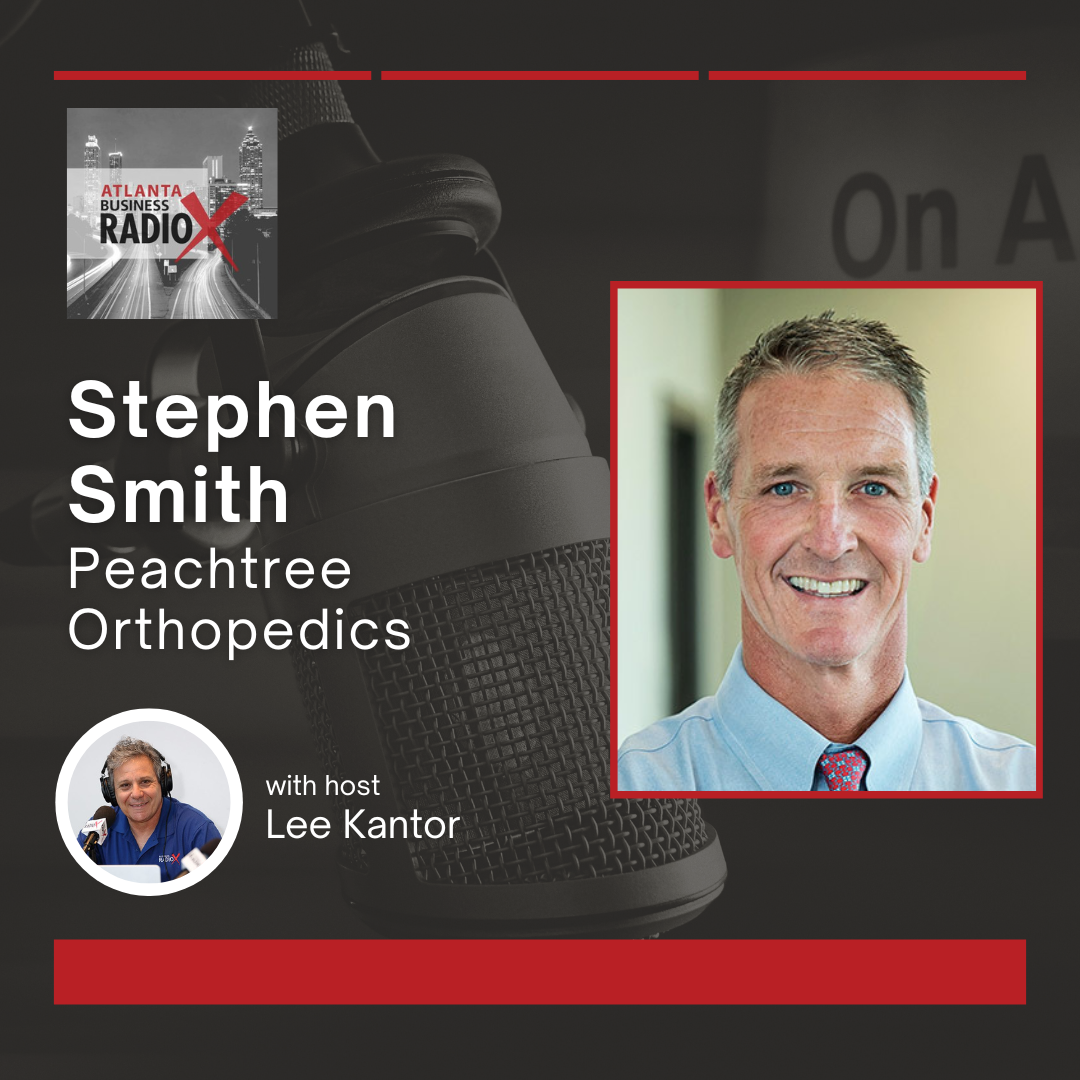

 On this episode of Atlanta Business Radio, Lee Kantor interviews Dr. Stephen Smith of Peachtree Orthopedics. Dr. Smith discusses orthopedic care for hip and knee issues, emphasizing the importance of exercise and weight management for joint health. He also highlights the Peachtree Orthopedics Foundation’s charitable work, including providing surgeries in Honduras and supporting disadvantaged medical students at Morehouse Medical School.

 Dr. Stephen Smith is an orthopedic surgeon with Peachtree Orthopedics in Atlanta, specializing in joint replacement. In addition to his local practice, he serves as Co-Director of the Peachtree Orthopedics Foundation’s Honduras Missions program alongside Katie Smith, PA.
Earlier this year, they led a team of 31 physicians and volunteers to Honduras, performing 40 life-changing surgeries entirely free of charge to local patients.
He also travels annually to Haiti to donate his expertise, reflecting his deep commitment to improving lives through compassionate, world-class orthopedic care.
Connect with Stephen on LinkedIn and Facebook.
What You’ll Learn In This Episode
- Leadership roles in the orthopedic field and overview of clinical specialties and career highlights.
- Peachtree Orthopedics Foundation: Origin and mission of the program. How they became involved and eventually became Co-Directors—the importance of bringing advanced orthopedic care to underserved communities.
- Scope of the 2025 Honduras Mission trip: 31 physicians and volunteers and performing 40 life-changing surgeries—free of charge.
- Impact & Long-Term Goals: The ripple effect of this work in local Honduran communities and how these missions inspire and influence their work back home.
 This transcript is machine transcribed by Sonix.
TRANSCRIPT
Intro: Broadcasting live from the Business Radio studio in Atlanta, Georgia. It’s time for Atlanta Business Radio. Brought to you by Kennesaw State University’s Executive MBA program, the accelerated degree program for working professionals looking to advance their career and enhance their leadership skills. And now, here’s your host.
Lee Kantor: Lee Kantor here. Another episode of Atlanta Business Radio in. This is going to be a good one. But before we get started, it’s important to recognize our sponsor, CSU’s executive MBA program. Without them, we couldn’t be sharing these important stories. Today on the show, we have Dr Stephen Smith. He is with Peachtree Orthopedics. Welcome.
Dr Stephen Smith: Thank you.
Lee Kantor: Before we get too far into things, tell us about Peachtree Orthopedics. How are you serving folks there? Air.
Dr Stephen Smith: We’re a group of about 35 orthopedic surgeons in Atlanta. We’ve been here since, I think, 1952. I’ve been here a long time. Uh, and we do every area of orthopedic surgery operate at Piedmont and Northside hospitals. We’ve got several different therapy centers around the around town, several different surgery centers around town. So we help serve Atlanta and various, uh, orthopedic needs, whether it be hand or spine or ankles or feet or hips or knees. I’m a hip and knee specialist, so that’s kind of my area.
Lee Kantor: Now, are the folks you see mostly older people? I would imagine with the aging of the population, there’s a lot of folks coming in for near hip issues.
Dr Stephen Smith: Yeah. So my patient population is on the older side, but you’d be surprised how many people in their 30s and 40s. See, I just finished a clinic About ten minutes ago, and I was seeing a guy in his 40s. So, yeah, I mean, there’s a lot of, uh, younger folks too, but we serve all ages now.
Lee Kantor: Is there any advice you’d give maybe somebody that’s getting older in order to get more, uh, use and ability out of their knees and hips? So there’s some do’s and don’ts as you age to have a healthy knees and hips.
Dr Stephen Smith: Yeah. I mean, a lot of times it boils down to losing weight and exercising daily and that I guess so many things boil down to that. But I think, you know, if you can maintain an ideal body weight and exercise daily, uh, which is easier said than done, I understand. But a lot of it boils down to that. You know, I think those two things are probably the most important pieces of advice I could give.
Lee Kantor: Now, does exercise have to be super strenuous or is kind of walking okay?
Dr Stephen Smith: No, I think as long as you do something, a lot of people ask me the best exercise, and I think the best exercise is the one that you’re going to do and stick with. So I always tell people to try and choose something that’s fun and that you enjoy. Whether it be walking or biking or swimming or go to the gym or doing ellipticals or, you know, what have you. I think that choose something that keeps you moving for, you know, 30, 45 minutes an hour per day. And that is going to be the thing that’s best for you is something that you’ll stick with and and actually do. And, you know, I hear all the time things like stationary biking and ellipticals are so boring. But, you know, you can plug in your phone and watch Netflix or catch up with content, Instagram, movies, whatever have you. But choose something that’s fun that you can do and stick with.
Lee Kantor: Yeah, I think sometimes people think to overthink it, that it has to be so hard or difficult or, you know, hitting personal bests. But there’s something to be said of just showing up every day and doing something.
Dr Stephen Smith: I completely agree. And you know, once you get in that habit of exercising daily, when you don’t exercise, you’ll miss it. And I think it’ll become a part of your, of your life. And it helps you in so many things, not only physically but mentally. Uh, I think it’s super, super helpful. I’m a big believer.
Lee Kantor: Yeah. And and don’t you think that humans are meant to move like we weren’t meant to sit on a couch for, you know, eight hours at a time?
Dr Stephen Smith: Correct. I think that’s a fantastic point. And, you know, people, I see a lot of hip and knee arthritis and people think, well, if I if I use it and I exercise more, I’m just going to wear it out quicker. And nothing could be farther than the truth. I mean, joints, uh, joints, whether it be a hip or a knee or a shoulder or what have you. Uh, they they love the movement. They say motion is lotion or. And I think that’s that’s that’s true. I think the movement is good. I mean, the joints were meant to move and they respond well to that.
Lee Kantor: Now let’s talk a little bit about the Peachtree Orthopedics Foundation. How did that come about?
Dr Stephen Smith: Yeah. So, um, it came about because we wanted to kind of have a non profit, non non profit wing of a group, uh, that uh could uh, pay for charity work that we’ve been doing in Haiti, um, and Nicaragua and Honduras. Um, it also helps to cover research efforts that we’re involved with. Um, and some various programs that we’re, um, involved with. We do a program at Morehouse that at Morehouse Medical School that helps, um, some, um, Financially disadvantaged students gain access to orthopedic, um, internships and fellowships. So we do a lot of things with the foundation, and it’s just an avenue that people can contribute. And, um, and we can do a lot of, a lot of cool things. Uh, with.
Lee Kantor: So how did that come about from the practice standpoint? Like you said, there’s, you know, three dozen or so, um, kind of doctors as part of your practice. How how do you all decide, you know, okay, we’re going to go to Honduras or we’re going to support Morehouse, like, like, how do those decisions get made?
Dr Stephen Smith: Yeah. So it’s it’s been a part of our fabric as a group really since the 50s. Um, one of our founding partners would go to Haiti every year and developed a lot of good relationships there. And so really, since the early 50s, our group has been sending 2 or 3 Three groups per year to Haiti to do work. Uh, and then, um, I don’t know if you follow the situation in Haiti, but it has become, uh, incredibly bad, uh, with the gang violence and really the breakdown of the government there over the past 2 to 3 years. And, uh, Haiti has become, uh, pretty impossible to do anything in because I think they’ve only got one functioning hospital now in port au Prince. Uh, and, uh, it has sadly become a place where you really can’t get a lot done. And it’s super dangerous to even go there now. So that that actually has been happening in Haiti for probably for the past decade or so. And so I actually started doing some work in Nicaragua and in Honduras and have developed a relationship there with some medical professionals in Honduras. And so we’ve kind of morphed our efforts, uh, from Haiti to Honduras. And now, you know, I do two trips a year where we do, we’ll go down there and do, uh, 30 to 40 knee replacements. Um, uh, in about 3 or 4 days. Uh, for deserving people in Honduras. Um, uh, so it’s been a tremendously rewarding, uh, effort. Uh, and we are trying to make that sustainable, uh, through, you know, each partner in my group actually has agreed to donate, uh, a percentage of their salary every year to the foundation so that we can fund those trips and make it sustainable. Uh, hopefully for a long, long time in the in the future.
Lee Kantor: Now, when you’re going over there, are you primarily doing During the surgeries. Are you training folks there to to do surgeries when you’re not around?
Dr Stephen Smith: Yeah. So we do both. Um, the we we do all the surgeries, but we have fellows down there that also learn with us. So we’re teaching the Honduran surgeons to do the the surgery. The problem in Honduras and many developing countries is that they just can’t afford the implants, the actual implants that you do. Uh, and a lot of orthopedic surgery where you’re replacing a hip or replacing a knee, uh. The implants can run, you know, $5,000 just for the implants. So they just simply can’t afford that when many people, you know, make 3 or $4 a day. I mean, they’re not going to be able to afford a $5,000 implant as you can. Uh, as you, as, you know, so we we provide the surgeries free of charge. We get Stryker, uh, Corporation and Crosslink Orthopedics to donate the implants. So we do everything for free and we carry everything with us each trip. Um, and we’re able to do these surgeries. And because we’ve got a relationship with an orthopedic surgeon there. Um, he can take care of the pre-op and post-op problems, because the last thing you want to do is go down there and do a bunch of surgery and just leave, and so that nobody’s really taken care of after or after the surgery. So, you know, thankfully, we’ve developed a really good relationship with some medical professionals down there. And they can, um, they can do the work on the ground after we leave. And it works out really good so that people were taken care of.
Lee Kantor: So, um, let’s talk a little bit about the work with Morehouse. Um, how did that come about?
Dr Stephen Smith: You know, it came about just, uh, through, you know, Morehouse Medical, um, students, uh, for whatever reason, we saw a need, uh, that they were not getting the same access to, uh, or to to orthopedic surgery residency programs in America. And we thought a lot of it had to do with in order to, to go from medical school to residency and to get the residency that you want. Um, it it takes a lot of money, believe it or not. Um, and the reason for that is that during medical school, you have the opportunity to go spend time with various residencies and get to know them and, and, uh, experience, um, that area of medicine. So, in other words, a medical student would go, let’s say they are interested in Vanderbilt. They would go over to Vanderbilt and spend some time with the orthopedic residents and, uh, work with them for six weeks during a, a elective rotation. Well, it takes a lot of money to go to Nashville and stay in Nashville and, and do that. And a lot of the students just didn’t have the financial resources to avail themselves to these, um, to these away rotations like that. So we saw a need and we stepped in. And we we like to help the students, if they so choose to do that, to help them do that and hopefully, uh, increase, um, the diversity within orthopedic surgery. Uh, and, and the field.
Lee Kantor: Now, are there enough orthopedic surgeons, um, with this kind of aging population? I would imagine that you guys a lot of demand for your services.
Dr Stephen Smith: Yeah. I mean, it’s like a lot of things in medicine. I mean, there’s enough in the cities and there’s not enough in the rural areas. Uh, and that’s been an age old problem in just about any, you know, family practice or OBGYN or what, whatever specialty you choose. So the trick is, uh, I think there’s enough Off in total numbers. But the trick is in order to kind of lure people to go practice and in more underserved areas. And I’m not sure what the answer to that is, but, uh, you know, as far as numbers, I think there are enough. It’s just perhaps geographically misplaced.
Lee Kantor: Is it, uh, is there a place for, like, telemedicine? I know that from a surgery standpoint, probably not. But is there is there some technology that can help alleviate some of the shortages in some of these, uh, areas?
Dr Stephen Smith: You know, telemedicine became very popular during Covid, and we did a lot of telemedicine. Um, but the problem with orthopedic surgery is that you can’t really do this surgery till, you know, uh, robotically from afar, at least at this point, you can’t. Um, and so you can only do so much through, uh, through telemedicine because we do a lot of injections Actions and, um, a lot of things like that that you just can’t do through telemedicine. But I think certainly there’s a part for telemedicine, but perhaps not as much in orthopedic surgery as, say, uh, primary care.
Lee Kantor: So if somebody wants to learn more about the practice, whether they have any issues or they want to just contribute to some of the causes that you’re all supporting, what is the best way to connect?
Dr Stephen Smith: Yeah. So just look up. Uh, just Google Peachtree Orthopedics. Uh, I think it’s Poke atlanta.com and you’ll see information on the foundation uh, and, and our group. So yeah anything is appreciated for sure.
Lee Kantor: Well, Steven, thank you so much for sharing your story today, doing such important work. And we appreciate you.
Dr Stephen Smith: Absolutely.
Lee Kantor: All right. This is Lee Kantor. We’ll see you all next time on Atlanta Business Radio.














