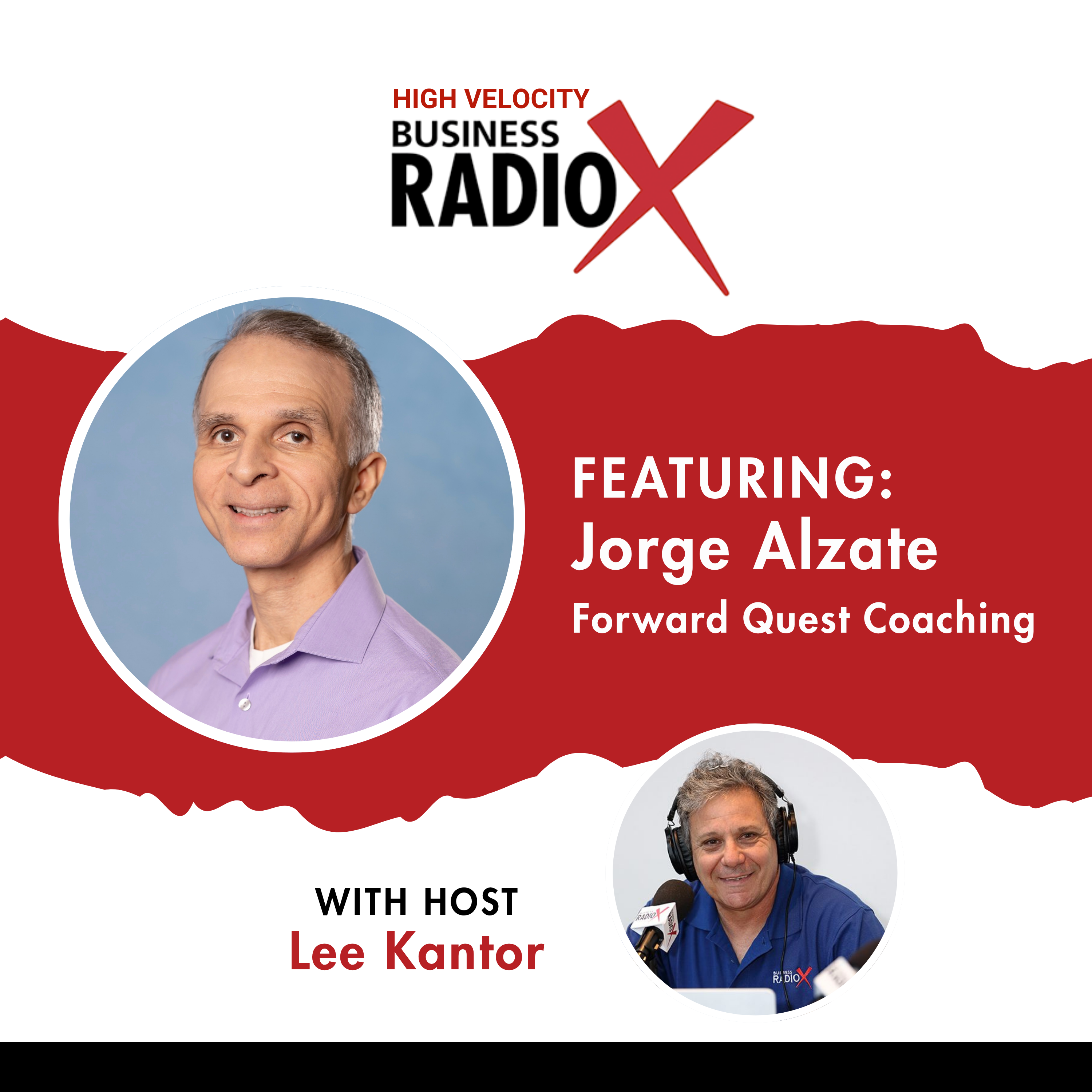

In this episode of High Velocity Radio, Lee interviews Jorge Alzate, founder of Forward Quest Coaching, about his transition from analytical chemistry to coaching introverted leaders. Jorge shares insights on leveraging introversion as a strength, strategies for introverts in business, and the evolving perception of coaching from remedial to developmental. He discusses success stories, practical communication tips, and the growing integration of coaching in corporate environments. The episode highlights the value of self-awareness, the unique contributions of introverted professionals, and the transformative impact of coaching on personal and career growth.
 Jorge Alzate is a leadership and public speaking coach and the founder of Forward Quest Coaching. After a 25-year corporate career spanning quality & food safety, digital transformation, and global program leadership, he now helps thoughtful professionals turn their natural strengths into leadership advantages.
He specializes in working with high-performing professionals such as scientists, engineers, project leaders, and emerging executives who want to communicate their value, lead with confidence, and speak with greater authority in business settings.
Through his Introvert Superpowers framework, he helps clients leverage strengths like deep thinking, observation, and preparation to build leadership presence, navigate high-stakes conversations, and deliver impactful presentations without forcing extroversion.
He is also the host of the podcast Forward Quest: Powering Introvert’s Success, where he explores leadership, communication, and personal growth through the lens of thoughtful professionals.
Connect with Jorge on LinkedIn.
What You’ll Learn In This Episode
- Transition from a corporate career in analytical chemistry to professional coaching.
- Specialization in coaching introverted leaders and leveraging introversion as a strength.
- Differences between introversion and extroversion in professional settings.
- Strategies for introverts to succeed in business environments.
- The evolving perception of coaching in the corporate world.
- Historical context of coaching as a remedial tool versus a proactive development resource.
- Integration of coaching into organizational development and employee benefits.
- The role of coaching in enhancing communication skills and self-awareness.
- Success stories illustrating the transformative power of coaching.
- The future of coaching as a structured, goal-oriented journey within organizations.
 This transcript is machine transcribed by Sonix.
TRANSCRIPT
Intro: Broadcasting live from the Business RadioX Studios in Atlanta, Georgia. It’s time for High Velocity Radio.
Lee Kantor: Lee Kantor here. Another episode of High Velocity Radio in. This is going to be a good one. Today on the show we have professional coach with Forward Quest Coaching,Jorge Alzate. Welcome.
Jorge Alzate: Thank you for having me, Lee. Nice to be here.
Lee Kantor: Well, I’m excited to learn about your practice. Tell us about Forward Quest. How are you serving folks?
Jorge Alzate: Well, this is a solo partnership business venture that I launched last year after taking an early retirement package from my corporate job.
Lee Kantor: So what was kind of had you always been a coach? What was your background?
Jorge Alzate: No, my background was actually in analytical chemistry. I worked in a lab for many years at that corporate job. A great job to be an introvert and not have to deal with people. You put your head down, do your work, and you make a living. Um, but I found that the thing that challenged me most was the people interactions. If I work with someone day every day, I build a really strong relationship with them. But I saw that the people that I didn’t work with on a daily basis, I really had a hard time connecting with them. So I found a way. I looked for ways to address this challenge, this, this gap in my professional development. And I found a way to project management also through Toastmasters to kind of push my career forward. As an introvert within a corporate environment and getting to leadership, that’s where I really saw where the, the natural affinity I had to build relationships to have meaningful relationships translated to coaching, where I could listen to people, hear them out, ask them questions, be curious. And I did this on the side. It wasn’t something I was being evaluated. It wasn’t something that I was hired or promoted for doing. I just it just came to me naturally. And so much so that when things changed, uh, people that used to report to me no longer reported to me, they would still reach out to me. They would still search me. Hey, can you still coach me once a month? I’m having a hard time here in my new team, and this would go on for years. So when I like I told you, I took that early retirement package, I said, let me see if this coaching is something that I can pursue as a, as a, as a new career.
Lee Kantor: Now, were the people you were coaching, were they primarily introverts or you just happen to be an introvert who kind of saw an opportunity?
Jorge Alzate: You know, I would say that the people that sought me out the most. I saw them as introverts. Not that we ever discussed that as a topic or a goal or a barrier, if you will. But I think there was a natural attraction, like attracts like sometimes. So, um, yeah, I think that just worked out that way.
Lee Kantor: So when you were in your career and you were, I guess, in the sciences, which I would imagine leads itself to an acceptance of introversion as just, hey, this is how it works. This is who we’re attracted to this type of work. When you got into the coaching realm, um, where I would think when you’re trying to attract business people, when you don’t have kind of the infrastructure you have, extroversion might be perceived as a better quality to have in that world. Was that like, how are you viewing kind of introversion versus extroversion when it comes to kind of building a career and building up your own professional, um, status.
Jorge Alzate: Yeah. And to be clear, introversion, the way I define it is, um, when you’re around a lot of people, large groups of people in social environments that drains energy and to recharge that energy, you go off on your own and do solo activities. And the more solo activities you do, the, the, the higher your energy gets. Extroverts are the opposite. They gain energy by being around people. If they feel down or low, they just seek out people to interact with. Does it need to be friends or family can be strangers. And the second thing is, uh, speaking. So introverts tend to think before they speak and extroverts speak to think there’s a kind of, uh, stream of consciousness going on as, as they’re talking. And that tends to take a lot of air time. So to your question, you know, if I’m launching a business and I need to be visible, I need to be vocal or frequent in my communication to others. In some ways it can be a challenge, but in other ways it can be an advantage. An example of an advantage would be creating thoughtful posts on social media that are well thought out and planned. Um, the reflection in formulating a business plan for sure is an advantage that an introvert has because there’s a deep inner world that we have. I think probably where, where an extrovert might have an advantage is that natural affinity towards large crowds. Um, to be around big social circle. So having a big social network. Uh, I’m just speaking personally. I don’t have, um. You can spread the word out. So that word of mouth that is, um, a, a business, uh, strategy. Uh, definitely an, an introvert with large social network has an advantage right out of the gate.
Lee Kantor: So when you said, okay, um, have this opportunity here, uh, circumstances, um, kind of were created that allowed me to pursue coaching now. So what was kind of the beginning stages were your first clients, people you had already had relationships with, or were you going out to the world and saying, you know, build it and they will come and, uh, here’s forward quest. I’m going to start, you know, like you said, posting, maybe get putting some of you know, your strengths out there, uh, creating thoughtful content and then just hoping to attract people to you. Was that kind of the the thinking at the beginning?
Jorge Alzate: I like the way you put it. Build it and they will come. I think I needed the world, I think I needed the universe to send me a sign to build it. And the reason I say it is, is because like, my origin story is I’ve been a toastmaster for about 15 years, and I was at a toastmaster meeting. I wasn’t even given a speech. I was I was on a panel, someone else was leading the panel and I was just answering questions and saw a guest came to the meeting. After the meeting, they came up to me and said, I really like the way you express yourself, like the way you talk. Can I get your number so we can exchange ideas? I said sure, and we met later on and he told me that he has his own business venture. He wants to launch. He wants help on communication and public speaking, and he wants to pay me to coach him. So this was like, you know, at the time, I wasn’t thinking about coaching. I just got the retirement package. I was applying to project management roles. Not getting a lot of traction, but someone had come up to me and after the meeting in person, go to the ATM, take out cash, and then hand it to me for the service that I just provided him.
Jorge Alzate: That was like a huge awakening, just a big knock on the head to say, this is time for you to build this, this potion. And a week later, I enrolled in a coaching academy where they teach you not only coaching skills, but also business skills, social media, how to, how to start a podcast. And that was where I started to build a little bit of traction, um, getting clients, you know, they, they kind of put you training wheels on you and tell you you’re going to start with pro bono. So put out a post on social media that you’ve got some spots open for pro bono coaching. You just got certified and so forth. And I got a lot of, um, hits with that post and I had some pro bono clients. So I was able to learn some things and, and start to develop my niche, which I did at the time, which is coaching introverted leaders. So that’s kind of how it started.
Lee Kantor: So then you, so you kind of leaned into the introversion and then now the focus is, is, is that still the focus is, um, working with introverted leaders?
Jorge Alzate: Yeah. I think that I’ve now developed a thought leadership position, especially on LinkedIn, where I tout that introversion is an advantage there. It’s actually a set of superpowers, um, that many introverts don’t realize that they have because they’re trying to adapt to an extroverted business world. And, you know, let’s be real, it is an extroverted business world, but with some self-awareness, with some education and coaching. Introverts can realize that the traits that they have naturally are, are superpowers that they can tap into and, um, help them show their value through their, in their profession and their business and their personal life. Uh, so yes, introversion, introverted leadership, introverted professionals, uh, moving forward and not it’s okay. There’s no, there’s no right or wrong here. If you want to say that introvert, then there’s something I need to get over. I need to act a certain way when I’m at, at, at, at my job, that’s going to take energy and that’s a choice. That’s okay. But there’s another way, which is tapping into your natural strengths and not pretending to be an extrovert, but believing in yourself that you’ve got natural abilities and you have value.
Lee Kantor: Do you find that, um, introverts are quicker to, um, identify themselves as introverts than extroverts are, are quicker to identify themselves as extroverts? Like do I, I’m an introvert and I spend like you a lot of time thinking about it. Do you think extroverts spend that amount of time thinking about their extroversion?
Jorge Alzate: Well, I think there’s some myths about what introvert means and what extrovert means and the way they think of each other. So extroversion, you know, you can substitute outgoing and everybody says, yes, it’s the same. An introvert, you can substitute shy, reserved, and everybody thinks interchangeable. And it’s not. That’s not true. Oh, shyness and introversion. They’re separate. Um, shyness can can be overcome with building confidence through courage and having mentors help you along that path. But realizing that you’re an introvert. Maybe you don’t have the words, but taking joy in solo activities like reading, you know? You know, large auditorium and you just by yourself reading or going on walks daily or bike rides like I do in, in New York City in the metropolitan area by myself. Um, you kind of realized that I like to be alone and I don’t, I, I grew up in a house of extroverts, so I was always the outlier, the one that had to fight against having the big parties and not wanting to join any of the big parties. So I think there’s a, there’s a realization that there’s a personality difference, but there’s always conflict involved.
Lee Kantor: Now, um, having worked in a variety of kind of environments over the years, can you talk about some strategies maybe an introvert can, um, execute on when it comes to like, say, um, they’re in a, in a meeting or a group setting. How do you recommend they, um, leverage their superpowers when there are groups of people around them where it may not be their, you know, favorite place, but they still have to execute and deliver in those environments if they want to, you know, grow their career.
Jorge Alzate: Yeah. I’ve recently, I’ve heard some of my peers in the introvert thought leadership space talk about making sure that organizations are adapting their evaluation systems to accommodate insurance because they can provide a value. Um, but they’re not comfortable speaking up for whatever reason. And you can attribute to introversion. I don’t, um, I’m, I’m of the, I’m in the camp where it is what you can control as an introvert to express yourself, to advocate for yourself. So the one superpower that has introverts all have is reflection. Reflecting on the meeting that’s coming up. And then, and here’s the kicker. Prepare for it. Do the work. Don’t expect to show up to that meeting unprepared and say, hey, I’m just going to use my natural talents, my, my intellect to speak up when the time comes up and that time never comes up because you’re sitting back, you’re reserved, you’re thinking you’re overthinking. Maybe. So the the key to being visible in the meeting. It’s not to talk all the time, but it is when you do talk. When you do speak up. Have something meaningful to say. And that is built through your preparation, through your rehearsal, your practice, your research before that meeting. And this is what we do. Anyway, we’re going to reflect, we’re going to overthink. We’re constantly visualizing, I do. Oh, and when that time comes, speak up. Another another tactic that can can be cultivated is curiosity. And that is when you do speak up. Have a question. Think about what was what’s being said. You’re going to do that anyway because you’re standing back as an introvert and now you’re discerning. You’re you’re thinking about the logic behind what people are saying and have a question. And then when the time comes, type in interrupt. Um, have to take that risk to be visible by asking a question that nobody else has thought of, because you you’ve thought about it because you have a discerning intellect. So those are just two, two ways that you can show up for yourself. Advocate for yourself in these in large business environment meetings.
Lee Kantor: So how do you, um, like when you’re, when someone’s working with you and you’re having a coaching session, are you kind of role playing how to deal with those situations? Because a lot of folks I know you didn’t, you don’t like using shy as kind of a synonym for introvert. Um, but there are a lot of people who are shy and may or may not be introverts, but they are holding themselves back in those kind of situations, or they’re not volunteering to speak at an event or be a panelist even. How do you like, what type of work are you doing to help them get the confidence that they need in order to do that kind of activity.
Jorge Alzate: Yeah. Recently I had a coaching engagement with an introvert who wanted to do just that to be able to articulate herself in a business environment with a potential clients on interviews. And this is a person who expressed herself through writing, got amazing, um, blog posts where deep thoughts were put on paper and put out there on the internet. Uh, and then I just asked her what, you know, what is it? What’s one thing you’d like to improve about the way you express yourself? And she said, well, I’m jumpy. I, I don’t I’m all over the place. I it’s just like a stream of consciousness. So one thing that I had her do is, well, what are what is that listener expecting from you? What do they want most? Well, they want value for me. They want some takeaways. So one of the tactics that I can use in this situation is look at what you’ve already done and then show me the structure. Um, how have you signaled to your audience the value that you are about to deliver to them without even seeing them? So that’s a technique that’s, that’s I’ve heard about, it’s called sorting and labeling, where before you say something, before you start explaining what you’re going to do, label it. Now here’s, here’s a way to organize your inbox. I’m going to give you three, three ways that I did this for a client. And those are the first two things you should say so that you signal to your audience that you’re about to give them value. So having some exercises, um, role playing, as you said, Lee, um, in a coaching environment to show how you label, um, and then you saw, you know, I think I did this on this conversation. I’m going to tell you two things to do. Well, if you’re hesitant about speaking up in a meeting and here’s the first one. And then I said the first one and he was the second one. So so those are some techniques that are pretty, uh, useful and, and foundational to, to start building up some public speaking confidence.
Lee Kantor: Now, are your clients typically the individual introverts or are they the organizations that have a bunch of introverts at the office or both?
Jorge Alzate: Wow. Well, well, yeah, I mean, that would be the, the, the evolution for me is right now it’s individuals. Um, for sure. Uh, but I would like to be able to have that, that, um, service to organizations that want to get the most out of their employees. And it’s really it’s you have to be careful when you approach coaching in a, in a corporate environment, because everybody’s always thinking, oh, I’ve been assigned a coach, that means I’m in trouble, right? I’m not performing. Um, but coaching is from coaching is taking someone that’s functional, that is doing their job. It’s doing it well, it’s providing value and making them optimal, optimal performance.
Lee Kantor: Do you really believe that people think it’s for fixing folks even today? Because I mean, I mean, I interview a lot of coaches and I talk to a lot of coaches and I’m seeing a trend, at least in upward trend to people want it as almost a perk nowadays. There’s an expectations of coaching, uh, especially for younger people to optimize themselves. Um, are you still seeing it maybe in the industry you’re in as, as kind of a, fixing rather than optimizing.
Jorge Alzate: Yeah, that’s music to my ears. We, um, if, if, if younger people are seeing this as a perk, um, as, as a natural course of their business evolution, then I’m here for that. But I think there is, uh, perhaps an old guard and, um, you know, I’m a, I’m a Gen Xer that has seen it that way. And I’ve talked to, um, similar, uh, some of my peers, some of my mentors and, you know, they’ve cautioned me that, that, that if you have a problem, here’s a solution. Get some coaching. Um, so yeah, there is, I think a stigma born out of, I don’t know how it was 20, 30 years ago, but I think that’s what I’ve been, how I was, how I was brought up into the business world. But you know, having a different mindset is key to opening this up because it is, it is a huge value add. And like you said, apart.
Lee Kantor: Yeah. I mean, from what I’ve, uh, learned in this space, at one point, this was like there were two at the beginning, coaching was either for the elite, you know, the superstar that was just trying to be the best person. They could be like a professional athlete, you know, would have a coach. Every, every top athlete has multiple coaches. Like there’s no, that’s not that’s a non-negotiable in that in that industry, obviously. But in business, um, some people had them, but a lot of times coaches were there, you know, to fix Bob because Bob’s got a problem. We want Bob to be at this level and Bob’s not. And we got to fix him in order to, to get him there. Um, but then something changed. It became more there became a lot more coaches, I think had a lot to do with it. And then when there was a lot more coaches than they were looking for a lot more opportunities. So then it expanded what coaching is and could be for organizations. And some organizations kind of leaned into, okay, we’re going to give everybody at the C level a coach or that’s built in or a lot of even, um, VCs or private equity firms include coaching when they take over a company. Like it became part of the culture of this is how we help get the most out of our people. And so it trickled down to lower and lower levels. I mean, that’s what I’ve seen.
Jorge Alzate: Yeah. And I mean, I’ve and I’ve heard, I’ve heard it described as democratization of coaching. And I did see it a little bit in the latter part of my corporate career where, um, it was offered as part of your health benefits. Um, therapy as well as coaching, uh, separated. Um, and I remember there was two organizations that were offering it, um, a third party that were offering it as, as a perk, as an option. Um, but I think what you’re talking about is now how do we, how do organizations start implement implementing this as, as, as a, as your normal development, your normal professional development? You know, you sit down in January, February, March and say, all right, um, you know, these are the goals that I have for my development or for the organization, the strategy. And now we’re mapping out what is your coaching journey look like for the coming year? And everybody’s got one that’s that’s to me is the ideal, uh, corporate, um, in, in, uh, environment. Uh, it’s a real journey for sure.
Lee Kantor: Right. Well, and it’s also, it kind of aligns with the way business is run now. I mean, you know, one of the first things to get outsourced is HR type things. So if you can deploy a coaching organization into your organization on a contract basis to help your people, I mean, that’s kind of a win win for everybody there. You’re getting your people a perk that they value. You’re getting more productive, uh, employee. And then it’s not really kind of part of the headcount of your organization. So then, you know, if it isn’t working, you can put in a different one or, or get rid of it altogether. So I think there’s a lot of opportunity for you in certain organizations, uh, to help them kind of holistically, um, work with their people, especially in industries that are, I would think, kind of introvert heavy, like maybe CPAs or certain types of, uh, lawyers or like you were in the sciences where there would be a lot of them that might be an opportunity for you down the road.
Jorge Alzate: Yeah, definitely. And I think you’ve mentioned it so much. I know there’s an organization out there that is looking to do that holistically and integrating not only the coaching, uh, as a, as an outsource, um, model, but now having the visibility, the accountability, the performance, the goals visible to the employer, the employee, as well as the, um, the coaching company. And that company is called moon. I got no problem mentioning them because they’re doing some great things there. They’re pretty new. And then you’ve always, you’ve got these other organizations that are still, um, playing that, that, you know, the company is not responsible for your coaching. You’re responsible for yourself, your organization’s like strawberry or even even in Ezra where they’re offering it, um, on a contract basis, um, to organizations as a perk, as an option. So yeah, I mean, that’s definitely a direction where I would like to take my career as a coach.
Lee Kantor: Now, is there a story you can share about, uh, one of the people you work with? Uh, don’t name them, don’t name their name, but maybe share their challenge they came to you with and how you were able to help them get to a new level.
Jorge Alzate: Yeah, that this is an interesting one because not an introvert as an extrovert, one of the, one of the, one of my first coaching clients where we had a previous business relationship, she admired my leadership style. Um, but she was, she had launched her own consulting firm and she was doing some other things at the time because she wasn’t sure that the consultant was going to take off. Um, so, you know, one of the questions is one of the golden coaching question is, what do you, what do you really want? And she was teaching. She loved instructing. She wanted to be a consultant. She wanted to launch her own business. She was doing all these things. Um, and then having pressure from the family as well. So, um, you know, starting to, to build structure into what’s, what’s most important to you. Um, but what choices do you want? What, what things do you want to leave out? And having that all reflected back at her, she realized, I want to do it all, but I also want my family to, um, be prioritized. Uh, if I’m leaving things out because if I’m pursuing all these things and I’m not looking, you know, taking care of my family, I want to make sure that they know that I love them first. So having that all, um, out there for her to see and realize, um, helped her make sure having a conversation that she needed to have and realize that she didn’t need to leave anything out. She just needed to prioritize her day. And this was like a huge realization, a transformation for her. And right now she’s she’s on fire. She’s lost her consulting business. She’s still teaching. She’s still doing one on ones with, uh, students and she’s having a great time and she sings my praises. So there you go.
Lee Kantor: See, it’s everything is possible. Uh, you know, if you just I think a lot of it is just reframing. You know, once you kind of understand what your, your, the outcome you desire and then just kind of reframe and then all of a sudden something clicks. A lot of times.
Jorge Alzate: Yeah, the reframing that’s a great term. Definitely coaching term. And then the realizing the outcome you desire. Some people have a hard time first realizing and then admitting it out loud because it’s always there on a subconscious. But when you say it out loud to another person on a Zoom call, there’s like magic pixie dust on that interaction. From what I’ve seen.
Lee Kantor: And that’s the value of coaching. I mean, a coach is going to be asking you those questions and exploring those areas that maybe you keep to yourself and you internalize it. And then when you to your point of externalize it and verbalize it, all of a sudden it becomes more real.
Jorge Alzate: Yeah, yeah. I’ve had that experience myself. And I know the power that, that, that verbalizing has. For sure.
Lee Kantor: So Jorge, if there, if somebody wants to connect with you, learn more about your practice. What is the website? What is the best way to connect?
Jorge Alzate: The best way to connect with me is on LinkedIn. I’m there all the time. My, my, my first name, last name where I Morales88. You can also I have a website. It’s called Forward Quest Coaching. You can connect with me there as well. I’m always looking to have conversations. Anything that you heard on this podcast, you want to talk a little bit more about, um, conversations. I’ll go over me.
Lee Kantor: And that’s, uh, J o r g e a l z a t e.
Jorge Alzate: Yes. Thank you for that. Yes.
Lee Kantor: Well, George, it’s been a pleasure. Thank you so much for sharing your story today. You’re doing such important work and we appreciate you.
Jorge Alzate: Oh, it was a pleasure, honor and a privilege. Thank you so much for having me on your podcast.
Lee Kantor: All right. This is Lee Kantor. We’ll see you all next time on High Velocity Radio.














