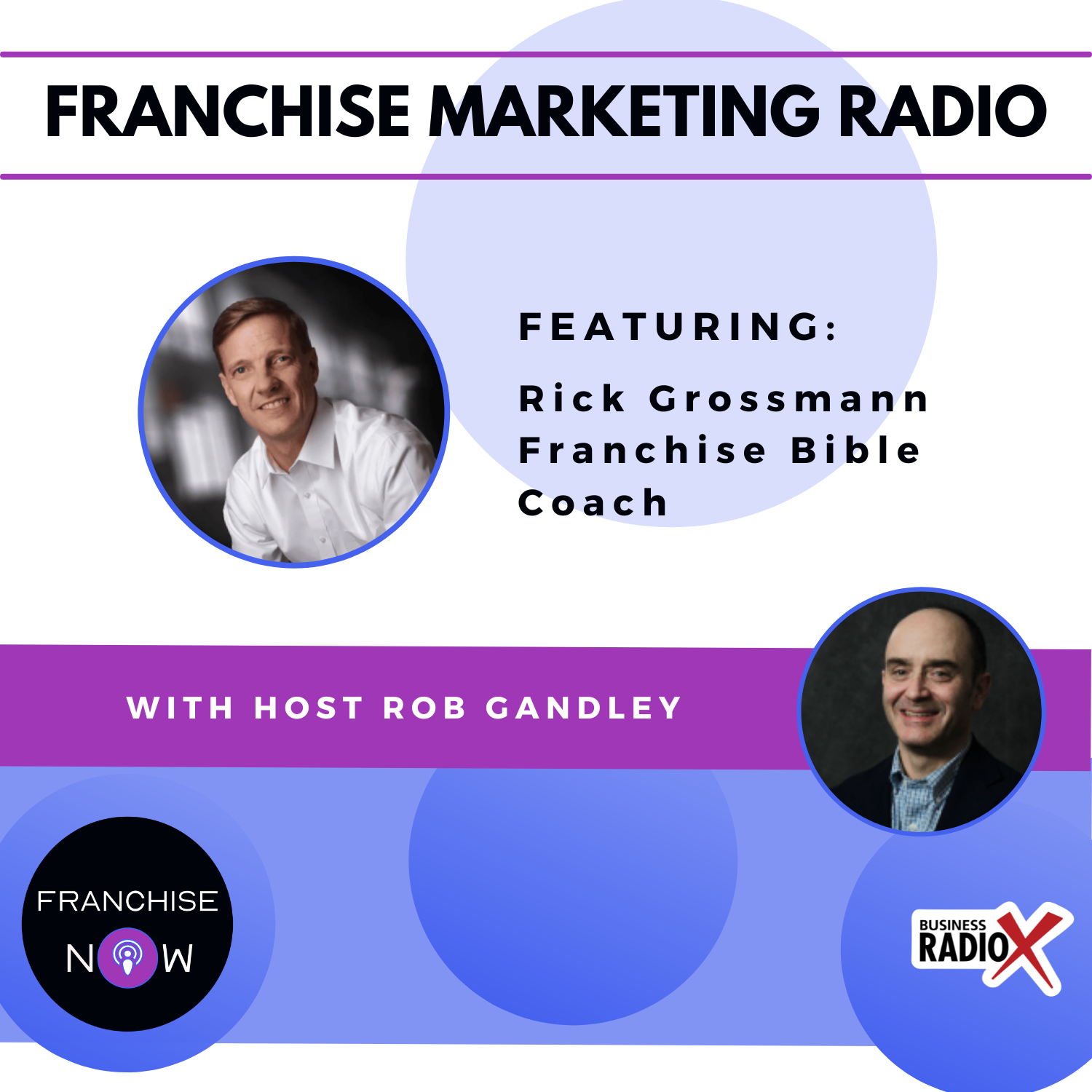


 Rick Grossmann has been involved in the franchise industry since 1994. He franchised his first company and grew it to 49 locations in 19 states during the mid to late 1990s.
He served as the Chief Executive Officer and primary trainer focusing on franchise owner relations and creating tools and technologies to increase franchisee success.
Rick developed and launched his second franchise organization in 2003. He led this company as the CEO and CMO growing to over 150 locations in less than three years. He developed the high-tech/high-touch franchise recruiting and sales system.
Connect with Rick on LinkedIn.
 This transcript is machine transcribed by Sonix.
TRANSCRIPT
Intro: Coming to you live from the Business RadioX studio. It’s Franchise Marketing Radio. Ready to revolutionize your franchise with AI? Franchise now empowers franchises with advanced AI solutions, automatic processes, and enhanced marketing strategies. From personalized customer interactions to predictive analytics, we help you harness AI to drive growth and efficiency. Transform your franchise with the power of AI. Visit Franchise Now to learn more and take your business into the future. Now here’s your host.
Rob Gandley: Welcome back, everybody to Franchise Marketing Radio. This is Rob Gandley. I’m your host and we’re going to talk today. I have a very special guest with me a little bit about mastering franchise growth in 2025 and what are some of the timeless principles? And we’re going to learn that from the Franchise Bible Coach himself, author of the Franchise Bible, CEO and founder of multiple franchises. I don’t want to steer all this thunder, but I want to introduce Rick Grossmann to the show. Welcome. Welcome to the show, Rick.
Rick Grossmann: Hi. Doing well Rob, hope you’re doing well. I’m excited to be on the show today.
Rob Gandley: Very cool. Very cool. So I’d like to dive in for the guests and really give them a framing of who you are. And, and then we’re going to dive in and see if we can break down some, some important considerations for growing franchises nowadays. We got a lot to unpack. But tell us a little bit about your background, how you came to be, how Franchise Bible, the book and also Franchise Bible Coach the business came to be.
Rick Grossmann: Okay, great. Thanks, Rob. Yeah. I started out really, uh, kind of young and and didn’t know much. And that’s kind of the way I do things, is dive in with both feet and I figure it out, or jump out of the airplane and make the parachute on the way down, right. So I was in my 20s, early 20s, and I had a business. A small business in California was in the entertainment field, um, doing, you know, event planning and entertainment and music and things like that for multiple types of events. And, um, started out as in the DJ business, believe it or not, in high school and kind of built that into a really great business. And I realized that people in other areas wanted to learn how to do that. So we had a speaker at school and he was in the franchise industry. And as soon as I heard him talking about it, it just the light bulb went off and it hasn’t gone out since. So we franchised that business while I was in college and grew that to about 50 locations across the country over several years, and learned how to do franchising from the inside out, and it was really exciting back then. We were up against the I call them the big boys.
Rick Grossmann: We were up against big franchises that had big names. I’ll never forget when we did our first franchise expo down in Los Angeles. We were set up next to, you know, subway and all of these different big brands. And we were this little old company and just starting out and kind of felt like David and Goliath a little bit. But we were blessed to meet Irv Coif, who is the original author of Franchise Bible and kind of see it over my shoulder there. And he was our franchise attorney and was really impressed with our ambition and was able to help us get started in the franchise business. And we grew that, grew that to about, like I said, almost 50 locations over the years. And we we had a great success, but we also experienced the challenges. And so we grew that. And then I left that to my partner and started another franchise in the travel business and grew that one, and then up to about 150 locations in a short period of time under three years. Back then, that was a lot. That was back before we had a whole lot of help. We did have the internet and email and things like that and websites, but it was still pretty new.
Rick Grossmann: And so I just really loved the startup. You know, some people say I’m either a pioneer and ahead of my time, or I’m a glutton for punishment because we now started many years ago. I started Franchise Bible Coach, and I was invited, of course, from the original author, who was my mentor, to take over the book when he got became ill with cancer. And then I’ve had that that series ever since, and now we’re up to our ninth edition. So it’s been a real journey. Uh, franchise Bible coach. Now we help franchise companies do the same. We help create and build them, and then we help our franchise, uh, franchise or clients build through those early stages. And then I say we’re kind of like the franchise or franchisor. We my team supports them like they support their franchisees. We implement the upside down pyramid from the book and all of the great things that makes it work well and have had some marvelous experiences with clients. And we’re, uh, we’re really excited to to grow more and help other people, you know, realize the dream of, uh, business ownership. So that’s what we’re all about.
Rob Gandley: Yeah. Well, I love having these conversations, and I think I say most of them that I love franchising at least once because it’s a great idea. And so many people been been their lives have been blessed and transformed by the idea of starting a local business and being a part of their community and all the different kinds of industries that represent. So you and I both got hooked with that idea, and then, uh, and then figuring out how we can help different brands, uh, realize that better for the folks that get involved. But with that being said, you know, 2025 is an interesting year. And I kind of before we dive into sort of what’s evolving, what’s what’s going on and how best to to sort of tackle that and take advantage of all that. Well, I wanted to start with sort of the fundamentals. Like if you could break it down into a short answer, I know you could probably spend an hour, but what are the what kind of has to be there in place? What are the fundamentals of a of a of a good brand. What do you look for? What do you try to build into an emerging brand?
Rick Grossmann: Yeah. Well, I’ll give you a one word answer to that big question. And it’s leadership. Or sometimes I say leadership, leadership, leadership. You know, the only thing, uh, that we’ve seen that’s been kind of a common thread with the brands that do really well is their leadership. And, and we look for clients that have the, you know, the attributes of a of a true leader or group of leaders. And they you know, we work with clients that have that commitment to their not only their customers but their staff, and that can be kind of guided into that same, uh, that same servant leader model that can be a great leader for franchise owners and the owner community as well. Uh, I always say that you can have a great business model and have mediocre leadership, and it won’t grow and it won’t do well. Or you can have a mediocre model and have, uh, have great leadership and it’ll do phenomenal. And you know what we look for and we only work with a handful of clients at a time. What we look for is a brand that has a great business model and great leadership potential. Uh, we spend we go in stages and phases and we don’t rush it. We don’t just rush in and get an FD done franchise disclosure document and just start selling franchises. Our system is molding and coaching and teaching the franchisors and their staff how to take that great leadership attribute and guide it into becoming a really great franchise leader. So we look for both. Great model, great leadership potential. And then we we can help them get there. We spend many months in that early stage just teaching and coaching and developing. And as we’re building out the different pieces so that by the time we launch, we have a franchisor and their team that are ready, willing and able to have a strong foundation to start adding franchises and then growing the proper way.
Rob Gandley: Exactly. So what a what a perfect answer. Anyone who’s listening, right, write some notes down because, uh, it is everything. Like you said, you can have a mediocre business model, uh, with good leadership and still and still do. Okay. So, yeah. Very important, very good. One word, three word. Answer whatever one you want.
Rick Grossmann: I teased you and started with the one word, and then it got got to be exactly.
Rob Gandley: So. So with that thought in mind, what do you think are the what would be those early pitfalls or common mistakes you see with a lot of those early emerging brands?
Rick Grossmann: Yeah. Well, I always say that you don’t know what you don’t know. Uh, as a franchisor, you might have a thriving business. You might even be a great leader. Um, but the franchise business is a very, uh, different business. And if you don’t have a coach or a consultant or somebody that’s with you that has, I would say, like climbing Mount Everest, you would never just go and climb Mount Everest by yourself. That would be suicide, right? But it’s surprising how many franchisors venture into the franchise waters by themselves. Um, if you’re trying to save money or trying to cut corners, don’t do it because you’re going to get into, uh, a highly competitive business. And if you don’t build the right foundation and get those those, uh, those early adopters on board properly and get them, uh, successful as soon as you can, you’re going to end up stuck. And there’s I call it the dirty little secret. Secret? I disappeared there for a minute. Um, the doldrums I talk about in Franchise Bible are getting stuck in that between 11 and 24 units. And that’s when usually, uh, if you don’t have strong validation from your franchisees, meaning they’re telling others and validating with potential franchisees that this is a great model, I’m doing well, then you’re you’re not going to sell more. And that’s 11, 12, 13 units isn’t really enough to, Uh, you know, keep the momentum going. And it certainly isn’t enough to live on and support your staff and become profitable.
Rick Grossmann: So I always say, be sure that you, uh, are getting help. If it’s not a company like mine, just make sure you get somebody with a strong track record that can help you along the way. Uh, because you’re getting into a brand new business. And even though it’s similar, you’re going to use your, your, your, uh, core business that you’re going to use as the franchise model. Uh, it’s totally different than than franchising and making sure all the elements are there for success. So that’s number one. And then I would also say, just make sure you have, uh, you and your team are committed to growing a business. I always say you can’t try franchising. You can’t dabble. Uh, it’s an expensive process. By the time you get through all the steps, uh, you can make your money back and more, which is great. Um, and you can actually, if you know what you’re doing, you can build budgets and, and get in, you know, kind of enter the franchise world and compete favorably. Um, which is one of the things we specialize in is helping people do that. But, uh, you need to make sure you have that, that core, um, belief system, uh, as a servant leader, too. You need to have that. And so those are my quick tips. Like, I, like you said, I could talk about that one element all day long. So.
Rob Gandley: Yeah. What are the common pitfalls? Exactly. There’s a lot of them, but there’s really one common one. And it just to kind of summarize it, you know, I know um, there was a little a little interruption there. You were talking about the dirty little secret and, um, just want to kind of have you fill that gap again. You were saying something. There was an interruption. I want to make sure the audience sees that or hears that. But you were you were getting into, you know, getting those first validators in place and doing it the right way. And and then you were talking about the dirty little secret. What was that? Just summarize that real quick again. And, uh, so the audience catches that.
Rick Grossmann: Sure. So you were talking about pitfalls. And, you know, one of those is. Selling to the wrong people and getting stuck in the doldrums, like I said. So you’re excited. Um, you have people that are interested and they have money in their hand, and you’ve just invested money to become a franchisor, and you want to start making money back, right? Yeah. Um, so people, one of the most common pitfalls I see when I’m trying to help a franchisor that’s already franchised is they’re struggling probably with the franchisees they awarded, uh, early in the process. And so you’ve got to make sure that those people are a good fit, a good match. They’re committed, they’re financially stable, all of those things. Uh, we help our clients with all of that. But the dirty little secret is that I think everybody that enters the franchise business thinks that people are going to line up, and they’re just going to be taking, uh, a whole, a whole, uh. List of people. And and there’s a reason for that. There’s a lot of reasons. But one is, as they’re starting to franchise people around them, their employees, their friends, their neighbors, family, everybody tells them that, oh, my gosh, that’s such a great thing. I’m going to I want one when I when you get franchise, I want one right. And then when they get their franchise disclosure document done and they go back to talk to those people, they all change their mind or their something’s up, or they don’t want to be the first ones or they don’t have money. And so here they stand with this, this great FTE that the attorney made, but they don’t have any buyers.
Rick Grossmann: And so then they get potentially desperate and they start looking for buyers and they start selling to the wrong people and then they get stuck and so. Right, um, that, that, that, that process is what gets them into the, into the doldrums where they, where they sit and then they start spending their money on ineffective marketing campaigns. Uh, or or methods that don’t work. Uh, and then they run out of money, unfortunately. So, um, you have to build it right from the very beginning, much like a system that’s franchised. Right? You’re going to create a system to be, uh, to onboard franchisees, to run that business, a mobile business, like a pet grooming or, uh, brick and mortar business, like a restaurant or something. And you’re going to teach them how to be a franchisee. And if you don’t know how to be a franchisee, you’re going to make you’re going to make probable mistakes. And so, um, the most important way to avoid pitfalls is to make sure you have somebody like a Sherpa. You know, we’re like a Sherpa that helps you up and down the mountain. If it’s not us, please get somebody else that knows what they’re doing. Yeah. Um, but, uh, that’s really the, the framework, making sure that they get off to a good start and they’re, they’re making good, you know, good choices along the way. Once you build that awesome franchise, or once you create that awesome foundation, you can grow. One of our clients we’ve worked with recently is game Day Men’s Health.
Rick Grossmann: And you can look them up online. They are growing and like gangbusters. Probably one of the most fast or I would say one of the fastest growing franchises in the history of franchising. And he follows the founder and CEO of that company. Evan just followed the system, and he’s a great leader. He had all the attributes, had a great model. And they they’re growing like crazy. So you have to commit to that process. And then you can you can enter the this is what I learned and this is what I teach our clients. You don’t have to have $1 million or $5 million in the bank. If you’ve got a good model and you have a commitment and good leadership and you know how to get there, you have the game plan. You can get there. You can enter the franchise world as a small company and grow to be a massive company and make, uh, you know, make a great living and hand it down to your legacy, down to your children, or sell it in the future. Whatever your goals are. But you don’t have to go out and raise venture capital and and try to try to enter the marketplace to become a franchisor. And that’s what’s exciting about it is a small business can turn into a great business, uh, through franchising, if you have the right game plan and you know where the on ramp is and you know how to grow the right way. But once you get on that freeway, it’s going fast and you have to do the right things. So that’s the exciting part.
Rob Gandley: Cool. Well, you know, that was extremely well said. And thank you for kind of recapping it and even going further. Uh, but just some key points to get you started really doing it right. So you can stay and grow and get, you know, to the, to the thresholds is like 100 units, right? Then it’s another, another game. But, um. All right. So in terms of your you’ve been in franchising quite a while and you’ve seen a lot. What do you think some of the biggest shifts are that we’re now seeing in 2025? What do you think some of the key shifts are now that you see, uh, that are affecting the success of, of the growth of a franchise or, uh.
Rick Grossmann: Yeah, the difference is that in the last, you know, three or 4 or 5 years have been technology. Um, we’ve, you know, the a potential franchisee is, you know, a husband and wife sitting at their kitchen table and they have an entrepreneurial bug, and they want to have their own business and have a little bit more control over their destiny. They’re the relatively the same, you know, motivators and inspiration that the buyer had 20 years ago. Right? And that people haven’t changed much. But and the reasons people want to buy a franchise haven’t changed much. The difference is the how we approach those folks. Um, you know, back when we didn’t have all of the, you know, call blockers and spam filters and things like that. So we were able to, uh, you know, get to people and present things to them in a different way. Uh, franchise expos were big back then, and there was a lot of them across the country. Um, and so that was a way that we could meet people face to face. We didn’t have zoom and things like that. So it was very personal. And as technology has, has entered the marketplace, uh, starting with websites and emails and things like that, online presentations and those things have changed the business. But the buyers are relatively the same. More tech savvy, obviously, but the if you can figure out how to keep your process personal.
Rick Grossmann: Um, and new technology implementation like, um, I of course is the buzzword these days. And, um, you know, things are speeding up with the advent and application of supercomputers and, and things like that. So we’re really seeing technology get, get to be kind of important to everybody. And that has changed the process. But we still want to make sure that we’re keeping the personal element there. This is a huge decision for a franchise buyer. Uh, imagine and put yourself in their shoes. You have a, like I said, a a young couple that’s sitting at their kitchen table where all the, all the, all the big decisions are made at the kitchen table, and they’re talking about starting a business, and they want the fast track. They don’t want to just start from scratch. They need, you know, they want entrepreneur, um, motivation. But they still have they still need some help. And that’s what franchise buyers look for. They look for the fast. The fast lane to get on and and build that business up quicker and more efficiently. And so imagine that they’re going to go out and get funding to buy a franchise. They’re going to put their life savings on the line. Maybe they’re getting a loan against their home. It’s a big decision and we can’t really shortcut it too much.
Rick Grossmann: Right. So we want to make sure that we’re using technology to make the humans more efficient. But we’re not eliminating the personal touch from the process because we need to make sure we’re building a relationship. And that’s one of the ways we work with our clients. We have a seven step process that we work with candidates with. And, um, and we know the brand inside and out because we built it with the franchise or we know the staff, we know the team, we know the motivators, we know all the different things that make that franchise special. And by doing that, we’re able to take a very personal approach with the candidates. And by learning about them, I call it it’s a mutual discovery process. So we’re learning about them and they’re learning about us, and we’re making sure that everybody’s agreeing with the onboarding of that franchisee on on our side. But we’re also making sure that the franchisee is made a very clear decision. And that way we’re that we have a much higher success rate overall. So it’s a big deal. Use technology, but don’t try to shortcut it. You know, don’t expect technology to do everything. And people are just going to show up, you know, with a signed franchise agreement and a check.
Rob Gandley: Right. Yeah. And just to dive a little deeper because this is where, you know, my background too, is, is really this idea again I and and where can it fit right now and exactly how should you look at it? Um, I think, you know, obviously, being an innovative franchisor is important to have a process for innovation. So you understand that you are leveraging the best. But but again, keeping in mind and looking through the framework of we got to keep it personal. It’s a personal business big decision for folks. And when they become part of the brand, it’s almost like a family, a network right, of business owners. So it’s a really big decision and it’s all about relationships. So but at the top of the funnel, I want to get your input on this. You know, one of the big problems that plague most businesses, even outside of franchising, but certainly inside of the idea of marketing a franchise opportunity, is the idea of managing the inbound, you know, response from your advertising. So there’s inbound lead flow, the inbound phone calls. And that is always been a problem for business owners, right.
Rob Gandley: Whether whoever they’re working with to do that. Then on the other side, how do you manage that lead flow. And this is where ICA being dropped in. Where it’s a nice balance, right? It can still add value. It can still communicate, um, and all of that. But then how do you see that? Like, you know, we both know that that can solve the response problem. But how do you continue to make sure there’s a personalization. Right. And do you agree like that’s uh, you know, again, a big problem is if I get 100 leads a month and I only respond to 70 within a day, and maybe I only connect with 30, that’s just not enough to get a result from the investment in the first place. So you need to almost talk to everybody if you could. Right? Get a yes or no from everybody. That’s one thing AI is good at because it can just work 24 over seven and beyond. But how do we balance that capability with that personalization. Like what are your thoughts on that.
Rick Grossmann: Yeah. Well and you know for the audience, you know, I’ve known you Rob for a long time and I can kind of, uh, validate for you a little bit. You know, you’ve been an innovator and a pioneer in the franchise space. Um, I asked you to write a section of the franchise Bible last time around for AI and Marketing and Technology. So you’ve been a pioneer in that. So anybody that’s really interested in that should definitely contact you and kind of help figure that out.
Rob Gandley: So I didn’t pay him for that folks. It’s a free. Yeah. Thanks, man.
Rick Grossmann: Yeah. Find somebody that knows what they’re doing. Um, yeah. So I, they did a study a number of years ago and I won’t quote, you know, exact numbers or even the the people that did the study because I don’t remember the details exactly. But the shocker was, is they they shopped a bunch of franchisors of all sizes, and they found that there was a very low follow up rate with leads. I mean, my goodness, the franchisor spends a lot of time and resources and money to become to get to that level where people are interested, and then they weren’t following up with people that were interested, which kind of makes you wonder what’s going on there. Um, so yes, you should be able to, uh, contact and touch every single lead. Uh, and it’s hard when you have hundreds or a hundred or or so leads. We with my, uh, travel franchise. We. That was in the early days of things like internet leads and portals and things like that. And we were getting three, 400 leads a month, and it was kind of mind boggling because me and my assistant, um, sales, uh, director were kind of going, you know, crazy trying to keep up with it. You know, some days we’d get 30 leads in a day, and it was just crazy. We didn’t know the difference between good ones and bad ones. Um, and so we had to create some, some technologies and some things to kind of manage the funnel.
Rick Grossmann: But we did touch every single lead. Uh, and it was it resulted in, you know, consistent growth over years. Uh, and that was really important. So, uh, the idea now is using AI, and I’m not speaking as an AI expert, but we do, uh, working with you and, and working through some different some things, but and it makes you more efficient. So every single lead should get some kind of contact and I can help with that. And then it helps you, you know, develop a funnel that can bring the serious interested people, uh, through a process of your present, your online presentation and follow up meetings and things like that. So it can be, uh, still a personal touch. Um, but definitely it can help you build those, you know, those steps and things. But if you’re getting so many leads that you can’t communicate with them, get less leads. Uh, this is important. You have to be able to make sure that you’re interviewing them as much as they’re interviewing you. We’re not just selling a commodity. You know, they’re not going to sign up and buy something and go away. They’re going to be I hate to use the word partner, because that kind of brings up different things in your mind, but it’s not a partnership. They’re a franchisee is 100% owner of their own business, but you are connected through that franchise agreement for a period of time. Um, preferably a long period of time if they’re doing well and you need to be able to work with these people and inspire them and make sure they’re on the growth track and meeting their goals and KPIs because they’re putting their life on the line for you as a franchisee, and you need to make sure that they’re happy.
Rick Grossmann: I always say happy franchisees make more money and that they’re being successful. They’re they’re, uh, living the life they want. It’s not about you. Uh, if you really investigate. And in my book, we talk about the upside down pyramid as a servant leader model, you’re at the bottom. You’re not at the top, You know, as a franchisor, you’re not the boss. What I’ve learned in business is the people that pay you are your customers, and you work for them. And so you’re the franchisees are paying you as a franchisor, which means you work for them and your team works for them. And every morning you should wake up and try to figure out how you’re going to help them and help help them make more money. Take obstacles out of their way and grow. Um, if you’re in it just to make money off a bunch of people, don’t do it. But be very creative. Be very creative and very focused on your your lead flow, and make sure you’re giving them the personal touch they need, but also that you’re learning about who they are and what they’re doing.
Rob Gandley: You know, I have a long list of questions and you’ve answered, like almost all of them, I love it. I love your answers are very detailed.
Rick Grossmann: I’m glad my kids don’t like it because they they get tired of my answers.
Rob Gandley: Yeah, yeah, they’re they’re very detailed. And you’re always right, dad. Um, but anyway, so, so coaching and mentorship though I wanted to kind of just jump into that idea because it’s a big part of, as you say, being a Sherpa, uh, franchise Bible coach. And, um, what in this tech forward world that we now have and of course, AI is part of that. But long before I was talked about, we had social media and we have, you know, search engines and we have this we have that, right. So there’s a lot to kind of understand. Uh, but how does coaching and mentorship play a role in understanding technologies and where they play and how they can help the brand scale and things like that? How do you try to approach that?
Rick Grossmann: Um, sure. So, you know, the important thing is, uh, like I said at the beginning, and this is not an insult because it’s just the fact. I mean, if I was learning how to fly an airplane, I would start knowing very little, right? And so the point of going to flight school is learning how to do it well. Um, because it’s it’s dangerous if you don’t. And same thing with the franchise system. Um, make sure you’re getting some help in that area, because it’s important that you try to limit your mistakes and, and see where the opportunities are and walk through the right doors, just like a franchisee. The reason they’re buying a franchise is so they don’t have to go out and figure out everything. And with with technology and it and it it changes by the day now. Um, you know, I think there was a study years ago that said that every their technology doubled every 18 months or something like that. And now it’s down to probably six months or three months. There’s so much innovation. Um, and we can get lost in it, believe me. And remember what you do. You operate a franchise company. Don’t go spend, you know, $1 million. I, we sometimes we jump in and help existing franchises that are already franchised and try to help them fix things that that they didn’t maybe do the right way in the first place. And we do help. Um, and one one of our clients had spent, uh, almost $1 million. Uh, over the years on trying to create this massive, uh, great technology platform for their franchisees and for what? When we did the evaluation at 65 franchisees, we did the evaluation.
Rick Grossmann: We found out that, uh, their franchisees didn’t even use the technology for the most part. And and they ended up and we had to say to them, are you in the technology business or are you in the franchise business? So don’t get, uh, you know, chase a wild goose chase. Stay on the on your focus. I sell franchises to people to help them build successful businesses. And I going I’m going to support them in that process. And that’s what you do every day. And there’s going to be a lot of, you know, shiny objects that come with technology, get somebody that knows well what to do in that tech space like you Rob. And then make sure that you’re building the proper way and you don’t start chasing things that are expensive and unnecessary. Um, and then you’re you’re on, you’re on good, you know, good footing at that point. So, um, make sure you’re, you’re getting some help because it’s, uh, and what I mean, and by the way, that doesn’t mean that, you know, the five emails you get every day that offer some new shiny thing. That’s not what I’m talking about. Do your research. Um, you know, search on ChatGPT can’t say it. Chatgpt or or the internet. And most important, talk to people that you trust, uh, your franchise attorney. Or if you’re not there yet, um, you know, somebody in the business that knows what they’re doing but just don’t get, you know, don’t go crazy with it. Just focus on on getting help. And of course, you can always call us and we’ll help as well.
Rob Gandley: That’s beautiful. That’s beautiful. So as we you’ve really unpacked a lot of amazing advice. I really anyone who’s thinking about getting into franchising or in the early anywhere really, but certainly in the emerging stages. Uh, listen very carefully. Uh, these are really critical things. But to that end, I was wondering if we could maybe summarize the top three growth principles right, if we could, you know, give give the audience something to work with there. Uh, maybe a summary of what you’ve already said a little bit, I’m sure. But what if you could boil it down, what would be like three things that, uh, you would zero in on for for growth principles to really think about?
Rick Grossmann: Yeah. Um, sure. So if you have a good, great business and you want to. And by the way, I say good to great because you can have a really good business. And what we do in our process is we help bring out the greatness in that model, um, as if it has the potential And we can help identify if somebody comes to us and they don’t know if they should franchise, we’ll help them. And if it’s a no or if it’s like, well, you need to work with one of our coaches for a while to kind of, you know, fine tune it, make it stronger and get ready for franchising. We’re not, you know, like you’re selective with your franchisees. We’re we’re very selective with our franchise or clients. Um, that’s why we only work with a small group at a time. But, uh, you can contact us, and we’re not going to pressure you into anything. We don’t want to push somebody into franchising because it’s a you have to have the right stuff. Um, but as far as three things, I would say servant leadership is number one. Do you have a model and a track record for for giving and not taking as much in your business model? Um, and you really care. That’s that’s probably the number one thing. Secondly, I would say, you know, you’ve got to have a model that really does work. It doesn’t. You know, some people think, well, I can’t sell ice cream in the winter in the north, and that’s not true.
Rick Grossmann: We’ve worked with several, you know, frozen dessert franchises over the years. And people do buy ice cream as long as they make kids that are that are, you know, want to be treated to something, they’re going to sell ice cream. Uh, one of our past clients opened their franchise in Colorado in, uh, I think it was February, January or February, and they were out there spinning their sign. And, you know, you know, it was probably 18 degrees and snowing sideways. So, um, you know, don’t worry about stuff like that. We can help you with that. Uh, or a coach or consultant can help you with that. Uh, just think about is your business, uh, a good business that somebody can learn in a relatively short time? You know, you can’t have a franchisee sign up and be in training full time for six months. Uh, they have to be able to fit it into their life. Make the transition and implement it in such a way that they can learn it, and you’re going to support them along the way. But if you need a doctorate degree, you’re going to narrow it down to. People that have doctorates. Nobody’s going to sign up and get their doctorate. Right. Um, so that’s the second thing. And I would say probably the third thing is. Um, being able to budget and and really commit to it because like I said at the beginning, you can’t try franchising.
Rick Grossmann: Um, and that’s something that we can help you with in the early stages. And it doesn’t cost anything to help you figure that out. Yeah. We want to make sure we’re doing our due diligence and helping as well. But, um, make sure that you’re really willing to start a new business. And I say that in the book. You’re you’re starting a whole new business. It’ll have the familiarity of your brand the way it is today, because that’s the product, um, and your service and your support is the product. If you’ve been thinking, you know, I’ve been running this, this business locally here for years and years and years, and I’ve been growing a little bit every year. And I’m making good money today. But where is it going to go in the next five years? Ten years? Are you just going to work all the way to the end and then what? Right. What’s your retirement plan? Small business owners are and myself included, just work, work, work. And you don’t think about the future, right? Retirement plan is is kind of a foreign thing. You don’t have a 401 K that your company provides and all that good stuff. But what’s your think about what’s your exit plan and where do you go at the end. And some people think, well, I’m going to sell my business for $5 million and go buy a bungalow on the beach. This and we’ve been a part of selling existing businesses, and it’s not as easy as you might think.
Rick Grossmann: Finding a qualified buyer that’s willing to pay you. What? What you think it’s worth, uh, and and looking at that, the process of that and paying a commission to somebody that helps you sell it. It’s really not as fruitful as most people think. Um, but you can invest, uh, now to build a model that will, you know, people, people in other markets will pay you a franchise fee and royalties in perpetuity, and then you really have something that grows in the if you decide to sell the franchise company down the road, it’ll be worth a lot more. The the multiple on the sale of a franchise company is much higher, much higher than a small business. And so you can build in a golden parachute retirement plan into your, uh, your life. If you have a great business that people will will be interested in in other markets, both customers and operators. So, uh, you know, think of those things, uh, as a kind of a checklist. Oh, by the way, on our website at franchise.com, we have a franchise readiness assessment. It’s free and it only takes you about five minutes. And we’re looking for some key things. And we’re learning about you as well. And then what we do is we offer a free consultation that shows the findings of that assessment. And then we kind of go over the features, advantages and benefits to our system and how it works. And again, we never have to pressure people if it’s something that people are thinking about.
Rick Grossmann: That’s a really easy way to kind of test it out a little bit. Uh, as well. And we use the principles of Franchise Bible as some of our foundational programs. And so I would say make sure you’re ready. And, uh, the good news is, is it’s very fruitful. I was a franchisor of two of my own brands. And when you’re on stage looking out at your franchisees and, uh, seeing them smile and realize their dreams, uh, I remember a grown man standing up and crying at one of our conventions because he was realizing his dreams through a business model he loved and making his dreams come true. And I can tell you a hundred stories like that. Yeah. Amazing. And that was my favorite thing. Uh, the annual convention is just, you know, it’s kind of like the big celebration for the year, and it’s just, uh, everybody gets together. Uh, you’re enfranchising you’re all on the same team, but you’re rarely on the playing field together, right? Because you’re out running your businesses. And so it’s really fun to get everybody together. So, um, you know, it’s it’s a great I think, of course, I’m a little bit, uh, partial, but it’s the greatest franchise expansion. I’m sorry. It’s the greatest business expansion model in history. Uh, and it’s really, uh, created some incredible opportunities for people to have an on ramp into business ownership without doing it by themselves.
Rob Gandley: Totally agree. And that’s why we do these shows because of that, those types of things. Right. The really is fun to watch people transform their lives. Brands expand doing good work, doing the work they do, but also contributing to the communities around them. It’s just a great a great thing to see. It’s, it’s it’s a really giving mine. I love that you led with servant leadership. And that’s a big part of my belief too, and learned a lot of that from you. And so but it’s definitely it’s so key and such a good thing to look for. So I just want to wrap us up, I know we’re coming to the top of the hour. Um, I wanted to give you one last, uh, close out if there’s anything else you wanted to share. And this maybe again, the website, you mentioned it just briefly there, but maybe the website. Share anything else you wanted to share with the audience?
Rick Grossmann: Yeah. Yes. Thank you. Uh, as I said, franchise Bible coach comm, uh, we have some a lot of good resources there. Uh, I write for entrepreneur magazine, uh, as well, and our book is published by Entrepreneur Press. And get it on Amazon. You can get it at entrepreneur.com. Um, and you know, one thing that I’m extremely proud of as our team. If you go to our our team page, you’ll see, um, some, some of the most incredible people in franchising. And we all believe in servant leadership. And, um, we’ve been really blessed to be able to bring this team together. And most importantly, we’re all here to help you build a successful franchise company. Uh, or if you’re a franchise candidate, we’re there to help you choose the right franchise and then get the financing and get the site selection help and get the help you need to grow. So, uh, that would be something worthwhile looking at. And, uh, we’re here and, you know, one last plug for for Rob, if you’re interested in anything, technology wise or marketing wise, you got to call and do a consultation with Rob.
Rob Gandley: I appreciate it, man. I gotta have you on more often. Yeah. So no, no, we will do more. We’ve done more in the past. I know we have. So but I love I love these conversations. I always learn from them. I learned a tremendous amount working with you over the years and the book is amazing. Franchise Bible or franchise? The franchise Bible? Um, it really is. I mean, if you read it and understood it all, then you would definitely be on a better path. Uh, so, so good start. That would be a good place to start. But thank you again, Rick, for your insights.
Rick Grossmann: Your I’m sorry to interrupt you, but before we close. My co author is Michael Katz and he’s one of the, uh, I think the best franchise attorney in the world. Um, but, uh, he might he might differ because he’s a very humble guy, but he, um, he works with our clients, and, uh, the the legal side is also unpacked in franchise Bible. And so Michael gives, you know, the fundamentals of every single section of the franchise documents and everything else. So we use it as a textbook. Actually, there’s a couple of colleges that are using it as a textbook and started franchise classes. So we’re excited about that. But Michael is wonderful as well. So, um. Definitely keep him in mind.
Rob Gandley: Absolutely. Yeah. And that part of the business is very important. It’s one of the things that protects the industry and makes gives it the integrity it has. And, uh, but it’s also a very important part of the offer. Right. And understanding how to, how to share the opportunity. And it’s there’s a lot of ins and outs to that. So it’s not as straightforward as you might think. And he is he’s a brilliant guy. So I can vouch for that I appreciate it. Thanks again Rick I appreciate your time today. Thanks. Thank, thank the audience for tuning in. And and we’ll, uh, please share the show if you enjoyed it. And we look forward to you on the next episode of Franchise Marketing Radio. Bye for now.
Rick Grossmann: Bye, everybody.














