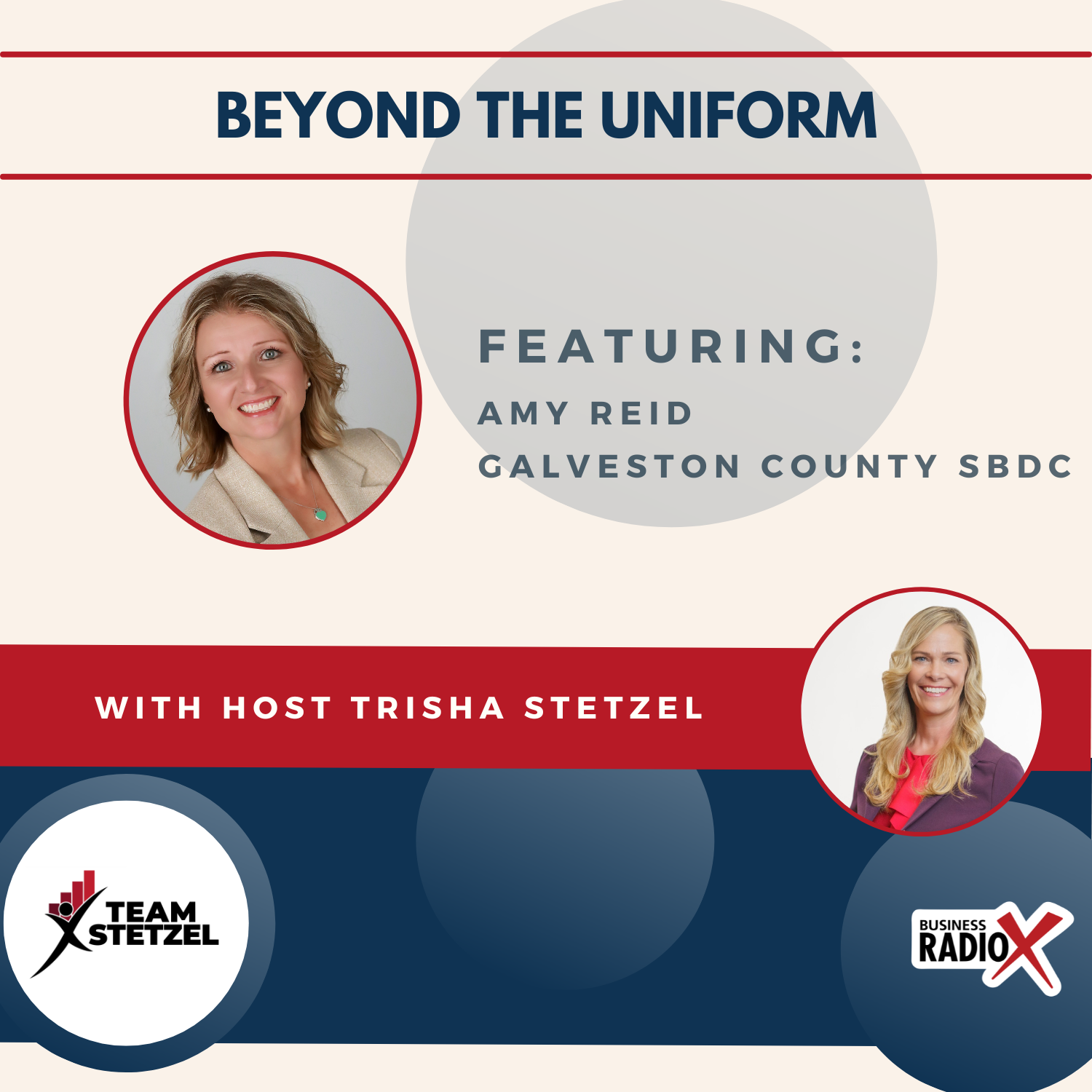

 Amy Reid is the Director of the Galveston County Small Business Development Center (SBDC) and a seasoned entrepreneur with over 20 years of experience in business ownership, human resources, marketing, and operations.
Since 2010, she has successfully run her own business and has spent more than a decade coaching and advising fellow entrepreneurs. Passionate about community engagement, she frequently speaks at business networking events and serves on various community committees.
In a recent discussion with Trisha, Amy highlighted the services offered by the Texas Gulf Coast Network SBDC, including no-cost business advising, alternative funding methods, and helping businesses connect with the right lenders.
They also explored the SBDC’s economic impact, its support for minority, women, and veteran-owned businesses, and the importance of passion and continuous growth in achieving success.
Follow Galveston County SBDC on LinkedIn and Facebook.
 This transcript is machine transcribed by Sonix.
TRANSCRIPT
Intro: Broadcasting live from the Business RadioX studios in Houston, Texas. It’s time for Houston Business Radio. Now, here’s your host.
Trisha Stetzel: Hello, Houston. Trisha Stetzel here bringing you another episode of Houston Business Radio. Beyond the uniform. It is my pleasure today to introduce you to someone that I met through the Houston Regional Veterans Chamber of Commerce several years ago, and we continue to connect on a personal level as well as professional level. Amy Reid, who is the director of Texas Gulf Coast Network SBDC in Galveston County. Amy, welcome to the show.
Amy Reid: Thank you for having me. I appreciate it, Trisha.
Trisha Stetzel: Long time coming. I’m so excited to have you on today. Yeah. So, Amy, uh, tell the listeners a little a little bit about you.
Amy Reid: So I’ve been doing this for about 14 years, and what we do is we provide no cost business advice to small businesses who either want to start or grow their business. Um, some people come to us and they just have an idea and they need somebody to bounce ideas off of. Um, and we help with that. And then once the idea is made, is it a viable idea and where does it go from there? And then other people have been in business for, you know, 20 years and they’re stagnant or they can’t figure out how to grow or it’s time to sell. Um, you know, it’s an exit strategy. So we help with all of that and we don’t charge anything for our services. Um, so a little bit about me is I’m just extremely passionate about helping small businesses. Um, they are going to have to drag me out when the time comes because I love what I do. Um, I love working with small businesses, and I love working with our community and our partners, like the Houston Regional Veterans Chamber of Commerce and all the all the chambers of commerce in Galveston County, um, as well as, um, our local lenders and, uh, Edc’s and cities. So I have a fantastic job. Love what I do.
Trisha Stetzel: That is so awesome. So, Amy, one of the things that you did not mention is you happen to be a veteran.
Amy Reid: Yes. Sorry. Um, I served Army National Guard in South Dakota as a logistics specialist.
Trisha Stetzel: Yeah. Wow. That is awesome. South Dakota, of all places.
Amy Reid: I’m from South Dakota, so it kind of made sense. Yes.
Trisha Stetzel: Fantastic. So, Amy, how did you get from, um, you know, when you grew up and found this amazing position with the SBDC 14 years ago? How did that transition happen for you?
Amy Reid: So, like a lot of people, when the oil industry started to decline, I needed to find a new role. And, um, I was in recruiting at the time for the oil and gas industry. So I had some human resources background, some facilities management background, um, payroll, office operations, a little bit of everything. So. And I own my own business, too. So I own a photography business. Um, and so when it came time to find what my next journey was, this kind of made sense. I had a little bit of everything that small businesses need to know about, and, and I just kind of rolled into that position.
Trisha Stetzel: I love that. So I want to back up and talk about what is the SBDC. So can you tell us what that acronym is? Um, and how that may or may not, uh, be associated with the SBA? Yeah.
Amy Reid: Sure. So the SBDC is the small Business Development Center, and we are what’s called a resource partner of the Small Business Administration SBA. So basically, I work for you. I work for anyone who pays their taxes. So those tax dollars are all given to federal government. And then they’re divvied up amongst programs. Um, and ours is an economic development program. So um, other resource partners that the SBA also supports are um, like score, um, which are mentors generally industry specific. And then there’s women in business centers. Um, there’s also bboc, which is the veterans, uh, side where they, they work with veterans, either fresh out of military service or as they grow as well. So you have all these no cost resources that are out there, but they are the cost because you already paid for it. Um, and my center is actually a part of University of Houston as well. So we get some state funding from them.
Trisha Stetzel: Wow. Did you say free Amy?
Amy Reid: Free? No cost. Yes. That is.
Trisha Stetzel: Amazing. Let’s talk just a little bit about how your, um, the Texas Gulf Coast Network SBDC in Galveston County works with the Houston Regional Veterans Chamber of Commerce.
Amy Reid: So, um, we have a an agreement with them, a Sam agreement where we support each other. Um, so if the um, Veterans Chamber of Commerce has an event going on, we help to publicize that. Um, we’ve housed them for some of their roundtables. They do the same for us. So if I call Dave Weaver and say, hey, Dave, we have this going on. Dave’s like, what time do I need to be there? Um, recently we did an event with the Department of Navy about how you could do business with them. And Dave was, uh, there in a heartbeat to support that with his team. Um, to make sure that everybody knew what that looked like from a veteran standpoint as well. So we have a great relationship with them.
Trisha Stetzel: Yeah. And because both organizations are so business focused and supporting veteran business owners. I think it makes a really good pair and match. Thank you for all you do for the chamber. We really appreciate it. Let’s talk, uh, maybe dive into a little bit more detail of the services you mentioned, a few of them. Uh, a few minutes ago. So I’d really like to dive into. Let’s start with what’s the number one service that these business owners are coming to the SBDC for money.
Amy Reid: They all need money. So. Yeah.
Trisha Stetzel: Okay.
Amy Reid: So? So that differs, right? So, um, if you’re a startup, you’re trying to figure out where is the working capital going to come from. The seed money. And so sometimes that looks like, you know, crowdfunding. It could look like. Um, it’s very hard for startups to get money. Um, as a startup, because you need to show that you have financial, uh, basically that is viable, right? You have to eliminate some of the risk when you’re talking to a to a lender. So sometimes we have to kind of think outside the box a little bit. Um, and then, you know, if you’re already in business and it’s time to expand or maybe, um, there’s something new going on in industry, you need some equipment. So we help with that too. But outside of the money part, you know, the lending is, you know, we have relationships with local lenders. So we know which lenders like what type of businesses, what they’re looking for. You know, some like to do $100,000 loans, some only want to do $800,000 loans, some want 650 credit score, some say 700 or more. So it’s our job to know those things so that we can pass that on to clients. But um, outside of that, we also help with marketing. Um, a lot of people know they need a market, but they don’t know how they should market.
Amy Reid: So we help them with that. Um, and then sometimes it’s growth strategy. So a lot of times, um, people are so busy doing whatever it is they do, like their services or or their products. Um, but they forget to actually, like, grow the business. So one of the things I always tell people when I first meet with them is I’m always going to be honest with you, even if it’s something you may not want to hear. And I’ll be your biggest cheerleader, but I’m also going to hold you accountable. So sometimes what we do is just following up to say, hey, how’s that business plan coming? Or, um, how is that marketing plan or budget coming? Because a lot of people don’t realize they need a budget for marketing. Um, but but a little bit of everything. And we also provide free market research. So, um, if you don’t know who your competitors are, it’s hard to stand out and know your value proposition if you don’t, um, know what the demographics are in your area or even know who your target market is, it’s hard to, um, really be successful and use that marketing money smartly.
Trisha Stetzel: Oh my goodness. So this whole market research thing. Like, I’m really excited about that. Uh, what does that look like? So let me back up. I got excited. Uh, how do these business owners who may be interested in something like that, Amy, how do they engage with the SBDC?
Amy Reid: So we just have a link. You go to SBDC, dot edu and you become a client, and then you’re attached to whichever SBDC is closest to you. So I’m Galveston County, but we have Harris County, Fort Bend all the way up to Huntsville A&M. And actually the SBDC is a nationwide program. It’s just the Texas Gulf Coast network is 32 counties in the south of Texas. So, um, once you’re a client, then you’re assigned to an advisor. And the advisor has access to all types of resources. So the the market resource or, I’m sorry, the market research software that we have, you’d pay hundreds if not thousands of dollars to get those reports that we can pull for you for free.
Trisha Stetzel: Very cool. So how is the relationship aiming? Do they come to you, uh, at the facility that you have for the SBDC in Galveston County, or is it a remote reach? What does that relationship look like with your clients?
Amy Reid: Really? Hybrid? Um, so I would say so, um, I cover the entire county, so I’m in three different locations throughout the week. Um, we have a, a calendar. You book, and it’s dependent on location, but we also meet online and we do short 30 minute telephone conversations if we need to as well. So and sometimes we go out to the client’s location like I will be later on today. So it just we try to really be what the clients need us to be and where we, we need to be.
Trisha Stetzel: Wow. That’s fantastic. And by the way, you said something earlier. No wonder we really connect because it is about straight talk and accountability. So yes, absolutely. And when you’re in that coach position, when you’re helping those business owners. It’s so important to help hold them accountable because if they keep doing the same thing the same way, they’re going to get the same results. And that’s not what they want when they reach out to you. Yeah, that is fantastic. Talk to me about. So you’ve got this, um, relationship with these clients, and you can help them with lots of things through the SBDC. Do you have courses or programs that these business owners can also engage with?
Amy Reid: Yeah. So, um, here at the SBDC in Galveston County, we do about 25 to 30 classes a year. So sometimes, um, that’s us presenting the classes and sometimes that’s bringing other experts in. Like, for instance, last night we had a class in Texas City. We went off location, um, and we had Workforce Solutions come in. They’re the experts in all their programs and that sort of thing. Um, and then, you know, later on next week, we have the IRS coming in to do, uh, getting ready for tax season class. And then I teach a bookkeeping class and a marketing class. So it just kind of depends on what you need some if you want online. Our website, the sbdc.edu, has, I think, over 200 on demand webinars that you can watch on all kinds of topics, including, you know, cybersecurity. Um, you know, you can just be on your your treadmill listening to cybersecurity while you’re, you know, working out or something. Um, but marketing all the things. Um, how to start a money, how to start a business with no money is like one of our most popular webinars that we have, I think.
Trisha Stetzel: Oh, like, listeners, if you’re not already, if you haven’t already gone to a SBDC. Is that right? Okay. If you haven’t already gone there and, like, filled out your profile, you should go there and do that. Right now, there are so many resources. So, um, client wise, Amy, are we just talking businesses that are startups? Who are the people that are engaging with the SBDC and, you know, are they taking advantage of all of these programs?
Amy Reid: So we are allowed to work with anyone who has 500 or less employees. So that’s that’s a pretty big business, right? That’s not what we normally would call small business. Um, but if you’ve seen a trend change over the years, you know, when when I first started, we had a lot of people who were maybe doing, like a gift basket businesses or consulting businesses. But now, um, that’s really changed. We have a lot of people who are service based, like plumbers, elecTrishans in the trades. Um, we have a lot of real estate. Um, laundromats. Uh, a little bit of everything. Assisted living. So we have, you know, those people who are looking to be owner operators in a franchise or they want to be, um, an owner, but maybe an absentee owner, and they’re looking for that, that little extra income, because maybe they’re a doctor and they want that extra income, you know, to look towards retirement or something. So it’s a plethora of people I wouldn’t say there’s just one type. So it is startups, acquisitions, um, and exit strategies all all rolled into it.
Trisha Stetzel: Wow. What an amazing resource. And because you have relationships with so many other organizations, it’s almost I’ll just call it a one stop shop to get connected to the things that you need. Right? Uh.
Amy Reid: Yes.
Trisha Stetzel: Yeah, I love that. That’s so amazing. So what what economic impact does the SBDC have on the communities that they’re serving?
Amy Reid: Well, um, I can’t off the top of my head remember what our entire network did, but I can tell you pretty close to what our center did. So we have three employees here. Two of us are advisors, and we have a program manager that handles our admin and our training, and our center alone had over $8 million in economic impact in capital last year, um, over 400 jobs. Um, we helped, I think over 160 minority small business owners and women. Um, and I think we had 48 veterans that we assisted last year. So, um, oh, and startups, I think we had 32, 31, 32 startups last year. So that’s just for our county. So think about on a nationwide, um.
Trisha Stetzel: Yeah. Or even your network. I’m thinking, you know, that 8 million times 36. Like that’s huge. Just in the Gulf Coast network, right? Um, amazing. And then you multiply that by the number of, uh, locations or sbdcs that we have across the nation. Wow. Uh, where is your physical location?
Amy Reid: So our center, our campus, as they call it, is in Lake City. Um, but I also office in Galveston on the island and then at the Texas city, la marque Chamber of Commerce as well. And then we have my other advisor offices in Friendswood. So we we really do try to cover the whole county.
Trisha Stetzel: Wow. Fantastic. All right, you guys, get on, go do some discovery, get your profile set up and take advantage of this. Amy, what does the future hold for the SBDC?
Amy Reid: So it’s kind of exciting, honestly, right now, um, we have we have some programs that we’ve recently piloted and now we’re putting into place. So, um, one of them is our vision adventure, um, where we have three different cohorts. So, um, they are, you know, a 12 week program. Um, but we’re doing the flip training, so you have homework before the class. So when you come in, it’s all hands on, integrated. Um, so we have a start smart, a grow smart. Um, and then we also have something called a virtual collaborative that we’re doing, and it’s, it’s kind of like the same framework as a as a mastermind. Um, where we just finished our pilot with food industry owners and, um, so we had, like, a food truck owner, a franchise, a big franchise restaurant, owner of family restaurant, um, home baker, and then a full bakery. And so they all came together, like each each month, shared best practices and challenges on different topics. So we just moderated and, you know, kind of chimed in. So we covered things like, um, inventory control and marketing and growth and expansion. So those are some cool programs that that are now coming into play. You know, we just finished the pilots make sure that that those all went well. And then the other thing is our I. So it’s important to us that with the way AI is transitioning, um, and becoming such a big part of everyone’s world that our small business owners understand it, there’s a lot of fear out there right now. Um, so I’m part of the national curriculum team for the SBDC, where we put together the curriculum to teach other advisors how to teach small business owners to use AI. Um, so we’re really excited about the things that we’re rolling out there. And because it’s really important to us at the SBDC that we’re relevant and we bring value, and if we’re scared of AI, then how do we help our our small business owners? So yeah, and I think we’ll just keep growing and expanding in the future.
Trisha Stetzel: Wow. Yeah. Ai is such a big topic and so many people haven’t even tried to use it and don’t even understand what it is. You know, many business owners, I find, think that AI is just a chat bot, right? They think, you know, ChatGPT or Gemini or one of these tools that are out there, and that is not it. That is just one piece of the tools that we can use to really automate the work that we’re doing, and especially those solopreneurs. It’s so important for us to save time on all of those administrative tasks, and being able to use AI to do that is amazing. So that sounds awesome. I can’t wait to engage in that. So, Amy, you said something. Uh, you said a BDC. What is that?
Amy Reid: Oh, America’s SBDC, that’s our nationwide umbrella. I’m sorry.
Trisha Stetzel: Okay. No, no. That’s okay. That’s what I’m here for as ask good questions.
Speaker4: Yeah.
Trisha Stetzel: Oh, my goodness, I love that. Um, anything else about the SBDC that we haven’t talked about that you really wanted to draw out?
Amy Reid: I think the only other thing is just to remember that, and I’ve already kind of said it, but you pay for our services, so there’s no reason to feel that you are alone or to struggle in your business. Come to someone who can either connect you to someone who can help you or who can help you. Um, and being held accountable is a good thing. Um, that means we’re going to be your biggest cheerleader when you hit those milestones, but we’re also going to help you push through those milestones that are challenging. So take advantage of it. It doesn’t cost you anything other than time, and I can pretty much guarantee that you’ll come out with value.
Trisha Stetzel: Oh gosh. Yes. Again, if you haven’t filled out your client profile, I’m telling you, you need to go do that. Amy. Um, as we get to the back end of our conversation today, I’d love to hear your favorite success story. Success story that comes out of the SBDC.
Amy Reid: So I know I mentioned earlier, I’ve been here 14 years. So, um, when I started about a year in, I worked with a client who came in and he wanted to start an assisted living home, and he had all kinds of experience in the industry. He was passionate about what he wanted to do and why he wanted to do it, but he didn’t have the money. He didn’t have the business sense. He didn’t even have. He had somewhat of a plan, but he he didn’t have enough of a plan, so he started coming to classes and workshops and we would meet every six months or so. He opened after 13 years of this journey together. He opened about a year and a half ago now, I guess. Um, and so not quite 13 years, but his persistence and his passion, everything came together. He’s thriving. We still meet constantly to some last night at our class, um, and we just. I’m his biggest cheerleader. I’m constantly talking about him. But for someone to be that passionate about that dream, I feel like that is truly, um, the the American dream. Making something come when it seemed like it was impossible and pushing through.
Trisha Stetzel: Oh, my. So I got goosebumps, like 13 years later. Right? That he birthed this baby business. And how amazing is that? And with your support all the way along the road, right? That journey that he’s been on. Um, gosh, thank you so much for being on the show with me today. There’s so much information to take in. I’m excited, uh, about what’s coming. Uh, and I love that the continuous improvement is there inside of the SBDC and that you’re tied to the bigger network. Right. Um, of America’s. Thank you, I appreciate you. I probably have to have you back on the show again anytime.
Amy Reid: Thank you for having me, I love that.
Trisha Stetzel: Thanks so much, Amy, for being on the show.
Amy Reid: Thank you.
Trisha Stetzel: That’s all the time we have for today’s show. Join us next time for another exciting episode of Houston Business Radio. Until then, stay tuned, stay inspired, and keep thriving in the Houston business community.














