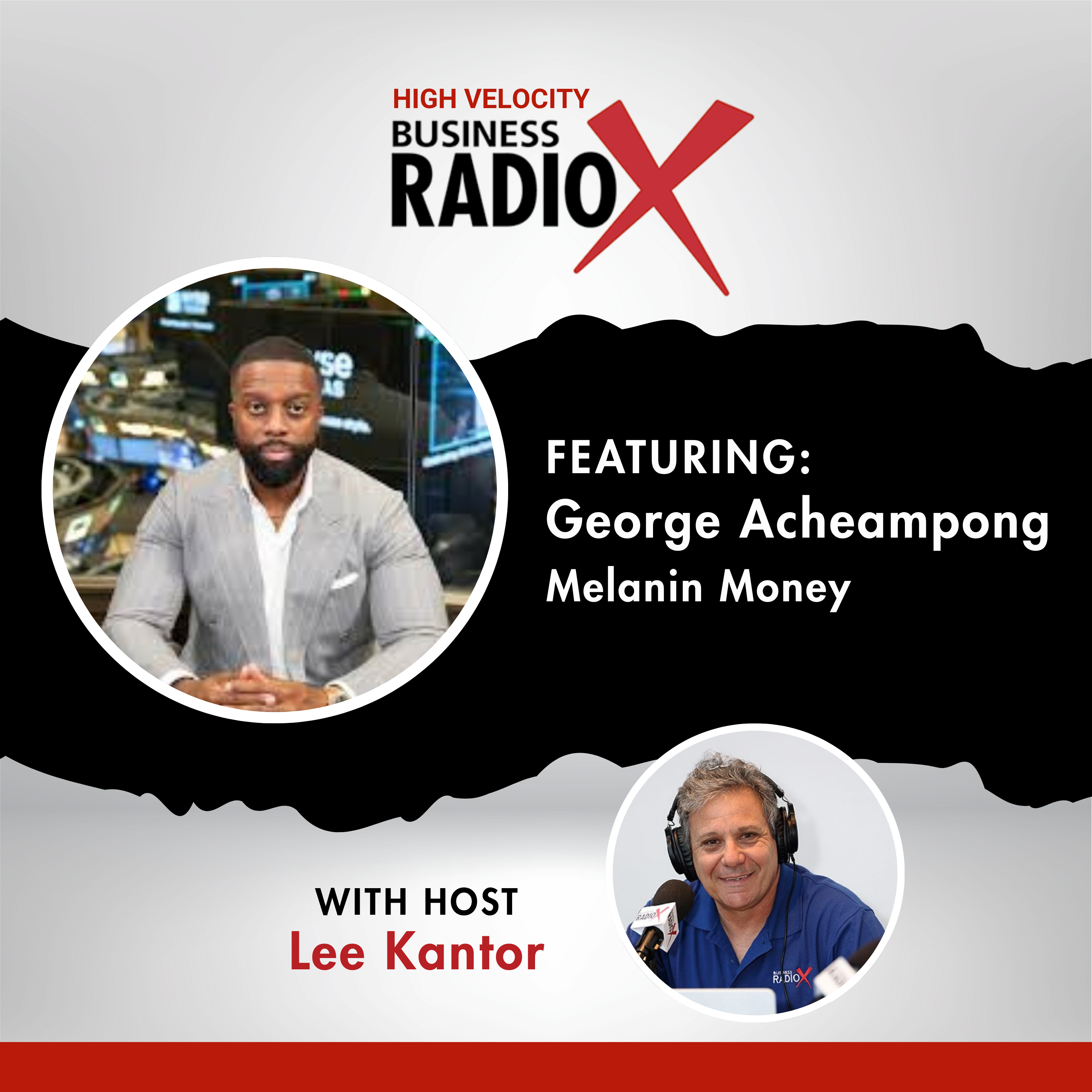

In this episode of High Velocity Radio, Lee Kantor interviews George Acheampong, founder of Melanin Money. George discusses the company’s mission to close the racial wealth gap by $100 billion through free financial education, workshops, and personalized advisory services. He explains Melanin Money’s approach to cash flow, tax strategies, investments, risk management, and estate planning, emphasizing the importance of patience and long-term wealth building. The episode highlights Melanin Money’s commitment to empowering people of color nationwide with accessible resources and expert guidance for achieving generational financial security.

 George Acheampong is a recognized thought leader in finance and entrepreneurship, serving as the Founder and Managing Partner of Capitalwize, LLC, a financial planning and investment management firm dedicated to helping aspiring and current first-generation millionaires build lasting legacies for their families.
He is also the Founder of Melanin Money, the #1 brand for wealth builders of color. Through merchandise, targeted initiatives, and programming, Melanin Money aims to close the racial wealth gap by 10%.
Connect with George on LinkedIn.
What You’ll Learn In This Episode
- Financial literacy and its importance in wealth building.
- Strategies to close the racial wealth gap, specifically targeting a $100 billion reduction.
- The mission of Melanin Money to create inclusive wealth-building opportunities for people of color.
- The role of free financial education through various platforms, including podcasts and workshops.
- Personalized wealth advisory services and their significance in financial planning.
- The ideal client profiles for Melanin Money, focusing on high-earning professionals and business owners.
- The importance of cash flow management and tax strategies in wealth accumulation.
- The challenges of transitioning from traditional employment to entrepreneurship in financial services.
- The impact of misinformation in financial education, particularly among younger audiences.
- The long-term mindset required for sustainable wealth building and the dangers of seeking quick financial fixes.
 This transcript is machine transcribed by Sonix.
TRANSCRIPT
Intro: Broadcasting live from the Business RadioX studios in Atlanta, Georgia. It’s time for High Velocity Radio.
Lee Kantor: Lee Kantor here. Another episode of High Velocity Radio, and this is going to be a good one. Today on the show we have the founder of Melanin Money, George Acheampong. Welcome.
George Acheampong: Thank you for having me.
Lee Kantor: Well, I’m excited to learn what you’re up to. Tell us a little bit about Melanin Money Mission purpose. How are you serving folks?
George Acheampong: Absolutely. So Melanin Money is a platform designed to create inclusive opportunities for people of color to build wealth. We are on a mission to decrease the wealth gap by $100 billion. Our clients have improved their collective net worth by over $244 million in the last 12 months and counting, and so just really excited to bring wealth building to underrepresented communities.
Lee Kantor: So how does it work? How does someone kind of join the opportunity? And is this an educational platform? Is it an investment platform or is it both?
George Acheampong: Yeah, it’s kind of a a generational wealth ecosystem if you will. So we have a couple of entry points. So number one we have our media and financial literacy platform. So we have a free for everybody. So we have a podcast that airs every week where we dive into various financial topics. We also produce obviously lots of content online. In addition to that, we have a free a community education platform people can tap into and join. We do live workshops about 52 times a year. Last year we taught over 30,000 people for free. And then of course, we have a full scale attacks and wealth advisory firm. So for those who are ready for a little more hands on support and want to hire their money team, we also have that available as well.
Lee Kantor: So what is kind of the path for the person that wants to increase their wealth? Like it sounds, a lot of it is content and a lot of free content that is kind of for the do it yourselfer. That would just kind of learn and then kind of go off on their own and do some of the recommendations. But ultimately, are you trying to move them into being a client at the wealth management? Is that part of it?
George Acheampong: Yeah. You know, obviously, you know, everybody may not be at a place where they need a full scale wealth management advisor or a money team. But um, so the pathway is we do a virtual five day workshop. And basically the thought process is there is we want to educate and coach people on the top strategies that have helped our clients get results. And at the end of that workshop, we invite people to the opportunity to work with our team intimately. And so this is the best of both worlds, because those who aren’t yet ready, they just got five days of training on the top strategies that we work with for our clients and then those who are ready to move forward. Then they are invited to to start working with our team.
Lee Kantor: Do you mind sharing some of those kind of top tenets that you recommend.
George Acheampong: Yeah, I think we’ll be helpful is I kind of I’ll go through kind of our advisory framework. Um, so first thing is we everything starts with cash flow, because if you don’t have a good pulse on how you are managing your money, then we’re not going to have the available resources to allocate towards building wealth after we go through cash flow, the cash flow matrix, then we dive into tax strategy. Um, we create a plan for our clients to save more money on taxes, because if they stop giving away unnecessary money to Uncle Sam, then they’ll have extra money to be able to invest. Then we move on to investment in wealth building. Um, and really get a clear pulse on what our client’s goals are, uh, what their time horizon is on, when they want to retire and ultimately develop a wealth building plan to make sense for them. Um, and then we address risk management, um, making sure they have all the right types and amounts of insurances in place, whether that’s, uh, health insurance, property and casualty, Um, disability life insurance, whatever the case may be, and make sure that that is dialed in. And then last but not least, uh, we move on to estate planning to make sure that they can protect and preserve their wealth that they’re building on to the next generation. Um, and and, of course, I can speak more specifically to some of our, like, flagship strategies that that’s helpful too.
Lee Kantor: Well, I’m just trying to get an idea for the listener, uh, ways to plug in. What would be the most beneficial to them? Is your the ideal kind of prospect for this, the aspirational person who is just kind of grinding and doesn’t know what to do? Or is it the person that maybe has been burned, uh, like, who is kind of the avatar for your ideal client?
George Acheampong: Yeah, I would say the avatar for our ideal client is on from a working professional standpoint, is someone who’s making, you know, at least $150,000 a year in income. Um, who’s who’s seeing that? A decent amount of their income is being kind of eaten up in taxes and is looking for a way to, uh, save more money in taxes and ultimately use that tax savings to build more wealth on the business owner entrepreneur side. I would say a business owner whose business is doing at least over, you know, 250 to maybe half $1 million in revenue. Um, and they focus a lot on growing their business. But ultimately, um, want to start focusing on prioritizing their personal wealth building. Um, I would say those are kind of our two ideal sweet spots for clients.
Lee Kantor: So it’s people who have a little bit of escape velocity, but maybe aren’t kind of maximizing it to get to the next level.
George Acheampong: Correct.
Lee Kantor: And do you find the people that are maybe the people that are making 150 grand or so are they are just they’re just kind of not doing anything with their money, like to, to be making that kind of money. That means you’re either at a job that has probably benefits, that has 401 that has some of these things that they could be doing to expand their wealth. Are they just not tapping into that or they’re not? They don’t know how to maximize it.
George Acheampong: Yeah. Great question. So to your point, someone who’s making, you know, $150,000, you know, they they, they figured out the money making part at least on one level. But I look at it in three major buckets. You it’s the money you make, how you manage it and how you maximize it. Right. And just because someone’s making decent money doesn’t mean they’ve ever been taught the best way to manage it. And it definitely doesn’t mean that they’ve been taught the best way to maximize it. And so essentially what we find is that, yes, maybe they have a 401 K, maybe they have some benefits. Um, we call them financial puzzle pieces, but ultimately they haven’t been able to figure out how it all fits together to put together, uh, those puzzle pieces in one cohesive and clear picture. And so our job is to kind of do an evaluation on what they’ve done already, um, identify areas of opportunity and really put together that financial puzzle that they’ve been looking for.
Lee Kantor: So what’s your backstory? How’d you get involved in this line of work?
George Acheampong: Yeah. Uh, so I’ve been in the financial services industry for about 14 years. Um, the way I got into the line of work was, uh, actually graduated with a double major in marketing and economics. I only got the economics degree because I just wanted to understand how to how to develop my personal economy. Right. Not how to do it for other people. But when I graduated, uh, back in oh nine, that was, you know, right around the time when the recession was happening, uh, marketing was viewed as a luxury. So I was interning for Coca-Cola, and they couldn’t bring me on as a full time employee at that time. And so I said, well, I have this economics degree. I wonder if I can do something with that. Um, ultimately explore some opportunities. Um, and started working for a financial services company, and they asked me to do an exercise called project 200, where essentially they wanted me to write down a list of 200 names of people who I felt like were doing well and I would want to trade paychecks with. But the problem was, I didn’t have a list of 200 people.
George Acheampong: I don’t think I could name 20. And so then from from from that point on, I was curious, why is it that the people that come from the communities that I come from, right? Maybe it wasn’t people that came to mind to be able to serve and to be able to help, right? And so I knew that there was a financial literacy gap, and I knew that there was a representation gap because there at the time, I’m not sure the stat today, but I think less than 2% or 1% of all the advisors, um, were advisors of color. And so as a result, if someone doesn’t if you don’t see someone that looks like you in this space, you probably think that it’s not for you. And so because there was not representation, most, most people, uh, didn’t think that wealth management was for them. And so I wanted to go on a mission to dispel that myth. And then ultimately create a platform that could serve people who, um, had the need but just didn’t know that it was available for them.
Lee Kantor: So that was, uh, so you became, at that point, kind of an entrepreneur that says, I’m going to, you know, open up my own shop and I’m going to bring in my own people, and this is who we’re going to serve.
George Acheampong: Exactly. Yep.
Lee Kantor: Now, what was that transition like to go from kind of the steady paycheck, the, you know, hey, I’m doing this. Um, I know as a wealth advisor, you are kind of an entrepreneur because it’s kind of an eat what you kill world. But, you know, doing your own thing and being responsible for other people is kind of a little bit of a mindset shift.
George Acheampong: Yeah, it’s a good question. Well, I actually have a funny story. So when I started out in the business, um, I thought I was getting a job, right. And then I remember like three weeks or so went by and I was wondering, you know, what happened to my paycheck? Um, and to your point, it was an eat what you kill environment. I wasn’t I wasn’t on salary. I was 23 at the time, so I didn’t have the, I guess, the foresight to understand that it wasn’t a base salary. And so, um, from the very start of my career, even when I was underneath another umbrella, it was 100% eat what you killed. So the transition, um, wasn’t as hard. Um, now, granted, there were other things that I had to now be accountable for. Like, I had to be in control of more of the marketing. I wasn’t able to leverage the the household name of the company I was working with. I had to get my own office and things of that nature. So that transition in terms of just building out the infrastructure of the business versus just being the industry expert, there’s a little bit of a shift there. Um, but ultimately, um, it was kind of a little bit of a blissful ignorance. I didn’t know what I didn’t know I was young, I didn’t have a lot of obligations, didn’t have a child at the time. Um, and so I just kind of grinded it out, um, and worked really hard. And then ultimately, um, you know, fast forward, it worked out.
Lee Kantor: So now when you were starting out and you have the mission that seems clear and that seems like something that, you know, you can rally people around. When did you kind of financially when you put your financial hat on, say, okay, this is something I’m going to be able to pull this off. We I’m getting traction now. Did you have kind of a moment where you were like, okay, I think we got this now.
George Acheampong: Yeah, that’s a good question. So I would say around might have been might have been 2017, 2018. I had an inflection point, um, because I wanted to build a business that was accessible for what? At the time, I believed to be everybody, but I didn’t quite yet understand the economics of what that what that would mean for the business itself. And so, um, I try to have like a low cost subscription service for financial planning. And I told myself at the time I was like, I’m going to be the Netflix of personal finance. But what I didn’t realize is Netflix’s intellectual property, and they and they’re a venture backed company. I was providing services. And so at that point, I had to kind of reimagine the way in which I showed up for the marketplace, and I had to split, uh, financial education from financial services. And so once I did that and really got clear on who my ideal avatar was, I was able to still make good on my mission by educating and coaching people at scale, while also still building a business that was sustainable. And I would say probably around 2019 is when I really started to build traction and momentum, that I knew this would be something that would be sustainable long term.
Lee Kantor: So it seems like your background in marketing and kind of this wealth management angle or economics was the kind of the secret sauce that helps kind of elevate you from others in the space.
George Acheampong: That’s a very astute observation that almost nobody connects the dots on, because for me, it wasn’t. It wasn’t even originally, uh, I guess transparent for me either, because I was like, all right, I knew I had this marketing degree, but once I went into the financial services industry, I didn’t really think much about it. But it wasn’t until I had to start doing marketing and it became innate. I was like, oh, okay, well, this is because I have a background in it, and it ended up still being a useful degree. Um, but yeah, most people don’t make that observation. So yeah, that’s that’s 100% accurate. My marketing acumen played a huge role in my ability to grow and even think creatively about how I needed to position my business model. That set me apart from other advisors in the industry.
Lee Kantor: Now, you mentioned earlier that a lot of your work is around education. Um, can you talk a little bit about how much misinformation is out there? And there is so much. I mean, one of my pet peeves in this space, uh, at least for a lot of young people I’m talking to, is they’re seeing all this kind of gambling and DraftKings and Polymarket, and they’re putting it in the pile of wealth management. And that’s really scary to me because I don’t see, you know, investing in the stock market the same as, you know, going to DraftKings and, you know, making a prop bets.
George Acheampong: Yeah, 100%. So, um, what I like, what I like to say is me and my company, we sit firmly in the middle of credibility and relatability because what the the challenge in the marketplace is you have people who are very credible, but it’s like watching paint dry when they talk about personal finance. And you have people that are relatable, but they don’t have the credentials, they don’t have the expertise, but they have a way of conveying the message that seems cool and innovative. And so people might gravitate towards that. But to your point, in many instances there can be a lot of misinformation there. So what I try to do is instead of calling out either side, I sit in the middle of being able to be relatable, but also having the credibility of a world class advisor and just try to drown out the noise and give people more context, because what I believe is that the missing bridge between between limiting beliefs. Right, um, of people who are trying to get into the space of understanding financial literacy, right. And the oversimplification of how it works is context, because you have financial creators that will say to your point, you can, uh, just do sports betting and make $50,000 a month.
George Acheampong: And it’s like, okay, sounds good. Um, and then you have, um, other people who, um, have limiting beliefs around what’s possible. But I think the, the bridge is context. If I can say, hey, look, yes, you can build a portfolio that pays you passively, but it’s not going to happen overnight. You’re going to have to, uh, do the boring, repetitive thing for years. You’re going to have to, uh, get skill set acquisition to create more margin between your income and your expenses so you can have a disposable income to invest. And yes, over time you can create that passive income. But the road to passive income isn’t passive. And so when people get the context, then they can say, okay, let me actually create a plan that makes sense. Create a plan that’s sustainable versus thinking I can, you know, just gamble and try to get a Hail Mary win and then maybe make some money off of a meme stock or, um, placing bets with DraftKings.
Lee Kantor: Yeah, it’s, um, one of the biggest gifts I guess my family gave to me when I was younger was explaining or for me to understand the power of compounding. And once I kind of understood that, that unlocked a different mindset on how I approach different things. And I just think that’s missing in a lot of younger people today.
George Acheampong: Yes, 100% 100. Like, everybody wants instant gratification. Um, and I think it’s just a derivative of like the easy access to dopamine by virtue of the way the world works with, you know, social media. Like, everything is just seemingly at your fingertips. Um, everybody seems to have it all figured out. Everybody seems to be living this grand lifestyle. And so people are unwilling to wait. Um, and so instead of taking advantage of the power of compounding, they’re looking for quick fixes in short term solutions that can get them to their perceived goal faster.
Lee Kantor: So what do you need more of? How can we help you?
George Acheampong: Um, I think just more people having awareness that there’s a platform that will meet you where you are and provide quality, uh, education to you. Um, again, like I said, we do free complimentary workshops all year long, mainly about, you know, 20% of the people that we reach most likely will be able to work with us in a 1 to 1 capacity. But ultimately, um, you know, the other 80%, we’re still providing high quality information. So just, you know, sharing the word that money and money is a platform that’s here to serve you, educate you, empower you on all things tax strategy, wealth building and personal finance.
Lee Kantor: And it doesn’t matter what stage you are in your kind of, uh, career or work life.
George Acheampong: Correct. Yeah. We can help people all across the country.
Lee Kantor: And, uh, the website socials. What’s the best way to connect to get a hold of you or somebody on the team or learn about the podcast?
George Acheampong: Sure. Um, uh, as far as our, our company, uh, social melanin money everywhere. So melanin money com is a website. Melanin money on social media, um, all platforms if you want to tap in with me personally. Um, George Jr, uh, my last name is a little bit unique, so hopefully you can put that in the show notes or something like that. But, um, um, if you search me, I’m probably the first one that’ll show up on social media. Um, and we’re happy to help.
Lee Kantor: Well, George, thank you so much for sharing your story today. You’re doing such important work, and we appreciate you.
George Acheampong: Thank you so much for having me.
Lee Kantor: All right. This is Lee Kantor. We’ll see you all next time on High Velocity Radio.














