Business RadioX ®

  • Home
  • Business RadioX ® Communities
    • Southeast
      • Alabama
        • Birmingham
      • Florida
        • Orlando
        • Pensacola
        • South Florida
        • Tampa
        • Tallahassee
      • Georgia
        • Atlanta
        • Cherokee
        • Forsyth
        • Greater Perimeter
        • Gwinnett
        • North Fulton
        • North Georgia
        • Northeast Georgia
        • Rome
        • Savannah
      • Louisiana
        • New Orleans
      • North Carolina
        • Charlotte
        • Raleigh
      • Tennessee
        • Chattanooga
        • Nashville
      • Virginia
        • Richmond
    • South Central
      • Arkansas
        • Northwest Arkansas
    • Midwest
      • Illinois
        • Chicago
      • Michigan
        • Detroit
      • Minnesota
        • Minneapolis St. Paul
      • Missouri
        • St. Louis
      • Ohio
        • Cleveland
        • Columbus
        • Dayton
    • Southwest
      • Arizona
        • Phoenix
        • Tucson
        • Valley
      • Texas
        • Austin
        • Dallas
        • Houston
    • West
      • California
        • Bay Area
        • LA
        • Pasadena
      • Colorado
        • Denver
      • Hawaii
        • Oahu
  • FAQs
  • About Us
    • Our Mission
    • Our Audience
    • Why It Works
    • What People Are Saying
    • BRX in the News
  • Resources
    • BRX Pro Tips
    • B2B Marketing: The 4Rs
    • High Velocity Selling Habits
    • Why Most B2B Media Strategies Fail
    • 9 Reasons To Sponsor A Business RadioX ® Show
  • Partner With Us
  • Veteran Business RadioX ®

How to Talk to Your Kids About Gun Violence

May 26, 2022 by John Ray

How To Talk to Your Kids About Gun Violence
Minneapolis St. Paul Studio
How to Talk to Your Kids About Gun Violence
Loading
00:00 /
RSS Feed
Share
Link
Embed

Download file

How To Talk to Your Kids About Gun Violence

How to Talk to Your Kids About Gun Violence

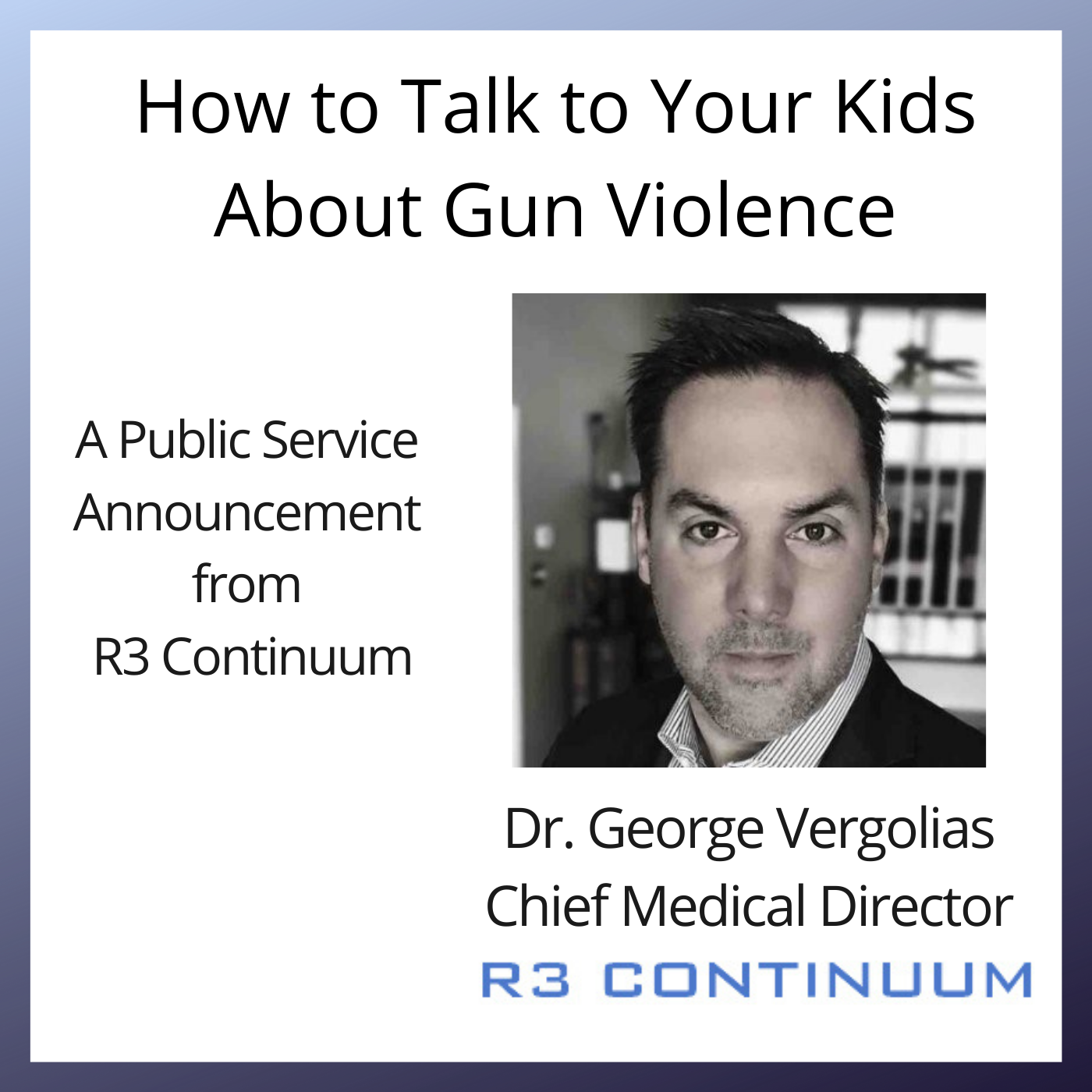
In this public service announcement, Dr. George Vergolias, Chief Medical Director of R3 Continuum, offers guidance on how to talk about gun violence with your kids.

TRANSCRIPT

George Vergolias: [00:00:00] Hello. My name is George Vergolias. I’m the Medical Director for R3 Continuum. I am a forensic psychologist and a certified threat manager with 20 years of experience, specializing in workplace violence and school violence. Most importantly, I’m also a father of a 14-year-old daughter and a 12-year-old son.

At R3 Continuum, our primary and passionate mission is to help organizations adjust to, manage and navigate through difficult disruptive events, including violent incidents. Last week, we collectively witnessed the heinous hate crime in Buffalo, New York, with the killing of 10 black community members at the Tops grocery store, most of them elderly. And we barely absorbed that event, until yesterday, once again, we woke up and bore witness to the attack at an elementary school in Texas, resulting in the deaths of two adult teachers and 19 children – second, third and fourth graders.

There are few words that can capture the outrage, the emotional reaction, the despair that comes with these events. Although we, at R3, can’t change these events having occurred, we can offer tools to make a positive impact. And towards that goal, I want to offer five tips for speaking with children about gun-related violence.

The first tip is that you should talk to them about their worries and concerns openly. Ask open-ended questions to understand what do they know, what are some misconceptions they have, what do they understand about the event. Express feelings about the event. Get them to open up about that, and express their feelings and thoughts. And then, you should also share your feelings as well. And you want to adjust that to their developmental age.

Secondly, adjust your dialogue to what you think they can handle emotionally. Kids at different age ranges and even kids at the same age range with different maturity levels will react differently to these events. Kids that have been previously traumatized may have a more difficult reaction, and you need to adjust that dialogue and that discussion accordingly.

Number three, reassure them about safety. These attacks are high impact, but they are low probability events. They’re unlikely to occur in any given school or any given school district. It’s also important to remind children about all the wonderful and exceptional measures that schools have taken to develop threat management teams, threat assessment, and reaction protocols and security protocols. In total, schools are a pretty safe place to be for kids and one of the most safe environments for them to be in the aggregate. And it’s important to remind them of that.

Four, reduced exposure to media and social media. This is not the time for information overload, particularly information that may not be accurate or may have been created simply for sensationalistic purposes in order to get clicks or additional views. We want to be cautious of exposing them too much to that. Ideally, you would want to titrate their exposure to those situations and that media over time, so they’re not overwhelmed.

Many of our kids, including my 14-year-old and 12-year-old, have their phones. It may be very difficult to get their phones back from them at this age with how much they’re involved in activity and social media. So, rather than trying to completely take the phone away, what you may want to do is some of the older teens where that might be more difficult, you want to at least check in with them periodically – once a day, twice a day – about what they’re hearing about these events, what they’re seeing online, what they’re being exposed to. And the goal there is to be able to correct any misinformation and give them an avenue to digest the information and talk it through. It’s really important to give them that opportunity.

Five, maintain regular routines and model healthy behavior. This is really important. Our kids will look to us for normalcy, as well as when something is not normal or off. And by maintaining regular habits, that becomes critical because these habits are are behavioral anchors to what is normal, and routine and comfortable in our life. And we want to model that and continue to show that in our daily interactions with them. To the extent possible, we want to continue those as much as we can. We can be sad, we can express outrage, we can express anger. Those are human emotions and they’re very normal in response to these events, but we also want to model a proper and productive way of managing those emotions and coping well through those events. And we want to be able to show our kids how to do that effectively.

This list is not exhaustive, but these are very easy take-and-used tips that you can utilize talking with children, and preteens and teenagers about gun violence, about the recent events in the last few weeks that hopefully can get them to express and open up a dialogue and be productive. Thank you for listening. Take care of yourself and take care of those you love.


About R3 Continuum

R3 Continuum (R3c) is a global leader in workplace behavioral health and security solutions. R3c helps ensure the psychological and physical safety of organizations and their people in today’s ever-changing and often unpredictable world. Through their continuum of tailored solutions, including evaluations, crisis response, executive optimization, protective services, and more, they help organizations maintain and cultivate a workplace of wellbeing so that their people can thrive. Learn more about R3c at www.r3c.com.

R3 Continuum is the underwriter of Workplace MVP, a show which celebrates the everyday heroes–Workplace Most Valuable Professionals–in human resources, risk management, security, business continuity, and the C-suite who resolutely labor for the well-being of employees in their care, readying the workplace for and planning responses to disruption.

Connect with R3 Continuum:  Website | LinkedIn | Facebook | Twitter
Tagged With: children, Dr. George Vergolias, George Vergolias, gun violence, kids, preventing workplace violence, public service announcement, R3 Continuum, school violence, teens, workplace violence

The R3 Continuum Playbook: Workplace Mental Health in a Pandemic

April 15, 2021 by John Ray

workplace mental health
Minneapolis St. Paul Studio
The R3 Continuum Playbook: Workplace Mental Health in a Pandemic
Loading
00:00 /
RSS Feed
Share
Link
Embed

Download file

workplace mental health

The R3 Continuum Playbook: Workplace Mental Health in a Pandemic

Dr. George Vergolias discusses how the pandemic has quite significantly affected workplace mental health, and he shares strategies employers can adopt to mitigate the effect of this pressing problem. The R3 Continuum Playbook is presented by R3 Continuum and is produced by the Minneapolis-St.Paul Studio of Business RadioX®. R3 Continuum is the underwriter of Workplace MVP, the show which celebrates heroes in the workplace.

TRANSCRIPT

Intro: [00:00:00] Broadcasting from the Business RadioX Studios, here is your R3 Continuum Playbook. Brought to you by Workplace MVP sponsor, R3 Continuum – a global leader in workplace behavioral health, crisis, and security solutions.

George Vergolias: [00:00:13] Greetings. I am Dr. George Vergolias, Medical Director at R3 Continuum. And today, I want to discuss the broadly known issue that behavioral health is being identified as the next pandemic. And with this increasing realization comes the challenge of figuring out how the pandemic is impacting the current state of wellbeing in our workplaces. This has had a significant impact on workplaces across the globe.

George Vergolias: [00:00:36] According to a recently published World Health Organization study, the pandemic has disrupted or halted critical mental health services in 93 percent of countries worldwide while the demand for mental health has been increasing. From the National Institute of Health, in the pre-COVID years leading up to 2019, roughly 10 percent of adults reported anxiety or depressive symptoms. However, in 2020, post-COVID, that incidence quadrupled to 40 percent. A survey in June of 2020 showed that 13 percent of adults reported new or increased substance abuse and 11 percent of adults reported onset of suicidal thoughts.

George Vergolias: [00:01:16] Fears of the virus created a significant stressor as well. But the response of governments to minimize spread, while understandable and needed, also created a host of other psychosocial stressors. Which, not only increased overall stress load, but simultaneously strained worker’s coping resources. These have had a profound impact on the workplace. Just some examples, unemployment or risk of such, reduced work productivity, increased absenteeism and presentism, increased irritability and hostility, reduction in team engagement, isolation and loneliness. And work from home with all of its attendant challenges such as home schooling and other issues. All of these have been present.

George Vergolias: [00:01:55] In my opinion, one of the most damaging aspects to business is when people are highly stressed, anxious, and depressed, they greatly struggle to bring innovation and creativity. And without innovation and creativity, businesses suffer. It’s kind of a classic Catch-22.

George Vergolias: [00:02:16] As a business leader, there are things that you can do to mitigate these issues within your organization. Proactively supporting your employees is a primary approach. And I want to highlight five key suggestions towards that aim that we continually find at R3 in the consulting work that we do with large and small organizations.

George Vergolias: [00:02:36] First, remember that even one year into the pandemic, this is still new to all of us. Even with very positive news of vaccines coming online, remember, this is a vaccine produced within a record-breaking timeframe for a disease that has not been known to us before in this particular manner or strain. Certainly, coronaviruses have been part of the human species journey for at least 10,000 years. But this particular version is a new wrinkle and we’re still sorting it out.

George Vergolias: [00:03:04] As leaders, it is critically important to place that in proper context. To explain that while science has made miraculous strides in combating this virus in such a short time, we still have more to learn and we still may have more adjustments. This helps level set expectations and tempers fears across your organization, and it’s an important first step.

George Vergolias: [00:03:26] Second, provide timely and accurate information to your employees. I like to say that fear loves a vacuum. In the absence of good intel, humans will tend to speculate. And when we do that without good information, we tend to do so in a negative direction. And in some cases, that can border on paranoid thinking and paralyzing fear. As leaders, it is important to provide our employees with information that is credible, believable, and based on the best available science at the time.

George Vergolias: [00:03:55] This doesn’t mean that what we share today will be accurate in a few months, as the science is evolving and the medical understanding is evolving over time. That is why the point above is critical to set the proper expectations so people can adjust to changes as we move forward. And then, provide your employees information so they can be informed based on best evidence science at the current time. And thus, make informed decisions pertinent to their safety concerns and in a manner that reduces anxiety and fearful isolation.

George Vergolias: [00:04:27] Third, we need to communicate clearly to our employees. Once you level set expectations and then find clear and credible information to disseminate, you must clearly communicate such to your company, employees, and, if appropriate, other stakeholders. Communication should be clear, concise, and placed into context of it being based on the best available evidence and information currently available.

George Vergolias: [00:04:52] This has several benefits. It allows you as a leader to convey a sense of accountability and competence at the highest level of your organization. And in doing so, you become a trusted voice and one that employees can rely on to find answers and provide needed resources. It also initiates a dialogue with your employees within the context of trust and candor, which can be vitally important at times of increased stress. And lastly, this allows you to later clarify any misunderstandings that might arise. And in the current context, if needed, reframe things later as the medical field learns more about the disease, about vaccinations, and even about new strains and their impact on people.

George Vergolias: [00:05:34] A key component of communication is communicating bidirectionally, in both ways, to your employees, but also listening. In a landscape of potential fear, communication must go in both directions. The best military generals seek input from and listen to their soldiers on the front lines because they have the most relevant up to date information of the battlefield. In many ways, as leaders, we could learn from this. Thus, communication must occur in both directions.

George Vergolias: [00:06:03] When people are fearful, they do want timely and clear information shared with them. But equally important is that they want their concerns to be heard and understood. Additionally, they may have suggestions for coping. They may have suggestions for accessing additional resources that leadership was not aware of. And they can offer support to others in ways that they have been dealing with things that leadership may not be aware, but which can be beneficial to others in your organization. Your employees are a resource for resilience, so do not let that resources go untapped. So, I recommend opening up a dialogue with your employees so that leadership can understand those concerns and then direct interventions and policies accordingly.

George Vergolias: [00:06:47] A fourth point is, set clear policy and act consistent with that policy over time, but make changes when needed. Let me explain that a little further. To be clear, I am not recommending any specific policy here as any policy must be anchored to your company, and culture, and your risk tolerance, as well as your particular organizational needs. Yet whatever policy you have about requiring vaccinations or not, returning to work or not, when to return or not, travel restrictions and so on, all of those should be outlined and explained as clearly as possible and as often as needed.

George Vergolias: [00:07:26] We often say that one has to repeat something up to seven times for a group to understand it and retain it. So, consistency is important here. As frequent shifts in policy can lead to increased confusion and frustration, as well as employees emotionally checking out if they keep hearing different variations of a policy. The only exception to this, of course, and something to be mindful of, is that, if medical experts make changes to best practice recommendations that directly impact your policy, that would require adjustments over time.

George Vergolias: [00:08:01] But, again, if you open up with my first bullet point saying that there clearly is kind of a new direction that we’re figuring out as we go and you set that level of expectation, people will adapt well to that. So, it is not the occasional change that is the problem here. It is rapid, seemingly irrational changes that can be problematic as your employees view leadership and their decisions. So, set a North Star by picking a course of action and follow that as long as it remains consistent with medical guidelines. As I said earlier here, consistency goes a long way. If you build in expectations properly, as noted above, your employees will be able to adjust accordingly and with minimal frustration.

George Vergolias: [00:08:45] Fifth, mobilize resources to build resilience and enhance coping. Employees will show individual responses to uncertainty and fear, and this will vary greatly. Some will seemingly show no noticeable response, and they’ll seem to be managing things very well. Others will evidently be struggling emotionally. And others may still be experiencing a silent struggle where they’re struggling internally, but they’re not showing it on the surface, and it may be much more difficult to detect.

George Vergolias: [00:09:14] And further, all of these different variations will occur on different trajectories as some people will improve in their functioning and coping with this, as others will continue to struggle. And when others are coming out of their struggle, different people that have been coping well might fall into a struggle. So, it is imperative to make available resources to help build resilience, tap into existing coping mechanisms, and in some cases, seek additional, more formal clinical treatments when needed.

George Vergolias: [00:09:45] Since the onset of this pandemic, we at R3 have seen a dramatic increase in request for these support services across the many organizations with whom we consult. These include the following, wellness outreach. Wellness outreach is timely and proactive outreach calls by trained resilience coaches with the goal of checking in on how people are coping, and assisting them to maximize their coping strategies, or tighten up existing strategies that may not be working as well as they’d like.

George Vergolias: [00:10:14] Another thing we’ve been doing is what we call facilitated discussions. These are group format discussions aimed at supporting employees and allowing them to address their fears, navigate cultural differences that might be existing in the organization, and share successful strategies for adapting and thriving to the pandemic and other social stressors that are occurring. In this role, we are really trying to help facilitate this discussion in a way that business leaders may not be comfortable with or may want an outside party as more of an objective support resource.

George Vergolias: [00:10:48] Another thing we’ve been doing quite extensively is what we call disruptive event management. When a negative event impacts a workplace, it could be the onset of a breakout of COVID. It could be an untimely death, in some cases of suicide. Any kind of event that really disrupts the flow and functioning and emotional stability of a workplace, we can respond providing onsite or virtual behavioral health coaching that supports and helps individuals adjust to that emotional impact after that specific disruptive event impacts the workforce. And the goal is maximizing a resilient adjustment. What we know is when these types of disruptive events occur, the sooner that we can get in and help people tap in to organic natural coping resources, the better people tend to do.

George Vergolias: [00:11:40] Then, another thing to consider is referring people to more formal clinical behavioral health options. In some cases, an individual is emotionally struggling at an intensity or for a long duration, such that linkage to a behavioral health provider and into clinical treatment is warranted. So, as you navigate forward as a leader, be aware of resources in your area. Be aware of resources through your employee assistance program, if appropriate, and others that might be covered through your available insurance options. So that if this need arises, you can mobilize those resources quickly and link employees to the proper resources if they need that level of treatment or support.

George Vergolias: [00:12:26] So, in summation here, employee behavioral health is suffering. And I expect and what we’re seeing from all the data is, we expect this to continue well into 2021 and likely into 2022. But here’s the good news, you can help change that and R3 Continuum can help. On our website, which is r3c.com, there are a number of resources that can be found in our Resources tab. Along with that, we have a number of tailored solutions to help support your unique challenges. Contact us today for a free consultation at info@r3c.com.

George Vergolias: [00:13:04] I want to thank you for giving me this time. And, hopefully, these tips and suggestions have been helpful so you can bring leadership to bear in a very proactive and positive manner as we navigate forward through the pandemic. Thank you again.

Show Underwriter

R3 Continuum (R3c) is the underwriter of Workplace MVP, a show which celebrates the everyday heroes–Workplace Most Valuable Professionals–in human resources, risk management, security, business continuity, and the C-suite who resolutely labor for the well-being of employees in their care, readying the workplace for and planning responses to disruption.

R3 Continuum is a global leader in workplace behavioral health and security solutions. R3c helps ensure the psychological and physical safety of organizations and their people in today’s ever-changing and often unpredictable world. Through their continuum of tailored solutions, including evaluations, crisis response, executive optimization, protective services, and more, they help organizations maintain and cultivate a workplace of wellbeing so that their people can thrive. Learn more about R3c at www.r3c.com.

Connect with R3 Continuum:  Website | LinkedIn | Facebook | Twitter
Tagged With: behavioral health, George Vergolias, mental health, pandemic, R3 Continuum, workplace mental health, Workplace MVP

Business RadioX ® Network


Our Most Recent Episode

CONNECT WITH US

  • Email
  • Facebook
  • LinkedIn
  • Twitter
  • YouTube

Our Mission

We help local business leaders get the word out about the important work they’re doing to serve their market, their community, and their profession.

We support and celebrate business by sharing positive business stories that traditional media ignores. Some media leans left. Some media leans right. We lean business.

Sponsor a Show

Build Relationships and Grow Your Business. Click here for more details.

Partner With Us

Discover More Here

Terms and Conditions
Privacy Policy

Connect with us

Want to keep up with the latest in pro-business news across the network? Follow us on social media for the latest stories!
  • Email
  • Facebook
  • Google+
  • LinkedIn
  • Twitter
  • YouTube

Business RadioX® Headquarters
1000 Abernathy Rd. NE
Building 400, Suite L-10
Sandy Springs, GA 30328

© 2025 Business RadioX ® · Rainmaker Platform

BRXStudioCoversLA

Wait! Don’t Miss an Episode of LA Business Radio

BRXStudioCoversDENVER

Wait! Don’t Miss an Episode of Denver Business Radio

BRXStudioCoversPENSACOLA

Wait! Don’t Miss an Episode of Pensacola Business Radio

BRXStudioCoversBIRMINGHAM

Wait! Don’t Miss an Episode of Birmingham Business Radio

BRXStudioCoversTALLAHASSEE

Wait! Don’t Miss an Episode of Tallahassee Business Radio

BRXStudioCoversRALEIGH

Wait! Don’t Miss an Episode of Raleigh Business Radio

BRXStudioCoversRICHMONDNoWhite

Wait! Don’t Miss an Episode of Richmond Business Radio

BRXStudioCoversNASHVILLENoWhite

Wait! Don’t Miss an Episode of Nashville Business Radio

BRXStudioCoversDETROIT

Wait! Don’t Miss an Episode of Detroit Business Radio

BRXStudioCoversSTLOUIS

Wait! Don’t Miss an Episode of St. Louis Business Radio

BRXStudioCoversCOLUMBUS-small

Wait! Don’t Miss an Episode of Columbus Business Radio

Coachthecoach-08-08

Wait! Don’t Miss an Episode of Coach the Coach

BRXStudioCoversBAYAREA

Wait! Don’t Miss an Episode of Bay Area Business Radio

BRXStudioCoversCHICAGO

Wait! Don’t Miss an Episode of Chicago Business Radio

Wait! Don’t Miss an Episode of Atlanta Business Radio














