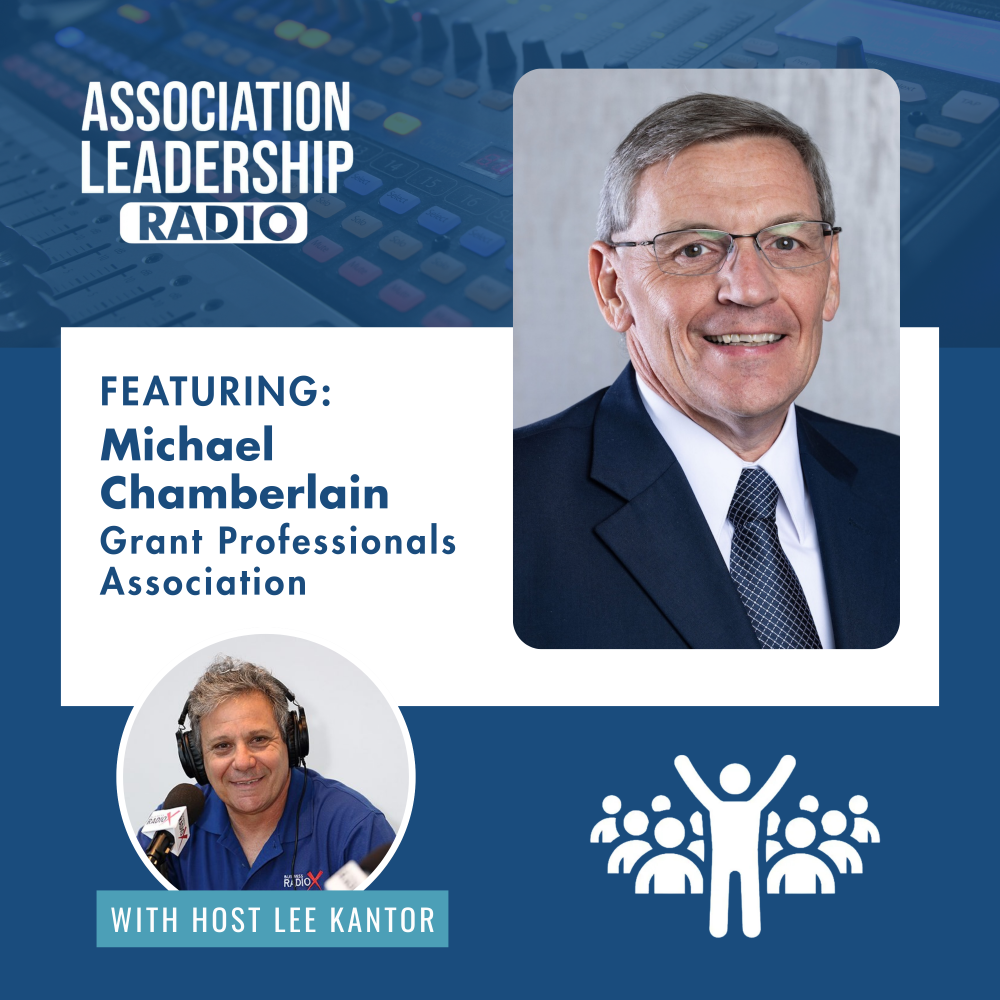

In this episode of Association Leadership Radio, Lee Kantor is joined by Mike Chamberlain, CEO of the Grant Professionals Association (GPA). They discuss the critical role of grant professionals in securing funding for nonprofits and local governments. Mike highlights the GPA’s mission to advocate for the profession, build community, and promote professionalism. He also addresses the challenges of navigating federal grants, the importance of ethical standards, and the need for organizations to diversify funding sources. The GPA offers resources like a consultants directory and educational materials to support grant professionals in their vital work.
 Michael Chamberlain is CEO of The Grant Professionals Association (GPA), an international membership association for everyone in the grants industry.
GPA and its affiliates work to advance the profession, certify professionals, and fund professionalism. GPA offers continuing professional development through local chapter meetings, regular webinars, the GPA Journal, and an annual conference.
The Grant Professionals Certification Institute oversees the GPC credential based on a body of knowledge for the profession. The Grant Professionals Foundation provides scholarships to individuals to advance their career. 
Follow GPA on LinkedIn, Facebook, X and Instagram.
 This transcript is machine transcribed by Sonix.
TRANSCRIPT
Intro: Broadcasting live from the Business RadioX studios in Atlanta, Georgia. It’s time for Association Leadership Radio. Now here’s your host.
Lee Kantor: Lee Kantor here another episode of Association Leadership Radio. And this is going to be a good one. Today on the show we have Mike Chamberlain and he is the CEO of Grant Professionals Association. Welcome.
Mike Chamberlain: Hi, Lee. It’s my pleasure to be here today.
Lee Kantor: Well, I’m excited to learn what you’re up to. Uh, can you give us a little brief overview of the Grant Professionals Association? How you serving, folks?
Mike Chamberlain: Yes, absolutely. So the Grant Professionals Association, we just celebrated our 25th anniversary a little over a year ago. So we’re relatively young in the association space, but our members are those people who write grant proposals, research grant opportunities and manage grant funds for their organizations. So that could be anything from your local school district to the nonprofit down the street to your city or local government. So anything to do with grants, that’s what our folks are are there doing. So we’re an individual membership organization, and we really focus on serving our members through advocacy, community and professionalism. And so when we talk about those three things, what we’re really talking about is advocating for the grants profession. You know, I always draw the parallel that very much like association executives and association professionals, grant professionals didn’t go to school for this. So they come from a variety of backgrounds. And so one of the important things we do is advocate for them as a profession and help people understand more about what the profession is. The second part of that is then building community. And as most association execs know, that’s probably one of the biggest and most important things we do is build community for those individuals. And it’s especially true for grant professionals because for many of them, they’re the only ones in their organization. So they really don’t have anybody to turn to within their organization to ask questions from. So they have to turn someplace else. And so that’s one of the things we do is provide that community for them to connect with their fellow grant professionals across the across the country. And now growing across the world. And then lastly, professionalism and education, as many other associations do. One of our primary objectives is providing continuing professional development. And as I mentioned, most grant professionals kind of fell into the field. So that’s where we can really provide a lot of detail and advanced education for them.
Lee Kantor: Now about how many people are in the grant professionals, like how many are out there as members or potential members.
Mike Chamberlain: So that is a great question. So we are currently just over 4500 members of the GPA. That other number is one that’s kind of a little bit of a mystery. And I’ll caveat that with we’ve done some research to understand the field, but because there’s no data currently collected on this, and this is one of our advocacy areas, is working to get, uh, grant professionals listed in the what’s called the standard occupational classification system to get them actually get that profession listed there so that the Bureau of Labor Statistics will start collecting information about this. Um, so roundabout way. The other part of this is looking at how many entities out there might be working and looking at getting grants. Um, so a couple of those benchmarks that we look at is in terms of federal grants, um, which has obviously been a hot topic the first quarter of this year. But how many federal grants are there, um, issued per year? And there’s literally tens of thousands of federal grants issued per year. Um, and then on top of that, all of the individual foundations, uh, also make grants. So, um, we look at those kind of numbers and then we look at the number of non-profits and other entities out there that are getting grants. So roundabout way to say this is there’s literally tens of thousands of people who do this work. Um, we just don’t know who they are and where they are yet.
Lee Kantor: Now, what was kind of the impetus of starting an association? Um, have grants been around for just that period of time or have grants been around for, you know, 100 years? I don’t know the history of grants.
Mike Chamberlain: Yeah. So kind of the first grants are the land grants, uh, that the government did, um, back in the 18 1800s, I believe, um, is when the land grants started. Um, so that’s where many people talk about the, the founding of grants. Um, but grants really didn’t become an industry until maybe the late 1960s to early 70s is when it really kind of came around that grants were a thing. Um, so our organization was founded in the late 90s when a group of people attended a training course and said, uh, as they came out of that training course, they said, there’s got to be more for this. Um, there’s got to be more to this. And, uh, at that time, there were some folks who, um, for lack of a better phrase, phrasing, um, just may not have been completely ethical in how they were approaching, um, serving others in the grants profession. So out of that group of five people that came together, um, they really had a focus on creating a code of ethics for the profession. Uh, and that’s been one of our foundational pieces and our bedrocks from the very beginning is the GPA code of ethics. Uh, and what was really important about that for them was not only having, as I said, about that community, but having that that foundational document that not only could they point to for themselves, but they could point to for others to say, this is what a true professional does in abiding by that code of ethics.
Lee Kantor: And then, so the people in a given, um, company like, or an association like you’re in a nonprofit, you believe that everybody in a nonprofit should at least assign someone to be in this space, because there’s a lot of opportunity out there that could benefit the nonprofit. So is that how you see it?
Mike Chamberlain: Yeah. It is. And one of the ways that I look at it, especially in terms of the organizational approach to things, um, some people look at a grant professional and some of them use the term grant writer and say, oh, they just fill out forms. Well, if that’s all they’re doing, they’re not really a grant professional because from my perspective, one of the things that is probably most important about the work of a grant professional is their holistic view of the organization and what it’s trying to accomplish. I’ve often said that if I wanted to learn about an organization that did anything with grants, I would go find their grant professional first, because they are the people they as a part of their process and part of their work, they’re going to touch every part of the organization. Um, and speaking of a nonprofit, um, a local nonprofit that does programing in the area, the grant professional is going to know what those programs are, who they serve, what the audience is, what are the other fundraising that’s going on? So talking to the other folks in the development, what’s the future of the organization knowing about the mission and the core values of the organization? So working with the executive team and understanding the finances of the organization. So working with the financial team to understand all of that. And that’s even before they write the first word of any grant proposal.
Mike Chamberlain: Um, and so they’re taking that information, doing good research to find a good match for the organization. Just because there’s a grain available doesn’t necessarily mean it’s a good match for the organization. So the grant professional is going to be doing that work in terms of the research, to make sure they have a good match for the grantor and the organization. Then they do all the work of preparing a proposal, getting it turned in, and then once the proposal is received and say they’re awarded the funds, then the second part of the work begins in terms of working with the program staff and the finance team to properly manage those funds and evaluate the program and give feedback to the grant maker. Um, that’s kind of one of the big differences between grants and a lot of other philanthropy is in some, in many cases, with philanthropy, if somebody gives a gift, they’re not expecting any kind of a report back other than maybe an annual report or a thank you note with grants, the grantor or the person making the grant is expecting a full report and a full accounting of what happened with their funds. And what were the outcomes and what were the not only the outputs but were the outcomes. What are the impact of that grant making in in the community?
Lee Kantor: So now in today’s climate, how has this is? I would think that your organization is super important to navigate kind of the storm that’s occurring now when it comes to federal grants at least.
Mike Chamberlain: Yeah. And that is, quite honestly, one of our biggest challenges right now is navigating that. Um, and in part because of the, for lack of a better term, the, the constant churn we’re being faced with right now. Um, what had been a pretty steady growth in federal grants over the last number of years, um, has kind of been turned on its head in the last few months. And so a lot of it is just trying to navigate these choppy waters, um, and figuring out what’s going on. And so one of the things that we rely on is some of the benchmarks and some of the, um, firm foundation, because there are a lot of rules around in speaking specifically of federal grants, there are a lot of rules around federal grants. Um, many of them are legislatively, uh, provided. In other words, Congress has passed laws about particular grant programs. And so, you know, not only do you have those laws in place, but you also have the, um, it’s the it’s the guidance for federal financial assistance. Um, but that’s rules and regulations around grants. So again, both sides of the coin there either what we call pre-award, before you get to the awarding the grant and post award, how the grants how are grants managed and how is the reporting done.
Mike Chamberlain: Both of those are well documented in terms of rule, current rules and regulations. So that’s part of what our members are dealing with is understanding what grants are. Um, you know what grants have been terminated. Um, and again, you know, that’s a debate to be had, but if they’ve been terminated, what are the recourse and what what can our what can GPA members do? Um, in that regard. And they are frankly being turned to by their organization to say, okay, we we no longer have access to this grant opportunity. What are other options? Um, and that’s certainly one area where our members and one of the things we’ve been reinforcing with our members is the ever popular need to diversify their funding, um, especially for nonprofits, you know, don’t rely on just one source of funding, whether that’s a government grant, a foundation grant, um, or whatever the case may be. And so that’s, you know, become abundantly clear, obviously, in these last few months, but it’s also where we’re doing our best to try to support our members in this in this time.
Lee Kantor: Now, are your members primarily employees of these organizations, or are they kind of freelance consultants that just help on a kind of a need basis?
Mike Chamberlain: It’s really a mix. So we have quite a few members who are employed by their organization, and a good percentage of our membership are consultants or consulting groups, um, that work with these organizations to help them navigate that. Um, so it’s it’s really a mix.
Lee Kantor: Now, you mentioned earlier, um, um, at the genesis of the idea, part of it was to protect the ethics of the organization and to do things to a certain standard. Uh, this area at least. I mean, as a layperson, there’s been a lot of, I don’t know, opportunity to be taken advantage of. I’ll say that, um, where a person doesn’t know how to do this, and then someone comes in and promises them a bill of goods of though this is its money’s there waiting for you. Just you just don’t know how to, you know, write the fill out the form properly. Um, and I would assume that your organization is, you know, is working with people who are the professionals in the association and are telling the truth and helping people achieve that. But is that an area that you have to kind of educate the consumer about, and also that you have to, um, point them to people that are kind of vetted, that are going to treat this truly as a business, not some sort of taking advantage of somebody with a promise that’ll never be fulfilled.
Mike Chamberlain: You’ve you’ve hit it right on the head. Um, that has been that from the beginning and continues to be one of the cornerstones of the association is promoting our code of ethics. Uh, and so that is something that we are very passionate about, our members are passionate about in terms of educating the general public about the code, that code of ethics. And so, you know, that’s I wouldn’t say it’s a common question, but it’s one of the more frequent questions we get is from somebody who’s just starting out pursuing grant funding. And they’ve talked to somebody and they’ve the individual has said, I’ll write this grant proposal for you. Um, and just give me a percentage of what the grant is as my fee. Um, that is very much against our code of ethics. Um, for a number of reasons, not the least of which is, um, that the grant was made is being made to fund a program, not to pay a grant professional. Um, and so when we get those questions like that, first of all, we explain that to folks about the code of ethics and, and why this is important. And then secondly, we will refer them to our consultants directory. And so everybody who is in our consultants directory, all the members of GPA agree to abide by that code of ethics. And so it’s really important for us and for them that they maintain that that high ethical standard.
Lee Kantor: So that’s kind of a red flag. If they’re saying that I just get rewarded for a piece of the action. That’s not standard practice.
Mike Chamberlain: Yeah, absolutely. That’s a big red flag. Um, because there’s so many things that happen within the grant making process. Um, and some have referred to it as the grant makers black box. Um, others, you know, it just depends on so many other factors. You could have one of the best proposals. Um, and this is one example that I’ve heard from grant professionals. You may have the best proposal. Um, but there are three other grant proposals from your state. Um, and they’re only going to give one grant out in that state. Um, and so you might not get the grant just simply for the fact that there were three other great proposals in your state. And the state next door only had one great proposal. Um, so there’s so many more factors involved in, in, in terms of the grant making process. Um, and so the grant professional has done the work, has worked with the staff, worked with the program staff, worked with the finance staff to do all the work to not only research the opportunity but to prepare proposal. Um, and so that is work being done on behalf of the organization. Again, whether it’s from the individual inside the organization or a consultant. And so it’s really important to recognize that grant professionals are doing the work and deserve to be compensated for that work.
Lee Kantor: Now, um, on this show, obviously we deal with associations of all shapes and sizes. Um, I would imagine not all of them have a full time employee on this, but you mentioned that this is something they should consider. What are some like? So you think that anybody that’s in the association business should have a body on at least pursuing this in some shape or form, whether it’s a part time consultant or investing in a full time employee.
Mike Chamberlain: You know, I think that depends on the organization. Um, from some associations, grants are are an important part of what they do in providing services and or, um, providing resources to the, to the general public. And I know there are a lot of, um, healthcare associations that do work in the grants field, um, and work on research and other opportunities like that. So I think it kind of depends on the organization itself. Um, and for many organizations, going back to your question about, you know, should they have somebody on staff or should they be using a consultant for many organizations, if they’re just getting into grants, a great way to do that is to work with a consultant, and to have that consultant help make sure the organization is what we call grant ready. Um, and that means making sure there’s a lot of the things that are in place before you start developing an application or proposal, but also making sure that your organization is ready for the rigors of a grant, um, and making sure that you can find and do the right research to find the right opportunity to match with what the association is trying to accomplish.
Lee Kantor: Now, if there’s organizations out there that don’t have a person doing this or they don’t, they’ve never done it before. Is reaching out to your organization a good first step to at least kind of understand the process and, and kind of explain, is there any kind of content on your website or that a way to explain to them kind of the benefits of pursuing grants and then, you know, then the next step, obviously, is finding the right person to launch this effort in their organization?
Mike Chamberlain: Yes. And so on our website, which is WWE professionals, we have, I mentioned before our consultants directory where you can match up with any of our literally thousands of consultants, um, who will, you know, again, looking at depending on what part of the industry you’re in, um, might be a better match for you, or you might be looking for somebody in your local area because you know that there are local funders who are interested in funding, uh, or interesting, interested in supporting your organization. And so part of the from the consultants perspective is we we often say, um, you want to find the right person that’s going to be the best fit for you and your organization and your organization’s objectives. So there’s an opportunity within our consultants directory to do that. And then from the larger picture, we do have some general information about what grants are and what they’re not. Uh, in terms of kind of general education for the public. And again, that’s one of those areas we are continuing to grow that grow those resources because we realize there’s a number of misconceptions out there about what grants are.
Lee Kantor: Well, I mean, I think that the word is out that there’s hundreds of billions of dollars of grant money available. And I would imagine just a small percentage of that actually gets, um, kind of acquired by the organization. Is that accurate?
Mike Chamberlain: Um. It depends. Um, and I use that phrase a lot, but that’s what a lot of our members say, too. It just depends. Um, you know, for for many federal grants, they can be highly competitive. Uh, and so, you know, many of those grants do get awarded, um, in terms of foundation grants, it really depends on what the foundation is focused on and whether that’s a community foundation or private family foundation. Um, so it’s really finding going back to what I said before about researching the opportunities. That’s one of the ways that a grant professional can really help. An organization is fine tune and understand not only what opportunities there are in grants, but finding the right match. Um, so that may be a family foundation in a city, you know, far away from where you’re at located. But it may be a real high priority for that foundation to support the kind of activities your association is doing.
Lee Kantor: Now, do you all, um, I know this is a national now international organization. Do you have chapters as well or is it centrally located and everything’s virtual? How does it work?
Mike Chamberlain: Yeah. So we do have chapters. Um, in chapters are really part of our, um, creating community. And that is creating community at the local level and giving members an opportunity to connect with others in their local community. So we have chapters across the US and one chapter in Canada. Um, so not exactly in every state, but we have chapters, like I said, across the country, in some states there’s multiple chapters, um, mostly kind of situated around metropolitan areas. Um, in some cases, they’re statewide chapters. Um, and they look to serve their members as, as well as we do, um, whether it’s through virtual meetings, um, some in-person events throughout the year. Um, we have our annual conference, which we call the Grant summit in the fall of the year, which is our in-person event. But we do as pretty much everybody does now, but we do a lot of virtual events just because it’s an easier way for so many people to connect.
Lee Kantor: Now, do you have any advice, um, for other association leaders when part of what they do is to kind of debunk misinformation. Are there some do’s and don’ts that you’ve learned over the years in your organization that has helped in that area that you might be able to share?
Mike Chamberlain: Um, I think that the one thing I’ve learned is, as much as you communicate, and I think most communications professionals would say this as well. But as often and as much as you communicate, it’s never enough. Um, because there’s always a new rumor out there or always a new, uh, concept that you kind of have to battle up against. And for as much as we’ve told people that taking a percentage of the grant is not the right thing to do, there are still plenty of people out there that are promoting that or at least sharing that. And so that’s one of those things that’s a constant battle for us. But I think that’s the idea that as much as you communicate it, um, you just need to communicate it more and more often.
Lee Kantor: Now, you mentioned that, um, when people are involved in this industry, they typically didn’t think, oh, this is what I want to be when I grow up. Is there any kind of effort to make this a path where people, you know, get some sort of a degree in this or they get, you know, some sort of, you know, certifications or, you know, proof of expertise in this area. Is there kind of an accreditation of this skill?
Mike Chamberlain: Um, so first of all, there is a credential. Um, and it is an accredited credential. It’s the grant professional certified. Um, and that is, uh, that credential is maintained by the Grant Professionals Certification Institute. Gbci. Um grant credential. Org is their website. Uh, so there is a credential for the field. Um, however, there’s not an education path yet. Um, and that’s one of the areas we’re working to develop. I mentioned before of working with the Bureau of Labor Statistics, Department of Labor, to identify and clearly define what, um, what the occupations are in the profession. And then our next objective beyond that, then, is to kind of work backwards into what are the exact what’s the exact curriculum that would look like for somebody to be successful as a grant professional? Uh, so many of our folks come from a background in journalism or writing or social work and education. So there are membership is incredibly well educated. And for us, it’s really a matter of finding that right pathway for them.
Lee Kantor: So it’s not an it’s not usually human resources. They come from more of a writing background.
Mike Chamberlain: Absolutely. That’s correct.
Lee Kantor: Oh that’s I wouldn’t have thought that. Like, I would have thought this would have been someone who was on a human resource path that had good writing skills. I didn’t realize they were we’re writing first and then getting into it.
Mike Chamberlain: Yeah. And oftentimes we hear this story over and over again from our members of they, you know, started in an organization and maybe they started on the program side or worked with, you know, maybe in the marketing communications team. And somebody said, you really do know how to write. Can you help us put together this grant application? Um, and they start into it. They find they really enjoy it. Um, and then start building their skills in it.
Lee Kantor: Interesting. Well, so what do you need more of? How can we help you? Do you need more members? You just want to get the word out more that the association is there to help. Like, how can we help you?
Mike Chamberlain: Yeah. So obviously more members. Um, one of the things, like I said earlier, we we know the the number of grant professionals out there is a very large number. We just don’t know how large. And so one of our continuing objectives is to get people to know about not only the association but the profession itself. Uh, and so for many individuals who are doing the work, they just kind of refer to themselves as, oh, I’m just a so and so. I just work at this organization. And one of the myths that we’re trying to eliminate, if you will, is that the grants profession is a real profession. Um, it requires a certain set of skills and abilities to be successful at it. Um, and it’s not just opening up a form, plugging in some stuff and hitting the submit button, but they have project management skills. They have finance skills, um, they have the ability to really pull together a story. Um, and, and again, that’s kind of why a lot of them come from a writing background is because they’re able to really have that narrative thread and be able to pull together, um, the stories of the people that are being served, along with the evaluation of the program, along with the financial side of it. And so being able to weave all that together in one great story to tell the story. And oftentimes with a limited character or word count for an organization, is really an art and a science. Um, and so again, as we continue to work towards helping people understand that grant the grants profession is something that is truly a profession and that there’s an opportunity for people to get better and be more effective and efficient as a grant professional, not only to serve their organizations, but to serve their communities.
Lee Kantor: And one more time, before we wrap up the website and the best way to connect with you or somebody on the team.
Mike Chamberlain: Is grant professionals for. Professionals. Um, and you can reach out to our staff through our website, um, connect through any of the resources there. Uh, I will share one other resource that we’re pretty proud of is our online learning platform, which we call Grant school. Um, so that’s available for folks if you’re just wanting to try out some stuff and learn about some of the basics of grants. Um, one of the things that we don’t do is do your basic training in grants. Um, there’s a lot of great organizations like Grant writing USA or the Grantsmanship center that do that work. Um, we really do the work after that in terms of helping people understand how to get better and more efficient and to really grow into the profession.
Lee Kantor: Well, Mike, thank you so much for sharing your story. You’re doing such important work and we appreciate you.
Mike Chamberlain: Yeah, absolutely. Lee, it’s my pleasure and it’s great to be with you today.
Lee Kantor: All right. This is Lee Kantor. We’ll see you all next time on Association leadership Radio.














