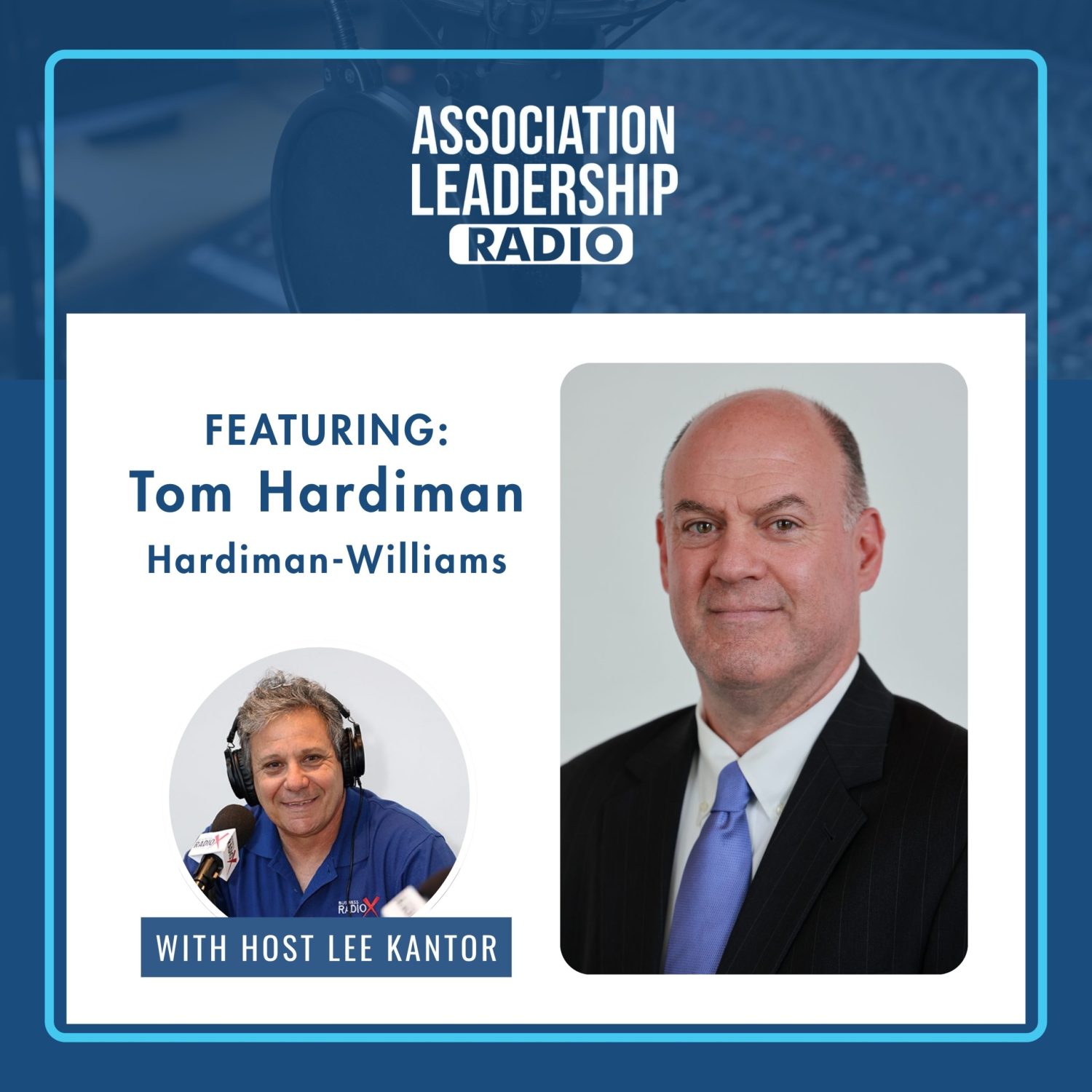

In this episode of Association Leadership Radio, Lee Kantor talks with Tom Hardiman, a partner at Hardiman-Williams, an association management company (AMC). Tom shares his journey into association management and the founding of Hardiman-Williams. The discussion highlights the benefits of partnering with an AMC, such as financial stability, operational efficiency, and talent retention. Tom emphasizes the importance of aligning incentives between AMCs and associations and shares success stories, including a dramatic turnaround of a struggling nonprofit. The episode provides valuable insights for organizations considering transitioning to an AMC model for enhanced growth and stability.
 Tom Hardiman, CAE has over 25 years of experience as a non-profit director including serving as the Executive Director of Modular Building Institute (MBI) since January 2004. During his time with MBI, Tom has seen the membership, as well as the market share for the industry, more than double. Tom also serves as the Executive Director of the Modular Home Builders Association since 2012.
Hardiman has experience advocating at the federal and multiple state levels on behalf of the industry. His background also includes banking, insurance, and small business development. He served on the board and as chair of the National Institute of Building Science’s Offsite Construction Council and has served as an advisory board member with the National Renewable Energy Lab’s (NREL) Innovation Incubator.
Hardiman earned bachelor’s and master’s degrees in Business Administration at Marshall University in Huntington, WV and the designation of Certified Association Executive from the American Society of Association Executives. He resides in central Virginia with his wife, Lesley. Tom is the father of one daughter, Grace, who is currently attending school in Japan.
Connect with Tom on LinkedIn.
What You’ll Learn in This Episode
- Operations and benefits of association management companies (AMCs)
- The backstory and establishment of Hardiman-Williams
- Trade-offs between partnering with an AMC versus internal management
- Advantages of having a dedicated management team
- Flexibility in service offerings tailored to nonprofit needs
- Managing volunteers and the complexities of state chapters
- Focus on the construction industry and advocacy work
- Transitioning from internal management to partnering with an AMC
- Common pain points leading organizations to seek AMC services
- The growing trend of associations utilizing AMCs for management
 This transcript is machine transcribed by Podsqueeze.
TRANSCRIPT
Intro: Broadcasting live from the Business RadioX studios in Atlanta, Georgia. It’s time for Association Leadership Radio. Now here’s your host.
Lee Kantor: Lee Kantor here another episode of Association Leadership Radio. And this is going to be a good one. Today on the show, we have Tom Hardiman who is a partner with Hardiman-Williams. Welcome.
Tom Hardiman: Hi, Lee. Thanks for having me.
Lee Kantor: Well, I’m excited to learn what you’re up to. Tell us a little bit about Hardiman-Williams. How you serving folks?
Tom Hardiman: Well, Hardiman-Williams is an association management company. So we’re we’re set up to manage nonprofit organizations. And we, um, we have two larger, uh, trade associations that we run out of our Charlottesville, Virginia office. And then we also have, um, unlike some other association management companies, We started our own events, uh, that we deliver turnkey. So two big clients and a series of events that we do from this office.
Lee Kantor: So what was the kind of back story? How did this come about? Did you start with one and then it just kind of naturally evolved?
Tom Hardiman: Yeah, probably like a lot of people on association management, you just kind of stumble into it. It’s not really a career path they tell you about in, uh, middle school. You just kind of like, hey, what’s this? Um, I was actually hired by the trade association called the Modular Building Institute in 2004. Um, and after about oh, eight years of, of, you know, really helping grow that organization. It’s a smaller group. Um, my number two guy, Steven Williams, which is where the Williams comes in and the and the company name, we got together and decided, you know, maybe it would be better if we formed our own company and then contracted back with the trade association and then went out and picked up some other business. And it all kind of fell into place in 2012. And that’s what we did. So we’ve we’ve been running the association management company now for um, a little over I guess about 13 years now.
Lee Kantor: Now can you share with the listeners some of the trade offs you get when you partner with an organization like yours to run the association for them, rather than them doing it internally?
Tom Hardiman: Sure. And I’ve been on both sides of it, so I’ll just speak for my experience. Um, when I was a salaried, uh, staff person for the trade association. Captive, if you will, captive staff, um, certainly still worked hard, wanted the organization to to fulfill its mission. Uh, but but at the end of the day, you could kind of, like, turn it off and go on about your business. And I didn’t really have any skin in the game. As to whether I hate to say it this way, whether they succeeded or not, my life didn’t depend on it. Other than, you know, I could move on. I could find another job. Um, and I have somewhat of an entrepreneurial spirit in me. Um, so I always wanted to really kind of. I love the industry we represent, and I wanted to really tie myself to it and say, I want it to succeed, I want my company to succeed. And we really kind of hitched our wagons together. And what it allowed us to do is, um, small trade association. I would have kind of maxed out on my salary and benefits and had to move on and move my family, and the number two guy would have eventually maxed out. There’s a lot of turnover. You just can’t afford to keep everybody. By moving to this model. We’ve been able to keep most of our team intact, but then we can we can contract with the client, but we can go pick up some revenue in other places, um, to help offset the raises and health insurance and things like that. It’s not all dependent on the one nonprofit. So it’s worked out well. Um, our, our business development guy, our sales guy has been with us 13 years. That’s practically unheard of in in. Nonprofit worlds. Uh, marketing guys been here seven years. Event planners been here ten. So we’ve been able to keep the core team together for for much longer this way than we would have had we all just worked for the association.
Lee Kantor: And it sounds like your incentives are aligned.
Tom Hardiman: Oh, absolutely. Um, if if that client doesn’t do well, my company doesn’t do well. So it’s pretty, pretty incumbent upon us to make sure the client and we’ve built them up from, uh, 250 members to now they have about 700 members internationally, the budget went from 800,000 when I took over to now it’s, you know, pushing 6 million in annual revenues. So it’s grown. We’ve put money in the bank for them. Um, the board has always been, you know, very generous to us to say, you know, you’ve helped us grow. We want to help you grow. So it’s it’s a real win win scenario.
Lee Kantor: Now, um, is everything outsourced or do they still do some things internally.
Tom Hardiman: For the for this group? We have a modular building institute and we have a similar organization called the Modular Home Builders Association. So modular construction we do everything we do the websites, events, um, all the advocacy, um, everything communications. We do it all bookkeeping.
Lee Kantor: Now is it, is that your offering to other associations or is it kind of you’ll, um, do whatever they need kind of thing.
Tom Hardiman: We can, we can we can piecemeal out anything. If somebody just wants bookkeeping or just wants a website or email communication, help us. The advocacy is a little harder. You know, if you have, um, state level lobbying needs, that’s a little difficult for us, you know, outside our home state. Um, but otherwise what we found and, you know, I’ve been involved with local, more charitable nonprofits like Boys and Girls Club there. A lot of these organizations are great at their mission, but they’re not always great at the business of nonprofits. Managing the back end, the budgets, the bylaws, the governance, the board meetings, the not so fun stuff there. Sometimes they’re not great at that. And if and if you’re out of compliance, then you can’t fulfill your mission. You know, you your nonprofit shuts down, and then what good is it so we can come in and just do the backroom stuff and let the organization, uh, fulfill their missions if that’s the desired outcome? We’re pretty flexible. Uh, partner and I basically get together and say, does this look like a good fit? Let’s let’s make a proposal. Or if not, we pass on it.
Lee Kantor: Now, how how does the kind of managing of the volunteers go?
Tom Hardiman: Um, it’s similar to any, um, any trade association. So I serve as the executive director. I’m the named director for that trade association. We have, uh, have that. That entity has committee working committees. We have chairs. We, um, we have, you know, our staff serves on some of the committees. So it’s the same. Uh, the only difference is each month, instead of them paying a salary to everyone here, they they pay us a set fee and we pay the salary. So as far as anyone outside looking in, it looks and runs the same as any, um, trade association would. It’s just structured a little differently on the business side.
Lee Kantor: Now, um, what about organizations that have chapters around the country? Do you work with those as well?
Tom Hardiman: Um, that’s a little trickier for us. We’re fortunate in the two groups we have. There are no state chapters. It’s it’s, uh, a national office, and we run it. We’ve got a staff of 15 here. Um, and we run it running a state chapter of a national organization. And it could be a little trickier, um, simply because you just, you know, we prefer kind of having the autonomy of, let’s work with the board and the volunteers and run it the way we think it should be run. And a lot of times you get constraints when you get into chapters and affiliates of other entities. Um, so not our model. It could work for others, but, um, we have not done that yet.
Lee Kantor: Now, um, it sounds like you do a lot of work in this in kind of the the business association world. Uh, are you involved, like, with chambers of commerce or medical or other?
Tom Hardiman: Um, you know, we’ve, uh, good or bad, we’ve always talked about diversifying our client base. Um, and we’ve put a few proposals out there. Um, but we seem to be in that wheelhouse of that construction, that trade association. It’s it’s what our sales guy does very well. Um, we went so far as to launch our own events called the offsite construction summits, um, which are not owned by either of the client. My partner and I own those events. So if it succeeds, we do well. And if it fails, we we take the brunt of it. So that is fairly unique for association management companies to kind of launch their own venture, if you will. Um, but we’ve we’ve kind of stayed in that construction wheelhouse. Not to say we always want to stay there, but it’s been very good for us so far.
Lee Kantor: So now in that world are you dealing with, um, like, who is the target for that?
Tom Hardiman: So in that world we have, um, modular manufacturers, companies that will make, uh, multifamily buildings or single family homes or, uh, we had a company that built an entire hospital, uh, hotels. So the member prospects are the manufacturers, architects, developers, uh, the material suppliers. Um, and like I say, the one group’s international. So we’ve got members in 25 different countries. So that’s that’s always interesting to see how, um, you know, they handle regulations and codes and challenges in different parts of the world. But, um, it’s always a learning experience and always new people to meet.
Lee Kantor: So in some of the advocacy work that you do, are you helping them navigate like right now tariffs are a big, uh, conversation. Is that something that where they can lean on your association to help.
Tom Hardiman: Yeah, that’s a fun one. We we have never had an international issue until this year when the tariffs hit. And our Canadian members are just kind of up in arms. And if you know any Canadians, they’re the nicest people in the world. They don’t get mad. Uh, they were mad. They were not happy. Like, what are you doing? What are we going to do about this? Um, so we we had to walk a pretty fine line on that one because we have a lot of us companies that are are, you know, want to build and keep things, you know, made in the USA. So we had to walk a line with that one. And generally opposed tariffs. Uh, specifically you know we have affordable housing problems. Tariffs don’t help. Um, there’s so many parts and pieces of the construction of the of the built world. That you cannot get in the US. You know the the not to get too wonky, but you know the drywall and the screws and the bolts and aluminum. You know, there’s they’re just not made here to a large degree. So we’re kind of taxing ourselves at a time when housing and construction prices are really sky high. So we’re opposed to those more commonly it’s it’s a state specific issue. Um, you know, we’ve got a member in New York that there’s a bill introduced and there’s a problem. What are we going to do? And we kind of rallied the troops around those type things.
Lee Kantor: So the internally of the United States is more of the issues that you’re kind of.
Tom Hardiman: That’s.
Lee Kantor: The bulk.
Tom Hardiman: Of it. Uh, although we’ve got a, you know, kind of a unique tax issue in British Columbia that popped up. And, you know, if you have business and industry, you’re going to have issues, uh, with with the government at some point, at some level. So it’s total job security. Government’s never going to keep their fingers out of out of anyone’s business.
Lee Kantor: And it seems to be the case now in your experience of having been on both sides of this. Um, any advice for the company that had been doing it internally and is now saying, you know what, I think that, um, we might be better served by partnering with somebody like Hardiman Williams. What does that transition look like, and what’s the easiest way to make that go well?
Tom Hardiman: Well, for for our client, it was very easy because the same staff. Right.
Lee Kantor: It was the same human beings. But if they’re going from.
Tom Hardiman: Same office, same everything.
Lee Kantor: Right.
Tom Hardiman: So it’s not always going to be right.
Lee Kantor: So in most cases it’s probably not going to be that. So how would they navigate that. And what’s the how do you know help them sell it into their board.
Tom Hardiman: Yeah I would I would say they would want to definitely look uh long term. You don’t want to make a reaction. You know, we don’t like this director. Let’s fire him. Let’s fire everybody. Let’s let’s flip this over to an AMC. Um, you know, it’s got to be very well planned out and, um, you know, reach out to us or any other AMC and say, you know, what do you think about this? Can you can we get on the phone and talk about this? There’s advantages to it. Um, what you don’t want is maybe entering it and saying we could save a bunch of money if we move everything to an AMC. Because I can tell you, AMC, the first thing they’re going to do is look at the tax return and see how much you know you’re paying your director and how much you’re paying your staff. And if if you’re trying to save money and your financials are going in the wrong direction, and AMC may not be able to just magically bail you out, um, we’ve always taken a long term approach with, with our clients, um, continuous improvement over time. You know, incremental changes eliminate waste. The whole Japanese philosophy, manufacturing philosophy. Um, and over time, it yields great results. But if you’re looking for that quick fix, maybe firing the whole staff and hiring an AMC is. Um, you know, it’s not ideal. Um, it happens, but it’s not ideal. And, I don’t know, it’s something I want to bring my whole staff in to try to put out a fire that somebody else caused. Um, particularly if it’s an industry we’re not very familiar with. A couple key points would be find an AMC that has experience, you know, with, with, with your field. That would be a good start. Um, and again, take a long term view of of what you want to accomplish. And wouldn’t AMC be the right model for you now?
Lee Kantor: Are you finding that, um, more and more associations are kind of leaning on AMC’s that that is becoming more and more the norm?
Tom Hardiman: I think the latest number I heard, and it probably came from AC, the American Society of Association Execs, um, it’s about 30% or so are managed by association management companies. Um, here in Virginia, I’m on the board of the Virginia Society of Association Executives. Um, and there’s, you know, several dozen in Virginia association management companies, some very big, some very small. Um, so, you know, once you start looking at some of the AMCs have six, eight, ten clients, then, yeah, the number of trade associations or non-profits represented is probably about a third. Again, we kind of specialize in one area and only have, you know, a couple of larger clients. But a lot of these AMCs will have, you know, ten plus trade associations that they’re managing.
Lee Kantor: Yeah. I’ll never forget the first time I went into one of their offices. And you look around and it’s like there’s the beekeeper association, there’s the like, it’s like every, you know, there’s cubicles for six different associations, like just in your line of sight and you realize that, uh, you’re not in Kansas anymore. Like, this is a different way of doing this.
Tom Hardiman: It is. But, you know, if you think about it, you can share a bookkeeper, you can share office space, right?
Lee Kantor: There’s economies of scale, especially on events and, you know, those type of things. That’s where I would imagine the savings is real.
Tom Hardiman: Oh, yeah. You know, you your event planner. And again our groups, they’re similar. So you know lesson learned in one you apply it to the other. Um, so there are definite advantages.
Lee Kantor: So um, what’s kind of the pain that a prospective, uh, client of yours is having right before they contact you? What is something that’s a symptom of. Hey, maybe it’s time to get an expert in here.
Tom Hardiman: Well, I’ve been on. I’m going to give you a different example. I was, um, on the board of a local. I mentioned the Boys and Girls Club. Um, and it’s it’s kind of that back room. That business side is like, nobody on staff really knew how to to plan a. But it’s cash flow usually. Um, we’re running short on money. We can’t pay the director and the staff. Um, nobody’s making dough or the donations. The charitable donations tightened up. People are uncertain, so they’re not giving to charities all those things and you have to come in and, um, I put myself in a just a terrible mess with one local association the director left. They were totally grant dependent and everything. The wheels just fell off the cart as soon as I stepped in and said, let me see what’s going on. And it was a nightmare. Um, but you just had to rebuild it. It’s it’s. What’s the policy? Let’s get the board together. Let’s let’s make some, you know, what’s our mission? Everything else set it aside. It’s not relevant right now.
Tom Hardiman: If we want to keep this, keep the doors open, we’ve got to make. We’ve got to focus on what’s important. And scope creep happens in every organization. Everywhere. You start off doing one thing, and then you just slowly start drifting outside of what you originally set out to do. And before you know it, you’re like, why? Why do we have so many people spending so much time on things that don’t seem important? And that’s the crux of of the matter. And you come in and say, why? You know, what are these three people doing? Yeah. You know, we had we had, uh, we needed money. So that organization hired an event planner who planned these great, elaborate, expensive events that made no money. And we paid her salary. And it’s like, okay, that’s got to stop. Just have somebody start calling people asking for donations. That would be a better use of funds in that case. But typically we find it’s financial reasons, um, cash flow problems or thinking they can save money trying something different. Um, so that’s that’s often the case.
Lee Kantor: Yeah. I can’t tell you how many other times I’ve been to a gala. And I’m like, are they making any money on this? Or is this just because they had a gala last year that we’re doing it again this year? Yeah.
Tom Hardiman: And then you can make money on some of these things. But you’re right, I’ve seen so many of them. It’s like, well, we have to do a golf tournament. Everyone else does, right. Have to do a gala. Everyone else does. And the poor vendors that are just getting beat up, you know, by every nonprofit in town.
Lee Kantor: Yeah. Well, um, if somebody wants to learn. Well, before we wrap, you mentioned, um, how the impact that that, um, your client has had since switching over. Uh, but can you kind of share that again? Because I think that’s important for people to understand that when you put your association in the hands of experts, you know, amazing things can really happen that simplify your life as running the organization and also helping more people that you’re trying to serve within the organization. So can you share, again, that kind of example of how once you became kind of your own entity and then you were able to really help the modular group, you know, get to really amazing new levels?
Tom Hardiman: Yeah, these are these are nonprofit associations, but you have to run them like a business. There’s got to be more money coming in than going out, obviously, or at some point you cannot fulfill your mission. Um, we grew it from $800,000 in revenue to almost $6 million in revenue, you know, 250 members to 700. The other group we run is the home builders group. We took them over after the housing crisis in 2008. We picked them up in 2012 when we started our when we moved to the AMC model, we picked up the residential group. They had three dues paying members, um, and $3,000 in the bank. They couldn’t pay us and we said, just give it to us. Um, if we sell a membership, that’s how we’ll we’ll pay ourselves, you know, we’ll pay ourselves commission only. Basically no other AMC is going to do that. By the way. I don’t know what we were thinking those first two, three, four years. We made almost nothing. But now we’ve had them as clients for, uh, again, 13 years, 150 members. They have a nice conference every year. They’ve got some money in the bank. Um, in fact, we, uh, we made it on the cover of Associations Now magazine for that one, because it was literally they said, we’re shutting the doors. And we said, just give it to us. We’ll we’ll build it back up. And it’s taken years. But, you know, we’ve built it into a really nice, reputable organization.
Lee Kantor: Yeah, that’s an amazing story. And it shows you a lot of times when you get that entrepreneurial spirit injected into a group, amazing things can happen.
Tom Hardiman: Yeah, I think so. Um, you try to run them like a business, but you also, you know, you’re you’re thinking of problems they’re going to have and how we’re going to mitigate the risks. And, um, just like small business owners do every day.
Lee Kantor: Right? And especially when the incentives are aligned, then everybody’s working together. It’s not like there’s a constituent that’s fighting against the other. You both have the same objective in mind.
Tom Hardiman: Absolutely. We set up our contract and our incentives to say. And the board, we, you know, we negotiate with the executive committees, and when we do well for them, we get compensated. You know, it’s it’s pretty straightforward.
Lee Kantor: Well, if somebody wants to learn more, have a more substantive conversation with you or somebody on the team, what’s the best way to connect?
Tom Hardiman: Well, our website is Hartman Williams, and there’s all the basic information there. Um, or they can shoot me an email Tom at Hartman williams.com and I’m more old school email guy so I answer all my emails. So that’s probably the best way to reach me.
Lee Kantor: Well Tom, thank you so much for sharing your story today. You’re doing such important work. We appreciate you.
Tom Hardiman: Well thank you Lee. Thanks for having me, I appreciate it.
Lee Kantor: All right. This is Lee Kantor. We’ll see you all next time on Association Leadership Radio.














