
Business RadioX ®

  • Home
  • Business RadioX ® Communities
    • Southeast
      • Alabama
        • Birmingham
      • Florida
        • Orlando
        • Pensacola
        • South Florida
        • Tampa
        • Tallahassee
      • Georgia
        • Atlanta
        • Cherokee
        • Forsyth
        • Greater Perimeter
        • Gwinnett
        • North Fulton
        • North Georgia
        • Northeast Georgia
        • Rome
        • Savannah
      • Louisiana
        • New Orleans
      • North Carolina
        • Charlotte
        • Raleigh
      • Tennessee
        • Chattanooga
        • Nashville
      • Virginia
        • Richmond
    • South Central
      • Arkansas
        • Northwest Arkansas
    • Midwest
      • Illinois
        • Chicago
      • Michigan
        • Detroit
      • Minnesota
        • Minneapolis St. Paul
      • Missouri
        • St. Louis
      • Ohio
        • Cleveland
        • Columbus
        • Dayton
    • Southwest
      • Arizona
        • Phoenix
        • Tucson
        • Valley
      • Texas
        • Austin
        • Dallas
        • Houston
    • West
      • California
        • Bay Area
        • LA
        • Pasadena
      • Colorado
        • Denver
      • Hawaii
        • Oahu
  • FAQs
  • About Us
    • Our Mission
    • Our Audience
    • Why It Works
    • What People Are Saying
    • BRX in the News
  • Resources
    • BRX Pro Tips
    • B2B Marketing: The 4Rs
    • High Velocity Selling Habits
    • Why Most B2B Media Strategies Fail
    • 9 Reasons To Sponsor A Business RadioX ® Show
  • Partner With Us
  • Veteran Business RadioX ®

Transforming Nonprofit Finances: Innovative Solutions for Sustainable Growth

January 26, 2026 by Jacob Lapera

Atlanta Business Radio
Transforming Nonprofit Finances: Innovative Solutions for Sustainable Growth
Loading
00:00 /
RSS Feed
Share
Link
Embed

Download file

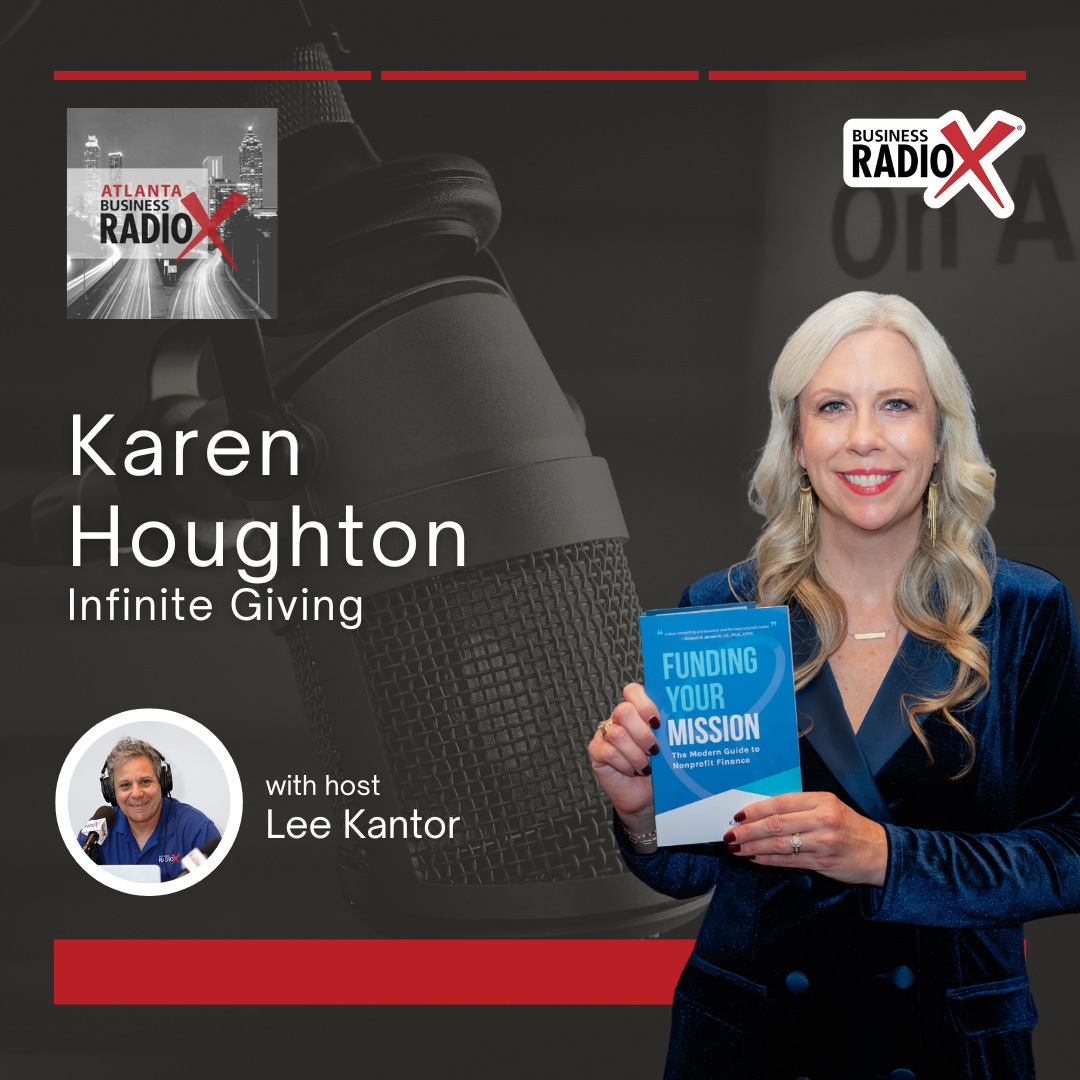
In this episode of Atlanta Business Radio, Lee Kantor interviews Karen Houghton, CEO and co-founder of Infinite Giving. Karen discusses how Infinite Giving empowers small to midsize nonprofits by providing tailored financial technology and investment advisory services, including streamlined brokerage accounts and support for accepting stock gifts. She highlights the challenges nonprofits face in accessing sophisticated financial tools and shares how Infinite Giving bridges these gaps, helping organizations achieve financial sustainability and amplify their impact. Karen also introduces her book, “Funding Your Mission,” and encourages nonprofits to leverage these resources for greater growth and stewardship.

Karen Houghton is the CEO and co-founder of Infinite Giving, a Registered Investment Advisor that helps nonprofits build financial sustainability.

With a background in both nonprofit leadership and venture capital, Karen brings a rare blend of heart and strategy to financial stewardship. She is passionate about democratizing access to wealth-building tools and guiding mission-driven organizations toward long-term financial health.

As a trusted advisor and advocate, she is reshaping how nonprofits think about money as a powerful resource for growing impact. Her work empowers tax-exempt entities to grow their assets, weather uncertainty, and fund their futures.

Connect with Karen on LinkedIn.

What You’ll Learn In This Episode

  • Challenges faced by small to midsize nonprofits in managing and investing funds.
  • Importance of financial sustainability for nonprofit organizations.
  • The gap in financial services tailored to nonprofits, particularly smaller ones.
  • The role of Infinite Giving in facilitating stock gifts and providing brokerage account services.
  • Discussion on the limitations of traditional financial institutions for nonprofits.
  • Strategies for nonprofits to manage cash and investments more effectively.
  • Introduction of the book “Funding Your Mission: The Modern Guide to Nonprofit Finance.”
  • The impact of streamlining the process for accepting stock gifts on nonprofit funding.
  • The importance of fiduciary oversight and support for nonprofit financial management.

Transcript-iconThis transcript is machine transcribed by Sonix.


TRANSCRIPT

Intro: Broadcasting live from the Business RadioX studio in Atlanta, Georgia. It’s time for Atlanta Business Radio, brought to you by Kennesaw State University’s Executive MBA program. The accelerated degree program for working professionals looking to advance their career and enhance their leadership skills. And now here’s your host.

Lee Kantor: Lee Kantor here, another episode of Atlanta Business Radio. And this is going to be a good one. But before we get started, it’s important to recognize our sponsor, CSU’s executive MBA program. Without them, we couldn’t be sharing these important stories. Today on the show, we have the CEO and co-founder of Infinite Giving, Karen Houghton, welcome.

Karen Houghton: Thank you. Good to be here, Lee.

Lee Kantor: Well, I’m excited to learn what you’re up to. I’ve been following your career for quite some time. For folks who aren’t familiar, can you share a little bit about infinite giving? How you serving folks?

Karen Houghton: Yeah, infinite Giving is a financial technology and investment advisory firm that exclusively serves nonprofits. So we are a fiduciary partner for tax exempt entities. And we are one place that can help them raise money, invest money and steward their money.

Lee Kantor: So what was kind of the genesis of the idea? How did you get involved in this line of work?

Karen Houghton: Well, I had a ten year career in the startup tech ecosystem in Atlanta as well as venture capital. I was a venture partner with Atlanta Ventures, but before that, I was actually the founder and executive director of a nonprofit. And so I’ve had the unique experience of filing for the 500 1C3 and being the fundraiser and working with boards. And then also as I grew into finance and deal size. I started serving on a lot of boards. So I’ve served on small nonprofit boards where we’re in a scarcity mindset, trying to build up our first reserve fund all the way to serving on the board of trustees at Barry College, right where we have a small $2 billion endowment. And so there’s a lot of different nonprofits out there. And our goal really is to serve the small to mid-size organizations who maybe are just with a bank or not sure what their investment strategies are or don’t even have a way to receive stock gifts. And that’s who we want to help, because we have a really passionate and firm belief that the more nonprofits that are financially sustainable, then the better our communities and and society will be. They’re often the ones doing some of the most important work at hand.

Lee Kantor: Now, do you have a niche within nonprofits? Do you focus on a certain type of nonprofit?

Karen Houghton: Yeah, We currently serve. As of today, we currently serve about 400 different nonprofit organizations all over the US, and they are in different industries. So we do a lot of national parks, schools, libraries, churches, ministries. So a bunch of different organizations. Probably what we’re defining is small to midsize is under 25 million in securities and savings.

Lee Kantor: So what is kind of the pain that they’re having where they’re like, I should contact Karen and her folks.

Karen Houghton: Well, what a lot of people don’t realize is that banks existed for more than a hundred years before the first tax exempt entity even existed. So if you’re listening to this and you are a business or retail client in the finance world here in the US, you’re like, what do you mean there’s no problems? All of this is so easy. If you are a tax exempt entity and you’ve done something like tried to open a brokerage account, or you have tried to get really good fiduciary advice from somebody who understands nonprofits, you realize it’s actually a lot harder than you think. 90% of nonprofit organizations in the US don’t even have a brokerage account. And because of that, they’re limited in how they can steward the funds they have. They can’t have endowments. They aren’t able to receive stock gifts. So it’s really quite limiting. And those major donors love to give those tax efficient gifts and those larger gifts. So what we’ve seen happen is that the big organizations stay really big. The small organizations stay really small because of the financial limitations that they face. So infinite giving is bridging that gap and trying to make it all easier and more accessible in a place made for them.

Lee Kantor: So the smaller ones are out there. They’re just getting like cash donations. That’s how they kind of mainly survive.

Karen Houghton: Yeah, and they have money sitting in a checking account sitting in a low yield savings account. If they’re wild and crazy, sometimes they are investing in a CD, right? Uh, but that is not the way that most savvy business folks or businesses actually grow, right? Most of us are in the market in some way, shape or form. Even if you have a retirement account, a 401 K, you are in the market. And the reason large non-profits and retail and business clients do that is because it works. Um, and so what’s interesting is that you take the nonprofit sector where financial stewardship is perhaps the most important. And we’re saying, actually, you only should have access to a checking and a savings account. Yes. Just leave. Leave donor money in a bank losing value to inflation because that’s responsible. So sometimes what feels safe to nonprofit leaders and donors is actually not good stewardship. We actually there’s a lot of really conservative ways where we can steward what we have as we seek. Financial sustainability as as organizations.

Lee Kantor: Now, um, for a lot of your clients, are you the first conversation they’re having about this or have they tried this before and it didn’t work out? Or are you the kind of the first person that said, okay, you’re unlocking a whole new potential area for financial stability and growth?

Karen Houghton: Huh? It does vary. Uh, we serve organizations where we’re their first brokerage account, and they’re asking questions like, can a nonprofit even invest? What are we allowed to do? Uh, there’s other, much more savvy organizations we serve, I think 46, in the Atlanta area. And they are oh, we have an investment account with our bank or someone’s brother’s uncle, uh, is investing our funds for us. And then often we’re like, great. What’s their nonprofit expertise? Where’s your investment policy statement? What fees are you paying? Uh, your funds are in a community foundation. What does that fee structure. And often just doing an audit of where are our funds? What are those returns? Why are they there? What are the fees? Um, how are we stewarding them with intention is a really helpful process that those volunteers or those, um, advisors who are helping, uh, those nonprofits may not have that expertise that’s needed.

Lee Kantor: Now, is your service like an advisory service where you’re kind of coaching them on how to do it? But are you also the place where they can, um, invest their funds?

Karen Houghton: Yes, we do both. So we are a registered investment advisor. So we do financial planning with them where we work through short term, mid term, long term strategies, whether it’s hey, do you want an FDIC sweet program so you don’t have to have six different banking partners to, you know, not go over your 250 K FDIC coverage to a brokerage money market, which is better than bank money markets typically. Right. And then we get into investment strategies where we do a lot of endowment creation, long term, uh, financial management disbursements, things like that. So yes, we’re investment advisors, but it often starts with cash. And how do we steward that cash? I actually have a book, uh, that we published called Funding Your Mission, and it’s a modern guide to nonprofit finance. You can find it on Barnes and Noble on Amazon. We’ve been a bestseller in nonprofit. Uh, but it talks through a lot of that of of hey, how do we think about moving from a scarcity mindset to a strategy mindset that ideally leads to sustainability? Or, hey, you have a checking account and you have an investment account, but isn’t there a whole bunch of funds that kind of sit in the middle right where you could have this midterm, like, hey, maybe you’re in fixed income, maybe you’re in mutual funds where you can grow cash in a conservative way. Um, and then even having, you know, the strategy and framework to use with boards and donors on, on how to move in that direction is quite helpful and often lacking in banking partners.

Lee Kantor: Now, can you share the story? Maybe early on when you had this idea and you were going to approach some non-profits? Can you share maybe that moment where somebody you know was your first client, or the first person you talked to and advised that helped them get kind of a return or an outcome that you were like, okay, this is something that that I can I’m getting traction. I have something here that’s going to help a lot of people.

Karen Houghton: Uh, sure. Like in our early, early days, uh, you know, we did a lot of customer discovery. We did over a hundred, uh, nonprofit leader interviews. Definitely made sure that we were building something with a large market. Um, the small to mid-size nonprofits, which is under 25 million, is securities, and savings is actually a $500 billion market here in the US that is incredibly underserved. Um, so we knew the market. We knew we had a lot of the data points. Um, and then once we launched, uh, I don’t think Aaron would mind me sharing this. So Aaron Hurst was the executive director of Endeavor Atlanta. And I sat down with him and he was like, yes, I understand the problem you’re solving, I experience it. I know we should be doing more with the funds we have. I know I should be receiving stock gifts. We don’t have access to any of that. There’s not an easy way to do it. Sign me up. And we had a few of those, um, just right out of the gate where it was a. Hey, we’ve got money that we want to. We want to work in steward. Uh, better. And we also want to open up those giving paths, um, to, to more of our donors. It may seem silly, but opening a brokerage account for a nonprofit, you and I individually can go online and do it in five minutes.

Karen Houghton: When you’re a nonprofit, it’s generally a 50 plus page application that requires wet ink, snail mail, and can take up to 12 weeks just to open a brokerage account. That’s why 90% of them plus don’t. And then there’s high minimums. A lot of organizations require, you know, a $2 million minimum, a half $1 million minimum. And that’s where it becomes really limiting. But we are one of the only firms that has the ability to streamline the entire painful process for a tax exempt entity. In fact, we have the only online brokerage account opening that exists for nonprofits in the country. So we take this very painful snail mail waiting 12 week process. And it’s a 30 minute appointment online and we have them up and going in three business days. Uh, and so we are trying to streamline all of that because again, we’re not serving business retail. And oh yeah, some non-profits, we were actually created to exclusively serve non-profits, which means we’re able to streamline a lot of the complex compliance requirements that non-profits have. We were made to serve them. So we solve a lot of pain points that they that exist for them in the traditional financial system.

Lee Kantor: And it sounds like the pain points are at the beginning, so that it would kind of preclude them from even starting, because it’s just too cumbersome to even attempt to begin because like, you know, whenever you have one of those situations where it’s it’s that difficult to apply. People just say, you know, they try it maybe, and then they get pushback and they’re like, why are we doing this is a distraction. There’s, you know, we should be doing other things where they’re missing out on a huge opportunity.

Karen Houghton: Right? It takes away from the mission. When something administrative becomes such a heavy lift, it becomes a burden rather than an opportunity. And it shouldn’t be that way. And even organizations who are like, okay, yes, we went through all that process ten years ago. We have a Vanguard account. Um, you know, it’s still like, great. Well, who’s rebalancing your accounts? Um, who’s suggesting no strategies? Who’s pulling your investment policy statement? Um, who’s looking at what other nonprofits are doing and helping with audit support? Oh, you receive stock gifts. Did you do the manual? You know, verbal confirmation? Did you sell it? Did you transfer the funds? Did your finance team create the receipt? It’s a very manual process, um, that we streamline all of that from receiving the gift to managing an endowment, handing the annual disbursement. So it’s more than just a strategy. There’s a whole process. Um, that’s very compliance heavy for tax exempt organizations, uh, that we really help streamline and lighten that lift, whether it’s their first time or they already have an investment strategy and they have a structure in place, but it’s still very manual. They don’t have that consistent fiduciary oversight. It’s somebody on the board who’s a volunteer. What do you do when that person rolls off the board? What do you do when you have three investment advisors on the board? You have conflict of interest. So really, the best practices for nonprofit organizations are to outsource, have an affordable, consistent fiduciary oversight that works very closely with the boards on that now.

Lee Kantor: Um, is there a story you can share regarding the once they unlocked, um, you know, people being able to donate and, uh, gift stocks that maybe they were skeptical or they were like, okay, let’s try it, but we don’t know. And then all of a sudden they got, you know, more than they had even imagined.

Karen Houghton: Absolutely. Well, the average online cash gifts like credit, debit online is $128. The average stock gift on a national level is $8,000. So these tend to be much larger gifts. Through the Infinite Giving platform, it averages closer to $14,000. And the reason these gifts are bigger, they’re less common, right? It’s anyone listening who is a donor. Right. It’s highly tax efficient to give stock gifts. Most of us hold the majority of our wealth in securities. And so you’re able to avoid paying capital gains taxes. And you get to deduct the full value of that gift. So it’s incredibly tax efficient to do so. Which is why those often tend to be larger gifts. So whether we’re streamlined, they already are doing it. And we’re streamlining a very archaic manual process. Uh, Or we’re allowing them to do it for the first time. Uh, it is a joy for us because we are seeing donors be generous. We are seeing non-profits be good stewards and do great work, and we get to be that processor and the bridge that connects those two.

Lee Kantor: So you’re seeing so sometimes you’re kind of unlocking something new and it’s dramatic, the amount of impact that’s coming to their bottom line and how many people they can serve and help and all that stuff.

Karen Houghton: Absolutely. It’s more tax efficient for the donors. It’s larger gifts for the non-profits. And then even if they’re already in that process, we are massively streamlining that experience, both for the nonprofit finance teams and the donor. So we’re increasing transparency and the administrative burden on a very traditional process.

Lee Kantor: And you mentioned that this, uh, this can you serve a variety of nonprofits so they could be a church, they could be an association. They could be any type of nonprofit.

Karen Houghton: Absolutely, yes. So any tax exempt status we can serve you.

Lee Kantor: And and that means even, um, you know, a family, um, what is it called, the family foundation or things like that? Trust foundation.

Karen Houghton: We can serve we we serve some foundations. Uh, here in Atlanta, we serve Venture Atlanta, we serve fintech Atlanta. So those would be associations. Uh, we serve a lot of charities, um, land trusts. Uh, so, yeah, a wide variety if there are multiple types of tax exempt statuses. But if you’re tax exempt, we’re able to serve you.

Lee Kantor: So if somebody wants to learn more, connect with you or somebody on the team or get a hold of that book, Funding Your Mission The Modern Guide to Nonprofit Finance. What is the website? What’s the best way to connect?

Karen Houghton: Yeah, funding your mission you can find on Amazon. That’s just a great resource to give to board members or your finance teams that is like, hey, here’s a framework that makes sense. We try to do a lot of storytelling. So for a finance book, uh, it’s pretty engaging. We got a lot of free resources in there. If you’d like to learn more, uh, we’d love to see how we can best support you. You can find us at Infinite Giving. Uh, and you can schedule a free consultation with us. Uh, you can do a 15 or 30 minute call, uh, and we can talk you through things. Uh, and, of course, you can email me directly if you’d like. Karen at infinite.

Lee Kantor: Com so what do you need more of? How can we help you?

Karen Houghton: We want to help more nonprofits. Uh, and so really, it’s sharing and spreading the word, uh, and making sure that more nonprofit organizations have efficient tools made for them who can essentially help them, you know, steward what they have with wisdom and ease.

Lee Kantor: Good stuff. Well, congratulations on all the success. Um, and, uh, thank you for everything you’re doing. You’re doing such important work, and we appreciate you.

Karen Houghton: Thank you. Lee, I appreciate it. It’s an honor. The when we look back and we see hundreds of nonprofit organizations who are becoming more financially sustainable. It is the greatest honor because these people are some of the most passionate folks doing some of the most important work, and we just get to be a small part of their journey. Uh, as they do that work.

Lee Kantor: Right. But the impact is real. I mean, the impact you’re having in the ripple effects that it’s causing. It’s just extremely, I’m sure, rewarding work.

Karen Houghton: Absolutely. I mean, to date, we’ve helped create more than $30 million in additional funding for nonprofits we serve.

Lee Kantor: Wow. Amazing story. Congratulations again.

Karen Houghton: Thank you. Lee. Appreciate it.

Lee Kantor: All right. This is Lee Kantor. We’ll see you all next time on Atlanta Business Radio.


Tagged With: Infinite Giving, Karen Houghton

Seth Radman With Infinite Giving

November 4, 2022 by Jacob Lapera

Seth Radman
Atlanta Business Radio
Seth Radman With Infinite Giving
Loading
00:00 /
RSS Feed
Share
Link
Embed

Download file

Infinite GivingSeth RadmanSeth Radman, Co-Founder & CTO of Infinite Giving.

He is an Atlanta-based tech entrepreneur and Georgia Tech alum who has started and grown multiple successful companies. He is a 4x startup founder with 2 exits, and he has built 40+ products used by more than 300 million people.

Seth was previously the Founder & CEO of Crescendo, an AI music training app used by over 1 million musicians that was acquired by Ultimate Guitar in 2019. He also built Upbeat Music App, a real-time virtual music platform acquired by MakeMusic in 2022.

Currently, he is Co-Founder & CTO at Infinite Giving, a modern investment platform for nonprofits. Seth has been featured by Apple, Forbes and TechCrunch, and he serves as a coach and advisor to startups in Atlanta and the southeast.

Connect with Seth on LinkedIn.

What You’ll Learn In This Episode

  • Fintech for nonprofits, Infinite Giving (current startup)
  • Coaching and mentoring early stage founders
  • Going through 4 startups with 2 exits
  • Prioritizing mental health as a founder

This transcript is machine transcribed by Sonix

TRANSCRIPT

Intro: [00:00:04] Broadcasting live from the Business RadioX studios in Atlanta, Georgia. It’s time for Atlanta Business Radio, brought to you by on Pay Atlanta’s new standard in payroll. Now, here’s your host.

Lee Kantor: [00:00:25] Lee Kantor here another episode of Atlanta Business Radio. And these are very favorite ones. These are the GSU ENI radio special editions and today is going to be a good one. Today we have Seth Radman and he is with Infinite Giving. He was recently a judge at the Main Street event over at the GSU football stadium. Welcome, Seth.

Seth Radman: [00:00:47] Hey, thanks for having me here.

Lee Kantor: [00:00:49] Well, I’m so excited to learn. First of all, tell us about Infinite giving. How are you serving folks?

Seth Radman: [00:00:55] Yeah, I’m happy to talk about I’m going to give it. So I’ve partnered up with Karen Houghton. She was previously the vice president at Atlanta Tech Village, and we have built a beautiful online platform that helps nonprofits invest reserve funds, create endowments and accept stock and crypto donations. So a lot of the things that they’re already doing that are kind of archaic with big banks and PDF forms, we’ve created a platform to help automate fully online.

Lee Kantor: [00:01:20] So now this is nonprofits of any size or do they have to have a certain kind of supply of money to be used in this manner for it to make sense?

Seth Radman: [00:01:31] We serve nonprofits of any size. Most of our customers so far are less than $20 million in assets under management, usually because once you’re bigger than that, typically you have your own people internally that help you manage stuff. So probably the more small to medium sized nonprofits, but we also do serve some very large ones with our crypto indoctrination tools to make things easier for them.

Lee Kantor: [00:01:51] Now what’s kind of the pain they’re having where infinite giving solves a problem for them?

Seth Radman: [00:01:56] Yeah, there’s really there’s really two big pain points. And really the the background for this is when COVID happened, we went on lockdown. A lot of nonprofits either got more emergency relief funding than they’ve ever gotten before or unfortunately, they had to shut down and close up shop because they just couldn’t meet ends meet. And so the net result is a lot of nonprofits have an excess of cash, at least if they’re still around. And so as we’ve seen in the past couple of years, just based on the way the stock market has moved and crypto and especially with inflation rate where it is, a lot of nonprofits are looking to invest their reserve funds or create endowments to create longer term sustainable growth. The challenge with that is working with big banks can be really tough for nonprofits. They don’t meet the greed index. They’re not going to grow as quickly as other for profit companies. And since they’re not for profit and tax exempt, there’s higher risk for things like money laundering. And so the risk level is just a lot higher for traditional banks, and it’s a very poor experience with high fees. So we’ve created a platform that essentially, instead of you having to work with manual PDFs on a 4 to 6 week process to open an account with another big bank, for us, it takes about just 10 minutes online.

Seth Radman: [00:03:05] So that’s that’s one way we help people with investing their funds in low risk, low cost ETFs and index funds. The other way is through alternate asset donations. You know, probably I don’t know the exact number, but it’s got to be at least 80 or 90% of the world’s wealth is held in stock, not cash. Yet nonprofits continually are primarily asking donors for cash. And so what we do is we make it a lot easier for nonprofits to donate stock to nonprofits. Sorry, for donors to donate stock to nonprofits, which is the most tax advantageous way to give right now. It’s very clunky to do that. Usually you have to fill out a PDF form, you have to sign it, you have to email it to your financial advisor. Then they do stuff. It’s a pain. Again, we’ve changed that so that it’s a two minute form online and we connect with your bank and give the instructions for you to transfer that over. So essentially helping nonprofits manage everything except for cash that they interact with, that’s the big problem that we’re trying to solve now.

Lee Kantor: [00:04:01] Is it a difficult conversation to have with leaders of nonprofits to make this kind of a change? Because it seems kind of large, at least they could perceive it as being this massive change?

Seth Radman: [00:04:13] That’s a really great question. What we’ve found so far is a lot of executive directors, a lot of executive directors and CFOs absolutely love this. It’s the product that they wish they had years ago. They can’t wait to get on board. I think the bigger challenge is typically navigating the politics within your board to get this approved, that some nonprofits require board approval to move forward with this. And usually from what we found, there’s usually one or two people on the board who have a background in finance and would think that it’d be better for them to personally manage the funds, which is a pretty big conflict of interest. So I think just navigating the politics around that is a big deal. But honestly, the problem is so big for a lot of these nonprofit leaders. It’s causing them such a headache to be missing out with inflation the way it is and to have to call a traditional wealth advisor every time they want to know their balance or get a giant stack of PDF reports just to see how they’re doing that they want in. I think it’s a matter of using the right tactics to persuade the rest of the leadership in the organization that it’s the right move for them.

Lee Kantor: [00:05:12] Now, in your free time, when you’re not leading this organization, you invest a lot of time mentoring and serving the startup ecosystem. Can you talk a little bit about maybe some of the less? Since you’ve learned through going through so many startups, including infinite giving and how you kind of relate that to what a startup founder maybe who is going through it for the first time.

Seth Radman: [00:05:36] Yeah, I’m glad you brought that up. I really enjoy mentoring and coaching other founders. I had a lot of fantastic mentors for me and I went through the Critics program at Georgia Tech, which was fantastic. Now I’m a coach for that program as well as an advisor for some startups at Georgia State and others across the Southeast. I think the probably biggest lesson, that biggest piece of advice that I really try to drill into a lot of the founders I work with is just spend more time with your customer. A lot of founders jump straight into building the product because that’s the fun, exciting thing to do. And and I get it. I’m a software engineer myself. I really like to build. It’s fun to hunker yourself down and build, build, build. But the reality is a lot of people are building things that unfortunately no one wants. And so it’s really important to be talking to your customer a lot more than you’d expect. And that’s one of the biggest failures that I’ve had. I’ve I’ve built over 40 iPhone apps and probably only three or four of them have had more than a thousand downloads because I built what I thought were cool ideas without actually talking to customers and making sure that it was solving a real problem for them.

Lee Kantor: [00:06:37] Now, as that relates to infinite giving, was this something that when you and Karen and your team were kind of brainstorming, you’re like, Oh, this is a no brainer. They’re going to just, you know, compounding down the door. This solves it’s so obvious. And then when you got into the weeds of this and you realize there’s always that one kind of rogue person that doesn’t want to give up control or has their own agenda. And it’s a little trickier navigating those politics than maybe how you pictured it on the whiteboard.

Seth Radman: [00:07:07] Yeah, it’s definitely we’ve definitely had some curveballs and things have been different than how we expected. Karen, my co-founder and our CEO, she used to run a nonprofit. She has that background. She really understands what it’s like to get burnt out in this endless fundraising cycle. And so I think our mission of helping nonprofits has stayed the same. How we do that has shifted a little bit. I don’t think it’s difficult to anticipate what the market’s going to do with the market being all over the place where it is right now. Some folks are more hesitant to investing, even though that arguably could be one of the best times while prices are low. So we’ve we’ve shifted a little bit towards some of our asset giving tools, helping with stock donation and endowments. But no doubt we did not know things right off the bat. But there is one thing we did that I highly recommend for a lot of entrepreneurs, which is before we wrote a single line of code, we did 100 customer interviews, we talked with 100 nonprofit leaders and we tried to understand, Hey, how are you currently managing your funds? What are you doing for stock donations, crypto donations? And we heard the same thing from a lot of them, which is, Oh man, we we know we should be investing. We just haven’t gotten around to it because we’re not quite sure where to start. We’re not quite sure how to even go about crypto donations, but we know we should be because all the research says that the average crypto donation size is much bigger than cash or stock. So we definitely validated the problem talking to a lot of customers. But once we built the product, it’s an experiment. There’s a lot of unknown variables that come into play and we’ve definitely had to pivot and adjust as we get feedback from our customers.

Lee Kantor: [00:08:37] Now, how do you take that information and and then relate it to pricing? How do you know? You know, you interview these hundred people who are probably in some way or another, an ideal prospect, some of them at least. How do you know? Hey, that’s worth a dollar, that’s worth $100. That’s worth, you know, $1,000,000. How do you kind of know the sweet spot or kind of can project somewhat of a sweet spot of pricing so you can begin offering it to the market?

Seth Radman: [00:09:06] Pricing is one of those things that is is really tough. I think there’s really only one way to truly do pricing right, which is to test it, right. You have to test lots of different pricing with lots of different customers for us for good or for bad, because we’re in a regulated industry and as an investment advisor, there are certain things that we have to engrave into our product a little more rigidly than you would with a more dynamic pricing model for other products. So for us, for our advisory services, we have a fixed fee based on your balance for assets under management that we’re registered with CC and we have to stick to that. We do have a SAS product that is a monthly fee that frankly we’ve just experimented with with different price points and we want to call with the prospect we’re going through everything, they’re sold on the product and then we get to the end when we’re talking about the fee and the cost and we’re looking at their emotional reaction, we’re looking at our close rates, we’re looking at the emails that we get after these calls to see if they want to move forward or if they don’t and what their pricing threshold is. But most of the time, frankly, what we do is we ask them, hey, what’s your budget for a technology like this to improve sustainability and increase your donations? I think for consumer products, it’s maybe a little bit of a taboo subject to say, hey, how much would you pay for this? You know, humans will tell you what they think they’d pay, but you really don’t know for sure until they convert. But for organizations, it’s usually a little more cut and dry. Not always, but a little more. Where there’s typically a budget specifically for things like this. And if you ask people, at least that’s a good starting point. But from my experience, the only way to truly know pricing is to start with your what you think is your best gut at first and experiment. Do split tests and see what the data shows.

Lee Kantor: [00:10:47] Now, in your experience going through several start ups, several exits, can you talk about kind of and maybe this is a bit of a taboo subject, maybe not so much today, but definitely, probably when you started, it was the kind of the mental health of a founder. You know, at one point there was just, you know, you’re living 24 seven and you’re proud of 24 or seven, 30, 65, Hustle, hustle, hustle. And today that seems to be a little less at least overt. At least.

Seth Radman: [00:11:18] Yeah. I’m so glad you brought this up because it’s not talked about enough. I was one of those people with my first couple of startups, my first app company, Plutonium Apps, and my my next startup Crescendo. I was one of those people working 14 to 16 hours a day, seven days a week. And the truth is that can only last you so long, right? You have to neglect so many other aspects of your life, your physical health, yours, your relationships with other people, eating, sleeping. You know, these are all things that you should be doing during the day. And I went through a period of time where I just was I kind of lost myself to the grind, just working as much as I could every day to move things forward. And it broke me where I essentially I had to take about a month off and I almost quit just because I was falling apart. And now I’m definitely one of those people who is in it for the long run that I’m trying to build not only sustainable business but also a sustainable lifestyle and a sustainable schedule for myself to be able to pursue this because I don’t want to be doing this just for another year or two.

Seth Radman: [00:12:19] I’d like I’d like to be doing this ideally for decades, the building products that people love. And so yeah, now my schedule is, is much better that I rarely work more than 8 hours a day. Sometimes it’s even less than that. If I’ve a time block where I have very focused and I’ve found that if I’m really dedicating a couple of hours to doing one thing with no distractions, no notifications, no email, no slack, that I can get a lot done in a short period of time. So I’ve I’ve really started focusing more on doing less, but making sure that I’m doing the important things and I’m doing them better, and also having the right balance of my day to spend time with my wife, with my cat, to be getting exercise and going rock climbing or playing saxophone and having some balance so that I can take breaks as needed and be able to sustain this for a longer period of time.

Lee Kantor: [00:13:04] Now, do you have any tips or advice for the listener regarding prioritizing? Because that’s at the heart of this. You have to have a true north. You have to have an idea of what is that most important thing, not the most urgent thing, but the most important thing. How do you kind of how did you solve that riddle?

Seth Radman: [00:13:25] Yeah, that’s a that’s a tough one. You really have to think about what’s most important in life. And then also with your business, what’s going to move things forward. And so for me, I mean, people, friends, family are at the top of everything that it really doesn’t matter what’s going on in my business. If something comes up with a really close friend or family member, I’m going to drop everything and they’re going to come first. But in terms of the business, there’s an exercise that I like to do that I think it’s something Warren Buffett or some other successful person did that I’ve copied and really enjoyed. You know, we all have to do lists and we probably have a ton of things on these To-Do lists. One thing that I like to do is I’ll create the top ten things on my mind that I really want to get done today. And then I’ll cross out. What I think are the five least important things. So there’s only five remaining and then I’ll cross out two more. So there’s only three, and then I’ll circle one item. What I believe is the most important thing. The key thing is not only to focus on doing that one most important thing, but to explicitly not do any of the other things on that list. There are so many distractions, so many easy wins that I can check off that list. I really try to structure each day by focusing on what is the single one most important thing that I can do to move my business forward. And usually there’s multiple things, but man, having that kind of laser like focus is really difficult. It takes a lot of discipline because there’s so many other shiny, catchy things that sometimes could be more fun or more exciting. But I really found that being consistent with the daily sometimes mundane tasks like sending code emails that move your business forward, that’s that’s really the key to making progress.

Lee Kantor: [00:15:01] Now, you recently were a judge at the Main Street event for GSU. Can you talk about your experience there and the caliber of founder that is coming out of that program?

Seth Radman: [00:15:12] Man the advantage issue is fantastic. The founders were so well-prepared, the pitches were fantastic. As a judge, we I really struggled to evaluate who I thought should be first, second and third place because they were all so fantastic. I think we’re seeing incredible ideas coming out of universities with with college students that are just very creative and have a lot of ambition and a lot of persistence to move forward with things that they’re passionate about. So the startups that I think are fantastic, I think there’s an important thing to note, which is, you know, just statistically, from what I’ve seen from these university accelerator programs, I don’t think we expect that all of them are going to continue working on their startup a few years from now. Some are going to decide to move on to other ideas. Some of them will fail, some of them will succeed. But I really have no doubt that the experience of building their company, going out to get customers, building the product, pitching in front of an audience, learning how to present yourself regardless of the path that these young founders take. I think it’s going to be an incredible skill set that will help them if they’re at a bigger company, leading innovation or leading change from within. If they do decide to do their own thing and are working on a smaller team or startup or really whatever path, whatever path they take, I, I know for me, entrepreneurship has really been personal development disguised as professional development that obviously I’m working to build a business, working to get customers. But I think by doing startups I’ve learned more about myself and how I can grow as a person. And I’m I have no doubt that the founders at GSA will be doing that too, because they were just off the chart in terms of talent, probably one of the most impressive university accelerator pitches that I’ve seen in quite a long time.

Lee Kantor: [00:16:54] And I love the fact that it’s not it’s not just tech only. It’s everything’s probably tech enabled, but tech’s part of it, obviously. But it’s not just kind of the same software app startups that you see in other events.

Seth Radman: [00:17:12] Yeah, I mean, I think nowadays people think every startup has to be a SAS mobile app or web app that can scale to be $1,000,000,000 company. But man, there’s a lot of great service businesses or great lifestyle businesses that will never get beyond a million, 5 million, 10 million or even 100,000 in revenue, but can be fantastic businesses. So I think it’s important not to fit all startups into one bucket of being the typical SAS or tech product that’s going to scale and grow quickly. There’s a lot of great service businesses out there and tech enabled services that do a lot of good and are quite fulfilling and adventurous for the founders that run them right.

Lee Kantor: [00:17:50] And as you mentioned, that those skills are transferable no matter what you decide to do for the rest of your life.

Seth Radman: [00:17:56] Absolutely. And I’ve seen this a lot through Crate X, through GSU. There’s a lot of founders who decide that either the startup lifestyle isn’t for them or they’re not in love with the startup they do. And what do they do next? They go to lead in strong leadership positions at other companies. They go into another startup. They go and find a different career path. That is exciting. But I have yet to find a founder who says the trajectory of their life wasn’t changed through building a startup because it just opens up this whole new path of opportunity and growth in such a short period of time that I haven’t really found in lots of other places.

Lee Kantor: [00:18:30] Well, so thank you so much for sharing your story today. If folks want to want to learn more about Internet giving, what is the website there?

Seth Radman: [00:18:38] Yeah, you can find us at Infinite Giving dotcom or you can hit me up on LinkedIn. Send me a message. We’ll be happy to chat.

Lee Kantor: [00:18:45] And if you go to just a LinkedIn. Seth Radman Radman. They can find you on LinkedIn.

Seth Radman: [00:18:52] Yep, you’ll find me with the saxophone next to my name.

Lee Kantor: [00:18:54] Good stuff. Well, thank you again for sharing your story. You’re doing such important work for the community, for your company, and for those kids out there that you’re inspiring to pursue Entrepreneurship. I think it’s super important. And we appreciate you.

Seth Radman: [00:19:10] Well, thank you so much. I appreciate the opportunity to come on here and chat and share a little more of my story.

Lee Kantor: [00:19:14] All right. This is Lee Kantor. We’ll see y’all next time on Atlanta Business Radios, GSU, any radio show.

About Our Sponsor

OnPay’sOnPay-Dots payroll services and HR software give you more time to focus on what’s most important. Rated “Excellent” by PC Magazine, we make it easy to pay employees fast, we automate all payroll taxes, and we even keep all your HR and benefits organized and compliant.

Our award-winning customer service includes an accuracy guarantee, deep integrations with popular accounting software, and we’ll even enter all your employee information for you — whether you have five employees or 500. Take a closer look to see all the ways we can save you time and money in the back office.

Follow OnPay on LinkedIn, Facebook, and Twitter

Tagged With: Infinite Giving, Seth Radman

Business RadioX ® Network


Our Most Recent Episode

CONNECT WITH US

  • Email
  • Facebook
  • LinkedIn
  • Twitter
  • YouTube

Our Mission

We help local business leaders get the word out about the important work they’re doing to serve their market, their community, and their profession.

We support and celebrate business by sharing positive business stories that traditional media ignores. Some media leans left. Some media leans right. We lean business.

Sponsor a Show

Build Relationships and Grow Your Business. Click here for more details.

Partner With Us

Discover More Here

Terms and Conditions
Privacy Policy

Connect with us

Want to keep up with the latest in pro-business news across the network? Follow us on social media for the latest stories!
  • Email
  • Facebook
  • Google+
  • LinkedIn
  • Twitter
  • YouTube

Business RadioX® Headquarters
1000 Abernathy Rd. NE
Building 400, Suite L-10
Sandy Springs, GA 30328

© 2026 Business RadioX ® · Rainmaker Platform

BRXStudioCoversLA

Wait! Don’t Miss an Episode of LA Business Radio

BRXStudioCoversDENVER

Wait! Don’t Miss an Episode of Denver Business Radio

BRXStudioCoversPENSACOLA

Wait! Don’t Miss an Episode of Pensacola Business Radio

BRXStudioCoversBIRMINGHAM

Wait! Don’t Miss an Episode of Birmingham Business Radio

BRXStudioCoversTALLAHASSEE

Wait! Don’t Miss an Episode of Tallahassee Business Radio

BRXStudioCoversRALEIGH

Wait! Don’t Miss an Episode of Raleigh Business Radio

BRXStudioCoversRICHMONDNoWhite

Wait! Don’t Miss an Episode of Richmond Business Radio

BRXStudioCoversNASHVILLENoWhite

Wait! Don’t Miss an Episode of Nashville Business Radio

BRXStudioCoversDETROIT

Wait! Don’t Miss an Episode of Detroit Business Radio

BRXStudioCoversSTLOUIS

Wait! Don’t Miss an Episode of St. Louis Business Radio

BRXStudioCoversCOLUMBUS-small

Wait! Don’t Miss an Episode of Columbus Business Radio

Coachthecoach-08-08

Wait! Don’t Miss an Episode of Coach the Coach

BRXStudioCoversBAYAREA

Wait! Don’t Miss an Episode of Bay Area Business Radio

BRXStudioCoversCHICAGO

Wait! Don’t Miss an Episode of Chicago Business Radio

Wait! Don’t Miss an Episode of Atlanta Business Radio