
 Kevin Eikenberry is the Chief Potential Officer of The Kevin Eikenberry Group – a leadership and learning company based in Indianapolis, IN with a team across the United States.
He has spent over 30 years helping organizations and leaders from at least 53 countries become more effective. Global Gurus has listed him on the list of most influential thinkers on leadership for the last four years. His blog and podcast are among the most popular on leadership.
Remarkable Leadership, From Bud to Boss, and The Long-Distance Leader, The Long-Distance Teammate, The Long-Distance Team, are among the books he has authored or co-authored.
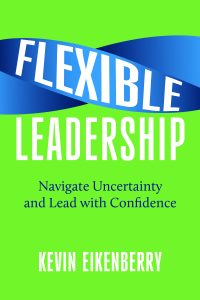
He believes his new book Flexible Leadership: Navigate Uncertainty and Lead with Confidence, is his best and most important work yet.
Connect with Kevin on LinkedIn, Facebook, and Twitter.
What You’ll Learn In This Episode
- Flexibility as a Leadership Skill: Why adaptability is essential for today’s leaders and how to develop it.
- The Power of Adaptability: How leaders can cultivate a flexible mindset to thrive in uncertainty.
- Leadership Mindset Shifts: Overcoming traditional leadership barriers to embrace a more adaptable approach.
- Moving Beyond Style: How leadership styles, and strengths can keep leaders from being as effective as they want and need to be.
- Adapting to Change: How leaders can shift their strategies to remain effective amidst uncertainty.
 This transcript is machine transcribed by Sonix.
TRANSCRIPT
Intro: Broadcasting live from the Business RadioX studios in Atlanta, Georgia. It’s time for High Velocity Radio.
Lee Kantor: Lee Kantor here. Another episode of High Velocity Radio, and this is going to be a good one. Today on the show, we have Kevin Eikenberry, who is the chief potential officer with The Kevin Eikenberry Group. Welcome.
Kevin Eikenberry: Thanks for thanks for having me. Lee.
Lee Kantor: I am excited to learn what you’re up to. Tell us about the Eikenberry Group. How are you serving folks?
Kevin Eikenberry: Well, we’re in the business of helping leaders get better so the world can be a better place. Because you know what, Lee? Nothing positive happens in the world without someone leading. And so leadership is a high leverage sort of activity. And that’s what we spend our time doing, is helping leaders and their teams get more effective so they can get better results.
Lee Kantor: So what’s your back story? How did you get involved in this line of work?
Kevin Eikenberry: Well, I was born. Oh, you don’t want to go back that far. So I have been doing this kind of work for a long time. I started the company almost 32 years ago, and prior to that I worked in corporate America. And really our business started in that all around learning in general. And we very, very quickly moved into focusing on helping leaders learn again from that leverage perspective that we talked about. So the back story is working in corporate America involved before I left, after doing sales and marketing roles, getting involved in sort of adult learning stuff, corporate learning inside of a large fortune ten company and then left to start the company. That’s now the Kevin Eichenberger.
Lee Kantor: Now before that, as I understand, you grew up on a farm. How had how did that impact kind of your view on the world?
Kevin Eikenberry: It it absolutely is true. And it did impact my view of the world. I think it has a lot to do with my work ethic. It has a lot to do with because we had a farm and other farm related businesses about thinking about what what customers really mean and how do we take care of customers. So I think it helped me in a lot of those kinds of ways. And, you know, I went to Purdue and studied agriculture and people said, how do you end up doing what you’re doing now? Well, I went to school to learn about growing things, mechanical systems and biological systems, and now we deal with human systems. So it’s still about systems. It’s about thinking in the big picture and then helping to create the learning that’s required so that those important things we want to have happen can actually happen.
Lee Kantor: And then you have a new book out, Flexible Leadership, Navigate uncertainty and Lead with confidence. What what kind of drew you to the concept of flexible leadership?
Kevin Eikenberry: Well, I’ve been as I said, I’ve been in this business doing this kind of work, written a bunch of books over the years. And and to me, this is the, the time. What’s different about our world today is things are more uncertain and complex than ever. And so if we think that we can lead the way we did five years ago and get as good of results as we did five years ago. That’s not a very good bet. In fact, I don’t think we can get as good a results because the world is changing and if we’re not changing with it, we can’t get the results we need. Now, I’m not talking about changing everything. A whole lot about leadership. Lee hasn’t changed at all. But the stuff that has changed matters a lot. And mostly this comes down to changing how we lead, not the what of leadership. Not the principles, not the not our values. I’m not talking about changing those things. Those things are rooted like a tree, but just like a tree. It has to bend and flex in the breeze. We have to be able to approach things in new ways. When we see the context is changing and that’s what the world is, is changing. So what do we need to do to adapt to those changes, to get to get the results we really want?
Lee Kantor: So now how do you recommend to your clients? Um, how to know what change is real? What change is fleeting? What changes? Is foundational.
Kevin Eikenberry: Yeah, that’s a really good question. And I think the first thing we have to recognize is let’s just talk about the word change for a second. So when when organizations talk about making organizational change or changes happening, what we end up doing is acting as if everything is changing. When the reality is everything is not changing. Much of about what’s going on in our business and about our work processes aren’t changing. But if we only focus on the change and we don’t have the context of what’s not changing, then we overreact, right? So we have to keep that in mind. And that will actually help us lead the changes that are happening. If we can get people to be clear on here’s what’s the same and here’s what’s new. That’s the first piece. And the second thing is to look at the change from the context of where it’s taking us. Right. So we talk about, uh, a context map or a framework that helps us see the situations that we’re in to help us decide how we might need to flex. And so five years ago, ten years ago, 15 years ago, a whole lot of our work, the work of of organizations, the work of leaders was in what we would call the clear context. We knew that we knew the cause and effects. We could apply best practices we could build, process processes that allowed us to continually and repeatedly get the same result every time, which was awesome, because we had an awful lot of things that we knew about. And as long as we applied based on what we knew, we’d be in good shape. But there are far fewer things that we know have all the information about anymore, right? With with globalization, with further specialization, with new technologies, with new ways of work, because of pandemic. All of those things create more unknowns. Um, and in fact, oftentimes we don’t even know all the things that we don’t know. And so once we can recognize that, that’s the context that we’re in. We can start to recognize that we need we need to lead differently in those moments.
Lee Kantor: But then how, as a leader, do you lead in the moments where there is so much chaos and so much uncertainty? Or how do you know where where the true north is if it seems like it’s always moving?
Kevin Eikenberry: So the first thing is the true north should still be what? Excuse me? What the goals and purpose of our organization is. So we have to keep that in focus and then say, what do we need? What do we need to do or try now? And I think the word the word try becomes really important. Because what. Excuse me again. So if you look back over the last few years, what organizations wanted to do after we came out of a pandemic was do what they’ve always done, which was create a new policy, which would be the new way we would do work. And we can now look back over the last 2 or 3 years and see that those policies that people implemented didn’t work very well because they were operating as if they now had all of the all the Intel they had all the insight, and they knew everything. When we don’t. So when we’re in a situation where we’re sure that we don’t know everything, we need to not try to set policy, but rather pilot things, try stuff, take small risks, do small experiments and experiment doesn’t mean try something. Just we’re going to try this and then we’re going to roll everybody else into that in six weeks.
Kevin Eikenberry: Try this, try this, try this. We’re thinking about an organizationally. We got to try multiple things so we can start to see what we learn from those experiments to help us make better decisions, because we start to get more information as we do that. And that’s not typically the way we’ve led in the past. We’ve tried to come up with a new way, and now this is where we’re headed. And and that’s getting us the kind of results we’ve gotten in the past, which think about it this way. Oftentimes people will say, Lee. Uh, man, if I know now if I had known six months ago what I know now, I’d have done something differently. And every time that we see that happening to us, that was a time that we should have done more testing and trying rather than just taking a single action six months ago. So the better we become at recognizing that we don’t have all the answers, the better chance we have to adjust the way we would lead compared to what is our natural or learned response.
Lee Kantor: Now, how do you help companies that may, like you described historically, might have experimented on a whiteboard and, you know, spent months and months of planning and then implementing whatever that brilliant idea was, and then tell everybody to fall in line to this more nimble, um, experimentation way to innovate and grow. That requires that’s going to have more failures and learnings, uh, rather than, you know, a big success or in some cases might have been a big failure. How do you kind of get that cultural shift? Because in order to have a culture that embraces experimentation, there is going to be people who are going to try things that aren’t going to work. And in a lot of organizations, especially large ones, they’re not very, um, they’re not usually holding up the people who, uh, who created a bunch of failed experiments. Those are the people who usually get fired.
Kevin Eikenberry: I think I think you’re right. So I think there’s a couple of things. First of all, that’s a really astute point that that in many organizations we can talk people talk about we want people learning, but they don’t really want them to make mistakes. Right?
Lee Kantor: You can learn all you want as long as it works, if it doesn’t work.
Kevin Eikenberry: And yet we all know individually that’s not how learning really works, right? So I would say a couple of things. So if you’re listening to me and you’re a CEO, then you have a chance to start to change that culture. But most people who are listening are probably somewhere in the middle of the organization. Maybe you’re a frontline leader. Maybe you’re a leader of leaders somewhere in the middle. And I would say the best thing you can do is to start trying this in small ways. And I mean, the way you described it, Lee, is the way people often think about it. Like, we’re going to try this on a big scale. I’m saying try it on small stuff. I’m saying just try stuff in little ways. Start getting people to work on that adaptation muscle, if you will, and and don’t make it on things that are sort of career limiting if we fail at first because as people get used to having the psychological safety to try stuff, uh, then there’ll be they’ll get better at the trying, we’ll get better at the learning. And the other piece is when we’ve only done one thing, and then if it fails, it’s a problem. It’s just it’s a big deal. But if we’re if we’re trying to fail forward rapidly, then the steps are smaller. The mistakes are smaller, and we we move on to the next one quicker. So, uh, in every one of those cases, it helps make it a bit safer. In the big picture, if all we’re talking about is big things, big tests, uh, that are highly visible, those are going to be more risky if we’re in the middle of the organization. But there’s lots of smaller things we can be trying just to see. And if we’ll do that, we got a better we have a better chance of success. We do, though, as leaders, to your point, need to recognize that we’re now asking people to do stuff that might not be what they’re used to or initially comfortable with.
Lee Kantor: So how do you build the culture that allows, you know, failed experiments to exist and still get a high five and still keep their job like it? To me, there’s a trust gap in the sense that a lot of times leaders tell people to take chances and to do experiments, but when it comes to the actual it not working. You know, that’s not like, oh, that was a good learning. You’re promoted. That’s usually not the case. It’s like, wow, that person doesn’t have a lot of good ideas. Why are they on the team?
Kevin Eikenberry: Yeah, it’s easy to say that I want that. And then it’s also then easy to blame people when they’re the one. They’re the ones that make the mistake. Right? So what I would say to leaders in A is as kind and yet as direct a way as I can, is that you need to go first. Being a leader means going first, which means don’t just start asking other people to try stuff. Try stuff yourself. Uh, and when we do that, we’re sending a different message, and we make. And when we’re the ones that have done the testing or we’ve tried something different, which fundamentally is what I’m suggesting, if we’re going to be flexible as a leader, we’re going to do it differently. You know, in a conversation, in a coaching moment, um, in a decision that we make, we might do it differently than we’ve done it before. If we’re willing to try things, adapt ourselves, we start to set the tone for others. Um, if you as a leader are listening and say this all sounds really good as long as they do it right. Uh, then you’re running all the risks that Lee’s talking about.
Lee Kantor: So when you’re working with your clients, do you have kind of a sweet spot in the type of firms you work with? Um, are they small? Are they large? Are they. You mentioned working for the largest of the large enterprises. Is that kind of where you spend your time? What’s the ideal client fit for you?
Kevin Eikenberry: So, uh, we’ve worked with with people, you know, in doing this for over 30 years, we’ve worked with just about every kind of industry you can imagine. But typically we are best suited because of the size of our organization to work with organizations or decision units of 10,000 employees or less. So we obviously work with some very large organizations, but but often that’s with a division with a. Region or something where they have decision making power and it’s not 50 or 70 or 100,000 employees, but it’s ten, five, eight, 10,000 employees that they have some buying power around. And so organizations really in the 2 to 10,000 employee range or decision makers in that 2 to 10,000 employee range is probably where we’re best suited and have had most success.
Lee Kantor: And industry agnostic, like it could be a service company, it could be a manufacturer. Doesn’t matter.
Kevin Eikenberry: Yeah pretty much we’ve we’ve had the chance to work across a lot of industries over the years. And you know, at the end of the day, everyone wants to ask, Lee, have you worked with people in our industry? Have you done this? Have you done that? And the answer is whether it’s yes or no. The reality is what they’re trying to find out is can you help our situation. And the situations are way more the same than different, right. Um, and so we have had a chance to work with folks in lots of different industries, both manufacturing, service and pretty much name it over the years.
Lee Kantor: So what’s the pain that your customer or prospective customer is having the day before they call you? What is frustrating them where they’re like, I got to get Kevin and his team in here.
Kevin Eikenberry: Well, it could be one of three things. It could be that they’re having trouble developing the leaders that they need for the future. So that could look like succession planning leadership pipeline. It could be that they’re that the leaders are the fact that their leaders aren’t as effective as they could be is causing retention or turnover problems. Those are probably the two biggest ones. And then the third one is just organizations that recognize that if we’re going to be more successful, we know that the the, the leaders are what will help us get there and are willing to invest in them, sort of, regardless of any other specific situation.
Lee Kantor: Now, do you have any advice for folks that maybe have grown up leading teams that were all in the office altogether human to human? I bump into people at the water cooler and now they’re dealing with more remote work. Maybe it’s global. Maybe it’s they’re just not seeing their people in person as much as they used to. Any advice for that type of a leader?
Kevin Eikenberry: Yeah. Well, um, before the pandemic happened, I co-wrote a book called the Long-Distance leader, and I’ve been leading a virtual, almost entirely remote team for about 15 years. And so I would say about three things. Number one is, as leaders of teams who are remote, virtual, hybrid, whatever way you want to say that, number one is you have to be more intentional about everything because you’re not going to see people a lot of water cooler. You have to make sure that you’re making time to interact with folks along the way. That’s the first thing. You have to be more intentional. Number two is you have to think differently about the way you communicate. We have so many different ways, mediums with which we can communicate, and we need to make sure that we’re using the right communication tools for the right times. And that includes don’t forget the phone and remember the webcam, because that’s the next best thing to being there in person. And then the third thing I would say is that we have to acknowledge that not everyone’s experience about where they’re working and when they’re working is the same. How they’re experiencing it may be different than us. We need to make sure that we’re connecting with our folks well enough to know how they’re doing, so that we can help them succeed moving forward.
Lee Kantor: What about advice to the young person who, um, hasn’t learned what it’s like to be in close proximity with their boss? How should they? What should they be doing in order to be promoted, to kind of get the most out of their experience in this new job? That might be remote?
Kevin Eikenberry: Yeah. You know, it’s really interesting. The first part of what you said is we have we have a we have a group of folks who came into the workplace and never went to the office. Right. And so now maybe they still haven’t, or now their challenge is I’m now in the office. What do I do? But whether that’s the situation or they are remote. Either way, we would suggest that you think about how do I become more visible, but do that in an ethical way. You don’t want to be the person that is just trying to be seen, but rather what you want to do is be seen in ways that’s that’s in alignment with the culture of your organization. But it’s also seen as not being just for you personally, but for the good and benefit, and with the intention of helping the entire team. If you’re doing those kinds of things, if you’re willing to volunteer not just to be seen, but because you want to add value, if you are willing to offer the chance to mentor others that are coming into the organization or whatever those things might be, as long as folks see you as doing it with good intention and see you as getting your core work done, as well as the things that help you be seen as adding additional value. You’ll be in good shape.
Lee Kantor: So if somebody wants to learn more, where should they go? Is there a website? What’s the best way to connect with you and learn more about your books and your practice?
Kevin Eikenberry: Yeah, if you go to the you want to learn more about US organization, just go to Kevin eikenberry.com. That’s Kevin e I k e n b e r r y.com. If you want to learn more about the book, just put a slash flexible. After that that’ll point you to everything related to the book. Flexible leadership including getting you a sample chapter. And in terms of me personally, along with those locations, you can also just connect with me on LinkedIn. I’d love to have you do that.
Lee Kantor: Well, Kevin, thank you so much for sharing your story today. You’re doing important work and we appreciate you.
Kevin Eikenberry: Thanks so much.
Lee Kantor: All right. This is Lee Kantor. We’ll see you all next time on High Velocity Radio.














