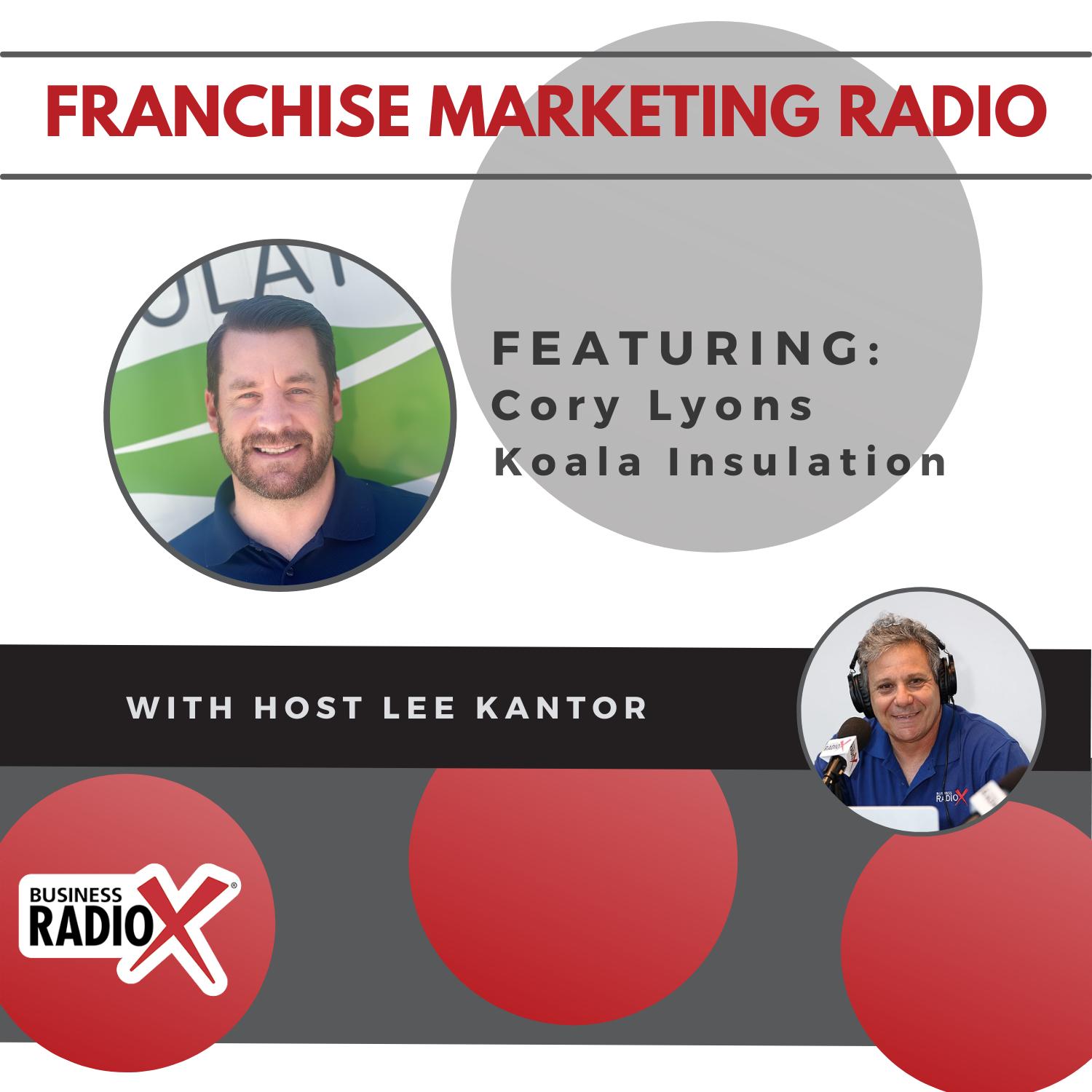

In this episode of Franchise Marketing Radio, Lee Kantor interviews Cory Lyons, Brand President of Koala Insulation. Cory discusses the company’s rapid growth since its 2020 launch, its dual B2C and B2B business model, and the importance of a franchisee-first culture. He shares insights on supporting franchisees, adapting to market changes, and the qualities they seek in new owners. Cory also highlights Koala’s shift toward multi-unit franchisees and outlines future plans for expanding services and maturing the brand, emphasizing collaboration and communication as keys to their ongoing success.
 Cory Lyons, Brand President of Koala Insulation, has been in franchising for over 20 years, focusing on supporting franchisees and leading both teams and brands.
Having a franchisee first mentality, this lines up with championing the success of our franchisees.
Holding leadership positions in fitness, wellness, restaurants and home services, Cory is a very well rounded leader in franchising.
Follow Koala Insulation on LinkedIn and Facebook.
Episode Highlights
- Overview of Koala Insulation’s business model and services.
- Growth trajectory of Koala Insulation since its launch in 2020.
- Transition from a B2C focus to incorporating B2B services.
- Challenges and lessons learned in franchising, particularly during the COVID-19 pandemic.
- Importance of a franchisee-first culture and its impact on business success.
- Strategies for effective communication and collaboration with franchisees.
- Ideal traits and skills sought in potential Koala Insulation franchisees.
- Changes in the profile of franchisees over time, including a shift towards more owner-operators.
- Multi-unit franchise ownership strategy and its implications for growth.
- Future growth plans and service expansion for Koala Insulation.
 This transcript is machine transcribed by Sonix.
TRANSCRIPT
Intro: Coming to you live from the Business RadioX studio. It’s Franchise Marketing Radio.
Lee Kantor: Lee Kantor here. Another episode of Franchise Marketing Radio. And this is going to be a good one. Today on the show we have Cory Lyons, who is the brand president with Koala Insulation. Welcome, Cory.
Cory Lyons: Hey, thanks for having me, Lee. Glad to be here.
Lee Kantor: Well, I’m excited to learn what you’re up to. Tell us a little bit about Koala Insulation. How you serving folks?
Cory Lyons: Yeah. Koala Insulation. You know, we are a full service insulation and ventilation company that focuses focuses on B2C as well as B2B, uh, insulation and ventilation services.
Lee Kantor: So what was kind of the genesis of the idea? How did this thing get launched?
Cory Lyons: Yeah. So, you know, Koala Insulation was launched, you know, out of a really a need, The installation space was a highly fragmented space. Really? No name to. You know, when you think about an installation company. And that’s where our founder said, hey, there’s an opportunity here. We began franchising in 2020 and the rest is history.
Lee Kantor: So what was it like kind of being the first in in a space like this? And how was kind of that initial growth? Was there some challenges or some lessons learned?
Cory Lyons: Well, yeah. In all stages of growth there are challenges and lessons learned, right? You know, when, uh, an emerging franchise or is just getting started, you know, there’s a lot of factors that come into play. You know, one one aspect that really, you know, uh, call installation benefited from was the Covid 19 pandemic with, you know, a lot of people staying at their homes. Right. And that’s right. When we started franchising and our business took off as a lot of, uh, you know, individuals were looking to get out of the corporate world and take their own destiny in their own hands. And we began franchising and and just having some had some rapid, rapid growth, you know, as, as we take a look at the business now, uh, compared to, you know, you know, four years ago, right. Our business has changed and evolved. All businesses need to do that, right? All all businesses need to evolve. And we’ve added the B2B component, uh, into our business. You know, when we when we first started, we were strictly a B2C or business to consumer business. And we’ve added the, you know, the commercial and and new residential build component to our business. And it’s just a whole new growth trajectory now for our for our franchisees.
Lee Kantor: Now, was that a difficult kind of shift in the selling to B2B versus B2C, or was that something that you were able to give the franchisee the tools they need to be able to have those two different types of conversations.
Cory Lyons: Yeah. So we’ve been able to provide the tools and the resources to be able to have our franchisees, you know, diversify into the B2B segment. You know, we’ll never turn our back on B2C. That’ll be our meat and potatoes of the brand. You know, as we continue to move forward. But adding that additional element of B2B is just it’s opened up so many different channels for our franchisees.
Lee Kantor: And it hasn’t been a distraction because a lot of times, getting these larger accounts, they spend a lot of time trying to make those kind of get over the threshold where the B2C is pretty, you know, do you want to buy this? Yes, I want to buy this. It’s pretty transactional.
Cory Lyons: Well, yes. Exactly right. You hit the nail on the head. Right. And having that B2C, the transactional component of it of our business is so critically important. That’s why I said we will never turn our backs on that. Uh, you know, you do a job, the customer pays, you do a job, the customer pays, right? Um, B2B, uh, you know, yes, there are larger jobs. Um, oftentimes the, you know, your the franchisees will get paid, uh, 30, 60, even potentially 90 days after the job is completed. So that’s why B2C is so critical for, for cash flow, right. But, um, the our franchisees who have diversified into B2B so. Well, they’ve got different crews, right? They’ve, they’ve they’ve stayed with their B2C crew and they’ve added a B2B crew as well. So now they’re really running two, you know, essentially two separate businesses underneath, you know, their koala insulation umbrella, you know, the B2C and the B2B. So B2C is still focusing on the customers and the individual homes, and the B2B is developing those relationships with the contractors and home home home builders and such as well.
Lee Kantor: Now I know as part of the koala brand, um, your franchisees are critical. The culture is critical. Can you talk about why that is and what other franchisors might be able to learn by leaning into a franchisee first philosophy?
Cory Lyons: Yeah, so you know, the franchisee first mentality. It’s something that I’ve had uh, throughout my, you know, 20 plus careers in franchising. And really what that is, it’s simply, hey, we’re either helping a franchisee or helping someone who is helping a franchisee. Uh, you know, as the franchisor, you know, we we work, uh, to support our franchisees. Now, uh, you know, ultimately, you know, I feel very strongly that the strength of our franchisees defines who we are as a system. And, you know, our franchisees are phenomenal business owners, great entrepreneurs. You know, they’ve taken the risks in the business and such, and they deserve to be supported. So every single team member that, uh, we have at koala HQ is that franchisee first mentality, individual, um, focusing on the culture, working together. We’re one team, we fly one flag and we’re all all in it together. By having that culture, um, really opens up all the doors to work together, to collaborate, to overcome challenges together and know that the, the that the franchisees understand that when we make decisions, we have the brand’s best interest in mind.
Lee Kantor: Now, can you talk about some tactics or strategies that an action plan that another franchisee or another business owner can learn how to kind of get that clear. When your customer is at the forefront like that and you you have to have clear communication. You have to manage expectations. Can you talk about tactically how some of this comes about? You mentioned collaboration. How do you make sure that the franchisees are heard and then they can speak freely and confidently and, uh, and know that they’re going to be listened to?
Cory Lyons: Yeah. Yeah, absolutely. Well, first and foremost, to me, feedback is a gift. Good, bad or otherwise, feedback is a gift. I want any and all feedback from our franchisees. Uh, no questions. And and being able to, to, uh, state that to our franchisees and follow through with that to having my door open. You know, the vast majority of our franchisees have my personal cell phone number and direct access to me because I want that that feedback, that feedback is so critical. So really open up all channels of communication like that. Uh, we utilize our franchise advisory council. I communicate with the Franchise Advisory Council, uh, all the time. Um, and really bounce ideas off of each other, uh, ensure that, you know, with, with new initiatives. You know, first and foremost, we have the, uh, uh, franchise advisory councils, uh, you know, figurative buy in, uh, to the program as well. Um, knowing that, uh, you know, they’re, they’re they’re oftentimes the tip of the spear on communication to, uh, now, you know, as far as, you know, the just the overall communication, you know, on top of the Franchise Advisory Council. You know, our our operations team, our franchise business consultants, you know, made up of our, you know, director of operations and three franchise business consultants for the franchisees. You know, they’re the they’re the one stop shop for, for all aspects of koala insulation. And, uh, you know, at the end of the day, we consider them, you know, the ultimate concierge, uh, for the franchise and be able to handle all, all aspects and really have all communications be able to be channeled through them to when it comes to marketing or field support and such as well. And so what that allows is collaboration amongst teams and franchisees. So uh, overall, you know, you you cannot over communicate with your franchisees, uh, as a responsible franchisor. And we do our best to, uh, to push that envelope on that over communication. But, uh, because communication equals support as well.
Lee Kantor: Now, is there a story you can share? Uh, maybe that nugget that you’ve gleaned from some of this collaboration or something that maybe started out as what a franchisee thought he was doing that you were able to kind of, um, scale and bring to the bring the knowledge and share with the rest of the organization. And it doesn’t have to be with koala. You’ve been doing this for a minute, but I think it’s so important that the lesson you learned about Franchisee First is not that isn’t it sounds like it’s, uh, common sense, but I don’t know if it’s a common practice.
Cory Lyons: Yeah. Yeah. Right. You know, um, I don’t know if it’s common practice either. You know, mentor of mine really taught me the, uh, the franchisee first mentality, and it stuck with me. Lee. Now, uh, you know, as far as you know, what we’ve learned through collaboration and such and, and, you know, I, I, I’m not going to sit here and say, hey, Cory Lyons is going to take the credit for for bringing koala insulation into the B2B world. I’m going to give that credit to some franchisees. And reason being is because of the collaboration and working close with each other. You know, I was being I was being tasked and I was being challenged and pushed by our franchisees to develop a formalized process when it comes to B2B, because it hadn’t been there. You know, when we when we first started, we were strictly that residential retrofit business. And, you know, so once, once I collaborated with many, many different franchisees and really soured their heads read as well to forward thinking this of our franchisees, that was an easy decision for me to say, hey, we need to devote time and resources to developing our B2B, uh, strategy overall. So that was 100% based off of collaboration with our franchisees. Uh, you know, getting into the B2B segment.
Lee Kantor: So what does that ideal Koala Insulation franchisee look like? What are some of the traits and some of the, uh, the things you’re looking for for the right partner fit?
Cory Lyons: Yeah. So first and foremost, drive and grit, right. You know, being being an entrepreneur, it’s hard. Right? It’s it’s extremely rewarding, but it’s hard. Um, you know, I, I often say that, uh, our business is very simple because it is, but I use the term simple. I don’t use the word easy because, uh, there’s really nothing easy about owning a business by any means. So we look for, for that drive, that grit, um, organization skills, uh, as, as well as, uh, management skills. Right. Those are all really important, but but one that really sticks out the most for, for me in franchising, it’s the ability to follow systems and processes. That is key. So during my conversations with potential franchisees, I speak specifically to systems and processes, right? Taking the successful business model and replicating it and replicating it and not deviating away from, uh, that proven process. Um, I’ve been around a long time. I’ve seen a lot of franchisees who’ve, you know, deviated one way or another from that proven process, and all of a sudden that, you know, that franchisee is running a business that’s no longer part of that brand because they’ve deviated away from it so much, or they made so many changes. Right. Well, that that goes away from the power of a franchise. So that’s something that I speak about from my initial conversation with a potential franchisee, is the importance of systems and processes and franchising. They can understand that have the drive and the grit and the management wherewithal. You know, we can teach them the installation space. We’ve done that with every one of our franchisees is teach, teach our franchisees the installation space. But you can’t teach like that work ethic aspect of it, obviously.
Lee Kantor: Now, um, has your profile of the franchisee changed? Are they getting younger? Are they different than when you first started?
Cory Lyons: Um, you know, we we are seeing a lot more owner operators today. Um, you know, it doesn’t really matter about the age, uh, you know, the most common franchisee out there is that corporate refugee, right? Somebody who’s, uh, cut their teeth in the corporate world, and now they want to take control of their own destiny. Destiny, uh, in business ownership. Um, but we’re seeing more and more owner operators than we did when we first started franchising, and I believe wholeheartedly that that’s a good thing. Lee. Uh, being active in the business versus just working on the business. Eventually, we want every single one of our franchisees to grow and scale their business and focus on working on it. But it’s so critical to be in the business and know the business, um, that allows you to grow and scale it. So, uh, we’re seeing a lot more owner operators, which I feel is a very, very good thing. Um, you know, versus, you know, when we first started franchising, we had a lot of, uh, uh, franchisees who were strictly that, uh, executive model or that semi absentee model.
Lee Kantor: Now, um, as part of your growth, are you looking for people? Are they coming in buying one? Are they buying three? Are they, you know, wanting to take over markets.
Cory Lyons: Yeah. So Lee, the vast majority of our franchisees are multi-unit franchisees. We only have one handful of, uh, single territory. Franchisees. All the rest, um, are multi-unit franchisees, so they own more than one territory, averages about four territories, and that four territories you can you know, you can get, you know, all or most of a, um, you know, metropolitan area.
Lee Kantor: And so that was that by design or is that just happened organically?
Cory Lyons: Uh, a little bit of both. Lee. Um, you know, uh, over the, uh, over the last couple of years, we’ve, um, you know, really been, uh, kind of limiting the number of territories for our franchisees without just a, you know, an absolute strong business plan and such as well. And that average has gone down to that. Four previously it was about five. And reason being is because we want to be able to have our franchisees grow in their market scale and then expand. And we find that it’s, it’s, uh, um, more beneficial for our franchisees to, to do that inside one market and then eventually take over the whole metropolitan area versus trying to, um, take on the entire metropolitan area at once. Right? So, you know, you, you know, the old saying you eat an elephant one bite at a time and we, we take the bites and then we grow the business.
Lee Kantor: So what’s on your roadmap? What are you most looking forward to in the future?
Cory Lyons: You know, I’m really looking forward to what what maturity looks like in our brand. Lee. Uh, you know, we’ve we’ve have grown rapidly. Our franchisees are thriving year over year. Revenue is just taking off, uh, you know, consistent growth. You know, business is a lot of fun when you got a great tailwind and we have a great tailwind at koala insulation. But the thing that I get so excited about and literally keeps me up at night thinking about, is, what does maturity for our brand look like? Now we’ve got one location who just hit five years with. The vast majority of our locations are under two and a half years old. So we don’t even know what that maturity looks like in our brand, which is so exciting for us as we continue to have the growth we add on, you know, additional services. And, you know, the business is the business looks completely different, uh, from a top line standpoint. Uh, you know, next year, the year after and the year after and so on and so forth, because we are still that young franchisor, right? You know, we’re the number one new and emerging franchisor, uh, this year, um, in the rankings. Right? So we’re still that young franchisor and emerging. So the sky’s the limit for this amazing brand.
Lee Kantor: So if somebody wants to learn more, have a substantive conversation with you or somebody on the team, what is the website? What’s the best way to connect?
Cory Lyons: Uh, koala insulation. Com and the franchise opportunities? I’m very active on LinkedIn. You can look me up at Cory Lyons, um, you know, and then, uh, empower Franchising.com as well, uh, as our parent company, Empower Brands, you know, holds a, uh, umbrella of ten, uh, service companies.
Lee Kantor: Good stuff. Well, Cory, thank you so much for sharing your story today, doing such important work. And we appreciate you.
Cory Lyons: Awesome. Lee, I appreciate you and I appreciate the time and the opportunity being on your show today.
Lee Kantor: All right. This is Lee Kantor. We’ll see you all next time on Franchise Marketing Radio.