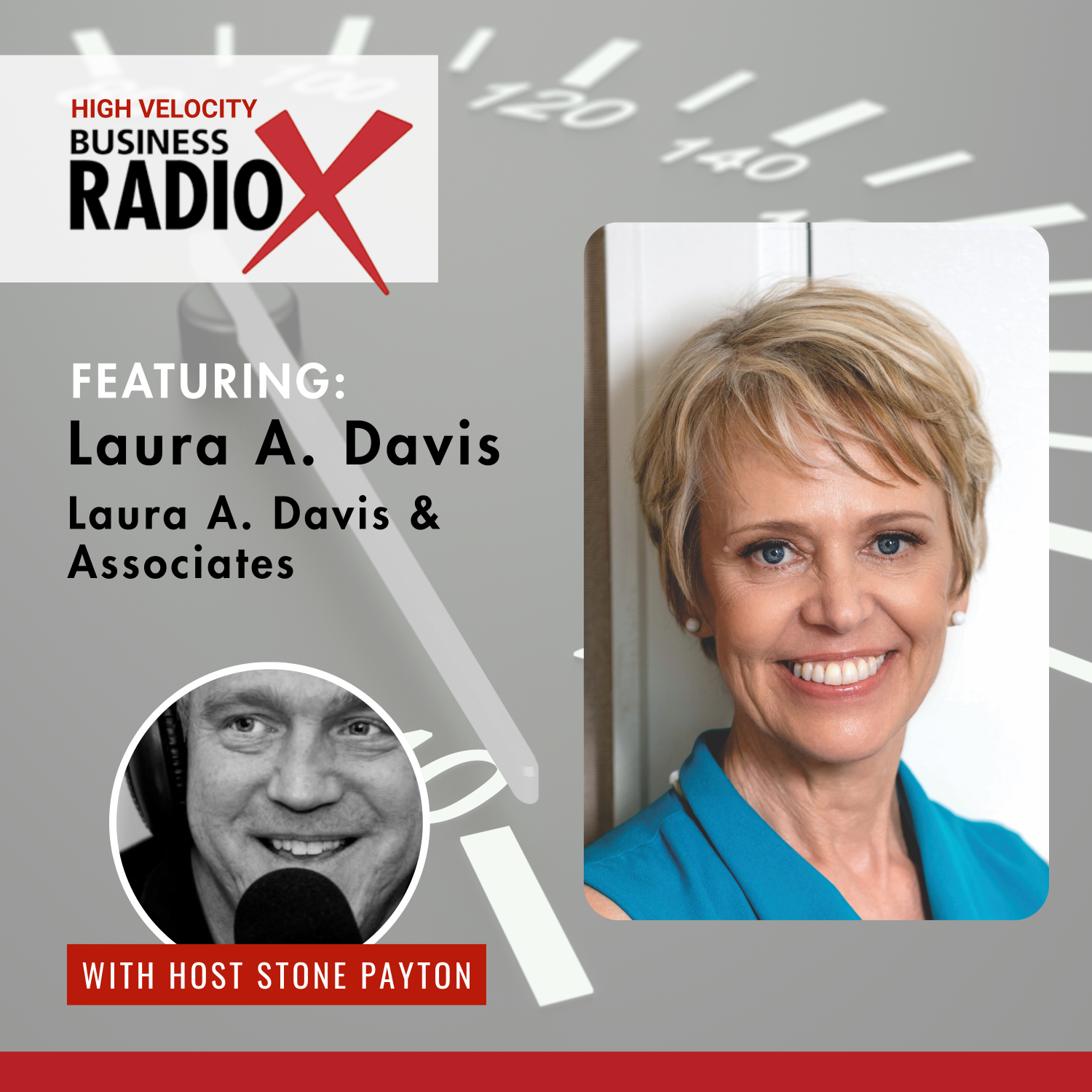

In this episode of High Velocity Radio, host Stone Payton is joined by Laura A. Davis, CEO and Founder of Laura A. Davis and Associates. Laura discusses her transition from a corporate career to coaching, focusing on leadership and team development. She emphasizes the importance of emotional intelligence, trust, and psychological safety in creating empowering work cultures. Laura shares insights on using assessments like Everything DiSC to improve team dynamics and highlights the rewarding aspects of her work, including witnessing clients thrive. The episode underscores the significance of empathy, effective communication, and continuous learning in leadership.
 Laura Davis is the CEO & Founder of Laura A. Davis & Associates, Inc., an Atlanta-based transformational leadership and team development training, executive coaching, and DiSC-based assessment firm founded in 1995. Laura and her associates assist individuals, teams, and organizations to navigate the new world of work by developing people to create healthier, engaged, agile cultures. Today more than ever, organizations need emotionally intelligent leaders, cohesive teams, and high-trust, high-performance cultures.
Laura and her associates help clients to create high-trust organizations resulting in an increase in employee engagement and passion, team productivity, and profitability. In addition to her experience with senior teams and leaders of best-in-class companies, she possesses a unique talent for seeing “the big picture” and for simplifying complex problems into their essential elements.
Laura has coached hundreds of senior and mid-level leaders from a wide variety of industries to “get out of their own way” and to become the effective leaders they were meant to be. She uses the original Wiley Everything DiSC to assist leaders in empowering themselves, their teams, and their direct reports to become self-directed and empowered in today’s turbulent environment.
She has also designed and delivered learning sessions focused on cultural change through the development of facilitative leadership and coaching skills for managers of numerous Fortune 500 companies, mid-sized companies, and non-profits. She has facilitated numerous transformational change initiatives both in-person and virtually.
Laura consistently delivers interactive, experiential training sessions in addition to coaching clients one on one and in group settings. Her training and consulting days are customized, relevant, and highly impactful and practical for everyday work. She consistently gets rave reviews regarding her expertise and the level of engagement she generates.
Laura is a Master Certified Coach through the International Coaching Federation, the most rigorous certification body in the coaching industry today. Prior to becoming an ICF Master Certified Executive Leadership Coach and Master Facilitator, Laura held both line and staff marketing management positions at Exxon, Equifax, and United Parcel Service.
She has a BA degree in Sociology with Honors from the University of Delaware. She earned her Master of Business Administration from Emory University on a partial scholarship. She has also been an Adjunct Professor in the Business Studies Program at Mercer University.
She is a sought-after speaker at professional coaching conferences and professional associations throughout the U.S. She is a contributing author of “A Guide to Getting It: Self-Esteem” and has published numerous articles in industry and professional association publications such as ATD, ICF’s Coaching World, Choice magazine, and more. She has appeared on “Good Day Atlanta,” a morning television show as well as on national and internet radio and podcasts.
Laura does her best to practice her “principles for inspired success” which includes uplifting others while having fun!
Connect with Laura on LinkedIn and Facebook.
What You’ll Learn in This Episode
- What emotional intelligence is and how Laura helps leaders and teams develop it
- The most important things for leaders to know and practice in today’s environment
- How and why Laura uses the Everything DiSC assessment from Wiley, and how this is useful for leaders and teams
- Why trust is so important in the workplace
- Why teamwork is so important in today’s organizations
 This transcript is machine transcribed by Sonix.
TRANSCRIPT
Intro: Broadcasting live from the Business RadioX studios in Atlanta, Georgia. It’s time for High Velocity Radio.
Stone Payton: Welcome to the High Velocity Radio show, where we celebrate top performers producing better results in less time. Stone Payton here with you this afternoon. Please join me in welcoming to the broadcast with Laura A. Davis and Associates. The lady herself, Laura Davis. How are you?
Laura A. Davis: I’m great. Stone. Great to hear from you. And thank you so much for this opportunity to chat with you today. It’s always fun to talk to you.
Stone Payton: What a delight to have you on the show. I think a good place to start. Tell us a little bit about mission. Purpose? What are you out there trying to do for folks Laura.
Laura A. Davis: Mhm. Yes. Well I had a corporate career myself, and was increasingly fascinated by why some leaders and some teams were great to work with and produced results, and others didn’t. And what I learned through extensive study in this journey I’ve been on for the past 30 plus years, is that organizations really need to create exceptional and empowering work cultures in order to be profitable and in order to attract and retain talent. And many people are great at their jobs. They get promoted because they’ve been good at what they do, but they have not had any exposure to leadership and team development training or emotional intelligence training. So they don’t really know how to lead people and to inspire people. And so that’s what we do to create healthier workplaces where people actually want to come to work and give their best.
Stone Payton: So what was that transition like so many years ago? Leaving the corporate arena, going out on your own, being a coach, running your own business? What was that like in the early years?
Laura A. Davis: Yes, it was challenging at first. I was very passionate about it, and I was fortunate. I had sort of unintentionally been planning it for a number of years. I had a wonderful boss at Equifax years ago. I was in my late 20s and he encouraged me to be an adjunct professor, which I did for a while, and I got the teaching training bug, if you will. But I knew I didn’t want to go back and be a professor, so I really networked and educated myself into this new career. Took the leap a number of years ago and really have been very fortunate. I had developed a lot of strong relationships, which is the key to being successful at any business, but particularly an expert based kind of boutique consulting firm. It helps to be able to connect with people and know what they need and really listen, so that you can offer the services that are going to help them get to where they want to go.
Stone Payton: So dive into the work a little bit and tell us more about the services, who you’re working with, what kind of activities you’re engaging in with groups or individuals. But kind of give us a little bit of a map of that.
Laura A. Davis: Okay, great. Yeah. Well, it depends on the company. How much, um. We do with them at any one time. And of course, you always want to meet people where they are. The ideal is to be coaching a senior leader and their team. And so we work one on one and as facilitators for group processes that are around building a cohesive, high performance team at the top, because that’s really where you want to start. And the key to that is trust and psychological safety. And so the next level down, if you will, is to really make sure that each of those individual leaders also understand themselves better. And that’s where the emotional intelligence comes in. Self-awareness. The most challenging part is even if you’re self-aware, it’s managing yourself. And we come from the philosophy that everyone has strengths. Everyone has inherent limitations. Or as we like to say, areas for growth and development. And we use the everything disc assessment, the original one from Wiley, to help people understand that it’s a scientifically validated and really reliable tool that you know, is constantly researched and updated and is now available on this really intuitive, beautiful platform, digital platform so that people can access it as part of their everyday work. But once people understand that another person is not behaving the way they’re behaving to make their lives miserable or difficult, but they’re actually coming from a completely different worldview. And you educate people about that. Then people can learn to adapt their behavior and have conversations about these differences in order to leverage them, because ideally, you want a diverse team so that that’s one major stepping stone. And then we also develop leadership and team development training around social and emotional skills, such as how to coach people, how to delegate to people, how to develop an emotionally intelligent team, and how to really inspire trust and teamwork. All of those sorts of they’re called soft skills, which I hate that term. I call them essential power skills because they’re so essential. But, um, you know, that’s really what we do. And it’s a lot of fun. It’s very diverse and very universal.
Stone Payton: So in terms of this risk assessment, I’ve done enough interviews with people in the professional services arena that I’ve come across that term. I’ve heard people talk about the assessment. Um, I didn’t realize there were different versions and like the original Wiley. So that’s interesting to to learn more about. But it strikes me that in the training coaching environment, having an assessment like that, which seems like it would be a great catalyst, if for nothing else, to just to create some, some meaningful dialog in a, in a training environment. Is that accurate?
Laura A. Davis: That’s very well said. Actually. It’s very validating because often people will have differences in the way they communicate or the way they approach problems. At the underlying heart of the disk model is your pace. Are you fast or slow or your level of skepticism. Are you more accepting or skeptical by nature? And then, you know, it gets more sophisticated from there. And the reason I do like the small IDE disk, you can always tell and you mentioned the term catalyst is they do have a platform called catalyst where you can look at yourself, you can look at colleagues, you can look at the team and a lot of depth. And the language is very non-judgmental. So what’s nice about a tool like this is it validates differences and and sort of explains why we might approach a problem differently. But more importantly, once you know that, what to do about it, to leverage the different strengths that you might have on a team or in an organization. And it’s really very powerful. It’s like, ah, I wish I had known this when I was a teenager because it’s really very, um, very useful in terms of collaborating and communicating and solving problems with people. And when things get tense, it’s very useful to because our tendency is to overuse our strengths in the wrong situation. When you know, ideally what you would do is have the self-awareness to say, okay, stop. I need to adapt my behavior to the needs of the other person and the needs of the situation. And it takes some practice. So that’s what we help train people on and coach people on to make that a part of their everyday awareness.
Stone Payton: Well, I would think that that could be an incredibly powerful tool as an individual who wants to get better at better at communicating or leading, trying to get results with and through the voluntary cooperation and effort of other people. And I’m also thinking, as a leader, man, I don’t want everybody communicating. Seeing the world the same way, I think was probably a we’re all probably richer for it if we do have people who are all over the map on this assessment. Yeah.
Laura A. Davis: Yes, that’s very true. And it’s interesting because without awareness, the tendency is to feel more comfortable and to like people who are like you. And so I have seen in large organizations, leaders sometimes hire people who are of the same style. And while that’s not good or bad, right or wrong, to your point, if you don’t have diversity of thought, you might have some blind spots. So if you’re aware of that and take steps to to fill that gap, great. But most of the time people aren’t without some education around it. So yeah, it’s a really useful tool as an individual leader to know how you’re impacting people around you and where you might need to. If you think of an old radio dial, turn the volume up and down, you know. And then you can adjust so that you’re meeting the other person where they are. And it doesn’t mean sometimes people will ask me, does that mean I have to not be who I am? And the answer to that is no. You just want to be the best you that you can be, and recognize that your natural way of doing things might not always be the best way to do it in any particular situation, or with a particular person. Sometimes it is great, but you’re wanting to be more agile, you know, be more adaptable and have that, um, that choice.
Stone Payton: I want to talk about this idea of emotional intelligence for a moment, if we might. It’s not the first time I’ve run across the term as we’ve been doing this coaching series, but has it been your experience that this is, um, you’re not just born with? Okay, here’s Stone, here’s your degree of emotional intelligence. Good luck out there. Is it, like, almost like a muscle. I mean, can you you can get better at it.
Laura A. Davis: Absolutely. You can get better at it. And and that’s a critical belief that the people that we work with, um, probably need to start with. But yes, you know, you have your IQ and you have EQ and just a little background context because I think it’s interesting. Daniel Goleman is the person who’s really attributed with making emotional intelligence popular. It had been around before then, obviously, but not not the term itself. But basically he’s done extensive research. And two things to your point. You can definitely grow your emotional intelligence, but it’s even more important than IQ. And I’m not saying IQ isn’t important. It’s helpful to be strategically smart and to have skills and be competent at whatever you’re doing. Obviously, at the same time, though, and particularly as you progress in an organization no matter what kind of organization it is. You have a greater sphere of influence, and you need to influence a lot of people that aren’t necessarily your direct reports or, you know, don’t necessarily have the same goals as you do. So to have those social and emotional skills that we call emotional intelligence is absolutely more important the more you progress. In fact, Goleman says it’s seven times more important in his research. Yeah, and what I love about Daniel Goleman is this man has so many IQ, traditional credentials, it’s not even funny, you know? So the fact that he recognizes that, I think lends more credence to the whole concept. But I see that in my work for sure. And you know that intuitively. You know, anytime you see a group of people, they can you can have stars, you can have the smartest, the best and the brightest, but they’re not always effective when they work together because they might lack this awareness and emotional intelligence.
Stone Payton: Well, you’ve clearly been at this a while, and I think maybe or at least in my case, it has changed, evolved. But I’ll ask you, at this point in your career, what, uh, what are you finding the most rewarding? What’s the the most fun about it these days for you?
Laura A. Davis: Oh, that’s a great question. I have a couple of clients. Well, I love all of my clients, but I have a couple of clients who have really embraced some of these principles and the principles really being, you know, creating this culture of trust and teamwork and psychological safety. And I worked with the CEO, and then I worked with the senior team. And then next level down were helping the leaders become more like coaches and facilitators themselves and teaching them some leadership skills. And then, you know, when you have that kind of alignment in a company. Things get done, you know? A company is much more profitable and profitable. This one particular organization I’m thinking of is actually a big nonprofit out west in the healthcare space. And as you know, we’ve undergone a lot of changes in every area of society, but particularly in that healthcare industry. And so they have just been able to do amazing things. So that’s fun for me to see their lives becoming easier and my clients having more fun accomplishing what they need to accomplish with, you know, out the other unproductive politics or the miscommunications or just the drains on your energy that can happen when you when you don’t have this kind of information and insight. Yeah, that’s fun for me.
Stone Payton: If you can get it. It sounds like fun.
Laura A. Davis: Yeah, absolutely. We’ve come a long way since my corporate days, and, um, I enjoyed my corporate career too. But this is very satisfying in that you get to work with a lot of different industries and learn a lot of different kinds of ways that people go to market or, you know, serve others. And, um, the principles are are similar across industries and so forth. So it makes it really, um, productive.
Stone Payton: I’d like to touch on the on the business side of running a coaching business for a moment if, if we might. And one of the first things you’ve made the decision somewhere along the line to get formally credentialed, invest the time and the energy. And I suspect some money to go through. What I understand is a pretty rigorous process. Can you speak to that and the advantages of doing that in your opinion?
Laura A. Davis: Absolutely. I am a big believer in education and credentialing. And I was fortunate I mentioned my my manager at Equifax all those years ago. He just noticed something in me. He was a coach, without knowing it, that I really loved to train people. I was always interested in human potential and psychology and spirituality and all those sorts of topics. And he said, well, why don’t you teach? And why don’t you learn more about this coaching thing, which was very new, really, as a profession in the 90s? I date myself Stone, but I was very fortunate in that I became through the ICF, which stands for the International Coaching Federation. You probably are aware of that by now. Um, a master certified coach in 1998 for the first time. And that means you go through a coaching school, an accredited school, and there are many now. There are only really two when I went through. But you learn things like how to have a dialog and how to how to listen and how to read people. And gosh, there were many, many aspects to it. Life coaching as well as business coaching as well as executive coaching. And I believe in a whole person approach. So I think that’s important and that’s what we bring to the table. So I did that and then I also was fortunate I was able to I networked my way around and I got connected with a company that has since been bought, but it was called the Forum Corporation out of Boston, and they were really a boutique consulting firm, probably 50 to 60 million in their heyday.
Laura A. Davis: But they did wonderful research. And and I met so many wonderful people that were the facilitators and instructional designers. So I really learned that trade as well, traveled all over the country and the world, actually to, um, work with clients. And then as my business grew, I did less and less of that. It’s a song by Korn Ferry now, but, um, I was exposed to a lot of good training, a lot of good coaching, a lot of good tools, and and that helped me a lot. But, you know, the other thing about coaching business is you have to think of yourself as a business owner. And I have spent money, as you said, hiring, uh, mentors and, you know, business coaches, uh, because it’s a very different thing to run a business, uh, than just to be a practitioner in your business. And I’m still learning. I’m still trying to figure that out. But for the most part, I’m still here, so something’s working.
Stone Payton: I’m sure the answer to this is yes, but I want to hear more, so I’ll just ask it. The whole sales and marketing thing does the strategy and the approach and all that change and evolve over a 20 plus year coaching career? Like, what’s the sales and marketing like getting the new business all the way through like that.
Laura A. Davis: Mhm. Yeah. I could answer that several ways. Well I think, you know, my mindset has shifted. I think of myself more as a business owner and what makes the most sense. I’m a little bit more discerning about the clients that I work with. Do they have a values match to me than I was perhaps in the beginning, but I do, you know, work at a at a higher level probably. And then I have associates that help me do some of the training and some of the coaching as needed. Um, in terms of just the evolution of companies, though, today I think people obviously we say this every year, the rate and you know, acceleration of of change continues to be just crazy. So we’re always trying to look at new ways of of connecting with people and and offering solutions that people can use just in time. We used to have the luxury of doing, you know, off sites for five days. I remember, and I’m lucky if I get two. Many times I might get a day or, you know, I’m supporting two companies that have large talent development departments, and they’re doing the bulk of the training. But I’m perhaps offering like advisory services and and everything. Risk assessment and all the tools that are part of that suite. And there are a lot of new ones that are constantly evolving. So hopefully that answers your question.
Stone Payton: Yeah. I mean, it has to change, I think. I knew early on, you know, some of the coaches I’ve talked to during this series, some of them are far earlier in their journey. And I think, you know, they struggle a little bit with just, you know, getting that, just getting the business, just kind of getting achieving some, uh, escape velocity. You know, where they can and they can focus on being.
Laura A. Davis: Traction or whatever. Yeah. Well, again, I was fortunate because I like to get out and talk to people. And I was in professional organizations, and I still think they’re important. I think it’s a little more challenging now because of, well, traffic and just people are used to remote and hybrid, uh, ways of communicating. So there might not be as much of that, but I think you just really need to let people know what you do and how you do it. And I always find there’s amazing synchronistic ways I get connected to companies. And, uh, you just have to have that mindset of, um, you know, let me try this. Let me try that. And if it doesn’t work, you adjust.
Stone Payton: So you’re a busy lady, though. You you are a speaker. You you’re a contributing author. Tell us. Tell us about this book that you helped put together.
Laura A. Davis: Oh, yes. Well, this was back in the early days, too. Uh, we wrote a book, a number of master certified coaches about self-esteem. It’s called A guide to Getting it. Self-esteem. And I was even on Good Day Atlanta, uh, which I was very nervous about. I remember back in the day, but I decided not to really focus on writing books, per se, but I’ve written a lot of articles and, uh, we of course do now social media and I do videos and that kind of thing. But I think one of the mistakes sometimes new coaches make, and I know I made it early on, is to develop a lot of content and to develop like maybe writing a book or a program and then, you know, you actually have to get out and talk to people and, you know, make sure somebody needs it, so you have to sell it. So it’s funny because I never thought of myself as a salesperson, but you’re really helping to meet people’s needs. And if you really listen to what people need and you have something to offer, I tend to start small, gain a client’s trust and at whatever level they’re ready to engage us. And then as we continue to offer great service. And what about this? And, you know, have you heard about this and just sort of meet them where they are and then suggest where they could go next? That takes on a life of its own. I think.
Stone Payton: You know, you have mentioned trust maybe as many as a half a dozen times during the course of this conversation. So, no, we have to talk about that, because the level of trust that you must have to endear and cultivate to, to do the best work you, you can do. Yeah. Talk about trust a little bit.
Laura A. Davis: Sure. Yes. And I actually work with some tools that help you measure trust. One is you may have read or heard of the Five Dysfunctions of a team. Wiley. Everything. This is. Pat worked together to develop a program called the Five Behaviors of a Cohesive Team. So it’s the positive spin on it, and it actually measures the level of trust on a team. Pre and post some kind of training and coaching and so forth. But you asked me specifically about people trusting me. So I do my best. Don’t always succeed. But I do my best at practicing what I preach. Being able to read the other person like I’ll look at what is their likely disc style, and I’m usually, you know, 95% right. I’ll get in the main quadrant and then as I get to know them further, I’ll be able to assess that. And there’s nothing manipulative about that. It’s just I know how they like to receive information, how they like to operate, how they like to solve problems. So I do my best to adapt to that. And then when I see where they might be getting in their own way around that, then I help close that gap.
Laura A. Davis: So I’ll give you a concrete example. Like during the pandemic, it was a time when we needed to have a lot of empathy for people, right? People were confused. What do you know? You have your dog walking in front of the zoom screen or what have you. And, uh, a lot of leaders got that at the beginning, but they’re like, okay, let’s let’s move on, get over it. You know? Okay, we are at home for now. We just have to get our work done. Right. And while that’s true, you have to manage people’s emotions as well as what needs to get accomplished. And so I did a lot of coaching. On helping senior leaders be more empathetic in that kind of scenario. And when they see that working, then they’re encouraged to do more of that. So that that’s a concrete example. But I would read the needs of that. And then I have the tools to be able to give them, you know, behavioral steps and mindset steps around that too.
Stone Payton: So no, I think it’s a great example. And it’s a reminder to try to to craft things in such a way that people get some a little bit of an immediate win from the counsel we’re providing or the direction we’re providing, and then they are they trust you and open up a little bit more, I guess, huh?
Laura A. Davis: Yes. That’s that’s a good way to put it. Early wins and and usually it can just be a, a relatively minor Shift in someone’s behavior or their attitude that can make a big difference. That consistency is the thing. So sometimes it’s really important to repeat yourself. And I know for myself, I know I’ve said it, but I’ll try to say it, you know, eight different ways because you know how it is. You’ll read a book and you read it and you’re like, yeah, this is great. And then you read it a second and third time and you swear there were things in the book that you didn’t read the first time. So it’s like that you have to repeat the messages to people, and then once they really, um, sort of internalize some of this, then it can really be more natural.
Stone Payton: Well, you clearly enjoy practicing your craft if you have time. When you have time, what do you do for fun when you’re when you’re not coaching? Any hobbies? Other pursuits?
Laura A. Davis: Yes, I do. I love traveling and I’ve been home for two months, so I’m ready to go. I’m going to Colorado, and then I’m going to go hiking after working in Colorado in a month or so. So that’ll be fun. So I do like to hike and walk and my latest is Zumba. I’m not very good, but try it. Try to stay healthy. Exercise, hiking I used to do yoga. I don’t do that as much anymore. But um, and reading, taking classes. So yeah, I keep I have some fun too. I’m not all work.
Stone Payton: Well, what’s neat about you is I think you, uh, you enjoy all of it. You really are having fun at the work, and then you get to go do this other stuff.
Laura A. Davis: Yeah.
Stone Payton: Good for you.
Laura A. Davis: Yes. That’s been my philosophy, and it works for me. And I think it works for a lot of people when when they realize that’s possible.
Stone Payton: Hey, before we wrap, I’d like to leave listeners with a pro tip or two, a piece of advice, maybe, you know, related to this general idea of producing better results in less time, but maybe within the context of some of the, the, the topics and competencies that we’ve talked about, maybe something to read or do or not do, but let’s give them a little something to chew on. And look, guys, uh, my pro tip to you is, uh, reach out and have a conversation with Laura. If any of this is striking a chord with you, but let’s leave them with a little something to noodle on. Laura.
Laura A. Davis: Okay. Um, well, I think we we grossly underestimate the value of listening and confirming what we’ve heard. And it’s something I’m working on all, all the time. Because in the disk model, I’m a high I. Meaning I like to talk, I’m outgoing and enthusiastic. And so taking the time to listen is important. And there’s a great quote that I often will, uh, pull out of my pocket here. And so I’ll do it now. It’s by Peter Drucker, who was, you know, a management guru in the day. And his quote is the most important thing in communication is to hear what isn’t being said. And I think that’s so true that we need to pay attention to all the nonverbal communication and the behaviors that people are displaying. Results don’t lie. And if I have said it, and I think the other person has heard it, but there hasn’t been a change, there’s some disconnect somewhere. And I think the second or the corollary to that is whomever is doing the communicating, usually like the leader in this, this situation, to take responsibility for getting that communication across, don’t immediately blame the other person, but recognize that maybe I could have said that paper better. Maybe I could have read the needs of this person and said it in a different way that would land for them. So I think that’s that’s the best I can do today as a pro tip.
Stone Payton: No, I think that’s tremendous counsel. So thank you for that. I’m so glad that I asked. All right. What’s the best way for our listeners to reach out, tap into your work, connect with you or somebody on on your team. Let’s give them some coordinates.
Laura A. Davis: Okay. Yeah. Great. So the website is WW Davis to A’s next to one another. Laura Davis was taken by a real estate agent in Texas like a month before I registered my domain name, but I know, so I have to say Laura a Davis all the time. Uh, we post on LinkedIn all the time and on other social media, um, probably LinkedIn and the website are the best places, but if anyone is interested in having a conversation with me, I’d love to have that, uh, talk with you. And my email is easy. It’s Laura at Laura Davis. Com and either I or my team will get back with you and set up a time for us to chat.
Stone Payton: What a delight, Laura. This has been an inspiring and invigorating conversation. Thank you for your insight, your perspective, your enthusiasm, and for hanging out with us today. You’re you’re clearly doing good work and we sure appreciate you.
Laura A. Davis: Thank you so much, Stone. It was really a pleasure to talk with you.
Stone Payton: The pleasure is all mine. All right, until next time. This is Stone Payton for our guest today, Laura Davis, and everyone here at the Business RadioX family saying we’ll see you in the fast lane.