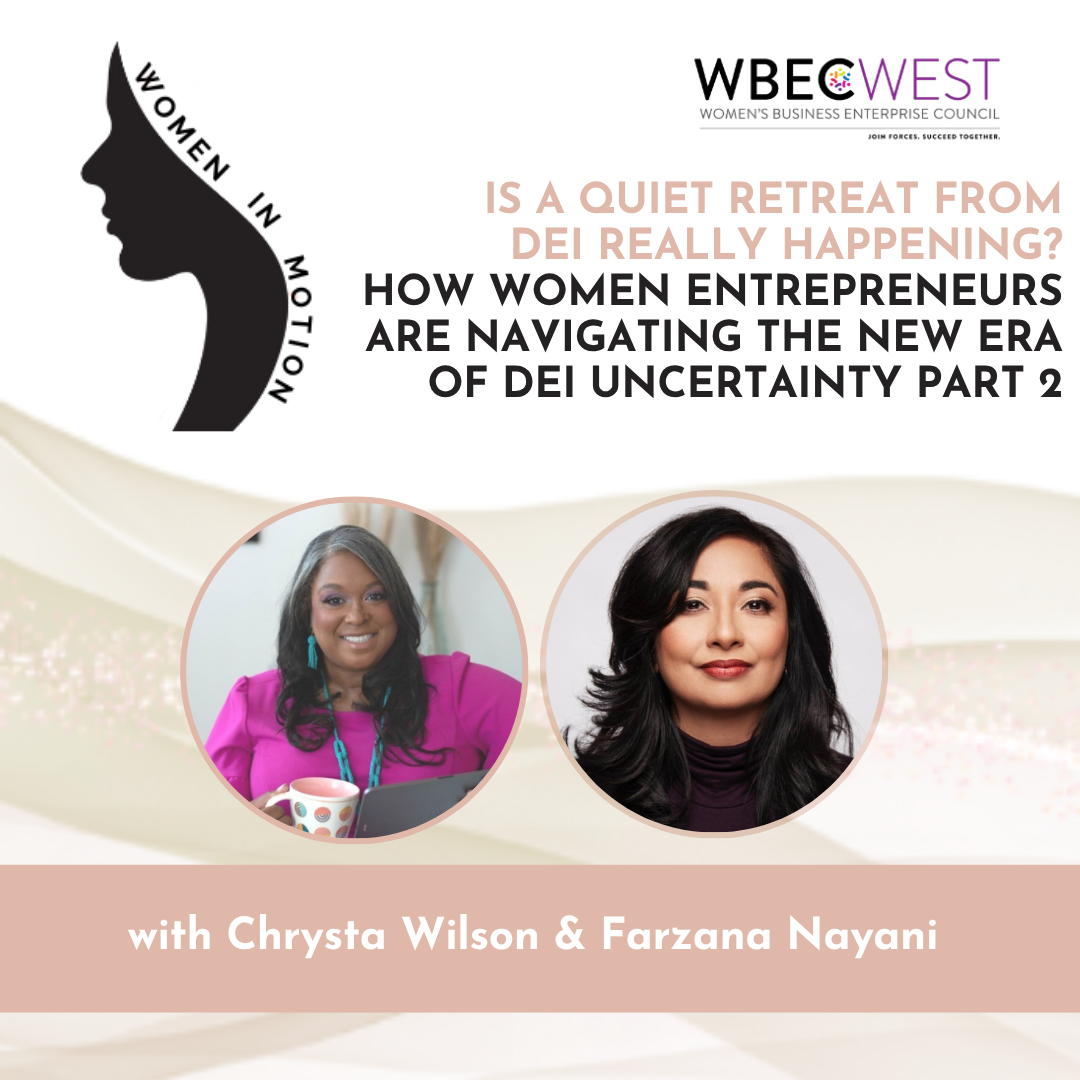

On today’s episode of Women in Motion, Lee Kantor and Renita Manley are joined by Farzana Nayani and Chrysta Wilson, leaders in workplace engagement and DEI consulting. The discussion explores the evolving language and strategies around diversity, equity, and inclusion, emphasizing the importance of aligning with client values and focusing on outcomes. The guests share insights on building authentic client relationships, navigating industry changes, and leveraging community connections. Listeners gain practical advice on adapting to shifting business landscapes and fostering resilience, particularly for women-owned businesses seeking to make a meaningful impact.
 Manazil Management, LLC was founded in by Farzana Nayani (she/hers), a long-time consultant and established leader in the community.
Her vision was to create a boutique consulting firm that could meet the needs of our ever-changing environment. Manazil Management, LLC is a women-owned and certified, and minority-owned and certified small business. 
Headquartered in Los Angeles, CA (Gabrielino-Tongva lands), the company’s team members spans locations across North America and represent a wide array of identity backgrounds, skills, and expertise.
Connect with Farzana on LinkedIn.
 Chrysta Wilson is a nationally recognized coach, strategist, and consultant with over 20 years of experience helping mission-driven leaders and organizations create more connected, equitable, and impactful workplaces.
As the founder of Wilson and Associates Consulting, Chrysta brings a unique blend of strategy, storytelling, and systems thinking to help clients navigate change, align their values with action, and cultivate cultures where people can thrive.
She is the creator of the Recipe for Transformation™ framework, which guides leaders through meaningful shifts in mindset, behavior, and culture.
Chrysta’s career spans public policy, community organizing, entrepreneurship, and public service. After serving in leadership roles within government and philanthropy, she launched a consulting practice and later, a community bakery—both rooted in joy, equity, and purpose.
She is a Professional Certified Coach (PCC) through the International Coaching Federation, a certified Positive Intelligence Coach, and holds a Master’s in Public Administration and a BS in Public Policy and Management both from the University of Southern California.
Known for her warmth, depth, and ability to make complex ideas accessible, Chrysta blends data, humanity, and hope in every engagement.
Whether she’s facilitating a retreat, advising senior leadership, or delivering a keynote, Chrysta shows up with presence, clarity, and a commitment to transformation that lasts.
Connect with Chrysta on LinkedIn.
Episode Highlights
- Current state of diversity, equity, and inclusion (DEI) initiatives.
- Evolving language and terminology in the DEI field.
- Importance of aligning business language with client values and priorities.
- Strategies for navigating client conversations around DEI.
- Adapting marketing language for women-owned businesses.
- Building authentic relationships with clients and stakeholders.
- The significance of resilience and agility in changing business environments.
- Evaluating the effectiveness of corporate DEI efforts.
- Leveraging community and ecosystems for support and growth.
- Fostering collaboration and genuine partnerships in the workplace.
Music Provided by M PATH MUSIC
 This transcript is machine transcribed by Sonix
TRANSCRIPT
Intro: Broadcasting live from the Business RadioX Studios, it’s time for Women in Motion. Brought to you by WBEC-West. Join forces. Succeed together. Now here’s your host.
Lee Kantor: Lee Kantor here with Renita Manley, another episode of Women in Motion and this is going to be a good one. But before we get started, it’s important to recognize our sponsor, WBEC-West. Without them, we couldn’t be sharing these important stories. This episode is actually part two of a series that we’re doing about DEI, Is a quiet retreat from DEI really happening? And on the show today, we have Farzana Nayani and Chrysta Wilson. Welcome to you both.
Farzana Nayani: Thank you. It’s wonderful to be back.
Chrysta Wilson: Glad to be here.
Lee Kantor: Now, Renita, before we get too far into things, why don’t you kind of recap part one and then let us know what we’re going to be talking about today?
Renita Manley: Okay. Thanks, Lee. So, in part one of the conversation, we spoke with Farzana, who did not hold back, she laid the groundwork on what DEI is currently looking like and why certification still matters. And now we’ve got Chrysta Wilson joining us, who is also a WBENC certified WBE, she’s going to be joining us to dig a little bit deeper into this DEI conversation. So, let’s just get started.
Lee Kantor: All right. And I think a great way to start is, Farzana, why don’t you share a little bit about your business and your background, and then we’ll ask Chrysta to do the same so the audience knows who we’re dealing with here today.
Farzana Nayani: Happy to, thanks, Lee, and thanks, Renita, for this wonderful continuing conversation. My name is Farzana Nayani. I’m the Founder of a boutique consulting firm called Manazil Management, LLC. We are based in Los Angeles, and I do a number of different services, including consulting, offering training for workplace engagement, and keynotes on leadership and inclusion. I also do coaching and assessment of workplace strategy and how to implement more effectively. You may also know my company name by Farzani Nayani Consulting and Training. People know me from the work I’ve done as an author, and I’ve written a couple of books on this topic as well.
Lee Kantor: And, Chrysta?
Chrysta Wilson: Yeah. So, I’m so glad to be here. Chrysta Wilson, I’m The Founder and CEO of Wilson and Associates Coaching and Consulting. We’re an 18 year old at consulting practice, and I’ll tell you, we help companies solve people challenges, like team tension, leadership breakdowns, or culture issues. And ultimately we help our clients improve retention and trust and strengthen the leadership bench, because we know what gets in the way of performance and things like miscommunication and tension and misaligned values. And so, we’re happy to do things like training and coaching, and strategy and change management.
Chrysta Wilson: And so, I’m glad to be here talking to Farzana, because we have a lot of things in common and overlap, so I think it’ll be a good conversation.
Farzana Nayani: Definitely.
Lee Kantor: Well, in the previous episode, Farzana, you mentioned that kind of the terminology is changing, people and culture is being used or is not being used, workplace engagement, some of the languages changing. How are you recommending your clients kind of navigate the semantics of this DEI issue?
Farzana Nayani: There is a definite shift. There’s a cooling off of certain terminology and an embracing of new terminology. And what I mentioned last time were the terms employee engagement and thinking about how we can move to people and culture. And I want to expand the conversation a bit more to those who are not even indirectly in diversity, equity, and inclusion work to think about how reframing can happen through just understanding your client’s priorities.
Farzana Nayani: So, for example, if we know that a client is focused on retention and thinking about talent management or performance, then just start with those words. And really the key as a WBE, as any business owner is to think about how to deliver value and solve a problem. And the key to that is to identify what the problem is currently and just use that terminology.
Farzana Nayani: So in the past, words that were emphasizing, let’s say, racial equity or the terminology that stress diversity, those were on the upswing. And right now there’s definitely been a shying away from those types of terms. Instead, thinking about how to create more workplace effectiveness and engagement and productivity, those are the types of words that I’m seeing now with regards to the shifting landscape.
Farzana Nayani: So, I hope that’s helpful for the listeners, and I think it can apply to anybody who’s in any field to do with working with organizations and people.
Lee Kantor: So, you’re focusing in on the outcome they desire rather than the specific words.
Farzana Nayani: Absolutely. And when we’re thinking about who’s making these decisions, I’m seeing a shift towards thinking about values-based leadership. So for example, creating an environment that does X, Y, and Z. So, instead of saying we want equity or we want X number of people, we’re not looking for quotas, we’re not looking for that type of metric. What we’re looking for is the environment that’s being created and instead emphasizing respect or emphasizing a place where everyone thrives, that sort of thing. So, I like, Lee, how you put it exactly, it’s really looking at an outcomes-based approach.
Lee Kantor: And, Chrysta, are you seeing the same thing?
Chrysta Wilson: Yeah. I would say the same. I’ve also seen other language, too, like again, looking at conditions. So, I’ve seen a lot of companies add language like what are the conditions that they can put in place to help their employees reach their highest potential. Or I’ve just seen a company put language out in their annual report, what are the conditions that can be in place to help their employees do their best.
Chrysta Wilson: Now, those of us, like I’m a retired evaluator, so we know that some of the things that have prevented people from doing their best have been things like they haven’t felt psychologically safe or that they didn’t belong. So, sometimes the language that they’re moving away from still finds its way back into the organizations. But the language that they’re talking about is around the workplace environment.
Chrysta Wilson: And so, I think that’s something that we want to pay attention to, and then use that language as you’re talking about your services and your programs, because I think when you use the language that your clients are using, it helps show alignment.
Lee Kantor: Now, when you’re working with your clients and you’re having these conversations, are they specifically using the words DEI, or are they are they mentioning that by name, or is this something that people are gingerly trying to navigate around without saying that?
Chrysta Wilson: I think it depends on the organization. I really do. I’ve seen a number of organizations who are still standing by the acronym. I also think the acronym is a kind of a hot potato right now. And so, you’ve seen people move to maybe DNI, maybe inclusion. I’ve seen an increase in belonging. And then, just like Farzana mentioned, I’ve seen also a focus on people and culture.
Chrysta Wilson: I always say this, I’ve been in the world of this work for 20 years, I’ve seen the language evolve over those 20 years. So, ultimately, what I see leaders really asking is this question, What is the environment that we want our people to work in? What do we care about when it comes to our clients, stakeholders, and customers? And then, how do we best get there?
Chrysta Wilson: And so, whether it’s called inclusion and diversity, diversity and inclusion, DEI, DEIB, people and culture, culture of belonging, I honestly don’t think it matters what it’s called. I think it really matters what’s the outcome that the company is trying to work toward and then how they best get there. And so, that’s I think what we’re seeing right now is this evolution of language, maybe an evolution of tactics. Now, true, some people are disavowing completely, but I do think by and large, a lot of people are just evolving language and tactics.
Renita Manley: Follow up question to that real quickly, for women specifically and in other groups as well, a lot of us have gotten comfortable to using our identity in marketing, in marketing our programs, our businesses, or our partnerships with other businesses. What do you say about, well, how are we supposed to shift our language now as a woman-owned business so that it’s not so all about our identity?
Farzana Nayani: I want to actually, if I could share, I think it’s looking at it with what you lead with. And I’ll just be frank, leading with race or leading with gender is, in a lot of cases, not the move right now. But what I’m seeing is if it’s layered with other things, it’s a real plus.
Farzana Nayani: So, for example, when I am going out to bid for a big contract, they’re asking if I’m a local business or they’re asking if I’m a small business. And so, I definitely lead with that, but that doesn’t take away that I’m also a woman and minority certified business. What that does, I feel like, is it just enhances my profile in total. Because if people, for example, the organizations are looking to move away from that, to be honest with you, not everybody is. It might be just a company-wide or organizational initiative, but the people that are in there making decisions, they still care about you and me. They still care about the the previous approach.
Farzana Nayani: And so, I think some of it is jumping through the hoops to kind of get in the door. But when you’re in there, we’re back to where we were, and that people know that it takes a lot. It takes a lot to be a WBE. It takes a lot to be certified. And it it takes a lot to get where we’re at.
Farzana Nayani: I’ve been running my business for eight years, I’ve been in the field for over 20, when people know and have seen that tenure, they trust it. And so, having women certification as a business owner really shows that trust. Having WOSP certification paired up with WBE certification, to me, I feel like it shows that I can play at a federal level. So, I feel that, again, it’s about packaging it together and then being able to lead with your strengths.
Lee Kantor: And then – go ahead.
Chrysta Wilson: Yeah. One thing that I would just offer as well is, last year I met with a buyer from a tech company. This was before a lot of the changes, but I think this wisdom is so good. He said that for all of us who are WBEs, that our differentiator is not that we’re OEB or a women-owned business. He said that we need to make the case why we’re the best in class. And I think that that’s how we future-proof.
Chrysta Wilson: So, for myself or Farzana, for all people who are listening, now more than ever, I think we’ve got to be clear about why we’re the best in class, what problem we solve. And if we’re not sure, everybody listening needs to figure out what’s a really expensive problem that we solve, get really good at it, and tell that story.
Chrysta Wilson: Like Farzana said, if you’re a local business, play up that you’re an expert in your geographic region because that is what makes you stand out. Not just that we also happen to be women, or people of color, or disabled, or a veteran. Those are assets that we bring, that color and shape, how we deliver our best in class service, but it’s just an addition. What’s going to help us win and be a long term strategy is being best in class.
Lee Kantor: And isn’t part of the way that you go about building these relationships is to kind of humanize the relationship and not just be boxes on a form. You want to get into a human to human relationship so people can see kind of your secret sauce and what makes you special and different.
Farzana Nayani: Yeah, definitely. I think you’ve hit the nail on the head. And the way that I would suggest WBEs and any business owner to go about doing that is to ask questions. It’s to emphasize that we’re listening, we’re here to offer a solution, as Chrysta was mentioning, and to really think about how to emphasize that this is an ongoing relationship.
Farzana Nayani: I’m saying that a lot with clients now, new and old, that, hey, I’m here for the long term. I’m not interested in a one and done situation. What I am here to do is be your partner, to be your partner in progress, and be your partner in problem solving.
Farzana Nayani: And the way that I can see that WBEs can establish that is to really understand what the values are of ourselves and also the values of the company that we’re working towards working with, and then see if there’s alignment. If there’s alignment, then we know that they’re here for the long haul. They know that we can work together and be true partners. And they know that it doesn’t have to be instant because this work is not an overnight thing in this day and age.
Farzana Nayani: Well, previously it was. Sometimes there were quick decisions made and then we find ourselves in massive projects, and then, boom, now they’re gone. So, what I’m finding is that clients are taking their time to make decisions, but the way that they’re making their decisions is they have to weigh pros and cons, and they’re checking us out.
Farzana Nayani: Let me tell you, as women business owners, as any business owner, they’re looking at your social media, they’re looking at what you’re saying, what you’re doing, and how you operate, and how you manage yourself. And all of those things play into the part of how we can be better partners to our clients and we can offer better our services to support them.
Lee Kantor: Now, you mentioned asking questions as a way to elevate the relationship from a transactional relationship to a deeper, more authentic partnership. Are there any other tactics or steps or conversation starters you can recommend in order to kind of pivot from that transactional relationship that no one wants to be that type of vendor, you want to elevate, to be that trusted advisor?
Farzana Nayani: Yeah. And there’s some advice that I can give myself because I’m having to shift. I am tried and intrude being known in this field for being responsive. I’m super responsive to the needs of others. However, what I need to do now is be proactive. And I really recommend all of us reach out and move towards asking the questions early, not waiting for the bid to be written up, or not waiting for the request to go out.
Farzana Nayani: I think that people are in a time right now where they’re trying to figure out what they need, and if we can be proactive and approach people early on, then we can be seen as that trusted partner. So, that’s something I could share as a tip that I’m trying to implement in these changing times, and I hope that’s helpful for other business owners as well.
Lee Kantor: Chrysta, do you have any advice you can share in this area?
Chrysta Wilson: Yeah. I think what I could offer is, you know, as experts in our craft, one thing that we can bring is our thought leadership and expertise. So for myself, one thing that we offer our clients is not even about like seeking the next sale, but it’s asking myself and my team asking themselves how can we be of service.
Chrysta Wilson: So, we pay attention to what’s happening in the industry and what’s happening in the market. And we offer like industry trends reports just to say we’re noticing this is happening, here’s a resource, here’s a tool. We’re noticing that these are some skills for our current clients that we’re hearing that they don’t have, and so we want to offer this little free resource that may help accelerate the skills in your team. It’s not the full program that we have, but maybe it’s a little snippet that it could be a faster resource for either a prospective client or someone that we’re just in talks with.
Chrysta Wilson: So, it’s almost like I always say, we give without the expectation that we’re going to get. And I think that’s one of the ways that we have built relationships and have been seen as a trusted advisor. Because what is a trusted advisor? We are giving advice and guidance. And so, I think those are two tactics that have been proven to be effective in our relationship building and our role as advisor.
Lee Kantor: Now, is there any advice you can give to the WBE that maybe is experiencing a shake up in their client base that all of a sudden now there is a lot of challenges that they hadn’t faced in a while. Anything you can share that’ll help them kind of stay resilient and adaptive during these changing times?
Farzana Nayani: Honestly, I would say that being agile is really key. Knowing that being flexible actually is our strength and that our size is our strength. So, thinking about if we can accept that change is constant, then what is the opportunity? And I think we can kind of swing around as women business owners, as small businesses to really support that.
Farzana Nayani: I’ve seen larger firms that are in my space really have trouble. They’ve had to slash budgets, lay people off, and maybe you’re experiencing that, too. But when we move to a leaner method and we really, again, listened to what the client needs and then serve that, that’s really what will be a chance for us to be, again, proactive and responsive at the same time.
Farzana Nayani: So, being agile is number one. Understanding that change is constant is number two. And then, looking at what the opportunity is, is really key, that’s number three. And I’m finding that, personally, as I’m shifting through this change as well, I’m being more creative. I’m looking at things in a new way. I’m having to kind of throw out things that really are not relevant anymore. And it’s taken a lot. You know, it’s a chance for us to really face ourselves and say, hey, what is it that we really want to do and who do we want to work with. And just let go of what no longer serves us, which it might be a cliche, but really it’s the time to do that.
Farzana Nayani: So, given that, when we do that, then, again, we’re more clear with our offer, we’re more clear with our solutions, we’re clear with our brand, and we know who we are, and that’s where we can come back to leading with our identity. Again, not just being a woman, but what it is, is the value we offer, and what Chrysta was saying, how can we be best in class and really stand out. So, I think all of that ties together to understanding that our size is our strength.
Renita Manley: I might be prying just a little bit, but do you mind telling us what are maybe some of those things that are no longer serving you, that you had to throw out as you reevaluate and become more creative with your business approach? And, Chrysta, I want you to answer that, too, if you’ve had to do the same.
Farzana Nayani: Definitely. I think that when people would come to us, there was a bit of, you know, a request sometimes because it was on trend. And a key to really evaluating if a client is serious is to notice if they’ve done the work before and if they’ll continue to do it after this “trend.” and right now, people that are following a trend will not be doing this work because it is not on trend.
Farzana Nayani: So, what I’m seeing is people who come to me now or who I’m reaching out to also, it’s because we have a values alignment. And you can tell this by their year end reports, by the communications that they put out, and even having a one-on-one conversation and ask.
Farzana Nayani: So, the thing that I’m letting go of is waiting for people to come to me. I think I used to be the problem solver, where folks would call me, we’re the firm that you would call to get people out of a crisis. We’d be super confidential. No one would know we we’re even in there and then we’re out. And I think I don’t want to be doing that type of work anymore.
Farzana Nayani: What I want to be doing is the type of work where we lead with integrity. We lead with respect. We lead with quality and caliber that people want. And we’re proud to partner openly, not because we’re trying to sweep under the rug something that went wrong. So, that’s a huge shift for me and I’m being very vulnerable in sharing that. But I’m not looking to serve the type of companies that do wrong. I want to serve companies that do right.
Lee Kantor: Chrysta?
Chrysta Wilson: Yeah. I feel like there’s so much in line with Farzana. You know, I think in the business that we’ve been in, not that I could speak for you fully, but I think I might, a lot of our work is cloaked sometimes in NDAs, because we do get called in times of crisis, because that is oftentimes where culture, and people, and crisis intersect. And so, I say in my work, you know, we’re the kind of the clean up people sometimes.
Chrysta Wilson: And so, I do have quite a bit of my clients who I say that when people are looking to do work around people and culture, there’s two pathways that they come into my world. It’s aspirational because there’s a value and a vision that is guiding them, or it’s because the bottom has fallen out and it’s a crisis. And so, I have never found in these years another pathway in which they come into our world around crisis of people and culture.
Chrysta Wilson: And so, for me, the first question that I heard, which was how do other WBEs navigate this time, the thing that I have been clinging to, because this time has been disruptive, I think I’m like many other WBEs, too, but the thing that has helped sustain us over these last, like, nine months has been having a very clear vision of the world that we want to help co-create, and having very clear frameworks and approaches about how we believe we can get there.
Chrysta Wilson: And so, it has just meant going back to that proverbial drawing board. So for example, we have two frameworks, Thrive Operating System and our Recipe for Transformation. So, they were programs that we offered that there just isn’t demand for. And I think part of the thing that’s not serving anymore, that second question, is, even though they’re programs that I love, like letting it go because people aren’t buying up, to be candid. But we’re still in alignment with our rest of our framework, so it’s going back to our framework and saying, well, what else do we offer that people likely will want and putting that front and center?
Chrysta Wilson: It’s not changing our identity. It’s not being fake. It’s not pandering. It’s going back to our identity of our business, our belief about what actually creates workplace, where people can get what they need and thrive, and companies can be productive and have high performance and high profitability, and put those services front and center. And so, that’s what we’ve done and we have found great success looking at how do we help leaders navigate change and navigate conflict.
Chrysta Wilson: And so, I think for any business that’s out there trying to figure out how do they navigate change and disruption, it’s having a very clear – this is a nerd term – theory of change or framework for your business, having a very clear approach that you aren’t just thinking of your business in terms of we have this service, but what’s your ecosystem that you have maybe multiple services that fall underneath, that you can switch different services, you can move them in and out, but still be true to the identity and the core of your business.
Chrysta Wilson: And so, I think that has been a recipe for our transformation and sustainability, even now, and so I would really recommend that to anybody who’s listening.
Renita Manley: Okay. Chrysta, I’ll ask you this question, then, Farzana, I’d love to hear what you think about it. So, what are some things that WBEs should be looking at for now when evaluating if a corporation or a potential partner’s DEI or inclusion efforts are strong or serious?
Chrysta Wilson: Well, I think there’s a couple things you could look for. In the world, we’ve often heard about, you know, some things like performative or transformative or real. And so, this is my own criteria, so I always say it would be performative if maybe you’re asked to speak on a panel, or you’re invited to an event, or there’s a photo op you’re invited to. And so, you think, wow, I’ve just been invited here to speak, to be in this photograph, to meet these people.
Chrysta Wilson: Or you’re told, like, we love what you’re doing, and I can’t tell you how many times I’ve been told that. We love what you’re doing. We love your framework. The periodic table of great culture elements, that’s so innovative. But then there’s no budget. Or I just got told by somebody within the WBE world, “Where’s the contract at?” And I’m like, “That is a great question. I don’t know.”
Chrysta Wilson: And so, I would say it’s almost that’s how I would call it performative. And I don’t mean that there’s even ill intention behind it. So, I’m not even calling out people for being like harmful or that’s not a kind of character attack. I just mean it’s going through the motions of support. But in small business, support really is transformative when it’s about connections, relationships, or ultimately a financial contract. And so, I would call that a profitable partnership. So, to me, what that looks like is it’s very clear from the start that they’re about introductions, relationships, procurement. You’re getting connected to budget holders, PNLEs. They see your value from the start.
Chrysta Wilson: And so, for me, a red flag is if you’re only talking to folks from supplier diversity, or maybe their DEI supplier inclusion, like, point person, but you’re not seeing any deal progress over 6, 12 months, that is feeling very, to me, performative. It doesn’t feel real in terms of the contracting relationship.
Chrysta Wilson: And then, I would say a green flag in terms of contracting, it looks like when you’re seeing decision-makers involved from the very beginning or you’re having conversations about here’s what we are investing in, here are our priorities, and we see how we might be able to work together, let’s have some conversations about what this might look like.
Chrysta Wilson: And I want to underscore, it’s not one conversation and it’s done, but that there’s an interest in seeing where this might lead to. So, I’m not speaking of timeline, but I’m speaking of from the very beginning, we want to see what kind of business we might be able to do together, let’s keep the line of communication open, so it doesn’t just feel like we’re inviting you to this luncheon, or we want to take these photos of you, and it feels more like marketing versus business.
Chrysta Wilson: So, that’s my initial thought, and I’m saying this from my own personal experience, but also from a number of WBEs that I’ve talked to over the years. I don’t know if there’s thoughts that you have, Farzana, or things that you’ve experienced.
Farzana Nayani: Yeah, I love listening to what you’re sharing, it’s making my gears turn as well. And I agree that some companies can be performative and kind of do the dog and pony show to get the suppliers to come out and sign up.
Chrysta Wilson: What I have noticed in contrast, in thinking about potential business opportunities that are real or strong or serious, I’ve seen these companies invest in building the business owner up. And I feel that I will take that education even if there isn’t a business opportunity, because I know they’re invested and I know I’m going to meet other people. And I know that when the time comes that I’ll be on a list because they know that I’m trained.
Farzana Nayani: So, an example I could give is a dear friend of mine, her name is Sonia Smith-Kang. She went through a training program, I believe it was with Macy’s. I will share her story, at the time, I don’t think there was a business opportunity. But years later, I saw this materialize in her clothing called Mixed Up Clothing, was listed on Macy’s, macys.com. I remember the day that it was listed, and I went and purchased her clothes. And I have kids, they’re teenagers now, but she sells children’s clothing with cultural patterns and prints. I remember charging my credit card, feeling so proud that I saw her from the ground up go through that program, wonder what would happen, but still believe in it, and then that company came through.
Farzana Nayani: And that’s what we’re talking about, because that was a program for women business owners. It literally was. And when I see companies, and I’ll just keep shouting them out, like Tory Burch Foundation or ones that I’m in as well, I was in the 10KSB program, 10,000 Small Businesses Program, I feel like these companies are trying to help us create opportunities, and they’re investing in us as business owners.
Farzana Nayani: So, with that, I feel that those companies refer other people. They refer us to people and they refer people to us. That’s the kind of ecosystem that we’re talking about that, you know, we want to be a part of. So, I feel like that’s what I’m interested in right now, like alliances and partnerships and collaborations that are intentional. I’m not looking for the bids that go up and go away because they already have the person in mind. We’ve all been there. You can feel it that when they put out that RFP, they already had somebody in mind.
Farzana Nayani: And that’s what’s going on in our business community. There’s nepotism. Sometimes there’s favoritism. There’s people who are incumbent that win the bid because they’ve been doing it for so long. Sure, I’ll be in those processes as well because I learn from them. But what I’m finding in my strategy is I’m looking at other places to learn and grow. And if my overall work is down right now, which it is – I’m happy to admit that. I’m working on vulnerability and sharing to help other people – but right now, I’m building my business infrastructure up.
Farzana Nayani: So, when the time comes, when this will change and there’ll be a chance for me to be on the ground again in front of people, I will be so much stronger. So, I’m learning and growing and I believe that the time is now for us to build ourselves up and learn and take advantage of these opportunities.
Lee Kantor: Now, how would you recommend other WBEs address kind of this chaos in terms of leveraging the communities and ecosystems that they’re currently in? Like WBEC-West, for example, you’re all part of that community, what is the best way to kind of lean on your fellow community members? I know each of you mentioned internally kind of figuring out what to do within the room of your team, but how do you kind of leverage the strengths of the communities that you’re part of and the ecosystems you’re part of?
Chrysta Wilson: Yeah, I can start. You know, I think, one of the things that happened when COVID came on the scene in 2020 is that we made our world the size of our computer screen. And so, I think one way that I want to invite all of us to tap into our WBEC-West resources is to get out of the computer screen and into the real world. It’s not to say that we can’t build relationships through a computer screen, we’ve been doing it for five years. But there is something so powerful when you can put a physical presence, and a face, and a voice, the smell of somebody’s perfume, just their physical energy to the name as well.
Chrysta Wilson: And I will say for myself, you mentioned it, too, Farzana, in your intro, like going to the Unconference that happens, like, on those boats and meeting both other WBEs but then also the corporates who are there. Because I think sometimes, too, we do this, we think of like, “Oh, my gosh. These are the corporates.” They’re the ones with the purses. We’re trying to get those contracts. And it feels intimidating for a lot of people. But at the end of the day, these are just regular human beings. They have a job. They care about their companies. And ultimately, they want to bring the best suppliers to their companies so that their companies can keep doing great stuff.
Chrysta Wilson: And so, the best suppliers, I’m telling you, are on these boats at Unconference because they’re us. But they got to meet us, so we got to be out there on those boats, or we got to be at the conference that we have, the regional conference, I can’t think of the name. But, you know, we have our regional conference and we got to go there.
Chrysta Wilson: So, I think it’s taking advantage of the meetups that we have, the regional conferences, and actually not thinking of every interaction as the next contract, but actually as just the next relationship that we’re trying to build as we make our world bigger than the computer screen. And for me, that has been transformational to remember that the world is bigger than the computer monitor, that you’re more than the little black byline at the bottom of your square or your LinkedIn profile.
Chrysta Wilson: And our network is big, and these people in our network are just generally great people. I say that and it feels corny, but every time I go to these events, I’m like, “Oh, my gosh. Y’all are amazing.” And I want to make connections. I want to introduce you to who I know. I want to partner with you. I want to refer you out. I want everybody to win, corporates and the other WBEs. But I don’t get that amped. It’s hard to get that amped on the Zoom screen because we’re overwhelmed, there’s 50 of us in a Zoom meeting. But when we’re in an intimate space, there’s just a different kinetic energy that happens.
Chrysta Wilson: So, I think that’s what I would say, Lee, we got to meet each other. We got to start building those relationships and not expect an instant payoff, but know that the riches are in the relationships. I guess if I had a catch phrase, that’s what I would say.
Lee Kantor: Farzana, do you have any thoughts?
Farzana Nayani: Yes. I would love to add, I think that I go to WBEC-West and the beautiful, wonderful, amazing business owners that I meet for encouragement and inspiration. I am inspired when I hear other people doing so well with their businesses. I want to be them when I grow up.
Farzana Nayani: And I remember years ago and this, by the way, was before I was even certified, I was asked to emcee one of the WBEC-West events. And I remember seeing the awardees get up on stage and receive the award and hear their stories of how they started in their garage or their the first native-owned business in their field, or others that I see that I just admire and look up to.
Farzana Nayani: And I said to myself, I want to be that one day. And it just encouraged me to get to the next step, even if I didn’t know what that was, I knew that someone started somewhere, and I’m starting where I am and I’m going to keep going. And I feel that every time I meet other business owners, other WBEs and go to these events, as Chrysta mentioned, you just get amped up. And that has kept me going.
Chrysta Wilson: And you know, LA has been through a lot. I live in Los Angeles. We’ve had the strikes in the entertainment industry. We’ve had the fires. We now have the ICE raids going on and that’s happening across the country. And morale is down. We’re upset. We’re questioning the future. And the one thing that we can do to keep our mindset strong and our hearts present is to be around each other.
Farzana Nayani: So, with all of the change and the tumultuous landscape that we’re in, the biggest thing we can do is just continue to serve the community and march on. And that will recycle dollars back into our communities the more we exist and thrive. We always give back. And that’s just a force of nature of being a small business owner and a women business enterprise. So, that’s what I would say, come to the events and take part, and you’ll also get inspiration in days where you may feel down.
Renita Manley: So, this event that Chrysta and Farzana are talking about, they’re getting all amped up about is our Unconventional Women’s Conference, the Unconference as Chrysta called. I like that nickname. The 2025 Unconventional Women’s Conference is actually happening on July 23rd at Newport Beach, California. So, if you haven’t registered for that, be sure to go to wbec-west.com and register today.
Farzana Nayani: I signed up and I’ll be there.
Lee Kantor: Now, before we wrap, Farzana, do you mind sharing some coordinates to connect with you? And also, if you could, who is your ideal client and what do you think is your superpower that you can help them?
Farzana Nayani: Definitely. The way to reach me is through LinkedIn, it’s my first and last name, Farzana Nayani. And you can go to my website, farzananayani.com. I’m on Instagram as well. I share a lot of good stuff there.
Farzana Nayani: My ideal client is a client that’s committed and is looking to continue to transform their environment, or the learning of people who work there, so anyone who’s looking for a facilitation training or a keynote.
Farzana Nayani: I think my superpower, I was reflecting on this just this month, my superpower is really taking information and making it easy for other people to understand. So, removing jargon, removing all the extras, and really getting into how it can be practically applied. So, if you’re looking for a consultant or speaker that can do that for you, I’m your person.
Lee Kantor: And, Chrysta, what is the website, best way to connect with you and ideal client and your superpower?
Chrysta Wilson: Yeah, so thanks again for having me. This has been fun. You can find me at recipefortransformation.com. And you can also find me on LinkedIn, it’s Chrysta Wilson.
Chrysta Wilson: And my ideal clients are folks who are ready to have a transformation, whether it’s through change, transforming conflict into collaboration, or ready to build the management and leadership skills that help them create productive, healthy workplace cultures. If you’re ready, I’m ready.
Chrysta Wilson: And my superpower, I would say that my superpower is helping people to bring heart and care back into the workplace. I have a dual superpower, if I could be greedy, and I would say that it is turning organizational tension into the tools required for that transformation. I help my clients move through conflict, change whether it’s unplanned or planned, and disruption and culture challenges with clarity and with purpose and with ease. Because, gosh, can stuff just be easy? That’s what my clients ask me. And I say, yes, it can be, and let’s make it easy.
Lee Kantor: Well, thank you both for sharing your stories today, Chrysta and Farzana. You’re both doing such important work and we appreciate you.
Farzana Nayani: Thanks for having us.
Chrysta Wilson: Yeah. Thanks for having us.
Lee Kantor: All right. This is Lee Kantor for Renita Manley, we will see you all next time on Women in Motion.