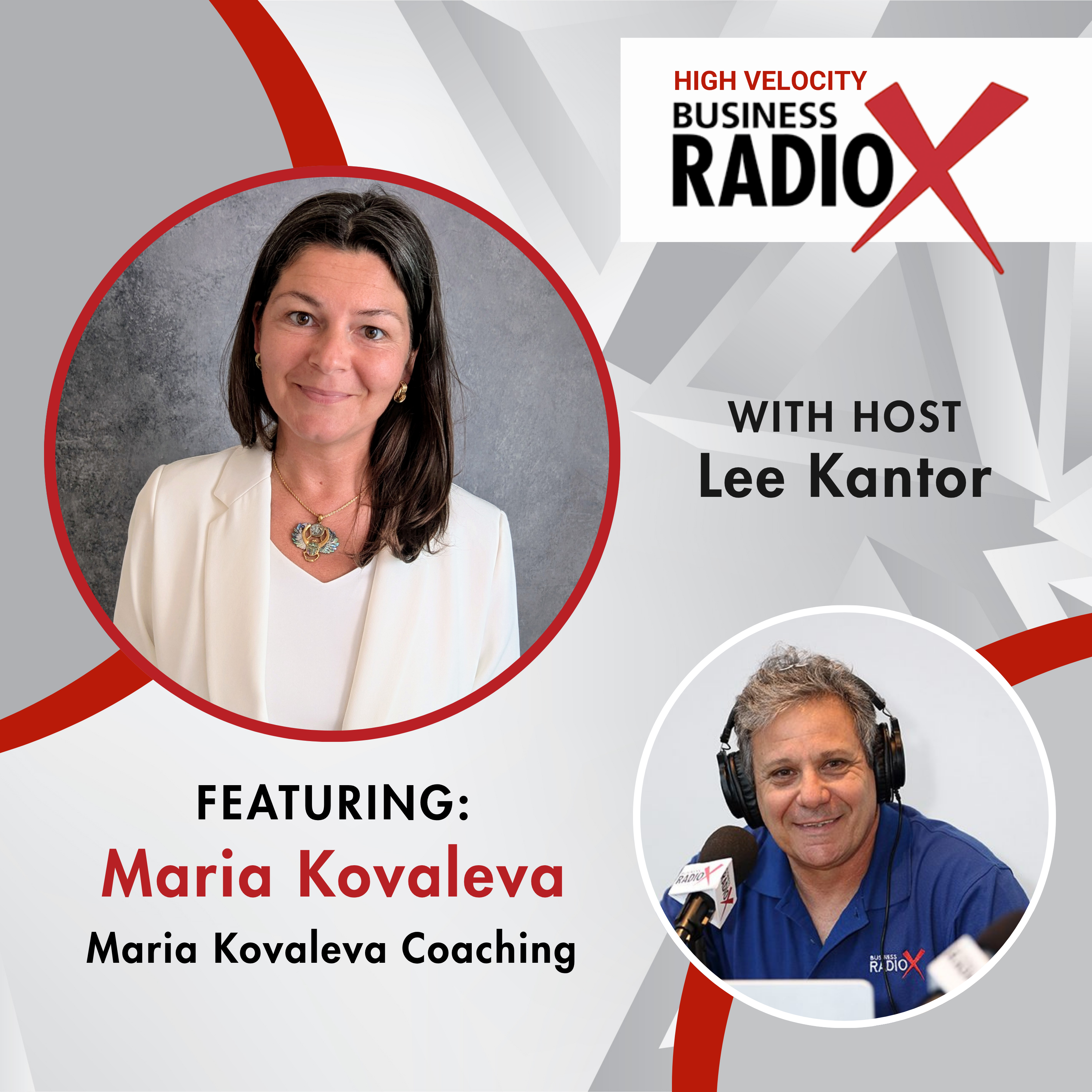

In this episode of High Velocity Radio, Lee Kantor interviews Maria Kovaleva—who empowers families to transform long-standing patterns into opportunities for healing, connection, and joy. With a trauma-informed lens and a passion for joyful living, she teaches parents how to cultivate calm, resilient, and deeply connected family dynamics.
 Maria Kovaleva guides families through transformative journeys, helping them break free from generational patterns and create harmonious relationships. By blending trauma-informed practices with joyful living principles, she empowers parents to build peaceful, thriving family dynamics.
Drawing from both professional expertise and authentic enthusiasm for life, she helps her clients discover their unique path to connection, healing, and joy. Her approach transforms challenging relationship patterns into opportunities for growth and deeper understanding be it at work, family or strangers on the street.
She is originally from Russia, educated in Canada, lives in California for more than 10 years, a mother of 2 daughters, a wife of 1 husband, a loving owner of 3 pets.
Connect with Maria on LinkedIn.
What You’ll Learn In This Episode
- Practical value of emotions vs. rational decision-making
- Emotional Freedom, Sovereignty, and Privacy—what they mean and why they matter
- Using emotions to improve decision-making in coaching
- Emotional sovereignty for stronger, distraction-resilient relationships
- Integrating emotional freedom into parenting and children’s emotional independence
- Navigating social media’s emotional influence with sovereignty and authenticity
- Emotional privacy in 2025 amid AI, algorithms, and digital nudging
- Societal benefits of embracing emotional freedom, sovereignty, and privacy—and how listeners can start today
 This transcript is machine transcribed by Sonix.
TRANSCRIPT
Lee Kantor: Broadcasting live from the Business RadioX studios in Atlanta, Georgia. It’s time for High Velocity Radio.
Maria Kovaleva: Lee Kantor here. Another exciting episode of High Velocity Radio. Though excited to be talking to my guest today, Maria Kovaleva. She is with Maria Kovaleva Coaching, and she’d like to share a little bit with us today about the practical value of emotions. Welcome, Maria.
Intro: Hello. Nice to be here. Well, thanks for inviting me.
Maria Kovaleva: Well, I’m excited to learn more about your coaching practice. Can you tell us a little bit about it?
Intro: Sure. I’m a relationship coach. I came to this niche through four years of niching in different areas, but I came to the conclusion that everything is about relationship and I am also a parenting coach relationship coach. I work with um in a career areas also, but everything is about a relationship because we are humans living among humans. Yeah. So certified uh, coach, I’m acc in uh, ICF credentialed environment.
Maria Kovaleva: So when you came to the conclusion that relationships are critically important, how where do you see people kind of making mistakes when it comes to their relationships?
Intro: Communication. I would say communication is the main area we would be beneficial to improve in and talking and uh, seeing each other as unique, as different, as important as someone who worthy of more attention. And yeah, I would say people come to me for being seen and heard. I would say that’s what we are craving for. For being seen and heard, for what we are worth of.
Maria Kovaleva: So can you explain how your emotions come into play when you’re dealing with relationships?
Intro: Yeah, when we want to be seen and heard, our wounds are coming outside. And how they come outside is through emotional. Um, very emotionally, I would say, in a dysregulated way. And of course, you you can understand when we we become angry, we become sad, we we become very emotional. And it might be very extreme emotions that we we try to show that we need to be, um, hurt, but also we can communicate those things in a very different ways. And that’s when clients come to me. We discuss how how you can communicate your needs to your partners, to your parents, to your kids in a different ways. And there are different ways when we practice emotional sovereignty, when we basically pause before responding, before forming, In response. That’s how we we can communicate in different ways. Usually we react. We react very emotionally. And usually it’s not very in a pretty way, I would say.
Maria Kovaleva: Now, do you find a lot of folks that’s how they spend when they when they have a conflict or a crisis or an argument, their first move is emotional or they’re reacting emotionally rather than kind of like you were saying, pausing, taking a breath. Yeah. Listening and trying to understand before just reacting in a very kind of knee jerk manner where you’re just saying whatever comes on you. If they hurt me, I’m going to try to hurt you worse. Like very tit for tat manner rather than kind of slowing things down, breathing and then just sharing maybe what’s going on rather than just attack, attack, attack.
Intro: Yeah, well, it’s not about attacking, it’s about more about defensive. We learn how to defend in in an aggressive way. Usually we learn it from our families and we don’t learn how to be emotionally intelligent. And that would be a very important subject in schools that I would introduce emotional intelligence and communication. So usually it’s about defense. And usually it’s about staying alive and survival how we react. And yes, it might be very aggressive, but when we go to the root cause it’s about survival and emotional sovereignty. It’s when you strong enough to pose, to get together, to understand how you want to respond. Because you have these seconds of freedom to choose how you want to respond in a way that would be beneficial to you and to another person, because you respect yourself and you have this freedom and you respect another person. So this is a position of strength rather than defensiveness and reactivity. And it’s about freedom.
Maria Kovaleva: Right? Because ultimately you have the choice on how to react. You don’t have to attack in your response. You can pause. Can you talk about how you came upon these learnings that you’ve been able to put into a coaching program like this? How did this come about? How were you able to figure all this stuff out.
Intro: Session by session, case by case. Four years of getting together. Reactions. Emotions of my clients cases. Tears up stories. It’s my work is very exhausting, demanding, but also very meaningful. Because when you look into the eyes of a real person with real struggles and I love working with parents because really, I’m working for kids. I cannot work with kids because coaching is for adults only. Um, because it’s it’s partnership, right? So we two adults working together in partnership. So I cannot literally work with kids, but I love to help kids because they are our future. So I chose to work with parents to help kids. And there are very different cases. And I, I thought how I can how I can change our future. What what are the instruments? What are the ways and changing the emotional landscape? Changing the approach. On how we can regulate our nervous systems and how we can change the communication within the families, within the communities, and how we can make a ripple effects on the bigger communities. Um, I don’t know. Countries, nations. I don’t know. I have a big vision about peace on Earth. Um, but I need to start from somewhere. So I decided to start with parents.
Maria Kovaleva: So what’s something a parent could do today if they’re having kind of a lot of friction with their children? What are some of the things they could do today that will help them kind of have a better relationship with their children?
Intro: Um, the most meaningful thing they can do, they can talk. Be the first one who can stop generational trauma here and now. They can start healing their generational trauma. They can be the first one in their families, the many generations who can be a different parent to their kids. They can give more love and understanding to their own kids. They can start to see their children as another human beings, not just their properties. They can see another. They can see the future in the eyes of their children. Um, they can see more curiosity in the relationship and communication with their children, even the smallest one. Even when they cannot talk yet. But there is so much communication happening between a parent and a child. Um, I would say. More curiosity and interest to another human being. It requires a lot of self-regulation, but I would say if there is curiosity and interest, then the play and game starts when you, um, when you want to be involved in self-development, when you want to be involved in self regulation for the purpose of understanding other human being and for the purpose of of being a better parent to serve your future? I don’t know. Yeah, that sounds like kind of a big task, but it’s what it is.
Maria Kovaleva: Now, is there a story you can share about maybe one of your past clients where you don’t name who they are, but maybe share what challenge they had and how after working with you, you were able to help them get to a different place.
Intro: The story of one client, right?
Maria Kovaleva: If you have a story that is maybe meaningful or it meant something to you or can illustrate what it’s like to work with you?
Intro: Mhm mhm. Um, I have a story of, um, a father of, um, two teenagers. They separated with mother and normally we would think that a mother would take care of kids, but she was so distant. And father thought that he would be a provider of, uh, financial part for the kids. But it was it was the case that, uh, a grand grandparents would be with the kids, and they were, um, like seven and ten at that time. So for several years they were living with grandparents. So the case was when father returned to their kid, to the kids, but they were so detached from father and mother were not there. Very difficult case because there was a gap, a huge gap of, um, uh, trust and a huge gap in, in father’s understanding what he, he, um, he saw his kids as a small ones, and now they are teenagers with their own view of the world. And there was a, um, a hard time, um, working with father, right? Because the kids needed this man, their father. So the success was to kind of turn this old enough man in his perspective on viewing this already grown up kids and, uh, changing his perspective from, I’m. I’m the father. I’m the one who tells what to do to the grown up men who understand that their, um, his kids are grown up with a totally different understanding of the world, and he became the one who gave them the space for their decision making. Um, who gave them the, again, freedom of expression, freedom of emotional freedom, uh, emotional sovereignty. It’s a huge, um, kind of shift of understanding and mindset for this man, for this father. So I, I would say it’s a success in coaching because it would it gives, um, those two kids, two teenagers, a different parent for now. I would say it’s, um, I would say it’s a successful story for me.
Maria Kovaleva: Now, if somebody wants to learn more about your coaching practice or or talk to you, or learn more about the stuff that you offer in your programing, what is the best way to connect with you?
Intro: Uh, I would say my LinkedIn is is very, um, active page. So it’s the best way to connect with me through LinkedIn profile.
Maria Kovaleva: Through your LinkedIn profile. And then how do you deliver your coaching? Do you do one on ones? Do you do group coaching? Uh, do you have a cohort? How does someone work with you?
Intro: Yes, I prefer one on ones. Uh, my like. Yes. My preference because I prefer, um. Depth. Depth. Depth. But I do, uh, small cohorts, uh, group coaching for emotional, emotional stuff. And I do parenting for group coaching. For parenting. Uh, they are changing all the time, so it’s better to connect with me. And then I figure out when it and what it will be for group coaching. But one on ones. Um, yes of course, connect with me personally.
Maria Kovaleva: And then LinkedIn is the best way. They just, um, type in your name, Maria Kovaleva on LinkedIn, and then they connect with you there.
Intro: Yes, yes.
Maria Kovaleva: Well, Maria, thank you so much for sharing your story today. You’re doing such important work and we appreciate you.
Intro: Thank you so much for inviting me and having me here to share my work.
Maria Kovaleva: All right. This is Lee Kantor. We’ll see you all next time on High Velocity Radio.














