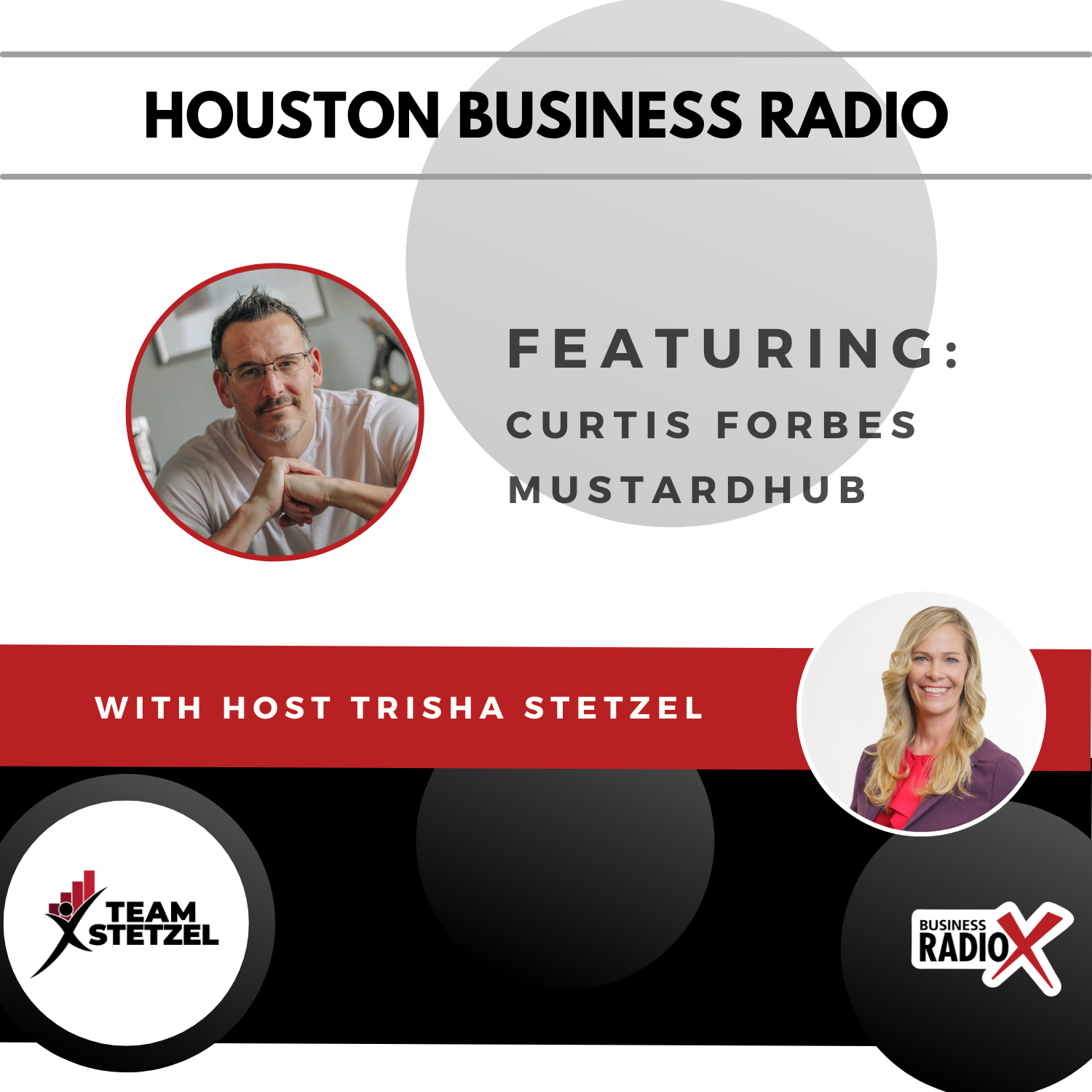


 Curtis Forbes is the Founder & CEO of MustardHub, a team engagement platform helping companies become destinations for workplace happiness. A 5X founder with three exits, Curtis has built and scaled businesses across education, technology, and creative industries.
With degrees from Berklee College of Music and NYU, his creative approach to leadership is influenced by his background as a musician and performer.
Outside of work, Curtis is a husband, father of four, and storyteller — with adventures ranging from visiting every MLB stadium in seven weeks to surviving a rattlesnake bite.
Trisha and Curtis Forbes discussed the importance of Mustard Hub, a team engagement platform that fosters workplace happiness and helps companies become destinations for employee engagement. They also addressed the challenges faced by businesses in adapting to the changing workforce and the need for budget-aligned solutions to address these challenges.
Curtis further explained the benefits of Mustard Hub, a platform designed to foster workplace equity and culture, and shared a success story of a preschool owner who saw a significant increase in employee satisfaction after using the platform.
Connect with Curtis on LinkedIn.
 This transcript is machine transcribed by Sonix.
TRANSCRIPT
Intro: Broadcasting live from the Business RadioX studios in Houston, Texas. It’s time for Houston Business Radio. Now, here’s your host.
Trisha Stetzel: Hello, Houston. Trisha Stetzel here bringing you another episode of Houston Business Radio. It is my pleasure to have this guest on with me. We actually met at the Franchise Business Review last year, which happened to be in Denver. And we’ve also had the opportunity to meet and talk about his incredible company. Curtis Forbes is with me today, founder and CEO of MustardHub, a team engagement platform helping companies become destinations for workplace happiness. Curtis, welcome to the show.
Curtis Forbes: Really happy to be here. I appreciate you having me.
Trisha Stetzel: Yeah, I’m super excited. I’ve had the opportunity to take an inside look at this amazing platform that you’ve built. And we’re going to talk a little bit about that today and a little bit about Curtis. So for our listeners who don’t know who you are or may not know who you are, tell us a little bit about you.
Curtis Forbes: Oh, gosh. Well, um, I might my early background is in music, actually, um, graduated with a degree in jazz composition, a master’s in jazz studies. Uh, spent about 15 years on the jazz circuit, performing up to four nights a week and teaching everything from privately up to higher education. So, um, I’ve performed with Grammy winners and was actually an active member of the Texas chapter for many years. I, uh, started an education company a little over 20 years ago while I was still performing quite a bit. And, uh, that was my entrance into the business world. And over the past 20 years, I guess we grew that small business and scaled the company to ten major markets across the country. And as I started to wind down my performance career, I also I built a startup in the video software space around 2012. Um, later exited a couple of years before Covid and and then, as the new world of work reared its head over the pandemic, I focused my energy on solving much bigger, much bigger people problems. But I’m a teacher, an entrepreneur. I think most importantly the the father of four amazing humans, a husband to my incredible wife who puts up with all my shenanigans.
Trisha Stetzel: Uh, I can’t imagine no shenanigans. Yeah. Uh, yeah. What an interesting path for us to go from music to education to business ownership. Although not strange. Just interesting. Right? Circuitous.
Curtis Forbes: Yeah.
Trisha Stetzel: Absolutely. Um, okay, so where does Mustard Hub come in? And before you go there, I want to ask you about the name, because that is one of the first questions I asked you before we even got here, right when we were getting to know each other. So tell me about the basis for the name first, and then tell us a little more about Mustard Hub.
Curtis Forbes: Gosh. Well, it was a little bit of an aha moment. You know, a mustard seed is is one of the smallest, um, seeds that can grow into one of the largest plants. And, you know, at the time when we built it, we were solving a problem for companies that work with a lot of independent contractors, organizations with team members who may feel disenfranchized or disassociated or even unable to access, you know, these types of benefits that, uh, um, you know, a lot of enterprise businesses can. And so, you know, it was this idea of being part of something bigger than just an individual, um, you know, so that’s sort of the genesis of where the name comes from. Um, I, I wish there was a a little bit of a better story, but I think that as you as you see the logo and I think, I think as you think about, um, what it means to be connected with a company that has a big, you know, a big vision or a mission that’s really meaningful to you. Um, but may not be, you know, one of their leadership or salaried, you know, it’s it’s a way to sort of be a small piece in a much bigger thing and feel a part of that.
Trisha Stetzel: Mhm. You should not undervalue the story behind mustard. The name Mustard Hub I think it’s fantastic. I love it and I see it and even through um your emotion and your values that you put out there for people to see, I think it’s really important that, uh, this just being a part of something bigger. Right. So tell me a little bit more about the the platform, not the technical parts of it, but why is it important to have something like this.
Curtis Forbes: Why is it important? Well, I mean, we now we now live in this culture driven workforce economy. I mean, times have changed, but companies are still operating, you know, the same way they did in the 50s, right? They’ll hire somebody. They hope it works out. Their employee sticks around for 30 years until they retire with with a nice gold watch and a trip to Florida. But we all know that that that doesn’t happen anymore, right? Almost half the entire workforce already has one foot out the door. Over 40%. And that’s on average, you know, in small businesses suffer disproportionately. You know, each marginal staff departure makes up a significant piece of the team. And in many cases, you know, that experience, the customer relationships, the institutional knowledge, it goes right along with it. And I think that given that, given that these times have changed, it has set up this scenario of winners and losers, right. You fight the change and you’re going to face more than two and a half times higher turnover rates, you’re going to have over 60% lower rate of revenue growth in a business life expectancy of, you know, less than eight and a half years. And if you embrace the change, you’ll find turnover can drop more than or up to about 150%, you know, four times higher revenue growth than between 300 600% ROI on your investment in people. So, you know, simply put, like there’s a new expectation in the workplace and traditional benefits are merely table stakes.
Curtis Forbes: There’s, you know, there’s over 11 million SMEs that feel the pain. A majority of them counted as their number one problem, right? Engagement, turnover. Most of those 11 million businesses have no solution for their people problem and no way to, I think, really empirically measure the real effects of their company culture on time, money and personnel. But like beyond that, the workforce is changing. You know, just like what I was mentioning a moment ago about, you know, some disconnected workforce, over 60% of the US workforce is going to be in the gig economy in the next five years. So how do you incentivize contractors? How do you incentivize small teams that can’t even provide benefits to their employees, like some preschools or salons or fitness centers that work part timers, you know, or hourly work workers? How can businesses that rely on this diverse worker classification use incentives and reward performance while keeping costs low? So I think that when you ask what’s important about it in these in these economic headwinds, this is a very budget aligned solution for something so comprehensive that I think many business owners often have anxiety over. And I think such a powerful solution to deal with this societal change that many business owners aren’t really sufficiently prepared to overcome.
Trisha Stetzel: Yeah, absolutely. So I’m thinking about the challenge, right? The challenge that Mustard Hub resolves or at least tackles. And a couple of things that you said, like engagement and turnover and benefits, I think are really important parts of what your platform can help with. Right. Or at least help start to tackle some of those challenges. So now people are even more curious, I’m sure, as they’ve listened to our conversation. What exactly does hub does Mustard Hub do?
Curtis Forbes: Well, what we set out to do, um, you know, Mustard Hub Operationalizes great culture by making personnel personal. Um, you know, it sounds, uh buzzwordy. But, you know, it is an employee and engagement platform like you described. It helps organizations develop winning company culture, uh, to help eliminate turnover and actually gain access to a lot of revolutionary business intelligence data to make better people decisions.
Trisha Stetzel: Hmm. That’s interesting. So I do want to ask you that. I mean, we all know that data is important. Some of us use it, some of us ignore it, but we know it’s important. So the type of data that you’re able to collect with this platform is mind blowing. I, by the way, if you didn’t hear me say this before, those of you who are listening, I’ve had the opportunity to see the platform and it is really, really cool. I’m going to have Curtis tell you how you can connect with him in a few minutes, so that you can also see how amazing this platform is, but it it’s mind blowing the data that you can get from this platform. So you talk a little bit about the data, Curtis, that you’re pulling.
Curtis Forbes: Sure. Well you know, data first of all gives you insights into um, you know, a lot of things you might not necessarily see otherwise. Insights with objective evidence, right? Our culture intelligence data can can tell you intrinsic and extrinsic motivators of your teams. They can level up management without really any training. Lift can alert you when your next employee is leaving the company before you, or maybe even they know. Um, that’s that’s pretty powerful stuff. I mean, imagine a scenario where you may not only be able to predict your next, uh, excuse me, your next staff departure, um, with accuracy, but but even help identify the next hire who has the experience, the expertise and personality attributes that are, you know, best going to succeed in that role. I mean, this this is what data can do, right? And that’s that’s incredibly powerful. We’re collecting millions of data points on virtually every type of interaction and activity that happens on this platform that can tell us, you know, a lot of this really, really incredible stuff that we wouldn’t be able to see otherwise.
Trisha Stetzel: Yeah, absolutely. One of the things that really stood out for me as you took me through the platform is this whole idea of, um, the I’ll just call it assistance with benefits. Uh, as I engage, I’m, uh, able to earn points or as the employer, I can give points. Right? Can you describe that a little bit to the audience?
Curtis Forbes: Sure. I would probably call it nontraditional benefits. I think benefits is a is a word of art that, uh, you know, means a lot of very specific things to specific people. Mustard hub does not carry, uh, health insurance. We are not a carrier. We don’t carry plans. Um, we don’t provide, you know, 401 K’s specifically. Now, what’s really unique and interesting about our platform is that we do have partners, um, and agency partners, and in our marketplace where team members can actually redeem these points, which I’ll talk about in a moment, um, towards, uh, purchases on the public health insurance marketplace, on Obamacare. They can actually use their points towards their monthly premiums, which is incredibly powerful. Um, so, you know, the way that, uh, the way that some of these things work, um, you know, businesses using sort of an agnostic currency on the platform. Right. Points to, um, businesses can incentivize their team members, um, with, you know, whatever behaviors that they’re really looking to promote. And so these employees, you know, or contractors really can rack up these points via a variety of different, you know, ways, both in the social engagement activity and also, you know, um, with regard to behavior recognition, etc., and then turn around and redeem these points in in this marketplace, it has over 1.5 million participating vendors that include everything from gift cards to exclusive vendor partners and even, you know, agency, insurance agency, partners, etc.. So that’s a little bit of how that works on the platform. Is that is that helpful?
Trisha Stetzel: Yeah, absolutely. There. So I have like 5 million questions. So I know we’re going to run out of time here. But I’ve also had the pleasure of seeing the platform. So since I’ve said that multiple times I think there’s probably some curiosity right now. Curtis, on what does that look like? So what’s the best way to get in contact with you? If someone’s interested in learning more about Mustard Hub.
Curtis Forbes: Uh, they can reach out to me directly at Curtis at Mustard Hub Comm. They can also email hello at Mustard Hub Comm, which would be our general mailbox on our website. There’s also a way to get on our website at Mustard hub.com. There is a way to connect with us. Um, you know, to, to learn more. Also.
Trisha Stetzel: Um, something you said earlier about contractors versus W2 employees. You may not have used that language, but that’s the language that that I would use. I’ve run organizations where we had a mixture, um, whether people agree with it or not, it does happen. And organizations have, uh, mixtures. So your tool, your platform can actually allow engagement without the challenge of this difference of W2 versus contractor. Can you talk about that.
Curtis Forbes: Yeah. So workplace equity is really important to us making sure everybody can be part of the discussion, but also giving the business owner the ability to configure it in a way to where he’s, you know, empowering all sides. Um, we never wanted to build a platform where a business owner or an administrator or whoever had to make a choice of whether or not they wanted to add certain team members or not. So we don’t have per user per month fees. We wanted organizations to sign up and add your entire census and you can actually configure these hubs, these these discussion areas, right? Based on the members, the team members that, um, that you are adding so mustered up essentially creates this environment where people can build relationships, right? They can collaborate, share, they can appreciate the contributions that each individual makes. And it doesn’t really matter what your employment classification is. Right? So this is where these businesses can celebrate people. And there are mechanisms built in that incentivize that recognize and reward employees for their behaviors that the business wants to promote. And in addition to the values that they want their teams to embody.
Curtis Forbes: And that doesn’t matter if you’re a contractor, it doesn’t matter if you’re on, you know, an hourly worker. It doesn’t matter if you’re working through the drive through or if you’re, you know, in an office in corporate. So the key here is that the businesses can really be intentional about the culture they want to create. And we all know that if you don’t create the culture intentionally, the culture will create itself. So there there is opportunities here for automation on the platform, which saves, you know, small business owners time and effort. There’s social engagement component that fosters collaboration. And business owners can configure that in a way to allow and disallow means very granular the customization. And we can also promote surveys, challenges, competitions to further engage staff with really little effort. So um, that’s kind of how we’re able to just bring everybody together, but then also give tools to the administrator to make sure that they’re creating it in a way so that whatever the stakeholders that are in this organization are able to access it and interact with it the way that they want them to.
Trisha Stetzel: Mhm. Is that something to me the last time we spoke two words. Operationalize. Operationalize that. Operationalize culture. Yeah. Get it out. Right. Talk about that. You said a little bit about culture. I was hoping that you would say that. So I wouldn’t have to because I just butchered it to death. It’s a big word. What can I say? Uh, but talk a little bit more about that, because I think that’s such an important part of what Mustard Hub brings to an organization.
Curtis Forbes: Well, you know, these these this system, it’s, um, the flexibility, I think. Second to none. And what’s really nice about the flexibility is being able to create these automations that can save time and effort, that can essentially create these, these conversations without a lot of manual lift. Right. Uh, rewards can be created for achievements that business owners want their employees to work towards. But it’s all simplified in just a click away, so to speak. Being able to promote these surveys or challenges, creating this conversation makes these relationships stickier. And it’s a self-perpetuating culture, right? It’s a self-perpetuating. It’s a mechanism that self-perpetuates this culture that you have intentionally created and developed without a manager needing to, you know, be in there spearheading every single conversation. Right. And so I think that that ultimately is some of the biggest value, because I think constantly business owners are having to having to either think about or figure out how can I more efficiently and effectively run my business, while also simultaneously creating this culture that I want to create, right? And, you know, is it expensive or how do I do it? Or what are the ways that I need to interact with my employees that will get them to feel or embody or demonstrate, right, this culture that I’m trying to actively create and that can feel overwhelming for a business owner. I know I was one, I wore that hat. I wore all those hats. Right? A lot of small business owners do wear all those hats. And so this platform essentially gives that business owner almost like a sidekick, right, where they can level up management, um, without, you know, really any, any, any training almost in a sense. Does that does that make sense?
Trisha Stetzel: Yeah, absolutely. Um, who. So if I’m a business owner, I’d like to know if this is the right platform for me. So what type can you describe the business business owner or owner business leader that be able to utilize this tool in their business.
Curtis Forbes: Sure. Um, well, it, uh, I it would, it would probably feel like grandstanding if I just said everyone, uh, you know, really would like to sound like, say, everyone. But, I mean, right now we’re built to scale up to teams of thousands, but we specialize with small businesses and franchises. It’s it’s a freemium model, so customers love us since there is no risk. It’s easy to use. And the upside is through the roof. You set your own budget and you can actually, you know, set safeguards so that you’re not going over budget. Partners love us as a huge value add to their suite of products and services. Since there’s no pressure on sales and support staff, you know, and the rewards can be pretty significant. So like I said, while it’s built for teams of thousands, there’s there are enterprise solutions that are out there. I should I mean we tried many of them for some of the other businesses that I had owned or worked with, and they didn’t really support the small business model, and they became challenging to use because of that. And so this was intentionally built to serve this, you know, marginalized community who theoretically might even need it more because of that disproportionate affect of each staff departure.
Trisha Stetzel: Yeah, absolutely. Which I it’s I think you’re back there. There’s a piece of your background that I think is missing from the story. So I want to find it. So we know like your background background and you came into business ownership. But how about the birth of Mustard Hub? Like, why did that even come up?
Curtis Forbes: Okay. Well. Years. So years ago, we built Mustard Hub as an internal tool to solve our people problem in the education company that I had owned. Um, it was built on top of some proprietary software we already had owned. And not long after we rolled it out. I mean, it completely transformed our ops and culture in ways I couldn’t even imagine. It solved our problems and the results were far beyond expectations. In fact, we saw turnover drop 80% in year one, and our top line jumped 42.5% in the first year alone. So I took this tool and we implemented it in the portfolio companies, in a holdings company that I had also owned, um, all of which had suffered from the same, you know, very real problems with the goal, I think, of incentivizing our entire census of members of full time, of part time, and of all those contract workers. Right. So you start to see, this is this is why it was built the way that it was. And after implementing this portfolio wide and seeing the same results. I productized it and I launched an MVP a short time later and began onboarding customers. And you know, it’s been an incredible journey with so many success stories. And since we launched actually a few years ago, we have had zero churn. Think about that.
Trisha Stetzel: Wow. Zero.
Curtis Forbes: Zero. Nobody believes me. I don’t know. I’ll take a lie detector test.
Trisha Stetzel: I believe you. We’ve spent enough time together. I can tell you’re telling the truth. Uh, amazing. So I’m glad that we filled that gap, because I think that’s an important piece to what this platform is really all about. Like you built it for yourself. You built it for your businesses before you rolled this out to others. And you know that it works. You proved it to yourself, right? You. You bought the platform. Built and bought the platform all inside, right? I’m just kidding. I’m kidding. Uh, as we get to the back end of our conversation, you talked about success stories. I love to hear one of your favorite client success stories.
Curtis Forbes: I would probably have to say one of my favorite was or is a, um, a preschool owner in southern Ohio. Um, Ruth Ann Brown, an incredible business owner. She’s a multi-unit preschool owner. And, um, she’s been on the platform for, for some time. Um, hearing how it’s so dramatically changed, I think her culture, I mean, her employee satisfaction, she actually just gave us some data on this about a month ago has jumped to 92%. Think about how incredible that sounds. She, um. She was she she saw, I think immediately what this was doing for her organization and actually became a very early investor because of it. So that’s probably one of my most favorite stories. Um, it’s, it’s it’s such an incredible feeling to work with such, you know, smart people. I think, you know, who who do such an incredible job at what they do and find so much success doing it. And individuals like that, seeing a platform like this, using it, finding success with it, and wanting to be part of its, I think its growth story.
Trisha Stetzel: Yeah. That’s amazing. I’m so excited that you came on. It’s been a long time coming. You and I met way back in October. Uh, the Franchise Business review connected. Uh, I got to see your platform in action and then invited you to the show so that we could talk about it, because I think that there’s something huge around operational design. Oh, I see. I get it.
Curtis Forbes: I see culture operationalizing culture.
Trisha Stetzel: I can say it. It’s okay.
Curtis Forbes: Just take it. You know what? I’ve practiced a bunch.
Speaker4: So you said it so many times. Uh, but.
Trisha Stetzel: I think that there is something really special about that. You know, we talk about culture all the time. Culture this culture, that culture, the other. But can we actually measure that? And the answer now is, yes, we can. And it’s your platform mustered Hope, which I think is amazing and beautiful. Well, thank you for joining me today. This has been an awesome conversation. I’d love to have you back to the show, because I’m sure there’s so much more that you could share about the platform and all of the amazing clients that are using it and those that may be interested in using it in the future.
Curtis Forbes: Trisha, thank you so much. I’m very I’m grateful to you as always, and I love chatting with you every chance I get.
Trisha Stetzel: I thank you, I appreciate that. So, Curtis, if people want to reach out, would you please give them your contact information one more time?
Curtis Forbes: Sure. Um, Curtis at Mustard Hub Comm can reach me directly. Uh, mustard. Uh. Excuse me. Hello? At Mustard hub.com is a great way to get in touch with the platform. Um, general inbox. And then on our website, mustard hub comm is a way to to connect and get more information as well.
Trisha Stetzel: Fantastic. Thanks again. I appreciate it.
Curtis Forbes: My pleasure.
Trisha Stetzel: That’s all the time we have for today’s show. Join us next time for another exciting episode of Houston Business Radio. Until then, stay tuned, stay inspired, and keep thriving in the Houston business community.














