
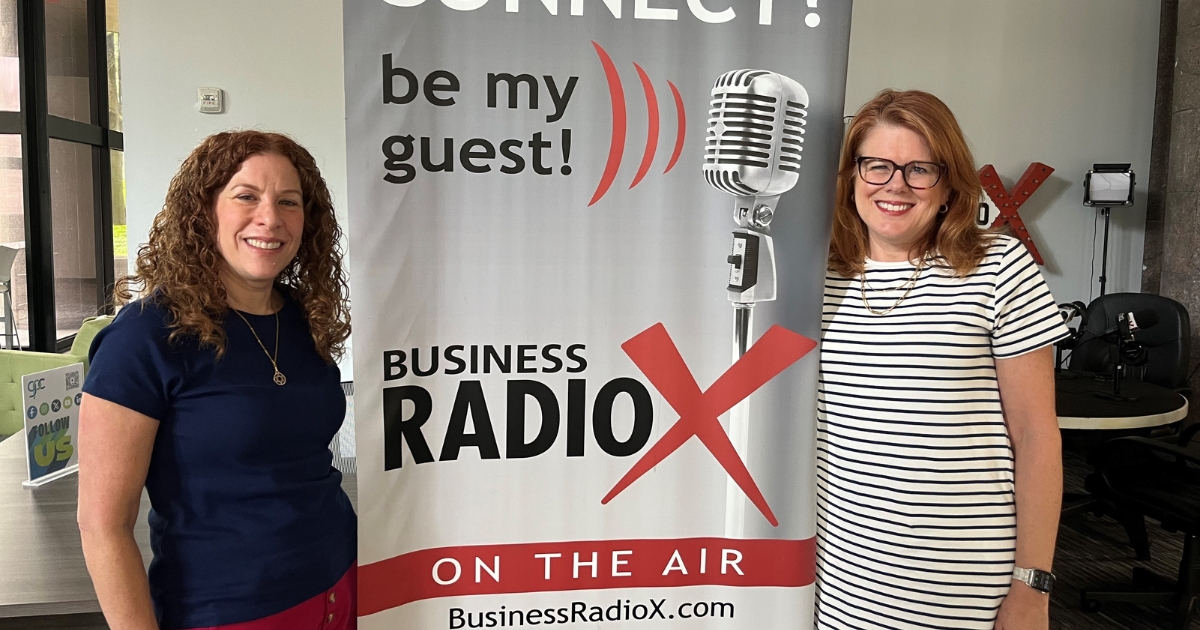
In this episode of Greater Perimeter Business Radio, Lee Kantor and Rachel Simon interview Nancy Gamble, CEO of Hire Profile. Nancy shares insights on the current job market in the creative and marketing sectors, discusses the impact of AI on recruitment, and offers practical advice for job seekers. The conversation covers the importance of networking, personal branding, and cultural fit, as well as strategies for standing out in a competitive landscape. Nancy also highlights the value of authentic employer branding and provides tips for both candidates and companies navigating today’s evolving hiring environment.

 Nancy Gamble brings people together. She uses her connective superpowers for good as the founder and CEO of Hire Profile Inc.
This former California girl got her marketing degree from CSU Long Beach, then worked in advertising in Los Angeles and recruitment in London and Atlanta, where she led the Creating Staffing Team at Aquent. Strong industry vision led Nancy to launch Hire Profile in 2003.
When she’s not matching Atlanta’s top talent with its leading creative and marketing employers, Nancy volunteers on the AIESECLife National Team, cooks, and gardens. She is a roadie for her musician husband. She lives in Alpharetta with her husband and their rescue dachshund mix, Scruffles.
Connect with Nancy on LinkedIn and follow Hire Profile on Facebook.
Episode Highlights
- Current challenges in the job market, particularly for job seekers in creative and marketing fields.
- The impact of economic fluctuations and significant events on hiring trends.
- The importance of networking and building relationships for job seekers.
- Strategies for job applications, including applying to a diverse range of positions.
- Navigating the interview process and addressing extensive project requests.
- The evolving role of AI in recruitment and its implications for the creative industry.
- Practical tips for leveraging AI tools in the job search process.
- The significance of cultural fit between candidates and companies in recruitment.
- The importance of employer branding in attracting top talent.
- Innovative approaches to showcasing candidates’ skills and experiences beyond traditional profiles.
 This transcript is machine transcribed by Sonix
TRANSCRIPT
Intro: Broadcasting live from the Greater Perimeter, it’s time for Greater Perimeter Business Radio. Now, here’s your host.
Lee Kantor: Lee Kantor here with Rachel Simon, another episode of Greater Perimeter Business Radio. And today’s episode is brought to you by Connect the Dots Digital. When you’re ready to leverage LinkedIn to meet your business goals, go to connectthedots.digital. Welcome back, Rachel. How you been?
Rachel Simon: I’m good. How are you?
Lee Kantor: I am doing well. So excited about this episode. We’ve got a great guest.
Rachel Simon: Me, too, I’m really thrilled to have our guest here today, someone I’ve known professionally for probably a number of years, and I was like, why has she not been on our show yet? So, here she is. So, we are going to chat today with Nancy Gamble, who is the CEO and founder of Hire Profile. And, Nancy, welcome. Great to have you here.
Nancy Gamble: Thank you for having me.
Rachel Simon: So, we always kick off every conversation with tell us a little bit about you and your business.
Nancy Gamble: Sure. Well, I’m an advertising, I guess, escapee from Los Angeles area. Everybody pray for them right now. And I moved to Atlanta to take a job as a recruiter for a global, you know, multinational company, and it was a great training ground and really got to know the Atlanta market. I didn’t know a soul when I got here.
Nancy Gamble: And worked there until I decided, like many entrepreneurs do, I could do it without you. I can do it better. And then, you realize, oh, boy, there’s a lot to learn about running a business versus just being a recruiter. However, I was able to keep it going, and we have grown and we have prospered, we’re in our 22nd year.
Rachel Simon: That’s amazing. Congratulations.
Nancy Gamble: Thank you. You know, there’s been ups and downs, I’m not going to lie. But the best part, and it will never get old, and that is calling someone and telling them they got the job. I will never ever tire of that and it’s what keeps me going.
Rachel Simon: Right. It’s those wins, right, that make your heart soar that you’re really making a difference for people.
Nancy Gamble: Yeah, absolutely.
Rachel Simon: I mean, you’ve been in business since 2003, so you’ve been through some ups and downs of the economy.
Nancy Gamble: The mortgage crisis, right. Before I started my business, we had 9/11, we have had threats of recession. I’ve been through lots of presidents. This quarter has been interesting, I won’t kid you. We’ve all been a little maybe freaked out at the news sometimes, but we have to stay strong, stay positive, and the work still needs to get done. And there are great people that have lost their jobs by no fault of their own, and we really want to help as many of them as we possibly can to find new positions.
Rachel Simon: Yeah. So, tell me Hire Profile focuses on creatives, people in the marketing and creative space.
Nancy Gamble: Marketing, creative, advertising, design, PR, digital web, everything like that, anything a marketing department or a creative or digital agency would employ. We don’t do administrative or nurses or IT, or anything outside. We’re very, very narrowly focused, but we are client agnostic in that we will work on corporate accounts, we’ll work with agencies, small boutique agencies, large worldwide companies, all of that, and in all sorts of different industries.
Rachel Simon: So, because you’re focused in the creative space and the marketing space, let’s talk a little bit about the market right now. Would you consider it to be a tough job market?
Nancy Gamble: I do. I do. And I think it has fluctuated some over this quarter. I think a lot of people were a little paralyzed, you know, post-election. Everything was coming so fast, people didn’t know what to think. I think we kind of have, in some ways, normalized the amount of news that will blow your mind every single day. And we are now, I think, built up a bit of a tolerance and we’re able to just focus on moving forward.
Nancy Gamble: So, I feel like we’re going to come out of it soon. But the last couple of months have been tough with big companies laying off entire departments, moving departments to other countries. I’ve had a lot of companies, some leaving Georgia, which I don’t think is political, but just happens to be. So, I’ve just known so many great people that have lost their job and not through any fault of their own.
Nancy Gamble: And so, it’s a great time if you are looking to upgrade your talent, or to add some positions, or to find like an innovation expert on AI because your company hasn’t really adopted it yet, there are just some amazing not only consultants and job seekers out there that could really up anyone’s game.
Rachel Simon: Yeah. It’s interesting. I saw a post this morning on LinkedIn from somebody who was looking to hire, you know, a marketing executive, and they were in the post – I’m going to try to remember it – it was like along the lines of how hard it’s been to find somebody because someone has great creatives, but they don’t understand the data, or the other person just wants to speak to the spreadsheet. And someone else I know who’s a very skilled marketer was like, there’s so many good people out there looking right now, perhaps you need to refine the way you’re looking for your talent.
Nancy Gamble: Well, and that’s why working with a professional recruiter or an agency that does that is that’s all we do. And most of the hiring that gets done, the person who’s doing a lot of the legwork, oftentimes this is a side job for them. They have their fulltime job. So, this search ends up taking quite a bit of time away from leadership and management to interview and screen, and reject, and do all the things that you have to do. And that’s why I think a lot of people say I get ghosted, because the volume of applicants, actually, a lot of the time, is the upfront narrowing of the field to the truly qualified.
Nancy Gamble: And that’s what we do every day, we have a very robust database that has been refined and added to and perfected for 20 years. And we obviously have, you know, the LinkedIn and all that, but we have advanced search tools within that. But it’s really the network. Kat Rutherford is my right hand, it’s she and I putting our heads together and say, ooh, oh, yes. Remember the guy we talked to last week? He would be perfect for so-and-so. And really putting that human element back into it.
Rachel Simon: And we love Kat. And Kat knows literally everyone in Atlanta.
Nancy Gamble: Yeah. When she came to me a number of years ago and really wanted to try something new, and so I thought I will train you to be a recruiter, but you already have the inherent skills, aptitudes, attitudes, everything about wanting to connect people, and she’s just been a star.
Lee Kantor: Now, can you give some advice for that candidate, the person that you mentioned that has maybe been laid off for no fault of their own, but they want to get back in the game, and they are frustrated by what seems to be a lot of attempts to get work, but then they’re not getting the work they feel like they desire. How do they stand out? How do they get on somebody like your radar in order to be found?
Nancy Gamble: That’s a great question. And there are lots of ways to skin that cat. I find that people who are pleasantly persistent —
Rachel Simon: I like how you put that.
Nancy Gamble: — and who write to me on LinkedIn, they offer their attributes, they offer their resume, obviously get things started. But I look for people who are being thought leaders. Even if they’re out of work, they can still talk about the work that they do, talk about companies who are doing that work well. So, I do look for people who are active on LinkedIn and who are also at trade association events or who volunteer to be panel speakers, to be on a committee.
Nancy Gamble: I mean, I remember being on the ad club – I don’t know, an award committee, and we all sat and stuffed envelopes and things like that. I felt like I call those people for the next 20 years because we had that experience together. So, you will have to do a lot of online applications, but you’ve got to get out of your house. And I really advise people to get away from the screen. Do not do this eight hours a day, five days a week because you will go nutso. Get out. Go see some people.
Nancy Gamble: And then, also back to netweaving – remember that book – that was all about going to an event, let’s say, and looking for ways that you can connect the other people in that room versus just looking for connections that will benefit you. Those kind of attitudes will take you far.
Lee Kantor: Now, when a person is out there, should they be doing those kind of applying online to things, or is it more effective to just target certain companies and just see if you know somebody within there and then start kind of rekindling maybe some weaker tie relationships within there to kind of see if there’s opportunities?
Rachel Simon: Two great paths, and the answer to both is yes. So, an example is my own husband. He’s the husband of a recruiter, so I have a lot that I can share with him, which he may or may not like at the beginning. He was leaving the mortgage industry, which is an obvious thing to do right now. But he wanted to go into something else as a client success.
Nancy Gamble: And he said, I am only going to apply to LinkedIn positions that I see, that I know somebody at that company. I said, that’s great and you need to do that, but I don’t think there will be enough volume. You will have to apply to some jobs that you don’t know anybody, companies you’ve never heard of, all of it. And he ended up getting a job that he loves at a company he’d never heard of in which he knew no one and loves it.
Rachel Simon: Oh, interesting.
Lee Kantor: And what was his path to that?
Nancy Gamble: Linkedin.
Lee Kantor: So, if he didn’t know anything, how did he know to choose that company?
Nancy Gamble: It was a role that he is familiar with, but he didn’t know the company. So, he’s a client success manager and he ended up getting a great job with Hannon Hill, and we’re just thrilled about it. So, it can happen to anyone.
Lee Kantor: So, it’s and not or?
Nancy Gamble: Yeah. So, like for an average job seeker, how many applications might they need to be completing? It really depends because I don’t think there is any average, because there’s entry level, there’s mid-management, there’s C-level people that are all looking, so I don’t have an exact number for you. But I have a dear friend who’s out of work and I won’t name her, but she will text me, I applied to 300 jobs this week.
Rachel Simon: Oh, goodness.
Nancy Gamble: I don’t think that is a number that other people need to replicate. I think it would be much less.
Rachel Simon: Okay. Yeah. But that’s tough. That’s an intense number of applications.
Nancy Gamble: Yeah, and then she’s like, I have to get out and get away from the screen or, you know.
Rachel Simon: Okay. I have a question, because this is something I see a lot in some of the marketing groups that I’m in. What is your opinion, in the marketing space, often people are asked to do pretty comprehensive projects as a part of the interview process.
Nancy Gamble: That’s a great question, and it’s something that recruiting firms have, I can’t say wrestled with, because we’re pretty against it if it starts to smell like a paid project.
Rachel Simon: That’s exactly what I was wondering.
Nancy Gamble: If it is something for their true future, if it is something that is intensive as far as workload, then I would push against that. Now, we have had people do a prospective 30, 60, 90 day plan. We have had people have to write a press release. We were working years ago with Cartoon Network, and I thought what they did was one of the smartest – this is a long ago – was they pulled a job jacket and they gave three or four art directors an old project that had already been completed, aired, everything, but they didn’t know about it, so they got the original brief.
Nancy Gamble: And so, this was a true project that – excuse me, it was a true test, not a paid project. This is something they weren’t going to use in the future. And then, it was a really good test of who would get the job and understand their work.
Rachel Simon: Yeah, that makes a lot of sense. I’ve just seen so many job seekers, again in various groups, who feel very uncomfortable being asked, and often with like 48 hour turnaround time, to complete a strategic plan to do X, Y, and Z. And they’re like, are you going to use this if I don’t get the job?
Nancy Gamble: Yeah. Well, that’s very, very true. And I always say, pay attention to the tension. If that is bothering you and you don’t feel like you’re being treated fairly and justly, then that’s a sign you probably need to walk away.
Rachel Simon: Yeah. Very interesting.
Nancy Gamble: And I’ll make one other comment about that. I think these elaborate tests are an indication that a company really doesn’t know how to hire. They don’t know how to see the skills and to truly assess a human being for their skillsets and their probability of success. So, they put them through all these hoops so they can see it in writing. I think if they were better interviewers, they wouldn’t need to go to those great lengths to find the right person.
Rachel Simon: Yeah. Interesting.
Lee Kantor: Now, how would you advise the candidates when it comes to AI? And I know AI for creatives is kind of a double-edged sword. I mean, it’s something here that seems like a wave that is not going away, so you better accept it in some form.
Rachel Simon: Definitely.
Lee Kantor: But there’s a lot of creatives that are kind of anti-AI in the sense that it’s cheating in some manner. They have some apprehension about using it or even saying they’re using it. So, how would you, if you were a creative, kind of leverage AI, or at least feel better about using it in order to upskill yourself? Because these jobs, it’s a must have at some point, if not now already.
Nancy Gamble: Right. The saying is that AI won’t replace your job, but somebody knows how to use AI well. So, I think they’re going to have to embrace it to some degree. Now, do you just throw a bunch of prompts in there and take whatever they give you? No. But if you can use it as an idea generator that then helps you have a launching pad to go create your own work, I think that it can be a useful tool.
Nancy Gamble: There was a great post, I think it was a Nike ad that they gave the creative brief to AI to see what they would come up with. And it was so far below what the agency had come up with. It was for the WNBA. And I just was like, wow, you can’t take the human element out. We’re not there yet. Hopefully whenever, we’ll be there, where the human doesn’t —
Rachel Simon: A friend of mine likes to say AI didn’t have a childhood, right?
Nancy Gamble: That’s great. I love that.
Rachel Simon: No, I mean, on the AI topic, which we talk about almost every single show because it’s just such a prominent topic for all professions, do you think that the market for people in the marketing and creative space is where it is right now because companies think that they can just throw some prompts into AI and they don’t need a copywriter anymore, like Gemini can write our stuff for us. We’ll just say, do this and then make three edits and post it.
Nancy Gamble: Yeah, I think there’s going to be some of that, probably. I do feel for the entry level college grads that are coming in for those entry level copy editor type positions, those might be fewer and further between. But not all companies have embraced AI, obviously.
Nancy Gamble: I was talking to a guy yesterday – not yesterday, two days ago, and he was saying that, you know, just think about the cost. Let’s say you have a thousand people, and all you do is give them ChatGPT at $20 a month. How much is that a month? $20,000 a month just to give one of the more basic AI capabilities to your staff.
Nancy Gamble: So, they’re not all there yet. I think that job seekers, as well as people on the job, need to use it as a tool to save them time and to be a jumping off point for creative work. I think obviously cleaning up your own writing, getting ideas, I mean, you can take it to make whole social media plans and calendars, and those types of tasks, I think, is a great use of it.
Rachel Simon: I agree, it is an amazing thought partner and a pretty darn good editor, too, right?
Nancy Gamble: Yeah. Yeah. I’ve learned a lot about commas and where to put them.
Rachel Simon: I have one client that has a certain word he just hates in content, and so I can say find what that specific word is in this blog and then remove them, because it’s much faster than if I’m reading it myself and I might miss one.
Nancy Gamble: Right. Right. Interesting. AI is not going anywhere. And one of the things, I’ll give one of our cheats out to job seekers, and we use this to help us as well, is, taking a job description and putting it into ChatGPT and asking what the top five questions would a hiring manager ask based on this job description for a job in client success or whatever. Then, you take what it gave you and say, now give me the answers.
Rachel Simon: Oh, that’s very interesting. And then, I suppose you could upload your resume into it to say –
Nancy Gamble: Yes. Take off your contact information, but yes, say, based on my experience, how would I best address these top five questions? So, yes, playing around with that and being ready and prepared for the most likely questions would be a great use of AI.
Rachel Simon: Yeah, I love that idea.
Lee Kantor: Now, is there any AI platforms that you recommend? Like you mentioned, ChatGPT, is there any AI platforms that are kind of geared towards marketing and advertising folks or creatives that is, you know, better than another?
Nancy Gamble: I am probably not the person to ask because I’m a little old fashioned that I’m still doing my own writing. So, no, other than ChatGPT, I don’t have a recommendation. I mean, obviously Gemini is on every screen that we open in Google, but that’s very information-based, like collecting information from all sorts of different sources to create an answer to a question.
Lee Kantor: But marketing firms aren’t asking, oh, I need somebody with this kind of experience. Are they even kind of tracking AI? Like do they ask you to say, look, they have to have, you know, so much? Or we’re just still at the beginning in this?
Nancy Gamble: I think we’re still at the beginning. It hasn’t become a job requirement in any of the jobs that we have had, I would say, in the last quarter, six months. Now they might start adding must understand AI, but I haven’t seen it yet.
Rachel Simon: Yeah, and I think it probably depends on, you know, is the company Microsoft-based, because if so, they’re probably going to only use Copilot. If it’s Google-based, they’re probably going to only use Gemini, because they can be internal so that it protects personalized information.
Nancy Gamble: I do know of one that I was talking to somebody at an event last night, and they were talking about Leonardo, that now has a new partnership with Canva, so that is something that, I believe, it creates video and now that’s built into Canva.
Rachel Simon: I love Canva.
Nancy Gamble: But then, there was a whole talk about are you a graphic designer just because you know Canva? Like there used to be so much that led up to you being able to be a commercial designer or content creator, and now it’s like, I can use Canva.
Rachel Simon: Yeah, I would say as somebody who’s used Canva pretty regularly for many, many years, I am 100 percent not a graphic designer, but I sure do love to make things in Canva. But there’s things that I am good at and other things where I’m like, yeah, this is not going to work. So, there’s still a lot of skill with the actual graphic design software.
Nancy Gamble: Like me losing and Canva could be a dangerous thing.
Rachel Simon: Yeah, exactly. So, let’s talk a little bit about, you know, you mentioned LinkedIn and kind of showing up as a thought leader. You know, I have obviously a lot of experience helping professionals who are in their current roles to position themselves. So, what are the things that you would look for a candidate that is going to help them break through the noise? And sort of my experience and sort of opinion is we don’t want to be we writing our profile for our intended audience. So, for job seekers, that intended audience is potentially the next company they could be working for.
Nancy Gamble: Well, that is an interesting, timely question, because I had a conversation with a woman who has a company that actually we’re going to start partnering with them. It’ll be released in our next newsletter. But it is where you can host a website that is just simply your name dotcom. It’s hard to explain you, it’s a page about you, but it talks about what your offerings are, any pricing packages that you have, when should you come in on a project, what problems do you solve. It’s very much catered to what you’re trying to do as a freelancer.
Nancy Gamble: They are going to be working on a job seeker one, but it’s so much better than having to build a website on your own, and also just sending someone to your LinkedIn page, which is much more chronological and doesn’t necessarily speak to what you’re trying to convey. So, we’re going to be helping candidates be able to create those profiles that they can then use in their search.
Rachel Simon: I feel like there used to be a website, because I believe I had a profile on it that was called like me.com, and it did something similar to that. That would have been like at least ten years ago.
Nancy Gamble: Yeah, that’s probably gone and maybe this will replace it.
Lee Kantor: Now, when you’re working with your clients, you mentioned you work with both kind of enterprise and agency, what does that look like? Are they coming to you because they’re frustrated, or are they coming to you because they just are trying to fill this position they can’t? Like what does that look like the beginning of a relationship?
Nancy Gamble: It has started on several notes. Sometimes they come because they’re failing, and that’s okay, this is not their main job. They’ve found a few candidates. Nothing good seems to be coming through their own posting. They said, we need to up our game. We need to get this filled and we’re not finding them. And that’s a great place to start.
Nancy Gamble: I like to start more at the beginning, before it’s been out there and beaten to death and, you know, but I can still come in and offer fresh ideas and fresh talent.
Nancy Gamble: We have people that have worked with us repeatedly, and they know what it takes to go do all of this legwork themselves. So, they come to us at the beginning and they said, you’re it, you do it. Even if we get an internal applicant, we’re going to send them to you to screen, profile, and then present them back to us with rationale, or obviously say that they weren’t a good fit.
Nancy Gamble: So, we’ve had both. I always talk to Kat about our ideal client, and a lot of times it’s a non-sexy mid-market company that they don’t have an entire recruiting team. They don’t have procurement. They don’t have chief people officer. They’re like, we need people, but we don’t have a department to take this on. And we’re not getting resumes under the door every day because we’re not Spanx or whoever. Those people are the people we can help them right away.
Rachel Simon: I mean, it’s the same for that size company who may not have an internal marketing team, right, and they’re going to bring an agency in to do their their marketing team.
Nancy Gamble: Absolutely, and we eventually helped companies be matched with agencies, too. That’s great fun, so much fun. And so, a lot of times it’s, okay, we’re getting rid of our agency, and now we’re going to bring it all in-house, and we got to build a team. So, we’ve had probably every scenario come. I like it when it’s near the beginning, but I also like it when somebody says I’m not touching this anymore, just do your thing, and that’s great.
Lee Kantor: So, what are some of the questions you’re asking them to really hone in on who they really want or what need they’re trying to fulfill? Because I’m sure a lot of times they’re coming to you with what they think they need, but because of your expertise, you’re like, well, maybe that’s a starting point, but what you really need is this instead. Like, you got to kind of work through it, right, because they don’t know what they don’t know and you see this every day.
Nancy Gamble: That’s such a great comment, because one of our kind of adages within recruiting is, if you want to make some money in recruiting, don’t give the client what they want, because they will come to you.
Nancy Gamble: And I had an organization come to me saying that they had too many men in leadership. They really needed a woman for this creative director role, and they really wanted somebody that came, but not from a design background. They wanted like a copy background. They wanted somebody in the local market who already had a lot of connections. I didn’t fill the role.
Nancy Gamble: And the guy moved in two doors down from me. I said, “Oh, nice to meet you, new neighbor.” He’s like, “Yeah, I just took this job as creative director here.” And he was a male from out of town with a graphic design background. I was like, oh, my gosh. I was trying to give them what they wanted and it wasn’t it.
Nancy Gamble: So, we really try to get what’s not written on the resume – or excuse me, the job description, what’s between the lines. And we really talked to them about who succeeded in the past, why didn’t the last person succeed, and also give me the good, the bad, the ugly. And sometimes it’s emphasis on the ugly. Is there a manager that’s driven off people? Is there a lack of resources? Is there something about this job that’s going to come up later?
Nancy Gamble: And we have a whole intake form that gives us the ability to walk through everything from department structure, to management styles, to, like I was saying, success, what attitudes, what skills, what professional demeanor is going to succeed here, and it’s different for every company.
Nancy Gamble: We really want to get into their culture as well. And a lot of people say we have a great culture. Well, what is that? What does that mean? Does that mean a beer truck comes around on Friday or does that mean I pay 100 percent of their benefits? So, it’s, okay, I appreciate the snacks, but let’s talk about what could really woo a top candidate and what makes this a great place to work.
Rachel Simon: Yeah, it’s interesting to think about that because companies, you know, one of the areas that is kind of becoming bigger and bigger in marketing is employer branding, and so how are companies positioning themselves to attract top talent?
Nancy Gamble: Yes.
Rachel Simon: And some companies are excellent at it. And lots maybe not so much.
Nancy Gamble: Yes. And we, as a third party agency, obviously, we don’t work there every day. So, in some ways we have to go a lot on what they tell us. And then, of course, we talk to people who have used to work there and this and that.
Nancy Gamble: I totally forgot what I was going to say, but getting under the hood with a client and also them having the relationship where we can give them feedback, “Okay, Jane went on your interview. She’s going to withdraw herself from this and here’s why, and you need to hear this. Your manager ate a sandwich the whole time they were on a Zoom call, or whatever. You know, this isn’t going well, that you’re not presenting your best foot forward.” Because we get a lot of feedback on our candidates, so sometimes we have to be able to have that relationship where we can give feedback back to them.
Nancy Gamble: And also at the beginning, if the salary is not up to par, it’s, you know, five days a week in office at a low salary and this, that and the other, you know, we’re going to have to say you’re going to get pushed back in these areas. You are giving us ten tough to fill criteria, we’re probably going to find seven of them. And you’re going to have to tell us which one or two or three you could live without. And so, we boil it down as far as we can.
Rachel Simon: Yeah. Very interesting.
Lee Kantor: Can you share a story where somebody came to you with a challenge and you helped them fill that position and helped that company maybe get to a new level? Obviously don’t name the name of the company, but maybe just the challenge that they had and how you were able to fill it and then elevate the company because of that.
Nancy Gamble: I have a very recent story, which we just had a sign offer and expect acceptance, but we probably had one of the tougher jobs to fill that we’ve had, and it was for a global CMO of a direct to consumer brand, but they had to know how to sell in the EU, in France and England. A lot of people say global, but that might mean Canada and Mexico. It might mean we have partners in China. But this was very specific and it was managing global teams.
Nancy Gamble: And the company came to us at the beginning and said, this is yours, just do what you do. And I mean, the Snoopy dance was going on with Kat and I, and it was a long process. I think we worked on it since April and she starts next week. And it was great to have that relationship and to have the trust of the head of it. This one does have an HR department. And to know that this is the right person for the job and they are going to take them to another level.
Nancy Gamble: We just saw a LinkedIn post the other day on a candidate who has absolutely grown her company. She has become now a client of ours, and we placed in a chief growth officer type of role. And her company is recognizing her and creating posts about her success and what she’s done for the company, leading marketing summits. You know, I just couldn’t be prouder, and we rejoice in their success. That is how we feel good about ourselves.
Rachel Simon: Are most of your candidates and jobs here local in Atlanta?
Rachel Simon: We’re probably 90 percent metro Atlanta or the surrounding suburbs. We’ve done some work in Bentonville, Arkansas, and we’ve done some Birmingham, and we’ve done a little Florida. But I would say there’s so much going on right here.
Rachel Simon: Yeah, definitely.
Lee Kantor: Now, before we wrap, we always like to share some LinkedIn tip. Is there a LinkedIn tip for a person trying to find the right candidate? Is there anything they should be doing or not doing in order to attract the right folks to their organization?
Nancy Gamble: Well, they need to call me, but, yes, I mean they have to have obviously a very clear objective of what they’re looking for. They have to post it. They have to create posts about it. They have to welcome conversations and put a name and a face with the opening instead of having it just be anonymous. And they should probably be thought leaders, too, and be out there and be reachable. Being reachable and approachable is really important.
Lee Kantor: Now, if somebody wants to learn more, have a more substantive conversation with you or somebody on the team, what’s the best way to connect with you?
Nancy Gamble: Well, you can connect with me on LinkedIn, and also you can call or you can email me. You can call 404-806-2285, that’s our main number. My email is nancy@hire-profile.com. And I’m happy to hear from you.
Lee Kantor: And that’s H-I-R-E.
Nancy Gamble: Yes, yes, H-I-R-E.
Lee Kantor: Good stuff. Well, Rachel, great chatting with you.
Rachel Simon: Great show. Good stuff.
Nancy Gamble: Thanks, guys. I appreciate the time.
Rachel Simon: Loved having you on.
Nancy Gamble: All right.
Lee Kantor: All right. This is Lee Kantor, we’ll see you all next time on Greater Perimeter Business Radio.
About Your Host
 Rachel Simon is the CEO & Founder of Connect the Dots Digital. She helps B2B companies close more business by leveraging the power of LinkedIn.
Rachel works with professionals, both individuals and teams, to position their authentic brand on LinkedIn so they can connect organically with ideal clients, attract the best talent, and stand out as a leader in their industry.
Connect with Rachel on LinkedIn.














