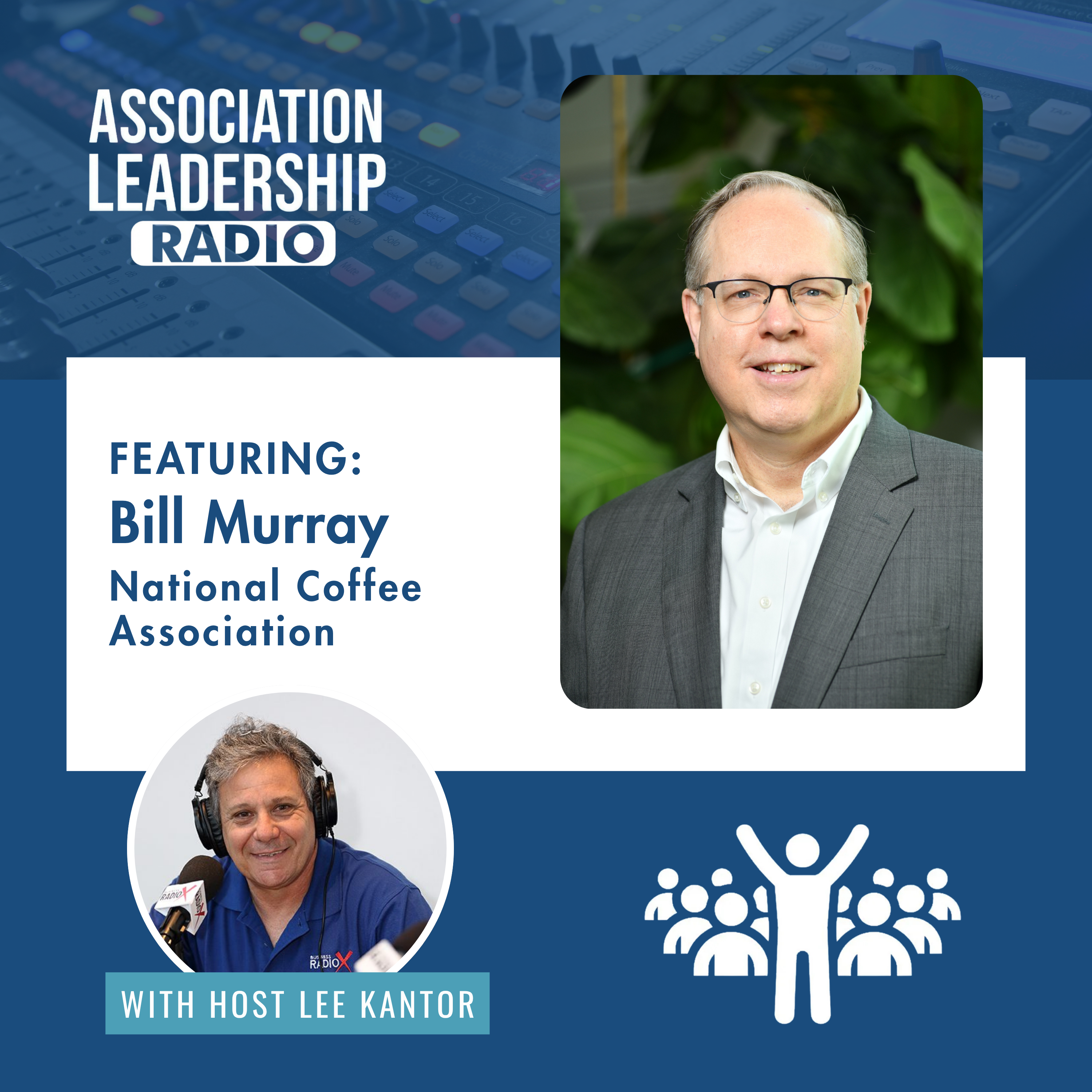

In this episode of Association Leadership Radio, Lee Kantor is joined by Bill Murray, President and CEO of the National Coffee Association. They discuss the NCA’s mission to support the coffee industry, changing trends like the rise of specialty and cold coffee, and the importance of delivering real value to association members. Bill shares insights on adapting to the digital age, understanding member needs, and fostering community through coffee. The conversation highlights the evolving role of associations and the cultural significance of coffee in society.

 William “Bill” Murray is President and Chief Executive Officer of the National Coffee Association, U.S.A. (NCA), a role he has held since June 2014. Bill leads NCA’s advocacy, regulatory, and member support activities on behalf of the hundreds of coffee-focused organizations that comprise NCA’s membership.
Prior to joining NCA, Bill was Chief Executive Officer of the Public Relations Society of America (PRSA), the world’s largest professional society for public relations practitioners and students with more than 32,000 members, successfully steering PRSA through “the Great Recession.”
Before joining PRSA, Bill worked in Hollywood for more than 20 years, capping his career as Executive Vice President and Co-Chief Operating Officer at the Motion Picture Association of America (MPAA), which represented the $40 billion multinational entertainment industry in more than 70 countries.
Follow NCA on LinkedIn.
Episode Highlights
- Overview of the National Coffee Association (NCA) and its mission
- Membership composition of the NCA, including representation of coffee shops and larger organizations
- Bill Murray’s background and journey to the NCA
- Changes in the association landscape over the past 15 years, particularly due to digital communication
- Importance of delivering tangible value to association members
- Evolution of market research offerings by the NCA
- Understanding and addressing member needs and challenges
- Trends in coffee consumption, including the rise of specialty coffee
- Increasing popularity of cold coffee beverages among younger consumers
- Cultural significance of coffee preparation and its role in social connections
 This transcript is machine transcribed by Sonix
TRANSCRIPT
Intro: Broadcasting live from the Business RadioX studios in Atlanta, Georgia. It’s time for Association Leadership Radio. Now here’s your host.
Lee Kantor: Lee Kantor here another episode of Association Leadership Radio. And this is going to be a good one. Today on the show, we have Bill Murray, who is the president and CEO of the National Coffee Association. Welcome.
Bill Murray: Well, thank you very much, Lee. I need to know right away. Who am I talking to? Are you a coffee drinker? That’s a key question.
Lee Kantor: Well, I am a coffee drinker and I’m a big fan of coffee, so I am excited to be talking to you.
Bill Murray: Perfect. Well, we’re off to a great start. Thank you.
Lee Kantor: So before we get too far to things, just tell us kind of an a macro view about the National Coffee Association and mission purpose. Who are you serving?
Bill Murray: Yeah, well, we are a trade association. We represent hundreds of companies in the coffee arena. Coffee importers, coffee roasters, equipment manufacturers, financers. Anybody who has an interest in the US coffee market. They’re welcome to join the association. And that’s who we represent. Our mission overall is to be an advocate for coffee, to get the facts about coffee out to the public, to work in the regulatory arena. You know, big picture. We want coffee drinkers to have access to their coffee and information about coffee. And we want coffee companies to be able to prosper to meet the needs of coffee drinkers.
Lee Kantor: Now is part of your membership the coffee, um, kind of the coffee shops where people drink coffee or is that a separate group?
Bill Murray: We have some coffee shops who are members, but we’re mostly roasters, importers. We’re typically larger organizations.
Lee Kantor: So what’s your backstory? How’d you get involved in, uh, in this association? Have you always worked in associations?
Bill Murray: I’ve always worked in associations. Uh, I started working in the motion picture industry many, many years ago. Uh, and that got a little tricky. Bill Murray working in the motion picture industry. But I’m not the actor. Uh, we were working on copyright issues. On market access issues. Uh, and eventually I made a move into the public relations arena. Uh, I worked for the Public Relations Society, uh, for about eight years. Uh, and then I was looking to do something different and this coffee position opened up. And one thing led to another. Uh, and they decided we were a good fit for each other. Um, but it wasn’t a logical transition. You know, I think initially the association wanted somebody who knew a lot about coffee. And I always loved coffee, I drank coffee. But during the interview discussion, we really came to. What do you want to do with the future of the association? Do you want to keep doing what you’re doing? Do you want to keep just being focused on coffee? Or do you want to bring a different perspective into the association from somebody who’s worked in other sectors? And that’s how I ended up here. They thought maybe we should be looking outside the world of coffee to pull out our future.
Lee Kantor: So what did you see outside of the realm of coffee in the future. Like, what was your vision?
Bill Murray: You know, I think one of the things that’s difficult about associations is that the world of associations has changed completely over the last 15 years. We used to have a lock on what we did. We provided information. We provided networking. We facilitated connections. We hosted events. And if you wanted to do everything within your discipline or your industry, your association was almost the only place you could go. But the digital world has completely changed all of that. And I think a lot of associations are comfortable just doing what it were traditionally doing. I believe that associations really have to deliver into aspects. We certainly do the network and the advocacy, the regulatory work. But we also have to provide tangible benefits for members. Things it can touch, angles they can use. So the end of the year when I look back and they say, hey, I was a member of the association, what did I get for my membership? There’s a full range of different things. We deliver market research. We’ve delivered technical documents on safety. For example, I see a world of associations where we have to deliver both of these things to make sure we keep our members coming at us.
Lee Kantor: I think you bring up a great point, and I don’t think enough associations are really focusing in on tangible value to their members. I think that they they aren’t kind of thinking the way you’re thinking in terms of really, if you’re not doing that, if you’re not pushing the value line to your members, you know, why are you even in the association yourself?
Bill Murray: You’re right. I mean, look, everybody’s under cost pressure. You know, and if you go back 15, 20 years ago, people join our associations almost because it was a a it was an obligation. You know, we’ve always been a member that’s no longer a reason to get people to make a contribution, to make that commitment. So the way I look at what we do here at the Coffee Association, we’re certainly active in the advocacy arena in Washington, working on regulatory issues. But over the course of each year, my objective is to make sure that we trickle out of useful, tangible Or resources on a regular basis over the course of the year. Sometimes that’s market research. Sometimes it’s little. It’s sometimes it’s information on technical dimensions. Coffee, coffee production. And you want to stay visible. You want to stay tangible. You simply can’t say to people, you know, we’re your advocate and we’re speaking up for you. That’s not enough anymore.
Lee Kantor: Yeah, that’s great points. And I hope other association leaders really, um. Keep it. Keep all that in mind as they’re leading their associations. Because I think what you’re saying is just so spot on. You cannot act as if the internet doesn’t exist. You, you you can’t behave just because your association’s 100 years old, that the internet isn’t here and that people get information from a lot of different places and and that’s just you’re not doing enough.
Bill Murray: I couldn’t agree with you more. The world has changed. And you know, if you’re not going to embrace that evolution, you know, look at what’s happening in the world around you. Talk to your members and have these hard conversations. You know, when I came to this association, it was a very different association. I was asking, what are the tangibles that we deliver? And there were very few and far between. And I was asking the folks that were working in the association, when people ask, why should I join the association, what do you tell them? And I just felt that the value proposition needed a lot of work. And, you know, I can give you an example. We do research on coffee drinkers every year. Or consumers. What do you drink? And how much are you drink? And we’ve always done this historically. When I came to the association, we essentially delivered one annual market research product for the year. That was it. Here. This is what people are thinking. It turned out there was a rich amount of data and information. We could take that and put it in an interactive database. We could give it to people not just in a printed document, but in a PowerPoint, and unlock it because they’re using it for sales presentations, for market assessments. We could do some reports using a database. We could take what was a static snapshot, and if it was a half a dozen different products and put it to the members at essentially the same price, that adding one piece of market research. So now that’s a perspective which is look at the value. Are there opportunities to make it more tangible and deeper her and keep doing that because you got to keep up with what’s at them.
Lee Kantor: Right? You’re delivering a way for them to make more revenue. And you know, that’s why they’re in business.
Bill Murray: You know, you just and the absolute key to the whole thing, I mean, when I talk to my members, what is the biggest issue you’re facing? You know what they say new business, business development, new customers. How do I grow my business? So that really requires us, from our perspective to say, okay, if I were in their shoes, what are the types of things they could be doing now? Which of those are appropriate for an association to support, and how do we do that? You know, my background personally, I’m an MBA. I went to business school, and I think that’s the perspective that I come from here. I think about this constantly as a business and my members business, and how do I support their business?
Lee Kantor: And also your background in PR and in the motion pictures, they’re all tie in as well. Like you’re you’re very focused in on, um, you know, kind of the client’s client.
Bill Murray: Absolutely, absolutely. I mean, the motion picture industry was really interesting. Uh, everything that they say about Hollywood is true. It’s a very, very tough place. Uh, people are brutal and they’re ruthless. And when you talk to people and you ask them, you know, what do you expect? And they’re right to the pain. They want to hear from you directly. They want to know how it’s going to impact what they’re doing. You know, I tell you a funny story. Uh, I was maybe one year out of graduate school at this motion picture Association, and every year Or they went out with a budget request and they asked for more money for the next year, as we all do. And that particular year, for the first time ever, one of the studios pushed back on the association. And I said to the association, before we can decide if we’re going to give you more money. Tell us what you did with the money we gave you last year. Well, this association had never done that before. I mean, they’ve been around forever. I was low man on the totem pole. The recall has to win through the association.
Bill Murray: It ended up on my desk. So I started asking people, you know, what did we do last year? And they would say things like, well, we had 22 meetings where we talked about things. We issued 50 memos on different topics. And I’m a little embarrassed to admit it. I mean, I just wrote all that down and I put it in a report and I went off to the studios. And I said, what do we do with the $30 million he gave us? Last year? We had 180 meetings and we wrote some memos and they seem happy they went away. But, you know, a couple of years later, as I came to understand what we were doing, I looked back at it and I was really embarrassed. I mean, if you said to me, what did you do last year? And I said to you, I convene 20 meetings. We’re missing the whole point here. What was the what was the outcome? How did you help people? Are there metrics? Right. And that’s been my evolution personally moved from activities to outcomes and value.
Lee Kantor: Yeah, I think that I mean, I hope other association leaders are listening to you because I think you are doing it exactly the right way. I mean, you have to your reason to exist is to help your clients, which are your members, make more money and help them grow or otherwise. Why do you need an association?
Bill Murray: Exactly. It’s not a social club. It is a business advocacy group. The social aspects are there and they are wonderful. But that is a byproduct of the real purpose of enterprise.
Lee Kantor: So let’s talk a little bit more about coffee because as I said, I’m a fan. You’re a fan. A lot of our listeners are a fan. Is there any trends in coffee consumption that we should be paying attention to?
Bill Murray: Yeah, absolutely. Um, oh, there’s so much we can talk about. First of all, overall, there is the rise of what we call specialty coffee. Now specialty coffee. It’s an interesting expression because there’s an official or technical definition of specialty Coffee. I don’t know how many folks are wearing this, but there are people who get certifications in coffee tasting just like a salt lawyer. Hey, and these coffee tasters will taste coffee. They will give it a certain point, and then technically, that becomes specialty coffee. But specialty coffee also has almost become a mark in description. And people will say, my coffee specialty. More and more consumers now tell us that they drink specialty coffee than ever before. 51% of coffee drinkers, more than half say they’re drinking specialty coffee. And I think what’s important here is what this really says about coffee our appreciation footprint and what’s happening. People are curious about coffee. They want to learn about coffee. So people are becoming more sophisticated and they certainly aren’t becoming more sophisticated. They want to try different things. And I see that continuing into the future. So one trend is we want to look for different, better, diverse coffees and see what that’s like.
Bill Murray: The other big thing that’s happening, and maybe, you know, today it’s about 100 degrees where I am. So we should talk about cold coffee. I hear this June, a more and more people are drinking cold coffee. These are either frosted beverages, iced coffee, cold brew coffee, things like this. What’s interesting in particular is this is driven by younger, younger people, in particular 80% of coffee drinkers are young coffee drinkers. Those who are 18 to 24 or are drinking cold coffee in one form or another. Older coffee drinkers. Only about 12% of people over the age of 60 are drinking cold coffee. So you’re saying cold coffee and a lot of different, um, formats. You see a RTD or a new drink beverage? Pre-modern beverage is, uh, in a cooler. You see coffee over ice, you see cold brew coffee. You see frozen beverages. Uh, but I think cold coffee is here to stay, and it’s going to be a bigger and bigger piece of the coffee world.
Lee Kantor: And and a lot of it, you think, is because the younger generation is embracing it. And they’re I mean, they’re using it kind of like an energy drink.
Bill Murray: Well, so this is really interesting. Um, if you look at how people drink coffee as they age. You see something very affluent and people that are 18 years old. They’re not drinking so much coffee where the coffee drinking habit really kicks in, where people double the amount of coffee they’re drinking or they triple it is after they’re about 24 years old, 25 years old. This is typically an age where you might start a family, you might have married, you might settle down where your adult responsibilities kick in. So it’s probably not coincidental that as people get older, they drink more coffee. They take that energy from caffeine and they embrace it. So right now, the people that are primarily focused on coffee, or in that 18 to 24 age group, I think it remains to be seen whether they’re going to keep drinking cold coffee as they get older? Is this going to diminish as they’re running around doing 50 other things? Um, we’re going to have to find that out as the years go by.
Lee Kantor: Yeah, I think as the popularity of the ready to drink it, you know, the pros and cons of that are it’s it’s simple, easy. You can drink it right there. But some of at least for me, the joy of coffee is the ritualistic preparation and consumption of it. Like to me, they go together. It’s not just I’m just just drinking it for the, you know, caffeine or the end result.
Bill Murray: You know, I think that’s one of the things that is so special about coffee. I mean, you’ll say to some, let’s get let’s get together for a cup of coffee. Or if you’re working in an office location, people might get together on the coffee machine and have a conversation. You know, I met somebody when I first took this position. Um, this person said to me he was an older gentleman. He said, coffee has been responsible for my marriage. And he said, it’s in a good way. My wife and I’ve been married for 35 years and I was baffled. How is coffee responsible for your marriage? And he said to me, you know, I always get up in the morning before my wife. I’m an early riser at my job. I get up and do everything and get ready. And the last thing I do, I read it before I leave. I make her a cup of coffee and I bring it to her in bed. I wake her up with a cup of coffee and. And, you know, for me it was so beautiful. And it just captured the, the culture, the aspects of community. The anchor, the coffee is for so many of us, which is one of the things that makes this job so interesting and so much fun.
Lee Kantor: Yeah. I mean, it’s part of people’s day. I mean, it’s just I mean, a lot of people like. Like that guy. His day starts with coffee.
Bill Murray: Absolutely. So, um, so I think coffee, you know, we have optional coffee drinkers. Uh, these are folks who say I just need the caffeine. I just need some coffee. We have social coffee drinkers. People want to get together around a coffee. We have people that just love coffee. They love the taste of it. They love to customize it. They love to experiment with it. 73% of this country drinks coffee. Uh, probably more than just about anything else we do together. It’s more people than drink water or milk. Uh, just about anything else that’s out there. So coffee is absolutely a core part of who we are as a And, um, then, you know, after all, we got started with the Tea Party being really weak and tossed in the ocean, and we had to drink something else. So here we are.
Lee Kantor: Here we are. Well, if somebody wants to learn more about the association, is there a website? Is there a way to connect with you?
Bill Murray: There certainly is. Uh, n a USA, not Oregon and CAA as in. National Coffee Association nca usa.org and you can reach us through the website and learn more about coffee.
Lee Kantor: Well Bill, thank you so much for sharing your story today. You’re doing important work. We appreciate you.
Bill Murray: I really enjoyed this. Thanks for the opportunity.
Lee Kantor: All right. This is Lee Kantor. We’ll see you all next time on Association Leadership Radio.