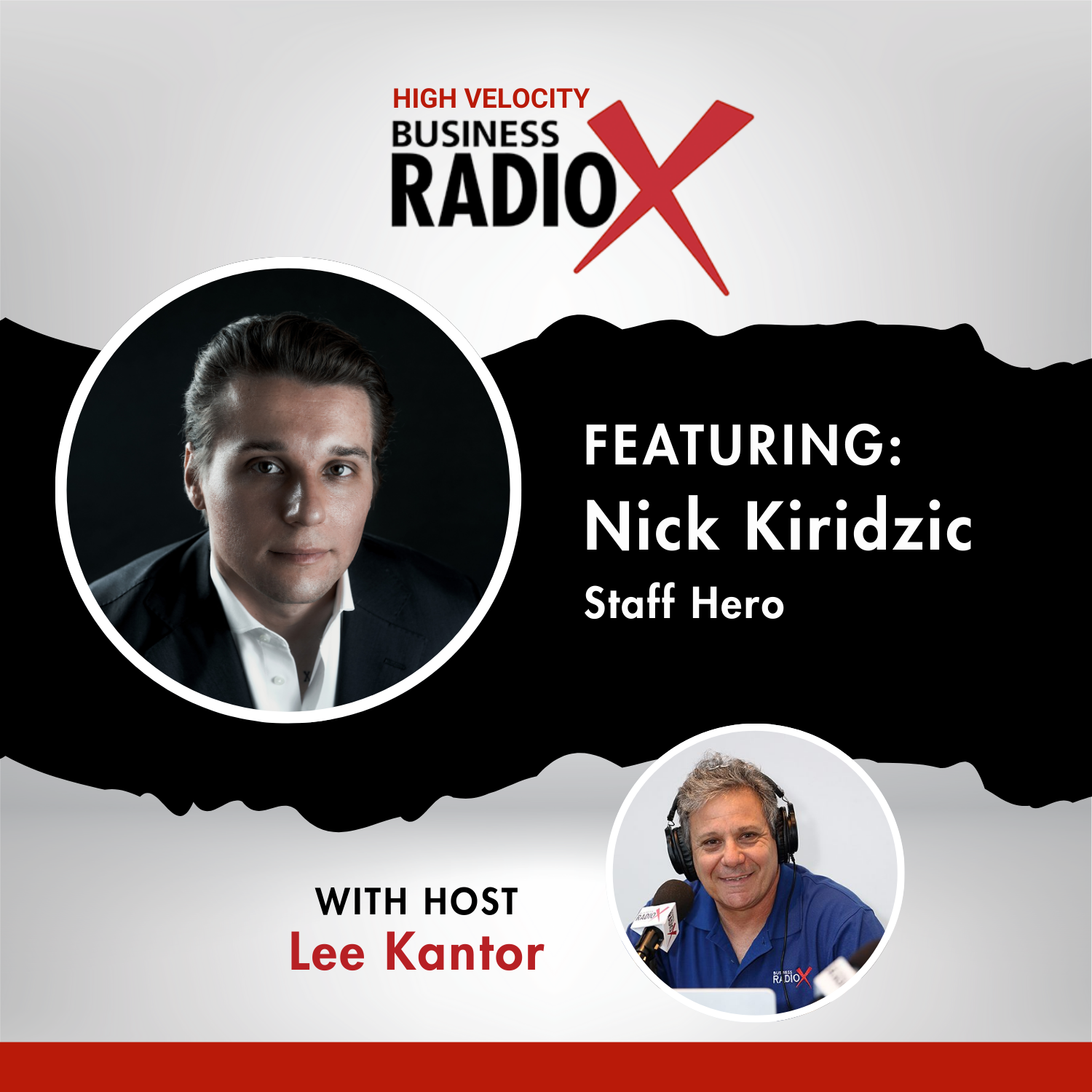

In this episode of High Velocity Radio, Lee Kantor interviews Nick Kiridzic, CEO of Staff Hero, a BPO company connecting U.S. businesses with skilled virtual employees in the Philippines. Nick shares his journey from the home care industry to founding Staff Hero, discusses the wide range of tasks virtual assistants can handle, and highlights how outsourcing can drive efficiency and significant cost savings. The conversation covers client success stories, overcoming trust barriers, and the growing role of virtual assistants and AI in helping small to medium-sized businesses scale and thrive.

 Nick Kiridzic is the founder and CEO of Staff Hero, a staffing and referral platform helping businesses across industries connect with reliable talent.
With a strong presence in healthcare and home care agencies, Staff Hero supports hospitals, nursing homes, and care providers by ensuring they have the workforce needed to deliver quality care.
He built Staff Hero to go beyond traditional staffing models, combining technology, referral partnerships, and a people-first approach. Passionate about entrepreneurship and leadership, he is dedicated to empowering organizations with the right people so they can grow, thrive, and serve their communities more effectively.
Connect with Nick on LinkedIn.
What You’ll Learn In This Episode
- How Staff Hero helps businesses across different industries, especially in healthcare and home care agencies
- The biggest staffing challenges companies face today and the approach that solves them
- The importance of referral partnerships in staffing and how they benefit both businesses and workers
- Lessons learned from working with hospitals, nursing homes, and home care agencies in New York
- How technology is reshaping hiring and workforce management, and how Staff Hero stands out from traditional staffing agencies
- Key trends shaping the future of staffing across industries
- Leadership lessons and advice for entrepreneurs building service-driven companies
 This transcript is machine transcribed by Sonix.
TRANSCRIPT
Intro: Broadcasting live from the Business RadioX studios in Atlanta, Georgia. It’s time for High Velocity Radio.
Lee Kantor: Lee Kantor here, another episode of High Velocity Radio, and this is going to be a good one. Today on the show we have Nick Kiridzic. He is the CEO with Staff Hero. Welcome, Nick.
Nick Kiridzic: Hey, how’s it going Lee?
Lee Kantor: It is going great. I am so excited to learn what you’re up to. For folks who aren’t familiar, can you share a little bit about Staff Hero? How you serving folks?
Nick Kiridzic: Yeah. So right now Staff Hero is considered a BPO company, which basically is like a virtual assistant company. We help connect quality employees overseas with small to medium sized businesses throughout the United States, really focused on quality, efficiency and overall and more cost effective approach to scaling a company.
Lee Kantor: So what’s your backstory? How did you get involved in this line of work?
Nick Kiridzic: Funnily enough, my, uh, the last couple of years are actually for like ten years, I was in the home care industry as a sales person. And for people who don’t know what home care is or how how it works, and internally we have to, as a business development representative, get patients who are interested in home care services. And then inside the office, there’s a team that processes the case, and it’s a grueling process filled with a ton of follow up paperwork, chasing doctors and stuff like that. And the company was a big company, but everybody that they assigned to me to take care of all my patients were just not really panning out. And so one day after getting fed up, like my bonuses were just not, you know, meeting my standards, I just started googling online. I came across an ad that was talking about, you know, hire somebody for like 4 or $5 an hour to do whatever you need them to do. And I came across that ad, I clicked the button, I hired somebody, trialed it for a week, and I was so impressed by, you know, what I can get for for that cost. And I hired that person, paid them out of my own pocket, and lo and behold, I doubled my numbers within the next couple of months.
Lee Kantor: So what types of tasks were they doing for you?
Nick Kiridzic: So people who typically hire virtual assistants, you know, believe that maybe they might be limited to calendar management, customer support or reaching out, you know, to clients via email acting as like a general assistant or executive assistant. But I saw that they could do a lot more than that. I mean, I even got them to eventually start taking on sales. I was training them on sales and they were able to just perform as a good sales people. I’ve had them fill roles where they are doing far more complicated tasks, which involved, you know, staffing in homecare. And this is me being in homecare for a long time, but, uh, involving staffing, you know, uh, reviewing, you know, data to make solid decisions for the company. So far, more complicated things than most people are using them for.
Lee Kantor: So in your business today, are you mainly serving the health care sector and home health care agencies?
Nick Kiridzic: Most of my clients are from those, you know, from the healthcare industry, simply because connections just kind of like went a long way. And, you know, word of mouth really spread fast. But I found myself helping people in real estate attorneys, even small firms even, you know, a lot of e-commerce people are finding, uh, my services useful. And yeah.
Lee Kantor: So now you’ve so you’ve expanded outside of healthcare into small to midsize businesses.
Nick Kiridzic: Yeah, Yeah.
Lee Kantor: Now, when you’re approaching kind of a new market that maybe you don’t have as many contacts in as your previous one, how are you going about getting the word out and letting people know that this service even exists?
Nick Kiridzic: You know what? I think people are hearing about it nowadays. Something is telling me that alongside, you know, the the rage for AI and stuff like that, most businesses are struggling. And I feel like I could smell it. Everybody that I come across that’s trying to start a business just feels like it’s a lot more teeth pulling. So everybody’s looking for that edge and they’re thinking AI is the thing. And also virtual assistants, people are realizing that they can start a business and and it be far more cost effective than it ever has been before. So I don’t think I have to really educate too many people about it. I think, though, when I do come across like a potential sale or I’m trying to close on somebody, I try to explain to them that you know what they’re looking at can be the the next step in them growing and scaling their business.
Lee Kantor: So when you’re having those kind of conversations, what do their your prospective clients think is holding them back where your service could help them?
Nick Kiridzic: I think most businesses tend to or business owners, especially in small businesses. They tend to handle all the work. And, you know, and this goes from customer support to billing to I mean, you name it literally. They just want to handle everything. And there’s a trust issue with, you know, having somebody handle everything or anything could be like really, really, uh, a tough move. But most people realize that if they want to grow, they gotta eventually hand it off to somebody. The next part is, financially, it doesn’t make sense. Am I really going to be paying somebody $25 an hour to just handle customer support? No, it doesn’t make sense anymore. So why not maybe hire somebody for 4 or $5 an hour? Then it can make sense, you know.
Lee Kantor: So what are those conversations? You’re talking to a business owner. Maybe they’ve never worked with somebody overseas before. How do you like what’s that conversation look like? Say they have a, um. I mean, I would imagine you have a lot of people that want help, maybe in social media or some sort of marketing that they would like, maybe automated. How do you have that conversation with somebody?
Nick Kiridzic: Yeah. Yeah, definitely. So typically because when we are going about our lead generation, we’re looking for people who have a need for for support for some kind of staff. Right. You know, people like they know what they’re clicking on and they get to me somehow. But I always ask the question, I put the ball in their court. I, I asked them like, well, what are some things that maybe you’re handling, or maybe other people in your in your company are handling that are really low cost tasks. Let’s start there. Let’s start small. What are some things you can you can think of. And if they can’t think of something. I, uh, I start throwing options their way. I was like, okay, well, who’s handling, like I said, customer support. It’s a very common one. Right? Who’s handling customer support? Um, do you have a lot of, uh, issues with data management? Um, with organization? Let’s start there. No. Okay. Let’s let’s talk about your sales. Who’s handling all of your, uh, sales, who’s handling, um, outreach for new, uh, new potential customers, for new sales. What does that look like? Um, and as we start chipping away at the smaller things, I’m always looking to paint a bigger picture. Large companies like Amazon, Google, they create major divisions that are solely based of, you know, operated off of people from different countries. So I want people to start thinking that way because you can eventually have that. And then we look into like management, leadership, all that kind of stuff.
Lee Kantor: Now, you mentioned a lot of your workforce is overseas. Are the people that are interacting with the clients also overseas or is or are there some people that are in America that are kind of the liaison?
Nick Kiridzic: Currently, our company is completely based out overseas. We don’t have one person other than myself and also my younger brother who, uh, took on, you know, he’s young and he wants to learn sales. So I gave him the opportunity to, uh, try to learn how to sell our services. Um, but that’s it.
Lee Kantor: So any inbound or outbound lead is being initiated by somebody overseas, and they’re the first line in the.
Nick Kiridzic: Yep. Correct.
Lee Kantor: And, um, who who is? Is there anybody on the team that’s kind of building community or building partnerships?
Nick Kiridzic: Yeah. So in terms of partnerships, no. But community. Absolutely. So in the Philippines it’s really important. Um, it’s really important for people to they have like a very good culture when it comes to maintaining community is what I’m trying to get at. Um, people are hearing about staff hero like crazy in the Philippines, and it’s only because I have hired people who understand how to reach out to the community and get connected with everybody, and show everybody what we have going on, the opportunity we have going on. Um, so like for them, when it comes to like social media, they really utilize social media like crazy out in the Philippines. So everybody’s seeing the same stuff. Um, I hope that answered your question.
Lee Kantor: So how about if my company wants help building community here in America? Does your team have the skills necessary to help build a community? Maybe moderate or to help? Um, my company when it comes to a more robust social media strategy?
Nick Kiridzic: Yeah. So the way I say is, if if you know how to teach it, then yes, you’d be surprised by how well learned or how educated. Um, some of these people really come. You know, they really can come in and maybe far more than just impress you, but they could take what you teach them and really run with it without coming back to you with too many questions like, look, you’re not going to hire somebody from, uh, Davao, and they’re going to come back to you and tell you they understand how certain things in Texas work, right? But if you are trying to build a community and need support, and maybe you get this person involved long enough 100%, I’ll give you actually a little example if you have a second, um, you know, if Amazon FBA was a very, very popular thing, uh, a couple of years ago where everybody was really, like running off the online arbitrage of Amazon, and it’s not as popular anymore as there’s far more, far too many loopholes, far too many barriers to entry. Um, but what I did was I paid for a course, I didn’t study the course. I hired somebody, and I paid her to study, and she studied for, like two months. And now, about a year later, she runs a Amazon FBA business under my name. So I don’t know if that answers your question in another way.
Lee Kantor: So as long as I can give good instructions, you have the people that can execute my vision with pretty hands off.
Nick Kiridzic: Pretty much. Pretty much.
Lee Kantor: Now are there, um, how good are they at AI? You know, workflows and creating AI? Are they better at taking a workflow I create and then just implementing it?
Nick Kiridzic: Well, like, you know, when I when we say like, are they better? It’s like you’re going to find people who don’t know it and then you’re going to find people who do know it. Part of what we do at Staff Hero is we have a pretty extensive, um, interview process, especially when we’re looking for, um, very real specific or skill specific, um, positions to fill. Um, just the other day, I interviewed somebody who was supposed to who’s trying to fill like a very basic admin position, but I saw that he had a lot of go high level skills, go high levels, CRM that’s very, you know, very popular for people who are utilizing a lot of AI, chatbots and stuff like that. And what I find is a lot of people who work in the Philippines that have executive assistant, uh, experience working for young modern companies. They all tend to get trained heavily on AI. So prompt writing is very, you know, important to a lot of them. Um, uh, building out CRMs and automations, learning how to use Zapier, stuff like that. I have been taught so many times over on how to do certain things, um, from somebody who just pulled that information from a previous client that they worked with.
Lee Kantor: So is that kind of one of the maybe unintended consequences? But a side benefit is that your people are getting better and better, and any new client is kind of getting best practices from all the other clients they had beforehand.
Nick Kiridzic: Yeah. Yeah, definitely in a way. But you know, I that being said, there is so much opportunity. It’s it’s quite amazing to see how many people I meet on a day to day basis, just interviewing new people where they come to me. And I just what I hear from the interview when I ask like, well, why did you leave that previous company? Or why were you fired? It just sounds like the previous company just did not know how to utilize them. They just, they they got lazy. They didn’t know what they could do with them. You know, they were they realized that this person was heavily trained, but then they didn’t know what to do with all that training, if that makes sense.
Lee Kantor: So how are you helping your clients kind of not make that mistake? Are you giving them a playbook? Are you giving them some instructions and training on how to get the most out of the service?
Nick Kiridzic: Because our company is relatively young, um, and I guess I would say I’m a little new to dealing with the customer experience. Not new in the sense like I don’t know how to deal with customers, but I’m also kind of giving a lot. I kind of act as a unpaid consultant in some way. I know what I need in my business to constantly grow, and I’ve seen what a lot of businesses fail to do. So I’m going to ask a lot of the maybe right questions to kind of uncover where we can place people to take care of a lot of the load. So, I mean, nowadays, you see, you know, a lot of these businesses that have been operating for 30, 40 years, like mechanic shops, like, for example, my father had a mechanic shop. He was still operating off of paper. If that kind of client came my way, I probably would have a hard time trying to convince him to use somebody from another country and have zoom meetings with them and then teach them how to, you know, yada yada. But, um, I am interviewing the client as well. I’m not just interviewing employees. I’m interviewing clients because the clients, because I’m looking for somebody who can not just find the benefit in hiring people overseas, but could actually use it like meaning who will actually use it and make sense of it, you know?
Lee Kantor: Now how are you selling the services? Is it in blocks of time? Is it by the hour? Like, how does someone work with you?
Nick Kiridzic: Yeah. So the service is very simple. They tell me we we determined that they have a need that we’re looking to fill. We determined that we’re looking to find somebody to take care of their position that we’re looking to fill. And we cover our company staff. We cover the payroll. We cover the HR, we cover the recruiting, we cover. If it means, um, replacing the employee. We record all the trainings. That way the client doesn’t have to do the retraining. We handle all of that kind of stuff, and the client just pays us for the hours that that the employee works.
Lee Kantor: So that’s kind of, uh. So you’re not hiring. The person isn’t hiring a person. They’re hiring, Um, your company, and then it might be a different person in six months than the first person you’re dealing with. I’m hiring staff here. I’m not hiring Bob.
Nick Kiridzic: Exactly. And I mean, that’s that points out the possibility that Bob, for example, leaves. Right. But, um, like I said, we are heavily not just client. The client experience is not the only important thing here is the the employee experience is also important here. So we’re creating long term positions. We’re looking to make sure that the client is looking for something long term as well. Obviously employees can come and go and like maybe they won’t fit what we’re looking for. But like I said, we’re hiring and then we’re training and we’re recording those trainings. Make sure that if we have to re recruit, that it’s as painless as possible.
Lee Kantor: Now, um, is there a story you can share that maybe illustrates how this can work for a small business so that, uh, maybe they came to you with a challenge, maybe. Share that. Don’t name the name of the company, but maybe what the challenge was and how you were able to help them get to a new level after working with you and your team.
Nick Kiridzic: Yeah, yeah. Okay, so, um, I’m not going to give a name, but it was. It is a home care agency. Um, they home care agencies, they have to constantly make sure that their patients are being taken care of. So it’s called it’s a staffing issue, right? Having aides available to take care of their patients. Um, people call out all the time. So in the middle of the night, at 1:00 in the morning, if an aide has to leave for whatever emergency, who does she call in order to communicate to the agency that, you know, like, I’m not going to be there, the patient’s going to be alone. So she calls it in at 1:00 in the morning. And the people that are supposed to be answering are called the on call department. Every home care agency has an on call department. Most of them are not really operating too well because they consist of people who live in the States. Um, and most people who live in the States do not want to answer a phone call at 1:00 in the morning, or they’ll be asleep, or they’ll fall asleep to the phone or whatever. The people in the Philippines, it’s a 12 hour difference. So when I came across this client’s issue, I explained to them that we can train people from the Philippines to do everything that this current on call staff does, and it will be virtually, you know, uh, you know, sixth of the costs in this case. And they wanted to test it out. They wanted to see if it would work. So instead of replacing their current team, they had them shadow along and see if they could take over some of the tasks. If there’s any, like Mishandlings, they could take over. They got trained for like about 2 to 3 weeks. And then essentially the company, the client replaced their entire on call department with four people from the Philippines. So ultimately saving themselves well over 100 $150,000 a year for the cost of $20,000 a year. Let’s just call it that.
Lee Kantor: And and there’s somebody on your team that’s kind of the account manager. Or is it always kind of interacting directly with the worker?
Nick Kiridzic: It’s always interacting with the worker. We we want to make sure that there’s not too many, you know, barriers to communication. We are placing the employees directly with the supervisor that’s going to be overseeing them, just like any company would have if I worked at a company and I had a direct supervisor, that’s who I’m going to be talking to. But we do constantly check in and follow up with the client and with the employee. We make sure that the employee is happy. We make sure we see like, hey, have you been talking to them lately? How’s work been going? Everything going well? What did you guys learn so far? What have you guys been doing? And same thing with the client. How are things with Bob? Um, has Bob been showing up? Is everything okay? Just checking in. Let me know if there’s any issues.
Lee Kantor: Well, if somebody wants to learn more, have a more substantive conversation with you or somebody on the team, what is the website? What’s the best way to connect?
Nick Kiridzic: Yeah, the best way to connect. I mean, if you have any questions, you’re looking for help with anything staffing related or you just want to learn some more, you can reach out to me at hero.com. That’s staff Hero.com. Um, or you can find me on Instagram. Nick underscore kurincic.
Lee Kantor: Good stuff. Nick. Uh, congratulations on all the success. You’re doing important work and we appreciate you.
Nick Kiridzic: Thank you so much, Lee. I really appreciate it.
Lee Kantor: All right. This is Lee Kantor. We’ll see you all next time on High Velocity Radio.














