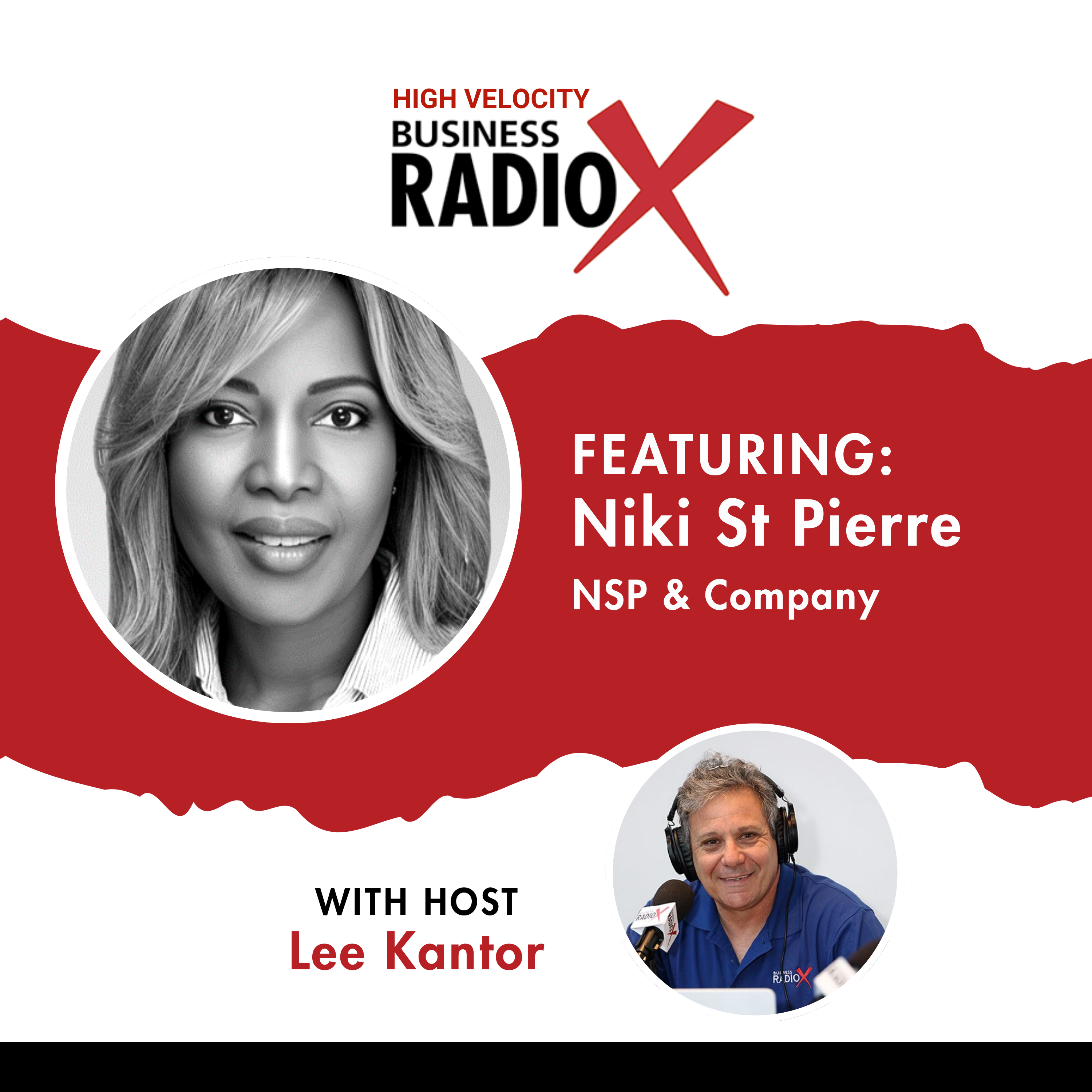

In this episode of High Velocity Radio, Lee interviews Niki Saint-Pierre, CEO of NSP and Company, discusses the challenges and best practices of organizational change management. She shares insights on why 70% of change initiatives fail, the importance of execution and alignment, and how her firm helps organizations succeed with tools like the Change Momentum Index. Niki highlights a global transformation case study, emphasizes leadership engagement, and explains how NSP and Company supports clients across industries in navigating complex change, fostering employee buy-in, and achieving lasting results.

 Niki St Pierre is the CEO of NSP & Company, a firm dedicated to helping organizations execute strategy, navigate disruption, and drive large-scale transformation. With over two decades of experience advising senior executives across finance, fintech, insurance, biopharma, healthcare, government, and professional services, she specializes in enterprise transformation, GenAI adoption, post-M&A integration, and workforce modernization.
Prior to founding NSP & Co., she served as Head of Organizational Change & Transformation at Perot Systems (now Dell Services), where she built and scaled the firm’s global change management practice. Earlier in her career, she held transformation leadership roles at Accenture and American Express, leading enterprise-wide strategic change and operational excellence initiatives.
At NSP & Co., she and her team bridge the gap between strategy and execution, ensuring that organizations not only design ambitious plans but implement them successfully. Using a proprietary, data-driven methodology, NSP & Co. helps clients accelerate change, integrate AI, and optimize operations—delivering sustained value today while positioning for the future.
A recognized thought leader, her work has been published on Forbes, she’s a LinkedIn Top Voice, and a frequent speaker on digital and GenAI-driven transformation, the future of work, and business integration. Her insights have been featured in Forbes, Smart Business Magazine, and industry events.
Niki holds an MBA/MPA from New York University (NYU) and is an active member of the Association of Change Management Professionals (ACMP) and the Forbes Business Council. She has served on several boards, including as a Board Member of the American Red Cross and an Advisory Board Member for Grateful Giving. As a WMNtech, she is committed to advancing women in leadership and technology.
Connect with Niki on LinkedIn.
What You’ll Learn In This Episode
- Organizational change management and transformation
 This transcript is machine transcribed by Sonix.
TRANSCRIPT
Intro: Broadcasting live from the Business RadioX studios in Atlanta, Georgia. It’s time for High Velocity Radio.
Lee Kantor: Lee Kantor here. Another episode of High Velocity Radio and this is going to be a good one. Today’s topic is organizational change management and transformation, and we have the CEO and Senior Advisor of NSP and Company, Nikki St. Pierre. Welcome.
Niki St. Pierre: Hi, Lee. Pleasure to be here. Thanks for having me.
Lee Kantor: Well, I am excited to learn what you’re up to. Tell us a little bit about your firm. How you serving folks?
Niki St. Pierre: Okay, absolutely. Well, I founded NSP company about roughly ten years ago. And what we do exactly, we’re a transformation consultancy and we help organizations turn strategy into sustained Gained momentum. And the reason for that is many of your listeners, they may know that about 70% of change in transformation efforts do not meet objectives. Right. Many people just say they fail flat out. Right. So there is a reason why there is such a great need for change. And what we specialize in especially are high stakes change like digital transformation, AI adoption, or cultural shifts. Right? Things that companies today are looking to reinvent themselves. And we help them through that sticky part in the middle, which is where success is made or lost, which really has to do with execution. So how do we make the vision or the strategy a reality?
Lee Kantor: So what’s your backstory? How’d you get involved in this line of work?
Niki St. Pierre: Oh, my. Okay. A well, for me, it’s I was recruited and I would say I was recruited. Graduated. I would say at a time, um, when organizational change, you couldn’t even get, uh, degree, right. Or even a class for that matter. In organizational change management today you can get a PhD. So I was really starting off in organizational change with one of the top firms. And at the time it was called Andersen Consulting. So I was recruited right out of graduate school, joined them, worked with a few partners. And I would say that’s really where I really got a lot of traction and really understanding and helping them even pull together for the New York City office. What organizational change management is, what it means to clients. So have been in industry right now for well over 25 years. And what we do exactly, we really help clients and our hardest times during change. And the reason why I say this is we oftentimes are called in when programs aren’t going well. Right. Because part of our mantra and how we work, our ethos is really it’s not only about focusing on the planning. The planning is important, but how do we execute? How do we ensure that people are brought along and they truly do understand what it means? And we also leverage our proprietary Change Momentum index. And that’s something that will be rolling out a little bit more broadly and using more consistently to what all of our client projects, and engage clients with it more directly. We’ve taken what we have found to be successful over the past 25 years in helping clients where others have failed, and where change was not able to happen. And when they call us, it works, right? So really took a step back to look at what makes, um, our efforts successful, right? And bottled it in a way. Right. To ensure that we can continue to leverage that moving forward with clients more consistently.
Lee Kantor: Now, you mentioned earlier that I think it was 70% of, um, of change isn’t meeting the objectives, or at least not in the way they thought it was when they kind of drew it up. Are there some kind of common, uh, reasons why that is so large? That number.
Niki St. Pierre: Ah. Great question. Um, I would say first off, it’s complex, right? So it’s not an easy feat. So if you think about it. Right. Oftentimes when you’re looking at changing a system and people would say, ah it’s easy. It’s just we’re just going to sometimes they’re just replacing. And even then it causes lots of commotion. Right. Even more so. So in trying to change one part for it to work effectively, It is interconnected to various different parts. And even if it’s a piece of technology, the fact that it’s interconnected with other technologies. These technologies also have different owners, right, who are responsible for the product. But above and beyond that, it also has customers. And by that I mean even internal customers. So as a result of that, without appropriately engaging everybody who’s involved, ensuring that there’s a certain level of alignment that happens and a unification of thought towards the future and the ability to maintain that throughout the execution. Right. It makes it extremely difficult for a program to be successful. In addition to that, it also has to do with the resources that are available to help the client transition From their current ways of operating to the new ways of working. So it’s very complex. Hence the 70% failure rate.
Lee Kantor: And the level of complexity I would imagine is even greater in these larger bureaucratic organizations. And to anticipate, you know, all of these unintended consequences, how this is going to impact somebody at a different level. That might be a user, like you said, a customer internally or externally. And then you have also the, um, you know, are we talking the same language when you say a word? Am I understanding the word in the way that you’re saying the word? It just it just any type of change, especially dramatic change, I would just imagine it. A lot of dominoes are falling in all different areas that people couldn’t really anticipate, even in the best case scenario.
Niki St. Pierre: Absolutely. You’re hitting the nail on the head with that. And I think for us, the offering that we bring to client really helps provide this type of support that they need are resources or highly skilled, highly experienced. We do not staff from a bench, so I don’t have consultants waiting and saying, okay, whatever the client I get, I’m going to fit your resume to match that need, right? It’s we do the opposite. It’s we understand we have a large network. Um, right now it’s grown to nearly about 100. We started off about 50. Um, for the past few years we’ve had about 80 consultants as part of our network, and it’s growing. But when we look at our offerings, we look at the strategic change leadership. Right. And how do we create that common vocabulary, like you’re saying, do we all understand what the aims and objectives are and also our roles in making this happen. Right. So our entire change strategy. Oftentimes because of the change, the nature of it, it may or may not require that we look at operations as well. Right. So this has to do with the rigor. It has to do with the operating model or the organization. Is it really designed to make the best use of technology. Um, also looking at it from a program management, we work very closely. If the client has um, program management on set, they have a PMO or if they need support or reinforcement, we can also support in that way. We also provide um, services that really helps ensure that communications are appropriately shared throughout the organization, appropriate levels of user support, and definitely the enablement part. The training part is also core so that everybody understands. But above and beyond that, what we do is we also tie into the organization’s values and their culture, and that’s really what helps make it stick.
Lee Kantor: Now, um, you mentioned a lot of times you’re called is because something went wrong. They, they didn’t have they didn’t execute in the way that they intended. Are you ever called in kind of proactively in order to put some of this good foundation in place so that maybe you can prevent some of these, um, issues that have to be triaged?
Niki St. Pierre: Isn’t that a great question? Um, you would think no, it is rare. That’s where we are hoping that clients go is you know what? Let me try to figure this out before it goes south. Right. But what happens is oftentimes, um, they get a sense that it’s going to be easy. And they look at it, they look at the technology because they are so engaged in it and they so want it wanted to happen there like this is so intuitive. It’s a slam dunk, right? I see the value so clearly. And what tends to happen is, um, sometimes people are in a room and they nod their heads, right? So they’re getting what they feel are the right signals from everyone. So they just forge ahead. And I would say those would be good times to, to call us, um, and to really ensure that they do have the right plan in place and so on. And this is where the change momentum index comes in. We have noticed this gap right between what leadership is seeing and sensing, because at the time, by the time the status report turns red, it’s almost too late, right? Because you’re losing money, the team is losing traction. So how can you get the right signals as senior leaders of the division or of a company, to know how your program is doing so that you can help to guide it and help course correct so that your programs don’t become red. And that’s the change momentum index. And what it helps clients do is realize what’s at stake. Help them understand what areas of their roadmap or their plans that need their engagement, and how to put that in place. So it not only tells you what’s not working on your program, but how to fix it in real time.
Lee Kantor: Now, how are the senior leaderships when they when they see it turn red or yellow or they’re getting nervous? Are they just ignoring the erosion of trust that’s happening organizationally? Is that something that’s just not a signal for them that they’re not even paying attention to? Because I would think that that is going to you’re going to pay a price for that over time.
Niki St. Pierre: Lee. Oh, that is such a great question. And I’d say that oftentimes it requires a certain level of emotional intelligence to take a step back and say, hey, what’s really going? What are the implications here? Right. And the high paced nature of these initiatives that we’re talking about sometimes senior management does not have the luxury of time. And what tends to happen is go, go go go go. And teams are working, you know, 12, 16 hour days. And they’re pushing really hard. And that tends to take the Predominant culture and people forcing through and powering through what needs to happen. Um, in instances where I’ve seen leaders take the time out, and that’s also one of the things that we do with our projects and programs, right? So we actually step in, we speak to management, we help them understand how the rank and file and how staff throughout their company, or seeing this initiative and the role and opportunity that presents itself. Right. And developing the communications, developing various artifacts to help Support leaders because of the breadth of what they have in front of them, the scope that they have. They need that reinforcement and support in order to effectively lead large scale change. And that’s an area where we help them make a difference. But by and large, without the appropriate levels of support, it is something that is difficult for the leaders, one to ascertain because of the busyness and the way that programs are reported on. That is one of the, I would say, key metrics that they don’t have. And again, I know I keep coming back to this, but there again is why the change momentum index providing I would say leadership with that pulse. Um, that is real time but targeted to various project teams that they may be leading how they need to truly get a sense of what’s going on when they need to interject and what they need to do.
Lee Kantor: Now, what’s happening in the organization right before they contact you and your team? What is the signal? What is the, um, sign that hey, something is amiss here. Um, maybe we ought to put some fresh eyes on this thing.
Niki St. Pierre: Okay, so great question. So we got called in at a few different points. So more often than not, I’d say about 50% of the time something has gone south really bad. So and we’re like a last resort. Okay. This program has not been going well. We are paying twice or three times. Right. Because we have to maintain licenses or we have to keep maintaining doing what we’re doing now and keeping this new system or project afloat. Um, so they really call us, right? 50% of the time when things are things are bad. Um, I’d say about, uh, 25% of the time, probably a little bit before that. Right. So some foresight. Things aren’t going well. It’s probably amber. It’s not completely red. Some areas are red right on their plan. And it’s the team that they have right now is not fit for purpose, meaning that the team needs reinforcement. Um, very dedicated, very good teams. But they need they need help, right, to really help them pull through. And sometimes it’s a mix of both internal resources and other consultants. I would say one of the differentiators for us in our resources is we tend to have very senior resources who come in with 15, 20 years of experience. Right? So when you bring that type of caliber to the table, um, combined with our methodology and our rigor of work, what you get, our impact.
Niki St. Pierre: Why? Because you get someone who can read between the lines, deal with the ambiguity. And this goes back to the point you made earlier, is, well, it may appear to be a straightforward project, but because it is so lived in and there’s probably this web right of interconnectedness on top of it, you need somebody who’s not only astute in the work, but politically astute as well, to navigate an entire global organization at times, um, to ensure that all the parts are kept whole while you’re transforming and transitioning. So that’s what we bring to the table. And at times, I’d say about 20, 25% of the time we start at the very beginning. The they have an idea, they have a vision. Right. We help facilitate, um, a session to get leader senior management aligned on the vision and strategy and the goals pull together the roadmap. So this is the ideal situation right. Then there is the roadmap. We work with them on the roadmap. Right. And then we also help them sometimes select their technology partners, help them and guide them through the the process of working with an implementer. And we continue on right supporting supporting them from an organizational change, really looking at the people side of it.
Lee Kantor: Now, is there a story you can share that maybe illustrates how this plays out in real life? Um, maybe don’t obviously don’t name the organization, but maybe the challenge that came to you with and how you were able to help them get to a new level.
Niki St. Pierre: Oh, absolutely. Um, my, there are so many initiatives. Um, let’s do a small, sizable one. Um, so this was this is for a global organization, and this was a fairly complex, um, integration technology implementation. And this was a few years back, so I don’t mind sharing more details around it. Um, so they have offices, um, in 56 countries. As a result of changes in the marketplace, their customers were asking more of them and wanted consistency and experience and more elevated experience, um, in all of their locations across the globe. So the problem that the client needed to solve for our client needed to solve for was, how do I ensure that my people have the same way of operating and working while still maintaining the local culture of their country, right? So across 56 countries And one of their end clients, right? Or I would say household names with operations throughout the world. And when you look at that senior most leader, they don’t care if you’re in Brazil, if you’re in, um, China or if you’re in London, right. When you’re giving me a report when we are working together, I want I want it to be the same way I want. I don’t want to have to decipher. Right. Country to country. Something needs to be consistent across the board and the staff internally. Also at the client also wanted to have better tools. So in working with um, the CEO, the leadership team as well as the global board, they contracted with us. Wonderful initiative. Love them. Great culture. Right. And as you can see, this was momentous because it really impacted their bottom line, given that it impacts their end clients so directly.
Niki St. Pierre: So came in understood. And even with that, huh? Going back to our points earlier, um, they had someone in the role, right, helping them as a transformation officer, um, for about five months or so did not work out. Right. So when they brought me in, they were like, Nikki, um, we need to provide results to the board in a month. We need to have a clear path forward. I’m like, do you understand the magnitude right of the ask? It’s for somebody to come in in less than a month, provide you a completely validated roadmap of what we’re doing. Right. And I shared with them like, okay, we’ll be able to give you something now how detailed or thorough it’s going to be, right? It’s going to be a swag, but it’ll be directionally correct. So came in, was able to map it out, was able to do that. Um, set up different types of um networks and structures and what I call the organizational change architecture. Right. Especially for something with this type of global scope, looked at different technologies. There was one that they were leaning towards. We decided to go with that, um, and then pull different internal teams together. My team was pretty slim. It was myself, and I think I had two others with me, and we piloted new ways of working. One of the key things is clients like to look to the outside. They like to look at what are other companies doing and things, which is good. But oftentimes the best solution for that client is what is within their organization, right.
Niki St. Pierre: What are your star performers? What are they doing? What do clients like about them? What have gotten you the positive visibility? Let’s understand that better. Let’s also look to the outside and see that how that may complement what you’re doing. Right. And then that with some of your key players within your organization, let’s forge the path forward. So that’s what we did. And then it took us about two years, two two and a half years to roll this out throughout, um, all 56 offices. But let me tell you, they embraced the change. They took the we had an entire branding and colors and schema and videos and things of that sort. And for each deployment, they would send in pictures, right, of how excited they are about the new ways of working. Right. So it really made a splash, not only due to the quality of the work products in terms of how they’re going to be working, using the different tools, the training that they receive, how they were part of the change. They didn’t feel that the change was being was happening to them. They really had a chance to contribute. They were listened to, their perspectives were taken into account, and they had various resources. Right. That gave them the source of truth. And also increasing the level of communications amongst the teams working on similar initiatives across the globe. So it was an outstanding success and it’s being used till today, the it has evolved. Even the name of the program has taken a different name, different shape, but it is still being used until today.
Lee Kantor: The the impact is real. That is a big change and I’m sure they’re feeling that every day.
Niki St. Pierre: Indeed, indeed. So it was a tremendous effort and leadership really came together on that one. Um, and to your point about having a good vocabulary, good understanding, one of the rigors that I had to put in place was a segment within their standing leadership team meetings and making this program a priority. So at first we started off, it was every two weeks, and then it grew to monthly, right where we reach a nice cadence. Um, but I think that was very, um, important to the success of the initiative is the fact that leadership took the time to make this a priority for their organization, and they reap the results.
Lee Kantor: Now, you mentioned this is a global organization. Is that your niche? Do you work primarily with international companies?
Niki St. Pierre: Great question. I work with a multitude of of organizations. Um, so one of the key things is we tend to be very good at working in highly complex industries. Right. Um, and regulated industries. So financial services, insurance, pharmaceutical, life science, healthcare. Right. Also government, state government, federal government, um, full life cycle professional services as well. Right. Not to say that we don’t deal with, let’s say, manufacturing. We’ve done work with manufacturing companies and other companies as well. Um, and the work that we do spans right from visioning all the way to impact. But we also come in at any point along along the journey. And some of the, um, companies, they are also oftentimes just nationwide, I would say in terms of size, I would say any company around 100 to Plus employees, right? Is would be a company that we would be, um, looking to partner with and support with their change initiative. Um, if the company is a bit smaller than that, then it’s really working with the leadership team and supporting them from, um, as a fractional transformation officer. Right. To help them grow, grow their business.
Lee Kantor: So what do you need more of? How can we help you? Do you need more, um, people on the team? Do you need more clients? Um, what are you looking for?
Niki St. Pierre: Oh, isn’t that a great question? I would say, um, right now that we are scaling, um, one of the things that would be great for our growth is really more clients, right? And clients who are looking at implementing new technology, clients that are looking at their culture, clients that are Looking at reinventing themselves, right? I would say since the pandemic, it has become prevalent, right, that the ways of working overall. Right. As a result of greater leverage of technology and now with generative AI, right, has really made it an issue for every company to take a step back and look at how they’re operating. And before taking the full leap in leveraging generative AI. Right. Company needs to modernize. They need to understand their operations, understand how they can streamline things better. Right. And how do also do they need to further augment what they’re doing with their staff so that the staff is also enabled to work efficiently? So this is all the areas where where we come in. Um, we also help to facilitate change acceleration sessions and innovation sessions. Um, and these oftentimes are I would say, more mid-sized middle market companies is our solution. Offering for them is to really help them get a plan in place. Right. And we work and partner with them to implement the plan on an as needed basis for larger entities. Um, I know I’ve mentioned significantly some of these global corporations, um, when they’re looking to change and transform their is a momentous there’s a huge work plan. There’s a huge body of work, right that needs orchestrating. So it is a bit more clear and more obvious of, okay, there’s a need for change and organizational change here in terms of how to manage that, but any client from 100 resources on up still requires this capability, and we’re flexible and nimble enough that we meet our clients where they are to support them on their change journey.
Lee Kantor: So if somebody wants to learn more about the Change Momentum Index or about maybe working with you, have more substantive conversation with you or somebody on the team, what’s the website? What’s the best way to connect?
Niki St. Pierre: Absolutely. If they go to WW. And Cocom, NSB and Cocom.
Lee Kantor: Well, Nikki, thank you so much for sharing your story today. You’re doing such important work and we appreciate you.
Niki St. Pierre: Oh, wonderful. Thanks so much for having me, Lee.
Lee Kantor: All right. This is Lee Kantor. We’ll see you all next time on High Velocity Radio.














