Business RadioX ®

  • Home
  • Business RadioX ® Communities
    • Southeast
      • Alabama
        • Birmingham
      • Florida
        • Orlando
        • Pensacola
        • South Florida
        • Tampa
        • Tallahassee
      • Georgia
        • Atlanta
        • Cherokee
        • Forsyth
        • Greater Perimeter
        • Gwinnett
        • North Fulton
        • North Georgia
        • Northeast Georgia
        • Rome
        • Savannah
      • Louisiana
        • New Orleans
      • North Carolina
        • Charlotte
        • Raleigh
      • Tennessee
        • Chattanooga
        • Nashville
      • Virginia
        • Richmond
    • South Central
      • Arkansas
        • Northwest Arkansas
    • Midwest
      • Illinois
        • Chicago
      • Michigan
        • Detroit
      • Minnesota
        • Minneapolis St. Paul
      • Missouri
        • St. Louis
      • Ohio
        • Cleveland
        • Columbus
        • Dayton
    • Southwest
      • Arizona
        • Phoenix
        • Tucson
        • Valley
      • Texas
        • Austin
        • Dallas
        • Houston
    • West
      • California
        • Bay Area
        • LA
        • Pasadena
      • Colorado
        • Denver
      • Hawaii
        • Oahu
  • FAQs
  • About Us
    • Our Mission
    • Our Audience
    • Why It Works
    • What People Are Saying
    • BRX in the News
  • Resources
    • BRX Pro Tips
    • B2B Marketing: The 4Rs
    • High Velocity Selling Habits
    • Why Most B2B Media Strategies Fail
    • 9 Reasons To Sponsor A Business RadioX ® Show
  • Partner With Us
  • Veteran Business RadioX ®

Planning for a Year-End Price Increase

September 19, 2022 by John Ray

Planning for a Year-End Price Increase

Planning for a Year-End Price Increase

While planning a year-end price increase is great, tending to your pricing shouldn’t be a once-a-year activity if you’re a professional services provider.

The Price and Value Journey is presented by John Ray and produced by the North Fulton studio of Business RadioX®.

TRANSCRIPT

John Ray: [00:00:00] Hello again. I’m John Ray on The Price and Value Journey. Planning for a year-end price increase. As I record this episode, we’re a couple of weeks into the fourth quarter of the year, and it’s time a lot of folks plan for pricing increases and adjustments that you need to make in your practice starting in the new year, right?

John Ray: [00:00:25] Well, wrong. Well, actually, more precisely, there’s a mixed answer. Yes, you need to plan a price increase. Don’t be that business owner who delays a price increase for so long that the frustration builds to a boil, and then one day, you snap and jack up prices with no forethought.

John Ray: [00:00:47] At the same time, pricing should always be a regular part of the diagnostics and fine tuning you perform on your business throughout the year. That’s particularly true for professional services providers who’ve accepted a wide variety of clients over time, often at various price points and terms. In those cases, it’s easy to lose track of relationships where it’s noticeably clear you need to put their pricing in line, both with the value those clients recognize in your work as well as the current reality of your practice.

John Ray: [00:01:24] Now, there are only three ways to increase revenue in your business. You can sell more of your services to existing clients, you can add new clients, or you can raise your prices. You’re constantly evaluating your success at the first two, selling more services to existing clients or adding clients. That’s business development, sales, and marketing. But how much regular attention are you giving to your pricing?

John Ray: [00:01:54] For most solo and small professional services practitioners I’ve encountered, they spend 90 percent or more of their time on business development, sales, and marketing. And pricing is a can they keep kicking on down the road.

John Ray: [00:02:10] Here’s just one of the problems with that way of managing a practice. The most immediate way to change the trajectory of your practice profitability is to adjust your pricing. This statement isn’t up for debate. It’s an accounting fact. Adjusting your pricing has a much more immediate impact than any changes you can make in your business development, sales, or marketing. The effect of those pricing changes is also more predictable. So, what changes do you need to make in the regular diagnostics you perform on your business to better incorporate pricing in that mix?

John Ray: [00:02:51] I’m John Ray on The Price and Value Journey. Past episodes of this series can be found at pricevaluejourney.com. I’d be honored if you’d subscribe on your favorite podcast app. And if you’d like to connect with me directly, you can send me a note, john@johnray.co. Thank you for joining me.

About The Price and Value Journey

The title of this show describes the journey all professional services providers are on:  building a services practice by seeking to convince the world of the value we offer, helping clients achieve the outcomes they desire and trying to do all that at pricing which reflects the value we deliver.

If you feel like you’re working too hard for too little money in your solo or small firm practice, this show is for you. Even if you’re reasonably happy with your practice, you’ll hear ways to improve both your bottom line as well as the mindset you bring to your business.

The show is produced by the North Fulton studio of Business RadioX® and can be found on all the major podcast apps. The complete show archive is here.

John Ray, Host of The Price and Value Journey

John Ray The Price and Value Journey
John Ray, Host of “The Price and Value Journey”

John Ray is the host of The Price and Value Journey.

John owns Ray Business Advisors, a business advisory practice. John’s services include advising solopreneur and small professional services firms on their pricing. John is passionate about the power of pricing for business owners, as changing pricing is the fastest way to change the profitability of a business. His clients are professionals who are selling their “grey matter,” such as attorneys, CPAs, accountants and bookkeepers, consultants, marketing professionals, and other professional services practitioners.

In his other business, John is a Studio Owner, Producer, and Show Host with Business RadioX®, and works with business owners who want to do their own podcast. As a veteran B2B services provider, John’s special sauce is coaching B2B professionals to use a podcast to build relationships in a non-salesy way which translate into revenue.

John is the host of North Fulton Business Radio, Minneapolis-St. Paul Business Radio, Alpharetta Tech Talk, and Business Leaders Radio. house shows which feature a wide range of business leaders and companies. John has hosted and/or produced over 1,500 podcast episodes.
Connect with John Ray:

Website | LinkedIn | Twitter

Business RadioX®:  LinkedIn | Twitter | Facebook | Instagram

Tagged With: John Ray, planning, Price and Value Journey, price increase, pricing, professional services, professional services providers, solopreneurs, value, value pricing

Raising Prices is Not Just About Making More Money

August 30, 2022 by John Ray

Raising Prices is Not Just About Making More Money
North Fulton Studio
Raising Prices is Not Just About Making More Money
Loading
00:00 /
RSS Feed
Share
Link
Embed

Download file

Raising Prices is Not Just About Making More Money

Raising Prices is Not Just About Making More Money

No, contrary to what some might think, raising prices is not just about making more money. For small and medium-sized business owners, better pricing allows for reinvestment in the business which benefits employees and clients.

The Price and Value Journey is presented by John Ray and produced by the North Fulton studio of Business RadioX®.

TRANSCRIPT

John Ray: [00:00:00] Hello. I’m John Ray on The Price and Value Journey. Raising prices is not just about making more money. Occasionally, I run into people who, in a bad attempt at humor, tell me that I’m contributing to the inflation problem because of my encouragement to professional services firm owners to tend to their pricing. I also get a few who, in a backhanded way, accused me of giving license to business owners to be “greedy”. That’s a big load of buffalo bagels, folks, and that’s as kind as I can be about it.

John Ray: [00:00:36] What the uninformed don’t realize, or sometimes they don’t choose to understand, is that arguably the biggest challenge small business owners face, and particularly professional services providers who are pricing what’s between their ears, is adequately pricing their product or service. Because of this struggle, the entire business suffers. Because of inadequate pricing, employees don’t get the raises they should receive leading to unnecessary turnover.

John Ray: [00:01:09] The business itself doesn’t get the cash flow needed for reinvestment to improve customer experience or add client benefits. There’s not enough financial flexibility to allow the business owner to work on the business instead of in it. Maybe, most important, the business owner suffers personally. They experience a high stress level, which, untended, leads to burnout, problems at home, and worse.

John Ray: [00:01:38] Small business owners are not like a corporate behemoth squeezing out every little penny possible, such as the one with a website in which you’ll go check out an item, come back a few minutes later to buy, and you’ll find the price has gone up a few dollars because your online behavior that they’re tracking surreptitiously predicts that you’re ready to buy.

John Ray: [00:01:59] I talked to one of my clients recently about this subject. He said something that I love, that one of the benefits of better pricing is that you fall in love with the business all over again. I just love that. He went on to talk about how the stress of business ownership gets lowered. You create a better life and you get time back. We talked about how time is a vanishing asset which can never be replaced.

John Ray: [00:02:28] In reflecting on our conversation later, I also thought about giving back. Small business owners overall are extraordinarily generous. They come at life wanting to help people and solve their problems. This characteristic extends over to their community involvement. They love being able to give back. Many owners I know put funding a cause important to them high on the list of reasons for leaving corporate to start their own business.

John Ray: [00:02:58] Sure, there are some bad actors among small business owners, but I find they’re the exception. The preponderance of small business owners I know, if anything, are too selfless. And that’s one reason I’m passionate about pricing.

John Ray: [00:03:15] I’m John Ray on The Price and Value Journey. Past episodes of the series can be found at pricevaluejourney.com. And if you’d like to send me a note, you can email me, john@johnray.co. Thank you for joining me.

About The Price and Value Journey

The title of this show describes the journey all professional services providers are on:  building a services practice by seeking to convince the world of the value we offer, helping clients achieve the outcomes they desire and trying to do all that at pricing which reflects the value we deliver.

If you feel like you’re working too hard for too little money in your solo or small firm practice, this show is for you. Even if you’re reasonably happy with your practice, you’ll hear ways to improve both your bottom line as well as the mindset you bring to your business.

The show is produced by the North Fulton studio of Business RadioX® and can be found on all the major podcast apps. The complete show archive is here.

John Ray, Host of The Price and Value Journey

John Ray The Price and Value Journey
John Ray, Host of “The Price and Value Journey”

John Ray is the host of The Price and Value Journey.

John owns Ray Business Advisors, a business advisory practice. John’s services include advising solopreneur and small professional services firms on their pricing. John is passionate about the power of pricing for business owners, as changing pricing is the fastest way to change the profitability of a business. His clients are professionals who are selling their “grey matter,” such as attorneys, CPAs, accountants and bookkeepers, consultants, marketing professionals, and other professional services practitioners.

In his other business, John is a Studio Owner, Producer, and Show Host with Business RadioX®, and works with business owners who want to do their own podcast. As a veteran B2B services provider, John’s special sauce is coaching B2B professionals to use a podcast to build relationships in a non-salesy way which translate into revenue.

John is the host of North Fulton Business Radio, Minneapolis-St. Paul Business Radio, Alpharetta Tech Talk, and Business Leaders Radio. house shows which feature a wide range of business leaders and companies. John has hosted and/or produced over 1,500 podcast episodes.
Connect with John Ray:

Website | LinkedIn | Twitter

Business RadioX®:  LinkedIn | Twitter | Facebook | Instagram

Tagged With: John Ray, Price and Value Journey, price increase, pricing, professional services, professional services providers, raising prices, solopreneurs, value, value pricing

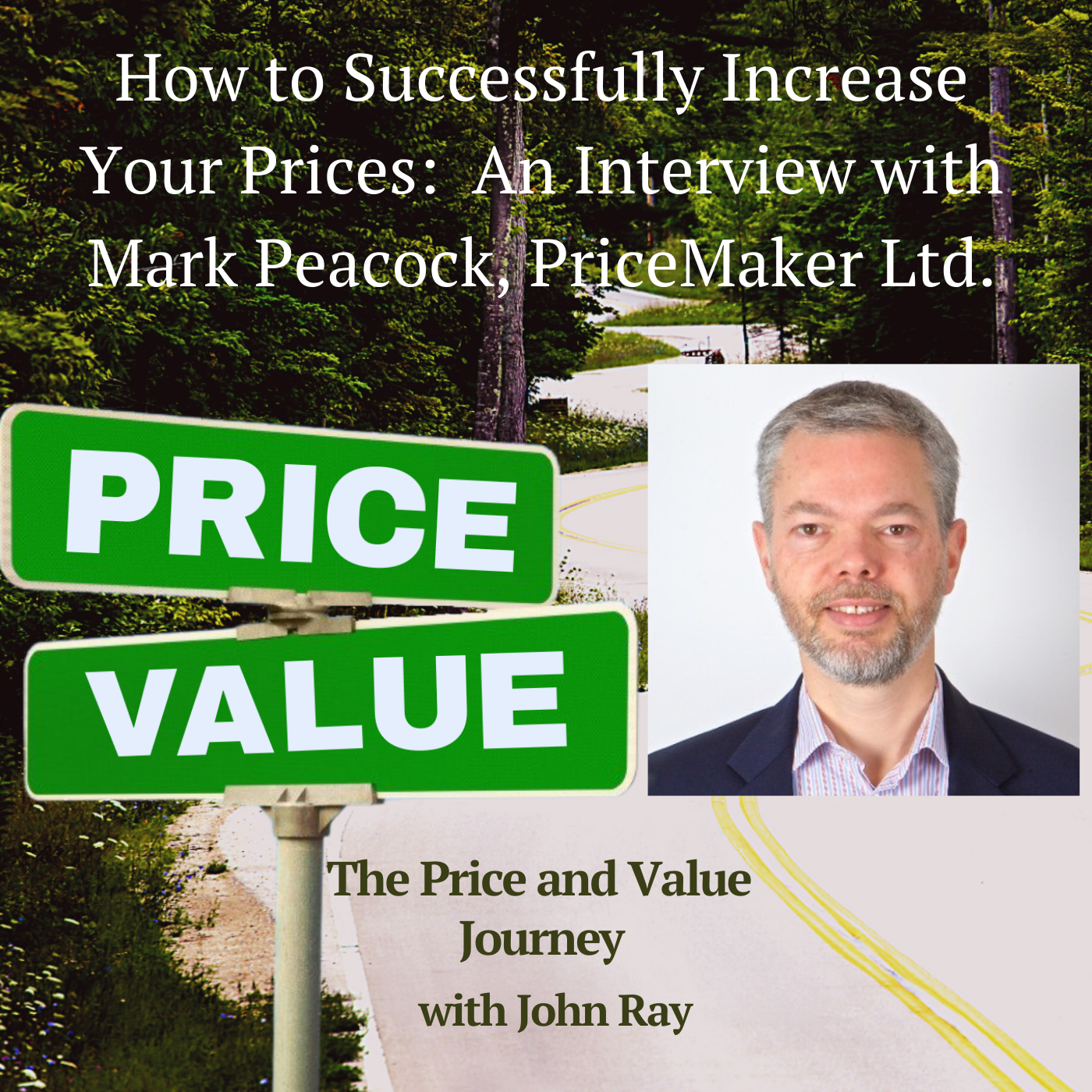
How to Successfully Increase Your Prices: An Interview with Mark Peacock, PriceMaker Ltd.

March 23, 2022 by John Ray

How to Successfully Increase Your Prices
North Fulton Studio
How to Successfully Increase Your Prices: An Interview with Mark Peacock, PriceMaker Ltd.
Loading
00:00 /
RSS Feed
Share
Link
Embed

Download file

How to Successfully Increase Your Prices

How to Successfully Increase Your Prices: An Interview with Mark Peacock, PriceMaker Ltd.

Pricing expert Mark Peacock joined host John Ray to discuss how to successfully increase prices in your professional services practice. Mark covered the primary reason services providers don’t raise their prices (fear), the role of options in better pricing, the two-stage communication process he advocates for a successful price increase, mistakes to avoid, and much more.

The Price and Value Journey is presented by John Ray and produced by the North Fulton studio of Business RadioX®.

PriceMaker Limited

Pricing is one of the most powerful levers any business can use to increase profits and drive revenue growth. Yet all too often businesses are too scared to review their pricing and typically many business owners are leaving a lot of money on the table as a result.

PriceMaker is a leading UK pricing consultancy that has helped its clients increase net profits by an average of 20%. They use a simple 7 step process for designing a better pricing strategy that focuses on what customers value, and helps businesses implement new pricing without the fear of upsetting customers. PriceMaker helps with any of the following pricing services:

  • Pricing New Products or Services
  • Review of Existing Pricing Strategies
  • Digital Pricing Strategy
  • Implementing Price Increases
  • Customer Pricing Research
  • Competitor Pricing Assessment
  • Tender Response Pricing
  • Training for Management & Sales Teams

Company website

Mark Peacock, Managing Director, PriceMaker Ltd.

Mark Peacock, Managing Director, PriceMaker Ltd.

Mark Peacock is a leading UK pricing expert focusing on growth businesses in the Tech, Services, B2B and Product development sectors. He is the founder and M.D of PriceMaker Ltd, a specialist pricing consultancy and has helped his clients create new pricing solutions that add significant bottom-line value (+20% average increase in net profits). Mark spent 25 years working in the corporate world for brands such as DHL and The AA and was business unit director for two business units with £25M revenue and +100 staff where he grew profits by +250% over 5 years. His broad expertise covers pricing, product management, sales, marketing, commercial strategy and P&L management and he is a full member of the Chartered Institute of Marketing, the European Mentoring & Coaching Council, and the Institute of Directors.

LinkedIn | Twitter

TRANSCRIPT

John Ray: [00:00:00] And hello again, everyone. I’m John Ray on The Price and Value Journey. And I’m delighted today to welcome Mark Peacock. Mark is a leading pricing expert based in the UK, focusing on growth businesses in tech services, B2B, and product development sectors.

John Ray: [00:00:21] He’s the Founder and Managing Director of PriceMaker Limited, a specialist pricing consultancy who has helped his clients create new pricing solutions that add significant bottom line value, on average 20 percent increase in net profits. Do I have your attention, folks?

John Ray: [00:00:41] Mark spent about 25 years in the corporate world for brands such as DHL. He has been in charge of business units with over 25 million in revenue, that’s pounds, not dollars. So, folks, that’s more than what you think given the conversion. And over 100 of staff headcount where he grew profits by 250 percent over five years. His expertise, not only includes pricing, but product management, sales, marketing, commercial strategy, and PNL management. Mark Peacock, welcome to the show.

Mark Peacock: [00:01:21] Well, thank you, John. It’s a real pleasure to be here. And thanks for that lovely introduction. I’m looking forward to our chat.

John Ray: [00:01:27] Yeah. It’s an honor to have you here. And we’ve got you here to address the question of how to successfully increase prices. But before we get to that, just real quick, you’ve got all this experience in corporate that goes well beyond pricing. And I’m just curious, when you left corporate to start your own practice, why did you focus on pricing?

Mark Peacock: [00:01:54] Yeah. That’s a great question, John. And when I originally left, I wasn’t absolutely sure what I was going to do. As you say, I have all of this experience in product management, marketing, running sales teams, and running a business. And then, I have my eureka moment and I thought, “Pricing. Nobody talks about pricing, particularly in the small and medium sized business world.”

Mark Peacock: [00:02:18] You know, you’ve got the likes of McKinsey’s and the big consultancies helping large corporates with pricing, but nobody really talks about it in the SME world. And I just felt that there was a place and a gap for somebody to come in and talk about how pricing can make a big difference to your business, and show people that it doesn’t actually have to be scary or difficult. And, actually, that there are lots of simple tactics that anybody can use that can make a big difference. So, I saw that as my mission, if you like. So, that’s why I’m on the show today, I guess, to help spread the word about the power of pricing.

John Ray: [00:02:58] Absolutely. And I think as we covered in the introduction, your focus is on several different sectors. Ours here on this show is on professional services firms, which you also have a wide experience with. Talk about from your perspective how bad the problem of inadequate or poor pricing is for professional services firms.

Mark Peacock: [00:03:26] Yeah. I think it starts with the point that people running these businesses are generally brilliant at what they do, whether they’re a marketing consultant, a lawyer, an accountant, an advisor, a consultant, whatever it is. They’re brilliant at what they do. But more often than not, particularly when it comes to pricing, they are a bit scared about it and they just default to the same method of pricing that everybody else in their industry uses. So, hourly rates, and daily rates, and project fees and things like that.

Mark Peacock: [00:04:04] And they don’t really put the thought that they need to into what’s the best pricing strategy for me. And the extent of that thought process is really, What’s my hourly rate going to be? Is it $50? Is it $500? Or is it $50? You know, where do I sit on that scale? And there’s a lot of hand wringing and worry and consideration. And then, we eventually settle on a number, whatever it is, and then we stick with it. So, we’ve gone through that hard question of what’s my hourly rate? And we don’t want to go through it again. So, we don’t move on any further.

Mark Peacock: [00:04:49] And in terms of how prevalent, it is what I think it’s right. You know, show me a business in the sector that’s got an amazing pricing strategy. And I’ll be quite surprised, people might be doing quite well with their pricing, which is great. But then, the question is, well, how much better could it be? So, yeah, there’s a lot. That’s why I’m passionate about what I do, because I think there’s a lot of people in this space that need help with their pricing.

John Ray: [00:05:19] How does someone that’s not an expert like you are, who has their own practice, how do they know they need to raise their prices?

Mark Peacock: [00:05:34] For me, the biggest indicator is the answer to the question, When did you last put your prices up? If the answer to that is more than a year ago, then you’re going backwards in terms of where you should really be. Now, we’re all aware of the threat of inflation, rising costs, rising prices. I’m sure it’s just as bad in the U.S. as it is in the UK at the moment for all sorts of reasons.

Mark Peacock: [00:06:07] So, if you don’t really think about it, people are unaware of the damaging effect of inflation over time. So, if I give a very quick made up example basing it on UK figures, $100 from ten years ago is not worth $100 today. It’s probably worth only about $70 in equivalent buying power. So, if you haven’t put your prices up in ten years, you’ve lost up to $30 in value, in buying power, that you would have had ten years ago.

Mark Peacock: [00:06:45] And the longer it goes on, the worse it gets, because you might think that inflation is only two or three percent – I’m not sure what it is in the U.S. at the moment – but that erodes the power of your dollar every single year. So, if you don’t do anything about it, you might think that the way to overcome that is to grow your business, is to sell more. You can do that, but your net margin is still deteriorating.

Mark Peacock: [00:07:11] So, I think the first question I always ask people is, When did you last put your prices up? Normally, always more than a year. People often say, “Well, probably three years ago we last put our rates up.” And often you’ll hear people saying, “Well, we haven’t put our prices up in ten years.” And that’s a big red flag for me. So, if that’s the case, then you really need to think about doing something about it.

John Ray: [00:07:40] Yeah. And I’m going to come back to what you said about if it’s been less than a year, because I’m sure there’s some folks that are probably shrieking at horror thinking about raising their prices every year. But I want to come back to that. But I want to talk about the reasoning behind why price increases don’t occur. And I assume fear is the biggest reason. But do you agree with that? And if so, why? And if you see something else, please comment on that.

Mark Peacock: [00:08:13] Yeah. Totally. I totally agree that fear is the underlying reason why people do not put their prices up. They might think it’s something else. They might think it’s due to market situation, increased number of competitors, my business is growing so I don’t need to. But the underlying reason is fear.

Mark Peacock: [00:08:38] And that’s because when it comes to thinking about that awkward conversation that you’ve got to have with your customers, people are scared. We’re scared because we don’t want to upset our customers. And if we do put our prices up, we don’t know how our competitors might react. So, all of that is going to affect our ability to achieve our revenue targets. And we might also lose out on new sales in the future that we would have got at our old prices.

Mark Peacock: [00:09:10] So, the conclusion, the thought process is, it’s far too risky. I don’t want to rock the boat. You know what? I’m just not going to bother and I’m going to focus on other things to grow my business, if that’s important to me. So, better marketing campaign, new products, recruit more salespeople, invest in new systems, whatever it is. There’s a whole load of things people will do to grow their business before they look at pricing.

Mark Peacock: [00:09:40] The pricing is the most powerful lever, as you know, John. So, it’s a shame that the fear gets in the way. Ignorance, I think lack of awareness of how to do it is another big factor, because that doesn’t get taught in business school, does it? You don’t do a module on how to increase your prices. You might remember what you learn about supply and demand and microeconomics, but that’s of no use at all in this situation. So, yeah, fear and lack of awareness, I think, are big factors in stopping people putting their prices up.

John Ray: [00:10:15] And unlike those that are in manufacturing, let’s say, that produce a product, what’s being sold for a professional services provider is what’s between their ears. So, it’s highly personal, right? I mean, it’s like you’re putting a price on your forehead, if you will, for people to say no to. And I think as much as people don’t want to admit that’s what’s happening, that’s really the way they feel down deep, right?

Mark Peacock: [00:10:45] Totally. And I think that’s also what holds people back from reviewing their pricing, because they take it very personally. And if somebody says no to the price increase, that’s a personal rejection. What I try and teach my clients is to separate the person from the product. So, think of it, this is the service I provide, it’s a product, and it has a price. And the best strategy, of course, is to provide options on our product range at different price points.

Mark Peacock: [00:11:17] So, it changes the conversation from the seller from “Will you buy from me, yes or no? And my rate is $100 an hour” to “Well, here’s the range of options that I provide, which one of these best meets your needs or the price you’re willing to pay?” So, it depersonalizes that link between the amount they’re paying you and your own self-worth and self-value. So, you need to get into that mindset of separating the two things and thinking about your pricing more carefully will enable you to do that.

John Ray: [00:11:53] Yeah. I just love that. I mean, because it really turns the conversation into yes or no. It’s a binary kind of thing into let’s talk about what your options are and you make the decision. And I, as the service provider, in a way, I don’t care what selection they make. Because I’m giving them options and they’re picking the one that fits best for them.

Mark Peacock: [00:12:21] Exactly that. And the best way to achieve that is rather than selling an hourly rate – so, let’s say I’m a website designer and I design websites for a living, and my hourly rate is $500 a day. And I estimate the job is going to take ten days, so $5,000 in total. So, rather than me pitching to the client and say, “Well, look, I charge $500 a day and it’s ten days, do you want me to do it, yes or no? And it might take more than that” – far better to just turn that into a project fee.

Mark Peacock: [00:12:51] And say, “Well, look, I’ve estimated the requirements. These are your objectives. This is what I can do. This is how it will look. And the overall project costs to meet your requirements is £5,000. By the way, if you want an enhanced version of what I can do, here’s another option with a load of extra services and features, and that’s £7,500.”

Mark Peacock: [00:13:14] So, you’re immediately moving away from “I charge $500 an hour” to “Well, here are two options. Which one of these best meets your needs at the price you’re willing to pay?” And of course, we’re using a few psychological pricing tricks in there, John, by high price anchor, which I’m sure you’re aware of. And that’s highly useful in terms of positioning the quality of what you do and allowing people to reference that to make a choice.

John Ray: [00:13:42] Yeah. I want to get back to options here in a second, but before we leave, I guess, the psychology of the service provider, let’s talk about ignorance. And as you said so well, the folks we’re talking about, those that are listening to this conversation, are brilliant people in what they do. But could that ignorance be what we’re talking about is the lack of understanding of a client’s perception of value and that’s where that ignorance is based. Is that what you see?

Mark Peacock: [00:14:21] I think it’s both facts and the lack of awareness of other ways to price what you do. I mean, if you work in a marketing agency, you’ve been trained to estimate hours and you’ve got a ladder of hourly rates, depending on your seniority. And that’s just the way it is. It’s the same in legal firms, accountancy, it’s just the same approach. And nobody takes the time or effort to think, “Well, is there a different way to price out what we do?” And we just get so used to pricing using that methodology.

Mark Peacock: [00:14:59] But you’re absolutely right, in terms of understanding customer value, that’s another area that people really struggle with. And the best way to think about this is, let’s say, I’m that website designer again and I’m charging $500 an hour. And if I’m [inaudible] a very small business, [inaudible], but they really love my help. Well, their ability to pay is very low, but they might perceive high value. Whereas, at the other end of the scale, you might have a much larger business as a client who thinks, “Oh, yeah. £500 a day, that’s a bargain. Let’s crack on.”

Mark Peacock: [00:15:41] So, if that’s the case, if that’s what happens in your market, why on earth would anybody try and sell the same price to both types of customer? It makes no sense if you think about it like that. Because people do perceive value in very different ways, and we need to adapt and adjust our pricing response accordingly. That doesn’t mean just saying, “Well, I’m going to charge you $300. And I’m going to charge you $500.” It needs to be more intelligent than that.

Mark Peacock: [00:16:15] But, yeah, understanding customer value is where really it all starts. And I think that is hard for people in this space. But there are ways and means to go about doing that.

John Ray: [00:16:27] Yeah. And we may get to some of that, but we want to get focused on how to increase prices because a lot of folks are struggling with that, knowing they maybe need to. And I think we talked about competitors and how folks are really focused in on what their competitors are up to. And the competitors are afraid, too, so how can I increase my prices, Mark, if my competitors aren’t?

Mark Peacock: [00:17:00] Yeah. That’s a really good question. I think the problem starts with the assessment that we’re all charging roughly the same price in terms of an hourly rate, whatever the number is. So, if I’m charging $500 and my nearest competitor, let’s say, they’re exactly the same price, how on earth can I get away with putting that up to $550 or $600? That feels difficult. Why would I want to do that? That makes no sense businesswise, because I’m going to lose business to those guys down the road and I’m not going to win any new contracts.

Mark Peacock: [00:17:40] Well, this is the problem with selling on an hourly rate or a daily rate, because you’re allowing the buyer to make it very easy to compare your rate with somebody else’s rate. So, the first step is turning it into options, or packages, or bundles. And that immediately sidesteps the easy comparison for a buyer to say, “Well, they’re £500 an hour and you’re telling me you’re £600 an hour and you turn it into a bundle?” Well, it’s $5,000, it’s $10,000 or whatever the number is, that’s far better, I think.

Mark Peacock: [00:18:18] In terms of how we go about this, the best advice I can give is, if you can understand your customers in terms of [inaudible] you need to do that. But in terms of the competitors, my advice is people get too worried about what competitors might or might not do.

Mark Peacock: [00:18:44] And whilst it’s important to know where you sit versus your competition, and particularly in terms of your price positioning, then get hung up on it. And if you feel your product or service has a high value, you have a good reputation, you have a strong brand, and you have lots of referrals and recommendations, then focus on that, first and foremost. And work out a plan to improve your pricing, not necessarily increase, but improve your pricing across your mix and let the competitors worry about it for themselves.

Mark Peacock: [00:19:24] I think all too often people, they anchor their pricing to the competitors. But why would you let somebody else determine the most important value lever that you’ve got that you can control, which is your price. And then, if you’re not sure, try and work out ways to improve your value proposition. Do I need to invest more in my branding, in my marketing? Do I need better systems to offer a better service? Do I need more people to support what I do? And all of that enhances and justifies the product that you’re selling unique to the needs and the market that you serve, rather than worrying about the customers.

Mark Peacock: [00:20:06] So, I guess my best advice there, John, is just forget them for a second and just crack on and sort yourself out. And then, worry about them further down the line. What do you think to that?

John Ray: [00:20:18] I couldn’t agree more. And, to me, that you’re focused on the wrong crowd. But you said it, instead of worrying about your competitors, focus on your customers. Go ask them why they’re doing business with you and you’ll be amazed at what you’ll find out, right? You will find out reasons that you’re delivering value that you didn’t even think of, right?

Mark Peacock: [00:20:41] Yeah. Yeah. Absolutely. And the other reason to do it like that is, you might flush out some really important things that you need to know about. So, if you do everything that we suggest and you go out with a very thoughtful price increase campaign, and you get some feedback from people that say, “Well, look, we’re not happy.” Well, what does that tell you? But what it probably tells you that it’s not actually the price that’s the problem. It’s the underlying quality of service or the product offering that you’re selling. That’s the real problem because they’re unhappy with it.

Mark Peacock: [00:21:17] So, the price of value equation has now gone out of balance in the eyes of the customer. Before, they were okay with the price value ratio, but now it’s tilted in the direction they don’t like. So, you need to know that so far better to have those awkward conversations and find out these things, than just carry on regardless. And, eventually, you’ll lose customers and business because you don’t understand why people are leaving.

Mark Peacock: [00:21:48] So, yeah, another good reason I think to tackle your pricing at least annually, I would say, to make sure you know what your customers really value. That’s my observation on that I think, John.

John Ray: [00:22:00] And then, on the positive side, you may have value that you’re delivering in ways that you don’t even think about. I mean, I’ll give the example of the accountant, that people do business with that accountant, not because they’re technically at the top of their game, which they are, but because they can explain difficult concepts in a way that folks can understand. I mean, I hear that a lot. And so, that’s a highly valued skill that that particular practitioner might not think about.

Mark Peacock: [00:22:45] Absolutely. And that’s a great point. So, it’s the soft reason why people are actually, “I love working with John because he explains things really clearly.” So, if John, the accountant, could turn that into a positioning statement and be very clear about the market, the people that they serve, and why he is particularly good for them, that will justify a price premium. Because people would be willing to pay more for John, the accountant, who’s brilliant at explaining difficult technical problems than the other guy down the road who just completes the books and sends in your tax return and doesn’t really explain things.

Mark Peacock: [00:23:27] So, really understanding that and having then the confidence to take that back to your business and say, “Yeah. Look, we’re really good at this. We should be pricing in line with the value that we’re offering because our customers see that value and are willing to pay for it.”

John Ray: [00:23:48] So, in terms of introducing options as a way to increase your pricing, and it sounds like there’s a process here, Mark, in going from hourly to introducing options. So, should I increase my hourly rate in the meantime while I’m preparing to introduce options?

Mark Peacock: [00:24:18] I would say not. Because if you don’t know where you’re trying to get to, you might make a mistake. Pricing is a long term game. Every single decision you make on your price today, or tomorrow, or next year will affect your business for years to come.

Mark Peacock: [00:24:37] So, for example, if we say, my hourly rate is $100 an hour. That’s your core price positioning then set for the next three to five years. And it’s very hard to move up from there. If you accept a deal and you knock a few dollars off because you really want it, well then you’ve lost that revenue and it comes off your bottom line for the next one, two, three years. So, every decision price is a long term game.

Mark Peacock: [00:25:06] So, I wouldn’t just rush ahead and increase the hourly rate without having thought through where do I want to get to in terms of my pricing. I think it’s far better to do that detailed work. It doesn’t have to be onerous or difficult. And you can come up with some ideas around options fairly quickly, evaluate the pros and cons of each, and then think, Where are we going to go with this? When are we going to do it? And is that acceptable to us as a business? I think that’s what I’d say on jumping too soon on that, John.

John Ray: [00:25:43] Got it. And what are the characteristics of successfully segmenting your clients so that you can introduce options that fit? And how important is fit with your current clients versus the clients you hope to get?

Mark Peacock: [00:26:07] Yeah. So, the simplest method that I talk about is to think about your market in terms of three different levels of price segmentation, high, medium, and low. So, every market, all of your listeners, all of their markets, will always have three levels of price willingness to pay.

Mark Peacock: [00:26:27] So, in the low segment, you’ve got your customers who are price sensitive. So, they have a low willingness to pay either because they can’t afford what you do. Or they don’t see the value in it, which is a different question.

Mark Peacock: [00:26:41] And the high willingness to pay segment, you’ve got customers that are willing to pay more, relatively speaking, for what you do because they value things other than price. They value your brand, your expertise, your reputation, the level of service you provide, whatever it is.

Mark Peacock: [00:26:58] And then, in the middle, you’ve got the core of your market, which is those people who don’t want to play at the cheapest end of the range but can’t afford the more expensive end of the range. And if you can design three options that fits each of those segments, you’ll be in a very good place, and that could be based around a package of services.

Mark Peacock: [00:27:23] So, one digital marketing agency I worked with had three bundles. An entry bundle for start up businesses for digital and design services. A medium bundle for existing businesses who were happy with where they were at with their marketing but wanted to take it up a level. And then, a premium bundle for investors and high growth businesses who were like, “Look, we’re totally ambitious. We want to go for it, basically.” And there were increasing components to each of these bundles. And, obviously, the fee went up, whether it’s a project fee, or a monthly retainer fee, or whatever it is.

Mark Peacock: [00:28:11] And the beauty is, when you now go out to market and sell like this, whoever you meet, you can basically say, “Well, here are the three options we have or here are three typical options. Which one of those best meets your needs at a price you’re willing to pay?” And you really don’t mind if the really wealthy buyers buy the cheapest package or the guys in the startup buy the most expensive package. You don’t mind. You might be slightly surprised.

Mark Peacock: [00:28:38] But it’s entirely their decision because they feel in control of that buying decision, which option might I choose. And it moves the buying process on one stage from “Am I going to buy from you, yes or no?” to “If I do buy from you, which option might I buy?” And that’s why options are so powerful.

Mark Peacock: [00:29:00] I always say one of the most important parts of pricing is choice and freeing your customers well-designed choices of price will do far more for your business than anything else. And three is the magic number, as we know. Two is okay, because it’s more than one. Four might be okay, but you’re probably getting into the territory of that’s too many.

Mark Peacock: [00:29:29] So, you can come up with three options that meet a broad range of customer needs. You’ll be doing very well. And you’re hedging your bets. You’re presenting a range of prices to the broadest spectrum of your market in terms of what they might be willingness to pay. So, you’re going to increase your chances of success.

John Ray: [00:29:52] So, I can hear folks now saying, “This is lovely, this conversation you guys are having about options, but how do options fit with increasing prices?” I mean, why does introducing options help me increase my prices?

Mark Peacock: [00:30:09] Okay. So, you could either just increase your price and, let’s say, it’s an hourly or a daily rate. So, let’s say one approach is to say, “Well, I’m charging $100 an hour and I’m going to put that price up by 10 percent. So, for next year, the price is $110 an hour.” So, that’s the traditional approach.

Mark Peacock: [00:30:28] The alternative to that is to say, “Well, if we can turn that hourly rate into packages, we can now go out to all of our existing customers and say, ‘Previously, we’ve been working on an hourly rate, but would now like to present to you some different options that you can consider.'” And it’s entirely their decision. So, I’ll use hourly rates for the sake of comparison, but it’s not really the best way to do it.

Mark Peacock: [00:30:56] But what I mean by that is, say for example, you now go out to your customers and say, “Well, if you want to carry on buying the same service, exactly the same, it’s $100 an hour. Or you can have a slightly enhanced version of that, which is $110 an hour. Or you can have the premium version of that, which is $130 an hour. Which one of those best meets your needs at a price you’re willing to pay?”

Mark Peacock: [00:31:19] And then, what you’ll find is that, certainly, your customers will stick with $100 product. But a proportion will upgrade to the 110 product. And maybe a couple will take 130 product. Because until you present that option to them, they can’t choose it, they can’t buy it.

Mark Peacock: [00:31:39] And then, if you can do the math, you can work out the weighted average increase. And what you’ll find if, say, 50 percent stay on the current rate, 30 percent by the £110 product, and 20 percent or less by the premium $130 product, your net average prices will have increased by between five and ten percent without you having to enforce an actual price increase on any of your customers. And that’s the power of choice.

Mark Peacock: [00:32:13] It’s that little bit of mass that works out the net effective price increase overall across each of the options. So, you can achieve increased prices by being more customer friendly, more tailored, and more responsive, and not upsetting your customers, which sounds a good way to do it. Why wouldn’t you do it like that if you know that’s the best way to do it?

John Ray: [00:32:41] Yeah. I mean that’s the proverbial having your cake and eating it, too, right?

Mark Peacock: [00:32:46] Yeah. Exactly.

John Ray: [00:32:48] Right.

Mark Peacock: [00:32:49] Sorry. Go ahead.

John Ray: [00:32:49] No. Go ahead, please.

Mark Peacock: [00:32:51] So, I was just going to say I’d use the example there by illustrating hourly rates. But, of course, that’s not the best way to do it. It’s far better to turn it into packages of options, which could be a monthly retainer, a monthly fee, a project fee, et cetera, rather than three different hourly rates. Just to clarify, I don’t want people thinking, “Mark said have three different hourly rates.” I mean, you can but it’s not ideal. I just wanted to clarify.

John Ray: [00:33:22] Thank you for clarifying that because I can see somebody getting that mixed up there. And so, talking about hourly rates, is this the way that I should make the jump from hourly? And should I make that jump with new clients only, or all of my clients, or just a few? What do you counsel on that?

Mark Peacock: [00:33:54] Yeah. It’s a good question. I always say when thinking about new pricing models, always think about new customers first, and then existing customers second. Because if we start by thinking about how can we improve our prices with our existing customers, we get tied up in knots because we just think, “Well, my biggest client, it’s going to be a nightmare talking about price increases to him, so I don’t want to do that.”

Mark Peacock: [00:34:22] So, let’s just put that issue to one side for a second and just think about new business. And the advantage of that is you can start with a blank sheet of paper, because none of your prospects or potential customers at this stage will know what your pricing is. So, you can go to them with a totally new price proposition and try things out. So, you could say, “Well, I’m just going to try out this new pricing approach on new customers only for a couple of months until I get confident with it. And then, I’ll bring it back to my existing customers and work out how we could apply it to them.”

Mark Peacock: [00:35:00] So, yeah, I always encourage folks to think about pricing for new business first, and then come back to your existing customers, and then seeing how you can translate or migrate the existing customers on to the new pricing model. And it just makes life a lot easier as well. They can have more fun because they’re new customers. So, let’s design something that’s really going to float their boat and meet our commercial requirements in terms of revenue and profit.

John Ray: [00:35:34] Let’s shift gears here, Mark, and talk just in general about how to communicate a price increase. And you’ve written and spoken on this. Let’s talk about issues like notice period, how much notice should I give? And just the communication of that, how that should unfold.

Mark Peacock: [00:35:59] And this is just as important as working out what is my new price. How you communicate and articulate and justify your pricing is as important as how you set the number. And when it comes to price increases, I think there’s a number of elements of good practice that businesses should follow.

Mark Peacock: [00:36:19] So, talking about notice period, so what’s a good what’s a reasonable notice period? So, for me, anything less than 30 days notice of a price change is a bit unreasonable. If you’re on the receiving end of a price increase and said, “Hey, John. We’re going to put our rates up effective tomorrow.” You’d be like, “Okay. Well, I haven’t budgeted for that and I wasn’t expecting it, so I’m a bit I don’t like that.”

Mark Peacock: [00:36:48] So, my advice is always minimum 30 days, even better, two months notice. So, if you can put your prices up, let’s say in January, the start of the calendar year, you need to be writing to your customers or emailing them or communicating with them by the end of October. Now, this seems quite far out, doesn’t it? “Oh, my God. That’s quite a lot.” But what it does is it gets your mind, your brain, your business geared up properly to manage and handle that price change, that price increase. So, by October, you need to have done the thinking about how you’re going to implement and apply this price increase. So, that’s what I’d say on timing.

Mark Peacock: [00:37:35] And the second reason for doing it like that is, again, it flushes out any disgruntled customer. So, you’ve got more opportunity to rescue that client and either do something bespoke for them. Or if you find that the two parties, there isn’t a meeting or there isn’t a good fit, then maybe it is time to part ways. I would say it’s far better to have 97 customers paying a higher rate than 100 customers at a lower rate. You’ll be better off financially, and you won’t be working as hard. So, what’s not to love about that?

Mark Peacock: [00:38:19] In terms of communication, it depends how many customers you have. For example, if you have hundreds or thousands, then you need to be doing some kind of mass communication, email, or letter. If you only have a couple of dozen, you can probably pick them off one by one verbally on a phone call, if you’re comfortable doing that. But get your script ready. And I don’t mean a script in the specific sense of saying something word for word. I mean, a guideline script. So, get your reasons ready. And this applies whether it’s a verbal conversation or a written communication.

Mark Peacock: [00:38:58] So, the way I would always position a price increase is as follows. We start with an acknowledgement that costs have risen. Now, in the current climate, and I’m sure this is the same in the U.S. as it is in the UK, prices are rising, costs are rising significantly. So, that is to your advantage because businesses, your clients, your customers, are aware that this is a problem at the moment.

Mark Peacock: [00:39:29] So, we can say something like, “As I’m sure you know, costs are rising at the moment and we need to move our business forwards to keep pace with the growth of our business,” or something like that – I didn’t word that very well. But we need to acknowledge upfront that cost is an issue. But once we’ve done that, we then move on to what that means for the customer. So, we only dwell on it very briefly, but then we move on to what does that mean for you. So, we can talk about the proposed price increase at that stage. “So, from next January or next April or next September, the new pricing will look like this, blah, blah, blah.”

Mark Peacock: [00:40:16] And then, it becomes a sales task. A price increase is a sales job in the sense that you have to remind and reinforce and reconvince all of your customers why they should continue to buy from you. So, we remind them of all of our strengths, all of our USP, all of our qualities.

Mark Peacock: [00:40:37] For example, “We are still the number one accountancy in our area. We specialize in providing friendly, easy to understand advice that meets the needs of your kind of business.” Or, “We’re the most creative marketing agency and we’ve won loads of awards and we are delighted to work with X,Y,Z and look forward to coming up with more ideas for you next year.”

Mark Peacock: [00:41:04] So, you’ve got to sell hard on the reasons and the benefits that people chose you in the first place. And update them, if you can, and remind them that that’s why they chose you in the first place. And then, you let them decide. Don’t play the hard sell in terms of where you’ve got to switch to our new pricing from next January. Let them decide. Because they are in control, so let them decide. And give them an out. If they don’t want to carry on, then say that’s fine. You know, “It’s been great working with you, but if you don’t see the value in this, then fine.”

Mark Peacock: [00:41:46] So, I’d be very gentlemanly about it, very professional, and treat people courteously, basically. So, I hope I’ve talked through the key stages there clearly, John. So, acknowledge the reason for the price increase. Costs are rising, explain what impact that is going to mean for the client as quickly as possible. Get it upfront. And then, thirdly, resell benefits as to why they should continue to work with you. Does that make sense?

John Ray: [00:42:18] Yes. Absolutely. Now, one post you made that discussed this, you applauded the idea of, in that first communication, not disclosing what the price increase would be. And I’m sure that’s shocking people to hear that. “You mean I’m going to tell people I’m raising price, but I’m not going to tell them how much? And isn’t the client going to ask me how much?” So, talk through that for us.

Mark Peacock: [00:42:54] Yeah. So, this is an even better price increase strategy. I’ve used it with my clients. And in the LinkedIn post I did, I was referring to my mobile phone provider, Virgin Mobile. And it’s exactly the same approach. And it’s a two stage communication process.

Mark Peacock: [00:43:14] So, stage one is we give all of the explanation and all of the reasons why our prices need to go up. And remind people of all the benefits of why they should continue to work with us. But we don’t tell them what the actual price increase is. All we say is, “We’re going to write to you next month and confirm you new prices for next year.”

Mark Peacock: [00:43:39] So, let’s say we write that first stage communication in October, and then we write the second stage for implementation in January, and then we write a second communication in November, and say, “Dear Mr. Customer. Following our communication last month, we’re pleased to confirm your new prices for next year as follows.” And then, you list them on the page.

Mark Peacock: [00:44:01] And what that does is a number of things. So, it manages expectations because the client now knows, “Okay. I’ve got a price increase coming.” It will flush out some early objectives. So, if you have any people that are particularly unhappy or want more detail, they will get on the phone to you or they will reply via email so you can start to have conversations with them.

Mark Peacock: [00:44:27] But most importantly, by the time they actually receive the price increase letter, which hopefully has some options in, in their mind, they’ll be thinking, “Oh, god. Is John going to push his prices up by – oh, gosh – it could be between ten and twenty percent maybe? I’ve heard of other people doing that in similar areas.” And you come along and it’s only eight percent and they go, “Oh, okay. Well, it’s not so bad then.” They still might quibble at this point. This is real life. This is grown up stuff. They still might argue at that point once they know what the real number is.

Mark Peacock: [00:45:03] But it’s a far better process because you’re being courteous. You’re letting them know where you’re at with your business. You’re also demonstrating courtesy by using this two stage process. And helping them get to grips with their planning, their forecasting, because they’ve got to think about their budget for next year.

Mark Peacock: [00:45:25] So, if they spent $5,000 a month on marketing fees, they need to know it might go up to five-and-a-half thousand. So, let’s shove that in the budget. And then, when the agency comes along and says, “Well, it’s only $5,300.” “Okay. Fine. Well, we’ve made a little saving.”

Mark Peacock: [00:45:43] So, I love that two stage process. Virgin did it to me for my mobile phone. I could see exactly what they were doing. But, of course, by the time the actual price increase came along, it was only an extra $0.93 a month on my mobile plan. I did the same thing for a manufacturing company. They had 300 customers, and it worked really well for them. So, no reason it can’t work for anybody in the professional services industry as well.

John Ray: [00:46:14] Yeah. That’s a really important thing you just mentioned, the psychology of it is that people assume the worst. And the worst is probably always a whole lot higher than what you’ve got in mind as a service provider. So, I love that.

John Ray: [00:46:34] We’re kind of running down on time, but I want to ask you one quick question before we wrap. Back to this business of raising prices every year, so I can hear people saying, “I’m going to be writing letters all year long here if I’m raising prices every year.” Talk about why you think that’s important as opposed to just one big increase every few years.

Mark Peacock: [00:46:59] Okay. So, far better to raise your prices on a regular pattern of frequency. So, do it once a year, every year, even if it’s only a couple of dollars or a couple of percent. And part of the reason for doing that is (A) you get your business into the habit of doing that, but you also train your customers to expect it. Even better, in your standard terms of business, you should have a clause that says, “We will increase our prices every year by an amount linked to inflation,” so they know it’s coming.

Mark Peacock: [00:47:34] So, get into the habit of doing it regularly. Do it the same time every year, whether it’s January, or April, or whatever works for you. And if there is a common habit in your industry, follow that common habit. So, if your industry generally puts prices up in January, do it in January, not in June. Because you’ll stick out like a sore thumb if you do it in June and everybody else is doing it in January.

Mark Peacock: [00:48:02] So, far better that than waiting three years and saying, “Oh. Sorry, guys. Prices are going up by 20 percent next year. We haven’t done it in three years. I hope that’s okay.” Far better, regular, small, frequent changes rather than big changes that are going to disrupt your business cycle. So, that’s my advice on that, John.

John Ray: [00:48:24] Okay. Awesome. Wow. You have shelled out the value today, Mark. And, folks, I think listening to this, you’ve gotten thousands of dollars worth of value here from Mark at no charge. So, thank you for that. But for those that want to dig deeper, learn more about your services that you offer, and maybe ask some questions, can they get in touch? And if so, how can they do that?

Mark Peacock: [00:48:55] Yeah. Of course. So, they can find me on my website which is pricemaker.co.uk. And if you go on there, there’s a pricing challenge and you click on it. It’s a self-assessment and you get a scorecard on your pricing capability. So, fill that in and it will give you loads more value. And you’ll find my contact details on the website as well. So, that’s pricemaker.co.uk.

John Ray: [00:49:21] Terrific. Mark Peacock, folks. Mark, it’s been a pleasure and thank you again for coming on and delivering so much value.

Mark Peacock: [00:49:31] Yeah. It’s been a pleasure, John. I always love talking about pricing, so thank you for inviting me today.

John Ray: [00:49:36] Thank you. And friends, just a reminder, if you’d like to hear more of this series, go to pricevaluejouney.com. And to connect with me directly, just send an email, john@johnray.co. Thank you for joining us.


About The Price and Value Journey

The title of this show describes the journey all professional services providers are on:  building a services practice by seeking to convince the world of the value we offer, helping clients achieve the outcomes they desire, and trying to do all that at pricing which reflects the value we deliver.

If you feel like you’re working too hard for too little money in your solo or small firm practice, this show is for you. Even if you’re reasonably happy with your practice, you’ll hear ways to improve both your bottom line as well as the mindset you bring to your business.

The show is produced by the North Fulton studio of Business RadioX® and can be found on all the major podcast apps. The complete show archive is here.

John Ray, Host of The Price and Value Journey

John Ray The Price and Value Journey
John Ray, Host of “The Price and Value Journey”

John Ray is the host of The Price and Value Journey.

John owns Ray Business Advisors, a business advisory practice. John’s services include advising solopreneur and small professional services firms on their pricing. John is passionate about the power of pricing for business owners, as changing pricing is the fastest way to change the profitability of a business. His clients are professionals who are selling their “grey matter,” such as attorneys, CPAs, accountants and bookkeepers, consultants, marketing professionals, and other professional services practitioners.

In his other business, John a Studio Owner, Producer, and Show Host with Business RadioX®, and works with business owners who want to do their own podcast. As a veteran B2B services provider, John’s special sauce is coaching B2B professionals to use a podcast to build relationships in a non-salesy way which translate into revenue.

John is the host of North Fulton Business Radio, Minneapolis-St. Paul Business Radio, Nashville Business Radio, Alpharetta Tech Talk, and Business Leaders Radio. house shows that feature a wide range of business leaders and companies. John has hosted and/or produced over 1,100 podcast episodes.

Connect with John Ray:

Website | LinkedIn | Twitter

Business RadioX®:  LinkedIn | Twitter | Facebook | Instagram

Tagged With: increasing prices, John Ray, Mark Peacock, price increase, PriceMaker, PriceMaker Limited, pricing, professional services, professional services providers, solopreneurs, The Price and Value Journey

Decision Vision Episode 45: Should I Increase My Prices? – An Interview with John Ray, Ray Business Advisors, LLC

January 2, 2020 by John Ray

should I increase my prices
Decision Vision
Decision Vision Episode 45: Should I Increase My Prices? - An Interview with John Ray, Ray Business Advisors, LLC
Loading
00:00 /
RSS Feed
Share
Link
Embed

Download file

Should I Increase My Prices
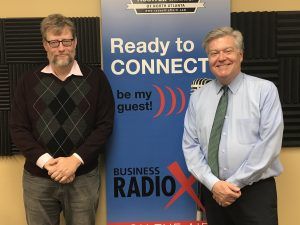
Mike Blake and John Ray

Decision Vision Episode 45:  Should I Increase My Prices? – An Interview with John Ray, Ray Business Advisors, LLC

“Should I increase my prices?” If this question makes you pause, then this “Decision Vision” episode is for you. Price and value authority John Ray speaks with host Mike Blake on the importance of pricing in a business, how to negotiate prices, why hourly billing is the wrong way to price, and dealing with the “it’s too expensive” objection. “Decision Vision” is presented by Brady Ware & Company.

John Ray, Ray Business Advisors, LLC

should I increase my prices
John Ray, Ray Business Advisors, LLC

Because pricing is the fastest way to change the profitability of a business, John Ray advises business owners on the “should I increase my prices” question, how to change their pricing, and moving to a value pricing model. His clients include attorneys, CPAs, consultants, other professional services firms, and technology companies. His blog, “Pricing for Profit,” regularly features examples and stories which help business owners in their own pricing journey. John is also a speaker on pricing and value at numerous chambers, business events and seminars. John also helps small to mid-sized companies achieve their profit and growth goals as an outside CFO.

John also owns and operates the North Fulton studio of Business RadioX®. John is the host of “North Fulton Business Radio” and “Alpharetta Tech Talk.” He also plans, produces, and promotes radio show/podcasts for businesses and entrepreneurs.

John is extremely active in the North Fulton community. He is on the board of the Greater North Fulton Chamber of Commerce (GNFCC), and serves in a variety of capacities there, including Chairman’s Circle, member of the Finance Committee, and Chair of the Awards Committee. John was named the 2018 Harry Rucker Jr. Volunteer of the Year by GNFCC.

For more information on John and his firm, find John’s LinkedIn profile here, go to raybusinessadvisors.com, or call John directly at (404) 287-2627.

Michael Blake, Brady Ware & Company

Mike Blake, Host of “Decision Vision”

Michael Blake is Host of the “Decision Vision” podcast series and a Director of Brady Ware & Company. Mike specializes in the valuation of intellectual property-driven firms, such as software firms, aerospace firms and professional services firms, most frequently in the capacity as a transaction advisor, helping clients obtain great outcomes from complex transaction opportunities. He is also a specialist in the appraisal of intellectual properties as stand-alone assets, such as software, trade secrets, and patents.

Mike has been a full-time business appraiser for 13 years with public accounting firms, boutique business appraisal firms, and an owner of his own firm. Prior to that, he spent 8 years in venture capital and investment banking, including transactions in the U.S., Israel, Russia, Ukraine, and Belarus.

Brady Ware & Company

Brady Ware & Company is a regional full-service accounting and advisory firm which helps businesses and entrepreneurs make visions a reality. Brady Ware services clients nationally from its offices in Alpharetta, GA; Columbus and Dayton, OH; and Richmond, IN. The firm is growth minded, committed to the regions in which they operate, and most importantly, they make significant investments in their people and service offerings to meet the changing financial needs of those they are privileged to serve. The firm is dedicated to providing results that make a difference for its clients.

Decision Vision Podcast Series

“Decision Vision” is a podcast covering topics and issues facing small business owners and connecting them with solutions from leading experts. This series is presented by Brady Ware & Company. If you are a decision maker for a small business, we’d love to hear from you. Contact us at decisionvision@bradyware.com and make sure to listen to every Thursday to the “Decision Vision” podcast. Past episodes of “Decision Vision” can be found here. “Decision Vision” is produced and broadcast by the North Fulton studio of Business RadioX®.

Visit Brady Ware & Company on social media:

LinkedIn:  https://www.linkedin.com/company/brady-ware/

Facebook: https://www.facebook.com/bradywareCPAs/

Twitter: https://twitter.com/BradyWare

Instagram: https://www.instagram.com/bradywarecompany/

Show Transcript

Intro: [00:00:01] Welcome to Decision Vision, a podcast series focusing on critical business decisions, brought to you by Brady Ware & Company. Brady Ware is a regional full-service accounting and advisory firm that helps businesses and entrepreneurs make visions a reality.

Mike Blake: [00:00:19] And welcome to Decision Vision, a podcast giving you, the listener, clear vision to make great decisions. In each episode, we discuss the process of decision making on a different topic from the business owners or executives’ perspective. We aren’t necessarily telling you what to do, but we can put you in a position to make an informed decision on your own and understand when you might need help along the way.

Mike Blake: [00:00:39] My name is Mike Blake and I’m your host for today’s program. I’m a director at Brady Ware & Company, a full-service accounting firm based in Dayton, Ohio, with offices in Dayton, Columbus, Ohio, Richmond, Indiana, and Alpharetta, Georgia, which is where we are recording today. Brady Ware is sponsoring this podcast. If you like this podcast, please subscribe on your favorite podcast aggregator and please consider leaving a review of the podcast as well.

Mike Blake: [00:01:03] So, today, we’re going to talk about adjusting your prices. And this show is going to be published shortly after the secular New Year. So, for those of you who celebrate Christmas, I wish you a merry Christmas after the fact. And those of you who celebrate the Catholic Protestant New Year, Happy New Year to you. If you are a Kwanzaa celebrant, I will wish you a happy Kwanzaa and readers as well. And happy Hanukkah. This will probably come out, I guess, a few days after the last evening of Hanukkah. And if you’re an atheist and don’t believe in any of this, I’ll just wish that you have a nice day.

Mike Blake: [00:01:49] But anyway, we wanted to make sure that this particular program started off the new year because it’s a topic that I think most business people are thinking about revisiting. And if you’re not, you probably should. And that is the topic of pricing. Pricing, I think, is one of the hardest things to get right, particularly, but not limited to professional services. Figuring out the price that you need to charge your clients, your customers is a challenge.

Mike Blake: [00:02:26] And it’s a challenge as much as anything because the market is not very transparent. Our competitors, at least in professional services, we don’t know exactly what they are charging except on rare occasions. And even if you do, you’re not exactly sure necessarily how to equate the value propositions. You may or may not be sure how your client equates those value propositions. And because pricing is so difficult, it is important, I think, to revisit that on a regular basis at least every year. Because that way, if you’re getting it wrong, you only have to live with the mistake for about a year or so.

Mike Blake: [00:03:07] And on the other hand, if you’re getting it right, great, you revisit it, you think about it for five minutes, “I’m good”, and you move on. And pricing has some interesting psychology to it as well, because we are making a statement to the market that we believe our product and service is worth X. And when somebody decides not to buy, whether it is a product or service, they are telling us that they don’t agree that it’s worth X. And that requires some mental toughness in order to kind of sustain yourself through that.

Mike Blake: [00:03:44] So, it’s an important topic and we’re going to get into it today. I was thinking about relaying an anecdote, actually, of a pricing challenge, an event that I just have. Now, I’m going to wait until we do the interview, because I think it will flow better. So, let’s jump into it. Joining us today is John Ray, who is the owner of Ray Business Advisors. John helps small to mid-sized companies, including law firms and CPA firms achieve their profit and growth goals, and God knows we need help.

Mike Blake: [00:04:16] John’s clients come to him to reduce the stress and anxiety, which often comes with day-to-day management of a business. John works with businesses to enhance their pricing strategies and make more money. John also relieves the burden of accounting and bookkeeping and improves business processes. John holds a Bachelor of Arts from Vanderbilt University, a school with a terrific baseball program, an okay basketball program, and a football program that’s lousy and that’s to see what probably is good in almost any other conference.

John Ray: [00:04:46] The longest bear market in history.

Mike Blake: [00:04:47] The longest bear market in history. Although Tennessee maybe giving them a run for their money now, interestingly enough. With honors in English and economics, John is also a studio partner for Business RadioX, voice of the Fortune 500,000 and produces this Decision Vision podcast. He helps business owners plan, produce, and promote their own radio shows and podcasts. And I can tell you that we’ve been very happy with John’s service and the impact that we’ve had and have the opportunity to make in the marketplace and sharing our knowledge.

Mike Blake: [00:05:18] So, you know, as an aside, maybe we’ll probably do a show on this. Should I do a podcast? I can tell you that for us, it’s been a successful activity and one that’s been well worth doing, we’re going to continue doing it for a while. So, if you’re hoping we would go away, sorry. John is very active in the North Fulton community. He sits on the board of the Greater North Fulton Chamber of Commerce and serves in a variety of capacities, including the chairman circle, member of the finance committee, and co-chair of the awards committee. John was named the 2018 Harry Rucker Junior Volunteer of the Year by the Greater North Fulton Chamber of Commerce. John, welcome to the program.

John Ray: [00:05:55] Great to be here. Great to be on the other side of the mic.

Mike Blake: [00:05:58] Yeah. So, I know you’ve been chomping at the bit to sort of jump in here, but I have to ask you, do you know who Harry Rucker Junior is and why the award is named for him?

John Ray: [00:06:08] I have no clue.

Mike Blake: [00:06:09] Okay.

John Ray: [00:06:10] I Googled him, but I couldn’t find him.

Mike Blake: [00:06:12] That’s an honest man right there. So, I guess he was so generous, he wanted all of his volunteer activities to go anonymously. So, there you have it.

John Ray: [00:06:22] Yeah.

Mike Blake: [00:06:22] So, let’s jump into this. I mean, why are we talking about this? You make a living off of helping companies figure out their pricing and correct their pricing, why is it so hard?

John Ray: [00:06:33] Well, first of all, it’s hard, I think, a couple of things. Well, first of all, I don’t know that folks get much training, if any, in pricing. And that’s really odd because of what an impact pricing has on the bottom line. So, studies from folks like McKinsey show that pricing has the biggest variable impact on the bottom line of the business. This is an accounting fact. So, it’s more than cutting expenses, it’s more than let’s do a better job with marketing or converting leads or what have you. So, pricing’s got the biggest impact whatsoever.

John Ray: [00:07:12] Yet, business schools, the last that I saw shows that only less than 10 percent of business schools out there actually have a course, just one course on pricing. So, we put entrepreneurs out there into the marketplace, get them going, and they’re good at customer discovery and they’re good at a lot of things that have to do with the business and if they’re not, they can go easily get those skills outsourced to receive those skills, but pricing is always a problem, because of this lack of training and education that they have once they start a company.

Mike Blake: [00:07:55] Yeah. It’s interesting. You know, going back to my own MBA experience, which was a very long time ago, my diploma is on a cave painting in France someplace. But we learned almost nothing about price. And the only time I remember it ever really coming up in a rigorous way was we did a marketing simulation and we had to do pricing and that was fine as far as it went, right?

John Ray: [00:08:17] Sure.

Mike Blake: [00:08:18] But there’s a limit to that. And I mean, I think you’re so right. In one respect, price is the easiest thing to change about your business, right? You can just decide to do it.

John Ray: [00:08:29] Sure.

Mike Blake: [00:08:30] Now, you may not do it correctly, but you can’t do it almost instantaneously, right? Whether it’s just changing the number you put on your engagement letters or going off the price gun-

John Ray: [00:08:39] Right.

Mike Blake: [00:08:39] … it’s fairly easy to change. In your experience, when people or businesses mispriced their offerings, do they tend to overprice or underprice them?

John Ray: [00:08:50] Underprice. And I’m an example of this, I have to say. I mean, I got passionate about this because-

Mike Blake: [00:08:56] You’re gonna testify, aren’t you?

John Ray: [00:08:57] Yes, I am. I’m going to confess right here. If anybody’s listening, I’m confessing. So, no, I mean, it’s, you underprice what you do, particularly, as you said in the intro, in professional services. Because in professional services, we price our sales and there’s these voices that speak to us that sit on our shoulder and whisper in our ear that says, “Oh, that person’s not going to pay that much. You know, that company is talking to other people”, or what have you. And, you know, you need to knock a little bit off of that. That’s not going to work. And we talk ourselves out of the way we should price.

John Ray: [00:09:42] I think there’s a misconception also that if you lower your price, you’ll get more business. And actually, the opposite is sometimes true because price is an indication of quality. And I could relay a lot of anecdotes about how increasing prices actually increase sales, because suddenly, that the customer base, that product or service was aimed at, saw a lot more quality in what they were being presented than they had previously. So, price is a signal, and it’s actually a marketing signal.

Mike Blake: [00:10:23] There’s a great episode on Frasier, where Frasier and Niles were talking about, I think it was some sort of massage therapist or something. And they’re bragging, basically bragged in terms of the hourly rate, right?

John Ray: [00:10:42] Right.

Mike Blake: [00:10:43] So Niles was saying, you know, “My massage therapist is $500.” Frasier comes in and says, “Mine is a $1,000-an-hour.” And Niles goes, “She sounds fantastic.”

John Ray: [00:10:52] That’s right. Yeah.

Mike Blake: [00:10:54] And, you know, I remember, earlier in my career, you know, one of the services we provide is something called a fairness opinion, which is an appraisal of a business where we have some fiduciary responsibility attached to it. So, there’s liability, so we tend to charge more. First one I ever did or maybe the second one I ever did but for a very friendly client. And I want to make sure I got the business, I underpriced it.

Mike Blake: [00:11:20] I got the business, but my client told me after the fact, he said, “Look, I appreciate the price, but I got to tell you, you almost didn’t get the work because your bid was so much lower than everybody else’s. We were concerned or the board was concerned that you actually knew what you were doing and you could put the requisite time and effort into this exercise. And I had to go to bat for you and say, ‘No. He knows what he’s doing in valuation, he just don’t know anything about pricing.'” I said, “Thanks.”

John Ray: [00:11:49] Right.

Mike Blake: [00:11:49] Right?

John Ray: [00:11:49] Yeah.

Mike Blake: [00:11:50] But, you know, we rarely get insight into that process. But I can tell you that, you know, A, I left about $35,000 on the table, no doubt, a minimum. And B, I nearly got nothing because I was so good at negotiating with myself-

John Ray: [00:12:05] Right.

Mike Blake: [00:12:05] … that I almost negotiated myself right out of that business.

John Ray: [00:12:09] And we’ve all looked at something and said, “That’s too good to be true”, in terms of the price. There’s something wrong. But we rarely take that sentiment and turn it around on our own product or service, right?

Mike Blake: [00:12:23] Right.

John Ray: [00:12:23] So, I think that’s what you’re getting at and it makes tons of sense. And I have never seen anybody. And if you’re out there, please write in and let us know and we’ll stand corrected. But I’ve never seen a business start out by overpricing.

Mike Blake: [00:12:44] We have no e-mail free to write in, by the way. We’re trying to fix that, but write in sort of metaphorically.

John Ray: [00:12:50] That’s right.

Mike Blake: [00:12:52] Or John will give you his e-mail at the end of this podcast, so you can write into there, I guess.

John Ray: [00:12:55] Yeah, there you go.

Mike Blake: [00:12:57] So, we’re over-thinking it, should pricing just be simple as, “Here’s what it costs me to deliver this product or service, here’s the amount of profit I want to make off of it”?

John Ray: [00:13:11] Well, certainly, your revenues have to exceed your costs. So, let’s just start with that. So let’s make the accountants happy and we’re going to agree to that. What I find, particularly in professional services, is that when a professional services provider focuses on pricing relative to the value that they deliver and just getting a piece of the value they deliver and that’s their equation, then they make a lot more money and they really don’t have to worry about their cost because they deliver so much value, generally.

John Ray: [00:13:54] So, sure, it’s important to have a profitable business, but that’s not really what we’re talking about here in getting our pricing right for professional services providers, it’s really about getting a piece of the value that you provide such that you can have a more focused business working with the best clients and not be so stressed, really running a business where you’ve got a bunch of clients where you really don’t want to service a bunch of them, right?

Mike Blake: [00:14:25] Yeah.

John Ray: [00:14:26] 20% or 30% of them, you really don’t want, but you’ve got them simply because you’re getting the revenue out of them. But they’re very low margin clients.

Mike Blake: [00:14:34] And that’s where you get back in the podcast number two, how should I fire my client?

John Ray: [00:14:38] That’s right. My favorite of the series, so far.

Mike Blake: [00:14:42] So, can different clients have different prices for roughly the same product or deliverable? And is that okay?

John Ray: [00:14:50] Absolutely. So, different clients have different values. And it’s okay to price based on those values. And it’s okay to offer options that clients can select, the options based on service levels, speed of delivery of the service, et cetera. In fact, I highly, highly recommend, in fact, demand of my clients that they offer options because that really helps ferret out what you’re getting at. So, I think the biggest mistake a lot of folks make is here’s my price, it’s kind of a fill or kill adversarial situation, right? Either you accept or you don’t. That’s the way the client looks at it, right? I think, Mike, what folks need to understand is that clients love options. They like to select. They like to see what your panoply of services are and come out with what they want.

Mike Blake: [00:15:59] And, you know, I think, perhaps, the best example, and I do this more and more, I offer choices as well, because I find that it enables clients to then choose what they want to do, right?

John Ray: [00:16:12] Right.

Mike Blake: [00:16:12] And when you’re with our clients, you make the relationship less adversarial. But, you know, that rule of three has been embraced for a long time by who I think is the king of price in the airline industry.

John Ray: [00:16:23] Yes.

Mike Blake: [00:16:24] Right? I don’t think there’s an industry anywhere that is more sophisticated about pricing than the airline industry.

John Ray: [00:16:30] Right.

Mike Blake: [00:16:31] And what do they offer on most of their flights? Business class, first class-

John Ray: [00:16:36] Coach.

Mike Blake: [00:16:36] … economy/surf class-

John Ray: [00:16:40] Right.

Mike Blake: [00:16:40] … or steerage. And, you know, they let you choose, right? If you want to have the first class experience and the glass of champagne before the flight even leaves a gate, you pay that. And, you know, if you don’t mind taking an elbow to the back of your head every once in a while on a five-hour flight to the West Coast, you can do that, too, right? And so, you know, the funny thing is, in my experience—and I’m just going to say this sort of on the down low, because nobody’s listening except for the two of us, right?

John Ray: [00:17:11] That’s right.

Mike Blake: [00:17:12] Most often, the most profitable service I offer is the lowest priced one.

John Ray: [00:17:18] And that means you’ve got it correctly priced, right? It’s important to understand that different clients have different values and will value things differently across the spectrum. So, here’s an example outside of professional services, coffee. So, I’m a cheapskate on coffee. I mean, I may buy the dollar cup at racetrack, I’d prefer to wait until I get wherever I am and hope they’ll give me a cup of coffee for free, right?

John Ray: [00:17:46] Then, there’s my daughter at college who’s racking up $5 charges at Starbucks seemingly every half-hour on the half-hour, right? And then, the most expensive cup of coffee sold in the United States the last time I looked was $75 a cup. And it comes from some “exclusive farm in Panama, where they get one crop a year and they have a big party and a tasting at this coffee place in California that serves this coffee and they sell out”. So, I think that’s crazy. But there’s some people that look at coffee as fine wine. So-

Mike Blake: [00:18:28] Yeah.

John Ray: [00:18:28] Right? And that’s cool. That’s their value system. They may have other things that they look at and they’re cheapskates about, but we all have a panoply of values that we ascribe to a lot of different products and services. And so, as professional services providers offering our services, we have to recognize that and price accordingly.

Mike Blake: [00:18:51] So, everyone saw an article pops up, it’s probably click bait, but I’ll probably take that click bait, which is on why hourly pricing is the wrong price for professional services. Do you agree with that and why?

John Ray: [00:19:08] Absolutely. So, hourly pricing, well, it’s wrong on a number of levels. One is that it’s not really the end price. It’s not what a client pays. Clients are interested in what they’re getting in to pay. So, when you deliver an engagement letter and it says, “We’re gonna charge you, the partner time is to $250 or $300-an-hour and the associate time is $125”, or whatever, fill in the blanks, that’s not a price, that’s just half the equation.

John Ray: [00:19:44] It doesn’t tell me how many hours each of them were gonna put into that. It doesn’t tell me what happens when the project blows up and it takes longer than what we thought it was gonna take, which is almost inevitable because things never go the way they are supposed to go, right? So, it’s wrong from that point of view. It is a relic of the industrial age when industrial companies were trying to price get their professional services providers to deliver pricing that they could equate with their inputs, basically.

John Ray: [00:20:20] I mean, I could go in the whole history of it, but the point of it all is that it’s from another age and another time. And what clients are really paying for is not how much time you spend on a project, they’re paying for the grey matter between your ears and your experience and all the things that you’ve seen with other clients. That’s what they’re paying for. I mean, I had this experience with one of your colleagues where I brought a client in. And this was just an exploratory meeting on whether this client ought to sign up to be a Brady Ware client, right?

John Ray: [00:20:56] And in 15 minutes, they gave tremendous help and advice that I think pushed that engagement over in terms of getting that client to sign up. But the point is, is if that were a paying client at that time and that client had been paying by the hour, then the value-to-price ratio would be ridiculous. That client would have gotten much, much, much more value relative to the price they paid than they should have if you’re billing in 15-minute increments.

Mike Blake: [00:21:30] Yeah. And, you know, one of the fallacies then also is that you’re punished for being more efficient-

John Ray: [00:21:36] Right.

Mike Blake: [00:21:36] … which is not the way economics are supposed to work. And, you know, use the accounting example, you know, I don’t think any of our clients are paying for our time or they should not be.

John Ray: [00:21:48] Right.

Mike Blake: [00:21:49] Right? On our tax side, they’re paying for one of two things. One, I’m bulletproof against an IRS audit, right? Or two, I’m exercising my civil obligation to minimize what I pay to Uncle Sam as much as I possibly can.

John Ray: [00:22:12] Sure.

Mike Blake: [00:22:12] Right?

John Ray: [00:22:13] Sure.

Mike Blake: [00:22:13] When you’re a tax client, the client’s are one of those two things, right? They either are terrified of Uncle Sam, they want nothing to do with them or they want to go into combat with Uncle Sam.

John Ray: [00:22:23] Right.

Mike Blake: [00:22:24] Right? And man, if your client would like to go into combat with Uncle Sam, please call us, because, boy, we make a lot of money there.

John Ray: [00:22:31] Sure.

Mike Blake: [00:22:33] And, you know, whether that takes one hour or fifteen hours, it’s the outcome you’re buying.

John Ray: [00:22:37] Right.

Mike Blake: [00:22:37] Right. Not the inputs.

John Ray: [00:22:41] Not the inputs.

Mike Blake: [00:22:41] Who cares? And also, it has to sort of go both ways, right?

John Ray: [00:22:49] Yes.

Mike Blake: [00:22:51] The client’s not going to let you suddenly charge more if something that was supposed to take you 10 hours, you know, takes you 100.

John Ray: [00:22:58] Right.

Mike Blake: [00:22:58] First of all, well, that’s not my problem if you couldn’t get your act together, right?

John Ray: [00:23:01] Right. Exactly.

Mike Blake: [00:23:02] So, by definition, you know, for the most part, some industries are not like this, but many industries, that hourly notion is a one-way street.

John Ray: [00:23:14] Yeah. And, you know, I think technology is such, artificial intelligence is such that I saw one study that this study said was, “In five years, 99% of all bookkeeper jobs would be eliminated.” Then, I think it was the same percentage for tax-prepared jobs. Well, I don’t know that that’s true, but directionally, it’s probably correct because of technology.

Mike Blake: [00:23:39] Absolutely.

John Ray: [00:23:40] Right.

Mike Blake: [00:23:40] I mean, we don’t have people cranking out tax returns by hand and-

John Ray: [00:23:44] Right.

Mike Blake: [00:23:44] … with slide rules and so forth.

John Ray: [00:23:47] Yeah. And so, as technology and particularly, artificial intelligence, links between institutions get more robust, I could foresee a time when tax returns are real time. You can see your tax return in real time as the year goes on, right?

Mike Blake: [00:24:02] Yeah.

John Ray: [00:24:02] And so, the value of a tax preparer, let’s say, comes from the advice they give around that return, not for the preparation of the return. And so, as you say, if you’re pricing by the hour and based solely on preparation of return, your business is headed straight down over the next few years.

Mike Blake: [00:24:25] Yeah.

John Ray: [00:24:25] Period. The pig is in the python, shall we say.

Mike Blake: [00:24:30] Yeah. So, how do you help your clients respond when they have their own customer, client or prospect that pushes back on price? You know, you’re charging me too much, I don’t want to pay that. What are some of the approaches that you advocate to engage in that conversation?

John Ray: [00:24:50] What I tell folks is that if you get that response to a proposal, typically, you’ve not had a great value conversation, because the client’s comparing that price or those prices relative to something other than the value that you’re providing. So, you’ve not done a really good job at marketing your value to that client or getting that client to understand that value. And you don’t have a good sense of where their values are.

John Ray: [00:25:23] And again, you know, it’s kind of interesting. I’ll give you an example of this. I had a client who I was having an exploratory meeting with and, you know, it was going well and he was almost downplaying what he really needed until his wife came in the room. And she was talking about how screwed up he was and how they needed to get their financial act together and their books were a mess and she was sick of it.

John Ray: [00:25:52] And it occurred to me at that point that this man’s value was getting his wife off his back. That had nothing to do with the services that I may have been providing, really, in terms of the way he looked at value. So, the point is, if I had never had an in-depth discovery session with him, I wouldn’t have understood that value and I might have priced my services a lot differently and he might have given me the “it’s too expensive” response, right?

John Ray: [00:26:27] So, you know, I think it’s really important to understand client value. And then, the other thing I tell folks is when a client says it’s too expensive, I say, you know, “Too expensive relative to what? Relative to doing nothing?” Meaning is, what’s the cost of doing nothing for this problem that you were sitting here talking about? Is it too expensive relative to you doing it yourself? See, when you ask those kind of questions back, then you get to the root of where the value really is in that client’s head.

Mike Blake: [00:27:03] So, you know, a lot of it, it sounds like is doing your homework upfront and then, if you get that push back, it means you have more homework that you have to do.

John Ray: [00:27:10] Absolutely.

Mike Blake: [00:27:12] And, you know, that makes sense to me. And, you know, in every case, this goes back to the right client provider match, right? And in some cases, you know, it’s also about letting clients sort of select themselves out, right?

John Ray: [00:27:29] Right.

Mike Blake: [00:27:32] You know, I know you and I have a slightly different viewpoint on this, so I’m going to raise it because I think it will provoke an interesting sidebar here, you know, when a client calls me and they say, “Hey, you know, I’ve got this valuation project, you know, here are the basic parameters, what do you think it will cost?” I will tell them because I want them to then self-select, right?

John Ray: [00:27:57] Sure.

Mike Blake: [00:27:57] In my view, if they have a heart attack over that price, right? Then, there’s no amount of value exploring I can do that’s likely going to bridge that gap, right? And it just saves both of our time. I know you take a different view on that. So, why don’t you explain your view, how you respond to that discussion or what?

John Ray: [00:28:19] I do take a different view on that. And here’s the issue, I’ll look at it and I say to a client, “Look, I’m not sure we’re a great fit, because what I’m sensing here is that you’re looking for a transaction because that’s your first question is what the price is. And I’m interested in relationships, I mean, you know, the way my practice is based. So, we’re probably not a good fit. Let me recommend some folks that might be better fits for you that you ought to have a conversation with.”.

John Ray: [00:28:55] And usually, what happens is, first of all, people are taken aback. Sometimes, they’re insulted. And I tell them I don’t mean to insult them. It’s just, you know, we have different ways of looking at a potential engagement. And I’m not offended when they start with that question. As a matter of fact, I’m happy because they’ve told me that they’re very price-sensitive and it’s probably a client I don’t want.

Mike Blake: [00:29:21] Yeah, absolutely.

John Ray: [00:29:21] Right? So, they’ve done me a favor. So, that’s the way I typically respond. Now, what I would say to you is if you’re going to respond to a price, I think the first price you should name is the absolute highest price you can come up with. So, I don’t know what your engagements cost, but let’s just make this up, okay? So, let’s say the biggest engagement you could ever imagine having is, you know, $150,000. What the way I would respond is, you know, “Hey, our engagements could range from $300,000 to $500,000.” Do you see what I just did?

Mike Blake: [00:30:04] Right.

John Ray: [00:30:04] Right? “On down. So, tell me what what we’re talking about and then, I can quote you a more accurate figure.” And so, then it adjust that conversation back around to where it needs to be.

Mike Blake: [00:30:19] So, let’s talk a little bit then about negotiating price. How do you do that, right? You can’t do business without some sort of negotiation. And, you know, people will haggle over. We’ll haggle over prices for, you know, where they can for things like cars and professional services. What are some tips you can offer to people that maybe aren’t all that comfortable haggling over price?

John Ray: [00:30:49] So, a couple things, I really think it’s important, this is where options come in. If you offer folks options, the good, better, best model, then it really gets into negotiating around service levels, or it should, not price. So, that’s what I highly recommend, is take your services and break them down into a good, better, best, and price around that. And then, the negotiation is about how we’re going to engage. It’s not, first of all, yes or no. And it should not be around price. The levels of negotiation should be what services we’re going to include or take out, depending on which option, either good, better, or best you’re interested in.

Mike Blake: [00:31:48] Well, actually, let me touch on one thing here, because one implicit assumption we’ve had about this entire discussion is that you, as a provider or as a producer, don’t want to compete on price.

John Ray: [00:32:05] Right.

Mike Blake: [00:32:05] But there are some businesses in which the thesis of competing on price is exactly your value proposition, right? And there’s nothing wrong with that as long as that’s sort of the strategy that you’re embarking on and you drive your business in that direction, right?

John Ray: [00:32:21] Sure.

Mike Blake: [00:32:22] You know, just as you mentioned, you’ll tell a prospect that leads off with price that, you know, here, maybe providers that are a better fit because price is sort of the start of their value proposition. I have those in my world as well.

John Ray: [00:32:34] Sure.

Mike Blake: [00:32:37] So, there’s nothing wrong with that, where you can run askew from that as if you don’t want price to be the lead of your value proposition. And then, you get sucked into the trap of the next thing you know, you’re negotiating on price and not on value.

John Ray: [00:32:51] Yes.

Mike Blake: [00:32:53] So, I just had this happen. I posted this on my LinkedIn profile last week and actually gets a post that got me the most engaged in the whole year. So, people felt my pain. And I basically said, “I’m never going to do this again”, which means I’ll probably screw it up in a couple of months. But-

John Ray: [00:33:11] You’re going to tell the story, right?

Mike Blake: [00:33:12] And I’m going to tell the story.

John Ray: [00:33:13] Okay. Good. Good.

Mike Blake: [00:33:13] And the story is that I was asked to bid on a project where I had a relationship with the company, but not the executives, they had some turnover. But we’ve done some work with them before. So, what we were going to do was effectively an update, not a de novo valuation exercise. And they submit a competitive bid, which is fine again, because I didn’t have a relationship with the people, just the company. So, it’s weird. There is institutional relationship, but not personal relationships.

John Ray: [00:33:43] And, you know, they came back to me and they said, “Look, you know, love to work with you, but, you know, this other provider came in a little bit lower, will you match that? You know, if you’ll match that, we’ll work with you.” And I wrestled with that. I slept on it overnight. I’d tell myself, “Don’t do it, don’t do it, don’t do it.” I’m like, “Oh, but the work is going to be fairly easy to do and I hate to lose a client”, right?

John Ray: [00:34:10] Sure.

Mike Blake: [00:34:10] Different from a new client because to me, losing a client is more painful than not getting when you could have.

John Ray: [00:34:16] Yes.

Mike Blake: [00:34:17] I think for me, psychologically, that was part of it.

John Ray: [00:34:20] Right.

Mike Blake: [00:34:22] The word is ego. And against my better judgment, I said, “You know what, yeah, I’ll do that.” But I did one thing right, which is I made them give me back something for the price. I didn’t just match it because I think when somebody says, “Can you do better?” and you just match and don’t give up anything, you’re telegraphing to the world that you’re trying to rip them off, basically, right?

John Ray: [00:34:42] Yeah. Yeah. I couldn’t agree more.

Mike Blake: [00:34:43] Right?

John Ray: [00:34:43] Yeah.

Mike Blake: [00:34:45] But if I can get something back from them, right? Then, it’s a more empowered discussion. I said, you know, “As long as we can do something where I get paid more if the work gets more complicated and you’ll agree to a multi-year contract with us, then I’ll go ahead and do it.” And two days later, they came back to me by email and said, you know, “Another provider came in, they matched your price and they’re not going to charge more even if the work gets more complex.” And for a second, I was a little upset because I did what they said and they didn’t. But after I took a deep breath, I wrote them an email message, “You know what, I think you found the right match for you. All the best.”

John Ray: [00:35:29] Right.

Mike Blake: [00:35:30] And, you know, as I thought about that, it occurred to me that they did me an enormous favor.

John Ray: [00:35:37] Yes.

Mike Blake: [00:35:37] Because that was not going to be the last time that happened between me and them.

John Ray: [00:35:42] Right.

Mike Blake: [00:35:43] And they were going to find some small thing, a spelling error inside of a footnote some place that to them was going to constitute a material error and find a way to break the contract anyway.

John Ray: [00:35:56] Right. Right.

Mike Blake: [00:35:57] And, you know, what they also told me is that their time was not viable. Because of the fact we’ve done work with them before, they’ve been working out to tell us about how their business worked and we had models built, they’re going to have to do that with a new provider. And it is frightening to work with a client whose time is not viable to them.

John Ray: [00:36:18] Oh, yeah.

Mike Blake: [00:36:18] Because they’re going to think my time is not viable.

John Ray: [00:36:21] Oh, exactly.

Mike Blake: [00:36:21] So, I posted it on my LinkedIn that I didn’t get burnt, I got singed because I dropped a few more hours into the proposal process than I should have. But it was actually a good ending, in that, I didn’t get the work and one of my competitors did.

John Ray: [00:36:37] And that time you put into it was tuition.

Mike Blake: [00:36:41] That’s right.

John Ray: [00:36:42] Right?

Mike Blake: [00:36:42] That’s exactly right.

John Ray: [00:36:42] That will help you next time.

Mike Blake: [00:36:44] That’s exactly right.

John Ray: [00:36:45] But what happened there is if you hadn’t had that conversation, right? If you hadn’t had that back and forth, then that client would not have revealed themselves. And it’s really important to get clients to reveal themselves to you.

Mike Blake: [00:36:59] Right.

John Ray: [00:36:59] Right? So that you understand what you’re dealing with. And if you’re okay having, you know, a business where, you know, you’re dealing with misers, because that’s what I call those folks—and by the way, just as an aside, statistically, for goods and services, studies show there’s about 25% to 30% of buyers are misers that they don’t want to pay. And so, it’s really important to understand them. So, because you had that interaction with them, because you had that back and forth, you got a real good picture on a client you really didn’t want at the end of the day. And all you really had to do was deal with, with your own psychology of saying, “Hey, it’s okay to let that one go. I’m better off.”

Mike Blake: [00:37:46] Yeah, that’s exactly right.

John Ray: [00:37:47] Yeah.

Mike Blake: [00:37:48] And I made it public for two reasons, number one, because I thought it was instructive. And number two, I was inviting mockery and the trolls of the internet so that I would be emotionally battered and bruised so much that I’d never, ever, ever do it again.

John Ray: [00:38:05] So, the bad memory of that would keep you from doing that ever again.

Mike Blake: [00:38:09] It was-

John Ray: [00:38:11] Yeah.

Mike Blake: [00:38:11] … intentional PTSD.

John Ray: [00:38:13] I love it.

Mike Blake: [00:38:13] Because I think in that case, it serves a process. So-

John Ray: [00:38:16] And you got all this love from people that have this problem, right? See, that’s what’s so revealing.

Mike Blake: [00:38:21] That’s right.

John Ray: [00:38:22] Yeah. I mean, that’s what’s so revealing to me about that story. One of the things about that story is people come back and say, “Hey, I’ve got that same problem.”

Mike Blake: [00:38:30] Yeah. That’s right. And you and I are both business advisors and, you know, one of the things, I think, a good business adviser does is understand that they make mistakes, too.

John Ray: [00:38:41] Yes.

Mike Blake: [00:38:41] And that they don’t know everything.

John Ray: [00:38:43] Right.

Mike Blake: [00:38:44] Because really, who wants to be around a know-it-all all the time, right?

John Ray: [00:38:49] Right. Particularly, when you know they don’t know it all, right?

Mike Blake: [00:38:51] Yeah, that’s right. It’s one thing if you can back it up.

John Ray: [00:38:54] Yeah.

Mike Blake: [00:38:55] John, we’re running out of time here, but thanks so much for coming on, especially, we’re recording this Christmas Eve here. John, how can people reach out to you if they want to learn more about pricing and get some advice on pricing in the new year?

John Ray: [00:39:08] yourpriceistoolow.com. How about that?

Mike Blake: [00:39:12] I love that.

John Ray: [00:39:13] I’d just put it out there.

Mike Blake: [00:39:15] Okay.

John Ray: [00:39:15] And if you want to go the old-fashioned way, raybusinessadvisors.com will get you to the same place and/or you can call me, 404-287-2627, or I put that challenge out there about folks that feel like they’ve priced adequately from the very beginning, so if you want to email me, let me know about you, we’ll do a podcast with you, maybe.

Mike Blake: [00:39:39] Absolutely. We’ll read your story online as you gloat to the rest of the internet.

John Ray: [00:39:43] That’s right. But jray@raybusinessadvisors.com.

Mike Blake: [00:39:47] So, that’s going to wrap it up for today’s program. I’d like to thank John Ray so much for joining us and sharing his expertise with us. We’ll be exploring a new topic each week. So, please tune in so that when you’re faced with your next executive decision, you have clear vision when making it. If you enjoy these podcasts, please consider leaving a review with your favorite podcasts aggregator. It helps people find us so that we can help them. Once again, this is Mike Blake. Our sponsor is Brady Ware & Company. And this has been the Decision Vision podcast.

Tagged With: CPa, CPA firm, Dayton accounting, Dayton business advisory, Dayton CPA, Dayton CPA firm, Decision Vision, increasing prices, Michael Blake, Mike Blake, price increase, pricing, product pricing, professional services, ray business advisors, service pricing, value, value pricing, value to client

Business RadioX ® Network


Our Most Recent Episode

CONNECT WITH US

  • Email
  • Facebook
  • LinkedIn
  • Twitter
  • YouTube

Our Mission

We help local business leaders get the word out about the important work they’re doing to serve their market, their community, and their profession.

We support and celebrate business by sharing positive business stories that traditional media ignores. Some media leans left. Some media leans right. We lean business.

Sponsor a Show

Build Relationships and Grow Your Business. Click here for more details.

Partner With Us

Discover More Here

Terms and Conditions
Privacy Policy

Connect with us

Want to keep up with the latest in pro-business news across the network? Follow us on social media for the latest stories!
  • Email
  • Facebook
  • Google+
  • LinkedIn
  • Twitter
  • YouTube

Business RadioX® Headquarters
1000 Abernathy Rd. NE
Building 400, Suite L-10
Sandy Springs, GA 30328

© 2025 Business RadioX ® · Rainmaker Platform

BRXStudioCoversLA

Wait! Don’t Miss an Episode of LA Business Radio

BRXStudioCoversDENVER

Wait! Don’t Miss an Episode of Denver Business Radio

BRXStudioCoversPENSACOLA

Wait! Don’t Miss an Episode of Pensacola Business Radio

BRXStudioCoversBIRMINGHAM

Wait! Don’t Miss an Episode of Birmingham Business Radio

BRXStudioCoversTALLAHASSEE

Wait! Don’t Miss an Episode of Tallahassee Business Radio

BRXStudioCoversRALEIGH

Wait! Don’t Miss an Episode of Raleigh Business Radio

BRXStudioCoversRICHMONDNoWhite

Wait! Don’t Miss an Episode of Richmond Business Radio

BRXStudioCoversNASHVILLENoWhite

Wait! Don’t Miss an Episode of Nashville Business Radio

BRXStudioCoversDETROIT

Wait! Don’t Miss an Episode of Detroit Business Radio

BRXStudioCoversSTLOUIS

Wait! Don’t Miss an Episode of St. Louis Business Radio

BRXStudioCoversCOLUMBUS-small

Wait! Don’t Miss an Episode of Columbus Business Radio

Coachthecoach-08-08

Wait! Don’t Miss an Episode of Coach the Coach

BRXStudioCoversBAYAREA

Wait! Don’t Miss an Episode of Bay Area Business Radio

BRXStudioCoversCHICAGO

Wait! Don’t Miss an Episode of Chicago Business Radio

Wait! Don’t Miss an Episode of Atlanta Business Radio