

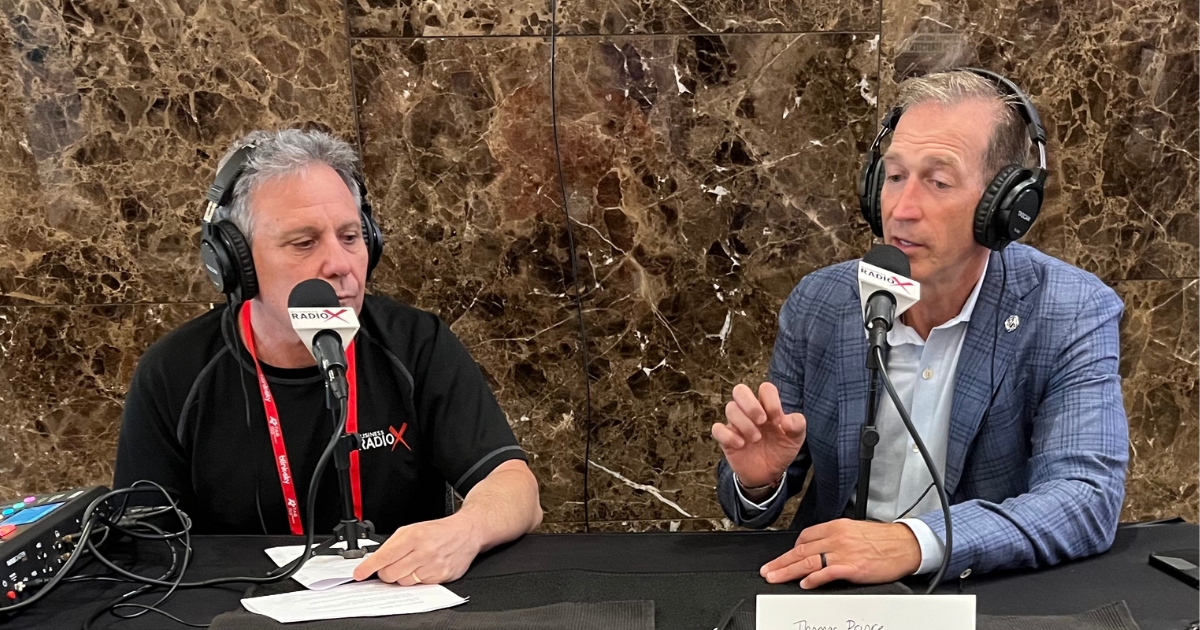

 Tom Priore co-founded Priority in 2005, and has served as the company’s chairman and chief executive officer since 2018.
Under his direction, Priority has grown from a founder-financed technology startup to be the fifth largest non-bank merchant acquirer in the U.S. by volume.
Tom has steered Priority from an organization focused on payments processing to a solutions provider across payments and banking, operating at scale with nearly one million active customers across its SMB, B2B and Enterprise channels.
Priority processes $120 billion in annual transaction volume and provides administration for nearly $1 billion in deposits.
Tom has an MBA from Columbia University and a bachelor’s degree from Harvard University.
Connect with Tom on LinkedIn.
 This transcript is machine transcribed by Sonix.
TRANSCRIPT
Intro: Broadcasting live from Fintech South 2025 at the Woodruff Arts Center in Atlanta, Georgia. It’s time for Atlanta Business Radio. Now. Here’s your host.
Lee Kantor: Lee Kantor here broadcasting live from Fintech South 2025. So excited to be talking to my next guest Thomas Priore with Priority Commerce. Welcome.
Thomas Priore: Thanks, Lee. It’s good to be here.
Lee Kantor: Well, I’m excited to learn what you’re up to. Tell us about Priority Commerce. How are you serving folks?
Thomas Priore: Yeah, sure. Uh, you know, Lee, we’re a payments and banking fintech. Uh, we bring solutions that cover everything from small businesses to enterprise customers. Um, and we provide software solutions that, um, help them move money faster. Uh, collect, store, lend and send money, as we like to say, and make it as efficient as possible to accelerate it through their business and optimize their working capital.
Lee Kantor: So what was the genesis of the idea? Had this business get launched?
Thomas Priore: Well, it’s interesting timing, in fact. Yesterday was our 20th anniversary, and we first started the business really with the idea that software and payments would be something that businesses needed to operate in a single platform. Right. And we think that’s already happened.
Lee Kantor: Got feeling there?
Thomas Priore: Yeah. 20 years ago that was, believe it or not, a novel idea.
Lee Kantor: Was it a novel idea?
Thomas Priore: So, uh, so we really launched the business with that in mind, built technology to help resellers who were serving small merchants to do just that. And, uh, on the success of that, we’ve continued to evolve. Uh, now we’re, you know, just shy of $1 billion of run rate revenue, uh, 225 million of of EBITDA 1200 employees. So we operate at scale, and we’ve added a banking capability so that not only are we using software and payments in an integrated fashion, but software, payments and banking solutions that are all threaded together that help that accelerated cash flow experience. I referred to kind of a few minutes ago.
Lee Kantor: So is the small merchant still important to your firm?
Thomas Priore: Uh, very, very important. We’re a couple hundreds, uh, small businesses. Uh, we probably on board, uh, anywhere from 4 to 4000, 4500 a month. Uh, and we try and help them, you know, really, across the the key areas of operating their business. Uh, certainly payments at the point of sale, that’s that’s core to what we do. Uh, but not only, um, getting that money in, but as we do give them tools to invest our excess working capital and get better yield and then use our tools that are also embedded in our solutions to make payments to vendors, uh, so that they’re making best use of their working capital.
Lee Kantor: Now, are your merchants, are they? Uh, is it industry agnostic, or do you have niches that you’re in? Is it e-commerce or is it brick and mortar?
Thomas Priore: We definitely have some areas where we think we excel. Uh, but it would certainly represent the broader, um, uh, diversification of, of of the small business, um, population in the US. I would say we probably do less on the hospitality side that, you know, let’s say that’s 30% of 35% of small businesses, maybe a bit more. You know, our portfolio is probably down below 20, but we do very, very well with, uh, business services, law firms, accounting firms. Uh, also in the medical profession, doctors offices and other, uh, retail trade sectors, uh, small manufacturing, things like that, that we have some unique tools that that really help us excel in those areas. Um, and we’re probably a little bit overrepresented in those spots.
Lee Kantor: Now, why was it important for your firm to sponsor fintechs house?
Thomas Priore: Look, we you know, we think this is, uh, a very important venue for promoting business. And in the Atlanta area, uh, we’ve we formed here 20 years ago. We’ve been an important part of the evolving and growing business population in the US. Uh, excuse me, in Atlanta. Uh, I’m sure you’ve seen it in your lifetime. This this whole area has just really grown, especially from a fintech standpoint. And, look, we we consider ourselves a, uh, you know, no longer an emerging company, but but now really taking a thought leadership in, in fintech. And because of that, this is the right place to be to, uh, you know, to discuss the things that are important to, to businesses of all sizes as it relates to, to fintech.
Lee Kantor: So obviously getting involved with Tag and Fintech South, that, um, shows your dedication to immersing yourself in the community. Is there anything else that you all do in the Atlanta market.
Thomas Priore: Well, this has been our operating headquarters for those for those 20 years. So we we’ve really built around this. Um, and our, uh, our staff is, uh, you know, has a number of things that, you know, we, we devote ourselves to in the, in the Atlanta area, whether it’s, um, uh, mentoring programs for, for students, internships, uh, as well as, um, you know, volunteering at, at, uh, uh, food banks and elsewhere. We’ve got an incredibly generous population of employees that, um, support their communities. And in a host of regards. So, you know, for those that are out in the Atlanta area listening, be on the lookout for, uh, you know, for for folks on priority, um, because they, they bring their best.
Lee Kantor: Now, what are you looking ahead, looking ahead in the future? Are there trends or things that we should be paying attention to that have got your interest.
Thomas Priore: Well, you know, there’s a there’s a trend. I’m sure it’s it’s it’s going to be broadly spoken about here at Fintech South which is embedded finances. Uh, this whole nature of, of, um, financial tools being embedded into software. Um, and we think that that’s a slightly different narrative. We like to call it connected commerce. Um, it’s not just about embedded financial tools, but it’s connecting that payments and banking experience that really is, um, largely built on legacy technology where things are temporal. Right. When you get money into your bank account, like, you know, you may not see it for a couple of days. Um, you certainly won’t have access to it over the weekend. Well, for a small business, if you could unlock that value because you’re part of a a solution that not only accepts money in, but then gets it into an account where you have utility for it on a weekend or a holiday. That’s really valuable to a business and that’s that’s what we do. That is the underpinnings of embedded finance. And we think that aspect that’s going to be table stakes. And as you solve that money in problem, well hey, now you’ve got a lot of flexibility for how you move money out. So.
Thomas Priore: Areas that are that are difficult problems to solve like construction and paying contractors, which is probably the poster child for, you know, I’ll call it slow money. Well, if I’m a a large contractor and, you know, I’m getting money in from my lender or I’m getting money in from my equity holder, and I’m able to qualify all the liens that, that I need to to get money out to my contractors. Guess what? That’s going to keep them on the job, right? That’s going to keep them motivated. And when that contractor gets their money, if they could push it down to their subs or to their employees in a smooth way, that’s going to keep them motivated and that’s just going to speed up the rate of commerce, and it’s going to make it a better experience for everyone, all the stakeholders in that. Those are the kind of problems we’re looking to solve that in fact, that’s what we’re solving today. And that’s just one example. There’s a host of industries where that that same dynamic exists that could create a better employee experience, a better operator experience, a better investor experience. So that’s where we’re set to work on. And, and um, you know, we’re excited about it.
Lee Kantor: So if your firm is cashing your writing checks, that’s probably a sign that they should be talking to you or somebody on your team.
Thomas Priore: Oh, yeah. Give us a call. You know what? It’s it’s funny, people ask, what’s your biggest, you know, who’s your biggest competitor? What are you what are you competing against? Some checks. And anyway, there’s checks, right? Uh, because there’s, there’s a lot of embedded costs in, in, uh, processing checks. Um, not to mention some of them are nefarious fraud. Others, um, that, um, uh, that really increase the cost of operating in that way. And it makes, you know, as we continue to refine these tools of and bringing together that payment and banking experience to create lower costs, better opportunities to keep money invested, which is implicitly lower cost, right, because I’m making return on my money. Um, suddenly the differential between digital acceptance and that checks, they look very, very different. In fact, not only do they converge, I would submit that that digital experience actually is of greater value. Uh, so educating, uh, population about that, that that’s, that’s where spending a lot of time doing and which is another reason to be down here at Fintech South.
Lee Kantor: So what percentage of companies are still using checks. Is it. It’s surprisingly high, right?
Thomas Priore: Uh, you know, depending on the sector. But yeah, I mean, the way you, uh, I kind of noted it. It absolutely is. So, uh, to put it into context in the consumer to business payments, like, that’s that’s pretty much been digitized, uh, about 80% of all consumer payments are are digital. Think of all the things we do in app on our phone or, you know, certainly we just pull our card out when we’re in a store. Um, so that’s largely been, um, been digitized, but the big area and that’s about a $6 trillion market. But in the US, the B2B market is nearly 20 trillion, and over half of that still happened, or just about half. It still happens on a check. So that that’s probably the biggest population of opportunity is getting businesses to, you know, start to start to look at the utility of managing cash differently. Um, and that’s probably the most exciting spot.
Lee Kantor: And that’s where, like you said, that’s the opportunity. And it’s strange because if they’re in their own personal life, they’re not doing it. You know, why are they continuing to do it in their business?
Thomas Priore: Yeah. No doubt. Uh, it’s it’s interesting, though, I think one of the dynamics that is a catalyst. Is that generational shift, right? Folks that have, uh, long tenured in their job. But, you know, they came into a world that was less digital and they’re exiting a world that they think of less digitally, but they’re being replaced by folks that that’s that’s just how they live right there.
Lee Kantor: Natives.
Thomas Priore: Yeah. Of course, of course. So, um, so that’s a catalyst to change the other. That was a big one, which is somewhat ironic. Um, but you’ll appreciate the utility of this was Covid, right? People weren’t in the office. It’s really hard to sign checks from your home. And especially if you need two signatures.
Lee Kantor: Right.
Thomas Priore: Yeah. Banks closed. So, uh, there’s there’s been, um, some interesting momentum from unexpected sources. And in that arena, I would, I would submit, I think we are at an inflection point because of the recognition of these trends.
Lee Kantor: Now, you think it’ll happen kind of gradually, then suddenly, kind of. All of a sudden it’ll just be adopted. More and more are going to just flip the switch. Or is this something that’s going to exist over? It’s going to take years and years to get everybody to switch over.
Thomas Priore: You know, I’ve always liked to say that in payments we don’t have, um, it’s not a revolution. It’s an evolution. And so I do think it’ll continue to be an evolution. Now the rate of evolution may, may pick up, but but I do still think it’s, it’s, it’s got to be an evolution. And a big part of that is look there are systems that businesses have invested in intelligently. So in their their core accounting systems, their, you know, enterprise reporting systems that are relied on day to day. And they were not necessarily built for the experience that you and I are talking about. So to have them pivot to it, just take some nuance. It it takes some sophistication, elegance and, um, you know, that’s why we’ve built a tool called our Priority Commerce Engine that is designed to work in coordination and collaboration with systems that are already in place to create a digital experience, but not through wholesale change, where you have to make substantial investments or tear something down. So the reason I believe it’ll be an evolution, getting to the point here is because it needs to contemplate what’s already in place and then work in coordination with it, not displace it. And and that’s a process.
Lee Kantor: And then like, how long does that process take. If somebody says, okay, Tom, I’m all in. I believe in what you’re saying. And I think we should make that change. Like, is this something that happens over, you know, months or years? Like, how long does it take for an organization to make that shift? Well, depending.
Thomas Priore: On size and motivation, as you might expect, there’s you know, we’ve had people who have made the decision and been stood up in a month and others that, you know, it’s, uh, depending on how embedded they need to become in our systems, which require some, some technical development that, you know, needs to be architected and thought through. You know, that could take six months, but it’s not. It’s in weeks and months, not years. And then the evolution of their base of payments from non-digital to digital, that’s a process as well because it requires education. So, you know, it’s a journey. And then, um, as you’re getting what exists today in place, well, you have new procurement activities that are occurring. So you want to get on the front end of, of that procurement process. So all of those things are just they, they they point towards long term partnerships and managing a long term partnership. And this I’ll call it this evolutionary mindset. Um, so, uh, the nice thing is you see results really quickly, right? And then when you start seeing those results and it’s hitting the bottom line that accelerates and, uh, you know, through that, call it that 12 month evolution, a lot of change can take place. It’s pretty, pretty fun to see.
Lee Kantor: So if somebody wants to learn more, have more substantive conversation with you or somebody on the team, what’s the best way to connect?
Thomas Priore: Just, uh, contact us. Yeah. Priority. Com. Um. And, uh. And connect. Um. We’re right. Uh, we’re right up in Alpharetta, and, um, we’ve got, you know, a a super motivated group of people, um, looking forward to to spreading the word, if you will.
Lee Kantor: Well, Tom, thank you so much for sharing your story. Um, you’re doing important work, and we appreciate you.
Thomas Priore: Well, I appreciate the opportunity to talk.














