
Business RadioX ®

  • Home
  • Business RadioX ® Communities
    • Southeast
      • Alabama
        • Birmingham
      • Florida
        • Orlando
        • Pensacola
        • South Florida
        • Tampa
        • Tallahassee
      • Georgia
        • Atlanta
        • Cherokee
        • Forsyth
        • Greater Perimeter
        • Gwinnett
        • North Fulton
        • North Georgia
        • Northeast Georgia
        • Rome
        • Savannah
      • Louisiana
        • New Orleans
      • North Carolina
        • Charlotte
        • Raleigh
      • Tennessee
        • Chattanooga
        • Nashville
      • Virginia
        • Richmond
    • South Central
      • Arkansas
        • Northwest Arkansas
    • Midwest
      • Illinois
        • Chicago
      • Michigan
        • Detroit
      • Minnesota
        • Minneapolis St. Paul
      • Missouri
        • St. Louis
      • Ohio
        • Cleveland
        • Columbus
        • Dayton
    • Southwest
      • Arizona
        • Phoenix
        • Tucson
        • Valley
      • Texas
        • Austin
        • Dallas
        • Houston
    • West
      • California
        • Bay Area
        • LA
        • Pasadena
      • Colorado
        • Denver
      • Hawaii
        • Oahu
  • FAQs
  • About Us
    • Our Mission
    • Our Audience
    • Why It Works
    • What People Are Saying
    • BRX in the News
  • Resources
    • BRX Pro Tips
    • B2B Marketing: The 4Rs
    • High Velocity Selling Habits
    • Why Most B2B Media Strategies Fail
    • 9 Reasons To Sponsor A Business RadioX ® Show
  • Partner With Us
  • Veteran Business RadioX ®

We Can Learn from Poor Fit Clients

May 3, 2022 by John Ray

We Can Learn from Poor Fit Clients
North Fulton Studio
We Can Learn from Poor Fit Clients
Loading
00:00 /
RSS Feed
Share
Link
Embed

Download file

We Can Learn from Poor Fit Clients

We Can Learn from Poor Fit Clients

As professional services providers, how should we engage with poor fit clients before we refer them on to someone else? Before we let them go, we can learn from them.

The Price and Value Journey is presented by John Ray and produced by the North Fulton studio of Business RadioX®.

TRANSCRIPT

John Ray: [00:00:00] Hello. I’m John Ray on the Price and Value Journey.

John Ray: [00:00:04] Do you want to be a commodity or a problem solver? If you want to work with clients who are a better fit for you and earn higher prices for your engagements, then the answer is clear, right? If, however, when someone asks the “what are your rates” question, and you respond by quoting figures and sending out a price list, then you’re in the red zone of positioning yourself as a commodity.

John Ray: [00:00:34] Now, when I’m asked the “what are your rates question” as kind of the opening question in a conversation with a client, I typically go straight to the “I don’t think we’re a good fit if that’s your primary focus”. Now, my answer to the “what are your rates” question that comes really early in a conversation is to go, typically, I go straight to the “we’re not a good fit” answer.

John Ray: [00:01:03] Now, some push back on me and say it’s better to offer a quote, because if the client passes out on whatever range of quotes that you offer, then no amount of value exploration will bridge the gap, and I get that point, but here’s where my approach to this situation could potentially shortchange me in another, more subtle way. When I respond to the “what are your rates” question with the “we’re not a good fit” answer and refer them on to someone else, I could be passing on an opportunity to learn.

John Ray: [00:01:41] You see, there’s something to be learned in any conversation with a client, which focuses on the needs, the hopes, the problems, and the values of that prospect. If you’re asking the right questions, you’re getting more data points that can be applied to other clients and other situations that you encounter. You’re learning and you’re becoming that much better at whatever professional services discipline you practice.

John Ray: [00:02:08] I read a blog post not long ago by a gentleman named Pye Jirsa. He’s the founding partner of Lin & Jirsa Photography. And here’s what he said, “It’s your responsibility to dive into the client’s psychology, to figure out what they want and what they value, and help them find a product that is going to suit their needs. In doing so, this process will make you a better photographer.”

John Ray: [00:02:37] Take that quote and fill in the blank of whatever you are. The point of it is we’re here to help and we’re here to serve. And even those clients that we perceive to be thrifty, we’ll call them, and not a good fit for you, they need help finding the place that they can get help. That may be your book. It may be a course. It may be some other way for them to get information that helps them along the way, that fits the budget that they have to solve the problem that they have.

John Ray: [00:03:09] Even if you find out that the person is sitting in front of you is a miser who will not pay based on the value you deliver, you’ve learned something about their problems, which can be applied to all clients, and particularly, of course, clients who are a better fit, and you’ll do a better job for those future clients. There are some clients, of course, who are so price-sensitive that they’ll refuse even the most basic conversation over their needs and problems.

John Ray: [00:03:39] They’ll refuse to sit with you and share anything until they know what you’ll charge. So, for me, at that point, there’s no real point in engaging with someone that’s so focused only on price. Whatever your approach on the “what are your rights” question, do every interaction with a client as an opportunity for professional development. You’ll be a better problem solver and you’ll earn higher fees for your services as a result.

John Ray: [00:04:11] I’m John Ray on the Price and Value Journey. Past episodes of this series can be found on your favorite podcast app or at pricevaluejourney.com. And if you’d like to connect with me directly, you can do so by sending a note, john@johnray.co. Thank you for joining me.


About The Price and Value Journey

The title of this show describes the journey all professional services providers are on:  building a services practice by seeking to convince the world of the value we offer, helping clients achieve the outcomes they desire and trying to do all that at pricing which reflects the value we deliver.

If you feel like you’re working too hard for too little money in your solo or small firm practice, this show is for you. Even if you’re reasonably happy with your practice, you’ll hear ways to improve both your bottom line as well as the mindset you bring to your business.

The show is produced by the North Fulton studio of Business RadioX® and can be found on all the major podcast apps. The complete show archive is here.

John Ray, Host of The Price and Value Journey

John Ray The Price and Value Journey
John Ray, Host of “The Price and Value Journey”

John Ray is the host of The Price and Value Journey.

John owns Ray Business Advisors, a business advisory practice. John’s services include advising solopreneur and small professional services firms on their pricing. John is passionate about the power of pricing for business owners, as changing pricing is the fastest way to change the profitability of a business. His clients are professionals who are selling their “grey matter,” such as attorneys, CPAs, accountants and bookkeepers, consultants, marketing professionals, and other professional services practitioners.

In his other business, John is a Studio Owner, Producer, and Show Host with Business RadioX®, and works with business owners who want to do their own podcast. As a veteran B2B services provider, John’s special sauce is coaching B2B professionals to use a podcast to build relationships in a non-salesy way which translate into revenue.

John is the host of North Fulton Business Radio, Minneapolis-St. Paul Business Radio, Nashville Business Radio, Alpharetta Tech Talk, and Business Leaders Radio. house shows which feature a wide range of business leaders and companies. John has hosted and/or produced over 1,300 podcast episodes.


Connect with John Ray:

Website | LinkedIn | Twitter

Business RadioX®:  LinkedIn | Twitter | Facebook | Instagram

Tagged With: John Ray, poor fit clients, Price and Value Journey, pricing, professional services, professional services providers, solopreneurs, value

The Elephant in the Room

April 27, 2022 by John Ray

The Elephant in the Room
North Fulton Studio
The Elephant in the Room
Loading
00:00 /
RSS Feed
Share
Link
Embed

Download file

The Elephant in the Room

The Elephant in the Room

The elephant in the room is the preconception, often negative, a prospective client brings to the table when they think about your profession. In a lot of cases, the elephant offers an opportunity to build trust, depending on how you handle it.

The Price and Value Journey is presented by John Ray and produced by the North Fulton studio of Business RadioX®.

TRANSCRIPT

John Ray: [00:00:00] Hello. I’m John Ray on the Price and Value Journey.

John Ray: [00:00:03] Years ago, I had coffee with a financial advisor, and during that meeting, he told me that one of the attributes of his firm that he was most proud of was the average length of tenure for financial advisors at the firm. He said, “I think it was about nine years, if I recall correctly, while the average length of firm tenure for the average financial adviser in the industry was nine months.”

John Ray: [00:00:30] Now, I was in a chamber group with this professional and I asked him why he had never mentioned this in our meetings, as I thought it was an important differentiator. I don’t remember his answer and not much else, frankly, about what we talked about in that meeting, but I remember this particular fact. I haven’t seen him in a long time, but I looked him up recently and he’s still with that firm here years later, so he and his colleagues must be doing something right.

John Ray: [00:01:03] For this financial adviser, this length of tenure issue was his elephant in the room. You see, the elephant in the room is the preconception a prospective client brings to the table when they think about your profession. For financial advisors, clients wonder whether they’re going to change firms because financial advisors jump around. If you’re an attorney, the elephant is most likely charging by the hour. Everyone remembers the bill they got for that six-minute phone call. If you’re a CPA, it might be not returning calls or answering emails during tax season.

John Ray: [00:01:46] It could be something which isn’t profession-specific. Age is one example. I was running an investment management firm at age 29 and that was a big elephant I had to deal with at that time. It could be that you’re a solopreneur and the client is wondering what happens to their work if they hire you, and then you get hit by the proverbial beer truck. Now, I know it’s not intuitive, and sometimes, it might be uncomfortable, but I’ve come to believe that it’s always helpful to call out the elephant in the room.

John Ray: [00:02:22] If you don’t bring it up, the prospect often will, and you might as well deal with that elephant in your own way. Now, if the prospect doesn’t ask about it, that doesn’t mean they’re not thinking about it, they might just be letting that question fester, and out of courtesy or some other reason, they’re not asking the question. They may be hoping you bring it up yourself. In any case, that question sticking in their crawl won’t get resolved and it will work against you if it doesn’t.

John Ray: [00:02:58] Further, if the prospect has a problem with your elephant even after you’ve addressed it, then you’ve done both you and the client of favor, you’ve quickly figured out that the two of you aren’t a fit, and you’ve granted yourself the freedom to move on. The most important reason to pet the elephant and talk about it is that doing so builds trust with clients, and all of us, as professional services providers, are in the trust business.

John Ray: [00:03:28] If you’re willing to initiate and calmly engage in a particularly thorny discussion about this elephant or anything else for that matter, your trustworthiness in the mind of the client goes way up. And that’s even true for the clients who don’t select you, by the way. Your willingness to talk about the elephant is a sign you’ll be straight with them during the engagement when problems arise, and that’s what clients are looking for. So, what’s your elephant? And how do you address it?

John Ray: [00:04:05] I’m John Ray on the Price and Value Journey. Past episodes of this series can be found on your favorite podcast app\ or you can go to pricevaluejourney.com. And you can also send me an email, john@johnray.co. Thank you for joining me.


About The Price and Value Journey

The title of this show describes the journey all professional services providers are on:  building a services practice by seeking to convince the world of the value we offer, helping clients achieve the outcomes they desire and trying to do all that at pricing which reflects the value we deliver.

If you feel like you’re working too hard for too little money in your solo or small firm practice, this show is for you. Even if you’re reasonably happy with your practice, you’ll hear ways to improve both your bottom line as well as the mindset you bring to your business.

The show is produced by the North Fulton studio of Business RadioX® and can be found on all the major podcast apps. The complete show archive is here.

John Ray, Host of The Price and Value Journey

John Ray The Price and Value Journey
John Ray, Host of “The Price and Value Journey”

John Ray is the host of The Price and Value Journey.

John owns Ray Business Advisors, a business advisory practice. John’s services include advising solopreneur and small professional services firms on their pricing. John is passionate about the power of pricing for business owners, as changing pricing is the fastest way to change the profitability of a business. His clients are professionals who are selling their “grey matter,” such as attorneys, CPAs, accountants and bookkeepers, consultants, marketing professionals, and other professional services practitioners.

In his other business, John is a Studio Owner, Producer, and Show Host with Business RadioX®, and works with business owners who want to do their own podcast. As a veteran B2B services provider, John’s special sauce is coaching B2B professionals to use a podcast to build relationships in a non-salesy way which translate into revenue.

John is the host of North Fulton Business Radio, Minneapolis-St. Paul Business Radio, Nashville Business Radio, Alpharetta Tech Talk, and Business Leaders Radio. house shows which feature a wide range of business leaders and companies. John has hosted and/or produced over 1,300 podcast episodes.

Connect with John Ray:

Website | LinkedIn | Twitter

Business RadioX®:  LinkedIn | Twitter | Facebook | Instagram

Tagged With: building trust, Business Development, John Ray, Price and Value Journey, pricing, professional services, professional services providers, prospects, solopreneurs, trust, trust builder, value

LinkedIn For Professional Services Providers: An Interview with Gregg Burkhalter, The “LinkedIn Guy”

April 14, 2022 by John Ray

LinkedIn
North Fulton Studio
LinkedIn For Professional Services Providers: An Interview with Gregg Burkhalter, The "LinkedIn Guy"
Loading
00:00 /
RSS Feed
Share
Link
Embed

Download file

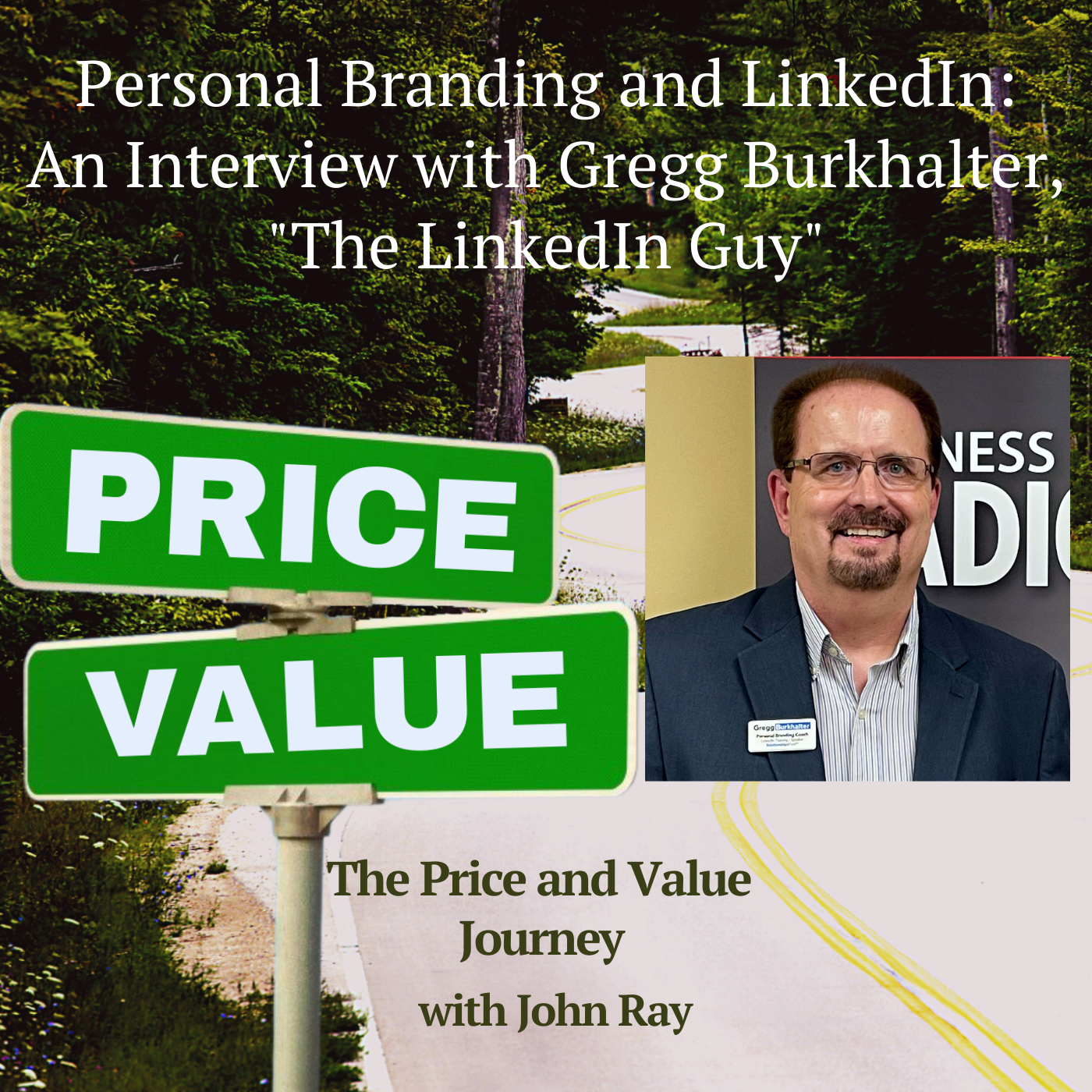
Gregg Burkhalter The LinkedIn GuyLinkedIn for Professional Services Providers: An Interview with Gregg Burkhalter, The “LinkedIn Guy”

Gregg Burkhalter, dubbed “The LinkedIn Guy” by his clients, joined host John Ray to share his advice about effective relationship building and personal branding on LinkedIn. Gregg talked about successful LinkedIn strategies for time-starved professional services providers, creating and sharing content, the value of being genuinely helpful without an agenda, and much more. The Price and Value Journey is presented by John Ray and produced by the North Fulton studio of Business RadioX®.

Gregg Burkhalter, Personal Branding, LinkedIn Training, Speaker

Gregg Burkhalter
Gregg Burkhalter, Personal Branding, LinkedIn Training, Speaker

It is very important to have a strong personal brand. Companies understand that their employees’ brand contributes largely to the company’s success.

Everyone has a personal brand. Your brand is built one of two ways: 1) By default: do nothing and you have to settle for how it turns out, or 2) By design: if you consistently focus on developing and building your brand, you can help shape the outcome.

LinkedIn has over 770 million users and is the digital home of your personal brand. LinkedIn is also a great place to build relationships and grow your professional network.

When you set up your LinkedIn profile, you’re defining what you’d like your brand to be. It is not your personal brand until others believe it. 

Gregg Burkhalter is a recognized authority on personal branding and LinkedIn. He has helped countless professionals in the U.S. and around the world define and grow their personal brand using LinkedIn.

Gregg is known by many as “The LinkedIn Guy”. He provides Personal Branding Coaching and LinkedIn Training via one-on-one and group training sessions, corporate presentations, and webinars.

Website | LinkedIn

TRANSCRIPT

John Ray: [00:00:00] Hello again, friends. I’m John Ray on The Price and Value Journey. I’m delighted to welcome an old friend today, Gregg Burkhalter. Gregg is known as the LinkedIn Guy, and that’s actually a name his clients and friends have given him because Gregg, in their eyes and I think you’ll hear as we go along on this show, is a recognized authority on personal branding and LinkedIn.

John Ray: [00:00:25] He has helped countless professionals in the U.S. and around the world define and grow their personal brand using LinkedIn. Gregg spent the first part of his professional career behind the mic at radio stations in Savannah, Jacksonville, Charleston, and Atlanta. And following his radio years, Gregg worked in national music marketing and distribution.

John Ray: [00:00:48] And as I mentioned today, Gregg is known by many as the LinkedIn Guy. He provides personal branding, coaching, and LinkedIn training via one-on-one and group training sessions, corporate presentations, and webinars. And he does this for clients and groups all around the world. Gregg Burkhalter, welcome.

Gregg Burkhalter: [00:01:09] John Ray, thank you for having me on your podcast. It’s great to see you again. And I’ve got to tell you, I’m a fan of your podcast, as are a lot of people right now. And I’ve noticed the guests that respect your knowledge so much, they get on your podcast. I’m honored to be among those guests. Thank you.

John Ray: [00:01:26] Well, I’m delighted to have you. And this is a topic that when we started the show, I immediately marked down – and immediately marked you for it, of course – because LinkedIn is so important for small professional services providers, for solopreneurs that are mostly B2B services, so we want to talk to those folks.

John Ray: [00:01:52] But before we get into some of the details of that, I want to talk about you and a little bit more about your journey because you’ve got an advisory practice. So, talk about how you built that practice around the use of LinkedIn.

Gregg Burkhalter: [00:02:05] Correct. Well, my early career, as you alluded to, was in music and broadcasting. And like most professionals, you don’t usually work your entire career in the same job. You usually have some kind of pivot or transition.

Gregg Burkhalter: [00:02:17] Well, my pivot occurred a little over eight years ago when the company I worked for, my dream job, kind of disappeared. And I started my period of discovery to see what is the next chapter in the Gregg Burkhalter life. And, fortunately, that chapter unfolded without me actually searching heavily for it. I found myself, on occasion, doing some speaking on LinkedIn to some social groups or some community groups in the area. And what do you know? Within, like, a short period of time, I started having people ask me, “Would you come talk to my group about LinkedIn?”

Gregg Burkhalter: [00:02:48] Of course this would not have happened had I not had the courage – thanks to a friend – to set up my very first LinkedIn profile and began using it. And I began using it with a strategy that proved to be correct. So, now that I’ve started my consulting business, I’ve watched it grow, I’ve watched others get impact from the strategy and advice I share with them. And I’m on a run right now that I’m really enjoying this facet in my career. And I would love to see others be able to experience what a service provider journey looks like when you have a strategy and a focus on helping others being of value and providing a service that others want.

John Ray: [00:03:27] For you, it’s hard to separate LinkedIn versus your practice, because LinkedIn is your practice. I mean, for the rest of us, LinkedIn is just a tool for us in our practice. But just talk about, I guess, just the building of your practice and maybe what you’ve learned as a solopreneur, what you’ve learned along the way in terms of how you’ve done what you’ve done and how you’ve been successful.

Gregg Burkhalter: [00:04:02] Well, I can tell you, step number one is building relationships. Because you can’t do it on your own. And that is why LinkedIn is so valuable. LinkedIn is a great tool – as you said, tool – for building and nurturing those relationships. That’s the beginning process. Then, the next step is probably beginning to decide what is your message? What value do you bring to your service area? How do you want to present yourself? And then, once you kind of get that voice down, then you begin using LinkedIn to become part of the community.

Gregg Burkhalter: [00:04:36] Again, while you’re spreading your message, you’re not becoming a one trick pony where it’s all about you. Because LinkedIn, in all reality, is not about you. It’s about the value you bring to the community. And it’s about building and nurturing professional relationships that will create ongoing opportunities for you throughout your business and your career.

Gregg Burkhalter: [00:04:56] So, LinkedIn, for me, I can tell you personally is more than a tool. It allows you to feel more fulfilled as a person because it allows me in the most effective way possible to help other people and to accomplish what I’m trying to do.

John Ray: [00:05:10] So, before you were the LinkedIn Guy and you started that profile, you opened that profile, what you brought was a relationships first mentality to the platform. It seems like your philosophy of being in the world and doing business really meshed with what LinkedIn is. That’s not necessarily true for everyone that’s on the LinkedIn, though, of course.

Gregg Burkhalter: [00:05:36] That’s correct.

John Ray: [00:05:37] I mean, most – I won’t say most – a lot of folks that are on LinkedIn, it’s about either they’re on there to get a job, which there’s nothing dishonorable about that. A lot of us have been on there for that. Or they’re on their cell, whatever they’ve got, their service or whatever it is. But you really came to the platform with the relationships first mentality. And I guess it was just your way of looking at the world, your philosophy of the world, just happened to hit the right platform.

Gregg Burkhalter: [00:06:14] Well, I can tell you that it actually helped my business grow at a rapid fashion. Because if you’re getting on LinkedIn and you’re nothing but a sales pitch machine, you might get lucky every now and then and maybe land a client, but your chances for long term success is not very good. Because relationships, not only with your clients, but with the community, is going to help you continue to do your business.

Gregg Burkhalter: [00:06:38] So, there’s two ways you can really use LinkedIn, in fact, just like hunting and fishing. I started out as a fisherman. I started fishing. I started trying to fish for relationships that I could nurture and grow. And then, once I got that traction going, I put on my hunter’s hat, and I started hunting for people that might be potential clients. Not to send them a one off sales pitch, but to decide I may want to nurture that relationship for future opportunities. So, it’s really a mix of both. But I can tell you if you’re only game plan is hunting, that is not a successful long range game plan.

John Ray: [00:07:15] Okay. Well, let’s dive into this right now, because I’m sure people are thinking because I’m thinking this. You went after people that you wanted to develop a relationship with. What does that look like for you? You go out after someone that you think is a great target for you – I hate to use that word – a great relationship for you to have, how do you nurture the relationship without being salesy?

Gregg Burkhalter: [00:07:42] Well, first of all, let me tell you, a potential client is not your only target on the relationship you’re looking for.

John Ray: [00:07:48] Oh, come on.

Gregg Burkhalter: [00:07:49] When you look for a potential client, that’s one particular person that you have on your radar. The one that people miss all the time is finding that person who already has a well-established brand who has a network of people who enjoys introducing and connecting people. That’s the relationship that will replicate sale after sale, intro after intro for you. So, that’s the two you should be going for.

Gregg Burkhalter: [00:08:16] But as for your approach, please do not just push the connect button on LinkedIn and expect me to grovel all over you and the services you provide. You’re not talking to me. You’re treating me like I’m just a number. Well, the next step is, maybe you write me a note. That’s a perfect thing to do. Write me a note. Explain to me why you’re reaching out to connect. What is the commonality that led you to want to connect with me and connect with me.

Gregg Burkhalter: [00:08:41] But please don’t give me a copy paste sales pitch immediately after we connect. Or in the original invitation you’re sending me, don’t send me a link to your calendar to schedule a time to talk. You’ve got to give time for that relationship to grow. And that is not usually in the first one or two conversations on LinkedIn. There’s more to it than that.

Gregg Burkhalter: [00:09:05] You’ve got to bring some value, value that you’re not expecting anything in return for to start nurturing that relationship. And that value might even be introducing your client to someone you already know who provides a different service that might be a good source for them. This is adding value. There’s ways you add value and just soliciting them to buy your product is not the top way to add value.

John Ray: [00:09:32] So, beyond introducing connecting people, which I can hear folks thinking, “Well, I don’t really want to connect someone I just connected with on LinkedIn who I don’t know to my clients,” so how do I add value to that person I’ve just connected with sort of connecting them with my clients?

Gregg Burkhalter: [00:09:55] Well, first of all, you can start figuring out exactly what your client’s needs are, what they’re looking for, what kind of resources they might get to utilize. And maybe you could maybe send them a link to an article that they would like to read. Or maybe invite them to something going on in the business community that maybe they would like to attend, and you’re going to be there, you’d like to say hello to them.

Gregg Burkhalter: [00:10:17] Or like I said earlier, maybe connecting with someone that once you speak with them, you say, “You know what? There’s some commonality here between these two.” They need to know each other. Create a synergy connection with somebody in your network that would be of value to them.

John Ray: [00:10:30] So, not necessarily a client, just a referral partner or someone that you think they ought to know for synergy reasons or what have you. Let’s talk about comments and how you make helpful comments that create connection.

Gregg Burkhalter: [00:10:47] I got to tell you, John, commenting on posts right now is one of the most valuable ways, most efficient ways, to create brand exposure for yourself. It’s also a very volatile way, if done incorrectly, to create brand damage.

John Ray: [00:11:03] Say more on that.

Gregg Burkhalter: [00:11:05] So, for example, say you see an article on LinkedIn by somebody you know or someone who’s respected in your industry, and you want to add a comment to give yourself a little brand exposure. If you type in “Great article,” don’t even waste your time. That’s phoning it in. There’s nothing there. So, if you’re going to comment, at least read the article. Find something in the article that you want to read the accent on, maybe add a little different perspective to.

Gregg Burkhalter: [00:11:32] But for goodness sake, please don’t either try to hijack the comment to promote yourself, or make a comment that would devalue what the person who’s posting is saying. You don’t want to grandstand. This is about helping others create brand exposure. And when you do that, believe it or not, you create brand exposure for yourself.

Gregg Burkhalter: [00:11:53] And commenting right now is one of the fastest ways to do that on LinkedIn. In fact, I tell a lot of my clients, if you’re not comfortable posting just yet, let’s become part of the community. Let’s find some people that you respect the content they share, that you admire, you like their message. And let’s start interacting with those people. If you do that, you’re going to jump start your branding on LinkedIn.

John Ray: [00:12:15] Yeah. I was going to ask you about those folks. So, the stats are -and I think I got this from you somewhere along the way – that there’s 90, 95 percent, maybe more, of LinkedIn users that get on and never make a comment. They never make a post. They rarely make one. They may get on and surf the feed a little bit and then they get off. And maybe they do that because they don’t know what to post or whatever the reason is. But can you build a strategy on LinkedIn around simply offering genuinely helpful comments to others and celebrating their work.

Gregg Burkhalter: [00:13:01] By the way, the person you just described, John, I use the term digitally dormant. It’s kind of like having a home phone nowadays, that phone is not going to ring. You’ve got a phone, but it’s not ringing. That’s what happens when you have a LinkedIn account and you don’t use it, it’s a home phone. Doesn’t happen.

Gregg Burkhalter: [00:13:19] So, yes, absolutely. That’s what I like about LinkedIn, is that LinkedIn allows you to even comment on people’s posts outside of your normal network. And the way you do that, by the way, is you can follow people on LinkedIn that are thought leaders way high above your branding stature, but you can follow these people and interact with those people and become part of the conversation. I call it getting out of the LinkedIn pond into the LinkedIn ocean.

Gregg Burkhalter: [00:13:47] But, again, if you’re going to comment, please read the article. There’s nothing worse than commenting on something. And when the viewer reads your comment, they say that comment has nothing to do with the article. Again, if you’re going to take time to comment, let’s take time to make sure that it’s a valid comment.

John Ray: [00:14:04] Right. Right. Yeah. That’s the minimum viable comment right there. And I think the other one – this is a personal pet peeve of mine – is what you mentioned earlier about hijacking comments and comments that are superficially helpful, but what they really are, are referential back to the writer of the comment. And people can see through that and it does damage, I think, to people that do that that they don’t see.

Gregg Burkhalter: [00:14:40] You’re talking about the person that tags a comment that says, “When I work with my clients, I tell them this. And by the way, I have a workshop coming on Tuesday where I’m going to reinforce this.”

John Ray: [00:14:49] Yeah. That person. That’s who I’m talking about.

Gregg Burkhalter: [00:14:53] That person really doesn’t understand what they’re doing. They think they’re walking that line of being humble and they’re so far over that humble line. It’s unbelievable.

John Ray: [00:15:00] Yeah. So, if you’re the victim of a comment like that, what do you suggest you do about that?

Gregg Burkhalter: [00:15:09] You’ve got to decide, is this person going to continue to do that over and over again? Maybe this person doesn’t need to be in your network. I mean, if they’re not interested in helping you grow your brand and be successful while you do it, that’s not one of their concerns, then maybe they don’t need to be part of your community.

Gregg Burkhalter: [00:15:24] And there’s a few ways that you can kind of solve that issue. One of the fastest ways is maybe you remove the connection on LinkedIn. But the ultimate way to fix that problem is you can block people on LinkedIn. That’s what I love about the platform is I can control the noise around my brand. And some people do not respect my brand at the level that I think they should, and they treat it like it’s a stepping stone to what they want to do. Those people you can block.

Gregg Burkhalter: [00:15:50] And if you block people on LinkedIn, basically they disappear from your LinkedIn community, you disappear from their LinkedIn community. And that particular problem of negativity or hijacking, it’s gone. So, that’s the highest level of getting rid of it. And I got to tell you, during COVID, a lot of the salespeople got extremely aggressive on LinkedIn, and my block people list grew rapidly. So, you can actually block up to 1,400 people.

John Ray: [00:16:18] Oh, really?

Gregg Burkhalter: [00:16:19] And right now I’m probably in the 300 range because, again, I avoid negativity. I don’t like self-promoters who are disrespectful of other people. I don’t like people who post comments that actually are negative towards certain people. I get rid of negativity and noise if it gets to loud.

John Ray: [00:16:37] Folks were chatting with Gregg Burkhalter. Gregg is the LinkedIn Guy, and he is a recognized authority on personal branding and on LinkedIn, and growing your personal brand through LinkedIn.

John Ray: [00:16:52] Gregg, I want to talk to those folks – and there’s a lot more of those folks – the people that really don’t use LinkedIn than the ones that are using it. Those folks that are early in their business and they’re saying, “Look, I’m trying to build a business. You know, I don’t have time for the fishing approach. I don’t have time to put my line in the water and just wait for things to happen. I mean, I’ve got to make things happen.” Respond to that individual?

Gregg Burkhalter: [00:17:25] Well, first of all, you’ve got to take your LinkedIn profile seriously. Because here’s why. John – I was telling someone the other day – most contacts that come to your company via email or a phone call, that first contact is not the first time someone’s heard of you. Because everybody nowadays, including myself, the first moment they consider doing business with someone and want to validate someone, what do we do? We go to Google and we type in their name. And you can guess what shows up at number one or number two, that is your LinkedIn profile.

Gregg Burkhalter: [00:17:57] So, your LinkedIn profile in reality is one of the first interests people have of you. And on LinkedIn, as a general rule, nobody is going to get to your LinkedIn company page unless they see something done by one of your team on the personal page that attracts them to you. So, that’s why you at least have to have a page that represents you well.

Gregg Burkhalter: [00:18:19] And what I see happen a lot of times is, people kind of have the attitude of that guy, the infomercial guy, Ron Popeil, the guy that does the rotisserie chicken, the guy that says, “Just set it and forget it”. That’s what they do. I mean, they set up their LinkedIn profile and they move away. Their career evolves. Their business evolves. And their LinkedIn profile is still stuck seven years before.

Gregg Burkhalter: [00:18:42] And one of the things I’ve noticed is, a lot of the service providers generally start their own business a lot of times the latter part of their career. And what they do is they never fully address on their LinkedIn profile the pivot that’s just occurred.

Gregg Burkhalter: [00:18:57] For example, you may go to a new service provider company, maybe led by an executive that used to work at an I.T. firm. You go to the person’s profile, and their profile reads like somebody looking for a job. So, they wrote their profile originally in job search mode. And, now they’re in client search mode and they haven’t changed their voice.

Gregg Burkhalter: [00:19:19] So, your LinkedIn profile should be a client attracting profile with the words below your name, how you present yourself in the About section, how you describe the services you provide, and who you provide those services to. That should be there. Not just a work history. I mean, we want to know what value would you bring should I engage with you. That should be prevalent in your LinkedIn profile. That’s the minimum.

Gregg Burkhalter: [00:19:44] In other words, I don’t even want you being active on LinkedIn if your LinkedIn profile does not represent you well. Because your purpose for being active on LinkedIn is to become part of the community, but it’s also to attract people to your page on LinkedIn. And if you get them there and there’s a derail, then you haven’t served your purpose. So, get your profile buttoned up first, then we can look at becoming more active.

John Ray: [00:20:08] So, what I hear you saying is that, it’s not about simply just give, give, give without any hope of getting anything back. It’s giving and being generous, maybe to a fault sometimes in the eyes of some. But that generosity comes back in ways you would never forecast, from places that you would never forecast.

Gregg Burkhalter: [00:20:37] That is correct. I mean, in the early part of your career, development for your company or growing your company, the giving is even more important. Because you’ve got to start helping other people in giving, and giving people an opportunity to realize there’s a value in what you do. And networking is part of that giving, sharing posts and content on topics that would be of interest to people that they may want to read.

Gregg Burkhalter: [00:21:02] By the way, please don’t post on LinkedIn about how you’re providing quality content, and then you give me the link to your web page and the post. I mean, every post you do should not have lead generation in the focus. It’s okay to have one that has a subtle lead generation, but it can’t be every one of them. It’s all about the percentage of what you do that is helping the community as opposed to what you’re doing and tried to help yourself.

Gregg Burkhalter: [00:21:30] And I would say the general mix is, if you’re just starting to use LinkedIn as a tool to grow your brand in business, I would say 75 percent of what you’re doing on LinkedIn has no direct input on generating a direct sales lead for you. You’ve got to make sure you give, give, give, and then you can take a little bit. Just give, give, give first.

John Ray: [00:21:52] Right. So, let’s talk about folks that hire other people to post for them on LinkedIn. Talk about the opportunities and the pitfalls.

Gregg Burkhalter: [00:22:06] Okay. There’s a couple of ways you can have people post for you. One is you can use a service like, say, Hootsuite, or Buffer, or one of these auto-publish services on LinkedIn. That happens all the time. I actually recommend that or actually say it’s okay to use those services for your company page. That doesn’t really bother me.

John Ray: [00:22:25] Your company page or your personal page?

Gregg Burkhalter: [00:22:26] You can use some for your personal page. But here’s my fear, if you automate your posting, you may think that you’ve done all you need to do on LinkedIn and you don’t become part of the community. So, posting is not the way initially to grow. It’s about being part of the community. Posting is an aspect. It’s not the most important thing.

Gregg Burkhalter: [00:22:47] Now, the thing you don’t want to do is hire someone to pretend to be you. In other words, it’s against LinkedIn rules to hire someone to log into your LinkedIn account and pretend to be you. That is against LinkedIn rules. It’s also against LinkedIn rules to use some sort of outside software like a bot or something like that to automate processes inside of LinkedIn that are normally done manually. For example, inviting people to connect, looking at LinkedIn profiles. These kind of things go against LinkedIn terms and service.

Gregg Burkhalter: [00:23:24] But the real problem is this, though, rules aside, you got to put some skin in the game. You can’t fake relationships. People see through it. We’re in the digital age. Social media has been around long enough. LinkedIn has been around long enough. We’ve seen it all. We can pretty well sense when something is genuine or when something is being phoned in.

Gregg Burkhalter: [00:23:46] So, to really be successful in growing your brand, growing your network, and using LinkedIn for long term success, you’ve got to have some skin in the game and that’s investing time yourself in the platform.

John Ray: [00:23:59] You know, you and I spoke about this offline when we were getting ready to do the show, and I’m going to bring it up here. I may post on it at some point. But I had a person who reached out to me, it was obviously automated. And I realized that now after talking to you. Folks, I’m going to read it. It said, “Hi, John. Excellent work at Ray.” That really turned me on right there. “I am really impressed by your experience in the medical industry.” Thank you. “Recently helped another chiropractor, like you, increase their monthly sales by 40 percent using Google ads. Do you have time this week for a quick call?”

Gregg Burkhalter: [00:24:54] There’s no chance that was generated by a bot or a computer, correct? That was not copy-paste. That was a handwritten, well-thought out –

John Ray: [00:24:59] That was so personalized, right?

Gregg Burkhalter: [00:25:02] You can tell.

John Ray: [00:25:04] And the problem is that – I’m not going to mention who this person is – I bring it up because folks need to know what these automations are capable of and what it makes their brand look like if they hire people to do this kind of stuff and those people don’t know what they’re doing.

Gregg Burkhalter: [00:25:24] Correct. In fact, if you have somebody who is actually helping you, maybe post content on your company page or on occasion maybe they’re auto publishing something to your personal profile, don’t accept what they’re doing. You need to go in and review what’s going on. You cannot turn your brand over to someone and just assume everything is going well. You’ve got to monitor. You’ve got to be part of the process.

Gregg Burkhalter: [00:25:48] And like I said, having that human aspect, that personal touch, even if you are using some auto-publish tools on occasion, just that human touch of that comment, or that like, or that interaction you can do publicly on LinkedIn, that’s what creates that emotional connection. It’s not the marketing material. It’s that emotional interaction with other people that creates that connection.

John Ray: [00:26:11] So, Gregg, we’ve talked about the negative, let’s talk about the positive. Let’s talk about, first of all, the right way to use LinkedIn. What I’ve noticed about you over the years, which you do extraordinarily great work in curating great content on LinkedIn, that’s not all you post, but that’s a lot of what you post. Talk about the right way to use it, why that works for you, why that may not work for others.

Gregg Burkhalter: [00:26:42] Okay. People ask me all the time, “Gregg, what is the proper way of using LinkedIn?” There is no specific proper way. The proper way depends on you. I know in my particular business there are certain things I’m looking for. I want to have time to build and nurture relationships. I want to have time to be part of the community and help other people. I don’t have a whole lot of time to sit and write a lot of content, because my time is focused on relationships and what I want to accomplish. That is one of the reasons why a lot of my focus when I’m finding stuff to post on LinkedIn is curated content.

Gregg Burkhalter: [00:27:18] But I got to tell you, John, even though it’s curated content, you’d be amazed how many people reach out to me to tell me how much they enjoy the stuff I share. So, even curated content, if it’s the proper quality stuff, it’s stuff that can add value to your community and to your brand. So, that could be that too. But the proper way on LinkedIn, it’s all on what you’re trying to do. There’s no proper way. The key thing is have a strategy, ease into it, don’t get too loud too fast.

Gregg Burkhalter: [00:27:46] This happens all the time. When I’ll speak to a group of people, they’ll get so jazzed up, they will leave there and they go from being not on LinkedIn to loud on LinkedIn. I mean, you got to ease into it. So, once you decide to be present on LinkedIn, start building up your exposure slowly. Don’t get too loud too fast.

Gregg Burkhalter: [00:28:06] John, you’re a great writer. I mean, you have the ability to take out a piece of paper and really lay down some thoughts in a real fluid manner, in a timely manner. That’s why I believe you writing content is so important to your brand. That’s part of the John Brand.

John Ray: [00:28:22] Thank you.

Gregg Burkhalter: [00:28:22] And likewise, there’s some people who make great video presentations. They can use video in there. But because video works for one person doesn’t mean the person who doesn’t make a good on screen appearance should have videos their number one tool. It all depends on the person.

John Ray: [00:28:37] Right. Right. And do you advise people on that?

Gregg Burkhalter: [00:28:42] Yeah. I would say, first of all, if –

John Ray: [00:28:44] I mean, in your work. When you work with someone, do you advise them on what to do?

Gregg Burkhalter: [00:28:48] Yeah. I kind of get a feel for what their strengths are. On your LinkedIn profile, as you probably are aware, you can actually put video on your LinkedIn profile. It’s up by your photo area. It’s called a Profile Video. But if you don’t make a good on screen appearance, I recommend my clients don’t do that. If it doesn’t represent you well or you don’t feel confident, don’t do that.

Gregg Burkhalter: [00:29:08] But there’s other things you can do. Like you can put your voice on your profile that’s a little bit less intense, that may add a little emotional side to your profile, you can do that. If you do use video, I’m going to recommend that unless video is the item you’re selling, I’m going to recommend you use it sparingly. Because just because a video is a powerful tool doesn’t mean every time I see you, I see a video of you.

Gregg Burkhalter: [00:29:34] Because in my opinion, video is the most high profile “Look at me. I have something to say” presentation way you can present on LinkedIn. So, if you come from nowhere, not being active, to all of a sudden you’re the video person, that’s a really high profile “Look at me” from not being anywhere. So, I think video is the kind of thing you use sparingly, but use it as part of your mix. It shouldn’t be everything you do.

John Ray: [00:30:00] And the other problem with video, and audio, too, for that matter, is, you can’t scan it and see is this something I want to spend time with? I mean, that’s part of the other problem. And so, you know, I’ve found for myself, when I post audio versus when I post something that’s written or an article that I’ve curated, those are two different responses.

Gregg Burkhalter: [00:30:27] That’s why audio podcast are so big now because you can take them with you.

John Ray: [00:30:31] No. Well, that’s true. But you can’t preview them. You really can’t preview them and scan them just like you would scan a post real quick to see, “Hey, I want to stay with this and dig into it.”

Gregg Burkhalter: [00:30:46] I think when you post a video and instead of just posting a video, it would help to have a proper introduction, maybe spotlighting some of the things that you talk about in the video. And, hey, here’s an idea, how about a time cue? Maybe do a little cue, “At 00:01:10, I talk about this”. I mean, there’s ways you can kind of help the viewer decide if they want to engage and to go right to what they need, if they want to. That’s an idea, maybe, when you post a video.

John Ray: [00:31:10] Yeah. No, that makes sense. I’m curious – you don’t have to mention names – just the circumstances behind folks that you have seen build not just their brand, because I think people think brand and they think that’s some ethereal attention getting thing that doesn’t have anything to do with their building their business, and they’re looking to build their bottom line.

John Ray: [00:31:44] I’m talking about folks that maybe they built their brand, not on purpose, but what they’ve done at the same time is they’ve really built their business out of LinkedIn and how they’ve been able to do that. And, again, I’m speaking right to those folks that may not even listen to this podcast, frankly, but those ones that are not on LinkedIn, not spending time on LinkedIn, but are missing out on the potential of it for building their business. I want to encourage those folks.

Gregg Burkhalter: [00:32:17] LinkedIn is the center of the B2B universe. There’s so many business conversations occurring on there daily. There’s endless opportunities of discovering new people to, maybe have as a potential client in the future, maybe to help along their journey. Just so many things you could do.

Gregg Burkhalter: [00:32:37] And what you have to realize about LinkedIn for small or medium sized entrepreneur companies, your personal brand is the driving force for your company brand. If you don’t have a solid personal brand and you’re leading a company in a certain industry, a service provider company, then the chance of that company being successful are greatly reduced. Because, again, until you build up traction and recognition for your company, you are the brand.

Gregg Burkhalter: [00:33:09] Like, people all the time hear me speak, but they never ask me, “Gregg, what is the name of your company?” Because they’re not buying my company. They’re buying the Gregg Burkhalter knowledge base. So, my company, I do have a company name, but I don’t drive my business based on what my company knows, it’s driven based on what Gregg Burkhalter knows and what folks around me in my community say about what I do.

Gregg Burkhalter: [00:33:35] So, yeah, if you’re not on LinkedIn, again, I go back to the home phone, it’s not going to ring. I mean, you’re not building digital proof. And more importantly, you’re not digitizing your business relationships. Yes, relationships have always been very important.

Gregg Burkhalter: [00:33:53] But if you haven’t digitize those relationships where you can groom those and nurture those in the digital realm, you are slowly losing those relationships. And LinkedIn is the public platform where you can do just that. And you can do it with ease. And you can do it while providing value to the community.

Gregg Burkhalter: [00:34:14] In fact, here’s another thing I’ll tell you about LinkedIn. If you get on LinkedIn and you clearly define your brand and you start getting traction, it’s a tremendous confidence builder. It also can actually make you happier, because LinkedIn, if you build your brand and start growing your business with a branding strategy, it builds clarity on what you do.

Gregg Burkhalter: [00:34:37] LinkedIn is going to force you when you’re writing your profile. You’re going to be forced to figure out what you’re about. And what you sorted out, kind of put it on your LinkedIn profile, and start that journey of sharing content and interacting with content around this particular topic, it builds confidence and clarity that you don’t have unless you make that journey.

Gregg Burkhalter: [00:34:59] If you’re not on LinkedIn, you’re marketing. We’re beyond marketing messages. It’s about communication, conversation. It’s about emotional connection to your company through your employees and your message through your employees. It’s not about what somebody is sending you marketing material-wise, that doesn’t convert. It’s the connection that converts.

John Ray: [00:35:24] And see, again, I think this is where some people are on LinkedIn, they think LinkedIn is marketing. If I’m on LinkedIn, that’s my marketing. And so, they’ve got that mentality as opposed to what we’ve been talking about, probably ad nauseum for folks, is being there to be part of a community.

Gregg Burkhalter: [00:35:45] Yes. They’re marketing self-promoting. Is that what it is? I mean, if what they’re doing on LinkedIn is self-promoting, then that’s self-promoting marketing. But if they’re on LinkedIn to build those relationships, bring value to the community, use LinkedIn for the purpose it was created, which, by the way, LinkedIn was created basically to help you connect and strengthen your professional relationships, learn skills that will help you be better at what you do. I mean, this is actually in LinkedIn’s terms of service. What is LinkedIn? In the first sentence or two, it talks about relationships. I mean, that’s what LinkedIn says it does.

John Ray: [00:36:22] You know, you sent this to me, and I want to read this or part of it. I’m not going to read all of it. But it says, “LinkedIn is the world’s largest professional network on the internet. You can use LinkedIn to find the right job or internship, connect and strengthen professional relationships.” There you go. “And learn the skills you need to succeed in your career.” I guess, LinkedIn learning is what they’re referring to there. But there it is, connect and strengthen professional relationships. So, that’s the way the platform is built. They put it right there right upfront.

Gregg Burkhalter: [00:37:02] Correct. But you’ve got to realize that LinkedIn as a business, okay? Microsoft bought LinkedIn. LinkedIn is a business. It’s doing well. So, LinkedIn has kind of expanded a little bit on that original description of LinkedIn. And, now, are offering some sales tools for companies to kind of help them in their sales process.

Gregg Burkhalter: [00:37:23] But what you’ve got to realize, sales tools or no sales tools, the center of what LinkedIn is about, building relationships is the center of LinkedIn. So, selling as a first strategy without the consideration of others and building relationships is marketing, and that’s old school. The new school is conversation, value, connection, validation, digital proof. Those are all parts of the new thing. It’s not just what you say, it’s what I can see about what you say, and what do others say, and what can I validate online about you. That’s where the conversions occur.

John Ray: [00:38:05] Now, speaking of LinkedIn being a business, should I have the paid version of LinkedIn.

Gregg Burkhalter: [00:38:16] LinkedIn has its value at the paid version. But let me just kind of tell you the different version of LinkedIn briefly. I’m on the free version. I’ve been on the free version since day one. Could I use the paid version and maybe get some extra benefits? Yeah, I probably could. So, why don’t I have it? Well, I just want to prove to people that buying something doesn’t necessarily make it work.

Gregg Burkhalter: [00:38:38] So, if you’re looking to build relationships on LinkedIn, share content for the community, grow your network, that kind of stuff, and you’re not really doing a lot of hunting, the free version of LinkedIn will be fine for you. But if you’re part of a sales team and you’re actually trying to identify potential customers, then getting the paid version of LinkedIn will have some extra value for you.

Gregg Burkhalter: [00:39:00] In fact, something most people don’t know is this, if you’re on LinkedIn and you either have the free version of LinkedIn or you have LinkedIn Career or LinkedIn Business, if you have one of those three versions, when you search for something on LinkedIn, the results you’re seeing are only your first, second, and third level connections.

Gregg Burkhalter: [00:39:21] So, if you’re a person with 300 connections and you do a search for a particular topic and I do a search for the same topic, my search results are vastly more extensive than yours. Likewise, if somebody in LinkedIn does a search for the service you provide and you have a very small network, you may not show up in their first, second, or third level result.

Gregg Burkhalter: [00:39:43] So, that’s why growing your network and to continuing growing your network is so important to creating brand exposure for you. But I bring this up to tell you that there’s only one way that you can search LinkedIn and actually search all 800 members of LinkedIn community. And that is with a paid version of LinkedIn called LinkedIn Sales Navigator. It is strictly focused on sales lead generation.

Gregg Burkhalter: [00:40:09] But what you need to know is, any activity you do inside of Sales Navigator, all the conversations you have inside of Sales Navigator, any of those conversations you have, if you ever change your mind and decide you don’t want to use Sales Navigator anymore, you will lose all those conversations.

Gregg Burkhalter: [00:40:25] So, that’s why I recommend that if you are going to use Sales Navigator, let’s start building those relationships, creating those conversations inside of the regular version of LinkedIn, and then maybe use the Sales Navigator to identify potential people you want to talk to. But let’s have the bulk of your conversations be inside of regular LinkedIn, so you have a documentation like a CRM of that whole relationship.

John Ray: [00:40:49] You know, one thing that I think some people have a real problem with is, they’re victims of the sector that they’re in, the business line that they’re in. Let me give you an example. If I help coaches build their business and I go out on LinkedIn and I want to build relationships and I go to connect with someone, then – I know it’s true for me. I’ve talked to you about it. I think true for you as well – when you have people that you connect with you and you read that profile, the cynicism measure goes way up real fast when you see someone that says I help coaches build their business through this. Because you’re expecting to get pitched when you connect with that person.

John Ray: [00:41:48] So, let’s give advice to those folks. How do they go build their network on LinkedIn – a financial advisor is another good example, an insurance salesman professional is a great example too – people are expecting to get pitched when they connect with that person. So, how do you build your network? And even though you’re in an area where others have given it a bad name.

Gregg Burkhalter: [00:42:18] Got you. Well, first of all, any time anybody sees you on LinkedIn, whether you invite them to connect or whatever, they see three things about you, your face, your name, and the words below your name. So, if the words below your name say something like, “I could sell ice to an Eskimo, the number one salesperson in America,” you may not want to connect with that person because they’re all about selling.

Gregg Burkhalter: [00:42:43] But if their headline or the words below their name say, “Improve operational efficiency, save 30 percent per year,” that might have interest. But to be sold to, we’ve all witnessed that so much in the last couple of years, we don’t like that.

Gregg Burkhalter: [00:43:00] And you were talking about the stigma, sometimes certain industries have certain stigmas. I read an article a few months ago and it really hit home with me about when somebody first hears about you or has a conversation with you, their mind goes through three brand filtering processes.

Gregg Burkhalter: [00:43:22] First of all, if they know nothing about you, they don’t know anything about your company or they know nothing about you, your brand and their opinion of you is based entirely on the industry you work in and the contacts they’ve had with people in that industry. So, if they don’t know the company you work for and your insurance, they don’t know who you are, you are an insurance agent, and in their mind, you’re the same person as every insurance agent they’ve ever met.

John Ray: [00:43:49] The next filter is, do they know your company? And do they respect what your company does? If they do, then you’ve gotten above that industry filter to now they sort of respect what you do because of your company. They know your company is good. But the ultimate filter is if they know about you, what you do, the skill with which you do it, that trumps all the other stuff. That is the ultimate tool for building trust with people and getting your brand and your message across in the manner you want.

John Ray: [00:44:26] Gregg Burkholder, folks. Gregg is the LinkedIn Guy. I think you know that by now if you didn’t already. And he is quite the authority on building your personal brand through LinkedIn. Greg, I’ve got to ask you, because we’re The Price and Value Journey, we talk a lot about pricing on this podcast, talk about the effect that being proficient on LinkedIn, building your brand on LinkedIn, your authority on LinkedIn, has with your pricing.

Gregg Burkhalter: [00:45:05] It’s amazing. I mean, if you want to attract the best customers who recognize your value, and respect your value, and are willing to pay you what it’s worth, if not even more than what you think it’s worth, a personal brand and a strong digital presence can do that for you.

Gregg Burkhalter: [00:45:25] Because the way business happens nowadays is people are going to validate you digitally. They’re going to look online for digital proof about you. They’re going to search your name and look for proof. And if they can find stuff online, either in your voice or from client voices or your activity in the community just shows that you’re a respected authority at what you do, if they can find that, if your brand has that kind of credibility, and they call you or email you for the first time, they are well on their way to doing business with you. That’s the value of having a strong brand, digital proof, and a community around you supporting and validating that you are the person you say you are.

Gregg Burkhalter: [00:46:06] It opens doors faster. It closes doors on sales faster. And it creates ongoing opportunities on LinkedIn because even though mentally you’re focused on the client at hand or maybe the client or two that maybe you have on your radar, but if you’re using LinkedIn properly, you are attracting numerous other clients out there that at this point you don’t know it’s happening.

Gregg Burkhalter: [00:46:30] So, just don’t ever assume that something’s not happening. Because if you’re using LinkedIn strategically, consistently, and with the proper attitude, you are always attracting people. I don’t know how far up the pipeline they are, but they are out there listening to your message.

John Ray: [00:46:49] And that in turn impacts your pricing and your ability to price.

Gregg Burkhalter: [00:46:53] Again, if they perceive your value and they recognize you as a thought leader or an authority on your subject, price does not usually even come up in the conversation. Initially, it’s are you available and how do I engage with you, that’s generally the conversation.

John Ray: [00:47:08] Oh, that’s music to everyone’s ears, for sure. Well, Gregg, as we close, this has been awesome, and I want to get to your contact information for folks that want to be in touch in just a second. But talk about the future of LinkedIn. I mean, what does that look like for you as you look through the crystal ball? And there’s lots of changes that keep happening in LinkedIn, what does the future look like for people that are active on the platform or want to be active on the platform?

Gregg Burkhalter: [00:47:37] Well, if you’re not active on the platform right now, you’re rapidly, rapidly getting behind the eight ball here. So, you’ve got to be on the platform. Linkedin is not going anywhere. It’s only going to get bigger. With the support of Microsoft and the vast database that LinkedIn has built up of business entail about your companies, employees, and stuff, there’s just so much information, and information is value. So, LinkedIn is only going to continue you to grow.

Gregg Burkhalter: [00:48:04] Yes, you’re going to see more people getting on LinkedIn. And, yes, you’re going to see people getting on LinkedIn that don’t understand how you’re supposed to look at LinkedIn. And they’re going to end up burning their brand and they’re going to leave after a while. I call those people LinkedIn opportunist. LinkedIn is not an opportunist platform. It’s more about long term.

Gregg Burkhalter: [00:48:24] So, if you get on LinkedIn and you say, “I think I’m going to try it for about 90 days,” don’t even try it. It’s not like that. It’s just a continual, consistent, everyday thing you do that you never let up on. And the good thing about it is if you use that strategy of being consistent, and authentic, and on their everyday, after about six months or so of doing that, nobody’s going to have to push you to do it.

Gregg Burkhalter: [00:48:47] You’re going to start seeing things happening that would not have happened had you not been on LinkedIn. And you’re going to start getting that confidence and that zeal for what the value of LinkedIn has. And by a year end, they’d have to force you to not get on LinkedIn because you know there’s so much good stuff there.

Gregg Burkhalter: [00:49:03] So, yeah, LinkedIn is going to continue to grow, continue to build. It’s going to involve. You’ve probably noticed all the changes. There’s more multimedia. There’s new features happening all the time.

Gregg Burkhalter: [00:49:12] In fact, thank you, LinkedIn, for always rolling out features and never telling anybody. It helps keep me in business. Because LinkedIn, I will log on one morning and everything is different and I start the discovery process. But that’s what I do. I kind of help people around me through the LinkedIn learning curve. So, yeah, LinkedIn is a place to be. Get on it or you’re going to get left behind.

John Ray: [00:49:33] And you do an awfully great job with that. I’ve relied on you for years in my journey on LinkedIn. And I would encourage folks to be in touch, if you’re interested, in the services Gregg has to offer in this regard. Or maybe you’ve got groups that could benefit from hearing what he has to say on LinkedIn and building your brand on LinkedIn. So, Gregg, let’s get to that important question, how folks can be in touch with you.

Gregg Burkhalter: [00:50:02] I would love for anyone listening to this podcast, if they would like to, to invite me to connect on LinkedIn, go to my profile, drop me a note, tell me you heard this podcast. I would love to have you to my network. You can also find out more information about what I do and kind of my talking points and my strategy by looking at the bottom of my LinkedIn profile under the Publications area, you’ll see several interviews and podcasts there.

Gregg Burkhalter: [00:50:26] And for more information, you can visit my website, which, of course, is my name, greggburkhalter.com. So, I would welcome the opportunity to connect with you, maybe have a conversation with you, and help you with what you’re trying to do on LinkedIn. Again, it’s a community. We’re all in this together. I’ll be glad to be of assistance any way I can.

John Ray: [00:50:44] Gregg Burkhalter, the LinkedIn Guy. Gregg, always a lot of fun. Thank you for coming on.

Gregg Burkhalter: [00:50:49] John, again, congratulations on your success of The Price and Value Journey. Great to be with you. Hope to see you again soon.

John Ray: [00:50:54] Oh, yeah. Absolutely. On LinkedIn. Folks, just a quick reminder that past episodes of this series, The Price and Value Journey, can be found at pricevaluejourney.com. And if you’d like to connect with me directly, you can email me, john@johnray,co. Thank you for joining us.


About The Price and Value Journey

The title of this show describes the journey all professional services providers are on:  building a services practice by seeking to convince the world of the value we offer, helping clients achieve the outcomes they desire, and trying to do all that at pricing which reflects the value we deliver.

If you feel like you’re working too hard for too little money in your solo or small firm practice, this show is for you. Even if you’re reasonably happy with your practice, you’ll hear ways to improve both your bottom line as well as the mindset you bring to your business.

The show is produced by the North Fulton studio of Business RadioX® and can be found on all the major podcast apps. The complete show archive is here.

John Ray, Host of The Price and Value Journey

John Ray The Price and Value Journey
John Ray, Host of “The Price and Value Journey”

John Ray is the host of The Price and Value Journey.

John owns Ray Business Advisors, a business advisory practice. John’s services include advising solopreneur and small professional services firms on their pricing. John is passionate about the power of pricing for business owners, as changing pricing is the fastest way to change the profitability of a business. His clients are professionals who are selling their “grey matter,” such as attorneys, CPAs, accountants and bookkeepers, consultants, marketing professionals, and other professional services practitioners.

In his other business, John a Studio Owner, Producer, and Show Host with Business RadioX®, and works with business owners who want to do their own podcast. As a veteran B2B services provider, John’s special sauce is coaching B2B professionals to use a podcast to build relationships in a non-salesy way which translate into revenue.

John is the host of North Fulton Business Radio, Minneapolis-St. Paul Business Radio, Nashville Business Radio, Alpharetta Tech Talk, and Business Leaders Radio. house shows that feature a wide range of business leaders and companies. John has hosted and/or produced over 1,100 podcast episodes.

Connect with John Ray:

Website | LinkedIn | Twitter

Business RadioX®:  LinkedIn | Twitter | Facebook | Instagram

Tagged With: build a personal brand, gregg burkhalter, John Ray, LinkedIn, personal brand, personal branding, pricing, professional services, professional services providers, solopreneurs, the linkedin guy, The Price and Value Journey, value

Finding the Ain’t

April 8, 2022 by John Ray

Finding the Ain't
North Fulton Studio
Finding the Ain't
Loading
00:00 /
RSS Feed
Share
Link
Embed

Download file

Finding the Ain’t

A visit with one of my clients and a CPA we were interviewing led to “finding the ain’t.” The “ain’t” in this meeting was the intangible my client identified which attracted him to this CPA. A real-life lesson in how intangibles are what makes prospective clients lean in, not our certifications or experience. The Price and Value Journey is presented by John Ray and produced by the North Fulton studio of Business RadioX®.

TRANSCRIPT

John Ray: [00:00:00] Hello. I’m John Ray on the Price and Value Journey. In the work I do as an outside CFO for a few clients and as a business advisor, I rely on CPAs to handle the tax work for my clients because compliance work, like taxation, for example, is not my expertise.

John Ray: [00:00:21] Not long ago, I had a series of different meetings with a client and a few prospective CPAs. After we’d completed our interviews, I asked my client which one he preferred. And he told me his favorite. “Why did you like him?” I asked. He answered, “Because any man who says ain’t is a man I know I can talk to,” he said. That’s not exactly the answer I was expecting, but I wasn’t surprised either. I was expecting to hear an intangible, and the only question was which one or two of those intangibles might stand out for my client?

John Ray: [00:01:03] I expected to hear an intangible rationale for my clients’ selection because clients do not select professional services providers like CPAs, attorneys, bookkeepers, or coaches based on qualifications and expertise. No, they don’t really care what school you went to, unless, of course, you just happen to go to the same school they did and then they might care. But they don’t care that you’ve got a great website. They don’t really care about your certifications and in a lot of cases, they don’t even know what all those letters mean. Your certifications and mine are worthless.

John Ray: [00:01:45] Okay. Now, that’s a deliberate overstatement. Certifications and all of the education and work that we’ve put into becoming subject matter experts in our given field are vital but only to a point. They are just the tickets to get into the show. They don’t get you backstage in that client’s mind. What gets you backstage is to have a value conversation. And that’s what this particular CPA who got chosen did. He didn’t spend any valuable time covering all the things we already knew and had moved past. He didn’t talk about his qualifications or his certifications or whatnot. He asked a lot of why questions and then he shut up and listened. His use of the word ain’t wasn’t really the ultimate determinant for my client, of course. It was just a symbol that he could point to, which indicated for him that this professional understood his problems, hopes, fears, and dreams.

John Ray: [00:02:48] As professional services providers, our job is to be known as someone who understands and holds solutions to problems. But you already know that. What can be hard for us to internalize, though, is that clients come to believe that we have solutions because of intangibles, which often have nothing to do with how you and I end up solving their problems. There’s an ain’t with every client. Spend your time trying to find it.

John Ray: [00:03:22] I’m John Ray on the Price and Value Journey. Past episodes of this podcast can be found at pricevaluejourney.com. Or, you can email me if you’d like to connect directly, john@johnray.co. Thank you for joining me.


About The Price and Value Journey

The title of this show describes the journey all professional services providers are on:  building a services practice by seeking to convince the world of the value we offer, helping clients achieve the outcomes they desire and trying to do all that at pricing which reflects the value we deliver.

If you feel like you’re working too hard for too little money in your solo or small firm practice, this show is for you. Even if you’re reasonably happy with your practice, you’ll hear ways to improve both your bottom line as well as the mindset you bring to your business.

The show is produced by the North Fulton studio of Business RadioX® and can be found on all the major podcast apps. The complete show archive is here.

John Ray, Host of The Price and Value Journey

John Ray The Price and Value Journey
John Ray, Host of “The Price and Value Journey”

John Ray is the host of The Price and Value Journey.

John owns Ray Business Advisors, a business advisory practice. John’s services include advising solopreneur and small professional services firms on their pricing. John is passionate about the power of pricing for business owners, as changing pricing is the fastest way to change the profitability of a business. His clients are professionals who are selling their “grey matter,” such as attorneys, CPAs, accountants and bookkeepers, consultants, marketing professionals, and other professional services practitioners.

In his other business, John is a Studio Owner, Producer, and Show Host with Business RadioX®, and works with business owners who want to do their own podcast. As a veteran B2B services provider, John’s special sauce is coaching B2B professionals to use a podcast to build relationships in a non-salesy way which translate into revenue.

John is the host of North Fulton Business Radio, Minneapolis-St. Paul Business Radio, Nashville Business Radio, Alpharetta Tech Talk, and Business Leaders Radio. house shows which feature a wide range of business leaders and companies. John has hosted and/or produced over 1,100 podcast episodes.

Connect with John Ray:

Website | LinkedIn | Twitter

Business RadioX®:  LinkedIn | Twitter | Facebook | Instagram

Tagged With: certifications, customer discovery, experience, intangibles, John Ray, Price and Value Journey, pricing, professional services, professional services firms, professional services marketing, solopreneurs, value

Battling Imposter Syndrome: An Interview with Stacey Ruth, Unstoppable Leader

April 5, 2022 by John Ray

Stacey Ruth
North Fulton Studio
Battling Imposter Syndrome: An Interview with Stacey Ruth, Unstoppable Leader
Loading
00:00 /
RSS Feed
Share
Link
Embed

Download file

Stacey Ruth

Battling Imposter Syndrome: An Interview with Stacey Ruth, Unstoppable Leader

Anyone who has started their own professional services practice faces imposter syndrome at some point in their journey. What happens, though, when the stress of imposter syndrome is so severe that you find yourself on the bathroom floor, bleeding internally and suffering severe headaches and hair loss? In a frank, raw interview with host John Ray, Stacey Ruth, CEO of Unstoppable Leader, shared her battle with imposter syndrome, and how it affected not only her physical health but her professional services business as well. Stacey discussed the many ways imposter syndrome shows up, how to diagnose and deal with it, how imposter syndrome can become a diversity and inclusion issue, imposter syndrome and pricing, and much more.

To download the imposter syndrome workbook Stacey mentioned in the interview, follow this link.

The Price and Value Journey is presented by John Ray and produced by the North Fulton studio of Business RadioX®.

Stacey Ruth, CPC, CEO, Unstoppable Leader

Stacey Ruth, CPC, CEO, Unstoppable Leader

Stacey Ruth is unstoppable. She founded two multimillion-dollar agencies, has been among the Top 50 Entrepreneurs Under 50 in Atlanta, and twice awarded Top 100 “It” Agencies by Experiential Marketer.

As a novice entrepreneur, she made nearly every business decision mistake possible – and learned how to make the necessary personal transformations in order to thrive. Her businesses survived personal challenges, the fallout of 9/11, deep recessions, and her own health issues resulting from a battle with imposter syndrome.

Today she coaches other CEOs and executives on how to make faster and more accurate decisions, using their inner wisdom. She is a passionate advocate for women leaders claiming their own seat at the table they design for themselves.

Stacey delivers sustainable change, measurable results, and immediate impact for her clients. Her human-centered approach is designed to help ignite the transformational leadership every organization requires.

Her book, Own Your Own Shift is available on Amazon, and her new book, Inside Out Smart will be available April 19, 2022.

Website | Stacey’s books | LinkedIn | Instagram | YouTube | Twitter | Facebook

TRANSCRIPT

John Ray: [00:00:00] And hello again, everyone. I’m John Ray on The Price and Value Journey. Today, we’re going to talk about imposter syndrome. And I think that’s an important topic for anyone who sells what’s between their ears. Because what’s between your ears and imposter syndrome can get mixed up in a big way, particularly if you’re coming out of corporate. You’ve had this shelter of corporate, maybe the branding and the assistance that comes from corporate. And, suddenly, you’re out in your own practice trying to do all your own thing, comparing yourselves to everyone else out there that’s doing what you’re doing, and wondering whether you’re doing it right or whether you belong where you are.

John Ray: [00:00:50] And we’ve got a fantastic guest to talk about this important subject. Stacey Ruth is the CEO of Unstoppable Leader. Stacey founded two multimillion dollar agencies. She’s been among the top 50 Entrepreneurs Under 50 in Atlanta. And twice awarded the Top 100 It Agencies by Experiential Marketer.

Stacey Ruth: [00:01:14] As a novice entrepreneur, Stacey made nearly every business decision mistake possible – wow. And she learned how to make the necessary personal transformations in order to thrive – even bigger wow. Her businesses survived personal challenges, the fallout of 9-11, deep recessions, and her own health issues resulting from a battle with imposter syndrome.

John Ray: [00:01:41] Today, she coaches other CEOs and executives on how to make faster and more accurate decisions using their personal wisdom. She’s a passionate advocate for women leaders claiming their own seat at the table that they designed for themselves. She’s got a new book out, it’s her second book following her first one, and her new book is called Own Your Own Shift, and it’s available on Amazon. And as we record this, it’ll be out in a few weeks on April 19, 2022. Stacey Ruth, it’s a pleasure to have you on.

Stacey Ruth: [00:02:17] Absolutely a pleasure to be here. I think you’ve got a really, really great group of listeners who can really benefit from what we’re talking about today. This is going to be great.

John Ray: [00:02:27] Yeah. Thank you. I really appreciate you being willing to share what you’ve got to share about your own journey. But talk about how you started your practice and just the background of your practice. What led you to go out on your own?

Stacey Ruth: [00:02:44] That’s a great one, because I was actually in a corporate agency. We were the largest global production and event marketing agency in the world at one time. And I’ll say, it was pre-focused on diversity and inclusion. And it was very much a, I’ll say, male lily white type of environment, very much like Mad Men if anyone watches that. And I was very much seduced, if you will, by the excitement and being a part of it. And it was also a sweatshop and I was very exhausted. And couldn’t kind of keep up with the politics. We were buying a new company, literally, every week at the time. And so, I chose to take the leap out on my own. And it was still in an industry that was male dominated.

Stacey Ruth: [00:03:52] And I don’t know if you and your listeners are aware, but imposter syndrome is not just up to the moment term that people are using to describe self-doubt. It’s actually a diversity and inclusion issue. And it belongs to the people who are first only or different in an industry or in a business or an organization.

Stacey Ruth: [00:04:17] And I was a woman CEO of a fast growing agency, and what was at the time a male dominated field. And I immediately started experiencing this since I was young and I was female, that maybe I didn’t have what it took. And then, I started trying to shore myself up. And that’s when things went a little bit sideways.

John Ray: [00:04:47] Now, was this before you left to start your own firm, or was it during this big firm experience that you had, or both?

Stacey Ruth: [00:04:56] Well, both. The big firm experience kind of set me up to feel that I was down in power structure as a young female. And I talk about that in my upcoming book, Inside Out Smart. And we’re talking about biases. And we’re talking about assumptions. And we’re talking about how society shapes a lot of our beliefs about ourselves. And so, it’s shaped a lot of my beliefs about what I was and was not capable of, even though I’m a relatively gregarious and confident person. But in that context, I experienced a sense of maybe I don’t belong here and maybe they’ll find out I don’t know what I’m doing. And that just carried over into starting my own business.

John Ray: [00:05:54] So, how were you able to start your own business when you had imposter syndrome to begin with?

Stacey Ruth: [00:06:02] That’s great, because the idea behind being able to move forward is to be able to tap into our inner concept of our self, our inner wisdom. Some of that is intuition. Some of that is our ability to connect to our own purpose, our own values. And I had enough of that to be able to take the risk, to take the leap. And that’s true of most entrepreneurs. And we have a growing entrepreneurial culture going on right now.

Stacey Ruth: [00:06:41] But 84 percent of entrepreneurs self-identify with imposter syndrome. So, it’s not just women, it’s not just underrepresented demographics, it’s not just black or brown or gay, LGBTQ+, whatever it is. There are things that will lead us to believe that maybe we don’t have what it takes. And someone somewhere is going to find out and we’ll be outed.

John Ray: [00:07:15] So, talk about what happened with you as you built your own firm. What was that journey like? What was going on with the firm? And then, what was going on with this arc of imposter syndrome for you?

Stacey Ruth: [00:07:32] Oh, absolutely. And, you know, I’m going to be really real with you, because I was my own worst nightmare boss when I started the agency. And so, I did what a lot of individuals with imposter syndrome will do.

Stacey Ruth: [00:07:51] And when we talk a little bit about how people can contact me, I do have an imposter syndrome workbook where people can identify whether they have it. There’s some questions on there and then ways to deal with it.

Stacey Ruth: [00:08:05] But I was micromanaging, so I was hovering over the folks that worked with me. I brought in additional executives who were men, who were older than me, in order to shore up what I felt was lacking credibility. I also was over delivering, over performing. So, I was burning the candle at both ends. I was working around the clock, 80 hour workweeks. And it was never enough. It was never enough for me. And my employees could never do enough for me in that dynamic.

Stacey Ruth: [00:08:50] So, a lot of people who are solopreneurs can identify and then they can also experience what might be going on in their organizations if they have employees or vendor partners and suppliers.

Stacey Ruth: [00:09:02] And what wound up happening to me, I didn’t realize what was going on. That was just what I thought I had to do. And what wound up happening to me – and I share this when I speak on imposter syndrome – is there was a day when I found myself on the floor of the women’s bathroom. My hair had been falling out. I was having headaches 24/7. And, now, I was bleeding internally. And that’s the level of pressure and stress that imposter syndrome puts on us.

Stacey Ruth: [00:09:38] And I’ve heard other women leaders talk about similar kinds of health issues. Arianna Huffington talks about it. I know there’s a number of people that discuss it. So, if we internalize it rather than recognizing it and dealing with it, it can actually do some serious damage to our physical well-being.

John Ray: [00:09:59] Did you attribute at that time imposter syndrome to the physical symptoms you are having? Or did that take a time to make that connection?

Stacey Ruth: [00:10:11] No, I did not. It took time to make that connection. And one of the reasons that I’m so willing to share what I went through was I actually was reading what Arianna Huffington was going through. I was reading what other women with imposter syndrome were going through, because I was following other women leaders, like, what are they doing? And so, I was starting to hear these stories and I was like, “Oh. That’s me.” And so, it was this slow dawning by hearing other people share what they were going through and how they were dealing with it.

John Ray: [00:10:48] And so, you really didn’t know imposter syndrome was to blame for any of this until you really identified it in others.

Stacey Ruth: [00:10:59] Correct. And I mean, I’ve certainly studied it, immersed myself in it, so that I really can deal with it. And I think I’m on a mission to share it with others, because given that I am a lifelong entrepreneur, given that I do believe that entrepreneurship is crucial as a foundation for our entire economic structure, and 84 percent of entrepreneurs are dealing with this. I think it’s so important to get it out there and not let people just think, “Oh, well. I just doubt myself.” Oh, no. There’s more going on. And it’s possible to overcome it, and it’s not difficult once you recognize it.

John Ray: [00:11:47] But what you’re implying here – or you’re not implying. You’re saying it flat out – thank you – is that you can go on and function “normally” for years and suddenly hit a wall, because that’s what I think I hear you saying was it captures your experience with imposter syndrome.

Stacey Ruth: [00:12:13] Yes. And, in fact, the more you achieve and the higher you go, I’ll say, the rarer the air where you are, the more likely you are to experience imposter syndrome in a new role in an organization where there aren’t any others like you at the level at which you’ve achieved. So, that’s what really starts to trigger it, first, only different and high achieving.

John Ray: [00:12:49] So, you found yourself on the bathroom floor. You had all these physical symptoms that were so powerful. What happened? How did you take care of yourself physically, number one? And number two, when did that connection come? You know, did it take a while before you read about Miss Huffington and others that had this same issue?

Stacey Ruth: [00:13:15] Well, I think that it tends to be when we start to realize something’s wrong and we start looking around for what it could be, that we start to see things that were right there in front of our face that we never saw before. And that certainly was my experience. Now, I had already been through all of the physical tests and they couldn’t find anything physically wrong with me, with standard blood work and all. I even had an MRI.

Stacey Ruth: [00:13:44] But I did go get therapy help with what was going on because everyone pretty much settled on. It was stress. And as we were getting into that conversation, I started to realize that it was really my concept of what was necessary and what I deserved that was not being met. And I was the only one who could meet it. And, of course, I was seeing what other women were experiencing kind of in concert with that.

John Ray: [00:14:19] Right. Right. Say more about that, the part about what you deserved. I mean, what was your mindset there?

Stacey Ruth: [00:14:27] Well, my mindset was classic for imposter syndrome. And the definition of imposter syndrome is, no matter what you’ve achieved, you tend to dismiss it as luck, knowing the right people. It’s something outside of your control. It has nothing to do with the fact that you actually worked really hard for it. You were really qualified for it. You really did the work. You did the work and you got yourself there. So, I realized I was pushing away my own credibility and handing over my success to outside situations, people that they were supportive but they didn’t cause it, if that makes sense.

John Ray: [00:15:19] So, for you, what did the arc of recovery look like? Was it something that took a while? Was it something that you had on the other extreme, a moment of pure insight where you saw the light from the heavens and you knew you were worthy? I mean, talk about the arc of your recovery.

Stacey Ruth: [00:15:41] Well, the arc of my recovery was starting to apply a lot of the tools. And the tools, for the most part, they are self-awareness and mindset tools. So, was I picking up the tools going, “This will fix my imposter syndrome”? No, not exactly. The first thing I was trying to do was get my self back in balance. As I’m getting myself back in balance, what I’m doing is talking to other people about what I’m actually feeling inside.

Stacey Ruth: [00:16:18] As impostors, we don’t want to let others see how hard we’re paddling just underneath the surface. And being able to have someone that I trusted, who I didn’t feel like sharing with them was going to sabotage anything I was doing in my career was extremely powerful. So, being able to share what you’re going through is critical. It gets it out of your head and allows you to get perspective.

Stacey Ruth: [00:16:45] Another thing that’s very important was being able to let go of some perfectionism and let go of some of that micromanaging control, which was part of the work. The other thing – and this may sound a little woo-woo to your audience, but it is probably one of the most powerful tools for dealing with imposter syndrome – is to be able to shift our internal mantras. And one of the ones that imposters have, especially if they’re starting their own business, is, no one will pay that much for what I do.

John Ray: [00:17:22] Oh, yes.

Stacey Ruth: [00:17:25] And you can shift that into an affirmation. And my agency, initially, was notoriously under charging for our services. No one will pay that much for what we do. And when we flipped that and said, “No. We are charging fair market value for very valuable services.” So, when you do an affirmation, your brain has to believe it’s possible. So, the way out there, affirmations aren’t as effective as simply saying I provide a service that has real value, and owning the value that you provide.

Stacey Ruth: [00:18:17] So, those are some of the things that it’s not a grand sweeping shift. It’s making those micromovements that continue to assert, I deserve it, I’m worth it, and I bring something of value through my experience.

John Ray: [00:18:38] Folks, we’re here chatting with Stacey Ruth. She is the CEO of Unstoppable Leader. I want to circle back around to, I guess, the how I know I’ve got imposter syndrome. For you, it was more obvious than maybe it is for some others who maybe they don’t have the physical symptoms. Maybe they haven’t hit that wall yet. But how do they know that they’ve got something that’s serious that they better take care of?

Stacey Ruth: [00:19:11] Well, I think one of the easiest ways to get our brain around the symptoms are – and this comes out of the book, The Secret Thoughts of Professional Women by one of the kind of forerunner researchers on imposter syndrome in women, which was discovered in the early ’70s – she defines five personality types.

Stacey Ruth: [00:19:37] One of them is the super hero. And that’s the person who’s going to do it all and take on that one more thing. And people are like, “Oh, my gosh. How do you get that all done?” So, if that resonates with you, you might have imposter syndrome. Another one is the expert. That’s the person who always has to have one more degree, one more credential, one more certification. They have all of this knowledge, but they can’t quite get out of the gate. And, you know, a lot of coaches deal with that. But not just coaches, a lot of folks feel that need.

Stacey Ruth: [00:20:20] Another one is – and I don’t think she calls it this. Oh, yes. She does – the natural genius. And the natural genius has always learned things really easily and things come easily to them. So, they’re smart, they’re capable. And then, they bump up against that one thing that it doesn’t come as natural to them and they don’t really know how to learn something new because it’s always been so easy for them. And so, they start to doubt themselves because, “Why is this one hard?” So, that’s another one, if that resonates.

Stacey Ruth: [00:21:04] And then, there are the perfectionists, the person who’s always got to get it 100 percent right all the time or do nothing. So, there’s a fear of failure behind that, and that leads to a lot of procrastination, which can also be a hallmark of the imposter syndrome. [Inaudible].

John Ray: [00:21:23] Well, for those folks, if they ever get it sent out or hit send or hit publish, whatever, then they’re looking at all the errors in it that they should have caught. Right?

Stacey Ruth: [00:21:36] It’s what keeps a lot of people from writing that book. It keeps people from applying for that job. It keeps people from making their deadlines. Or – oh, my gosh. This one – that burst of energy that gets you across the finish line and the person says, “Oh, well. I’m really motivated when I have a deadline, so I’ll get it done.” And yet that’s actually not how our brains work. So, what actually happens is, yeah, you get it done, but it’s probably got a lot of mistakes in it. So, the procrastination and perfectionism which can go hand in hand can actually feed each other.

Stacey Ruth: [00:22:23] So, if any of those resonated, someone might be dealing with a case of imposter syndrome. Mine was classic and mine was intense. Not everyone’s is that classic or that intense. And yet, if it goes without being dealt with, it can build, which was also what happened for me.

John Ray: [00:22:46] Now, speaking of intense, I saw Sheryl Sandberg, formerly with Facebook and Google. She said that both men and women are susceptible to imposter syndrome, but that women tend to experience it more intensely and be more limited by it. What’s your perspective on that?

Stacey Ruth: [00:23:09] This is true. It was first identified in women and in the ’70s where women were coming into the workforce. And I said it earlier in the conversation, imposter syndrome is really a diversity and inclusion issue. Because we, as a society, tend to feel like if I’m the only woman or only fill in the blank, any underrepresented demographic – I’ll just use women because it was first discovered with women – then I feel like there’s no one I can relate to. And, therefore, I don’t belong.

Stacey Ruth: [00:23:53] So, there’s a sense of not belonging where we are, because when we look around in the landscape, we can’t identify with anyone else. So, that’s one reason that women and other underrepresented demographics will feel that way.

Stacey Ruth: [00:24:09] Another reason, especially for women, we feel like we might be betraying other responsibilities. So, we might be betraying because that’s still the way the society is structured, “I have the responsibility for the home. I have the responsibility for the kids.” And then, “I’m not being true to that responsibility.” And, also, “What about my peers? I’ve now left them behind.” So, all of those internal struggles can really feed it, especially for women.

John Ray: [00:24:44] Okay. I don’t want to get men off the hook here.

Stacey Ruth: [00:24:48] No. They’re not off the hook. No, no. Especially male entrepreneurs.

John Ray: [00:24:55] Yeah. Let’s pull them in here. So, what is the issue with men? Do they not have imposter syndrome as much? Do they not talk about it as much but they really do have it underneath the surface? What’s going on with men?

Stacey Ruth: [00:25:14] Well, again, I think that especially when men achieve a certain level within an organization, that high achieving man, the man who goes out on his own and starts a business, we have then put ourselves in a first only different situation. So, all the same feelings can apply, “I’ve left my peers behind. My peer group is back there, they’re behind me. Why am I so special? So, I don’t belong here.”

Stacey Ruth: [00:25:54] Maybe the guy was a the natural genius. And now suddenly, “I’m doing something I have no context for, no experience for, and I don’t know what to do. And I feel like somebody’s going to find out that I don’t know what I’m doing.” All the same rules apply.

John Ray: [00:26:14] I got it. So, let’s talk a little bit about, I guess, how you deal with it. And do you need a third party? You mentioned getting therapy, do you need a third party, a live person to be able to help? Maybe a trusted adviser or a coach, someone like that? And if so, how do you find that person? Because you’re at a moment of, obviously, doubt, how do you find a trusted person that you can walk that journey with?

Stacey Ruth: [00:26:54] Well, as a coach, I happen to believe that no one “needs a coach”. Now, all the coaches are going to cringe when I say this. I don’t believe anyone needs a coach. I believe that coaches accelerate what we’re ready to lean into. They give perspective, accountability, and all of those kinds of things that it just takes longer and it can be harder to do on our own.

Stacey Ruth: [00:27:26] So, can someone get over imposter syndrome on their own? Yes. Of course, they can. They can pick up the books. They can do the blogs. They can get all the information. Putting it into application is so much faster and easier when you do it with somebody who understands. So, that is possible with a mastermind support group. It’s possible with a coach, like myself. It’s possible with a mentor. It’s possible with a therapist. I mean, there’s a number of outlets that you can work through.

Stacey Ruth: [00:28:02] I think for CEOs, especially women CEOs, who especially deal with this, working with a coach who’s been there, done that, got the t-shirt, is a great way to accelerate getting through that because it does slow you down, limit your growth, and limit what kind of income you can generate.

John Ray: [00:28:27] Yeah. I want to get to that now because this is The Price and Value Journey and I’m all about pricing. And you brought that up earlier, so I want to get to income and pricing here in just a second.

John Ray: [00:28:42] But you mentioned the term get over it, getting over it, and I don’t know what the term is, do you ever really get over it? Or maybe it’s a bad analogy that once an alcoholic, you’re always an alcoholic. It’s just a matter of controlling it and dealing with it mentally, the mental aspect of it, and doing what you’ve got to do, whether you’re in AA or whatever, to walk that journey as an alcoholic. Are you always suffering from imposter syndrome or it’s just a matter of controlling it?

Stacey Ruth: [00:29:20] Well, that’s an interesting choice of analogy.

John Ray: [00:29:25] Maybe it’s a bad analogy, Stacey, but –

Stacey Ruth: [00:29:28] No. Actually, I don’t know that it is. Actually, I’m going to pause for a moment. I’m going to say something I really want your listeners to lean in and hear this.

Stacey Ruth: [00:29:45] If you’re dealing with imposter syndrome, it’s not your fault. Because a lot of people will take that on and say, “There’s something wrong with me. What’s going on?” It’s not your fault. You’re a product of the society and the society’s beliefs and values. You can change yours. So, choosing to change is the important thing.

Stacey Ruth: [00:30:12] And the reason I said that that’s not such a bad analogy with someone who’s dealing with addiction, whether it’s alcoholism, drug addiction, or any other kind of addiction, is, the 12 step programs say, the solution is actually to understand, have a self-awareness, a consciousness of who you are in the context of the greater whole. And change how you’re seeing yourself so that you don’t feel empty inside. That you don’t feel like you’re lacking something inside.

Stacey Ruth: [00:30:47] And they say it’s of a spiritual nature. Well, I believe spirituality is based on values, and purpose, and meaning. And a lot of people who are dealing with imposter syndrome have kind of disconnected from their internal guidance system, which is values-based, purpose-based, meaning-based. And we’re really measuring ourselves by these externals.

Stacey Ruth: [00:31:08] We’re constantly comparing ourselves to everyone else and looking for affirmation that we’re okay. They’re not going to kick us out of the club today because they didn’t find out that we don’t really belong here. So, instead, we can turn in to our own inner guidance system that says, “No. I’m perfect, whole, complete exactly the way I am and I can do this. And if I need help, that’s not an admission of weakness. That’s an admission of willingness to grow and learn.”

John Ray: [00:31:46] I mean, we talked extensively about your bathroom floor experience. I want to give you a chance to talk about the other side of that. And just as you’ve been able to recognize and then put that experience in the box it belongs in your life. What has been the result for you and your business and your life?

Stacey Ruth: [00:32:15] Oh, my gosh. Well, I will tell you, I stopped racing. I love that question. I stopped racing against myself. It felt like I was competing with people, competitors, the industry, other CEOs. I was trying to be better, stronger, faster, all of that. I was doing it at the expense of my poor body that was just trying to serve me.

Stacey Ruth: [00:32:51] And, by the way, I do want you to know that I am 100 percent healed physically from that. So, I feel more energetic. I feel more engaged. But mostly I feel more fulfilled. The money is great. I mean, here we are, price value, you know. The money is great. It doesn’t fill the gap of self-doubt that is created by imposter syndrome. It never is enough because it’s always external.

Stacey Ruth: [00:33:29] So, what happened is I got a lot more satisfaction and I’m like, “Well, hey, this is doing something that is really of service I really love, and I get paid good money for doing it. What more do you want?”

John Ray: [00:33:45] Great words and great story here from Stacey Ruth. She’s the CEO of Unstoppable Leader. So, Stacey, let’s talk about pricing. Let’s get there. So, for you, how did imposter syndrome affect your pricing? How did you get to a point where, again, you put that in the box and kept it from affecting how you communicate and talk about your value?

Stacey Ruth: [00:34:26] Yeah. Well, it’s interesting – let me collect my thoughts on this one. Imposter syndrome can continue to pop up even after you’ve done the work. You recognize it when it does. And one of the places that it popped up for me recently, in like the last three years, when I really leaned in to doing the executive coaching, which I had people asking me to coach them, so I said, “Well, there’s a need for this. I’d be happy to step in and do this and I love it. I absolutely love it.”

Stacey Ruth: [00:35:11] And that little impostor syndrome sitting on my shoulder whispered in my ear – this is classic imposter syndrome – “Who do you think you are to coach CEOs and executives who are more successful financially, hierarchy, all of that, than you are?” And so, I’m walking through this because the answer to that is, “I don’t need to be more powerful, more successful in order to be able to serve. What I’m able to do is help them bring out their own inner wisdom.”

Stacey Ruth: [00:35:58] That’s what coaches do. We ask powerful questions and we help people discover their own truth, and their own value, and their own worth. So, I don’t have to lord it over them. I’m not even supposed to. That’s not my job. And so, I know what my value is and so I could set that imposter syndrome off my shoulder and say, “No. No. Not today. We’re not going to do that because that’s not even the truth of the experience,” if that makes sense.

Stacey Ruth: [00:36:30] I’m not sure if I answered your question, but I felt like that was an important shift for people to be able to hear that. I can charge what an executive coach charges because I’m being an executive coach. I’m not being the executive.

John Ray: [00:36:43] Right. Right. And I think what I hear you saying is that you really switched in your head from thinking about making this comparison of externals, external position, power, authority, whatever, to the outcome that you’ll help foster in the person that you’re going to be working with. And that’s where the value is, right?

Stacey Ruth: [00:37:14] Correct. That’s where the value is. And I’ve been in other industries. I’ve been in marketing. And a lot of folks are starting all different kinds of marketing and sales type organizations right now just as rife with imposter syndrome and pricing is all over the highway. And a lot of startup businesses are nickeling and diming on things that really have more value.

Stacey Ruth: [00:37:49] And you can get something on Fiverr for $5. Why would I pay someone $1,200, $2,000 for the same thing I could get for $5 on Fiverr? And so, that leads to a lot of imposter syndrome. Why should I charge $2,000 for this? Well, because you are providing the service. You’re making sure it’s tailored and customized. Whatever is going on there that makes it a higher value, own it.

John Ray: [00:38:24] Well, people are making the wrong comparison, right? I mean, they’re looking at the competitors instead of looking at the outcome they bring about. And they may have done this – like you’re saying you may have done this – many times before, but that doubt and that, “Oh, they won’t pay that,” that voice that comes in your head, it still comes back. And so, do you treat it like a friend and just wave at it and say, “Okay. I see you,” and they keep going. Is that what you do? That’s what it sounds like.

Stacey Ruth: [00:38:58] A little bit. A little bit. And the steps I go through are awareness, “Oh, I recognize that voice. I know what that voice is about. Okay. We’re having an impostor moment. Let’s just have a moment.” And then, when that happens, “Okay. Is that true?” Questioning those thoughts is critical to shifting them, “Is that true?” If it’s not true or if I don’t know that it’s true, what’s an alternative? And then, pursuing the alternative and testing it. Being willing to test that alternative. And that’s really how the shift occurs. Individual variations, of course. But that’s the critical component is awareness and then questioning our thoughts about that.

John Ray: [00:39:57] You know, I’m so glad we could do this show because I work with folks a lot on their pricing, and what I recognized, the base problem for so many of them really is imposter syndrome. And that’s really the underlying problem. I’m not the psychologist. I’m not the coach like you are.

Stacey Ruth: [00:40:18] I’m not a psychologist, I just want to be clear. Neuroscience, yes. Psychologist, no.

John Ray: [00:40:24] Okay. Noted. But I guess what I would ask you, to submit to you, is, I think it’s dangerous for people to think about this in terms of, “Oh, I need to get what I’m worth, because that takes you down the internal conundrum that you’re going through and switch it toward outcomes I bring about.” And if you do that, it should help get you out of the whole business about thinking that it’s about you. It’s not about you. It’s about the outcomes you help foster with the work that you do.

John Ray: [00:41:15] And I realized for some people that may be a subtle difference. But that’s really the step folks need to take. That’s what I would think. Now, give me your reaction to that.

Stacey Ruth: [00:41:27] Well, it actually makes me think about something that a lot of new coaches are told, is, you’re not selling coaching. Coaching is what you do. It’s not who you are. And so, to be able to share the results that you create changes the entire conversation. So, helping someone get out of overwhelm, helping someone be able to get clarity around what next steps are, that’s what coaching does.

Stacey Ruth: [00:41:57] So, when somebody says, what do you do? I don’t say coaching. I say I help executives and CEOs who are dealing with exhaustion, overwhelm, a new position, a lot of change, and really help them get clarity and focus so they can grow their influence and impact. That’s what has value. That’s what creates the price value equation.

John Ray: [00:42:22] There you go. Yeah. I love it. I love it.

Stacey Ruth: [00:42:26] Yeah. Results are the deal. Results are the deal. And allowing yourself to own the results and not feel like you’re being full of yourself.

John Ray: [00:42:42] Yeah. I like it.

Stacey Ruth: [00:42:43] And to get the testimonials, to ask for the referrals, all of those things imposters will hold back on as well.

John Ray: [00:42:52] Great point. We could talk more about that, that’s for sure. But that’s a great way to end. Stacey Ruth, CEO of Unstoppable Leader. Wow. Stacey, I can’t tell you how much I appreciate you coming on and sharing your story in such a raw and real way. I really appreciate you.

John Ray: [00:43:16] And I just want to go back because I bungled your book when I mentioned your books.

Stacey Ruth: [00:43:21] All the books. All the books.

John Ray: [00:43:21] Yeah. That’s what happens when you release multiple books, right? So, Stacey’s first book was Own Your Own Shift.

Stacey Ruth: [00:43:32] Be careful how you say that. Yes.

John Ray: [00:43:35] That’s right. And I almost bungled that, too. But her new book is called Inside Out Smart. So, be on the lookout for Inside Out Smart.

Stacey Ruth: [00:43:45] Yeah. April 19th it launches.

John Ray: [00:43:46] Coming here in April 19, 2022. And Own Your Own Shift – I got that right – is out. It’s been out. You can get it right now. So, I wanted to clarify that for everyone. But, Stacey, again, thank you so much for coming on. Before we let you go, I would love it if you could, if you don’t mind, sharing your contact information so folks that are interested in hearing more about you and your work can be in touch?

Stacey Ruth: [00:44:15] Absolutely. I think one of the best places to reach me is through my website, unstoppable-leader.com. And you can find me all over social media, Facebook, Instagram, Twitter, Stacey Ruth Says, and that’s S-T-A-C-E-Y. So, I look forward to connecting with your listeners. You’re doing great work here.

John Ray: [00:44:42] Thank you, Stacey. I really appreciate you. And thanks again for coming on.

Stacey Ruth: [00:44:46] Thank you very much.

John Ray: [00:44:48] Folks, just a quick reminder, if you’re a newcomer to this series, you can find the full show archive at pricevaluejourney.com or on your favorite app. Just use that search term price value journey, you’ll find the show. And if you’d like to connect with me directly, just send me an email. john@johnray.co. Thank you for joining us.


About The Price and Value Journey

The title of this show describes the journey all professional services providers are on:  building a services practice by seeking to convince the world of the value we offer, helping clients achieve the outcomes they desire, and trying to do all that at pricing which reflects the value we deliver.

If you feel like you’re working too hard for too little money in your solo or small firm practice, this show is for you. Even if you’re reasonably happy with your practice, you’ll hear ways to improve both your bottom line as well as the mindset you bring to your business.

The show is produced by the North Fulton studio of Business RadioX® and can be found on all the major podcast apps. The complete show archive is here.

John Ray, Host of The Price and Value Journey

John Ray The Price and Value Journey
John Ray, Host of “The Price and Value Journey”

John Ray is the host of The Price and Value Journey.

John owns Ray Business Advisors, a business advisory practice. John’s services include advising solopreneur and small professional services firms on their pricing. John is passionate about the power of pricing for business owners, as changing pricing is the fastest way to change the profitability of a business. His clients are professionals who are selling their “grey matter,” such as attorneys, CPAs, accountants and bookkeepers, consultants, marketing professionals, and other professional services practitioners.

In his other business, John a Studio Owner, Producer, and Show Host with Business RadioX®, and works with business owners who want to do their own podcast. As a veteran B2B services provider, John’s special sauce is coaching B2B professionals to use a podcast to build relationships in a non-salesy way which translate into revenue.

John is the host of North Fulton Business Radio, Minneapolis-St. Paul Business Radio, Nashville Business Radio, Alpharetta Tech Talk, and Business Leaders Radio. house shows that feature a wide range of business leaders and companies. John has hosted and/or produced over 1,100 podcast episodes.

Connect with John Ray:

Website | LinkedIn | Twitter

Business RadioX®:  LinkedIn | Twitter | Facebook | Instagram

Tagged With: imposter syndrome, Inside Out Smart, John Ray, Own Your Own Shift, Price Value Journey, pricing, professional services, professional services practice, professional services provider, solopreneurs, Stacey Ruth, Unstoppable Leader, value

Our Intelligence is a Vulnerability

April 4, 2022 by John Ray

Our Intelligence is a Vulnerability
North Fulton Studio
Our Intelligence is a Vulnerability
Loading
00:00 /
RSS Feed
Share
Link
Embed

Download file

Our Intelligence is a Vulnerability

Our Intelligence is a Vulnerability

In our professional services practices, our intelligence is a vulnerability, but not because we don’t know what we’re doing. On the contrary, the sharper our intelligence, the more captive we can be to our biases. Further, and contrary to what we might like to think, our intelligence is not the primary reason we usually win business. The Price and Value Journey is presented by John Ray and produced by the North Fulton studio of Business RadioX®.

TRANSCRIPT

John Ray: [00:00:00] Hello again. I’m John Ray on The Price and Value Journey. I recently finished a book called We Need to Talk: How to Have Conversations That Matter by Celeste Headlee. It’s a book I highly recommend, by the way, for a number of reasons, a couple of which I’ll talk about here.

John Ray: [00:00:19] There’s some obvious human reasons why we all need to improve our ability to communicate with each other. But there are some business reasons as well, Headlee notes. And she references research by Nobel Prize winning psychologist Daniel Kahneman, and he’s the author of Thinking, Fast and Slow, another book I highly, highly recommend, by the way. She points out that in Kahneman’s research, he finds that most people would rather do business with someone that they like and trust than someone they dislike.

John Ray: [00:00:51] I realized that may seem like a no-brainer to you and to all of us, but get this, customers will choose a likeable person over a less likable person, even if the likable person’s product is lower quality and higher priced. Professional services providers, what this means is that our degrees and certifications don’t mean as much as we’d like to think. It’s not that they’re not important, it’s just that our expertise at a certain point is assumed. Further, our ability to price our services effectively is more closely tied to our likability than our expertise.

John Ray: [00:01:32] Let me say that again, our ability to price our services effectively is more closely tied to our likeability than our expertise. We’re given a lot of latitude and dollars by our prospects and clients if we are likable. A major piece of likability, too, is tied up, not in how well we express ourselves, but how well we listen.

John Ray: [00:01:59] Headlee goes on to point out a red light warning in all of this. The smarter you are, the more you’ll assume that you know your biases, and therefore are effective at self-assessment. In fact, Headlee observes the exact opposite is true. Research indicates that the belief that your intelligence protects you from erroneous assumptions may actually make you more vulnerable to them. Our intelligence actually works against us as we evaluate our likeability, objectivity, or our ability to listen.

John Ray: [00:02:40] So, here’s the question then, what do we do to put a check on our erroneous biases and assumptions about ourselves? Now, for me, it’s having a few individuals who I can trust to tell me not what I want to hear, but what I need to hear.

John Ray: [00:02:59] So, what works effectively for you or what do you need to introduce in your practice? It could be hiring a coach. It could be engaging a mentor. It could be having an unofficial board of directors. Whatever it is, though, you need to have some friendly yet frank objectivity coming from a trusted third party that will help you overcome the limits and the biases that are inherent in your intelligence.

John Ray: [00:03:29] I’m John Ray on The Price and Value Journey. Past episodes of this series can be found at pricevaluejourney.com. And if you’d like to connect with me, you can send me a note, john@johnray.co. Thank you for joining me.


About The Price and Value Journey

The title of this show describes the journey all professional services providers are on:  building a services practice by seeking to convince the world of the value we offer, helping clients achieve the outcomes they desire and trying to do all that at pricing which reflects the value we deliver.

If you feel like you’re working too hard for too little money in your solo or small firm practice, this show is for you. Even if you’re reasonably happy with your practice, you’ll hear ways to improve both your bottom line as well as the mindset you bring to your business.

The show is produced by the North Fulton studio of Business RadioX® and can be found on all the major podcast apps. The complete show archive is here.

John Ray, Host of The Price and Value Journey

John Ray The Price and Value Journey
John Ray, Host of “The Price and Value Journey”

John Ray is the host of The Price and Value Journey.

John owns Ray Business Advisors, a business advisory practice. John’s services include advising solopreneur and small professional services firms on their pricing. John is passionate about the power of pricing for business owners, as changing pricing is the fastest way to change the profitability of a business. His clients are professionals who are selling their “grey matter,” such as attorneys, CPAs, accountants and bookkeepers, consultants, marketing professionals, and other professional services practitioners.

In his other business, John is a Studio Owner, Producer, and Show Host with Business RadioX®, and works with business owners who want to do their own podcast. As a veteran B2B services provider, John’s special sauce is coaching B2B professionals to use a podcast to build relationships in a non-salesy way which translate into revenue.

John is the host of North Fulton Business Radio, Minneapolis-St. Paul Business Radio, Nashville Business Radio, Alpharetta Tech Talk, and Business Leaders Radio. house shows which feature a wide range of business leaders and companies. John has hosted and/or produced over 1,100 podcast episodes.

Connect with John Ray:

Website | LinkedIn | Twitter

Business RadioX®:  LinkedIn | Twitter | Facebook | Instagram

Tagged With: biases, intelligence, John Ray, likeability, Price and Value Journey, pricing, professional services, professional services providers, The Price and Value Journey, value

The Post-It Note You Need on the Bathroom Mirror

March 30, 2022 by John Ray

Post-It Note You Need for Bathroom Mirror
North Fulton Studio
The Post-It Note You Need on the Bathroom Mirror
Loading
00:00 /
RSS Feed
Share
Link
Embed

Download file

Post-It Note You Need for Bathroom Mirror

The Post-It Note You Need on the Bathroom Mirror

Some folks use a Post-It note in a prominent place, like the bathroom mirror or on their computer monitor, to remind them of their goals and to provide motivation. Here’s a suggestion for what that note should contain to help you to attain those goals. The suggestion may surprise you. The Price and Value Journey is presented by John Ray and produced by the North Fulton studio of Business RadioX®.

TRANSCRIPT

John Ray: [00:00:00] Hello. I’m John Ray on the Price and Value Journey. The Post-it Note you need on the bathroom mirror.

John Ray: [00:00:10] Some folks use the Post-it Note in a prominent place like the bathroom mirror or on their computer monitor to remind them of their goals and to provide motivation to reach those goals. The idea is that if you visualize it, it will happen. For some, visualization might work wonders. For the rest of us, it sets us up for failure and despair. And my golf game is just one example.

John Ray: [00:00:40] Now here we are as I record this episode, we’re approaching the end of the first quarter, 2022, and that Post-it Note with the goals for this year, for some of us, might feel like more of a screaming inditement than encouragement. Maybe we’re even working off a new note, one with more modest aspirations, and we’re feeling guilty because we lowered our sights.

John Ray: [00:01:07] Instead of goals based on sales or number of clients, try this reminder note and see how it fits for you. Stuff I need to quit doing. What should be on this list are the items that you as the owner of your business have no business doing yourself yet you persist. It’s low-level client work. It’s bookkeeping or marketing details. It’s work that’s necessary for the health of your business but it doesn’t mean that you need to be the one to do it even if you’re a solopreneur.

John Ray: [00:01:46] Now, just to be clear, low level doesn’t mean low value. On the contrary, the outcome of a low-level task can often be very high value. By low level, I mean repeatable tasks, which you can teach someone else to do such that you can focus on those items which most need your own attention. Now whatever is on your list of stuff that you need to quit doing, it’s those things that take you away from high-level client work, which is the real value add or the business development work that you never seem to have time for.

John Ray: [00:02:29] Now, I just didn’t come up with this idea myself. W Edwards Deming, who was born in 1900, writing on management and leadership, observed that 85% of the reasons for failure are deficiencies in the systems and process rather than the employee. The role of management, he said, is to change the process rather than badgering individuals to do better. Now, Deming’s management philosophy of total quality management, by the way, was arguably the single biggest idea, which drove Japan’s recovery after World War II.

John Ray: [00:03:15] Now, if we apply Deming’s idea to our own businesses, we might infer that about 85% of the reason we don’t hit our goals for top-line growth arises from a failure of our systems or processes. So if you’re off track on the goals you set for yourself for this year, follow Deming’s idea. Quit badgering yourself to do better first. Tear up that Post-it Note you started the year with and make up a new one. Focus on removing the sand in the gears of your business, the minutia you have no business doing. As you get those details off your plate, you’ll be amazed at the value you’re giving yourself and your business.

John Ray: [00:04:04] I’m John Ray on the Price and Value Journey. Previous episodes of this series can be found at pricevaluejourney.com. And to connect with me directly, you’re welcome to email me, john@johnray.co. Thank you for joining me.


About The Price and Value Journey

The title of this show describes the journey all professional services providers are on:  building a services practice by seeking to convince the world of the value we offer, helping clients achieve the outcomes they desire and trying to do all that at pricing which reflects the value we deliver.

If you feel like you’re working too hard for too little money in your solo or small firm practice, this show is for you. Even if you’re reasonably happy with your practice, you’ll hear ways to improve both your bottom line as well as the mindset you bring to your business.

The show is produced by the North Fulton studio of Business RadioX® and can be found on all the major podcast apps. The complete show archive is here.

John Ray, Host of The Price and Value Journey

John Ray The Price and Value Journey
John Ray, Host of “The Price and Value Journey”

John Ray is the host of The Price and Value Journey.

John owns Ray Business Advisors, a business advisory practice. John’s services include advising solopreneur and small professional services firms on their pricing. John is passionate about the power of pricing for business owners, as changing pricing is the fastest way to change the profitability of a business. His clients are professionals who are selling their “grey matter,” such as attorneys, CPAs, accountants and bookkeepers, consultants, marketing professionals, and other professional services practitioners.

In his other business, John is a Studio Owner, Producer, and Show Host with Business RadioX®, and works with business owners who want to do their own podcast. As a veteran B2B services provider, John’s special sauce is coaching B2B professionals to use a podcast to build relationships in a non-salesy way which translate into revenue.

John is the host of North Fulton Business Radio, Minneapolis-St. Paul Business Radio, Nashville Business Radio, Alpharetta Tech Talk, and Business Leaders Radio. house shows which feature a wide range of business leaders and companies. John has hosted and/or produced over 1,100 podcast episodes.

Connect with John Ray:

Website | LinkedIn | Twitter

Business RadioX®:  LinkedIn | Twitter | Facebook | Instagram

Tagged With: business processes, goals, John Ray, Price and Value Journey, pricing, process, professional services, professional services providers, solopreneurs, Systems, Systems and processes for entrepreneurs, The Price and Value Journey, value

Prices are Marketing Signals: The Woodworker Edition

March 28, 2022 by John Ray

Prices are Marketing Signals The Woodworker Edition
North Fulton Studio
Prices are Marketing Signals: The Woodworker Edition
Loading
00:00 /
RSS Feed
Share
Link
Embed

Download file

Prices are Marketing Signals The Woodworker Edition

Prices are Marketing Signals: The Woodworker Edition

Prices are marketing signals. Prices send messages of quality, and sometimes prices send a signal you didn’t intend:  that your service is inferior in some way. A master woodworker’s story illustrates the point. The Price and Value Journey is presented by John Ray and produced by the North Fulton studio of Business RadioX®.

TRANSCRIPT

John Ray: [00:00:00] Hello. I’m John Ray on The Price and Value Journey. A few years ago, I gave a presentation to a group of business owners on pricing and specifically how pricing is the most important driver of revenue and profit growth in a business.

John Ray: [00:00:15] To understand pricing, it’s important to understand the value equation customers sort through as they evaluate a purchase. Regardless of whether they consciously realize it or not, clients weigh a comparison in their head. Does the value received from this product or service exceed the cost of the purchase? Now, that value could be tangible or intangible. Most often it’s a combination of both.

John Ray: [00:00:43] After my presentation, I received a comment from Hans Meyer. He’s a friend of mine who, at the time, was in the office products business. But on the side, Hans is a phenomenally talented wood craftsman. In fact, he does that work fulltime now that he’s retired. He makes a variety of wood decorative items, toys, puzzles, teaches other craftsmen, and exhibits at weekend trade shows.

John Ray: [00:01:12] Hans shared with me that he started making wood fret crosses. Now, wooden fret crosses can be extremely ornate and intricate. They’re beautiful works of art. Hans had made several large ones, which he had priced at $40 to 50 each. Despite their beauty, the crosses were just not selling. And in turn, this led to another problem, these crosses had been to eight or ten different craft shows and had not sold.

John Ray: [00:01:43] Well, finally, out of frustration at one show where, again, the crosses were not selling and not wanting to have to lug them back home yet again, Hans decided to mark them down and get rid of them. With pen in hand, he started changing prices. What are you doing? A voice called urgently from the next booth. It was a lady who was exhibiting her crafts next to Hans and she was curious.

John Ray: [00:02:10] Hans told her the saga of his crosses and how he wanted to mark them down to get rid of them. “No,” she replied emphatically, “do not do that. Absolutely not.” Hans was exasperated, he said, and he handed her the pen, “Okay then, you price them.” Well, she took the pen and she made new tags for the crosses, pricing them from $125 to 150 each. During that same show, Hans sold three crosses at the new higher prices to three different customers.

John Ray: [00:02:48] Hans now routinely sells these ornate crosses from $175 to 225 each. That’s about four times more than before his fellow exhibitor took that pen and in just a few short moments completely transformed the profitability of these products.

John Ray: [00:03:08] As business owners, we need to understand that our price is sometimes interpreted as a signal by customers. A signal of quality or a lack thereof. A readiness to discount or markdown may be interpreted by the client as an admission that the product or service really doesn’t have that much value after all. In such cases, discounts may not actually drive a sale. On the contrary, the signals sent by a discounted or low price may drive the client away and into the arms of another provider whose higher price signals better quality.

John Ray: [00:03:47] In the case of Hans and his decorative fret crosses, a higher price reinforced in the minds of buying clients what they came to the craft show to purchase, an intricately carved handmade item, handmade by a master craftsman. Hans’ original much lower price may have been interpreted by potential buyers as a signal these items were not of much quality and craftsmanship.

John Ray: [00:04:16] If you enjoy a craft beer or wine and you’re not really a connoisseur, think about how you order in a restaurant confronted by a list of beers and wines. Some of which you’ve never had before. Some of which you’ve never heard of. What’s your first impression of the $8 glass of craft beer you’ve never heard of compared to that $2 Budweiser draft? The former has to be good if it’s $8, right?

John Ray: [00:04:45] Now, you don’t have to imbibe to be subject to this phenomena. What about that delivered pizza from the national chain which you purchased with a discount you accidentally found online and which comes in a box with more coupons taped on top? How does your perception of the quality of that pizza compare in your mind to the more expensive version you get in a sit down Italian restaurant, which, not only doesn’t deliver, but doesn’t discount?

John Ray: [00:05:15] This dynamic is not just true in extremely subjective products like arts and crafts or food and drink. What’s your immediate perception of the experience, intellectual depth, advice, and service quality of the attorney advertising on a billboard for a $199 divorce versus an attorney who asks for a $10,000 retainer to begin the divorce process? Absent any other information, which attorney would you think offers the best quality service?

John Ray: [00:05:53] Understand that your price is a signal to potential buyers. Price your service with care. Those prices may be interpreted in ways you never considered and can reveal much more about your service than you can imagine.

John Ray: [00:06:10] I’m John Ray on the Price and Value Journey. Other episodes in this series can be found at pricevaluejourney.com or on your favorite podcast app.

John Ray: [00:06:21] I want to give a shoutout to Hans Meyer. If you’d like to see more of his work, go to hanspuzzles.com, that’s H-A-N-S-puzzles.com Hans is an outstanding woodworker who makes not only puzzles and fret crosses, but all manner of unique handcrafted wood products.

John Ray: [00:06:46] If you’d like to connect with me directly, you can send me an email, john@johnray.co. Thank you for joining me.


About The Price and Value Journey

The title of this show describes the journey all professional services providers are on:  building a services practice by seeking to convince the world of the value we offer, helping clients achieve the outcomes they desire and trying to do all that at pricing which reflects the value we deliver.

If you feel like you’re working too hard for too little money in your solo or small firm practice, this show is for you. Even if you’re reasonably happy with your practice, you’ll hear ways to improve both your bottom line as well as the mindset you bring to your business.

The show is produced by the North Fulton studio of Business RadioX® and can be found on all the major podcast apps. The complete show archive is here.

John Ray, Host of The Price and Value Journey

John Ray The Price and Value Journey
John Ray, Host of “The Price and Value Journey”

John Ray is the host of The Price and Value Journey.

John owns Ray Business Advisors, a business advisory practice. John’s services include advising solopreneur and small professional services firms on their pricing. John is passionate about the power of pricing for business owners, as changing pricing is the fastest way to change the profitability of a business. His clients are professionals who are selling their “grey matter,” such as attorneys, CPAs, accountants and bookkeepers, consultants, marketing professionals, and other professional services practitioners.

In his other business, John is a Studio Owner, Producer, and Show Host with Business RadioX®, and works with business owners who want to do their own podcast. As a veteran B2B services provider, John’s special sauce is coaching B2B professionals to use a podcast to build relationships in a non-salesy way which translate into revenue.

John is the host of North Fulton Business Radio, Minneapolis-St. Paul Business Radio, Nashville Business Radio, Alpharetta Tech Talk, and Business Leaders Radio. house shows which feature a wide range of business leaders and companies. John has hosted and/or produced over 1,100 podcast episodes.

Connect with John Ray:

Website | LinkedIn | Twitter

Business RadioX®:  LinkedIn | Twitter | Facebook | Instagram

Tagged With: John Ray, marketing, marketing signals, Price and Value Journey, prices, pricing, professional services, professional services providers, solopreneurs, The Price and Value Journey, value

Experts Don’t Chase

March 25, 2022 by John Ray

Experts Don't Chase
North Fulton Studio
Experts Don't Chase
Loading
00:00 /
RSS Feed
Share
Link
Embed

Download file

Experts Don't Chase

Experts Don’t Chase

Experts don’t chase for a lot of reasons. One reason is that they’re too busy. The unsolicited pitches of a business and life coach prompts thoughts on expertise, chasing prospects, and the unintended signals some professional services providers send. The Price and Value Journey is presented by John Ray and produced by the North Fulton studio of Business RadioX®.

TRANSCRIPT

John Ray: [00:00:00] And hello. I’m John Ray on The Price and Value Journey. Dogs chase, experts don’t.

John Ray: [00:00:10] Sometime ago, a business and life coach connected with me on LinkedIn. Almost immediately, the automated private messages followed in a steady beat. My usual response to all this is simply to ignore. But the bots kept delivering the appeals, though, and they were progressively more urgent.

John Ray: [00:00:32] One note promises that her suggestions can help my business get back on solid ground. Never mind that she’s made no attempt to engage me in any personal way to find out exactly what I do, what’s going on with my business, what my needs are, and even what my favorite flavor of ice cream might be. Nothing.

John Ray: [00:00:55] In all these bots – yes, bots. Automated robot messages – she doesn’t offer me any insights that might help me in my business. Not even a pointer to the book she’s got for sale, an e-book, or even a blog post. Not even a pithy quote. Nothing.

John Ray: [00:01:16] Finally, in the last message I received, I got this, “I get it. You’re busy. But that doesn’t mean I’m giving up on you.” Good grief. That’s awesome. It’s great to know that I’ve got someone out there, someone who doesn’t know me from Adam’s house cat who’s not giving up on me.

John Ray: [00:01:38] Now, maybe you think I’m cranky for my critique, and maybe you think I have something against LinkedIn Sales Navigator or other similarly generation tools. But the tools and the technology aren’t the issue. The problem is how they are employed. These tools can be a godsend for professional services providers legitimately trying to expand their network. When used to chase people, though, with what amounts to spam, these tools devalue the brand you’re trying to build.

John Ray: [00:02:13] I’m thinking about this situation from the point of view of the coach, not me and the hundreds of other people she’s spamming on LinkedIn. Frankly, I feel a little bit sorry for her. She may be the best business and life coach one could ever hire, but that’s not the vibe she’s giving me. The signal she’s sending is that she has to chase people to get business. And that dents my perception of her abilities as a business coach.

John Ray: [00:02:41] If she’s so great, why does she need to chase me or anyone else with automated bots on LinkedIn? She’s not offering me even a glimpse into how she, out of the thousands of business coaches I could find on LinkedIn, might be able to help me with the particular problems that I have. She’s offering me no glimpses of her expertise, even though she clearly has some. Yes, I went to her website and poked around. All she’s doing is chasing.

John Ray: [00:03:10] That’s what dogs do, chase. Experts don’t chase. They’re too busy to chase. And let’s suppose she’s actually fortunate enough to shake out a few leads from this hunting she’s doing. If any of these leads turn into prospects, will this coach be able to command prices which reflect the value she delivers to clients? The chances are slim, I think, because she’s sending signals that she needs the business arguably worse than I or any of our other targets need her coaching. She’s fostering the perception, whether intended or not, that she badly needs the business.

John Ray: [00:03:54] And if you’re a coach who wants to receive prices commensurate with the value you offer, it’s a bottom line killer.

John Ray: [00:04:02] I’m John Ray on The Price and Value Journey. The show archive for this series can be found on your favorite podcast app or at pricevaluejourney.com. And if you’d like to connect with me directly, you can send an email to john@johnray.co. Thank you for joining me.


About The Price and Value Journey

The title of this show describes the journey all professional services providers are on:  building a services practice by seeking to convince the world of the value we offer, helping clients achieve the outcomes they desire and trying to do all that at pricing which reflects the value we deliver.

If you feel like you’re working too hard for too little money in your solo or small firm practice, this show is for you. Even if you’re reasonably happy with your practice, you’ll hear ways to improve both your bottom line as well as the mindset you bring to your business.

The show is produced by the North Fulton studio of Business RadioX® and can be found on all the major podcast apps. The complete show archive is here.

John Ray, Host of The Price and Value Journey

John Ray The Price and Value Journey
John Ray, Host of “The Price and Value Journey”

John Ray is the host of The Price and Value Journey.

John owns Ray Business Advisors, a business advisory practice. John’s services include advising solopreneur and small professional services firms on their pricing. John is passionate about the power of pricing for business owners, as changing pricing is the fastest way to change the profitability of a business. His clients are professionals who are selling their “grey matter,” such as attorneys, CPAs, accountants and bookkeepers, consultants, marketing professionals, and other professional services practitioners.

In his other business, John is a Studio Owner, Producer, and Show Host with Business RadioX®, and works with business owners who want to do their own podcast. As a veteran B2B services provider, John’s special sauce is coaching B2B professionals to use a podcast to build relationships in a non-salesy way which translate into revenue.

John is the host of North Fulton Business Radio, Minneapolis-St. Paul Business Radio, Nashville Business Radio, Alpharetta Tech Talk, and Business Leaders Radio. house shows which feature a wide range of business leaders and companies. John has hosted and/or produced over 1,100 podcast episodes.

Connect with John Ray:

Website | LinkedIn | Twitter

Business RadioX®:  LinkedIn | Twitter | Facebook | Instagram

Tagged With: Experts, John Ray, Price and Value Journey, pricing, professional services, professional services providers, prospects, solopreneurs, The Price and Value Journey, value

  • « Previous Page
  • 1
  • …
  • 8
  • 9
  • 10
  • 11
  • 12
  • …
  • 14
  • Next Page »

Business RadioX ® Network


Our Most Recent Episode

CONNECT WITH US

  • Email
  • Facebook
  • LinkedIn
  • Twitter
  • YouTube

Our Mission

We help local business leaders get the word out about the important work they’re doing to serve their market, their community, and their profession.

We support and celebrate business by sharing positive business stories that traditional media ignores. Some media leans left. Some media leans right. We lean business.

Sponsor a Show

Build Relationships and Grow Your Business. Click here for more details.

Partner With Us

Discover More Here

Terms and Conditions
Privacy Policy

Connect with us

Want to keep up with the latest in pro-business news across the network? Follow us on social media for the latest stories!
  • Email
  • Facebook
  • Google+
  • LinkedIn
  • Twitter
  • YouTube

Business RadioX® Headquarters
1000 Abernathy Rd. NE
Building 400, Suite L-10
Sandy Springs, GA 30328

© 2025 Business RadioX ® · Rainmaker Platform

BRXStudioCoversLA

Wait! Don’t Miss an Episode of LA Business Radio

BRXStudioCoversDENVER

Wait! Don’t Miss an Episode of Denver Business Radio

BRXStudioCoversPENSACOLA

Wait! Don’t Miss an Episode of Pensacola Business Radio

BRXStudioCoversBIRMINGHAM

Wait! Don’t Miss an Episode of Birmingham Business Radio

BRXStudioCoversTALLAHASSEE

Wait! Don’t Miss an Episode of Tallahassee Business Radio

BRXStudioCoversRALEIGH

Wait! Don’t Miss an Episode of Raleigh Business Radio

BRXStudioCoversRICHMONDNoWhite

Wait! Don’t Miss an Episode of Richmond Business Radio

BRXStudioCoversNASHVILLENoWhite

Wait! Don’t Miss an Episode of Nashville Business Radio

BRXStudioCoversDETROIT

Wait! Don’t Miss an Episode of Detroit Business Radio

BRXStudioCoversSTLOUIS

Wait! Don’t Miss an Episode of St. Louis Business Radio

BRXStudioCoversCOLUMBUS-small

Wait! Don’t Miss an Episode of Columbus Business Radio

Coachthecoach-08-08

Wait! Don’t Miss an Episode of Coach the Coach

BRXStudioCoversBAYAREA

Wait! Don’t Miss an Episode of Bay Area Business Radio

BRXStudioCoversCHICAGO

Wait! Don’t Miss an Episode of Chicago Business Radio

Wait! Don’t Miss an Episode of Atlanta Business Radio