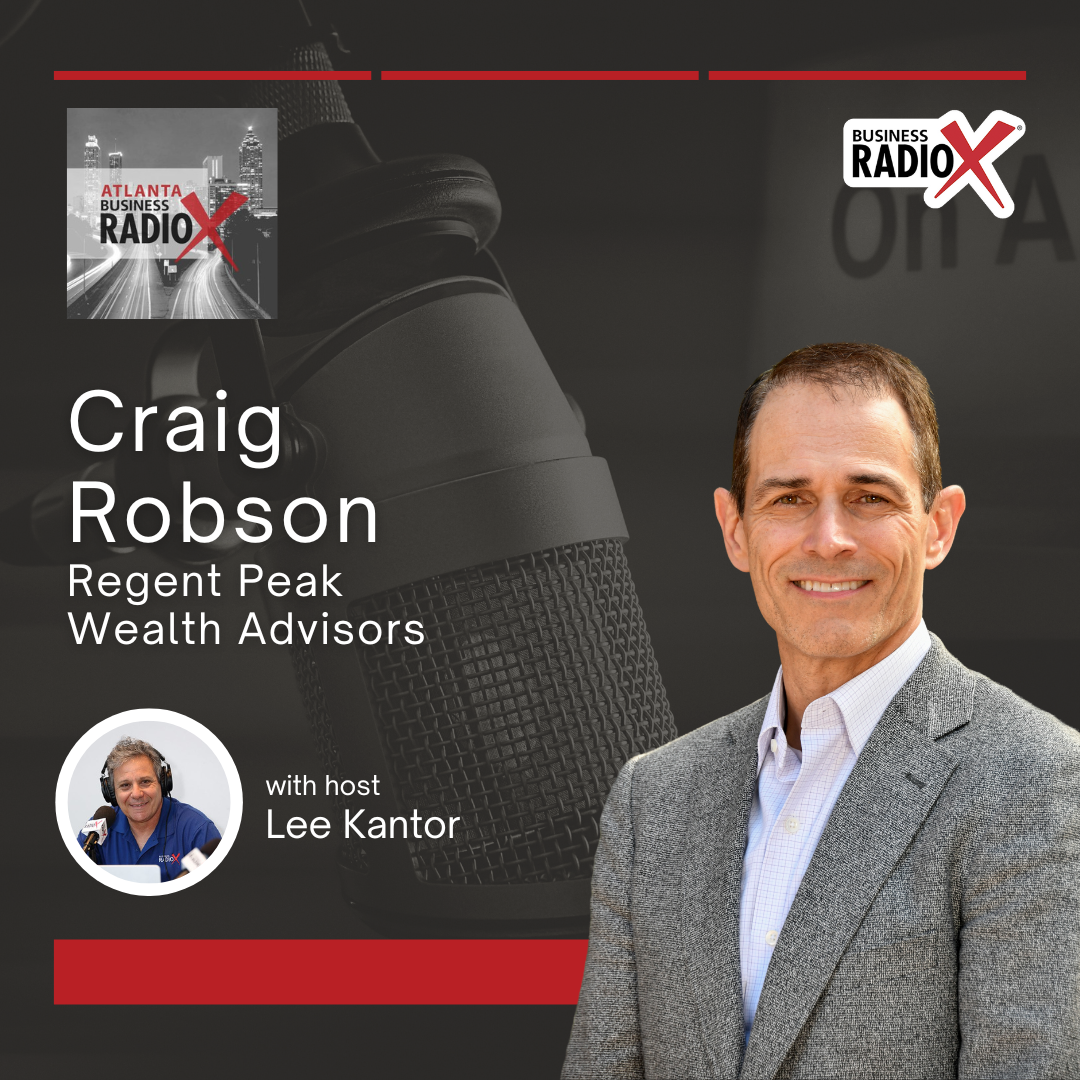

 In this episode of Atlanta Business Radio, Lee Kantor interviews Craig Robson, founding principal of Regent Peak Wealth Advisors. Robson discusses his transition from engineering to wealth management, his 25-year career at Merrill Lynch, and the founding of Regent Peak to better serve clients with complex financial needs. The conversation covers Regent Peak’s holistic, collaborative approach to serving business owners, executives, generational wealth families, and high net worth individuals, emphasizing proactive planning, technology integration, and coordination with other professionals to deliver comprehensive, client-centered financial advice.

 Craig Robson is the founder of Regent Peak Wealth Advisors. At Regent Peak, he serves as Managing Director and sets the firm’s overall vision and strategy. The creation of Regent Peak Wealth Advisors, an independent advisory firm, is a direct result of his desire to provide all relationships with objective advice free from the conflicts of interest that might come from large institutions.
He earned a bachelor’s degree in industrial engineering from Lehigh University in 1991. For the next 3 years Craig provided consulting services on behalf of Accenture Consulting, primarily within their manufacturing and information technology divisions, to both publicly traded and privately held corporations.
An unexpected opportunity to employ his practice management experiences within the financial services industry arose and in 1994 Craig embarked on creating a unique wealth advisory offering within Merrill Lynch. He has been recognized for his investment acuity and was recognized by Forbes Best-in-State Wealth Advisors list in 2024 and 2025.
He holds the CERTIFIED FINANCIAL PLANNER™ certification awarded by the Certified Financial Planner Board of Standards, Inc., the Certified Investment Management Analyst® (CIMA®) designation and he is a Certified Divorce Financial Analyst® professional. He holds all the relevant general securities registrations and insurance licenses.
Craig and his wife Angelia have two children, Nicholas and Lucas, and they live in Atlanta, Georgia. He enjoys playing ice hockey, swimming, hiking, volunteering for animal rescue groups, food drive initiatives in his local community with church, and coaching youth sports.
Connect with Craig on LinkedIn.
What You’ll Learn In This Episode
- Wealth management strategies for diverse client categories
- Services tailored for privately owned business owners and corporate executives
- Support for multifamily generational wealth families and high net worth individuals
- The importance of a consultative and holistic approach in financial advisory
- Collaboration with other professionals, such as CPAs and estate attorneys
- The role of technology and AI in enhancing client understanding and engagement
- Proactive financial planning and tax strategy discussions
- Addressing complex financial needs during life transitions, such as divorce
- Continuous growth and learning for both clients and advisors
- The evolving landscape of the wealth management industry and client-centric practices
 This transcript is machine transcribed by Sonix.
TRANSCRIPT
Intro: Broadcasting live from the Business RadioX studio in Atlanta, Georgia. It’s time for Atlanta Business Radio, brought to you by Kennesaw State University’s Executive MBA program. The accelerated degree program for working professionals looking to advance their career and enhance their leadership skills. And now, here’s your host.
Lee Kantor: Lee Kantor here, another episode of Atlanta Business Radio. And this is going to be a good one. But before we get started, it’s important to recognize our sponsor, CSU’s executive MBA program. Without them, we wouldn’t be sharing these important stories. Today on Atlanta Business Radio, we have the founding principal and managing director at Regent Peak Wealth Advisors, Craig Robson. Welcome.
Craig Robson: Hey, Lee. Great to be with you. Thanks for having me.
Lee Kantor: Well, for folks who aren’t familiar, can you share a little bit about Regent Peak Wealth Advisors? How are you serving folks?
Craig Robson: Yeah, I’d love to. So. So, Lee, we think of Regent Peak as a registered independent advisory firm that intentionally serves wealth creators. And we kind of think of them in four buckets or categories. The first would be private label business owners such as myself. The second would be corporate executives or C-suite executives, as we like to kind of think of them, that could be a CEO or a CFO of a publicly traded company. The third kind of wealth creator bucket would be multifamily generational wealth. So you’ve got a matriarch and a patriarch of done just a fantastic job of growing their wealth, working really hard throughout the years. And now they’re looking for an advisory firm to help them just start to shift assets towards future generations. There’s lots of education around that to make sure that they do it successfully. And then fourth, and finally, I would say high net worth, even ultra high net worth divorcees. Unfortunately, people do get divorced in this country and we will serve one of those individuals even through the mediation process if needed, but equally, if not more important in helping them kind of create a life plan post-divorce. So and really just a commonality amongst those wealth creators is that they’re looking for an advisory firm to really kind of coordinate their financial affairs so they could focus on the things that they tell us they really love to do, like their own careers, their families, and their hobbies and interests.
Lee Kantor: Now, when they come to you, are they already established wealth creators or are they aspiring wealth creators? So are they on the way up or are they already there?
Craig Robson: I would say they’re usually already on the way there. That said, we certainly have onboarded relationships that are like future wealth creators or up and come wealth creators. You calmly, you’re kind of making an educated forecast, and if you think that they would be a good fit for our practice, because the more complex the situation, the better we feel we can serve those relationships. So that’s how I answer that.
Lee Kantor: Now are they when they get to you, have they already had a wealth advisor and then they’re transitioning to you, or is this somebody that maybe was a do it yourselfer that is transitioning to you or somebody who just, you know, maybe they just dumped all their money in their 41K at their work and then now they need more advice.
Craig Robson: Yeah, I would say the majority of the relationships we on board are either ones that have really the majority of their assets are in the four walls of their business, and so they need somebody to help them with kind of pre exit or pre liquidity planning. So we’re working with them maybe 3 to 5 years before they sell their business and then have that monetization event. So they truly never worked with anybody prior to that because we were doing that very important consultative and foundational work. The second, I think, is when you think of these C-suite executives, it’s it’s really when they get pretty high up in the org chart, if you want to use that visual where they’ve got lots of equity compensation that starts to really dwarf their overall net worth, and they need an advisory firm to help them in terms of thinking about what the concentrated position, how to think about the taxes when they’re diversifying or unwinding those positions, making sure they stay within their shareholder requirements. So long story short, I’d say most of the relationships that we on board have not had an advisor before. We certainly meet folks that do and ah, maybe not. Um, don’t feel like they’re getting the services or they’ve outgrown that relationship, but I’d say the majority are ones that, uh, first time interviewing a wealth advisory firm.
Lee Kantor: So when they’re if they haven’t had a wealth advisor before and they have one or they’re considering you, um, what are kind of some of the points of differentiation that you’re, um, talking to them about when they’re making this decision? Because this is, you know, obviously, this is probably one of the biggest decisions they’re going to make for the remainder of their lives.
Craig Robson: Yeah, we would agree. Um, and I think that’s a great point, is that if if individuals understand that, um, this is really serious and this is really important, they’ve got to get this decision right. You know, I like to say, look, you could put the order. You could put the priority order. But I would say once health, family, finances and faith are the big four and you could stack them whichever way you want, but you got to get those four right, in my personal view. Uh, and so these individuals come to us and they are really looking for a couple important things. One, that somebody has the competency and skills that can help them not only navigate the financial kind of picture today, but continue to grow with them. Most of these individuals look entrepreneurs. It’s in their blood. They’re going to continue to be entrepreneurs until a much later in their life, if that makes sense. So they’re not going to stop after one business exit. Um, so they’re looking for firms that have the skills and the competencies to help them. That could be in terms of tax optimization, that could be collaboration with the state attorneys to making sure that we talked about the multifamily generational wealth, making sure that everything’s in place so that if and when they choose to shift assets, God forbid, they pass away prematurely, that there’s a plan that one can execute on and be proud of.
Craig Robson: Uh, I think another kind of point of differentiation is a lot of these individuals are familiar with, you know, maybe the public equity markets, but they’re really excited about is the private investments. So, uh, one of the things that I think we do different than a lot of other independent firms is we certainly diligence a lot of private equity, a lot of venture capital. And we think that’s an important kind of sleeve within one’s overall allocation. So there’s definitely some things that they hear from us. They may not be hearing from others. I think digital assets could be another, uh, unique kind of conversation. So, so points of differentiation in terms of planning, in terms of, um, you know, collaboration with other professionals and in terms of making sure that we’re getting to know kind of next gen. And so there’s that kind of like continuation of wealth growth and continuation of having success at that wealth is maintained. I. I think that’s what individuals are looking for when they interview us.
Lee Kantor: Now, in your specific as the leader of the organization, had you always been an independent wealth advisor or did you work for larger firms and then decided to go the entrepreneurial route yourself?
Craig Robson: Uh, leave the latter. So yeah, I’d love to maybe share with you for a few minutes kind of my background. So, um, you know, I’m a graduate of an engineering degree. I actually call myself an engineer. Um, and, uh, I was hired by Accenture Consulting back in 92. Sounds right. Uh, that gives you an idea of how old I am. Um, in Atlanta. Um, you know, they thought the city of Atlanta might get the Olympics. So you had a lot of consulting firms hiring engineers and really staffing up for for the big event that did occur, of course. Um, but that was kind of brought me to Atlanta. So I’ve always loved consultative and consulting kind of work. And so I did that for three years. Uh, after three years, I transitioned into the wealth management industry and started with Merrill Lynch, and I built a very successful practice at Merrill Lynch for 25 years. And on my 25th anniversary, literally that day, I handed in my resignation letter and lifted myself and my team members and our the majority of our practice north of 90% to start reaching peak wealth advisors, because again, things were getting when I say different, our clients needs were becoming more complex. Our clients were getting larger in terms of size and in terms of, um, you know, points of differentiation and just things that they were interested in, in getting advice and help from. And we were very limited and very conflicted in that a previous situation. So we felt a continued to help our clients on a go forward basis. We had to be our own independent firm where we could remove that conflict and do some of the things I just referenced before that either we couldn’t do or very limited in doing in more of a bank or wirehouse type of structure. I’ll just stop there and see if that makes sense.
Lee Kantor: Now, when you’re talking about the lane you’re in for your clients, Is it solely wealth advising or are you kind of have recommendations when it comes to other needs they might have, whether it’s insurance or if it’s some other tax? Where do you kind of where do you play in that spectrum?
Craig Robson: Yeah. Um, so, uh, I’m insurance licensed. I’m not a CPA. Um, so the way we describe this to our clients is they should think of us as the quarterback or the individual. That’s who we’re going to coordinate everything. Uh, and then we will certainly weave in other industry experts where appropriate and where needed to help us in terms of executing on their plan. So we want to look at everything comprehensively. So that includes, you know, not only, uh, one’s tax situation, but as you referenced, not only their insurance needs, but their property and casualty needs. So we’re going to look at everything from from life, from health, from, you know, homeowners auto. We want to take a look at all that and making sure that what they have today is best of class. Uh, and in the future, we’ll continue to monitor those things. If the landscape is always changing. So I like to say, look, the the portfolio side of the house is certainly very important. Um, we love that work, but that’s just a piece. You know, we really kind of think of it as we have like a ten point plan when we’re talking to new relationships. There’s ten kind of verticals that we focus on. Um, so it’s much more than wealth management. And that can include things like executive compensation analysis. We have a lot of corporate executives I mentioned in there. The reality is most of these executives, they understand their base salary and they understand their cash bonus. But things like restricted stock units or rsu’s, as we call them, these are forms of equity compensation, um, performance share units, um, incentive stock options, um deferred compensation.
Craig Robson: There’s lots of different components of their overall total compensation plan, which they’re less familiar with. And they really need somebody to help not only educate them but really help them try to manage through those. And what’s really evolved from that, that I have no problem telling you I would have never imagined 20 years ago is, look, our executives are really sharp individuals. They’re in high demand and they’re getting recruited all the times. And, you know, our advice is, look, that’s, you know, Mr. or Mrs. Client, that’s your job. If you’d like to make a move, keep us obviously in the loop, happy to help you any way I can. And we’re we’re helping them is like when they get offers from other companies comparing and contrasting what they’re giving up for what they’re getting. For example, the company they’re with now may have a pension, and the company they may choose to go to does not have a pension. How do we make them whole? How do we fill that gap? Right. Companies not going to create a pension just for one executive if they don’t have it already. Right. So it’s that analysis, that gap analysis I like to say, which is really foundational to what we do. Um, so there’s many different things we do besides just wealth management. And we love sharing that from a differentiation perspective.
Lee Kantor: Now, how does that kind of work in a practical sense? You mentioned that you would like to be the quarterback of this team of trusted advisors that they have as their kind of board of directors. But how does that kind of work, like let’s say specifically tax? If you have a person, maybe one of your clients is retired and then they’re making some decision about a, um, a Roth conversion, and they have their, you know, kind of issues that they’re having for their income they’d like to be, um, having and then this a wrong move here could affect, you know, their tax bracket. So how do you play with the CPA in order to, you know, maximize, uh, the opportunity, but without kind of hurting, uh, you know, maybe, uh, the amount of money that they’d be giving away in taxes. So how how would you play with that CPA if you’re the quarterback, are you in contact with the CPA or is that something that you make a recommendation and then the client goes to the CPA?
Craig Robson: Yeah. Um, so typically that scenario, what I’ve learned over the past 31 years, Lee and this isn’t every single time, but this is most of the times our firm is the one that’s leading on those type of conversations. So let’s take Ross conversions. Right. So I’m a big advocate of of Roth conversion planning. That doesn’t mean everybody should do it. There’s a lot of work, as you said, to make sure that you’re not putting a client in a significantly higher tax bracket. Or if you are, everybody knows it going in and you’ve made the educated decision on why that you believe. That’s a good move, right? Um, so there’s lots of preplanning work that goes into that. And, you know, the beauty of artificial intelligence within our industry, there’s so many different pieces of software that we’ve diligence and now added to our practice allows us to very quickly but thoroughly. Right. Leverage someone’s situation, use their their tax income situation, use their retirement accounts, run kind of what if scenarios. And then we present that to our client. And it’s usually like we’re the one that’s leading on this this recommendation or this opportunity, and then we’ll bring the CPA in, because if the client says, hey, I get it, but I don’t want to do it, I’m not going to waste the CPA’s time and have my client charge by the hour for that service. But most of the times the clients say, yeah, this really makes sense or I’m glad I learned more about it. Maybe next year, maybe we decide that there’ll be a lower bracket because they’re retiring, if that makes sense. So the quick answer is that we usually, I would say eight out of ten times leading on those conversations. We do all the pre-work, all the planning, and then we loop the CPN to make he or she signs off. I want them to sign off on it, or at least I want them to be involved. So the client, you know, basically has two sets of professionals that don’t work at the same firm, you know, providing them advice.
Lee Kantor: So you’re making a recommendation, the client. But are you in communication with the CPA? Is it you are you kind of authorized to have that conversation say, hey, this is what they look like this year, and this is, um, you know, So then you two are communicating and the client with your their blessing is kind of out of the loop. Or you just making a recommendation and the client is then communicating with the CPA.
Craig Robson: Um, almost every time we’re making the recommendation with the client first. And if the client says, I think this is something I’d like to entertain, I said, let’s bring your CPA in because he or she may have some pieces of your compensation or your tax picture that we didn’t model that we’re not aware of or you forgot. Guess what? Sometimes clients forget. Um, so, um, hopefully I’m answering your question. Um, we we always want the CPA to basically sign off on the recommendations before we hit the proverbial send button, if that makes sense. Um, sometimes the CPA will be invited to join earlier on in the pre-planning. Most of the times the clients say, Craig, why don’t why doesn’t your team do the analysis? Let’s look at the analysis together. And if I’m interested in proceeding, we’ll then bring the CPA, CPI on so they can sign off on it.
Lee Kantor: Yeah. The reason I’m asking is that a lot of firms, they have different relationships with the other trusted advisors, and I just want the listener to understand where you stand when it comes to these types of communications. Because as somebody who maybe has accumulated wealth, you know, some people are comfortable delegating, some people want, you know, their hands on every single thing that’s happening. So I just wanted people to understand your position when it came to the types of communication and interaction with the other folks involved, because, like you said, the more complex, uh, you know, the more questions, the more times that clarity and communication is critical. And I just wanted to know how your firm, uh, wants to deal with those types of situations. Um, now, how.
Craig Robson: Can I add two points to.
Lee Kantor: That? Yeah. Go ahead. Good.
Craig Robson: Yeah. So I think part of this is collaboration, which we’re big advocates of, like, you know, when we onboard a new relationship, the one of the first things I will do is with their permission, of course, is provide me, you know, your CPA’s name and your attorney’s name, and I’m going to call and introduce myself to them. Like that happens within week one. Right. Assuming they have a CPA and they have a state attorney, you wouldn’t believe how many high net worth individuals I meet do not even have wills and trusts. So that’s one of the first things we want to get them. Introductions to attorneys, right? Um, most of the individuals we work with have CPAs because they’re, again, high income, high net worth individuals. So we want to make that that outreach to let them know that we have a mutual client. And we’re looking forward to advising them together. Um, the second point is just to be to be very clear in my history, and this isn’t every single time, but I would say most of the times, you know, we typically find is that most CPA firms are so busy and maybe don’t have the right capacity or resource strategy. That’s just kind of one person’s view. They don’t have enough time to really have these proactive planning conversations. That’s what I hear time and time again. So we’re kind of filling that void. I’m not saying we’re the only firm that does that. I just can only speak from our experience. So we’re filling that gap or that void and doing that proactive planning, such as a Roth conversion analysis. That’s that’s a that’s a taxable event. I’m literally recommending client pay more taxes. It’s rare that I’m ever excited about or recommend making that recommendation. So we want the CPA to sign off on that. I want another set of eyes or ears on that call. Typically the CPA, to make sure that there’s no surprises come next April 15th when you’re filing your tax return. So it’s very important that we get them involved. But the majority of the time they’re coming in the back end to sign off on it.
Lee Kantor: Yeah, I agree 100%. I think that the wealth advisors, at least in my having interviewed probably 10,000 people in a lot of wealth advisors and a lot of CPAs, the wealth advisors are very much trying to build a relationship and trying to kind of watch the back of the client. And the CPAs are usually more hands off and don’t want the level of customer support and service that the CPA does. I think wealth advisors do a hundred times better job. At least from their spirit and their intention, they want to have more conversations. They want to do more. And the CPAs are more transactional.
Craig Robson: The generalization I would agree with that statement completely.
Lee Kantor: Yeah. And I think that that’s one of the big disservices that especially high net worth people have to deal with that, that kind of that’s to me a disconnect and an opportunity for CPA firm. If they would just take, you know, maybe follow the playbook of a wealth advisor a little bit more, um, or create partnerships where their communication level is a lot stronger. Um, because I agree with you that it’s usually, you know, there’s some reason why they can’t be more responsive or proactive.
Craig Robson: Yeah. It’s again, I come back to resource strategy, I don’t think. And yes. And this in no way a criticism the CPA industry because lots of fantastic CPAs have got great relationships with many of them. So I say this as a generalization. I think they haven’t figured out the resource strategy, and their business feels very lumpy or cyclical, like four times a year with quarterly, you know, quarterly payments, quarterly estimates, obviously, April 15th being the big date, October 15th, we just came past. So they kind of have this cyclicality to their business. And if you know, if they were to ask me, I would certainly recommend they do things differently and find a way, like you said, to have more proactive conversations with their clients. I think they gain a lot more business. And for the younger folks, younger professionals, I tell them, I think CPA industry is a fantastic one to go into because it’s very top heavy from a from an age demographics perspective. And you know, they’re doing it. I will say this, they’re doing a really good job of trying to change the culture in CPA, in the CPA industry, in terms of working ridiculous hours during tax season, right, and terms to try to make it more than, like I said, just a behind your computer kind of running, you know, software analysis all day. Being in front of clients. But they’ve got a lot of work to do there. But if you’re somebody who’s young and doesn’t know what career choice to go into, I think the CPA industry is one that could be really, um, transformed over the next couple of decades.
Lee Kantor: Yeah, I think that with the technology evolving as quickly as it is, you better move into a more relationship driven world instead of a transactional world, especially on things that can be automated. Um, and I mean, that goes with wealth management as well. I mean, I think your strategy of leaning into community relationships, focusing on big things like mission, legacy, those are things that are human to human interactions. And you better find the right humans to partner with. Otherwise, the especially young people are just going to, uh, move to some automated, impersonal thing. If it’s just transactional, they’d rather not deal with the human.
Craig Robson: Yeah. If we think about technology and I mentioned artificial intelligence a little earlier in our conversation. So we’ve leveraged and diligence many different pieces of AI software within our industry that have been additive to our practice. So if I pick on on, you know, taxes for a moment. So we found a piece of software that allows us to take, you know, one’s 100 page tax return document and summarize it in five pages. Right. And what the aha moment for me was, uh, this was maybe 4 or 5 years ago, a random question at dinner. My wife and I, for one a few times were alone eating dinner without our kids, and she just said to me, and maybe it was even around taxes. And I remember she said, hey, Craig, how much money do we make? I looked at her like, well, honey, you signed the tax returns every year. She’s like, well, I don’t ever read them. And right then I was like, huh? Of course she doesn’t, right? Why does she do it? It’s too many pages. It’s it’s almost Greek or nobody has the attention span to go through. All that information, all those numbers. So I said to her, I said, well, you know, what would what how would you or what would incentivize you to read him? She said, well, somebody gave me an executive summary.
Craig Robson: I should have known that my wife went to University of Georgia grad school from accounting. Right. So she’s if anybody can kind of speak to the, uh, the kind of the challenges that would be her. She said somebody would just give me an executive summary, like the key takeaways from that 100 page document. That would be easy to read. I was like, that’s what we need to do. So we found a piece of software that takes not just tax returns, estate plans, homeowners insurance policies, property casualty like auto insurance, boat insurance. And it just it provides this very simple yet informative document that says, here’s the you know, here are the things that you need to know about your your most recent tax return. This here’s a visual org chart of your estate plan. God forbid if something happens to you. Here’s how your assets flow. Here are the trustees, the executors. You can. People want that. Like people want that information, but they’re going to get bogged down If you try to go through a 50 page document, then you’re going to lose them.
Craig Robson: Right. So, um, you know, I think that’s where AI is, is really just, um, rapidly evolving. And the firms that will leverage that will be in an advantageous situation because, yeah, we’re very proactive with these different pieces of information. So we talked about this a little earlier. I’m not an estate attorney. And I told my clients and prospects right away that said I know enough to be dangerous and share with me your estate plan documents. We’ll come back to you with an executive summary, and I can look from there and see if it’s time to bring in your attorney, assuming you still meet with them. Another good example of the state attorneys don’t speak to their clients unless it’s a, you know, getting their first wills and trust created or God forbid, something’s happened. Divorce, death rights. Bankruptcy. Something. Right. Crazy. Uh. Or unique, I should say, um, that they don’t really have a relationship with them. So this provides us that intermediary opportunity to step in as that quarterback and say, let’s take a look at all these and see again if there’s things that need to be refreshed, amended or completely changed.
Lee Kantor: And I think that by focusing that empathetically on the needs of the clients, and you’ve had enough clients and enough history and enough industry knowledge to know, okay, these are the the big drivers that we have to get. Right. And while we’re an expert in this part and you and if you are the quarterback, like you say in the and kind of managing the other relationships or at least kind of educating your client on what’s what in each of those other areas, and you can summarize and give them kind of the, the, um, you know, Reader’s Digest version of the, the nuts and bolts of it, rather than being overwhelmed or not even understanding and just nodding their head about it, you’re serving your client better. That helps you, um, you know, help them get the outcome that they desire. Um, so kudos to you for doing that. And I think it’s much needed and I wish more advisers would take that type of empathetic kind of point of view, and that’s really customer service. You know, you are serving the customer in ways that they don’t really they don’t know what they don’t know. But you do know what where some of the kind of landmines could be.
Craig Robson: Yeah. Thank you. You know, I, I mentioned my wife like she’s a I better say this and it’s the truth. She’s very intelligent. Right. But again she’s not going to read 100 page document. I can’t tell you how many clients of mine. We’ve got CEOs of publicly traded companies. I’m not going to name them on this radio broadcast. Right. Um, but but very successful people. We’ve got very successful business owners. These are sharp individuals. What they’ll say to me is, hey, Craig, we didn’t hire your firm. We could have bought the S&P 500 ourselves. That’s not why we hired you, right? We’ve hired you for all those other very important foundational work. We acknowledge portfolio construction is important. We import, we acknowledge that we want our assets to continue to grow responsibly, right this wealth creation. But we don’t want to pay a lot of taxes, right? Um, we acknowledge that we’re very interested in other type of asset classes. I referenced digital, like the Bitcoin and Ethereum of the world, the venture capital, the private equity, the private real estate. We acknowledge there’s more than just public equities, right. Um, and they would say, like if, you know, we’re too busy doing the things we do, we don’t have time to keep up with with the latest and greatest where the industry is shifting and changing. So that’s not just on portfolio construction, but again, that goes into estate taxes, that goes into succession planning, that goes into tax planning.
Craig Robson: So there’s so many facets that goes into again, we do a lot of work with our clients in terms of I just had this conversation with an executive. He just retires as CEO position. And now he wants to to join two boards. He wants to be on two boards. And so we’ve had a lot of experience of helping our clients kind of, in essence, build out their resume. The resume is really good, by the way, but they have to put themselves in the right position to be considered for board. And they do that. Do they need to go to maybe MIT? Mit’s got a fantastic program in terms of preparing one to be on a board. Right. Do they have to be networking differently than they were previously as the CEO to put themselves in the right community, where people know that they’re open for being on a board seat? And, you know, you and I both know once you get one opportunity, then it just kind of it’s like a domino effect that builds on itself. So there’s so many things that clients come to us because we we told them very proactively, these are the things that we can do for you, that I think the wealth management kind of industry hopefully is changing in terms of being more than just a portfolio manager. That was my point.
Lee Kantor: Yeah, and it’s interesting because those executives used kind of a, uh, informal board, if you will, or a board of trusted advisors to get to the position they’re in. You know, they had people that were watching their back that were, you know, mentoring them and supporting them and, and, um, and giving them the tools and the access to what they needed to do to kind of continue up the corporate ladder to get to the position they’re in. And you’re just doing the same thing in another area that they’re not. That’s important to them, but isn’t their expertise.
Craig Robson: You nailed it right. And I think the you know, I like to say, you know, if you’re not growing, you’re slowing, right? If you’re not continuing to grow and do things different, you’re just going to slow down. And maybe that’s what you want. But, you know, I learned a long time ago, you’re in my business. At least your clients are a reflection of yourself. And so I like folks that are, you know, entrepreneurs that, uh, C-suite executives, folks, folks that kind of want to continue to grow, uh, and those folks that really enjoy working with because, like I said, it just presents more unique situations, more complex kind of needs. Excuse me. So, um, that’s really fun for me. And so, you know, I’m growing with them. We kind of get to feed off each other, if that makes sense. I’m learning from them and they’re learning from me and my team.
Lee Kantor: So if somebody wants to learn more, have a more substantive conversation with you or somebody on the team. What’s the website? What’s the best way to connect?
Craig Robson: Yep. So, uh, you can find us on our website, wealth.com. Um, we’re obviously on all the social media, media channels. Um, we provide a lot of content out there in terms of LinkedIn. We do interviews such as this podcast. So it’s very easy to find us. Um, but we are open for business, as I like to say. So if you’re a wealth creator like we talked about at the top of this call, uh, and you fit in one of those kind of primary four buckets or categories. Um, we love to have a conversation to see how we can help you and your families.
Lee Kantor: And that’s a Regent Peak wealth.com.
Craig Robson: You got it.
Lee Kantor: Well, Craig, thank you so much for sharing your story today. You’re doing such important work and we appreciate you.
Craig Robson: Thank you. Lee.
Lee Kantor: All right. This is Lee Kantor. We’ll see you all next time on Atlanta Business Radio.














