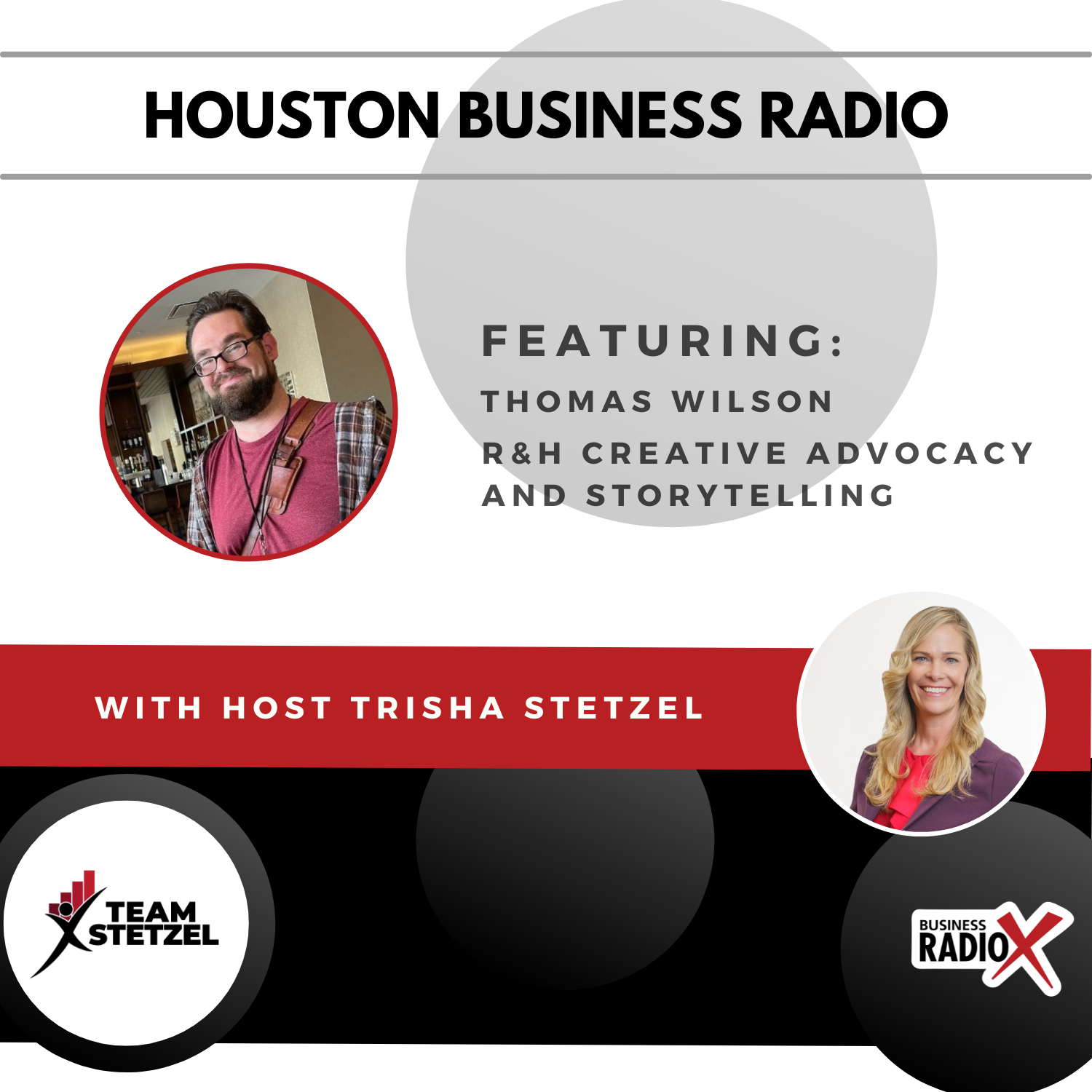

 Thomas Wilson is the founder of R&H Creative Advocacy and Storytelling, a professional writer, advocate, storyteller, and speaker with over a decade of experience. He specializes in shared storytelling, using empathy and compassion-based care to foster connection and understanding.
Thomas actively engages in community events and champions storytelling as a tool for personal growth, education reform, and leadership development.
Trisha and Thomas discussed the importance of storytelling in business, education, and personal growth, with Thomas emphasizing the need for empathy-based leadership and a shift in understanding how people learn.
They also discussed the flaws in the current education system and the importance of teaching in a way that caters to individual learning styles. Lastly, Thomas shared his favorite story, “All of the Places You’ll Go” by Dr. Seuss, and encouraged listeners to connect with him through his website or show notes.
Connect with Thomas on LinkedIn.
 This transcript is machine transcribed by Sonix.
TRANSCRIPT
Intro: Broadcasting live from the Business RadioX studios in Houston, Texas. It’s time for Houston Business Radio. Now, here’s your host.
Trisha Stetzel: Hello, Houston. Trisha Stetzel here bringing you another episode of Houston Business Radio. I have the pleasure of speaking with an entrepreneur who is making a meaningful impact in the world of education, gaming, storytelling, and so much more. Mr. Thomas Wilson, thank you for being with us today.
Thomas Wilson: Thank you. I’m glad to be here.
Trisha Stetzel: I’m so excited to have you on. So tell us a little more about Thomas Wilson.
Thomas Wilson: Definitely. So, um, I always say I run our creative advocacy and storytelling. Um, but I also like to say that my story very much starts with stories. I have been a lifelong fan of stories overall and their ability to impact. My inspiration comes from being a neurodiverse youth, from a youth who had his own mental health struggles. And what I have learned is a very common story of when I was very young, before a lot of things kicked in. Being considered a genius, being considered very talented. And then as my life progressed, things changed and my neurodiversity really kicked in. My mental health did, and I dealt very much with schools, um, establishments, businesses that were meant to support people like me, deeming me too hard to work with. And I’m not here to say that I was a saint. By no means was I a saint. Um, but I faced a lot of judgment and worry. And in that time, one of my greatest connections was to stories. It helped me to feel more human, less alone, very connected, but it also really connected me to the idea of what so many people around me wanted, and the power of empathy based leadership, the power of storytelling, and really the power of sharing a story. And I realized not everyone is meant to be a storyteller or advocate or, um, you know, be a public speaker, but that is the heart of what I do. I run events, I do public speaking, I write articles, I run games, all kinds of stuff. We never have enough time in a discussion for me to go over everything I do. But the heart of it is sensory friendly care, empathy based storytelling, and in a passionate and patient mindset. Um, and that’s not just for people like me, it’s for everyone. I always say that that’s for the heart of my community is those youth, those people seeking that. But the best kind of work is always done for all people.
Trisha Stetzel: Absolutely. And if you want more information beyond what Thomas and I are going to talk about, all you have to do is Google R and H creative advocacy and storytelling. You’ll find so much more information about the difference that Thomas is making out there. I’d love to. And I know we’re going to take a couple of topics today. I want to talk a little bit about storytelling, and then I want to dive into the way the way we learn. And I think that that’s really important. And it goes along with storytelling. So, Thomas, why is storytelling so important to to adults? I know as children it’s very important. But as adults, why is storytelling so important?
Thomas Wilson: So I always say that I think it’s just because we are human. Um, storytelling is in its heart and in its core, a human experience. It is infused into our culture, into our arts, into our daily lives, our schools, our TV shows, mediums, everything. Storytelling is as human as being a human being. And yeah, there are a lot of youth that love storytelling, and I think that’s fantastic. But I think for adults in particular, we kind of are taught to move past creativity in a lot of ways. We’re taught stories are for kids or, um, that, you know, if you play or have fun. It’s childish. And I think we as people really need to hone in the idea that as kids, we love to play, we love to tell stories. We love to hear books, read books, all of these things. We love to paint. We love to do everything. And I think the main reason why it’s so important for us as adults is the reason of how much we crave it as a youth, um, in our world. And if it was not a necessity of life, we would not crave it. Um, so many youth. It’s an inherent, natural part of our life. But I think we need to challenge the. You’ve got to grow up mindset by giving up this and acknowledging play. Stories. Creativity. It’s just good for the human mind, body and spirit.
Trisha Stetzel: Absolutely. So I’d like to take it just a little further into business. Why is it important to be a good storyteller in business?
Thomas Wilson: So the first couple of things I can say are kind of generic business advice. Good stories connect us to our communities. They allow us to get on things like this talk on the radio, get our name out there. But I think especially for a business on more of like an empathetic manner or a more emotional manner. Good stories help us to understand how to better serve our community. They help us to understand how to connect to people, and they help us to understand how to get our message out there. Um, those things are so important. I think any, you know, business owner who has a degree of success knows the importance of, like, human connection. But human connection is so often stories. It’s it’s knowing how to talk to people, how to carry a conversation, how to interact and have fun. And as us, as business owners, if we want to be seen as kind, considerate or caring about our community, we have to know how to tell our stories. And especially for those people who are, you know, they don’t have the access, the ability to access a lot of buildings. They are worried about going somewhere and being overstimulating, being able to connect and tell people exactly how you can support them and potentially even gain lifelong clients, lifelong fans, dedicated workers. It really comes down to how you communicate your story.
Trisha Stetzel: Mhm. I love that. So I’m thinking about people who are afraid to tell stories. That’s really what’s bubbling up for me right now. And people who may feel guarded and not comfortable telling a personal story or even a story about something from their past. But I also heard you say it’s about having fun and connecting with people and being real about who you are. So what would you say to people who are afraid to open up and tell their story?
Thomas Wilson: Um, so the first thing I would say is, if you are not truly comfortable telling your story, don’t tell your story. Um, it is a very scary thing to get up in front of people and talk about yourself. Um, I think it’s I think public speaking is still like one of the top fears. I’ve heard it, like, out to death for some people. Um, but in that I would also say, if you do want to tell your story to someone, tell it to the people you trust first. Practice it on bill, utilize it in safe spaces and then if you’re comfortable, I would say work your story down to the bits that you feel comfortable sharing. Like I always tell people, I work very hard to tell my story. Not my siblings story, not my mother’s story. I work very hard when I say there was a significant loss to leave out certain things, as that impacted a lot of people and in a very negative way. And so a big thing for me is honoring the people I love by not broadcasting their life. Um, but in that I also have the elements of like, this is what happened, this has changed my life. And so it’s good to have that ethos, but it’s also good to be protective and honest in our story. And we don’t have to share everything, especially in this digital age where it seems like everybody’s giving away everything There’s a lot of power in sharing the finer points and doing it well.
Trisha Stetzel: I love that, I think that’s fantastic. So stories are a great, a great way for us to build community and to connect with other humans and even connect in business to the people we want to serve. I think that’s so important. But there’s also this whole aspect of learning from stories, which is important. We learn about others and we learn things through the stories we hear and even the stories that we tell. There’s this whole idea of the way we learn that I would love to dive into, because I know you have some thoughts around the way adults learn, and even the way we’re teaching adults. What are your thoughts around that?
Thomas Wilson: So I first I want to say, um, and I think this is something a lot of people can reflect on and appreciate. Um, our understanding of education is very flawed, not just in the United States, but around the world. I think a lot of the time. Like when I learned about my when I think about my first job, I should say, um, I had to sit down in front of a computer, do a couple hour training. Um, I was not retaining information. I was I felt very much like I was being tested, which I was. Um, and, you know, tests aren’t inherently bad, but we are learning how inherently flawed they are towards education each day. Um, but that experience was very unpleasant, and I’ve had to go through that several times. And a big part of that was because I wasn’t being taught how I learned. I wasn’t applying the skills, I wasn’t doing what I needed. But I think for a lot of people, we also come from a system that puts youth into a building, potentially with thousands of other kids. Um, so I from what I’ve heard, sometimes there could be up to 10,000 or more. And then we test them. We give them tons of homework. We have them take multiple classes. We don’t teach them what they want to learn. We create a lot of social anxiety just being in a building. We don’t have people properly staffed and supported as teachers. And then for some reason, all of these flaws that really have nothing to do with how the students are doing, um, gets blamed on the student if they’re failing or doing bad.
Thomas Wilson: Um, and then we look at how hard it is to be a kid. I know there’s a lot of people who challenge like, oh, it’s not hard to be a kid. I encourage people to look through a lens of empathy. If you say that like that’s your gut response. Um, but then we take in social anxiety worries, neurodiversity fears. And then for some reason, that’s what that’s what we do for multiple years for multiple people. And then when we get into the workplace as adults, we’re already traumatized, worried, anxious. The amount of people I talked to who don’t like red ink on a paper because it reminds them of their worry, their anxiety, failing tests. It’s astronomical. And really, all of this is centered in on. We’re not teaching people how they learn. We’re teaching them how they want to learn. And especially when you have a class of like 40 people and you have one teacher or one person doing the training, and they’re just saying, these are the facts, this is what you need to know. You can test it on your own. I’ll come around if I can. That just adds to that. And people learn in complex, different ways. And if people fail that education, it’s not so much necessarily the teacher. It’s not so much that individual, but our understanding of how people learn. And we need to change that and honor the patterns in which a person learns.
Trisha Stetzel: Wow, I love that. So by the way, I just want to take a pause here and allow you to tell people how to find you again. So if they’re interested in having a conversation or want to learn more about the work that you’re doing. Thomas, how might they find you?
Thomas Wilson: Um, yeah. So my email and I didn’t realize how many of these letters sound identical until I made the email and started telling people. Um, but my business email is n d t t rpg. Um, again, kind of a lot of similar sounds. Um, but n d t rpg at gmail. I always welcome questions. I will make sure that my LinkedIn is set up there as well, and given I will make sure that my website is available, you can also find me on Instagram and a couple other things. Although personally I’m not the biggest fan of social media, so I’m not on it a ton. Um, but I love questions. I love getting to talk to people, to explore and have conversations. I think especially as a genuinely empathetic conversation is such a missing art form in the world right now.
Trisha Stetzel: I agree, when you and I spoke over the phone a few weeks back, I knew that I wanted to have you come on so we could have this deeper conversation. I felt like we had this connection because you were so kind and empathetic just over the telephone. And now we get to meet here on video and have a deeper conversation. I want to track back then to, um, teaching the way we learn. So how do we do that? What are your thoughts around allowing people to learn how they learn?
Thomas Wilson: So I think a big first step is communication. Um, I, I’ve had I’ve done presentations where I have bullet points and things, but and you know, it can be hard, especially if you don’t not good on reading on a screen, which a lot of people aren’t. Um, but what I always try to do is one for me. Remove my ego. Um, so often I think the biggest barrier to education is the presenter’s ego. They have to be willing to answer questions. They have to be willing to redefine re-explain, um, and break down things. I always say, you know, it’s not if someone doesn’t understand. It’s not their fault necessarily. It it can be a wide variety of mental and cognitive emotional stimuli, all kinds of things that can impact that. But I think the other thing is really understanding how to communicate in an empathic way, and how to set up a space in a secure manner in which people actually feel comfortable asking for help. I’ve been in a lot of trainings, and I feel like either someone’s just talking at me, or the space is just not conducive to questions. And a lot of us are programed not to ask questions in today’s world. Um, but another big thing, I think it is really also understanding how to listen. I think as presenters, educators, we have to listen. I’m not saying listen to talk, but listening to actually listen. And then when I think we actually carry this out and this is going to be the hardest part, is making sure that you are checking in with people, refocusing, redistributing how you’re giving information.
Thomas Wilson: Um, and I think one of the easiest ways to do that is have your target audience there and offer the education style based on what people are seeing. So, like I do a lot of Dungeons and Dragons, and I work with beginner friendly groups, and I will broadcast that as beginner like a beginner group. And if you want people to learn a certain way, I highly encourage saying like, okay, sensory friendly classroom in the title or in the description Corruption or, um, you know, patient, kind or just like, slow paced, kind of like keywords that really catch the eye. Um, and I would also emphasize each class having that discussion on, okay, we’re going to talk about this. Let’s work together. Let’s have this conversation as we go. And I think the last thing is if you get feedback, change your training going forward based on that feedback, some feedback is going to be outright toxic. Some is not is not going to be conducive. Um, especially as someone who has a lot of his work is influenced by reviews and things. It can be really hard to like take some of that feedback. But I think especially if you place that as like, this is what we’re expecting, this is what we’re doing. This is why you were here, and let’s work together. I think that’s one of the easiest ways to emphasize that feedback is going to be positive.
Trisha Stetzel: Yeah, we need that feedback loop as trainers, as educators. Uh, before we started recording, I said I was really interested in this topic because I spent a lot of my time training or facilitating conversations with adults, professional adults. And I think one of the things that I think I know, one of the things that you said is people are expected. Adults even are expected to learn a certain way. So oftentimes we create our curriculum to be that of the expected way that we would teach. So I love all of the input that you’ve had here on those those things. So what other tools can we use, Thomas, to teach adults?
Thomas Wilson: Um, so I so I love that question because I think it varies very much. Um, I would say the first thing I always recommend, communicate with your audience before you start teaching them. Gather what they need. And it’s always hard to get like, I work with a lot of young youth who have autism, and it’s always hard to convince someone to display like personal information before they’re actually there and they feel comfortable. Um, but I would encourage, um, so something I’m doing, I’m running a class with my local pace center. Um, and what I’ve been doing is constant positive communication, even if that’s just a reminder of like, hey, class is a week out or a few weeks out. I’m so excited to hear from you. Um, I also will implement like, positivity, like positive feedback on what I observed and like being genuinely grateful for people being signed up for something. I also think in that vein, a really instrumental tool that I’m kind of surprised I haven’t brought it up yet. Is a strengths based mindset. Um, we live in a world that is so deficit based, um, and is so just inherently targeted towards groups of people, um, adults, youth, really. We all fit into it. And so many people are met with, oh, you got a 50 on a test, meet me after class with like a negative mark or an unhappy face versus you got a 50 on a test.
Thomas Wilson: How can we help you succeed? How can we make this better? Let’s create a game plan. And so I would say if you can also greet people with that like genuinely do that, that’s huge. Another thing is really implementing the mindset of um, perfection is not going to happen. Uh, another little saying I have is we’re not going to try to be perfect, but we’re going to do our best. It’s really helpful. And the last thing I would say is, um, as you’re teaching other tools that you can have really quickly for the sake of time, um, make sure that you’re highlighting those strengths, that people show that growth, all of that. Make sure that you are representing the people in your class well, on social media, um, on everything you post. And then the other really quick thing is make sure that you are emphasizing to people that their voice matters. And either that’s on social media, that’s after the class, whatever. Make sure you’re honoring that by getting proper permissions, um, in those trainings to reflect that positivity and to make sure that people know that you’re not going to just, like, take photos of them and put them on social media.
Trisha Stetzel: Right? Yeah, that’s a that is definitely a big deal. We need to honor their privacy. I love that you used strengths based mindset. I do an exercise called Areas of Awesome, so I love that exercise. I do a lot of things, Thomas, that I feel are what we would consider maybe juvenile teaching tools like puzzles, games, colors, using markers on a whiteboard, music. How do you feel about those kinds of, uh, teaching mechanisms for adults?
Thomas Wilson: I think they’re necessary. Um, those are we, as human beings, so often love stimuli? Um, there’s a lot of negative stimuli that can happen, but having a fun, creative space, I think is a really powerful way to emphasize and to encourage the idea of a relaxed learning space. The only thing that I have to say, and I’m not necessarily saying this you, but to a wider group of people is make sure you don’t, you know, disregard or make it too child like? Um, I work with a lot of people, um, who are. Who, like, they’re adults. They’re in their 50s, 40s, 30s, whatever. And they show up to someone and something. Someone knows they have a diagnosis and they’re greeted with the hey buddy kind of mindset, or like the removal of the name altogether. Um, the other thing I would say is, like, if someone says something but you don’t catch it and you have those tools, don’t just go, okay, well, we’re moving on. Actually ask that person to repeat again and listen better. Like double down on it. And then with those tools as well, I would also emphasize and this is something I work really hard to do. Um, you know, don’t force them on people. Right. Those tools are great. They’re powerful. They’re they’re fun. But in that, a lot of times those games can become a really, really quick way to like de-age a human being. And one of the key ways that can happen is when someone, especially if they have a diagnosis with something and someone shows up immediately and does it for them. Um, and then just assumes that they did the right thing. Um, and so those are things that I would always add to that. But I think fun stimuli. Fun things, when they’re utilized well, they aren’t absolute necessity.
Trisha Stetzel: Fantastic. This has been wonderful. You’re going to have to come back because we’re out of time. I don’t know where our time went today. So as we get to the back half of our conversation, Thomas, I’d love for you to share a story. Uh, it could be one of your stories. It could be a story of somebody that you’ve worked with. Of course, respecting that. We don’t have to tell anybody’s names, but I’d love to hear one of your favorite stories.
Thomas Wilson: So, um, I think I’m going to cheat it a little bit. One of my all time favorite stories is the Doctor Seuss book um, All the Places You’ll Go. That book has, uh. For a while, it popped up in my life at some really interesting points, like when I was struggling in elementary school. That book was always in a classroom, or when I was struggling in high school that would that book popped up and I didn’t notice a trend in it until I was talking to one of my high school counselors at one school I was at. And she’s like, this is hard, but it is, um, it’s just a hiccup. And she mentioned that because I’ve read it several times. And so when I went back to my program that I was at really struggling in a mainstream school system, she sent me a card and it just said, see, like it’s just a hiccup. And it had all the places you’ll go on it. And shortly after that, when I graduated high school, something a lot of people never thought I would. Um, the high school itself, they got all the teachers to sign it, and they handed it to me. But they also gave me the book signed by the principal. And it was all the places you’ll go. And since then, that book has popped up in my life in some very interesting times, kind of unexpectedly. But the story of someone just exploring life and going to all these far off places and doing all of these amazing things has a very strong spiritual kind of mental, metaphysical connection to me. And it is not the most, um, conventional book people jump to, but it’s it’s one of those books that has become like a part of my story.
Trisha Stetzel: Wow. I love that all of the places you’ll go. How did you know I love that? I love Doctor Seuss as well. Thomas, thank you so much for being with me today. You are. All of the things that you shared today are absolutely incredible, and I know that the listeners that, um, listen to my show every week are going to get so much value out of our conversations today.
Thomas Wilson: Thank you very much. It’s been a lot of fun.
Trisha Stetzel: Good. I’m glad again, if you would like to connect with Thomas, you can find him at. He’s the creator of R and H creativity. Uh, excuse me. Creative Advocacy and Storytelling, LLC. You can Google that, or I’ll put all of his contact information in the show notes so you can just point and click. Thanks again, Thomas, for being with me today.
Thomas Wilson: Thank you.
Trisha Stetzel: And that’s all the time we have for today’s show. Join us next time for another exciting episode of Houston Business Radio. Until then, stay tuned, stay inspired, and keep thriving in the Houston business community.














