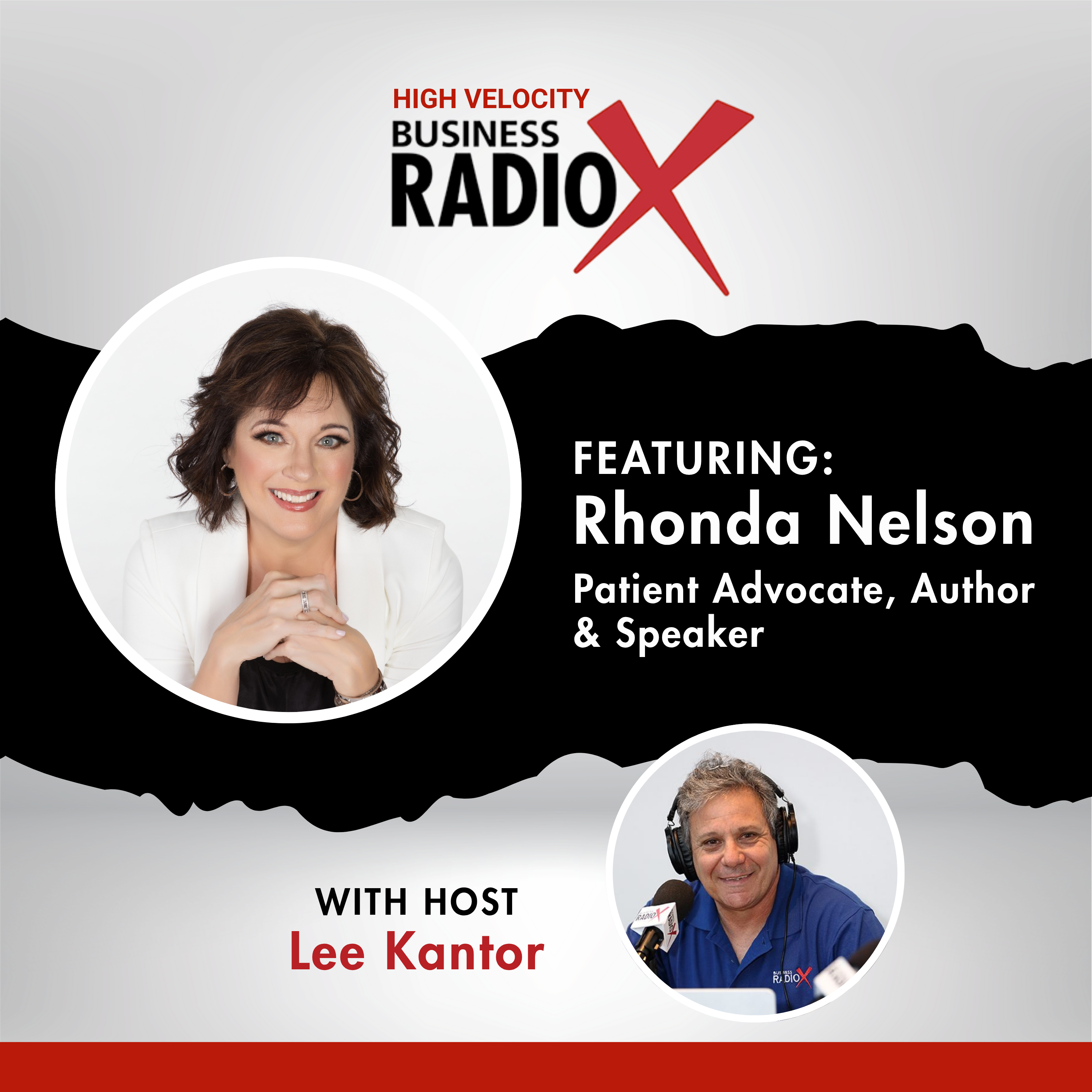

 Rhonda Nelson, renowned patient advocate, author, speaker and philanthropist is a beacon of resilience and strength.
Her charitable work spans championing equitable access to affordable healthcare, supporting those diagnosed with AERD (Aspirin Exacerbated Respiratory Disease), serving as a voice in the foster care system and encouraging women to reinvent themselves in their different stages of life.
Follow Rhonda on Facebook.
What You’ll Learn in This Episode
- Overcoming the challenges of chronic illness and AERD.
 This transcript is machine transcribed by Sonix.
TRANSCRIPT
Intro: Broadcasting live from the Business RadioX studios in Atlanta, Georgia. It’s time for High Velocity Radio.
Lee Kantor: Lee Kantor here. Another episode of High Velocity Radio and this is going to be a good one. So excited to be talking to my guest today. We have Rhonda Nelson. She is a renowned patient advocate and author, speaker, and a philanthropist. Welcome, Rhonda.
Rhonda Nelson: Hi, how are you? Thanks so much for having me.
Lee Kantor: Well, I’m so excited to learn more about what you’re up to. Can you talk a little bit about your work as a patient advocate? How did that come about?
Rhonda Nelson: Well, it came about because I have struggled for over 20 years with pretty rare respiratory disease called e d, which is aspirin exacerbated respiratory disease. It took me about two years to get a diagnosis, and a few years to get to a point where I was, well, medically managed. And so I just through that struggle, I knew that there had to be other people going through what I was going through, and so it just became a passion of mine to advocate for patients with, but also navigating the, um, the insurance system and the medications that work well for this disease can be a daunting task as well. So while it’s not relatively well known, it has come a long way, and it’s in not only people, but physicians knowing about it and understanding about it. And so I’m just I want to be the voice, the voice of the disease, if you will.
Lee Kantor: So talk a little bit about what it feels like to be in that situation where something is obviously wrong and no one can kind of figure it out. Like how as a patient. Kind of do you make your moves when it comes to that? Because a lot of people just rely on whatever the doctor says. I’m just going to do. And when you’re just not getting satisfaction. How does a patient kind of maneuver around such a complex ecosystem?
Rhonda Nelson: Well, you make a really good point, because in a lot of my speaking and interacting with patients, you know, I talk about that because we we grew up kind of what the doctor said was the wherewithal and the be with all. And that’s what we did, and we pretty much didn’t question it. And throughout my journey, I just, you know, I wasn’t getting anywhere. I wasn’t getting any answers. I wasn’t feeling any better. I was feeling worse. And multiple trips to the E.R. when I would have exacerbations. And, you know, I just so I just dug I kept digging for research to point me in the directions. I studied just as much as I could about the disease, and then I just went to doctors that knew about the disease that, you know, I couldn’t find anyone locally, so I had to go where they were. That led me to learning about. One of the keys for me was to medically journal what was going on with me on a day to day basis. You only have a short period of time with your physician. They don’t know what’s going on with you. All the other hours of the days, of the months, of the weeks. And so to go in and, you know, say, this is what’s happening, this is what’s working. This is not what’s working. We have to find answers. So it’s so important for people to understand how you have to be your own advocate, even with your medical doctors. And it might be doctors you’ve been seeing your whole entire life for for a big majority of your life, but you still have to have that line of communication and, and and if you don’t agree with what they’re saying or what they’re telling you is not working, you have to speak up.
Lee Kantor: So let’s talk a little bit about medical journaling. I’ve never heard of that before. What does that entail?
Rhonda Nelson: So really it’s just keeping a journal of of what goes on with you, especially if you’re, you know, in my case, my flares would typically happen in the middle of the night. Why? Well, now, what I know is the reason early on they were happening is because I would, uh, you know, I would cough and I would sneeze and I’d have all these kind of horrific symptoms. And so I would take Tylenol PM to sleep because I now I can tolerate Tylenol. There are some patients that cannot I can tolerate Tylenol, but I can’t tolerate any other insects. So I would take Tylenol PM and that was causing me to have a reaction. And so I, you know, I started just like writing down these kind of things that were happening and trying to put the pieces of the puzzle together so that when I did see my physicians, I could say, hey, this is something that’s happening on a regular basis. Why is this? What do we do to control this? And it’s just because you I couldn’t rely on my memory to remember if I only saw my doctor once every six weeks or three months. I can’t remember every single thing that you know how a medicine was working. Tracking the reactions or tracking the progress of the medicine or new things that were happening to me. Um, you know, maybe during spring I would see an influx in flares, or in the fall I would see influx in flares, but I can’t remember all of that and be able to get that out in my short little window of an appointment with a physician, so I just started writing things down.
Lee Kantor: So you were keeping track of the like, kind of on a daily basis. How am I feeling? When am I having kind of a flare or an attack? Um, what medicines did I take that day? Maybe what I was eating or things like that. You were just kind of keeping track of kind of the minutia of the day, so that when you did go see a physician, you were equipped with kind of, okay, this is what’s happening, you know? And now I can even probably if you were so organized, you can mark on a calendar. These are the days I had a flare. And this is what I was happening in the day or two before each flare. So then that way in that meeting, it’s productive. It’s not you trying to remember. Oh yeah, it was a Wednesday. Like that’s that probably wouldn’t help the doctor kind of, you know, problem solve.
Rhonda Nelson: Right. Exactly. And it truly is. It’s like putting a puzzle together. And I mean, I, I say this when when I speak a lot, I, I say this about every condition or issues that you’re experiencing with your body. It doesn’t just have to be asthma or ARD or anything like that. If you don’t have a diagnosis or you’re seeking a diagnosis of what is wrong, it’s important to to document all of this stuff so that you can get the big picture so that your physician can get the big picture. You know, just that little 20 minutes that we’re in the office with them. You don’t you don’t get a whole lot of time. So you need to go in prepared and bombard them with as much information as you can about what’s been going on with you while you’re not in front of them.
Lee Kantor: Now, were you the one that concluded that it’s all, or was it the physician that figured it out?
Rhonda Nelson: It was the physician. So I had, um, when this first started happening, I was living in Nashville, and then my husband and I, uh, purchased a historic inn in North Carolina, and we had moved to North Carolina, and I was still struggling to get a diagnosis. And I happened to be referred to an allergist. And coincidentally, he had just returned from Denver, um, from a seminar about N.e.r.d. Now, mind you, this was in 22,002, so many years back. And and it still wasn’t very, um, it wasn’t as commonly well known as it is now. Um, it was often misdiagnosed because just of the symptoms that you have mimic so many other things. But when I walked into him and again, I went in with, you know, just with a ton of information about, you know, what was happening and what had been happening over the, the months prior. And he said to me, you know, you don’t have just asthma or you don’t have just nasal polyps and chronic infections, he said. I truly believe that you have a key, and the key was that I had documented enough to know that when I would take NSAIDs, I would have flares. And so and by flares I mean go into anaphylactic shock. And so that was the key. And he recognized it immediately.
Lee Kantor: And it was just kind of luck that you just happened to run into a doctor that had just come from a conference. So it was top of mind. It wasn’t kind of buried in the back of a book he read, you know, 20 years ago.
Rhonda Nelson: Right. Yeah. Yeah. That was truly that was truly a a stroke of luck for sure.
Lee Kantor: And then once you had the kind of accurately diagnosing it, then were you able to get treated in a way that now it’s manageable.
Rhonda Nelson: Yes. Um, so aspirin desensitization is one treatment for it. And that was pretty, um, pretty common and popular treatment for it, um, back in at that time. Um, so basically what it is, is that you just, um, you’re given aspirin challenges and you work your way up through the dosages and until you reach a plateau with no reaction. Now, in my case, because he had only done two in his whole entire time of practicing, um, he admitted me to the hospital and we did it in ICU, but also because my reactions to the aspirin were so severe. So it it was a day long process. And then once I reached Hundred and 50mg of aspirin with no reaction. Then what you do is you. You’re on a daily aspirin protocol. Now, that’s, you know, that presents its own challenges. You have issues with some people have issues with, um, it being hard on the stomach on the GI track. Um, obviously, if you’re taking, uh, high doses of aspirin when you have any kind of dental surgery or regular surgery or things like that, you know, you have to some doctors require you to back off. Um, so there’s all kinds of things. Fast forward to today. Aspirin desensitization is still done, and it is still considered a protocol that works well for some people when other things don’t work well. I am no longer doing that. I am on a biologic. There are biologic meds that are new that work really well for us patients. And so, um, that’s That’s what I take now.
Lee Kantor: So now, though, you’re everything’s kind of under control, and it’s manageable.
Rhonda Nelson: It is. Um, there are times when, um, you know, it’s a little more difficult, and I have to add some extra medicines along with the biologic. Spring and fall seem to be pretty big triggers for me. Um, but I don’t have any issues with, say, exercise induced asthma or anything like that that would cause me to have to use, uh, inhalers or things like that. Um, overall, I am very well managed and my polyps have not. Um, I’ve not had a regrowth of polyps like several, like many patients experience. Um, and again, the biologics are, are part of that, that they keep the polyps at bay. Um so that’s yeah, I, I feel blessed that I’m, I’ve found this particular, um, medication that works. But there are a lot of challenges with these biologics and with insurance companies. And then in other countries right now, they’re not readily available. So that presents problems for those patients as well.
Lee Kantor: So now that you’re spending a lot of your time kind of as a patient advocate in this area, are you finding that there’s a lot more people that are suffering for this than they’ve just been misdiagnosed? They didn’t even know that this was kind of where they were at.
Rhonda Nelson: Yes, and it is. We see that a lot. And and it’s I think the, the hardest part of the disease to diagnose is the aspirin sensitivity part, because if you’re not paying attention and you don’t and and again, this is where documenting this stuff comes into play. If you just randomly don’t know that you are sensitive to aspirin and NSAIDs, if you take them and you have a asthmatic attack or go into anaphylactic shock, but you don’t put two and two together, you can oftentimes miss that for quite a long period of time because, you know, we don’t I mean, most people don’t just constantly pop in saids and and aspirin for no reason at all. So, um, you know, you may someone may take it, have a reaction. Let’s say they’re taking it for a back ache. Their back doesn’t feel great. They do that. Their back feels better. They don’t take it anymore for a period of time. And then something else comes along. They have a headache, they take it and they have another one. So if you don’t start documenting these things, it’s it’s it’s difficult to catch that. That could be the denominator that you’re looking for.
Lee Kantor: Right. Because you’re not connecting the dots because they seem disparate like it doesn’t. They’re not the same. So you think that something else is causing it, not the medicine.
Rhonda Nelson: Correct? Yes.
Lee Kantor: So, um. Now, what was it like, kind of saying? Okay, now I have this. I, um, kind of I’m on the other side a little bit of this, and I want to advocate because that’s a I mean, that’s a big step to not just say, well, I solve my problem, but now you want to help other people with the problem. What was kind of the thinking around that, and why did you choose to do that?
Rhonda Nelson: Well, my journey with it was quite frustrating. Um, my husband is a musician and is on the road a lot, and so, um, there would be times when we would be in, you know, other cities or on the bus in the middle of nowhere. And I wasn’t well managed. And so I would have go into these anaphylactic episodes and, you know, have to be taken to the emergency room. And because we moved around quite a bit, just, um, you know, thinking that certain areas would be better climate wise for me. But then you, you know, you’re constantly chasing new doctors and doctors that understand what’s going on and understand. And the bandaid medication for it is prednisone. And sometimes, um, you know, for lack of understanding the disease, a doctor will keep you on, you know, doses of prednisone long term, which has its own right.
Lee Kantor: That’s a steroid. That’s not. Yes. Not everybody can handle very well for any length of time.
Rhonda Nelson: And the side effects of it are horrible. Um, you know, it does it does put a bandaid on whatever you’re taking it for, but it does have some horrific side effects. So through all of that, I just I knew that I wanted to be a voice for this disease because my husband is in little River band. I knew we had a an audience and a pathway to do that as well. And so it just really became a passion of mine. And then I got involved with Allergy Asthma Network, and I went, um, to one of their Capitol Hill days where you spend the whole day on Capitol Hill and you’re, um, just speaking to, uh, legislators and representatives about whatever current bills they happen to be working on. But that particular year, it was it was surrounded by, um, it involved a lot of bills based around asthma. And so that’s how I got involved with Allergy Asthma Network. And then that’s where really my advocacy passion started to bloom even more. Fast forward to today. I sit on their executive board of directors. And, um, you know, I just knew that is something that a lot of people struggle with. A lot of people don’t know they have it. It’s often misdiagnosed. And I just wanted to be that voice to bring awareness to the disease.
Lee Kantor: And that’s a great lesson for the listeners out there that you were a sufferer, but then you got through it, and you don’t want to just solve the problem for yourself. You felt that it was important for you to kind of leverage your platform and your resources to help others. And that probably gives you a feeling that a good feeling in terms of now there’s a Y and there’s, you know, you have work to do now. This is now. It sounds like it’s an important part of your life going forward, this kind of advocacy.
Rhonda Nelson: Absolutely. We’ve done a couple of fundraisers for, um, Allergy Asthma Network with the band And. And, you know, just to raise awareness for, ah, um, we speak about it when we I wrote a book called A Different Life and it’s, um, just about my life, my husband’s life, our life on the road, things we do together, um, to help organizations that are near and dear to us using the pathway, little River band, um, to help certain causes. And, um, so we we used to go out and do, um, songs and stories from the road and we would it would be myself, my husband and a couple of the other band members. And, um, you know, we would touch on, on D in those as well. And it’s just any way that I am able to talk about the disease, I always swoop up on that opportunity.
Lee Kantor: Now, what advice would you give other listeners out there, especially women that that would like to kind of tackle? This is a big project for for a lot of people to do what you’re doing. How how should somebody go about or what have you learned about going about tackling something that is such a large project? Is there some kind of do’s and don’ts you’ve learned over the years? Because obviously you didn’t just flip a switch and now you’re in the point. You’re right. Um, this was a slog, right? You had to suffer. You had to figure it out. You had to find the right allies, and then you had to really kind of find that lane for yourself so that you can be the advocate that you become. So any lessons you can share?
Rhonda Nelson: Well, here’s here’s what I think about it. I think any little thing that anybody does to raise awareness for whatever it is, whether it’s ARD or whether it’s any other disease or cause, um, nothing is ever too small. You know, I am blessed by the fact that I have the pathway of little River band to use and spread the word. And we can, um, not only for local but for other causes too, that are near and dear to our heart. And we can do fundraisers and we can do all kinds of things. Um, but for for others, nothing is too small when it comes to raising awareness for whatever is near and dear to your heart, whether you just do a something locally. Um, whether you do, maybe just a walk. You know, people do all kinds of walks for different diseases and organizations. Maybe you just make a donation and you just are passionate about it, whatever. Cause it is. If you’re if you’re talking about it amongst your family and friends, you’re raising awareness. And that’s what people tend to overlook, because just sharing it with your circle of people is raising awareness. So it doesn’t have to be something big and splashy and over the top. Um, you know, because you might be in a circle of friends and you’re talking about whatever the cause is you’re talking about, and it might trigger a light bulb in one of your friend’s head that says, hey, I have another friend that either if you’re talking about a disease is going through something that sounds similar, let me share this with them. Or if it’s a cause that you know is near and dear to them, maybe they have a friend that could benefit from cause or they become interested in it. So nothing that anyone does is ever too small. I think sometimes we get caught up by the fact that we think what we do is not big enough and grand enough, and that’s not really the case.
Lee Kantor: Right? So take some sort of action, because when you knock over that first domino, you don’t know what other dominoes are going to fall because of that action.
Rhonda Nelson: Absolutely, absolutely. So I’ll give I can give you a perfect example. Um. Go ahead please. Here in town where we live. And it’s called Eli’s house. And it’s a it’s a home that’s, um, started a little over two years ago, and I knew nothing about it. Now, I’m born and raised in Nashville. Um, we’ve lived here. Back here this time, two and a half years. But I knew nothing about this organization. And it just so happened that, um, a group of women that I’m in, one of them had found out about this organization and was doing a lunch and learn, and I found out about it. And it is something that is very near and dear to mine and my husband’s heart. It’s a it’s a home where women can go up to five women with their children, and they can live for up to two years. And they, you know, job mentors, um, financial mentors, they can complete geds. And just there’s so many resources that this home has for them now, there’s certain criteria they have to meet before they can live there, but nevertheless, they are. It’s not a shelter. They are in a home. It’s a home environment. They’re working towards, um, you know, being able to be out on their own with their children. And so it’s just it’s an amazing organization because I found out about that through a friend with this lunch and learn, we are now going to be doing a, um, benefit concert for them in December. And so, you know, that’s just a perfect example of something that I didn’t know existed. We’ve been aligned with other organizations like this around the country, and it’s just something that’s very near and dear to us. So through a friend, by having a simple lunch and learn, go eat a sandwich and, um, learn about this organization, I’ve now become involved with this organization and we’re excited to to do other things for them.
Lee Kantor: Right. And that and that’s a great example of this was in in your town and your neighborhood and you didn’t know it existed. And there’s so many kind of hidden gems out there that are doing good work and that it just didn’t come across your radar yet. But all it takes are those kind of random acts and, and you showing up for the lunch and learn or you, you being curious and and then that domino, you know, caused the next one and the next one. So no action is too small. So people, please take that to heart. And if there’s a cause that’s important to you, don’t you know, don’t make it, don’t keep it at best kept secret, you know, go out there and evangelize about it.
Rhonda Nelson: Absolutely. I and I just I feel like that, you know, again, people kind of get in the mindset of I can’t do enough for or I can’t do anything that’s big enough for the organization. And and again, I. I am a firm believer that whatever someone can do to help an organization is huge, right?
Lee Kantor: Yeah, there’s no act that’s too small. And don’t and don’t kind of, um, self-select out like you take the action, err on the side of taking the action. Don’t err on the side of keeping it a secret.
Rhonda Nelson: Exactly, exactly. So.
Lee Kantor: So if somebody wants to learn more about your book, um, a different life or the different works you’re, you’re doing as an advocate, um, or just kind of connect with you, is there a website? What’s the best way to kind of connect with you?
Rhonda Nelson: Yes. My website, it’s Rhonda nelson.com and it’s r h o n d a b as in boy nelson.com. And you can drop me a note there. Find out what I’m doing. Um where I might be. All of the good things also. Um Instagram and Facebook. Um, is Rhonda Nelson and I have some exciting things that are on the horizon that I’m going to be doing and really looking forward to. Um, just staying out there and staying active and interactive with everybody that I meet, whether it’s at shows or whether it’s at events that I do or things like that. Um, again, and just spreading the word, spreading joy and spreading the word about and the other causes that we’re involved in.
Lee Kantor: Well, Rhonda, thank you so much for sharing your story today, doing such important work. And we appreciate you.
Rhonda Nelson: Thank you so much for having me. I really appreciate it.
Lee Kantor: All right. This is Lee Kantor. We’ll talk to you all next time on High Velocity Radio.














