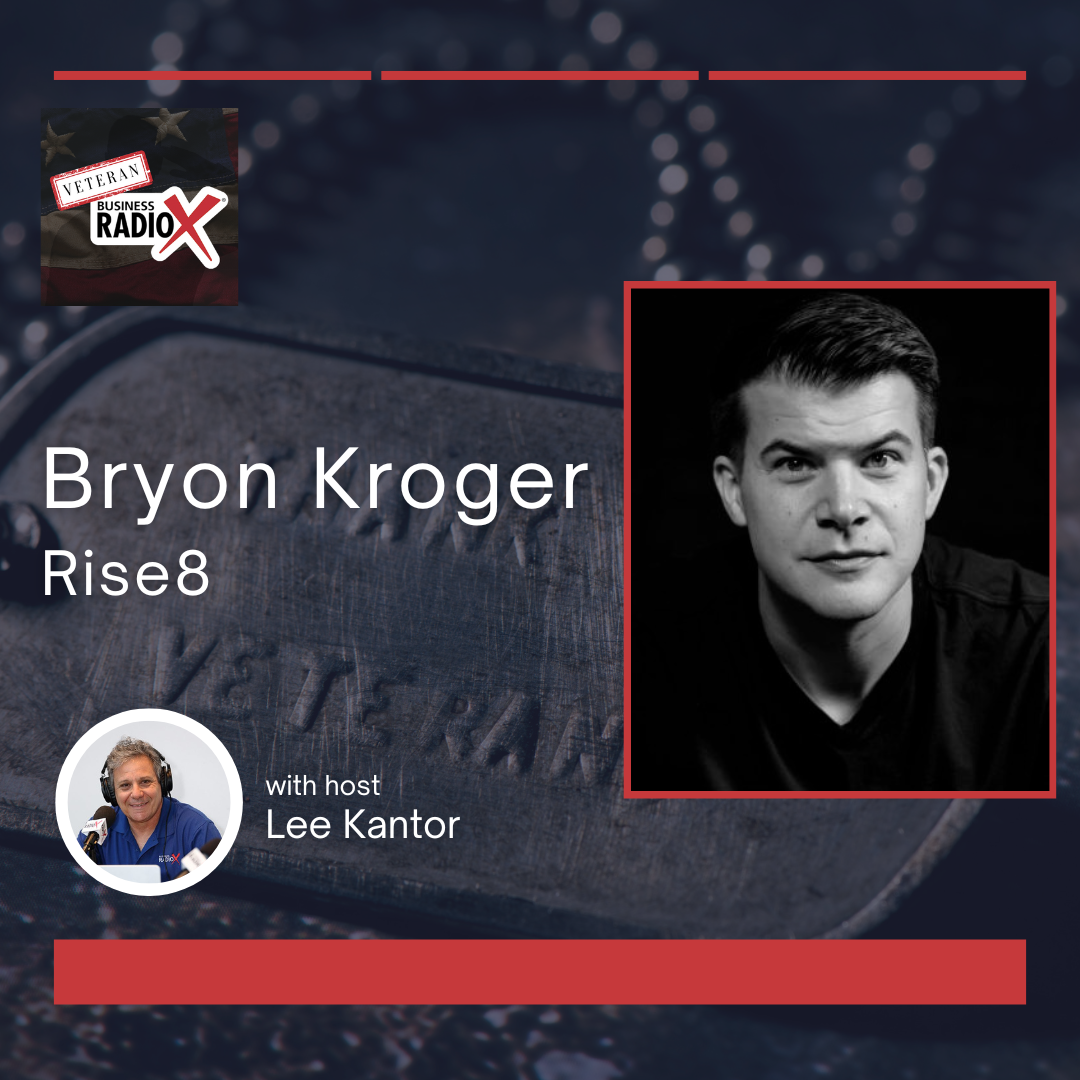

In this episode of Veteran Business Radio,host Lee Kantor talks with Bryon Kroger, founder and CEO of Rise8. Bryon shares his journey from U.S. Air Force intelligence officer to tech entrepreneur, discussing how his military experiences inspired him to improve software delivery for the Department of Defense and Veterans Affairs. The conversation covers overcoming bureaucratic hurdles, building a mission-driven company culture, and supporting veterans transitioning to civilian tech roles. Bryon also highlights Rise8’s commitment to hiring veterans and offers advice on battling imposter syndrome, emphasizing the importance of recognizing achievements and fostering community support.
 Bryon Kroger is the Founder and CEO of Rise8, spearheading initiatives to deliver software solutions 25x faster than traditional methods.
A former US Air Force targeteer with firsthand experience of the devastating impact inadequate software has on mission success, Bryon co-founded Kessel Run, the DOD’s first software factory, where he served as COO leading acquisitions, development, and operations for the enterprise-scale software lab that defined DOD DevOps.
While there, he pioneered the first continuous Authority to Operate (cATO). Frustrated with the lack of industry partners capable of leading defense digital transformation, Bryon founded Rise8 to fill that gap.
Today he is the leading expert on cATO and the bureaucracy hacking necessary to continuously deliver valuable software users love. 
Connect with Bryon on LinkedIn.
Episode Highlights
- Transition from military service to entrepreneurship
- Challenges faced in software development during military service
- Importance of rapid software deployment in government contracting
- Overcoming bureaucratic hurdles in software delivery
- Building a company culture focused on mission impact
- Strategies for recruiting and retaining top talent in a startup environment
- The significance of closing the feedback loop between developers and end users
- Addressing imposter syndrome among veterans transitioning to civilian careers
- The role of training programs like SkillBridge in supporting veterans
- Commitment to delivering measurable outcomes for warfighters, veterans, and clinicians
 This transcript is machine transcribed by Sonix.
TRANSCRIPT
Intro: Broadcasting live from the Business RadioX studios in Atlanta, Georgia. It’s time for Veterans Business Radio, brought to you by ATL vets, providing the tools and support that help veteran owned businesses thrive. For more information, go to ATL vetsource. Now here’s your host.
Lee Kantor: Lee Kantor here another episode of Veterans Business Radio and this is going to be a good one. But before we get started, it’s important to recognize our sponsor, Veterans Business Radio ATL vets, inspiring veterans to build their foundation of success and empowering them to become the backbone of society after the uniform. For more information, go to ATL vets. Today we have a great show on it. We have the founder and CEO of Rise8, Bryon Kroger. Welcome.
Bryon Kroger: Thanks for having me.
Lee Kantor: Well, I’m excited to learn what you’re up to. Before we get too far into things, tell us about Rise8. How are you serving folks?
Bryon Kroger: So we provide continuous software development to the DoD and Veterans Affairs. Our focus is on shipping mission outcomes into production. So we want to make sure that the software we build very quickly gets into the hands of warfighters, veterans and clinicians.
Lee Kantor: So what’s your backstory? How’d you get involved in this line of work?
Bryon Kroger: Well, I spent ten years active duty Air Force. So for the first seven years I was an intelligence officer, I did almost entirely targeting operations assignments. And as I like to tell people, it’s not like what you see in the movies. I had really terrible software to work with, and I was conducting very critical missions. And sometimes I saw our bad software caused missions to fail and people to die. And so I got pretty frustrated towards the end of my time. So around year seven, I applied for acquisition Intel exchange, and I got assigned to the program office where they made my terrible software. The targeting program office. And from there I launched an initiative called Kessel Run, a project inside the Air Force big digital transformation initiatives. Probably one of the most successful ones in the department. And yeah, from there I spent three years building that up, scaling it. It was very successful, and I decided I wanted to help other people do software better and critical mission spaces.
Lee Kantor: So you were were you a technologist? You were actually doing the coding?
Bryon Kroger: Yeah. So early on in my career, like I said, I was an intelligence officer targeting. I did teach myself some basic programing skills to try to solve some of my own problems when I was out in the field, but it wasn’t until the last three years that I really got deeper into that. But very quickly, I transitioned from writing code, which I will say I’m not. I’m not a great software developer. I’ve got like a fifth grade software programing level, but managing the delivery of software is what I became really passionate about. I called myself a bureaucracy hacker. I’m really good at figuring out how to get the software that great engineers build into the hands of of users.
Lee Kantor: So that’s what you sensed as the kind of root cause of the problem. It was just either there wasn’t efficiencies or there weren’t. There were communication issues, like what was kind of at the heart of why this was so difficult.
Bryon Kroger: Yeah, the root cause is definitely around the actual deployment of the software. And so I think there’s a few things at play. One is oftentimes when contractors or even blue suiters are writing code, they don’t know what environment they’re targeting, like where is the software going to live? And so they have to make a lot of assumptions. And when those assumptions prove false, it’s hard to deploy your software. That’s maybe one class of problems. A bigger one though was the the ATO process, the cybersecurity and privacy compliance process that the DoD uses. Um, and so we figured out how to hack that bureaucracy and make sure that we can go fast. Deploying software on demand, sometimes multiple times a day, while still meeting all of the compliance requirements. And this would include for. You know, we did secret top secret environments. Uh, so really stringent compliance requirements. And we’re able to meet those requirements and go fast at the same time.
Lee Kantor: So by being on kind of both sides of the table, it gave you an insight and maybe the ability to understand where where speed can be found.
Bryon Kroger: Yeah, absolutely. And I realized something there. And this is why, you know, I don’t know if I knew it was the root cause going in, but I also sensed other issues, like the developers were really disconnected from the actual end users and how they were going to be using their software. Uh, as one example. And, you know, it turned out that was just a symptom of slow software delivery, because once you speed up software delivery, now the time from code written to in the hands of users goes from years like in the DoD. This takes years sometimes, uh, to, you know, now we could do it daily. And so this gives you a really tight feedback loop with your end users. They want to talk to you because they get software quickly. And you want to talk to them because it helps you build better software. And so a lot of the other issues kind of melted away once we established those really fast feedback loops by delivering software quickly.
Lee Kantor: And then I would imagine once you did that then kind of the culture improves, right? Everybody is seeing, you know, their their efforts pay off in getting information quickly as opposed to being this bureaucratic kind of black hole.
Bryon Kroger: 100%. And this crosses all industries, right? One of the most famous examples that I always love is the Nummi auto manufacturing story. There’s a This American Life podcast episode about it. That’s that’s fantastic. But it was essentially GM’s worst performing plant in the US. Toyota said they’d do a joint venture with MGM. Gave them that plant to work with. Um, they brought those people out to Japan. And just instead of trying to indoctrinate them or do what we do in the military, which is put everybody in front of computer based training and tell them what their values should be and hope that changes the culture. They just said, come and work with us in a different way. And once people saw the results of working in a different way, it changed values, attitudes and beliefs. It changed the culture. It became the highest performing plant in the United States within a few weeks. And so similarly, we saw those same results. And everywhere I go with Rise8, we see that culture improves once delivery improves.
Lee Kantor: So then once you left the military and then started rising, was that kind of just the next logical step in your progression, or was this kind of a thing that you were like, you were kind of debating or struggling with making this kind of decision?
Bryon Kroger: Yeah, it was the obvious thing that I needed to do based on the mission I have, because I’m passionate about creating a future where fewer bad things happen because of bad software. You know, I’ve seen the worst of the worst. Um, I think, uh, to say that it was an easy decision, though. It’s not true. I was, uh, you know, I had three kids at the time. We ended up having a fourth shortly after I started receipt. Um, you know, I spent ten years in the military. I didn’t really know what it meant to have a civilian career, let alone to start and scale a company. So those are all really scary decisions. And I had almost no runway, like, I, um, it’s a funny story. Well, sad story, but, uh, you know, my my father had passed away, uh, about four months before I was getting out of the military, and, um, he he had stashed some money in a coffee can in his, in his trailer. And, uh, that became my runway to start rising. It wasn’t much, um, but it was enough to get me off the ground.
Lee Kantor: So when it was, um. So now you’re in kind of the civilian workforce, and you have a company that is working with the government. Was that something that, um, you know, the early days? Were you getting kind of early wins because you had said you had made such powerful relationships and had demonstrated so much value. Was it kind of not that difficult to get those early opportunities, or was this something that you struggled with? Because a lot of firms, you know, a lot of people come out of the military and they’re like, I’m going to do this thing based on what I did. And for some people that, you know, that’s a that’s a big lift.
Bryon Kroger: Yeah. Um, I’m fairly risk averse. So I like to have a really solid plan going into things. I would say certainly my, my connections and my reputation from starting Kessel Run inside the military helped, like a lot of people said, hey, help me build a Kessel Run. Um, but, uh, as you probably well know, government contracting is very difficult even if somebody wants to work with you. And so I had to learn a whole new skill about how to go after and win contracts, um, and how to do those in ways where I could actually deliver what I was selling, right? Which is something very transformative. As you can imagine, when you’re doing this high end kind of software development, it’s not the cheap butts and seats kind of approach that the government is used to. And so you’re trying to convince people, you know, even though I had my success at Kessel Run, it’s like, well, can Bryan run a company? Can he hire the, you know, elite talent that can help me from the outside? Uh, can he scale? There’s, you know, all of these doubts that they have and rightfully so. And so, you know, you got to start over. I was leading Kessel Run, which was like a 1500 person organization, and I started over as a company of one. Right. Um, and you just build bit by bit and keep stacking wins until you have a stack of proof that you are who you say you are.
Lee Kantor: So what were kind of the early challenges? Um, was it kind of just learning the language on how to do an RFP, or was it, um, you know, I got to get some more talent in here that I trust that can, you know, actually deliver the things that I’m telling them I’m going to deliver.
Bryon Kroger: Yeah. Um, you know, getting the talent in the early days is always difficult. Especially that first employee. You know, when you’re a company of one going to two, it’s like convincing somebody to risk their livelihood on you is is a challenge. I think the reputation helped. Um, and because I, I knew that I wanted elite talent and I didn’t I say this is like good advice to anybody going into the civilian workforce, but especially if you’re striking out on your own, even if it’s as an independent consultant, is like, know your value and stick to it. All of these prime contractors, like when you first start, you’re probably going to have to subcontract. It’s hard to win prime contracts until you have some demonstrated past performance, and they will try to get you to, you know, give discounts and lower your rates. And, uh, you know, you got to do what you’ve got to do to survive. But I would tell people, you know, at the end of the day, if you make a sacrifice on rates, for instance, that translates to lower salaries, which translates to lower talent. And that means you probably can’t deliver as much as you want to. And so I just had a policy of like, I’m not going to discount my prices. My prices are my prices. And they are that way because I know that’s what people are willing to pay. It’s worth it. It’s actually extremely valuable. And that’s hard to do in the early days. But it paid off because I was able to, uh, command the kind of rates that were able to get me the kind of talent to reinforce that virtuous cycle of hiring really great talent, crushing it on a project, and then winning more work. Um, and I think other people get stuck in a doom loop where they lower their prices, they don’t deliver well, and they have to lower their prices even more.
Lee Kantor: So what were your other non-negotiables?
Bryon Kroger: Oof! Uh, we have we have a number of them. You know, I, uh, you never know this at the outset, but I, I screen customers, I guess I should say, for, uh, our ability to ship outcomes to end users. And so if I don’t believe that the customer either has a path to production or is willing to let me build one, I wouldn’t take them. So there were a ton of people that wanted to work with us, but, you know, they’re perfectly complacent with, uh, you know, marketing and PR stunts and fake delivery. And, uh, I just said no to a lot of those opportunities. And, um, it’s hard it’s hard to walk away from, you know, multi-million dollar, uh, contracts, especially ones that will come with good PR but we just kept focusing on where can we actually deliver value to war fighters and veterans and clinicians.
Lee Kantor: So you were kind of clear with your true north and you just stayed focused on that. It’s either a hell yeah or no.
Bryon Kroger: Yep. And like I said, that’s hard to do in those early days. You know, uh, it’s like very attractive to look at $1 million contract or even a $500,000 contract. And to say no to that in the early days is hard. But again, something that definitely pays off in the long run if you’re trying to build long term value.
Lee Kantor: So when it comes to leading a team, um, as a civilian, what is the difference between that and your time in the military? Like how or is it the same?
Bryon Kroger: Uh, it’s generally the same. I think in a lot of ways, the military prepared me well to lead a team in a company. Um, maybe the one thing that I’ll say is very different from building this from the inside at Kessel Run. Uh, as a as a military member versus being on the contractor side. Twofold. One is at Kessel Run. I was, you know, I guess operating with other people’s money, the taxpayers money. And so I took that very seriously, like, I care about doing right by the taxpayer. But, uh, you know, I didn’t have to worry about, you know, if we messed up, we’re five civilians going to get fired, right? Like, people’s jobs weren’t generally at risk. I didn’t have to deal with HR and payroll and all that stuff, you know, um, coming to the other side, it’s like you make mistakes and it can cost people their livelihoods. Um, and, and, uh, it’s just the gravity of the situation is much different. And then the other one is just control, right? Uh, when when I was leading Kessel Run, I had full control over the decisions because I was the government. Um, now I face inherently governmental decisions, and I have to rely on my champions and stakeholders to do the right thing.
Bryon Kroger: Uh, so it’s a lot more influence where it used to be, uh, just like command authority and being very directive. And along with that, there’s maybe a another aspect that I’ll mention and that’s that, you know, uh, you can’t, uh, operate with the same, um. Kind of, uh, scaling model. So, you know, at Kessel Run and the reason why I wanted to leave government and start rising, you know, I had an assignment cycle that was coming up, and I was going to have to go to a new place and I could start a new Kessel Run, but it was always going to be one by one by one. Right? You can vertically scale wherever you’re assigned. But I was never going to be able to really, in a direct way, help, uh, several Air Force programs, let alone Army, Navy, VA. Right. And so coming out and starting rising the trade off, even though I have less control, I’m able to scale horizontally and have more horizontal impact. And so that was a trade off worth making for me.
Lee Kantor: So are you. Is are you getting the outcome you desired?
Bryon Kroger: Yeah, absolutely. So I mentioned that I am passionate about creating a future where fewer bad things happen because of bad software, uh, that, you know, drive, uh, for us. We talk about that in terms of outcomes. So mission impact with software is created through user outcomes. So user outcome would be a change in human behavior that produces some mission impact. Maybe we can generate more space support requests or we can operate a mission with five fewer people. Um, those are the kinds of things we aim for. And as software developers, we have direct control over those changes in user behavior that we can create through software. And so I’ve organized my entire culture around putting outcomes in production right into operations. And, uh, our goal is by the year 2040, we want to put 50,000 outcomes into production for critical missions. And right now we are we are on track. Uh, we have an annual goal every year. We’ve met it every single year. And, uh, I’m just really excited that I get to keep doing this. It’s like I pinch myself sometimes. It’s hard and it can be scary sometimes, but, uh, it’s definitely impactful. And, um, something I’m really passionate about.
Lee Kantor: So do you have any advice for veterans Leaving Service today? Is there anything that you would like to share about your journey that might make it a little easier for them to drive impact as they, you know, enter a new chapter?
Bryon Kroger: Yeah, absolutely. I think, you know, in the tech community, there’s this concept of imposter syndrome that gets talked about a lot. It transcends the tech community. But I think it’s talked about a lot there. And I think it’s something every veteran faces when they’re leaving the service. Uh, they go into the civilian job market and they feel like an imposter. And, uh, I think the, the antidote to that is being able to I mentioned this earlier, in fact, have a stack of proof, like an undeniable stack of proof that you are who you say you are. And I think that there’s two things that can be true. One is you don’t actually have that proof, so you need to go get it. And you got to look in the mirror and get really honest of like, do I have the stack of proof or am I just not taking account of it? If it’s you don’t have it, go get the training. Like the skill bridge program, for instance, is a phenomenal way to get a six month, uh, you know, DoD paid internship with a commercial company, learn skills, and use that time to build that stack of proof. Um, or if you’re on the other side of that, you actually do have the stack of proof going into this, this thing that you want to do is you’ve got to be able to accept it.
Bryon Kroger: And I think a lot of times people are like, oh, but it’s different because I was in the military. It’s not, uh, you have a stack of proof that you are who you say you are, and you just have to take account of it. And I think one way or another, uh, you can get over that imposter syndrome. And that’s where the magic happens. And, you know, I would say, uh, the thing that people overlook or maybe underestimate is just getting the reps in, like, don’t focus on, uh, you know, everybody can be guilty. And I love going. Bowling is important. It’s great to look out ten years and five years and one year. But I think it’s easy to get stuck in the trap of of doing that and not just putting one foot in front of the other and, uh, stacking those small wins until you get to that big picture. And, um, yeah, I would just say put the reps in and, uh, you’ll get get over that imposter syndrome and you’ll get to where you’re going.
Lee Kantor: Yeah. I think it’s so important to, to just do capture those wins in some sort of visible manner where you see it, at least, so that you don’t forget. Because I think a lot of people, they just forget the day to day victories. And then when asked about it, they don’t, you know, they discount it or they, like you say, underestimate the impact that they’ve made. So I think it’s important to kind of visually see some of those victories. So you, you don’t have that imposter syndrome because it really is kind of Self-sabotage. Um, because it’s not necessary.
Bryon Kroger: 100% agree.
Lee Kantor: So what do you need more of? How can we help you? You need more talent. It sounds like you got this kind of figured out on how to get the work. Um. What, you need more, uh, funds to grow. What do you need?
Bryon Kroger: Right now? We are growing 50% year over year. That’s our target. Or that’s actually the cap that I set on the company. I don’t want to grow faster than that so that we can maintain our culture and our quality level. But, um, that means we are always hiring. So if there are veterans out there, I would say, um, help me help you. I love doing the skill bridge program that I mentioned earlier. We’ve had I think just over 20 veterans come through our program. Um, we’ve either employed them ourselves. I think over half of them. We’ve employed ourselves and we’ve found employment for everybody else. We don’t have anybody that did not get employment. And then, um, you know, we’re, uh, I think upwards of 40% veterans at Rise8. So, um, that said, if that’s not for you, uh, and you just care about this ecosystem like I do, and you want to make a difference and create better software for warfighters and veterans and clinicians, uh, happy to just be an ally in the community. Um, people can follow me on LinkedIn. I talk a lot about it there and share the good word and get people to focus on this problem.
Lee Kantor: And if somebody wants to connect and learn more about rise, what’s the website? What’s the best way to connect with you or somebody on the team?
Bryon Kroger: Yeah, you can find me on LinkedIn, shoot me a DM or, uh, rise US is our website. Uh, that’s the number eight. Us. Uh, and there’s a form there that you can contact our team.
Lee Kantor: Well, Brian, thank you so much for sharing your story. You’re doing important work, and we appreciate you.
Bryon Kroger: Thank you.
Lee Kantor: All right. This is Lee Kantor. We’ll see you all next time on Veterans Business Radio.














