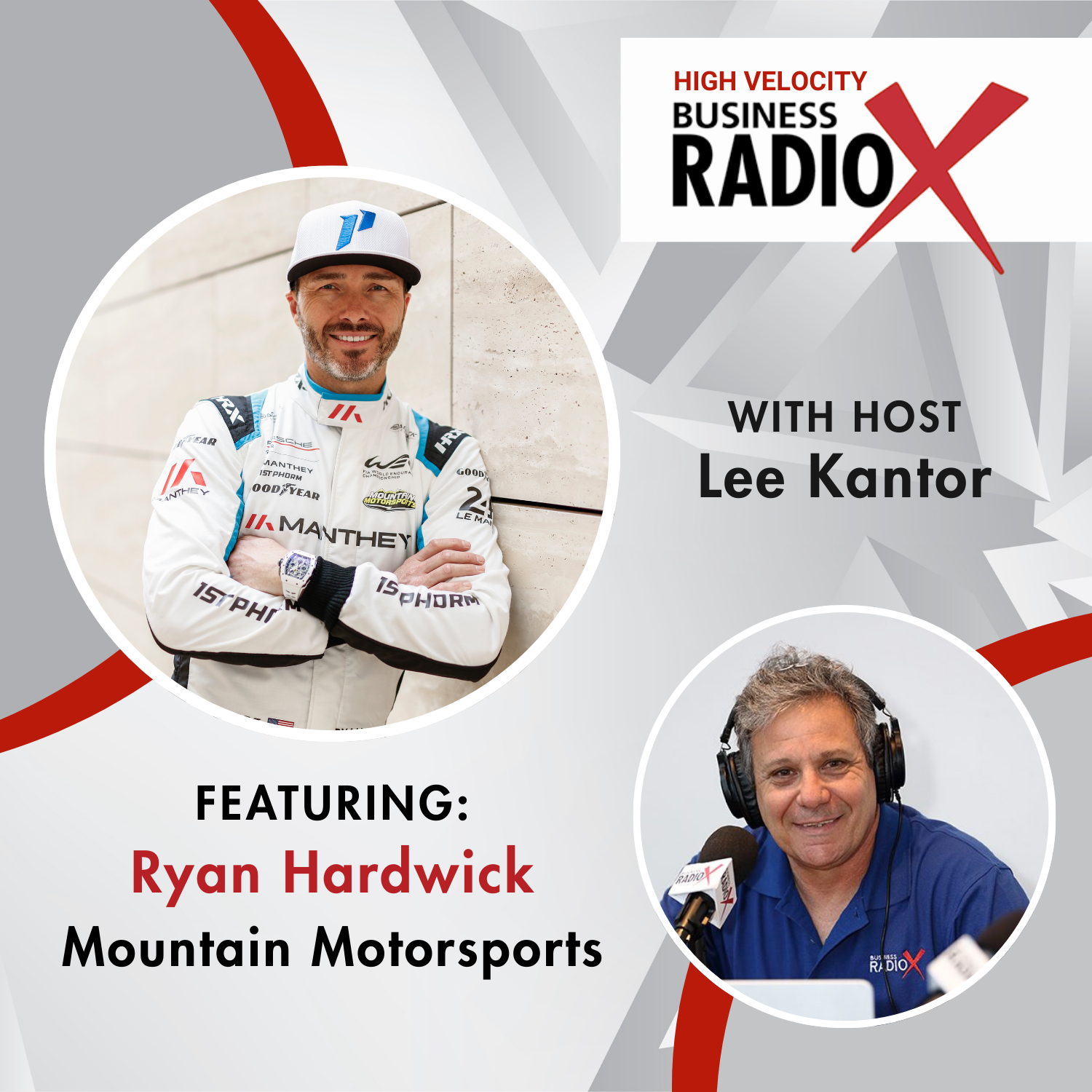

In this episode of High Velocity Radio, Lee interviews Ryan Hardwick, co-founder of Mountain Motorsports and professional race car driver. Ryan shares his journey from riding dirt bikes as a child to building one of the Southeast’s largest powersports retailers. He discusses the company’s growth through acquisitions, the importance of core values and team culture, and draws parallels between racing and business leadership. Ryan also highlights trends in off-road vehicles and invites listeners to upcoming racing events, offering insights into entrepreneurship, teamwork, and the powersports industry.
 Founded in 1999 by lifelong friends Ryan Hardwick and Justin Price, Mountain Motorsports began as a single-line Honda dealership in East Tennessee. Since then, it has grown into one of the nation’s largest powersports retailers, operating 12 dealerships across the Southeast, including five locations in the greater Atlanta area.
Mountain Motorsports remains family-owned and operated, and represents numerous of the world’s leading powersports brands offering motorcycles, ATVs, UTVs, and personal watercraft all under one roof. Guided by the motto “Greatly Exceed Expectations,” the organization continually reinvests in its people and communities, fostering long-term customer relationships through exceptional service, expert training, and community engagement.
In addition to his work with Mountain Motorsports, he is a professional endurance racer, racing for Manthey Racing’s Porsche 912 team, recently became the first Atlantan to win the 24 Hours of Le Mans in the LMGT3 Division, which is the largest and most difficult class, and cemented his legacy by becoming the first American to win the FIA World Endurance Championship in the LMGT3 Division.
For his efforts in the final race of the season, he was awarded the Goodyear Wingfoot Award, given to the race’s MVP across all divisions.
Connect with Ryan on LinkedIn and Facebook.
What You’ll Learn In This Episode
- Ryan Hardwick’s journey from childhood dirt bike riding to professional racing and entrepreneurship.
- The founding and growth of Mountain Motorsports as a major powersports vehicle retailer.
- The range of products offered by Mountain Motorsports, including motorcycles, personal watercraft, and off-road utility vehicles.
- Insights into entrepreneurship, including the challenges and rewards of starting and running a business.
- The importance of leadership, team dynamics, and company culture in both racing and business.
- The development and significance of core values in guiding business decisions and team interactions.
- The strategic approach to business expansion through acquisitions and partnerships.
- Market trends in the powersports industry, particularly the growth of off-road utility vehicles.
- The parallels between racing teams and business teams in terms of teamwork and precision.
- Upcoming professional racing events and the excitement surrounding endurance racing.
 This transcript is machine transcribed by Sonix.
TRANSCRIPT
Intro: Broadcasting live from the Business RadioX studios in Atlanta, Georgia. It’s time for High Velocity Radio.
Lee Kantor: Lee Kantor here. Another episode of High Velocity Radio, and this is going to be a good one. Today on the show we have Ryan Hardwick with Mountain Motorsports and Professional Racing. Welcome.
Ryan Hardwick: Hi. How’s it going?
Lee Kantor: I am doing well. I am excited to learn what you’re up to. Tell us a little bit about Mountain Motorsports and professional racing.
Ryan Hardwick: Yeah, two very exciting worlds. A lot of similarities and some differences. But Mountain Motorsports is we are one of the largest retailers of powersports vehicles in the world, powersports vehicles being motorcycles both on road and off road, personal watercraft like jet skis and also off road utility vehicles, you know, like Polaris Rangers and Can-Am ATVs. So all of the fun things, you know, people use to have adventures and explore the great outdoors. And we’re headquartered here in Atlanta, Georgia, and currently have 11 dealership locations around the Southeastern United States representing all of the top brands you know, in the industry, all the Japanese brands, as well as several brands you know, from Europe, like like Ducati and KTM and and also American brands like Polaris and Canadian brands like Can-Am. But so we’re a multi-line dealership, you know, with, uh, you know, lots of locations but all focused around fun and the outdoors.
Lee Kantor: So what was what was kind of the genesis of the idea? When did like, did it start with motorcycles? Like where did it what was kind of how it began? The origin story?
Ryan Hardwick: Yeah. It’s, uh, it started with motorcycles of me growing up with my dad. My, uh, my father raced dirt bikes, uh, just on the amateur, you know, level. He was never professional, but, uh, he enjoyed racing dirt bikes. So from like age four, I was, I was riding and dirt bikes with him. And then by age six I was racing and really just kind of grew up on two wheels in the woods with my dad. He got my best friend into it a young age, and so we really just kind of grew up on dirt bikes and loved them, and it was how we spent time together as a family, really. And so I, you know, I followed that passion, as you know, throughout school, I, I was racing and, you know, kind of rising through the ranks and, and eventually that’s how we got into the dealership. But it started with that, you know, that that love and passion of the sport. So, you know, you always hear do what you love and you’ll never work a day in your life. For me and my best friend that was learning to ride, you know, with my dad and I, the two of us become we’re lifelong business partners. We started Mountain Motorsports together. We we started the business when we were 19 years old, opened our first dealership at 20 years old. So when our doors open. And that was 25 years ago. So we’ve been in business together for more than half of our lives. And it’s a lot of it’s a heck of a lot of fun. You know, we’re still just a couple. Couple of young guys that enjoy riding dirt bikes.
Lee Kantor: So what was it like, though, transitioning to being a business owner? Because that’s a you know, that’s a sport of its own. Being an entrepreneur, can you talk about, you know, kind of some of the things you learned or lessons learned or advice you would give other people who are passionate about something and were able to turn their, you know, their hobby or their passion into, you know, a business.
Ryan Hardwick: Yeah. I mean, first and foremost, for anyone who’s on that path in that road, I think it’s I think personally it’s one of the best things you can choose to do in life is to go into business for yourself. Um, it’s not for everybody. Um, and it doesn’t mean, you know, you’re you’re you’re not cut out for great things. I mean, being a valuable team member is also, uh, not the easiest thing in the world to do either. Um, but in my opinion, uh, if you if you have the guts. Really? And the bravery to go your own way and start something yourself. Uh, the world of entrepreneurship can be very rewarding, not only just financially, but just, you know, personally and professionally. You know, I, I’ve just always enjoyed, um, being in a leadership role. Uh, I’ve enjoyed, you know, guiding other people. I’ve enjoyed sharing, you know, from my experiences what I’ve learned. And, and, you know, we do that within our businesses and, you know, within our dealerships. And so, um, I think it’s a great way to spend, you know, your, uh, your career, um, if you really enjoy, you know, creating something. Right? You know, um, it’s, uh, there’s there’s not, I would say only childbirth. You know, I, I’m blessed with two amazing sons and, uh, you know, the feeling of, you know, raising two, two boys in this world and seeing them grow and seeing them develop is very similar to the feeling I get, you know, creating a new business, uh, that didn’t exist before, you know, we were there and seeing it grow and thrive and seeing our team members grow and thrive. And, you know, themselves, you know, buy new houses for their families and new cars and, uh, you know, it’s it’s just very personally rewarding. So I’d highly recommend it. Um, not for everybody, but, uh, you know, if you have the guts, uh, I’d highly recommend you to take the joke.
Lee Kantor: Now, when you were growing up and you were racing that obviously you’re the one that’s on the bike while the race is going on, but it takes kind of a team to get you on the bike. Uh, can you talk about maybe some similarities in being an athlete on a, on a team like that as it is to kind of okay, now you walk into your dealership and now you have a team around you and you’re leading that. Can you talk about similarities from those two worlds?
Ryan Hardwick: Yeah, I think that the similarities you’re drawing there is, uh, quite a bit much more connected to the racing I’m doing now, later in life. Um, I’m racing professionally for Porsche, um, in the World Endurance Championship and the, the largest, uh, sports car endurance races around the world that this sport, uh, automotive racing it it requires, uh, a tremendous amount of people to make one race car go around the racetrack. Um, and so when you tune in and that’s any kind of auto racing. So if you’re watching, you know, the Daytona 500 and NASCAR or the Indianapolis 500 or Formula One or what, we do a race like the 24 Hours of Le Mans, you’re going to see lots of race cars out there going around a track together, and each one of those cars are backed by, at the minimum, somewhere around 30 ish people at the maximum can be upwards of a hundred people per car in what it takes to make that car go around. And these people are mechanics engineers. There’s logistics people. There’s people who are focused only on, you know, tires, uh, preparation wheels. So there’s there’s so many people it takes to make a race car go around, and there’s only one guy that gets to drive it, right. You know? So a lot of the times the drivers get, you know, a lot of the credit and and things like that. That’s who you see up on the podium at the end of the race. But there’s a tremendous amount of people behind the scenes that make it work.
Ryan Hardwick: Um, and there’s a lot of similarities to running a business, right? You know, in our dealerships, we have between 30 and 50 people at each dealership location. And we’re we’re at 11 now with, uh, 12 as under construction. And 13 is on the way shortly after that, uh, in the coming years and, and, you know, having, you know, you know, 30 to 40, 50 people at each one of those locations is, uh, yeah, it’s a lot of people all working together for, you know, what we try to make as one common goal. And that’s the same way a race team works, right? You know, if one person, let’s say, the guy who his job is to change the tires, if this guy makes one mistake in one tire change, and for us, it’s like a 24 hour race. It can totally ruin the race for where a driver, we’re we’re competing on track for tenths and sometimes one hundredths of a second. And if we drop the tire gun or we’re just, we’re just, frankly, 3 to 4 seconds too slow on the tire change that takes the driver to make up 3 to 4 seconds. That can take hours and hours in the race when you’re only, you know, you’re you’re only chipping away at it at a 10th at a time. So, uh, endurance racing is the ultimate team sport. I truly believe, you know, and, uh, and, you know, entrepreneurship and running a running a small to medium sized business is, uh, right up there, you know, as well.
Lee Kantor: Now, can you share maybe. I don’t know if there are similarities, but obviously choosing the right people to become part of the team that buy into the mission and the culture. Are there any suggestions on how to kind of vet people to make sure they are the right fit, and they are going to kind of buy into that culture because like you said, you know, in your world, milliseconds count. Uh, so there’s no nothing too small to kind of pay attention to.
Ryan Hardwick: Yeah. Um, you know, culture, uh, culture matters. I mean, it’s tremendous in any in any team, um, you know, sport or in any business. You know, I can tell you from our business standpoint at Mountain Motorsports, we really did a much better job, I would say, in the latter half of our existence, um, the first half of our existence, we had, um, we had a mission statement, you know, and we had a, you know, uh, you know, set of rules and, you know, employee handbooks and those things. But these types of things are what most businesses have, and they’re not really culture derived. Um, in the latter half of our business, you know, we learn from others that came before us that were doing it better than us. Um, but we developed, uh, after a lot of time and, and hard work, uh, we developed a set of core values that we really lives by. We. Really? It’s it’s what drives the business. It drives our hiring decisions. It drives our hiring decisions. Um, it drives how we interact with our customers, how we interact with our vendors. And, and, you know, defining a set of core values that are shared, that are listed there, there at Mount Motorsports, there on the wall, you know, for everyone to read and see. You know, our in our employee meetings, we talk about them, you know, daily, weekly, um, we make every decision, you know, based on this set of shared core values. And, um, you know, so I encourage you, if you’re a business, you don’t have a set of core values that you share with all your employees and your teammates. Um, you need to work on developing it because it sure does make every decision. And, you know, operating the business and running the business together, uh, a heck of a lot easier.
Lee Kantor: So what are some of the core values at Mount?
Ryan Hardwick: You know, these are unique to every business, right? You know, at Mountain Motorsports, a lot of it is defined from, you know, the founders, right? You know, from myself and my best friend, uh, Justin Price. You know, we looked at what is how do we live our lives, right? You know. And what is it that we, um, you know, that we believe in? That is just the correct and right way to live. You know, I’ll I’ll give you one of ours is we do what’s right. Uh, all of the time, even when no one is looking, you know. And, yeah, that’s easy to say, but if you really think about it and do it, I mean, to really apply that to everything in your life, uh, whether it be family, relationships, um, you know, how you treat your friends, uh, you know, and especially how you treat your customers and your teammates is you just you just do the right thing. When you’re faced with a challenge, you do the right thing. And even when no one’s looking, and even if you could possibly get away with it, nobody’s really gonna know. We still do the right thing, even if it costs us money, even if it costs us, you know, profit.
Ryan Hardwick: Uh, we do what’s right, you know? And we believe that if you do what’s right over and over, you know, good things tend to, you know, come back to you. Um, another one for us is competitiveness. We live to compete. That is our core value. I mean, obviously come from racing my whole life. I think competition is good. I love it. Uh, I love to win. I hate to lose. And we bring that as a part of our business. You know, we compete on everything. We measure ourselves. Uh, we measure ourselves against our competitors. We measure ourselves against ourselves. All of our different dealerships are always competing against each other. And we like to know who’s the best, who’s on top, who wins, who loses. We keep score, we keep track, and we reward winning. And, um, we we we we condone failure. We don’t like it, but we, you know, someone does have to lose in competition, right? Um, but, uh, yeah, we love to compete and we play to win. And, uh, that’s another important core value for us.
Lee Kantor: Now, when it comes to the business and growing the business, um, what, um, where did the opportunity start bubbling up like you expanded obviously, from motorcycles to all kinds of motor sports. Was that kind of a gradual thing? Or, you know, when a new thing was invented, you’re like, okay, well, that we should be selling some of those as well. Like, how did you kind of capitalize on this trend?
Ryan Hardwick: No, it’s much more a bit more complicated than that. We’re very similar to, uh, we’re extremely similar to automotive dealerships. So, as you know, if you, uh, are able to grant it from, say, Ford to open a Ford dealership, those are licensed and franchised dealerships, right? Not anyone can open a Ford dealership. You have to apply. You have to be approved by Ford. There has to be an open territory for you to open a Ford dealership. And basically that comes at the control of the manufacturer. So for us, uh, we represent now we represent 12 different manufacturers. They’re all the top manufacturers in our industry. But we sure didn’t start that way. You know, we we began life as a single line Honda dealership. We were approved for a Honda dealership, uh, very close to my hometown where I grew up, uh, in East Tennessee. Um, and, uh, and that’s how we started, uh, we applied for and got approval. And it was a very competitive process. This was in the late 1990s. Um, the Honda did have a open point, is what they called it. So, uh, an area, a geographical area near our hometown where they were lacking sales in their current dealer network, and they assigned an open availability and were accepting applications for anyone, uh, you know, who could own and operate a motorcycle dealership in that area. And so that’s how we started life. We applied. There were thousands of people, I’d say thousands. There were hundreds of people that applied, uh, you know, at that time to, you know, have a Honda dealership, most of which were people who already had Honda dealerships, and they were trying to open their second or third one.
Ryan Hardwick: And, um, and our application was approved after there’s several layers. You have to go out and do a live in-person interview and, um, uh, myself, my business partner, we were young guys, you know, full of passion. Um, I was currently a student at the University of Tennessee. I was I was going to business school at the time, so I hadn’t even graduated college. Uh, but, you know, I was passionate studying. We, you know, we came from racing. We told our story of how we grew up with our father and, you know, loving, you know, these machines and dirt bikes and how we wanted to share, you know, that passion. And I think we just stuck out from our age, right. And our in our passion. And, uh, we went out and we, uh, obtained a really good partner, uh, to help us start the business. Who, uh, the guy was, uh, he owned the Yamaha and Kawasaki dealership in our hometown, and we were customers of his. We we that’s where our family, you know, bought motorcycles and jet skis and and we convinced him that. Hey, man, you know, you should be our partner. Uh, because, honestly, it was a prerequisite from Honda. You you they weren’t going to grant a dealership to a couple of, you know, 20 year old kids who had it never, you know, owned or operated any business in their entire life. Uh, so, uh, we had to have a partner who had to have a minimum of 25% equity in the business, uh, that had previous dealership ownership or general management experience. And that’s where our partner Charlie came in.
Ryan Hardwick: Uh, so there were three of us there to start, you know, that business. And, uh, and they approved us. You know, they approved us. And, you know, that was in 1999, and we were off to the races with construction and opened our first store in 2000. And how we grew, uh, in just like an automobile, automobile landscape, you can’t just choose to put a, you know, a Ford or a Chevrolet or a Honda or Yamaha dealership anywhere you would like. Most of the dealer network is built out across the United States of America. And so now to expand, to go from one dealership to two to 3 to 4, you have to do it through acquisition. So we had to become able and willing to be able to reach out and, and uh, you know, acquire, our competitors or dealers that were currently in the marketplace that were maybe looking to retire or just looking to sell their business. So, um, we’re we were essentially over 25 years. We became quite a regional consolidator of motorcycle dealerships. Um, to create our 11 dealerships we have now, we’ve had to make 26 acquisitions. So we would go in to a market that may have 2 or 3 motorcycle dealerships, each having 1 or 2 franchise brands. And we would go make deals to acquire, uh, all three in that market, and then we would combine them into one location. Uh, so each of our dealerships are really large facilities that have, you know, ten, 11 or 12 different, uh, brands within them. So, uh, we would combine smaller dealerships into larger ones, um, all around the southeast.
Lee Kantor: Now, how did the boats and the, um, you know, the other kind of water sport? Stuff.
Ryan Hardwick: Intertwined. That’s.
Lee Kantor: Is that the same? Is it the same rule like that? You like just anybody can’t sell a boat. They have to, you know, kind of be a licensed boat salesperson.
Ryan Hardwick: If you want to sell a new one, I guess you could. There’s a lot of less rules if you want to open a pre-owned, you know, boat or Marina dealership. But if you want to be a franchised retailer or the new, uh, manufacturer brands, um, yeah. You have to be approved by the, the original manufacturer.
Lee Kantor: So then does that do you have to like, is your locations near water all the time or some of the time.
Ryan Hardwick: No, we’re not with all of our markets are yes, close to water, but our locations don’t have to be on the water per se. So we’re more we like to be located more convenient for our customers. So most of our locations are like right on major interstate highways or, you know, major, you know, thoroughfare, you know, roadways. So like here in Atlanta, we’re on the Cobb Parkway in Marietta. We have locations on Interstate 20. Um, we have, you know, locations in Roswell and up in Buford. So we’re around the lakes, like in Atlanta, for example. We have dealerships close by to Lake Allatoona, Lake Lanier, and also Lake Oconee. Uh, so all of the watercraft that we sell, it’s convenient, uh, you know, for, like, the people traveling and stuff to those lakes to stop in, uh, for any service or maintenance needs they may have. Um, uh, yeah, but we’re not necessarily right on the water. That’s a little less convenient to get to for everybody.
Lee Kantor: And then you sell new and used.
Ryan Hardwick: Yes, sir.
Lee Kantor: On on all your brands.
Ryan Hardwick: Yep.
Lee Kantor: And so what do you need more of? How can we help you? You have locations right now in Georgia, Alabama and Tennessee. Uh, is that the plan to just keep expanding from that base?
Ryan Hardwick: Yeah, we just we we really like the southeastern United States. We’ve had opportunities to expand elsewhere in the country. We just for our industry, you know, it’s, uh, it’s more enjoyable to do these things and relatively warmer climates. You know, we we like areas with lakes. We like areas with public riding areas, you know, for all our off road vehicles. Um, and we love areas with, you know, awesome, you know, twisty, you know, pavement roads. Right. For all the on road motorcycles. So, you know, East Tennessee, North Georgia, you know, you know, uh, western Alabama, these are these are great markets for, you know, our products. So, uh, yeah, our, you know, uh, growth and expansion plans are centered, uh, not necessarily just in those three states that we currently are now, but around the southeastern United States.
Lee Kantor: Right. So I would imagine people in adjacent states are driving in to get to see the large selection and all the cities you offer them.
Ryan Hardwick: Yeah, we do. We pull in a lot of customers, especially from the Carolinas. Um, our Tennessee stores sell quite a bit into Kentucky, you know, to the north and Virginia, um, but, uh, uh, yeah, the state of Florida is very well covered. And, you know, dealer network, we don’t have a lot of people come up from Florida, but, uh, yeah, Tennessee, Georgia, the Carolinas, Alabama. Uh, yeah. We’re we’re we’re we’re the largest around for sure.
Lee Kantor: Now is the trend. Are you seeing more kind of motorcycle, uh, sales or versus kind of water? Uh, crafts.
Ryan Hardwick: It’s off road. Off road is really growing. Um, you know, both in the not really the ATVs, but the larger utility vehicles. I don’t know if you’re familiar with, like, the Polaris, uh, Ranger and Razor, um, you know, the Can-Am Maverick that these, you know, off road vehicles that are essentially kind of like small jeeps, but much more, uh, you know, uh, sophisticated, uh, suspension and, uh, and even powertrains and transmissions. So really off road capable vehicles that you can enjoy with multiple people. I mean, some of them seat like six people in them. So you can take your whole family and, you know, go camping and go off roading and, uh, you know, go up in the mountains. And so it’s a tremendously fun sport. And we’re seeing a lot of growth in that area.
Lee Kantor: So if somebody wants to learn more, have more substantive conversation with somebody on the team, what’s the website? What’s the best way to connect? And also maybe the best way to follow you in your racing.
Ryan Hardwick: Yeah. Uh Mountain Motorsports. Com. I mean, if you just do a simple Google search for Mountain Motorsports or, you know, largest retailer of motorcycles in the southeast, you’re we’re easy to find. And, uh, like I say, yeah, uh, several locations in Tennessee, Georgia and Alabama. Um, yeah. And then on the racing front, uh, currently this year I’m racing in North America’s leading championship, uh, which is called the IMSA WeatherTech Championship. Uh, we just finished our first race of the year. It’s the Rolex 24 in Daytona. Um, and next up for us is the 12 Hours of Sebring. Uh, another really grueling, uh, long endurance race in Florida. And we actually finished our championship in October, uh, here in Atlanta, uh, the Petit Le Mans at Road Atlanta. So it’s a ten hour endurance race. Awesome. Awesome event up in Braselton. Uh, if you’ve never had the chance to go. I mean, it’s an amazing time to come out with your family. Uh, you can get really close to the cars. Uh, just a general admission ticket. You can get down into the paddock, uh, and see all the teams and the the the pit road and the, you know, uh, all the, you know, tire changes and pit changes. You can see them all really up close and personal. Uh, a lot closer you can get than, like, a NASCAR or Indy car race. So, um, I’d love to invite anybody in the Atlanta area to come out to the petite Mama in October. It’s an amazing event, and I’ll be racing in it. Uh, in the number 912, uh, factory Manthey Porsche.
Lee Kantor: Good stuff. Well, thank you so much for sharing your story.
Ryan Hardwick: Yeah. Appreciate you having me on.
Lee Kantor: All right. This is Lee Kantor. We’ll see you all next time on High Velocity Radio.














