Business RadioX ®

  • Home
  • Business RadioX ® Communities
    • Southeast
      • Alabama
        • Birmingham
      • Florida
        • Orlando
        • Pensacola
        • South Florida
        • Tampa
        • Tallahassee
      • Georgia
        • Atlanta
        • Cherokee
        • Forsyth
        • Greater Perimeter
        • Gwinnett
        • North Fulton
        • North Georgia
        • Northeast Georgia
        • Rome
        • Savannah
      • Louisiana
        • New Orleans
      • North Carolina
        • Charlotte
        • Raleigh
      • Tennessee
        • Chattanooga
        • Nashville
      • Virginia
        • Richmond
    • South Central
      • Arkansas
        • Northwest Arkansas
    • Midwest
      • Illinois
        • Chicago
      • Michigan
        • Detroit
      • Minnesota
        • Minneapolis St. Paul
      • Missouri
        • St. Louis
      • Ohio
        • Cleveland
        • Columbus
        • Dayton
    • Southwest
      • Arizona
        • Phoenix
        • Tucson
        • Valley
      • Texas
        • Austin
        • Dallas
        • Houston
    • West
      • California
        • Bay Area
        • LA
        • Pasadena
      • Colorado
        • Denver
      • Hawaii
        • Oahu
  • FAQs
  • About Us
    • Our Mission
    • Our Audience
    • Why It Works
    • What People Are Saying
    • BRX in the News
  • Resources
    • BRX Pro Tips
    • B2B Marketing: The 4Rs
    • High Velocity Selling Habits
    • Why Most B2B Media Strategies Fail
    • 9 Reasons To Sponsor A Business RadioX ® Show
  • Partner With Us
  • Veteran Business RadioX ®

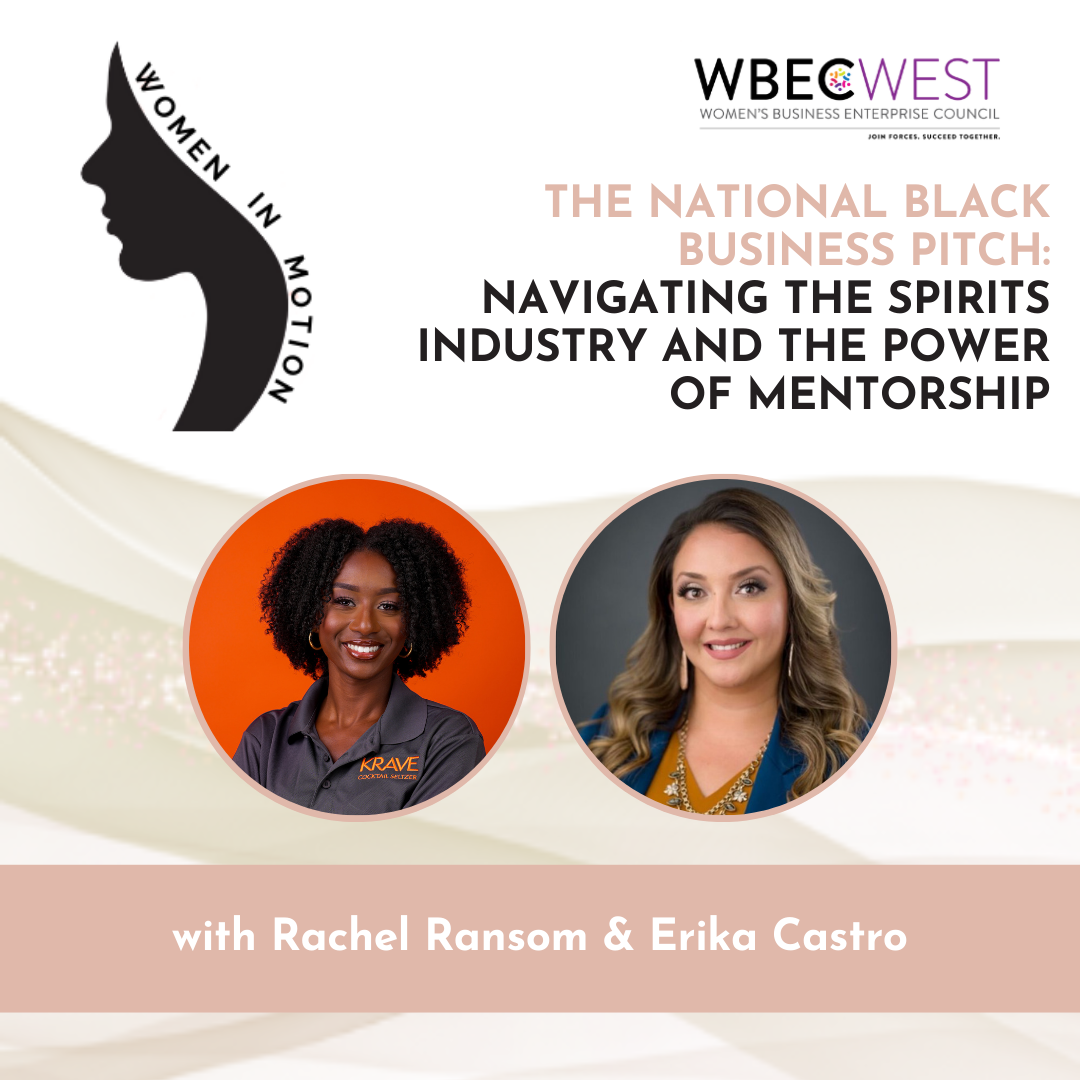
The National Black Business Pitch: Navigating the Spirits Industry and the Power of Mentorship

January 7, 2025 by angishields

WIM-Rachel-Ransom-Feature
Women in Motion
The National Black Business Pitch: Navigating the Spirits Industry and the Power of Mentorship
Loading
00:00 /
RSS Feed
Share
Link
Embed

Download file

In this episode of Women in Motion, Lee Kantor speaks with Rachel Ransom, co-founder of Krave Cocktail Seltzer, and Erika Castro, a corporate representative from Salt River Project and Rachel’s mentor. Rachel shares her journey in launching Krave, a Washington D.C.-based canned cocktail brand, discussing the challenges of entering the spirits industry and the importance of pitch competitions for funding. Erika provides insights on mentoring, the significance of business certifications for minority and women-owned businesses, and the value of networking. The episode highlights the collaborative spirit and resilience needed for entrepreneurial success.
Rachel-RansomRachel Ransom is the Co-Founder of Krave Cocktail Seltzer, a vibrant brand dedicated to redefining the ready-to-drink cocktail experience.

A proud Hampton University alumna, Rachel launched her career in technology and real estate sales, where she honed her expertise in business development and relationship-building. This experience in high-energy industries fueled her passion for entrepreneurship and equipped her with the strategic mindset to bring Krave to life.

Today, Rachel channels her sales acumen and entrepreneurial spirit into expanding Krave’s presence throughout Washington, DC, with a particular focus on Virginia, her home state. Krave-logo
She remains committed to creating a refreshing, quality cocktail brand that resonates with diverse communities and aims to make Krave a staple in the local spirits market.

Follow Krave on LinkedIn.

Erika-CastroErika Castro is the Supplier Diversity and Supplier Management Manager at SRP Salt River Project.

SRP is a community-based, not-for-profit organization providing reliable, affordable and sustainable water and energy to more than 2 million people in central Arizona.

Follow the Salt River Project on LinkedIn, Facebook, X and Instagram.

Music Provided by M PATH MUSIC

Transcript-iconThis transcript is machine transcribed by Sonix


TRANSCRIPT

Intro: Broadcasting live from the Business RadioX Studios, it’s time for Women In Motion. Brought to you by WBEC-West. Join forces. Succeed together. Now, here’s your host.

Lee Kantor: Lee Kantor here, another episode of Women In Motion and this is going to be a good one. But before we get started, it’s important to recognize our sponsor, WBEC-West. Without them, we couldn’t be sharing these important stories. Today on Women In Motion, we have Rachel Ransom with Krave Cocktail Seltzer, and Erika Castro who is the corporate representative from Salt River Project. Welcome.

Rachel Ransom: Thank you.

Lee Kantor: All right. Well, before we get too far into things, let’s talk to Rachel about Krave Cocktail Seltzer. Tell us about your business.

Rachel Ransom: Yeah. So, Krave Cocktail Seltzer is a Washington, D.C. based and black women-owned canned cocktail seltzer brand. We launched the brand back in July of 2024, and we focused on creating your classic cocktail recipes in seltzer form. So, the recipe we have out right now is our Lemon Drop Cocktail, and we’ll be looking to add on a tequila-based cocktail in the upcoming summer.

Lee Kantor: So, what’s your backstory? How’d you get involved in this line of work?

Rachel Ransom: So, Krave was started by me and two of my friends. One of my friends had an idea to start a canned cocktail line, and then in perfect timing a spirits investment company called Pronghorn, who solely invests in minority-owned spirit brands, hosted a pitch competition for former HBCU students. Two of the three of us went to a Historically Black College, Hampton University, and so we applied for this pitch competition with our idea of Krave.

Rachel Ransom: So, basically, we just submitted a PowerPoint to them. They liked our PowerPoint, gave us startup money of $10,000, and flew us down to Miami to pitch to investors. So, from there, we utilized that money to hire a beverage formulator, hire a manufacturer, graphic designer, get the proper licensing. And had to put in some additional money of our own, but that really helped us get kickstarted and launch Krave in D.C.

Lee Kantor: Now, was that kind of the trajectory you were on prior to Krave? Were you going to be an entrepreneur? Were you looking for a venture like this?

Rachel Ransom: So, I was always going to be an entrepreneur, but I had no thoughts of getting involved in the spirits industry. Professionally, I sell cloud computing technology, so I’ve been involved in sales for a while. Outside of that, I had started about two years ago, gotten into real estate. I got my Virginia real estate license, which is where I’m from, and was a practicing realtor when this opportunity came. Since then, I have paused real estate. I still do my technology sales, but I’m all in on Krave.

Lee Kantor: So, what was part of that learning curve to get into the spirits industry? I’m sure you were aware of spirits, but you weren’t aware of the business of spirits.

Rachel Ransom: Right. No, it was a huge learning curve from what the licensing laws look liked state to state, to what type of information you have to have on your actual can, and so many things in between. What was really helpful for us was finding some mentors in the industry, so between the relationship we developed with the spirits investment company, Pronghorn, alongside finding some other canned cocktail brand owners who had been in the business for either a few years or up to 20 years, and utilizing them as mentors to help us learn what we didn’t know. But then, there were also a lot of instances of trial and error and figuring things out as we went along.

Lee Kantor: So, what was it like at the beginning stages where you have maybe an idea, but how do you kind of iterate that and make it come to life for that prototype, you know, first test beverage, are you just hanging out together, just mixing things in a pitcher, shaking it up?

Rachel Ransom: So, actually, that is kind of how it started. We thought of what were the one to two cocktails we want to start with. We landed on lemon drop and mojito. From there, we spent an afternoon making kitchen recipes, different versions of a lemon drop, and a mojito cocktail to see what we liked the best. We were looking for something that wasn’t too sugary, wasn’t too high in alcohol content, and also had a nice fizz, but also wasn’t too diluted by the soda water.

Rachel Ransom: So, once we finally landed on something that we liked, we interviewed probably 12 beverage formulators across the U.S. and landed on a great company out of Oregon called Sonoma Beverage Consulting. We worked with them, basically we sent them our kitchen recipe, and then they utilized commercial grade ingredients to recreate that recipe. And we went back and forth over about five or six iterations until we solidified what the the perfect Lemon Drop Cocktail would taste like.

Lee Kantor: So, you went from just hanging out to sending it to a formulator. You didn’t have like a mid-step of should we just bring this to a farmers market or just the public in general to see what they think?

Rachel Ransom: No. And honestly, looking back, that’s something we would do future state for our next run. We’d make a smaller batch so that we could get the community’s feedback on it to ensure we were on the right track. So, that was a risk that we were taking. But we knew we wanted to make this a beverage that could be eligible to be in retailers, so we didn’t want it to be something that we were, you know, just batching in our kitchens and then giving it to the public.

Rachel Ransom: So, with that, we knew we wanted to work with a beverage formulator. But we know that in the future we’d want to, again, work with the beverage formulator, but make a small batch quantity to have some sort of a focus group to test out the product before bringing it directly to shelves.

Lee Kantor: Now, did you have Krave as a brand that you had kind of a look and feel for that was kind of the foundation of this and then building the beverage to it, or was the beverage first and then you built Krave around that?

Rachel Ransom: So, the name was actually first. The name came from just we were going through a couple different names and wanted to find something that felt like someone was doing something. We wanted it to be an action verb, so Krave is something that we landed on. And then, from there we built the brand concept around it of thinking how can we differentiate ourselves from all of the cocktail seltzers that are already out there? So, our focus was, let’s focus on your classic cocktails that have a higher ABV than average, less amount of fizz, not as diluted, really flavorful. And so, that’s how we we got to what the beverage would be after establishing what the name would be.

Lee Kantor: So, what was it like when you have the idea, you find these folks in Oregon, you send them the idea, and at some point they’re sending you that first can that you have to crack open. And you’re like, “Well, I hope this tastes like I picture in my head”?

Rachel Ransom: Yeah. So, with our beverage formulator, they would send us back a small sample of bottles with the lemon drop cocktail in it. From there, once we finally got it finalized, we got the final recipe, and then we had to hire a completely separate vendor. We had to hire a manufacturer. So, the manufacturer would take the recipe that we got from the beverage formulator. They’d create it on a larger scale. So, for our first run of product, we did 1,000 gallons of the Lemon Drop cocktail, and then that’s who puts it in the actual cans for us to then sell to retailers. So, it was a long process.

Lee Kantor: And isn’t it a little nerve-racking because at each stage you got to, you know, hope that it’s the way that you picture? I mean, even like if you’re printing something, they still check the printer to make sure they’re printing colors exactly, right?

Rachel Ransom: Yeah. It was extremely nerve-racking, especially going from such a small sample size to a large production run.

Lee Kantor: Right. Like how many cans is that?

Rachel Ransom: So, that was 10,000 cans. And so, if something went wrong, that was a lot of money that was gone.

Lee Kantor: Exactly. That’s times 10,000.

Rachel Ransom: Yeah. Thankfully we found a manufacturer that was local. So, we found a company called Nidra down in Chesapeake, Virginia. And so, we were able to visit the facility before they created our drink. And we were able to be there as they were mixing the drink, so that before they put the mixed ingredients into cans, we were able to taste it and make sure it still tasted like our small batch recipe before going into the cans. So, that helped a little bit to make us feel a little more comfortable.

Rachel Ransom: Now we’re running another production with them actually this week. It’s double the size, so it’s 20,000 cans. And we’re not going to be there for them to put it in the cans because we just have to trust that they’re going to, you know, follow the same recipe. But, again, it is nerve-racking especially as you start to create more and more product.

Lee Kantor: Now, why was it important for you to become a part of the National Black Business Pitch series?

Rachel Ransom: Yeah. So, with having a business like Krave, like I said, we just launched in July, and we’re not at the point exactly where investors are willing to invest in us just because we don’t have enough history of proving ourselves in terms of revenue and growing and scaling our business. But we’re not in a place as three founders to self-fund this business completely on our own.

Rachel Ransom: So, utilizing pitch competitions has been extremely helpful for us to be able to fund our business and just continue with the next production run and things like that. So, after doing some research online and finding the National Black Business Pitch, it was really important for us to apply and hope to participate in hopes to obtain the necessary funding to keep pushing our business forward.

Lee Kantor: Now, what was it like working with Erika Castro as your mentor on this adventure?

Rachel Ransom: I had an awesome experience with Erika. First, Erika has a lot of experience judging pitch competitions, which was extremely helpful in terms of reviewing my pitch with her. I got some great feedback that, obviously, was really helpful in terms of winning the pitch competition. But Erika also gave me some great information that comes from the WBEC group in terms of applying for or getting my business certified as a minority business and as a woman-owned business. Because what I learned from Erika is that there are a lot of organizations out there that have specific funding to work with these minority or women-owned businesses. And so, if we can get ourselves certified in that capacity, that’s going to help us in terms of obtaining new and larger retailers.

Lee Kantor: Now, Erika, as a seasoned business person and business leader that you are, what was it like mentoring the folks from Krave?

Erika Castro: Well, I would just say it was so easy. And, Rachel, congratulations. I haven’t gotten a chance to tell you, but I am so proud of you.

Rachel Ransom: Thank you.

Erika Castro: I was just so delighted to hear that you won, so it was kind of, you know, a validation that the the feedback worked. But honestly, Lee, I don’t know that Rachel needed too much feedback because she was just great. She, I think, already had a refined pitch. I had recently come out of judging another pitch competition. There was a few things that we talked about in terms of tweaking her pitch, but other than that, I mean, I think she was ready and she was prepared.

Erika Castro: And the other thing that I will have to say, too, is I think people’s energy really shows to the audience, to the judges. And I think when you have someone that has the energy that Rachel has, I think it’s so easy to work with them and to believe that a company as young as theirs that started earlier this year, is in the place that it’s at. And so, that’s the biggest takeaway for me is, man, if someone really wants something, it is achievable. And, obviously, it’s so much work to get there, but it just makes me really proud. So congrats, Rachel.

Rachel Ransom: Thank you.

Lee Kantor: Now, Erika, do you have any advice for other people doing pitch competitions or leaning on pitch competitions as a way to launch their venture? Are there some do’s and don’ts, you know, as being somebody who has judged these events and mentored these events? What are some do’s and don’ts for someone that’s entering their first pitch competition?

Erika Castro: Yeah. I mean, I think I would just say, before you probably come to a pitch competition, you probably want to have done a lot of homework and your research on what your business is. And I think Rachel kind of showcased that. She was a perfect example of that with her and her teammates at Krave because, as you heard, there was so much backend that had to be done before she even got to that point. And to even be able to navigate the beverage formulators and the manufacturers and all of that, I feel like there’s just so much backend and homework. So, that’s what I would recommend is, obviously, be able to do your homework.

Erika Castro: And then, I’m sure people have heard of the Business Model Canvas, but use that to your benefit. Because I think once you kind of know who you’re trying to target in terms of a customer, what do you want your company to look like in terms of a brand, what do you want people to think, see, and feel when they’re interacting with your brand, and so I think all of those things you can kind of lay out with developing a really great Business Model Canvas.

Erika Castro: And so, that’s what I would say is, before you kind of embark in any of these pitch competitions is make sure you kind of have that ready. Because I think for Rachel and her team, it was kind of a natural next step in terms of the recommendation that I provided to get certified, because it just opens up the opportunity for more markets, and for other corporations to maybe have their beverage in their supermarkets. And a lot of companies are trying to find women-owned, minority-owned businesses to feature, and so by them having the certification, it’s only going to be a benefit.

Lee Kantor: Now, Rachel, is there any advice you can give to people doing their first pitch? It sounds like you guys did a great job of preparation, but is there anything maybe from the nervousness or the actually getting on stage or getting in front of people and sharing maybe for the first time, is there anything you learned from that experience?

Rachel Ransom: Yeah, absolutely. And I think there’s a differentiator between a pitch competition that’s virtual versus in-person. Virtual being that it’s easy to have that pitch and presentation mode and read off your notes. But I think the biggest thing, one, is to make your pitch conversational. You don’t want it to feel to the judges that you’re just reciting a script. And then, if you are pitching in-person, it’s always great if you can memorize the pitch versus reading off of note cards, but it takes a lot of practice to be comfortable and confident and conversational in how you deliver your pitch.

Rachel Ransom: So, I just think that continuously practicing to different people to get their feedback, seeing what kind of questions they have from your pitch, that way, you can intertwine those answers in your pitch, and that’s one less thing that the judges have to ask you. I think that’s that’s a big thing, so practicing and specifically doing so in front of different audiences to get different perspectives.

Lee Kantor: Now, Rachel, if somebody wants to learn more about Krave, is there a website? Where are you at in your rollout?

Rachel Ransom: Yeah, absolutely. So, right now, Krave has placement across 21 to 22 retailers in Washington, D.C. In January, we will be expanding across the State of Virginia as well to be in grocery retailers. And if you want to keep up with Krave in terms of knowing what stores we’re located in and what events we’re hosting on a monthly basis, you can go to our website at drinkkrave – with a K – .com or @drinkkrave on Instagram.

Lee Kantor: Now, Erika, before we wrap, I know Rachel isn’t a WBEC member just yet, a WBEC-West member just yet. But for folks who are at this stage, do you have a recommendation, when would you become part of the WBEC-West community? Like, what’s the right time for a business to join the WBEC-West community?

Erika Castro: I think anytime you want to kind of expand to new markets – like in Rachel’s case, she’s expanding to Virginia – anytime you want to have any new retailers, I think that kind of just opens up the door. So, I would say for a business like hers, absolutely, I would say you do that right away. Not only does it provide access to potential retailers and companies that could have your brand, but I think it also expands your network. And they do say that people do business with who they trust. So, the more that you can develop those relationships, I think the more people are willing to listen to you. And I’d love to see Krave come to Arizona and everywhere else.

Rachel Ransom: Yes.

Erika Castro: So, that’s the next goal, Rachel, let’s get this across the country.

Rachel Ransom: Absolutely.

Lee Kantor: So, Rachel, what do you need more of? How can we help you?

Rachel Ransom: What do we need more of? Honestly, to take us to the next level, we definitely need more funding so that we can fulfill larger orders for all of the grocery retailers that we’re starting to inquire with. So, from our team standpoint, we’re going to continue to participate in pitch competitions and start looking for investors as we get closer to the summer.

Lee Kantor: All right. Well, Rachel and Erika, thank you so much for sharing your story today. You’re both doing such important work and we appreciate you.

Rachel Ransom: Thank you for having us.

Erika Castro: Thank you.

Lee Kantor: All right. This is Lee Kantor, we’ll be back next time on Women In Motion.
 

Tagged With: Krave Cocktail Seltzer, Salt River Project, The National Black Business Pitch

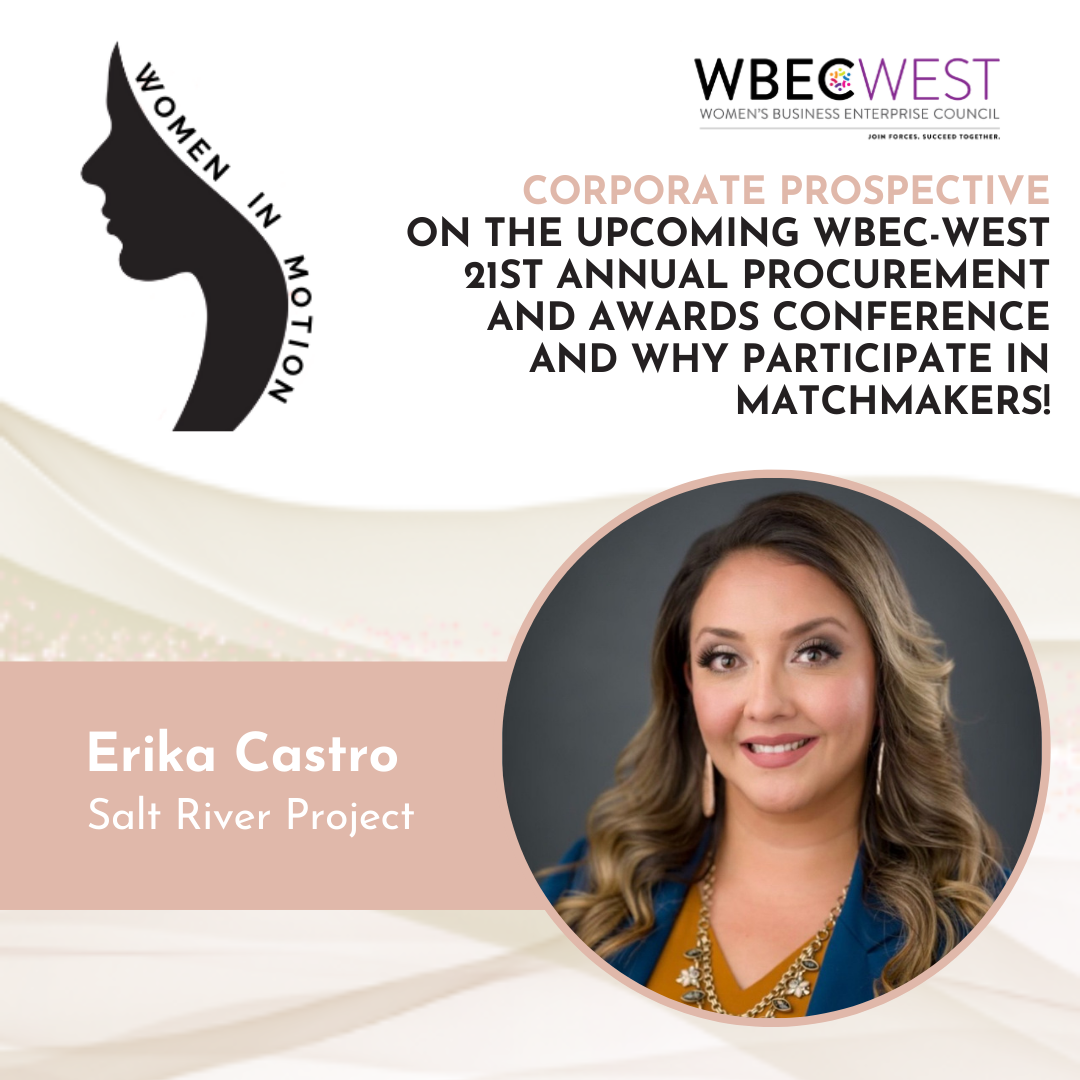
Corporate Prospective on the upcoming WBEC-West 21st Annual Procurement and Awards Conference and Why Participate in Matchmakers!

August 23, 2024 by angishields

WIM-Erika-Castro-Feature
Women in Motion
Corporate Prospective on the upcoming WBEC-West 21st Annual Procurement and Awards Conference and Why Participate in Matchmakers!
Loading
00:00 /
RSS Feed
Share
Link
Embed

Download file

In this episode of Women in Motion, host Lee Kantor is joined by Erika Castro from Salt River Project (SRP) about the crucial role of women in corporate procurement and supplier diversity. Erika emphasizes the importance of building relationships with women business owners, effective networking, and preparation for events. She highlights SRP’s commitment to community engagement and collaboration with women-owned businesses.

The episode also previews an upcoming procurement conference organized by WBEC-West, stressing the value of face-to-face interactions and proactive networking for business growth. Erika provides practical advice on articulating value, seeking feedback, and maintaining connections.

Erika-CastroErika Castro is the Supplier Diversity and Supplier Management Manager at SRP Salt River Project.

SRP is a community-based, not-for-profit organization providing reliable, affordable and sustainable water and energy to more than 2 million people in central Arizona.

Follow the Salt River Project on LinkedIn, Facebook, X and Instagram.

Music Provided by M PATH MUSIC

Transcript-iconThis transcript is machine transcribed by Sonix


TRANSCRIPT

Intro: Broadcasting live from the Business RadioX Studios, it’s time for Women In Motion. Brought to you by WBEC-West. Join forces. Succeed together. Now, here’s your host.

Lee Kantor: Lee Kantor here, another episode of Women In Motion and this is going to be a good one. But before we get started, it’s important to recognize our sponsor, WBEC-West. Without them, we couldn’t be sharing these important stories. Today on Women In Motion, we have Erika Castro with the Salt River Project. Welcome.

Erika Castro: Thank you. Thank you for having me.

Lee Kantor: I am so excited to learn what you’re up to. Please share a little bit about Salt River Project. How are you serving folks?

Erika Castro: So, Salt River Project, also known as SRP, is an Arizona company. It’s a public water and power utility with over two million customers here in the Valley. And the Valley, we kind of refer to like the Phoenix metropolitan area. But, yeah, water and power utility, that’s what we do. That’s our bread and butter.

Lee Kantor: Now, what’s your background? Have you always been in that line of work?

Erika Castro: Yeah. So, I actually have been with the utility for I’m going on 16 years, so definitely have enjoyed being in the utility space. And my background is in corporate philanthropy, but most recently within our supply chain area working in supplier diversity.

Lee Kantor: Now, you are one of the corporate representatives at WBEC-West. Can you talk a little bit about why it’s important for your firm to be a member of WBEC-West and to be a corporate rep?

Erika Castro: Yeah. So, SRP has been in the Valley for over 100 years. And SRP’s establishment was actually established pre-statehood, so it’s really important for SRP to just really be engaged with the community, and more importantly, with the business community because, obviously, SRP can’t do all of the things that we do if we don’t partner with suppliers that can get us the services and good to be able to provide reliable, affordable power and water.

Lee Kantor: So, when WBEC-West has an event, like they are having in Henderson coming up September 17th through 19th, their 21st Annual Procurement Conference, how do you kind of attack that? Is that a must attend event for you and your team? Can you talk a little bit about how you kind of get the most from the corporate side of the table?

Erika Castro: Yeah, absolutely. So, I’m also a proud member of WBEC-West and I truly believe in its mission of advocating, supporting women business owners, and ensuring that they have the opportunities necessary to compete for sustaining contracts and opportunities. And so, for SRP, really, it’s an imperative. Like I mentioned, we are not able to do the great work that we do at the utility if it wasn’t for many of our women business owners. And so, in this case, it’s really important for us to be there.

Erika Castro: WBEC-West is our regional partner for WBENC, and not only are they just an amazing team – so I am going to brag on the team – but secondly, they’re very intentional with everything that they do. And that means a lot for SRP because we know that when women business owners are competing for contracts, they’re ready. They’re ready and they’re well-prepared, and they’re winning contracts.

Erika Castro: So, like I said, for us it’s really important to be there. It’s an imperative for us to be there. So, we are planning on attending with several members of our procurement team, which is super exciting because we always like developing the connections with our women business owners, but women business owners, also – we call them WBEs – they’re super excited to meet our procurement folks. And so, just making those connections, I think is really important because at the end of the day, we’re kind of the funnel and the advocate for women business owners and the utility. But procurement, who knows about the projects, those folks are the ones that is really important for WBEs to meet, so we’re really excited to go with a team of folks to the WBEC-West conference.

Erika Castro: And you asked a great question, Lee, about just preparing, and so we do prepare in advance for the conference to make sure that if there’s anything upcoming that we need, that we’re looking for those things at the conference.

Lee Kantor: So, we talk a lot on this show with WBEs, but we don’t talk a lot with the corporates, so I’m just trying to give the WBEs a little insight into how the corporates prepare, and how you’re kind of getting the team ready, and how they’re kind of gathering the information that’s important to them so that the WBEs have an idea of maybe how to kind of anticipate some things so they’re better prepared. So, can you share a little bit about, you know, when you’re in a meeting with the procurement folks and you’re saying, “Okay, this conference is September 17th through 19th, here’s the game plan. Here’s the best way to kind of get the most out of it.”

Erika Castro: Yeah. So, we kind of approach it from the perspective that each one of our procurement individuals that will be attending, they kind of have their area of responsibility. So, someone may be very specific that all they do is, you know, IT support, someone else may just do, let’s say, marketing and communications and environmental support. But once we kind of have this conversation with our procurement individuals, we kind of go at it from the perspective that you are representing our entire supply chain at SRP. So, really, the goal is to ensure that we are talking to everyone else and we’re kind of getting a feeler out there for everyone else in procurement of what is needed or what are the big things that are kind of coming down the pipeline where we may need additional sources of WBEs.

Erika Castro: And so, that’s really kind of how we approach it. We have a discussion and we kind of just survey, survey all of our peers on what they need. So, in that way, when we go to the conference, we know the types of things that we need. And obviously for the types of things that we don’t need, I always tell this to anyone that I meet, whether it’s at SRP or not, is that it’s so important, I think, to always give some positive feedback to WBEs, because, one, they look to you for that experience from the corporate perspective.

Erika Castro: So, although there may not be opportunities in business, it’s so important to make sure that you’re giving them feedback and that you’re giving them some honest, good feedback that they can take back for other potential relationships for them or other potential opportunities. Because the last thing that I want is, you know, to have our team prepare and go into this conference making everyone believe that everyone’s going to do business with SRP tomorrow, and that’s just not really the reality.

Erika Castro: So, one, it’s kind of just knowing what it is that we need going into it. But two, if we know that there’s not a fit, still making sure that we’re, one, accessible – and that is one thing that I’m really proud of at SRP is that we have a great team – and you can be assured that if you reach out to anyone from our team, they’re going to get back to you. And oftentimes, I think there’s a lot of folks that are reaching out to procurement and supplier diversity, and I think just the fact that there’s not a lot of resources in those departments, it just takes a little bit longer maybe to get back to someone. We have a great team and we have a strong team, so that’s one thing that we really pride ourselves with is that we love to provide feedback just in the true essence of helping develop one another.

Lee Kantor: And it sounds like relationship part of this is very important. You don’t want this to be transactional. You don’t want it to be like, I sell widgets. I don’t need widgets. Buy. You want it to be more human to human.

Erika Castro: I mean, one of the things that I always talk about is, you know, the relationship part should always come first. And even when we talk about matchmaking, whenever a WBE and a corporate gets into a matchmaker, I really don’t like being in a space where it’s just like you get someone’s 30-second pitch, and then you don’t really learn anything about that person. I want to get to know you. And I know that for anyone that has gotten a contract, really, they say people do business with who they trust, and so, for me, I think definitely it’s developing those relationships.

Erika Castro: And I know that a lot of folks would agree with that. It’s developing the relationships, the work comes after. Because kind of what I mentioned, even if there’s not an opportunity immediately, if I’m in conversation with someone internally, or even externally because there’s a huge network of us folks that talk outside, so it’s other corporate representatives talking to other corporates, and even if we can’t use them, if we’ve developed this relationship with a certain individual, a WBE, we’re more likely to recommend them. “Oh, you know what? We haven’t been able to use this person but, man, they would be great.” And so, yeah, absolutely, relationship building I think is the number one that I would say coming in here and really trying to develop that and just being yourself.

Lee Kantor: Now, I’m glad you brought up this matchmaking event that’s going to happen there and sharing a little bit about how you prepare your team to kind of go into that event. Is there some kind of do’s and don’ts? You know, like these are red flags. These are green flags. Are there things that you can share with the WBE? Like you mentioned one, I want to know a little bit about you as a human, not just your elevator pitch. But can you share a little bit about things that you like and don’t like?

Erika Castro: Yeah. I mean, I really appreciate when we can come into a conversation and when a WBE will ask for feedback. There is one event in particular that I attended where I heard a pitch of a company, and this is a great example of kind of being open to feedback is that this company kind of talked about they were in the painting industry and they talked a lot about doing business with a certain segment and government work and a ton of government work. And it sounded like a lot of their work really was focusing on in this particular segment of homebuilders.

Erika Castro: And so, you know, one of the things that I proposed to her after that conversation is, “Well, have you thought about procurement with large corporations because the type of work that you do -” and it was a specialty type of painting “- if you’ve seen any of these large corporations, they have beautiful facilities, have you not thought about getting into procurement with large corporates?” And she hadn’t thought about that.

Erika Castro: So, going back to your question, I think one of the things that I really appreciate as always that I’d like to recommend in any sort of matchmaker, you’re always seeking out either advice or just open to any feedback. I think that’s always a great thing. And I guess things that you want to stay away from is, one, obviously, I think in any matchmaker setting, you have limited time. And so, the last thing that you want is to take up the entire conversation. If there’s five people in the table and you’re going on for now three minutes, it’s not being mindful, I guess, of the other folks at the table. So, I think just kind of having the awareness of how much time do you have, how many people do you have, and not kind of overtaking that conversation because I think that could be perceived negatively.

Erika Castro: So, that’s what I would recommend that we definitely be mindful of others, but, two, also be open to the feedback and suggestions of whoever’s there, not just from a corporate standpoint, but I think there’s a lot of great feedback and suggestions that can be made from other WBEs. Because you might have a WBE there that’s been in business for 20 plus years and someone that’s just starting out, and I think there’s a lot of great feedback and advice that can come from someone that has a seasoned business or an experienced business.

Lee Kantor: Right. And there’s a lot of synergies that might be just waiting there if you’re kind of open to that. Now, when it comes to working with your company, how important is kind of doing the homework and research and really understanding? Because if you’re a WBE and you can’t go to every single corporate matchmaking, you can’t go with everybody, so you’ve got to pick a handful, is it important for you to hear some of the kind of key words and some of the hints that maybe they have done some homework and that they have kind of at least understand some of our pain points and some of the opportunities within our organization?

Erika Castro: I mean, especially being in the utility space with a lot of our upcoming initiatives and our renewable initiatives, I think there’s a lot of value to be had and someone just making sure that they’re prepared. And I always think this way, if there’s a corporation and we know what we’re looking for going into it, I think the same concept could be made for a WBE that they come prepared to the conference knowing which corporations they would like to target, because, like you mentioned, you may not get face time with everyone that maybe you’d like.

Erika Castro: So, understanding, let’s say, that if a utility was in my area of focus, that if I haven’t talked to one of the utilities, that I will make it a point after the fact to connect with them or to reach out. And I always think that it’s also important to note that, one, yes, doing your homework, but, two, if you maybe haven’t done your homework because maybe you just haven’t looked at this company, maybe it’s someone that’s out of state, a company that’s out of state, I think it’s understanding, you know, come with some questions like what kind of questions can you ask the company that’s going to help them solve their needs, and what types of maybe new innovative things are happening where maybe you could help solve a problem for them.

Erika Castro: And so, absolutely doing your homework, but then also having a plan going into it because I think sometimes, especially with some of the conferences and the amount of people, it can be a little overwhelming for WBEs. And so, if they come prepared, they know that they kind of have a plan in place. And if they meet additional corporate’s along the way, well, that’s just a cherry on the top.

Lee Kantor: Right, that’s the bonus. Now, is there any advice you can share when it comes to maybe following up and networking with folks that, like you mentioned, you’re going to see some of them at this matchmaker event, but you’re going to just see some of them, maybe you’ll go and attend one of their speaking events or maybe you’ll run into them at lunch, how would you kind of navigate the networking part of this with the corporates because we respect your time and we don’t want to be so forward that we assume that you’re going to make time for me. How would you do that from a networking standpoint in order for me to maximize my best chances of interacting with you and, maybe at some future point, doing business?

Erika Castro: Yeah, I mean, I think it’s important to always lean in. I know this is kind of maybe a played out term, but I always say just lean in. And even if you can’t have a five minute conversation because, to your point, people are busy and they may be talking to others, just introduce yourself. Make it a point to introduce yourself and maybe provide a business card and ask them for theirs so that you can kindly follow up after.

Erika Castro: And the other thing, I think, is just making sure that you clearly articulate what it is that you do in any sort of follow up. Whether you do get a chance to talk to folks on site or whether you’re following up, it’s just being able to clearly articulate that, because I think many times you hear of companies that they kind of say, “Oh. Well, I do X services?” And you’re like, “Okay. Well, what about X services?” So, I always like to ask for examples, “Well, give me an example of something that you’ve done.” And if they have examples for me for the utility space, “Well, do you have examples specific to the utility space?” If they do, great. If they don’t, then I just ask for an example, period, because I think that can kind of help me figure out, “Okay. Yeah. Then, that would be a great person to introduce to X person internally.”

Erika Castro: Because our job really is to be the connector and the conduit between the WBEs and our internal businesses. And so, I think just making sure that you’re being seen, and if you know that there’s three corporate representatives there, make sure that at least touch base with one of them. And if there’s only one, then obviously you want to try to at least get them to give you their card or follow up. But definitely if there’s more than one, then make sure that you at least touch base and make a connection with at least one of the corporate reps.

Lee Kantor: Now, for you, this event in the past, has there been a story you can share, a memorable moment from a previous conference that you would like to share that maybe you made a connection or you helped somebody or something that you remember.

Erika Castro: Yeah. So, last year, we had a WBE that attended in the construction space, and they hadn’t been as connected with WBEC-West in a little while, and they were so thankful and appreciative that, one, we invited them to join us – and they’re an existing supplier – and two, that they were able to make all these additional connections, because one of the things that I know WBEC-West is big on and I always talk about is that this network is such a supportive network. Women help build each other. And although, you may not be able to do business with maybe a corporation, there’s probably another WBE that you can team up with or subcontract for.

Erika Castro: So, in this case, the company that I was mentioning, it’s ensuring that we were introducing them to a lot of other women, one, that they could mentor because this business has been in business for a while. And two, that they could have also kind of this network of people that they could then team up with or partner with on future projects. And so, coming out of there, this WBE was just super excited and very appreciative. And we have just seen their business flourish and grow not just with SRP but as a business. And I do think that a lot of that is a direct result of continuing to be engaged in events like this.

Erika Castro: You know, especially out here in Arizona, there’s a lot of growth, especially in the construction space. So, if there’s anything in that area, then it’s also kind of just knowing what area you live in and what are kind of the hot areas that are growing and developing, and how can I potentially work with the business like that to get future opportunities.

Lee Kantor: And this event is an opportunity for you to get in front of corporates that can really make a difference in your business. I mean, this to me is a must attend event. If you’re involved in the community and you’re a member, I think it’s super important to invest the time to attend here because meeting face-to-face with these people like yourself, it can be a game changing account if you can land a Salt River Project account for some of these WBEs. So, I wouldn’t sleep on this opportunity. I think this is a must attend event this September 17th through 19th. I mean, how often do people get a chance to meet with you and your team face-to-face like this? It’s probably not that frequently.

Erika Castro: I mean, there’s a few times a year, and then also the fact that I mentioned that we’re bringing folks in procurement. Oftentimes, myself and maybe someone else on the team gets to attend, but we’re not part of the procurement team that’s actually making the decisions with the internal client. That’s why I think this is just so important because, one, you have a team of folks that are going to be there. And then, two, I just think that just professional growth, who doesn’t want that? Who doesn’t want the professional and business growth?

Erika Castro: I think a lot of things that you may learn at an event like this could also help propel your business to the next level. And I think oftentimes we think, you know, I’m going to come out of here and I’m going to get a contract. And I think if you walk out of there and you made X amount of connections, you kind of have to make a goal for yourself and you come out with those connections. And you came out with all these additional learnings that can help you grow your business, I mean, that’s a win, because we all know that a contract won’t happen overnight.

Erika Castro: And so, I think, one, it’s just making that first introduction. And then, secondly, is that there’s just so many other opportunities for personal growth and development, both on a personal level and also at a professional level through your business.

Lee Kantor: And the dates again for this event is September 17th through 19th. It’s in Henderson, Nevada. You can go to wbec-west.com to learn more. This is the 21st Annual Procurement Conference. I think it’s a must attend event if you’re a WBE and you’re already investing in the community, take this next step and learn from your peers in person, meet them face-to-face, get in front of a bunch of corporates that can help your business get to a new level. I think that you should really attend this event. What do you think, Erika?

Erika Castro: I say it’s a great investment, like I said, in yourself and in your business, so I agree with you. As many people that can sign up and register, like you said, it’s just having access, and we all talk about having access to opportunities, this is it.

Lee Kantor: Yeah. This is where it happens. So, Erika, if somebody wants to connect with you and learn more about Salt River Project, what’s the website there.

Erika Castro: So, you can find us at srp.net/supplierdiversity. That will take you to our site, one, to where you can register to be a prospective supplier to SRP, and then two, it does have all of our forms of communication. It has our phone number, our email. And then, it also has just some other additional fun things that we’ve been doing, like tracking our economic impact in our community, so that’s on there as well. And I’ll say the website again, it’s srp.net/supplierdiversity.

Lee Kantor: Well, Erika, thank you so much for sharing your story today. You’re doing such important work and we appreciate you.

Erika Castro: Thank you.

Lee Kantor: All right. This is Lee Kantor. We’ll see you all next time on Women In Motion.

 

Tagged With: Salt River Project, WBEC-West 21st Annual Procurement and Awards Conference

Business RadioX ® Network


Our Most Recent Episode

CONNECT WITH US

  • Email
  • Facebook
  • LinkedIn
  • Twitter
  • YouTube

Our Mission

We help local business leaders get the word out about the important work they’re doing to serve their market, their community, and their profession.

We support and celebrate business by sharing positive business stories that traditional media ignores. Some media leans left. Some media leans right. We lean business.

Sponsor a Show

Build Relationships and Grow Your Business. Click here for more details.

Partner With Us

Discover More Here

Terms and Conditions
Privacy Policy

Connect with us

Want to keep up with the latest in pro-business news across the network? Follow us on social media for the latest stories!
  • Email
  • Facebook
  • Google+
  • LinkedIn
  • Twitter
  • YouTube

Business RadioX® Headquarters
1000 Abernathy Rd. NE
Building 400, Suite L-10
Sandy Springs, GA 30328

© 2025 Business RadioX ® · Rainmaker Platform

BRXStudioCoversLA

Wait! Don’t Miss an Episode of LA Business Radio

BRXStudioCoversDENVER

Wait! Don’t Miss an Episode of Denver Business Radio

BRXStudioCoversPENSACOLA

Wait! Don’t Miss an Episode of Pensacola Business Radio

BRXStudioCoversBIRMINGHAM

Wait! Don’t Miss an Episode of Birmingham Business Radio

BRXStudioCoversTALLAHASSEE

Wait! Don’t Miss an Episode of Tallahassee Business Radio

BRXStudioCoversRALEIGH

Wait! Don’t Miss an Episode of Raleigh Business Radio

BRXStudioCoversRICHMONDNoWhite

Wait! Don’t Miss an Episode of Richmond Business Radio

BRXStudioCoversNASHVILLENoWhite

Wait! Don’t Miss an Episode of Nashville Business Radio

BRXStudioCoversDETROIT

Wait! Don’t Miss an Episode of Detroit Business Radio

BRXStudioCoversSTLOUIS

Wait! Don’t Miss an Episode of St. Louis Business Radio

BRXStudioCoversCOLUMBUS-small

Wait! Don’t Miss an Episode of Columbus Business Radio

Coachthecoach-08-08

Wait! Don’t Miss an Episode of Coach the Coach

BRXStudioCoversBAYAREA

Wait! Don’t Miss an Episode of Bay Area Business Radio

BRXStudioCoversCHICAGO

Wait! Don’t Miss an Episode of Chicago Business Radio

Wait! Don’t Miss an Episode of Atlanta Business Radio













