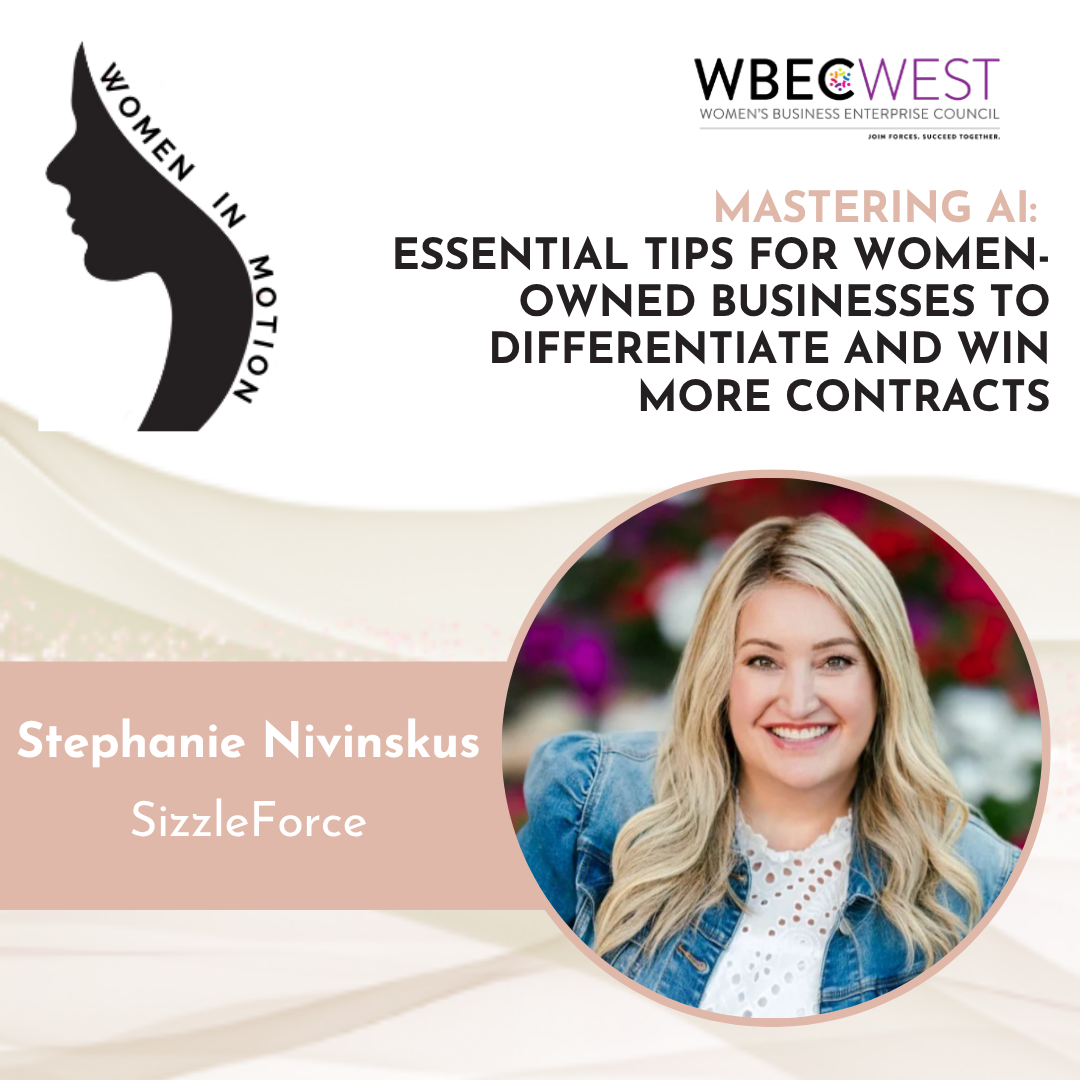

In this episode of Women in Motion, Lee Kantor and Renita Manley welcome back Stephanie Nivinskus, an AI marketing expert from Sizzle Force. Stephanie shares practical strategies for women-owned businesses to use AI in clarifying their unique differentiators, enhancing credibility, and winning more contracts—especially during the proposal and RFP process. She emphasizes the importance of providing AI with rich, specific inputs and engaging in iterative dialogue to generate compelling, customized content. The episode also highlights an upcoming hands-on workshop at the WBEC-West conference, where Stephanie will offer deeper insights into strategic AI use for business growth.
 Everyone’s got a story to tell, and Stephanie Nivinskus, CEO of SizzleForce, knows how to tell them. Since 1995, she’s helped thousands of business owners, big and small, transform their mission and vision into strategic marketing plans, compelling brand stories and meaningful marketing messages that humanize commerce, maximize opportunities and win customers.
The international #1 bestselling author of Absolutely Unforgettable: The Entrepreneur’s Guide To Creating A Heart-Centered Brand That Stands Out In A Noisy World, Stephanie is well-respected in the marketing industry.
She has written for Forbes and Entrepreneur and shared the stage with some of the world’s most renowned marketing and business growth experts, including Les Brown, Jasmine Star, and Suzy Batiz at Digital Marketer events as well as at countless business-building conferences including Level Up Live, The Copywriter Club IRL, and more.
Connect with Stephanie on LinkedIn.
Episode Highlights
- Use of artificial intelligence (AI) in business strategy.
- Importance of clearly articulating business differentiators.
- Challenges faced by women-owned businesses in proposal processes.
- The difference between competent and compelling proposals.
- Connecting proof of capabilities to client pain points.
- Strategic use of AI to enhance messaging and content creation.
- Importance of providing specific inputs to AI for better outputs.
- Techniques for repurposing content across different platforms.
- Upcoming conference for hands-on learning about AI in proposals.
- Need for expert guidance to avoid generic AI outputs in proposals.
Music Provided by M PATH MUSIC
 This transcript is machine transcribed by Sonix
TRANSCRIPT
Intro: Broadcasting live from the Business RadioX studios, it’s time for Women in Motion. Brought to you by WBEC-West. Join forces. Succeed together. Now, here’s your host.
Lee Kantor: Lee Kantor here with Renita Manley. Another episode of Women in Motion. And this is going to be a good one. But before we get started, it’s important to recognize our sponsor, WBEC-West. Without them, we couldn’t be sharing these important stories. Today’s topic is how to use AI to clearly articulate your differentiators, prove your credibility and win more contracts. Renita, this is a very important show. And we have with us Steph Nivinskus with SizzleForce to help explain all this stuff.
Renita Manley: That’s right. We have Steph who’s joining us again today. Steph has become our, like, WBEC-West AI marketing guru. But this time, she’s actually educating us on how we can use AI before the proposal process even begins. And for those of you who are attending our conference in Phoenix, Arizona this December, Steph will be continuing this conversation in person. But at the conference, she’s going to be giving way more insight, and she’ll be answering your personal questions about your business. So, let’s start off today with this question about your session. On your session description, there is a powerful statement about it. It says that if buyers don’t instantly see what sets you apart, you won’t win. So, why do you think so many businesses struggle to clearly communicate their differentiators?
Stephanie Nivinskus: I think one thing that happens all the time, especially I see this all the time in the WBEC circle, there’s so many brilliant women that are way too close to their own brilliance, right? They know what they do. And often, they don’t know, though, why it matters. Or in some cases, they know exactly what they do and they know exactly why it matter, but they don’t do a good job of articulating that well to other people, right? So, other people are left to guess, right?
Stephanie Nivinskus: Like it’s pretty crazy, honestly, when I will sit down next to different people and I’ll say, “Oh, so what makes you different?” and how many of them will give me like some snooze-worthy response like, “Oh, well, we have great service,” or “We’re really known for our quality work,” or “We’re all about integrity.” And when the truth is, literally, anybody could say that. Anybody. And everybody does say those things. So, that doesn’t Set you apart in any way, right? Like what I think is really missing here, it’s not talent, it’s translation, right? So, like, when you learn how to use AI properly, it gives you not just words, it gives you words that take you from being like everybody else to being unforgettable.
Renita Manley: All right. That sounds really good. So, here’s my next. It actually sounds really good because I know some WBEs might be wanting to know, “Well, what type of differentiated can I have?” But she can’t tell you that unless you come to the conference or you ask SizzleForce marketing directly. So, I want to ask you next. Many WBEs do feel like their proposal writing skills are very strong, yet they still get shortlisted. So, besides the differentiator aspect, what else is missing?
Stephanie Nivinskus: Yeah, I think a lot of times, people sound really competent on their proposals, but they don’t sound compelling. And there’s a big difference, right? Like buyers, at the end of the day, every buyer wants to feel understood. And that doesn’t matter. If you’re selling WBE to WBE or you’re selling to the corporates, it doesn’t matter. Everybody wants to feel understood. They want to feel like you get them. And so, one thing that I am frequently advising people of is the importance of connecting the proof of your capabilities to the pain points that the proposals reveal, right. When you start doing that, that’s how you get evaluators looking at it and saying, “Oh, my gosh. Finally, someone who gets us,” right. That’s how you move from being qualified to fulfill the proposal to actually being chosen to fulfill the proposal.
Lee Kantor: So, let’s get a little bit into the weeds with the AI portion of this. A lot of people, hopefully, everybody, but definitely a lot of people are playing around with AI, and they’re probably using it in a kind of a superficial surface manner, and they’re not really kind of wringing out the most value from AI. Is there anything you can share when it comes to AI on how to use it strategically to help a business clarify, amplify, and really have their differentiation shine? Is there something you can share about that, so that they can stand out and be the one that’s chosen instead of just another one on the list?
Stephanie Nivinskus: Yeah. So, one mistake I see people make is they often will just insert really generic prompts. There’s so many of them that are floating all around the internet, all around social media and people will be like, “Oh, my gosh. Use this magic prompt and it will do all these things for you.” And really, about 99% of them are complete garbage. I’m sorry to break it to you, but they are complete garbage.
Stephanie Nivinskus: So, here’s what I want you all to know. Any outputs you get from AI are a direct reflection of what you have fed it, right? So, this is why it is so important to equip your AI to write on your behalf in a powerful way. So, like some things that you might want to feed it, you might want to feed it your case studies. You might want to feed it your testimonials, an audience profile, the psychology, the things that keep them up at night, the things that they fear, the things that they have been burned by in the past and are not willing to let happen again, any differentiators that you’ve already identified, and then you continue to peel back the layers of the differentiating onion as time marches on. The more that you start doing this, the more likely AI is going to be giving you content that really has extracted consistent themes for you, right? This is how it hones in on your tone. This is how it generates content that’s really rooted in the unique insights and the unique value that you provide.
Lee Kantor: Do you have to give it kind of competitor information to give it some context, so it knows what’s special about you versus what other people in the market are doing? Is there any value into kind of giving it outside information, maybe industry information that isn’t just all about you, but it’s just about the ecosystem as a whole?
Stephanie Nivinskus: Yeah, there’s definitely a place for that. The important thing is to understand how to provide that information and communicate it to the AI, so it does not mix signals and think that that competitive information is actually yours, right. So, yes, to the question, should you provide competitive information. And when you do that, you make sure to educate the AI. Say, you know, being very clear, “This is information on my competitors. I’ve named this file XYZ.” And then, you make sure the file that you upload is called XYZ or whatever it is, right. And then, you need to instruct it saying things like, “I want you to analyze what you see that my competitors are talking about doing, positioning,” all that stuff, “but I do not want you to duplicate it. I want you to identify my key differentiators knowing what theirs are.”
Lee Kantor: And when it kind of spits out its response, how often is it important to just kind of push back and ask it to dig deeper or to take another look at this or I disagree? Like, like how much back and forth is there or do you just take whatever they just kind of give you?
Stephanie Nivinskus: Yeah. Well, I think that depends on a couple things. I think it depends on how much time you have. And I also think it depends on how deep you really want to go. I mean, I get into very, very, very long and detailed conversations when I’m using AI to generate any type of content. Even though I know how to write killer prompts, I still get into this because I think genius is uncovered through discussion and brainstorming. And so, I largely will use whether it’s ChatGPT or Gemini or whichever one it is, I will use it as my brainstorming partner. I call it sparring, right? I’ll also ask it to do things like act like my harshest critic and tell me why what you just wrote is the worst thing I could ever say. And you start getting very interesting feedback at that point, and it will help shape what you’re writing. Of course, it really depends also on how strong of a writer you are, because some people might be like, “Oh, my gosh. It’d be easier to just do it myself than spar with ChatGPT.” And for some people that’s true. But most people, it’s not true because most people aren’t going to consider all of these different angles.
Lee Kantor: Yeah, I find that people aren’t kind of pushing enough. Like they’re just taking kind of the first response back, and then moving on instead of kind of doing what you’re doing is really getting in there, and digging in, and going layers and layers deep, and looking at kind of facets that you’re curious about and you want them to kind of poke at and to find that, uncover that hidden gem or that kind of clever answer.
Stephanie Nivinskus: Yeah. Most of the time, when people are copying and pasting the first answer, often even the second answer, they’re getting a bunch of regurgitated, snooze-worthy stuff, right? They’re getting stuff that it might sound nice when it first is read, the words sound pretty, but they don’t do anything to set you apart. They don’t do anything that makes somebody that’s reading it feel energized or motivated or driven to take any sort of action because it’s just more noise. It just sounds like all the other stuff that’s out there.
Lee Kantor: Now, ultimately, the WBEs want to be differentiated as the obvious choice in their RFPs. Is there anything that you see as kind of the low hanging fruit that can help them become that obvious choice?
Stephanie Nivinskus: Yeah. Yeah, definitely. One thing is to rely on AI to help you build what we call visibility equity, okay? So, whenever you have an insight of any kind, you want to ask AI to repurpose it into other types of content for you. Specifically, thought leadership content in this particular case, right. So, for example, let’s say that you were interviewed on a podcast, right? You would take the transcript from that podcast, upload it into AI, and then say, “Help me repurpose this discussion into three different pieces of thought leadership content.” For example, a lesson that can be learned from this, a misconception that can be debunked from this, a commentary on why this is extra important, something like that.
Stephanie Nivinskus: And then also have it — creating unique content for different platforms, as well as unique content for the same platform. So, let me explain. That kind of sounded confusing but, for example, when you go to AI, you don’t want to say, “Create something for LinkedIn.” And every single time you just get a text post, okay. That’s going to get real boring. It’s not going to differentiate you, right? You need to take advantage of the different types of content that you can put on LinkedIn. So, have a text post at one point, have a video at one point, have something with an image at one point. Get that variety to keep your audience engaged.
Stephanie Nivinskus: And then outside of just LinkedIn, whatever other social platforms you’re on, say, for example, you’re on LinkedIn but you’re also on YouTube, right? How can you repurpose this podcast script into a YouTube short, something that’s under 60 seconds, maybe even 10 seconds, seven seconds, right. What nugget can you grab out of this to make it applicable over here? And when you get AI being your content syndicator, so to speak, that’s when you’ve tapped into real power.
Lee Kantor: So, now, we’re just scratching the surface on all this. At the workshop, I’m sure you’re going to be digging in a lot deeper, and it’ll be a lot more interactive with the attendees. Can you tell us where the WBEs can go to experience this workshop firsthand? I know it’s in December. Do you have the logistics or website?
Renita Manley: Yeah, Lee, you know what, Stephanie, I was going to answer that for you if you want me to. Or did you?
Stephanie Nivinskus: Yes, please. Yes, please. Because I was like, I know it’s in December in Arizona.
Renita Manley: It’s something. Okay. The conference is actually taking place December 16th through the 18th in Phoenix, Arizona. And Stephanie, along with another WBE by the name of Lisa Rehurek, those two will be diving deeper at the conference into how AI can be more helpful with your proposal.
Renita Manley: Now, this is the word on the street, and I’m not here to gossip or do anything like that, but I’m just being very honest. I am learning that corporates or whoever’s who’s reading these contracts or proposals, they are starting to see patterns in their submissions and it’s getting rather boring. I guess maybe Stephanie, everybody’s using the same prompts, and they’re getting the same regurgitated information. So, don’t think you can bypass coming to our conference just because you can Google what prompts should I use for this proposal, for this RFP? You probably need to talk to people like Stephanie and Lisa, who will be presenting at our conference, so they can give you the real inside scoop on how to update those prompts to ChatGPT and how to play around and maybe even manipulate ChatGPT to help get you those proposals that differentiate you from everybody.
Renita Manley: So, if you want to talk to Stephanie more and Lisa more again, Lisa’s another baby who will be presenting at our conference coming up on AI and RFP integration, go to our website WBEC-West.com. That’s WBEC-West.com and register to join our conference. That’s in person December 16th through 18th in Phoenix, Arizona.
Lee Kantor: And Steph, if somebody wants to connect with you about SizzleForce or just connect with you in general, is there a website for SizzleForce or maybe your LinkedIn kind of coordinates?
Stephanie Nivinskus: Yeah. Absolutely, yes. Sizzleforce.com. I always say sizzle like bacon, force like may the force be with you. SizzleForce.com. And you can find me on LinkedIn. My name’s a little crazy. So, hopefully, it’ll be in the show notes that can be a link to me on LinkedIn. Also, if you really want to learn more about how to use AI practically to grow your business, I do a ton of stuff on TikTok that I, then, repurpose on YouTube and Instagram and Facebook.
Lee Kantor: Well, thank you so much for sharing what you do. You do important work and we appreciate you.
Stephanie Nivinskus: Thank you. I’m so excited to see everybody in December.
Renita Manley: Me too. I’ll be there. I’ll be there this year, Stephanie. Looking forward to meeting you.
Stephanie Nivinskus: You too.
Lee Kantor: All right. This is Lee Kantor for Renita Manley. We’ll see you all next time on Women in Motion.














