Business RadioX ®

  • Home
  • Business RadioX ® Communities
    • Southeast
      • Alabama
        • Birmingham
      • Florida
        • Orlando
        • Pensacola
        • South Florida
        • Tampa
        • Tallahassee
      • Georgia
        • Atlanta
        • Cherokee
        • Forsyth
        • Greater Perimeter
        • Gwinnett
        • North Fulton
        • North Georgia
        • Northeast Georgia
        • Rome
        • Savannah
      • Louisiana
        • New Orleans
      • North Carolina
        • Charlotte
        • Raleigh
      • Tennessee
        • Chattanooga
        • Nashville
      • Virginia
        • Richmond
    • South Central
      • Arkansas
        • Northwest Arkansas
    • Midwest
      • Illinois
        • Chicago
      • Michigan
        • Detroit
      • Minnesota
        • Minneapolis St. Paul
      • Missouri
        • St. Louis
      • Ohio
        • Cleveland
        • Columbus
        • Dayton
    • Southwest
      • Arizona
        • Phoenix
        • Tucson
        • Valley
      • Texas
        • Austin
        • Dallas
        • Houston
    • West
      • California
        • Bay Area
        • LA
        • Pasadena
      • Colorado
        • Denver
      • Hawaii
        • Oahu
  • FAQs
  • About Us
    • Our Mission
    • Our Audience
    • Why It Works
    • What People Are Saying
    • BRX in the News
  • Resources
    • BRX Pro Tips
    • B2B Marketing: The 4Rs
    • High Velocity Selling Habits
    • Why Most B2B Media Strategies Fail
    • 9 Reasons To Sponsor A Business RadioX ® Show
  • Partner With Us
  • Veteran Business RadioX ®

2021 HR Internal Audit Checklist

June 18, 2021 by John Ray

DLREpisode10DSOsAlbum
Dental Law Radio
2021 HR Internal Audit Checklist
Loading
00:00 /
RSS Feed
Share
Link
Embed

Download file

DLREpisode10DSOsAlbum

2021 HR Internal Audit Checklist (Dental Law Radio, Episode 9)

Does your dental practice have an employee manual with up-to-date provisions addressing bullying? Workplace violence? Do you have a cell phone policy? An internet policy? Have these policies been examined and updated recently? If not, your practice is at risk. Host Stuart Oberman offers a checklist all dental practices should review to ensure their HR processes and policies are adequate. Dental Law Radio is underwritten and presented by Oberman Law Firm and produced by the North Fulton studio of Business RadioX®.

TRANSCRIPT

Intro: [00:00:02] Broadcasting from the Business RadioX studios in Atlanta, it’s time for Dental Law Radio Dental Law Radio is brought to you by Oberman Law Firm, a leading dental centric law firm serving dental clients on a local, regional and national basis. Now, here’s your host, Stuart Oberman.

Stuart Oberman: [00:00:27] Hello, everyone, and welcome. Today’s topic, HR, the favorite topic within a dental practice, human resources. So, a couple of things I want to talk about. As COVID-19 has involved, and I know everyone’s sort of getting COVID-19 out, if you will, but from an HR standpoint, it has taught us an invaluable lesson of how unprepared our dental practices were.

Stuart Oberman: [00:00:52] So, what we’re going to do is we’re going to go through this topic of 2021 internal audit checklist. What do our doctors need to know from an internal HR standpoint? There’s a couple of things that we want to take a look at. First and foremost, employee files and records, critical. Every HR starts with employees’ files and records. So, some basic information, and I know this sounds elementary like, “Yes, I know we do this,” but I will tell you, when things come about, and things hit the fan with the employees, our doctors are missing this information, and sometimes it is absolutely critical.

Stuart Oberman: [00:01:36] So, what do we want to do? First off, employee files and records. First and foremost, employees never, ever in a million years have control of their own personnel file because what happens is employees are terminated, they’re fired, they quit. And I will tell you, the first thing that goes is their own personal records, especially if they have disciplinary problems.

Stuart Oberman: [00:02:00] So, what do we do? So, what should be included in our basic employee files and records? First, from a basic standpoint, we have to review and update the person employee information. What does that include? Home address and mailing address. So, what happens is if you’ve got to send out a termination letter, we’ve got to send out a separation notice, and you have the wrong address. Then, employees complain. 30, 60, 90 days later, they report you because they haven’t received their separation notice. And now, you get a notice from the government, the Department of Labor, that, “Hey, you haven’t said the separation notice out.” Basic information.

Stuart Oberman: [00:02:36] Phone numbers, how do you get a hold of your employees? We have some doctors that their employees, you change your number seem like every week. So, again, if they’re fired, discharged, whatever, how do you get hold of them? So then, take a look at your insurance benefits, your 401(k) benefits and other benefits. Are you in compliance? Are they offered to your employees? Is there a name change?

Stuart Oberman: [00:03:05] We were doing an estate planning the other day and a particular client didn’t realize that she doesn’t know if the Social Security Administration ever changed her legal name. So, we did a will based upon her maiden name, and she’s been married for 20 years. And our client couldn’t tell us what was on file for her legal name. So, those are the simple things that we need to take a look at.

Stuart Oberman: [00:03:39] Emergency contacts. What are you going to do, who are you going to call if one of your employees has a stroke in your office, has a medical issue? Who are you going to call? Dependent information, children. Basic file information. Is this elementary? Yes. “Well, I’ve got all this information,” but you’re going to be surprised of what you don’t have should this case arise.

Stuart Oberman: [00:04:02] So, HR. HR starts – I can’t stress this enough, every HR has to start with a foundation, which is employee manual. I talk about this all the time, I talk about it for years, and it’s amazing to me that our doctor manuals are 15-20 years old. They’re put together because the practice that they purchased 15 years ago, all they did was change the name, they bought it from a friend, they got it online on the Internet, and they paid a couple of thousand dollars for something that’s 25 pages. So, HR is absolutely critical.

Stuart Oberman: [00:04:40] One thing you have to do in today’s world is confirm that you’re manual is up to date, federal and state law. We get calls all the time, the office manager will say, I’ve been working on this manual for six months. I need help. Can you put it together?” And we say, “Within 10 to 14 days, you’ll have it. It’ll be up to date. It’ll be in compliance.” So, if you’re working on putting a manual together for six months to a year, how in the world is your office manager keeping up to date as to what’s going on? The answer is they’re not.

Stuart Oberman: [00:05:18] So, another important issue is dress code. Do you have a dress code policy? Is it defined and acceptable? How do you address tattoos? How do you address non-traditional hair colors? How do you address body piercings? What’s going to happen if you tell that one individual, “Well, you can’t do this. You can’t do that. You can’t wear this. You can’t have that,” now, you’ve singled out an employee. Now, we’ve got all kinds of problems; where if we have it on employee manuals, it’s across the board. Everyone has to comply with it. And if they don’t, then you’ve got a problem, and it’s something you need to address. Or what happens if they choose to, one day, violate it and you have no company policy? How do you handle that?

Stuart Oberman: [00:06:11] Do you have a cell phone policy? I know we talked about this on a previous podcast. What happens if you have data on your cell phone that needs to be destroyed? Can you say whether or not your employees are actually taking pictures of you on their phone that eventually is going to be published? Or are they recording your conversations? What’s the policy?

Stuart Oberman: [00:06:39] Social media policy. Is there restrictions? Internet policy? A pipeline was just hacked. Do you have a policy in place for your employees to log in remotely. Is it a separate computer? Is it a separate line? Internet line. Do you have a policy where they can’t check their emails on your desktop in your practice? Is there a dating policy in the workplace? What’s the policy? If you don’t have a workplace policy, are you setting yourself up for sexual harassment issues?

Stuart Oberman: [00:07:26] And that brings us to the next point. All policy manuals should have an anti-harassment, anti-discrimination, anti-bullying provision. How do you handle workplace violence? And how do you handle drug and alcohol in the workplace? What are you going to do if one of your employees comes back from a state that allows the uses of marijuana but violates your policy? What are you going to do? What are you going to do with violence? You have an employee, male or female, their spouses constantly coming up, their boyfriends coming up, their girlfriends coming up and harassing them in your office, harassing your staff, what are you going to do? Do you have a policy and procedure for that?

Stuart Oberman: [00:08:19] Bullying. Some employees are very aggressive, some are not aggressive, some are overly aggressive, how do you handle it? Anti-Discrimination, do you have a policy and procedure in place where you indicate that you will not tolerate any kind of violation of Title VII, race, color, creed, sexual origin. Anti-harassment, sexual or otherwise, what’s the policy? All these are issues that if you don’t address, the state and federal government will – primarily, federal – and you have EOC issue breathing down your neck very, very quickly if you don’t get this under control.

Stuart Oberman: [00:09:03] So, these are just a couple of things that we need to address from an HR standpoint. Do you have a termination policy? Do you have a review policy? Are your employees reviewed? Do you have a probation policy? Do you have a compliance reporting policy? Do you have a policy and procedure in place where they can report to an outside third party that they have sexual harassment issues, or anti-discrimination issues, or bullying, or workplace violence? What’s the policies in place for that? How do you handle it?

Stuart Oberman: [00:09:38] So, this is a very, very short podcast. Again, I could probably talk about five hours on this entire slide, but I want to make sure that this is a very synced and to-the-point issues. These issues do not involve changing the world of a massive overhaul in your practice. These are very, very simple issues that if addressed and addressed properly, you will save yourself, your staff a lot of headaches down the road.

Stuart Oberman: [00:10:12] So, HR, you got to know about it. You got to appoint someone to oversee this, you cannot do it, should not do it. You should be reviewing your policies and procedures, at least monthly. Implement any change, any security issues that you need. Do you have a policy in place if you are hacked? What do you do? How do you do it? How do you respond? Who are the people you’re going to call?

Stuart Oberman: [00:10:42] So, again, HR, huge issue, huge concern, COVID-19 sort of brought all this out into the forefront, but these are very, very specific things that we need to take a look at. So, if anyone has any questions, concerns, please feel free to give us a call – Oberman Law Firm, my name is Stuart Oberman – 770-554-1400 or send me an email, love to hear from you, stuart@obermanlaw.com. Thank you again. And we so appreciate you listening to our podcast. And I wish everyone to have a fantastic day. Take care.


About Dental Law Radio

Hosted by Stuart Oberman, a nationally recognized authority in dental law, Dental Law Radio covers legal, business, and other operating issues and topics of vital concern to dentists and dental practice owners. The show is produced by the North Fulton studio of Business RadioX® and can be found on all the major podcast apps. The complete show archive is here.

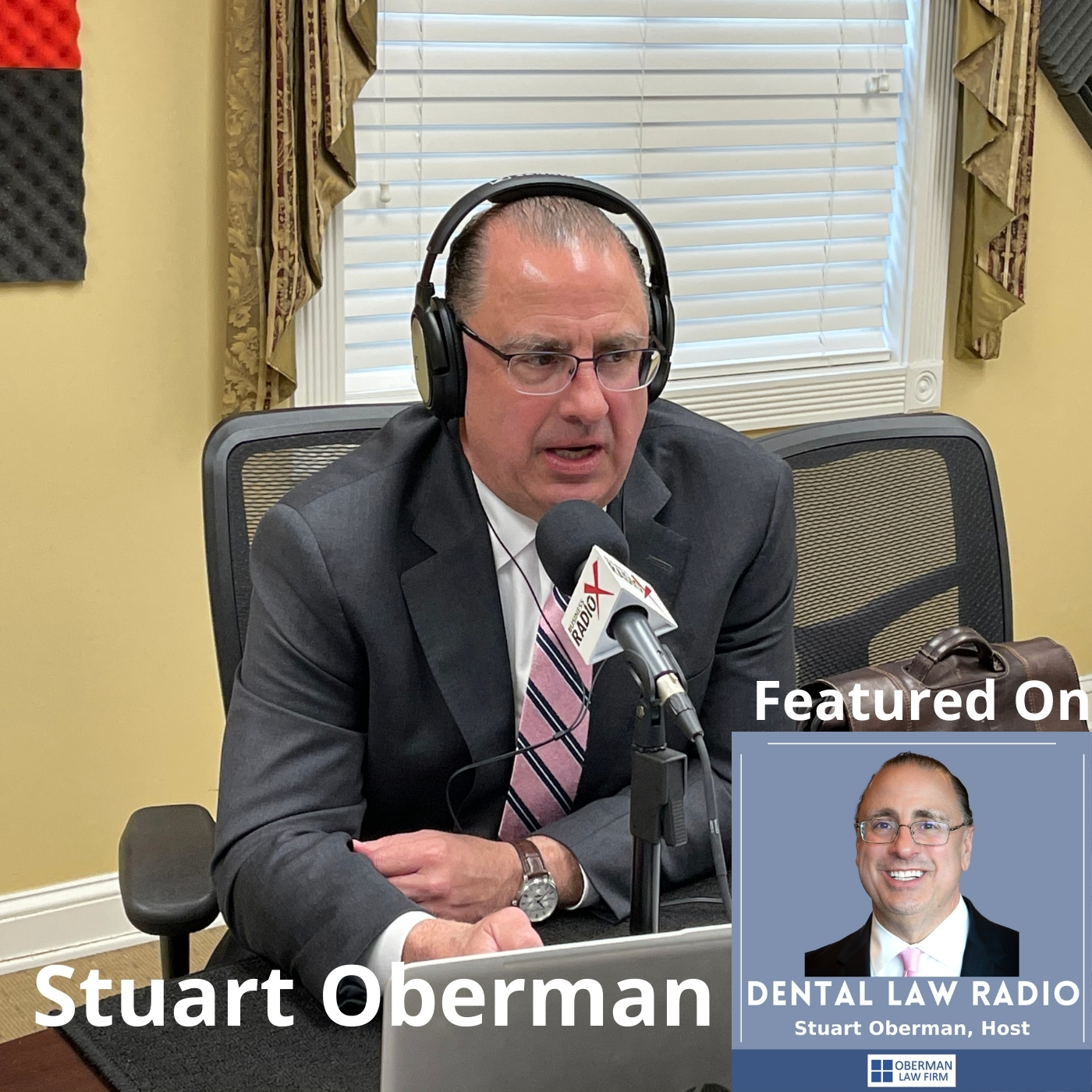
Stuart Oberman, Oberman Law Firm

Oberman Law Firm
Stuart Oberman, host of “Dental Law Radio”

Stuart Oberman is the founder and President of Oberman Law Firm. Mr. Oberman graduated from Urbana University and received his law degree from John Marshall Law School. Mr. Oberman has been practicing law for over 25 years, and before going into private practice, Mr. Oberman was in-house counsel for a Fortune 500 Company. Mr. Oberman is widely regarded as the go-to attorney in the area of Dental Law, which includes DSO formation, corporate business structures, mergers and acquisitions, regulatory compliance, advertising regulations, HIPAA, Compliance, and employment law regulations that affect dental practices.

In addition, Mr. Oberman’s expertise in the health care industry includes advising clients in the complex regulatory landscape as it relates to telehealth and telemedicine, including compliance of corporate structures, third-party reimbursement, contract negotiations, technology, health care fraud and abuse law (Anti-Kickback Statute and the State Law), professional liability risk management, federal and state regulations.

As the long-term care industry evolves, Mr. Oberman has the knowledge and experience to guide clients in the long-term care sector with respect to corporate and regulatory matters, assisted living facilities, continuing care retirement communities (CCRCs). In addition, Mr. Oberman’s practice also focuses on health care facility acquisitions and other changes of ownership, as well as related licensure and Medicare/Medicaid certification matters, CCRC registrations, long-term care/skilled nursing facility management, operating agreements, assisted living licensure matters, and health care joint ventures.

In addition to his expertise in the health care industry, Mr. Oberman has a nationwide practice that focuses on all facets of contractual disputes, including corporate governance, fiduciary duty, trade secrets, unfair competition, covenants not to compete, trademark and copyright infringement, fraud, and deceptive trade practices, and other business-related matters. Mr. Oberman also represents clients throughout the United States in a wide range of practice areas, including mergers & acquisitions, partnership agreements, commercial real estate, entity formation, employment law, commercial leasing, intellectual property, and HIPAA/OSHA compliance.

Mr. Oberman is a national lecturer and has published articles in the U.S. and Canada.

LinkedIn

Oberman Law Firm

Oberman Law Firm has a long history of civic service, noted national, regional, and local clients, and stands among the Southeast’s eminent and fast-growing full-service law firms. Oberman Law Firm’s areas of practice include Business Planning, Commercial & Technology Transactions, Corporate, Employment & Labor, Estate Planning, Health Care, Intellectual Property, Litigation, Privacy & Data Security, and Real Estate.

By meeting their client’s goals and becoming a trusted partner and advocate for our clients, their attorneys are recognized as legal go-getters who provide value-added service. Their attorneys understand that in a rapidly changing legal market, clients have new expectations, constantly evolving choices, and operate in an environment of heightened reputational and commercial risk.

Oberman Law Firm’s strength is its ability to solve complex legal problems by collaborating across borders and practice areas.

Connect with Oberman Law Firm:

Company website | LinkedIn | Twitter
Tagged With: dental practices, dentists, HR, Human Resources, Oberman Law Firm, Stuart Oberman

Overview of Potential Employer Violations

June 11, 2021 by John Ray

employer violations
Dental Law Radio
Overview of Potential Employer Violations
Loading
00:00 /
RSS Feed
Share
Link
Embed

Download file

employer violations

Overview of Potential Employer Violations (Dental Law Radio, Episode 8)

Does your employee manual have a cell phone use policy? What about a social media policy? Do you realize that an increasing number of employees and employment candidates are secretly recording conversations with employers? If your answer to any of these questions is “no,” then you’d better listen to this episode as host Stuart Oberman addressed potential employer violations in these questions and more. Dental Law Radio is underwritten and presented by Oberman Law Firm and produced by the North Fulton studio of Business RadioX®.

TRANSCRIPT

Intro: [00:00:02] Broadcasting from the Business RadioX studios in Atlanta, it’s time for Dental Law Radio. Dental Law Radio is brought to you by Oberman Law Firm, a leading dental-centric law firm serving dental clients on a local, regional and national basis. Now here’s your host, Stuart Oberman.

Stuart Oberman: [00:00:27] Hello, everyone, and welcome. Today’s topic, employer violations, one of the biggest areas that we see problems with in our dental practices day in and day out is employer violations. And what’s happening is employees are getting smart. With the advent of the Internet, they are well aware of compliance issues, what our dental practice owners are and are not allowed to do and where are the pitfalls. And what’s happening is this is evolving so quickly that I just want to run through some basic, basic things that from an employment law standpoint, where do our owners need to be as far as common problems?

Stuart Oberman: [00:01:19] So, one of the most obvious things that we’re seeing is that potential employment candidates are now recording conversations during interviews. So, what’s happening is, is that you have to be very, very, very careful and trained as to the questions you are asking people you are now hiring. I don’t care whether it is a hygienist, your front desk, your office manager, your chief operating officer, your technology person, it doesn’t matter. So, when you interview potential candidates, you have to have a list of questions that you know are in compliance with state and federal law, specifically with federal law. You also should be prepared that you have to have a list of questions that you cannot ask and you cannot go down.

Stuart Oberman: [00:02:27] So, an issue comes up, well, what happens if a candidate opens that door? I always say that if you have to ask whether or not it is correct or not, or I should ask that question or not, it probably is not a question you want to answer, because there’s nothing worse than having a candidate come back to you and say, “Well, you know, I didn’t get the job. I certainly appreciate your time. But the questions that you’re asking me are now in violation of state and federal law. And I think you should be reported.” How are you going to respond to that?

Stuart Oberman: [00:03:05] Also, this is sort of jumping off topic, but what you have to be careful of is that employees, existing employees, are now recording your conversations one on one, whether it’s in staff meetings, whether it’s in huddles, whether it is in disciplinary matters. You have to be very, very careful what you say, how you say it, and who is witnessing what you are saying. I would stress out, always have a particular person in there with you, whether it’d be your office manager or consultant, whoever you choose, to be in the interview with you. And I would be very careful who you’re training to do your interviews.

Stuart Oberman: [00:03:52] So, one thing that we were seeing a little bit of scrutiny of, also, we’ve got a little bit of guidance from the National Labor Relations Board, is that not allowing employees to discuss their pay with co-workers. This is a hot topic because everyone wants to know what everyone else is paid. Obviously, if you are a small company, and you’re overpaying one employee and underpaying another, and all of a sudden, employees find out what their pay structure is, that becomes sort of a mutiny, if you will. And then, the worse part is, is that if you are knowingly has something in writing regarding this particular matter.

Stuart Oberman: [00:04:30] So, there is ways to curtail certain conduct, certain speech, if you will. But if you have a blanket policy in your employee manual that says you are prohibited from discussing pay with your fellow employees, and if you do, you’re going to be fired, I would urge you to have your counsel take a look at that, because that may be in violation of state and federal law and maybe outside the guidance of the National Labor Relations Board. So, you have to be very, very careful.

Stuart Oberman: [00:04:59] So, on a side note, again, going off topic for a second, one of our clients actually owns a couple of dental practices, and they purchased a system of employee manuals that are about five volumes. Well, after I picked myself off the floor when I heard that, there is no way in the world that a dental practice or multiple dental practices are going to, in any way, comply with five volumes of internal regulations. I will tell you this. If you have that many employee manuals, I would shred every manual, and I would get something smaller, condensed, that is thorough, because if you got that kind of manual, that kind of broad compliance that you are complying with, I think you’re asking yourself for trouble.

Stuart Oberman: [00:05:59] Another area is failing to pay overtime. Big, big issues are coming out now. Fair Labor Standards Act. The federal government is part of Labor issuing guidance on this and has has done so in January. There’s a big push now to scrutinize employee versus contractor. This is go back to the IRS rules, I think, from 1987, I believe, where they sent out 20 guidelines, time, place and manner. So, you’ve got to take a look at what’s going on.

Stuart Oberman: [00:06:29] Also, you’ve got to take a look at whether or not you are still conducting working interviews, which are an absolute no-no. If you have a candidate is actually working through a working interview and they’re injured, or you do not to renew their contract, if you will, after a couple of days, or a couple of weeks, or a couple of months of working, you probably have the Department of Labor issues where they’re going to be eligible for unemployment. So, you’ve got to really take a look at that.

Stuart Oberman: [00:07:00] Again, you got to take a look at your end of the contract, you got to take a look how you’re paying your associates, how you’re paying your how hygienists. Are they 1099s? W2s? I think most of CPAs are going to say err on the side of caution, put them under W2. If they are under a 1099, I would urge you to pay their entity and not them directly. We’ve had auditors that have basically said to us in audits that if we are paying an entity and not an individual on a 1099, we wouldn’t be sitting here.

Stuart Oberman: [00:07:33] One thing under this world of of social media, if you will, is that disciplining an employee for complaining about their work on social media. Can you curtail that speech? Yes. Is it a tricky path? Yes. Are you allowed to have regulations? Yes, but it is a very, very fine line as to what social media conduct you can curtail. First and foremost, every employee that you have, I don’t care how long they’ve been there, who they are, they need a nondisclosure agreement because what happens is, is that on the social media part, when you got an employee who leaves, or fired, or discharged, they’re going straight on social media. They’re going to talk about what you do, how you do it, all the good, the bad and the ugly in the practice. There’s not a thing you can do about it, potentially, if you don’t have a nondisclosure agreement.

Stuart Oberman: [00:08:28] So, there’s three things you really need – social media policy, cell phone policy, and internet policy. So, you can curtail certain conduct, you can curtail certain speech if it is detrimental to the practice. Again, you’ve got to be very, very careful what that compliance looks like. And in today’s world, you have to have a policy and procedures for anti-discrimination and anti-hostile working environment. That’s got to be in writing. That has to be outlines as to how that takes place, what the procedures are if it’s violated, whether it is a probationary matter, whether it is a regulatory matter, whether it is a immediate termination.

Stuart Oberman: [00:09:14] So, you’ve got to look at all those things as far as a hostile work environment. And that’s a moving target. So, I would urge you to take a look at your employee manuals, and that has to be in there.

Stuart Oberman: [00:09:28] So, let me tell you one other thing that I think that is becoming critical in today’s cell phone texting world. So, most employees, at some point in their employment career, will be texting you as a practice owner or supervisor, whoever may be listening to the podcast, something about the work, the workplace, what they’re doing, what other people are doing, and you’re going to have some confidential information on your employees cell phone and text messages about your practice.

Stuart Oberman: [00:10:08] So, my question to you is, what happens if that employee is fired or leaves? Where is that information going to go? If you are an employee and it’s on your cell phone, what happens if that employee is fired, and all of a sudden, you’ve got discussions on that particular employee cell phone regarding workers, pay, compliance issues? That’s going public. So, how do you prevent that? Again, non-disclosure agreements.

Stuart Oberman: [00:10:45] Also, one recommendation would be to have a cell phone information destruction policy that if that employee leaves, you, in writing from the employee, certify that they will destroy your information on their cell phone. So, there’s a push right now in technology and employment issues that an employer mandates an app that they create, is installed on an employee’s cell phone. And when that employee is discharged, fired, quits, resigns, whatever it is, that that program will destroy all the information regarding your practice on that employee cell phone.

Stuart Oberman: [00:11:37] I’m going to tell you from a practical standpoint, if I’m an employee, there’s no way you’re putting an app on my cell phone. It’s not going to happen. It’s just not going to happen. So, there needs to be some policy procedure in place that will certify the destruction, specifically with a non-disclosure agreement. Things are shifted by accident to third parties that are potentially detrimental to your practice.

Stuart Oberman: [00:12:07] So, those couple of things are a very, very brief overview to a very complex issue regarding employment law, but I think if you could take the six or seven things, apply them, take a look at what your policies are, take a look what’s your internal operations are, take a look at what you have employee manual-wise, do you have the nondisclosures? Do you have the cell phone, social media, Internet policies? Do you have the employee cell phone destruction data information? How do you have that? Do you have a policy and procedures in place that your employees have to return to you within 48 hours of their termination, quit, resignation, everything that they have that belongs to you? Because I will tell you, if it gets into wrong hands, there’s a lot of governmental regulations that come into play here, and there’s a lot of potential exposure.

Stuart Oberman: [00:12:58] Again, hot topics where we had an employer issues, employee, all this really come about in the last year or two as technology is becoming more and more used in a dental field, as employees are becoming more and more technology savvy, if you will, they understand what’s going on. So, our doctors are going to understand what’s going on now to be one step ahead of that.

Stuart Oberman: [00:13:19] So, again, simple steps, simple things. Take a look at it, take a look where you’re at, policy procedures, take a look at where you need to go implement it, talk to your counsel. If you haven’t talked to your counsel or advisors about this, I would strongly recommend that you do ASAP, because what happens is if you delay, time goes on and things never get better as time goes on. So, hopefully this has helped. And we’ll look forward to seeing you in our next podcast. Have a great day.


About Dental Law Radio

Hosted by Stuart Oberman, a nationally recognized authority in dental law, Dental Law Radio covers legal, business, and other operating issues and topics of vital concern to dentists and dental practice owners. The show is produced by the North Fulton studio of Business RadioX® and can be found on all the major podcast apps. The complete show archive is here.

Stuart Oberman, Oberman Law Firm

Oberman Law Firm
Stuart Oberman, host of “Dental Law Radio”

Stuart Oberman is the founder and President of Oberman Law Firm. Mr. Oberman graduated from Urbana University and received his law degree from John Marshall Law School. Mr. Oberman has been practicing law for over 25 years, and before going into private practice, Mr. Oberman was in-house counsel for a Fortune 500 Company. Mr. Oberman is widely regarded as the go-to attorney in the area of Dental Law, which includes DSO formation, corporate business structures, mergers and acquisitions, regulatory compliance, advertising regulations, HIPAA, Compliance, and employment law regulations that affect dental practices.

In addition, Mr. Oberman’s expertise in the health care industry includes advising clients in the complex regulatory landscape as it relates to telehealth and telemedicine, including compliance of corporate structures, third-party reimbursement, contract negotiations, technology, health care fraud and abuse law (Anti-Kickback Statute and the State Law), professional liability risk management, federal and state regulations.

As the long-term care industry evolves, Mr. Oberman has the knowledge and experience to guide clients in the long-term care sector with respect to corporate and regulatory matters, assisted living facilities, continuing care retirement communities (CCRCs). In addition, Mr. Oberman’s practice also focuses on health care facility acquisitions and other changes of ownership, as well as related licensure and Medicare/Medicaid certification matters, CCRC registrations, long-term care/skilled nursing facility management, operating agreements, assisted living licensure matters, and health care joint ventures.

In addition to his expertise in the health care industry, Mr. Oberman has a nationwide practice that focuses on all facets of contractual disputes, including corporate governance, fiduciary duty, trade secrets, unfair competition, covenants not to compete, trademark and copyright infringement, fraud, and deceptive trade practices, and other business-related matters. Mr. Oberman also represents clients throughout the United States in a wide range of practice areas, including mergers & acquisitions, partnership agreements, commercial real estate, entity formation, employment law, commercial leasing, intellectual property, and HIPAA/OSHA compliance.

Mr. Oberman is a national lecturer and has published articles in the U.S. and Canada.

LinkedIn

Oberman Law Firm

Oberman Law Firm has a long history of civic service, noted national, regional, and local clients, and stands among the Southeast’s eminent and fast-growing full-service law firms. Oberman Law Firm’s areas of practice include Business Planning, Commercial & Technology Transactions, Corporate, Employment & Labor, Estate Planning, Health Care, Intellectual Property, Litigation, Privacy & Data Security, and Real Estate.

By meeting their client’s goals and becoming a trusted partner and advocate for our clients, their attorneys are recognized as legal go-getters who provide value-added service. Their attorneys understand that in a rapidly changing legal market, clients have new expectations, constantly evolving choices, and operate in an environment of heightened reputational and commercial risk.

Oberman Law Firm’s strength is its ability to solve complex legal problems by collaborating across borders and practice areas.

Connect with Oberman Law Firm:

Company website | LinkedIn | Twitter
Tagged With: employee handbook, employer violations, Oberman Law Firm, Stuart Oberman

DSOs and Governmental Investigations

June 4, 2021 by John Ray

DSOs
Dental Law Radio
DSOs and Governmental Investigations
Loading
00:00 /
RSS Feed
Share
Link
Embed

Download file

DSO

DSOs and Governmental Investigations (Dental Law Radio, Episode 7)

As DSOs grow and scale, they are coming under serious federal government scrutiny, in part because some have developed a reputation of being non-compliant. Host Stuart Oberman offers eight compliance-related matters you must get right to scale your DSO successfully and without regulatory setbacks. Dental Law Radio is underwritten and presented by Oberman Law Firm and produced by the North Fulton studio of Business RadioX®.


TRANSCRIPT

Intro: [00:00:02] Broadcasting from the Business RadioX Studios in Atlanta, it’s time for Dental Law Radio. Dental Law Radio is brought to you by Oberman Law Firm, a leading dental-centric law firm serving dental clients on a local, regional, and national basis. Now, here’s your host, Stuart Oberman.

Stuart Oberman: [00:00:25] Hello everyone, and welcome to the show. I want to talk about one of the hottest topics in the industry today, DSOs. I can’t tell you how many calls we get as a firm, how do we grow? How do we scale? How do we get to five practices? How do we get to ten? How do we get to 20? Now, I got 20 practices, how am I going to sell? What’s my multiples? What’s my EBITDA? What’s the calculations?

Stuart Oberman: [00:00:51] But what we’re not hearing a lot about, which is a lot of undertow right now, is DSOs are coming under serious governmental scrutiny. And what’s happened is that, as DSOs grow – now, we’ve got to say what DSOs are. So, I’m going to say the middle market where you have a doctor that owns maybe five to ten practices, that’s a middle market. And they want to grow to be the grandfathers, if you will, of the DSOs.

Stuart Oberman: [00:01:21] So, the DSOs c, if you will. So, what’s happened is that we are seeing an enormous uptick in regulatory investigations, especially those that accept Medicaid and all other state and federal health care programs. So, what’s happened is that, as the governmental payers, state and federal, start auditing the payments to the practices. The OIG, Office of Inspector General, who you never, ever want to get a letter from, is also investigating these particular matters.

Stuart Oberman: [00:02:06] And what’s happening is that we’re seeing a lot of issues regarding Anti-Kickback Statute, improper payments, improper billing, coding. And as the OIG and HHS combined forces for regulatory matters, it’s made it clear that DSOs are, in fact, a target. If you have not discussed with your counsel or advisors how and what the regulatory issues are and what OIG is looking for, then I would suggest that you have a strong conversation over lunch yesterday.

Stuart Oberman: [00:02:45] So, what’s happening is that, as governmental regulatory matters are being investigated further and further by OIG, HHS, we’re seeing more and more companies, DSOs, if you will, enter into what we call CIAs. Now, that doesn’t mean it’s a criminal agency. It stands for Corporate Integrity Agreements. Again, if you are a DSO, if you are a doctor that owns multiple practices, if you are a doctor that has Medicaid or receives other state or federal health care reimbursement, I would strongly suggest you understand what the OIG does, how it tracks with it’s fellow agency, HHS, and what the CIA is, a Corporate Integrity Agreement.

Stuart Oberman: [00:03:40] So, what’s happened is that, as private equity becomes more and more prevalent. They used to say the most expensive thing to get is money. But, now, it’s the cheapest thing to get. So, there’s a huge upswing right now in Medicaid spending for dentistry. And what we’re seeing is that it’s starting to draw a lot of fire. So, what do we do? How do we do it? This conversation is probably a 90 minute conversation, if not a day long compliance conversation. But I want to run through maybe about eight things that we need to take a look at if you are, in fact, a DSO or if you are a doctor looking to scale a DSO.

Stuart Oberman: [00:04:29] So, if you have one practice, you better get your house in order as far as payments go, coding goes. Because as practices grow, they get sloppier with compliance. So, what’s happened is that, again, the first thing we got to realize is that the government is looking hard at DSOs. It’s coming under scrutiny. A DSO has to build a culture of compliance. It’s got to start from the top down.

Stuart Oberman: [00:05:02] So, what does that look like? So, you have to have – third topic – an effective compliance program to begin with in order to implement the policies and procedures that focus on both the quality of care in adherence to governmental regulations. That is a tall task.

Stuart Oberman: [00:05:25] The fourth thing we want to take a look at is – without a doubt, I don’t care if you got one practice or 800 – you have to have a chief compliance officer. And that doesn’t mean that is your front desk person. It doesn’t mean that is your hygienist who moonlights as your office manager, as your front desk, as your consultant. You have to have a chief compliance officer. There’s absolutely no way that as a doctor, you will know what the proper coding is, what the correct procedures are for payment, what the OIG is looking at as far as guidance goes, as far as what the hot buttons are as far as audits go.

Stuart Oberman: [00:06:21] So, how do you do this? So, a lot of DSOs – again, I’m going to use, you know, our DSOs between 2 to 20 practices and maybe even 30 – they have to have a training program for policies and procedures in place. And they can’t do it once. They have to have a continuous review, training, and compliance program.

Stuart Oberman: [00:06:46] Now, I will say that the large-scale DSOs really have a good overall compliance program. But what happens is, that’s a lot of trial and error, that is a lot of missteps along the way. And our middle market guys have got to learn the trials and errors. So, again, this is an ongoing process. You cannot have a one meeting for sterilization and not know what in the world is required for compliance on the payment side, which is critical.

Stuart Oberman: [00:07:28] So, the next part is that – number six – you’ve got to respond to a compliance issue timely. So, when the government says we need this, we need that, you can’t get around to it whenever you need it or whenever you feel like it. We run into so many problems where our doctors do not promptly get under control the particular letter and issues that they’re concerned about. So, how do you have a system for compliance? This is where your chief compliance officer has to come into play.

Stuart Oberman: [00:08:08] If you get a notice that OIG is now sending you I love you letter and they have a probably seven or eight page non-compliance issue, and now they’re clawing back millions of dollars, how do you respond to that? Do you give it to your front desk? Do you give it to your hygienist? Do you give to your spouse who may be your office manager? So, you’ve got to have a system in place. You can never, ever delay a governmental notice.

Stuart Oberman: [00:08:40] So, one thing that has to be a balance is that – this is number seven – all compliance programs have to be designed to ensure quality and medical necessity. So, when your audit occurs and they want to claw back millions of dollars because they’re going back five years. They’re going to want to know where is your proof, where is your documentation, where is your quality of service, where is your code, and is there a medical necessity. That is absolutely critical to your defense. They’re also going to take a look at potentially your vendor relationships. If you’ve never heard of AKS, Anti-Kickback Statute, I would strongly recommend you have a meeting yesterday with your corporate attorney.

Stuart Oberman: [00:09:45] These are just some basic things that we’re looking at. Congress is even getting involved in this, which is never a good thing. Where they’ve made it clear that they are looking at DSOs as a corporate structure. And they are looking at the compliance issue, the reimbursement issue, the quality of care issue, the medical necessity issue very, very, very closely. And when Congress comes out and says this, you know there’s a problem.

Stuart Oberman: [00:10:20] So, the last thing you want to do – and I’ll say this is number eight and probably the final topic on this. Again, I could talk, probably, for hours and days on this particular compliance topic – you have to understand AKS, Anti-Kickback Statute, and you have to understand on the compliance side, audit side, OIG side, HHS side, the safe harbor provisions.

Stuart Oberman: [00:10:45] So, now, you’re thinking, what in the world is AKS and how does that apply to my DSO? Because all I do is I treat kids all day long and I’m looking forward to maximize my revenue through aggressive coding, aggressive treatment. And how does that even come into play with my vendors, my treatment, my care, my coding, my revenue? So, you’ve got to understand all these things.

Stuart Oberman: [00:11:19] And, again, what we’re seeing is that as our offices and doctors scale, this is the last thing they’re worried about is compliance, which this should absolutely be the first. Because if you get an audit and you’re trying to scale, and scale hard and, all of a sudden, you get a nice letter from OIG that says you owe a couple million dollars and you think you’re going to be growing, your practice just stopped dead in its tracks. Because you will spend months and years trying to get this squared away and thousands and thousands and thousands of dollars on attorneys fees, costs, trying to deal with this.

Stuart Oberman: [00:12:03] So, again, we’re getting a lot, a lot of calls all the time, how do I scale how do I grow, what do I need to do, and everything. It’s revenue based. But one of the key issues is revenue is great. And what’s my multiple? That’s great. But my question is, how in the world are you going to scale? Because when you do a transition – and I had a chance to talk about this probably about a month or two ago for the American Health Law Association, I did a speech on due diligence on acquisitions. And this was a huge topic because if you are in the midst of a governmental investigation and you’re trying to even remotely sell your practice, you’re dead in the water.

Stuart Oberman: [00:12:53] Because they’re going to want to know everything about what your risk is, whether or not you’re under a CIA, Corporate Integrity Agreement, what the terms are, and you’re, essentially, going to be untouchable. So, this one particular area could set you back for years and millions of dollars. That’s the last thing you want to do.

Stuart Oberman: [00:13:14] So, again, I could talk for forever on this topic, but this is becoming a hot topic. It’s been hot for a while. It’s getting even hotter as the markets scale. There’s more money than ever flowing into private equity. Compliance is getting sloppy and Congress got its antennas up. Because any time there’s money involved, Congress has got its ears up.

Stuart Oberman: [00:13:38] So, hopefully, this has been a little bit of a refresher if you’re familiar with this. And, hopefully, this has been an eye opening podcast if you’re looking to scale or you have scaled and you’re looking to sell, and then what’s the next steps. So, I’d like to thank everyone for joining us and we’re going to continue talking about our hottest topics in the dental industry. We want everyone have a fantastic day. Thank you.


About Dental Law Radio

Hosted by Stuart Oberman, a nationally recognized authority in dental law, Dental Law Radio covers legal, business, and other operating issues and topics of vital concern to dentists and dental practice owners. The show is produced by the North Fulton studio of Business RadioX® and can be found on all the major podcast apps. The complete show archive is here.

Stuart Oberman, Oberman Law Firm

Oberman Law Firm
Stuart Oberman, host of “Dental Law Radio”

Stuart Oberman is the founder and President of Oberman Law Firm. Mr. Oberman graduated from Urbana University and received his law degree from John Marshall Law School. Mr. Oberman has been practicing law for over 25 years, and before going into private practice, Mr. Oberman was in-house counsel for a Fortune 500 Company. Mr. Oberman is widely regarded as the go-to attorney in the area of Dental Law, which includes DSO formation, corporate business structures, mergers and acquisitions, regulatory compliance, advertising regulations, HIPAA, Compliance, and employment law regulations that affect dental practices.

In addition, Mr. Oberman’s expertise in the health care industry includes advising clients in the complex regulatory landscape as it relates to telehealth and telemedicine, including compliance of corporate structures, third-party reimbursement, contract negotiations, technology, health care fraud and abuse law (Anti-Kickback Statute and the State Law), professional liability risk management, federal and state regulations.

As the long-term care industry evolves, Mr. Oberman has the knowledge and experience to guide clients in the long-term care sector with respect to corporate and regulatory matters, assisted living facilities, continuing care retirement communities (CCRCs). In addition, Mr. Oberman’s practice also focuses on health care facility acquisitions and other changes of ownership, as well as related licensure and Medicare/Medicaid certification matters, CCRC registrations, long-term care/skilled nursing facility management, operating agreements, assisted living licensure matters, and health care joint ventures.

In addition to his expertise in the health care industry, Mr. Oberman has a nationwide practice that focuses on all facets of contractual disputes, including corporate governance, fiduciary duty, trade secrets, unfair competition, covenants not to compete, trademark and copyright infringement, fraud, and deceptive trade practices, and other business-related matters. Mr. Oberman also represents clients throughout the United States in a wide range of practice areas, including mergers & acquisitions, partnership agreements, commercial real estate, entity formation, employment law, commercial leasing, intellectual property, and HIPAA/OSHA compliance.

Mr. Oberman is a national lecturer and has published articles in the U.S. and Canada.

LinkedIn

Oberman Law Firm

Oberman Law Firm has a long history of civic service, noted national, regional, and local clients, and stands among the Southeast’s eminent and fast-growing full-service law firms. Oberman Law Firm’s areas of practice include Business Planning, Commercial & Technology Transactions, Corporate, Employment & Labor, Estate Planning, Health Care, Intellectual Property, Litigation, Privacy & Data Security, and Real Estate.

By meeting their client’s goals and becoming a trusted partner and advocate for our clients, their attorneys are recognized as legal go-getters who provide value-added service. Their attorneys understand that in a rapidly changing legal market, clients have new expectations, constantly evolving choices, and operate in an environment of heightened reputational and commercial risk.

Oberman Law Firm’s strength is its ability to solve complex legal problems by collaborating across borders and practice areas.

Connect with Oberman Law Firm:

Company website | LinkedIn | Twitter
Tagged With: Dental Law Radio, dental service organization, DSO, Oberman Law Firm, Stuart Oberman

How to Avoid HR Problems

May 28, 2021 by John Ray

HR Problems
Dental Law Radio
How to Avoid HR Problems
Loading
00:00 /
RSS Feed
Share
Link
Embed

Download file

HR Problems

How to Avoid HR Problems (Dental Law Radio, Episode 6) 

From an HR perspective, Covid-19 has changed everything for a dental practice; the issues, regulations, and consequences of non-compliance are more complicated than ever. Host Stuart Oberman reviews the “must have” processes needed to avoid HR problems.  Dental Law Radio is underwritten and presented by Oberman Law Firm and produced by the North Fulton studio of Business RadioX®.


TRANSCRIPT

Intro: [00:00:02] Broadcasting from the Business RadioX Studios in Atlanta, it’s time for Dental Law Radio. Dental Law Radio is brought to you by Oberman Law Firm, a leading dental-centric law firm serving dental clients on a local, regional, and national basis. Now, here’s your host, Stuart Oberman.

Stuart Oberman: [00:00:25] Hello everyone and welcome to Dental Law Radio. Oh, our topic today, H.R., H.R., H.R. So, near and dear to our hearts. So, through this whole process, COVID-19, I think it taught us a lot. It let us take a look at what our doctors were and were not doing. And it really exposed a lot of problems. So, you know, what happened in the last year? What happened in the last five years?

Stuart Oberman: [00:00:59] So, anyone who owns a dental practice, works in a dental practice, knows for a fact that H.R. is changing every single day. There are more rules and regulations for employees than we ever had before. There’s more regulatory matters. There’s more problem employees. Employees are harder to deal with. Our doctors are fed up, discouraged with H.R. They can’t find employees. Employees are quitting. Employees are complaining. Tight economic conditions.

Stuart Oberman: [00:01:30] So, you know, where are we at? So, we have to look back at what happened this past year. It really brought a lot of things to the forefront. So, I would tell you, 2020, COVID-19 changed everything in H.R. Pre-COVID-19, what was ignored is now absolutely mandatory. We have states that are getting involved in H.R. like we never seen before. Federal Law is changing daily, it seems like, National Labor Relations Board, EEOC, Federal guidance, IRS, tax changes. You know, it’s a wonder that a lot of our doctors who’ve been practicing for some time, we’ll get these calls and they’ll say, “I’m done. I don’t want to put up with OSHA. I don’t want to put up with HIPAA. I can’t handle the H.R. I’m out of compliance. I need to go.”

Stuart Oberman: [00:02:27] So, what happens is, is that they’re frustrated, and we get it. So, I want to offer a couple of things. We put out a mandatory checklist for our clients. And I would encourage you to send us an email and we’ll send that mandatory checklist for you to you if you email us and request it. So, that’s mandatory checklists review, what you need on a daily basis to review.

Stuart Oberman: [00:03:04] So, another thing that we looked at is the hiring process, H.R. This exposed a lot of things. We had some practices that had a 70 to 80 percent turnover rate. If you don’t have an H.R. process and onboarding process in place, and you’ve got turnover at 70, 80 percent, for whatever reason, you are in a world of hurt, as we say. You’ve got to have an onboarding process. So, what we’ve developed is a new employee checklist. Again, at the end of today’s podcast, I’ll give information out on how to reach out to us and get that from us requested. If you need it, it’s there for you. If you need a mandatory checklist, it’s there for you.

Stuart Oberman: [00:03:51] So, the H.R. process we talked about, you know, in prior podcasts is a simple, simple process. I don’t want our guys to – I say our guys – I want our dentists to really go out on a deep end because it’s simple things, small things. You eat an elephant one bite at a time. You can’t overhaul a massive system. You’ve got to have a guideline on how to do this.

Stuart Oberman: [00:04:19] So, one of the things we stressed before, employee manual, got to have it. There’s no question you’ve got to have it. We mentioned before, social media, cell phone, internet policy, nondisclosure agreements, non- solicitation agreements. If you think your employees, if you think your associates, if you think your hygienist won’t steal your information from you when you leave or when they leave the practice, you are sadly mistaken. Because I will assure you, those are the first things that go. So, all those have got to be buttoned up and they got to be tight.

Stuart Oberman: [00:04:53] Employee files – I can’t stress this enough – you got to keep track of your employee files, reviews, negative, positive, review process. Do you even have a process in place for reviewing employees? And I know I said this before and I’ll say it many times through this podcast series, employees should never ever, in a million years, have control of their personnel files. Because I will guarantee you, you get an employee fired, that file goes with them. You’ll never see that file again. You need to have a limited access on your personnel files.

Stuart Oberman: [00:05:32] And I say that because our doctors call us all the time, you know, “John left. Mary left. They were fired,” or “we terminated them.” Great. So, where’s their file? Let’s see it. “Well, we can’t find it. We don’t know where they all went to.” That’s a huge problem. You’ve lost a battle. Period.

Stuart Oberman: [00:05:54] So, what are your practice policies? Internal operations? What are your processes? Success? You have people, processes, and systems. What’s the process? Again, do you have a recruiting or hiring process? What does that look like? Do you have an on boarding process? How are you recruiting? How are you handling complaints? Do you have a reporting process? Do you have a mechanism for them to file complaints against you internally before it goes to a third party?

Stuart Oberman: [00:06:38] Classifications, we talked about this earlier, previous podcast. Are you an employee? Are you an independent contractor? You’ve got to know these classifications because they’re detrimental to your practice if you don’t. What are the benefits? How are they being distributed? Are they equal? What is your OSHA and HIPAA policy? Are your manuals out of date? All these are compliance issues. All those things that you absolutely need to know.

Stuart Oberman: [00:07:09] So, on our are mandatory checklists that we have for review – I’ll be glad to send them out. Just let us know if you want one – that’s a pretty detailed process for what you need to review internally and a new employee checklist. So, I want to touch on new employees real quick. So, we all hear about the dental practices that recycle employees. If you go to some websites and you type in a name today that you saw, you’re going to see that same name in a year, six months. There is a whole mechanism for employees that are really bad, but they’re being recycled. The problem with that is, you could see who’s hiring them is not doing their due diligence. They’re not doing the background checks.

Stuart Oberman: [00:07:59] We had a particular employee – I’m sorry – employer that we discovered they hired employee without coming in with a full background check. We said, “We came in too late. You need to do a background check and have a process in place.” So, they did a letter of offer. They went ahead and offered the person the position. Come to find out, three days later a report comes back, they got a bankruptcy, they got a couple of felonies, assaulting an officer, drugs. Now, what do you do? Do you tell the employee who just told their employer that I’m no longer offered a job. What do you do?

Stuart Oberman: [00:08:51] So, those are things you’ve got to control. You’ve got to have an on boarding process. You know, why have an employee that has embezzled four other practices and you’re hiring them for accounting? Check the resumes, check the resources, do the background checks. For $100 dollars, you can make your life very, very easy. And our doctors don’t do that. And they hire because they need a body and that’s a disaster waiting to happen. That’s an H.R. nightmare.

Stuart Oberman: [00:09:25] So, you know, I want to go off topic a little bit. But if you got a disgruntled employee that’s leaving, put that employee under wraps, if you will. That employee needs to be given a severance, especially if they got dirt on the practice. You need to get them to sign a release. So, once they are paid X, Y, Z, dollars, whatever it is, as a severance. “Well, they’re not due a severance.” I get that. But what are you going to do if they got dirt on the practice and all of a sudden they start making inklings that they’re going to go to OSHA, HIPAA, Department of Labor, because you’re not paying them for overtime, they’re misclassified, they’re not exempt, they’re exempt.

Stuart Oberman: [00:10:10] So then, what do you do? You need to shut down that employee. You need to go ahead and get them under release. So, once they have been compensated, they sign a release, they can’t go forward with any other claims. And if they have a claim that has been withdrawn, they can’t go on social media, provided that you even have a social media policy. If you don’t, then the release will cover that. These are things you’ve got to do. In today’s world, these are the check downs that you have to have. And if you don’t, then, all of a sudden, we get these calls, and the cycle starts. And then, it’s damage control. Then, we’ve got things going on the internet, which we’re going to talk about in subsequent podcasts. And it becomes a snowball effect.

Stuart Oberman: [00:10:58] So, these are the basic things. Again, before COVID-19, you know, our doctors weren’t necessarily exposed unless something happened. But COVID-19 hits, now, we’ve got all these regulatory issues. We’ve got all these problem employees. We’ve got employees refusing to come to work. Employees that quit. We’ve got turnover. We’ve got H.R. problems. And, now, it’s exposed. The curtains down. So, you’ve got to make sure that you’ve got all the stuff done, checked down, in compliance. Because we’re in a different world, we’re in different time, and it’s not going to get any better. It’s not going to get any better. And you have to have a system in place as we go forward. People, processes, and systems, got to have it to avoid trouble in today’s world. It’s getting tough. It’s getting tougher every day.

Stuart Oberman: [00:11:43] So, again, as I say, 10,000 foot view. You know, this is a whole topic for an hour discussion, but we’re going to break it down to some things we think that are really needed in today’s market. So, anyway, if you have any questions, please call us, 770-554-1400. Visit us online, obermanlaw.com, stuart@obermanlaw.com, S-T-U-A-R-T@obermanlaw.com. And reach out to us, ask for the checklist, we’ll be glad to send it out, get you on a mailing list, keep you up to date. So, I’d like to wish everyone a fantastic day. And we look forward to having you join us on subsequent podcasts. Thanks a lot. Bye.


About Dental Law Radio

Hosted by Stuart Oberman, a nationally recognized authority in dental law, Dental Law Radio covers legal, business, and other operating issues and topics of vital concern to dentists and dental practice owners. The show is produced by the North Fulton studio of Business RadioX® and can be found on all the major podcast apps. The complete show archive is here.

Stuart Oberman, Oberman Law Firm

Oberman Law Firm
Stuart Oberman, host of “Dental Law Radio”

Stuart Oberman is the founder and President of Oberman Law Firm. Mr. Oberman graduated from Urbana University and received his law degree from John Marshall Law School. Mr. Oberman has been practicing law for over 25 years, and before going into private practice, Mr. Oberman was in-house counsel for a Fortune 500 Company. Mr. Oberman is widely regarded as the go-to attorney in the area of Dental Law, which includes DSO formation, corporate business structures, mergers and acquisitions, regulatory compliance, advertising regulations, HIPAA, Compliance, and employment law regulations that affect dental practices.

In addition, Mr. Oberman’s expertise in the health care industry includes advising clients in the complex regulatory landscape as it relates to telehealth and telemedicine, including compliance of corporate structures, third-party reimbursement, contract negotiations, technology, health care fraud and abuse law (Anti-Kickback Statute and the State Law), professional liability risk management, federal and state regulations.

As the long-term care industry evolves, Mr. Oberman has the knowledge and experience to guide clients in the long-term care sector with respect to corporate and regulatory matters, assisted living facilities, continuing care retirement communities (CCRCs). In addition, Mr. Oberman’s practice also focuses on health care facility acquisitions and other changes of ownership, as well as related licensure and Medicare/Medicaid certification matters, CCRC registrations, long-term care/skilled nursing facility management, operating agreements, assisted living licensure matters, and health care joint ventures.

In addition to his expertise in the health care industry, Mr. Oberman has a nationwide practice that focuses on all facets of contractual disputes, including corporate governance, fiduciary duty, trade secrets, unfair competition, covenants not to compete, trademark and copyright infringement, fraud, and deceptive trade practices, and other business-related matters. Mr. Oberman also represents clients throughout the United States in a wide range of practice areas, including mergers & acquisitions, partnership agreements, commercial real estate, entity formation, employment law, commercial leasing, intellectual property, and HIPAA/OSHA compliance.

Mr. Oberman is a national lecturer and has published articles in the U.S. and Canada.

LinkedIn

Oberman Law Firm

Oberman Law Firm has a long history of civic service, noted national, regional, and local clients, and stands among the Southeast’s eminent and fast-growing full-service law firms. Oberman Law Firm’s areas of practice include Business Planning, Commercial & Technology Transactions, Corporate, Employment & Labor, Estate Planning, Health Care, Intellectual Property, Litigation, Privacy & Data Security, and Real Estate.

By meeting their client’s goals and becoming a trusted partner and advocate for our clients, their attorneys are recognized as legal go-getters who provide value-added service. Their attorneys understand that in a rapidly changing legal market, clients have new expectations, constantly evolving choices, and operate in an environment of heightened reputational and commercial risk.

Oberman Law Firm’s strength is its ability to solve complex legal problems by collaborating across borders and practice areas.

Connect with Oberman Law Firm:

Company website | LinkedIn | Twitter
Tagged With: Dental Law Radio, HR, Human Resources, Oberman Law Firm, Stuart Oberman

How to Mitigate the Risk of Lawsuits

May 14, 2021 by John Ray

Mitigate Lawsuits
Dental Law Radio
How to Mitigate the Risk of Lawsuits
Loading
00:00 /
RSS Feed
Share
Link
Embed

Download file

Mitigate Lawsuits

How to Mitigate the Risk of Lawsuits (Dental Law Radio, Episode 4)

Host Stuart Oberman covers the basic internal procedures necessary to mitigate the risk of lawsuits in a dental practice.  Dental Law Radio is underwritten and presented by Oberman Law Firm and produced by the North Fulton studio of Business RadioX®.

TRANSCRIPT

Intro: [00:00:02] Broadcasting from the Business RadioX Studios in Atlanta, it’s time for Dental Law Radio. Dental Law Radio is brought to you by Oberman Law Firm, a leading dental-centric law firm serving dental clients on a local, regional, and national basis. Now, here’s your host, Stuart Oberman.

Stuart Oberman: [00:00:27] Hello everyone and welcome to Dental Law Radio. So, today, is going to be an interesting topic. So, as a law firm in the dental space, if you will, we have clients in about 28 states, all the way from California, Maine to Florida, and we get this question over and over and over again. How do I mitigate my risks of lawsuits?

Stuart Oberman: [00:00:55] That’s a wide topic. You got all kinds of issues to look at. You’ve got State Department of Labor, you’ve got Federal Department of Labor, you’ve got IRS, you’ve got EEOC. You have lawyers breathing down your neck for certain regulatory matters because employees’ rights have been violated. So, you know, what is the risks of a lawsuit?

Stuart Oberman: [00:01:25] And I would say it’s probably a failure to have internal proper procedures in place. What does that mean? On a 10,000 foot view, do I have an employee manual? Do I have nondisclosure agreements? Do I have cell phone, internet, policies, social media policies? Am I in compliance with the National Labor Relations Board? Am I in compliance with my State and Federal law? There’s really a couple things that you really need to have. And we’re going to talk about this on subsequent podcasts, but I want to maybe drill down on some specifics regarding employee manual because these are critical.

Stuart Oberman: [00:02:14] Every practice should have an employee manual. “Well, I’ve got one, you know, John gave it to me when I bought his practice. And, yeah, it’s not bad. You know, it’s 29 pages. It’s a little old. But I wrote on it. And I think we got employees sign over good.” Or, “You know, I went on the internet and I bought one.” Great. Great. Well, how’s that working out for you?

Stuart Oberman: [00:02:43] So, if you have an employee manual that you’ve got from someone, trash it. If you bought a practice and you implemented the employee manual that you now scratch outs or had on a Word document that is 15 years old and you decided to put different names on it, scrap it, shred it, it’s garbage. You’re going to need an up to date employee manual that has a couple of things. If your employee manual in today’s world is less than 70, 80, 90 – I think our employee manual that we draft for dental doctors on dental sides is, probably, 100 some pages – job descriptions, acknowledgments, nondisclosure agreements, all that’s got to be included. Social media, cell phone, internet policies got to be included.

Stuart Oberman: [00:03:31] So, what are some of the things that we see really need to be within these employee manuals? Again, we’re just touching on some stuff. So, one of the things that in today’s world, in today’s media world, in today’s society, you have to have non-harassment provisions. There’s no question about it. If you do not have provisions regarding harassment, regarding sex, color, creed, origin, nationality, then you are opening yourself up to a huge, huge problem. Anti-discrimination statute language should be included in your employee manual. Again, these are basics in a world within which we live. Anti-retaliation, a previous podcast we talked about OSHA, HIPAA, whistleblower. What to do if you’re fired?

Stuart Oberman: [00:04:31] In your employee manual, do you have a process for probation? Do you have a process for reporting complaints? Do you have someone in your practice – I don’t care how big you are – that is a go-to person for complaints. If you’re a doctor, chances are they’re not going to want to report to you directly regarding any kind of internal issues. You need to have a point person designated in your practice that has the authority to take down the investigation. Do you have an anonymous reporting process? And, again, I don’t care whether you’re a 20 practice owner or one practice owner.

Stuart Oberman: [00:05:16] Next one, Family Medical Leave Act. How many employees do you have? Does it even apply? There are some instances that you will say I do not need a Family Medical Leave Act. And you have to sign a document to the government that says that you do not comply or do not have to comply with the Family Medical Leave Act, because they just don’t believe you. The Emergency Paid Sick Leave Act. The Emergency Family Act. Especially in today’s world under COVID, a Medical Leave Expansion Act under FFCRA if you’re under 500 employees.

Stuart Oberman: [00:05:58] I could probably talk about this topic for about three hours on this one particular area, what it takes to have an employee manual. But you’ve got to be very careful on this area. So, the next question is, “Well, you know, I got a manual and a company gave it to me and it’s five volumes.” I’m going to be really honest with you, if you can comply with a five volume employee manual, I need to come work for you. Because I have never seen that before. And we’ll look at manuals and it will be three, four, five volumes of employee manual. How in the world can you be in compliance on that side?

Stuart Oberman: [00:06:42] It’s very basic things that will keep you out of trouble. If you’re required under your massive war and peace novel of employee manuals, there’s no way. You got too much liability, you got too many holes that it is impossible for you to comply with. Keep it short. Keep it simple. Basic stuff. Basic information. And that is probably one of the biggest ways that will keep you out of the EEOC, Department of Labor, National Labor Relations Board, governmental investigations.

Stuart Oberman: [00:07:25] So, again, it’s the basic stuff. A lot of times our doctors will get way, way complex. They don’t need it. They’re being sold stuff they don’t need, which happens a lot. So, we need to be real careful with that. So, it’s the little things that will keep you out of trouble. It’s not, you know, recreating the world, but it’s simply one wheel at a time to get you there. So, again, that’s 10,000 foot view.

Stuart Oberman: [00:07:52] We see a lot on our side. We handle as a firm a lot of H.R. issues. We see what works. We see what doesn’t. It’s a moving target between state to state. It’s a moving target between employee to employee. And it’s a moving target in today’s regulatory matters. So, hopefully, you’ve taken away, you know, one thing that you need to look at to avoid H.R. issues, to avoid any kind of compliance issues, which is understanding basic employee manual, why you need it, why you don’t. We talked about HIPAA and OSHA before, so this is all part of that particular puzzle. So, again, quick topic today, just enough to give you a 10,000 foot view, as we say.

Stuart Oberman: [00:08:37] So, I want to thank everyone for joining us today on Dental Law Radio. If you have any questions, if you have any concerns, reach out to us. Give us a call, 770-554-1400. Or send an email, stuart, S-T-U-A-R-T, @obermanlaw.com. And we hope that you will join us on subsequent podcasts. And our goal is to keep you up to date in the industry, leading edge, cutting edge information. So, thank you everyone. Have a fantastic day. And we look forward to talking to you soon. Thank you.


About Dental Law Radio

Hosted by Stuart Oberman, a nationally recognized authority in dental law, Dental Law Radio covers legal, business, and other operating issues and topics of vital concern to dentists and dental practice owners. The show is produced by the North Fulton studio of Business RadioX® and can be found on all the major podcast apps. The complete show archive is here.

Stuart Oberman, Oberman Law Firm

Oberman Law Firm
Stuart Oberman, host of “Dental Law Radio”

Stuart Oberman is the founder and President of Oberman Law Firm. Mr. Oberman graduated from Urbana University and received his law degree from John Marshall Law School. Mr. Oberman has been practicing law for over 25 years, and before going into private practice, Mr. Oberman was in-house counsel for a Fortune 500 Company. Mr. Oberman is widely regarded as the go-to attorney in the area of Dental Law, which includes DSO formation, corporate business structures, mergers and acquisitions, regulatory compliance, advertising regulations, HIPAA, Compliance, and employment law regulations that affect dental practices.

In addition, Mr. Oberman’s expertise in the health care industry includes advising clients in the complex regulatory landscape as it relates to telehealth and telemedicine, including compliance of corporate structures, third-party reimbursement, contract negotiations, technology, health care fraud and abuse law (Anti-Kickback Statute and the State Law), professional liability risk management, federal and state regulations.

As the long-term care industry evolves, Mr. Oberman has the knowledge and experience to guide clients in the long-term care sector with respect to corporate and regulatory matters, assisted living facilities, continuing care retirement communities (CCRCs). In addition, Mr. Oberman’s practice also focuses on health care facility acquisitions and other changes of ownership, as well as related licensure and Medicare/Medicaid certification matters, CCRC registrations, long-term care/skilled nursing facility management, operating agreements, assisted living licensure matters, and health care joint ventures.

In addition to his expertise in the health care industry, Mr. Oberman has a nationwide practice that focuses on all facets of contractual disputes, including corporate governance, fiduciary duty, trade secrets, unfair competition, covenants not to compete, trademark and copyright infringement, fraud, and deceptive trade practices, and other business-related matters. Mr. Oberman also represents clients throughout the United States in a wide range of practice areas, including mergers & acquisitions, partnership agreements, commercial real estate, entity formation, employment law, commercial leasing, intellectual property, and HIPAA/OSHA compliance.

Mr. Oberman is a national lecturer and has published articles in the U.S. and Canada.

LinkedIn

Oberman Law Firm

Oberman Law Firm has a long history of civic service, noted national, regional, and local clients, and stands among the Southeast’s eminent and fast-growing full-service law firms. Oberman Law Firm’s areas of practice include Business Planning, Commercial & Technology Transactions, Corporate, Employment & Labor, Estate Planning, Health Care, Intellectual Property, Litigation, Privacy & Data Security, and Real Estate.

By meeting their client’s goals and becoming a trusted partner and advocate for our clients, their attorneys are recognized as legal go-getters who provide value-added service. Their attorneys understand that in a rapidly changing legal market, clients have new expectations, constantly evolving choices, and operate in an environment of heightened reputational and commercial risk.

Oberman Law Firm’s strength is its ability to solve complex legal problems by collaborating across borders and practice areas.

Connect with Oberman Law Firm:

Company website | LinkedIn | Twitter

Tagged With: dental practice management, dental practices, employees, employment manuals, lawsuits, Oberman Law Firm, Stuart Oberman

Whistleblower Employees

May 7, 2021 by John Ray

Whistleblower Employees
Dental Law Radio
Whistleblower Employees
Loading
00:00 /
RSS Feed
Share
Link
Embed

Download file

Whistleblower Employees

Whistleblower Employees (Dental Law Radio, Episode 3)

On this edition of Dental Law Radio, Stuart Oberman discussed problem employees who file complaints with OSHA and HIPAA, the preemptive actions a practice owner should take, how to handle the situation once a complaint has been filed, and much more.  Dental Law Radio is underwritten and presented by Oberman Law Firm and produced by the North Fulton studio of Business RadioX®.

TRANSCRIPT

Intro: [00:00:02] Broadcasting from the Business RadioX Studios in Atlanta, it’s time for Dental Law Radio. Dental Law Radio is brought to you by Oberman Law Firm, a leading dental-centric law firm serving dental clients on a local, regional, and national basis. Now, here’s your host, Stuart Oberman.

Stuart Oberman: [00:00:27] Hello, everyone. And welcome to Dental Law Radio. We’re going to cover two topics today that really have surfaced in the last couple of months. For the last couple of years, they really have been, I would say, on the rise. But with COVID-19, as I said before in previous podcasts, I don’t necessarily harp on COVID-19, so I think we’re ready to come out of that particular scenario – there’s a lot of lessons learned. And I think that that particular period of time, which is still ongoing, has really taught our doctors a lot of lessons.

Stuart Oberman: [00:01:06] So, one of the things that we’ve really, really want to harp on today is compliance and employees. You know, I’ve said before that the patients are easy. The employees can be very problematic at times. And I’ve heard a saying from one of our employees, practice of dentistry would be a fantastic career. But, again, those are different things that we want to take a look at. So, what are we talking about today? What’s on the topic today? What’s hot? What are we developing? OSHA and HIPAA whistleblower.

Stuart Oberman: [00:01:38] So, I’ve been talking about this for a while on the road, you know, before all this. But what’s happened is that, as I said before in a previous podcast, problem employees are going three places, OSHA, HIPAA, Department of Labor, State and Federal. So, your problem employees are going to file complaints with OSHA and HIPAA. The question is, how do you deal with that? What do you do when you get that nasty letter that says you have committed a whistleblower violation, or an OSHA violation, or HIPAA violation? So, how do you get to an OSHA whistleblower? And what in the world is a whistleblower?

Stuart Oberman: [00:02:24] So, we think a whistleblower, we think massive corporations, you know, the guys in the internal side that are complaining to the government that this is not correct, this is not correct, over expenditures here, this is wrong, this is wrong, compliance issues, violations of the law. But, really, in our dental practices, it’s simply employees who complain for whatever reason. A lot of it is disgruntled employees who are not happy with their pay, their circumstances, and they’re going to get even, and they’re going to file a complaint with OSHA or HIPAA for whatever reason.

Stuart Oberman: [00:02:59] So, the question is, you get these letters – as we talked about on a previous podcast, you have a system in place. And if not, you need to get one very quickly on how to respond to this. So, what happens is, you get this letter from either OSHA or HIPAA. You got a certain time period to respond. You have certain things that you need to do. And you’re going to know – depending on how big your practice is – right away who did it. Who complained to the government, you’re going to know. If not, you’re going to find out very quickly.

Stuart Oberman: [00:03:32] Of course, what’s going to happen is you’re going to be absolutely livid at that employee for filing a complaint against you when you’ve taken care of that employee, you give them all the raises. But for some reason, you got a complaint. Now, you’ve got to deal with it.

Stuart Oberman: [00:03:49] So, provided you have a process in place, you will respond to it. Hopefully, you will get counsel to do that, and not have your consultant do it or have a staff member do it. But you’ll get outside professional counsel to do it on the legal side that understands how to do it.

Stuart Oberman: [00:04:06] So, you will work that investigation. And the question is, you are absolutely livid to this employee who filed this complaint. And you’re going to get even. Bad thing to do. Bad thing to do. Wrong thing to do. Detrimental thing to do. So, under federal rules, the whistleblower statute, you cannot retaliate against an employee. So, what does that mean? That means you can’t fire them. You can’t demote them. You can’t lay them off.

Stuart Oberman: [00:04:38] Now, that does not mean that they have lifetime employment. But if they’re already a problem employee in a perfect world, you’ve already got an HR file on them. And if I don’t touch on it on subsequent podcasts, your employees should never have access to their own personal files. That is your lock and key. They should never take care of their own personnel file.

Stuart Oberman: [00:05:07] So, what happens is, on the whistleblower, you’re going to get mad, you’re going to get even, you want to go fire this employee and say “You’re fired.” Or better yet, “You’re demoted. I’m cutting your hours,” whatever it is. Now, the problem is that, if that occurs solely because they filed a complaint, you now have violated Federal Law under the federal whistleblower statute. So, that becomes a mess.

Stuart Oberman: [00:05:30] So then, what happens is now you get into the Solicitor General’s office where they send you a nasty letter that you now are under federal investigation for violation of the whistleblower statute. Which is, 99 percent of the time, if you handle an OSHA complaint correctly, it’s going to be a process, but usually it’s settled, it’s worked out well. You take the correction action. You go down the road.

Stuart Oberman: [00:05:59] The problem is, is that when you have a whistleblower issue because you fired, demoted, or laid an employee off, or cut hours, whatever it is because they filed a complaint, now you’re in a whole different realm. Now, all of a sudden, you are under the whistleblower statute. So, you’re going to be investigated by the Solicitor General, which is never good. Never good. Now, you’ve got another governmental agency investigating you.

Stuart Oberman: [00:06:28] Look, at the end of the day, a lot of the complaints are dismissed. Investigators get it. It’s a disgruntled employee, there’s no cause. But if they find that you have violated the federal whistleblower statute – now, I will tell you this, this goes to any industry that has OSHA or HIPAA. I know we’re talking dental specific, but this is any industry, whether it’s trucking or whether it’s some other kind of industry or business, this applies. So, this is across career lines.

Stuart Oberman: [00:07:05] So, again, they dismiss complaints or they do the investigation and they dismiss the complaint, and you’re done. But the problem is that, if they find that you violated the federal statute. So, what happens? So, you’re responsible for the employees back wages, which is never good. Or they require that you reinstate the employee. First, you got to understand this, you didn’t like the employee when they were there. You hated them when they filed the whistleblower complaint. And, now, you’ve got to bring them back because the feds say you’ve got to bring them back. And you got to reimburse the employee the attorney’s fees, which is very expensive sometimes, very, very expensive.

Stuart Oberman: [00:07:46] So, what’s the takeaway? Again, we’re looking at a 10,000-foot view as to what occurs. One, if you have an OSHA or HIPAA complaint, first and foremost, as I said in previous podcasts, you’ve got to have process in place to respond to it. Then, what happens is, when you get it, you’ve got to handle it correctly.

Stuart Oberman: [00:08:09] If you’re going to have an employee discipline matter while you have a whistleblower matter going on or OSHA or HIPAA complaint going on, you better have good reason to discipline an employee. That should be well documented previously. All employee problems should be documented. All employee problems should be of record. Signed by the employee on HR side. So, this way, if you are under investigation for OSHA or HIPAA violations and you fire the employee, you’ve got something that says this is not lifetime employment. And that we need to get rid of this employee for a lot of reasons.

Stuart Oberman: [00:08:54] So, the processes is, that once you get it, understand it, do not take a knee jerk reaction and fire the employee, demote. Talk to counsel, get guidance on how to handle this, what to do with it. And proceed with great caution. So, again, that’s a 10,000-foot overview on where we’re going with this and what we wanted to do.

Stuart Oberman: [00:09:17] We’ve talked about this for a lot of time, a lot of years. But we’re seeing an enormous increase in this. Now, one thing you’ll need to do is make sure that you’ve got your HIPAA issues under control for your patient flow of information. Encryptions, authorizations to get medical information, that’s a whole another topic for a whole another day. But we want to keep it on a high level with the whistleblower violation matters.

Stuart Oberman: [00:09:46] So, again, process, process, process, understand what you’re doing, understand the complexities, get guidance on these matters. Do not try to handle it yourself. Do not delegate it. This is something that doctors, or especially sole practitioners, need to get this done. So, that’s going to conclude our podcast today on OSHA and whistleblower allegations.

Stuart Oberman: [00:10:12] So, we want to thank you for joining Dental Law Radio. If you want to reach out to us or contact our firm, please feel free to do so. Please visit also dentallawradio.com, Oberman Law Firm at 770-554-1400. Or if you want to, send me an email, stuart@obermanlaw.com. Thank you again so much for joining us. We hope you just took one bit of information away. And if you did, it’s a complete success. Have a fantastic day. And we’ll look forward to talking to you soon on subsequent podcasts. Thank you very much. Have a great day.


About Dental Law Radio

Hosted by Stuart Oberman, a nationally recognized authority in dental law, Dental Law Radio covers legal, business, and other operating issues and topics of vital concern to dentists and dental practice owners. The show is produced by the North Fulton studio of Business RadioX® and can be found on all the major podcast apps. The complete show archive is here.

Stuart Oberman, Oberman Law Firm

Oberman Law Firm
Stuart Oberman, host of “Dental Law Radio”

Stuart Oberman is the founder and President of Oberman Law Firm. Mr. Oberman graduated from Urbana University and received his law degree from John Marshall Law School. Mr. Oberman has been practicing law for over 25 years, and before going into private practice, Mr. Oberman was in-house counsel for a Fortune 500 Company. Mr. Oberman is widely regarded as the go-to attorney in the area of Dental Law, which includes DSO formation, corporate business structures, mergers and acquisitions, regulatory compliance, advertising regulations, HIPAA, Compliance, and employment law regulations that affect dental practices.

In addition, Mr. Oberman’s expertise in the health care industry includes advising clients in the complex regulatory landscape as it relates to telehealth and telemedicine, including compliance of corporate structures, third-party reimbursement, contract negotiations, technology, health care fraud and abuse law (Anti-Kickback Statute and the State Law), professional liability risk management, federal and state regulations.

As the long-term care industry evolves, Mr. Oberman has the knowledge and experience to guide clients in the long-term care sector with respect to corporate and regulatory matters, assisted living facilities, continuing care retirement communities (CCRCs). In addition, Mr. Oberman’s practice also focuses on health care facility acquisitions and other changes of ownership, as well as related licensure and Medicare/Medicaid certification matters, CCRC registrations, long-term care/skilled nursing facility management, operating agreements, assisted living licensure matters, and health care joint ventures.

In addition to his expertise in the health care industry, Mr. Oberman has a nationwide practice that focuses on all facets of contractual disputes, including corporate governance, fiduciary duty, trade secrets, unfair competition, covenants not to compete, trademark and copyright infringement, fraud, and deceptive trade practices, and other business-related matters. Mr. Oberman also represents clients throughout the United States in a wide range of practice areas, including mergers & acquisitions, partnership agreements, commercial real estate, entity formation, employment law, commercial leasing, intellectual property, and HIPAA/OSHA compliance.

Mr. Oberman is a national lecturer and has published articles in the U.S. and Canada.

LinkedIn

Oberman Law Firm

Oberman Law Firm has a long history of civic service, noted national, regional, and local clients, and stands among the Southeast’s eminent and fast-growing full-service law firms. Oberman Law Firm’s areas of practice include Business Planning, Commercial & Technology Transactions, Corporate, Employment & Labor, Estate Planning, Health Care, Intellectual Property, Litigation, Privacy & Data Security, and Real Estate.

By meeting their client’s goals and becoming a trusted partner and advocate for our clients, their attorneys are recognized as legal go-getters who provide value-added service. Their attorneys understand that in a rapidly changing legal market, clients have new expectations, constantly evolving choices, and operate in an environment of heightened reputational and commercial risk.

Oberman Law Firm’s strength is its ability to solve complex legal problems by collaborating across borders and practice areas.

Connect with Oberman Law Firm:

Company website | LinkedIn | Twitter
Tagged With: dental practices, dentists, HIPAA, HIPAA complaints, HIPAA whistleblower, Oberman Law Firm, OSHA, OSHA whistleblower, OSHAA complaints, Stuart Oberman, Whistleblower Employees

COVID-19 and OSHA Compliance

April 30, 2021 by John Ray

OSHA Compliance
Dental Law Radio
COVID-19 and OSHA Compliance
Loading
00:00 /
RSS Feed
Share
Link
Embed

Download file

OSHA Compliant

COVID-19 and OSHA Compliance (Dental Law Radio, Episode 2)

On this episode of Dental Law Radio, host Stuart Oberman discusses current issues in OSHA compliance resulting from the COVID-19 pandemic, the risks of non-compliance for dental practice owners, and much more. Dental Law Radio is underwritten and presented by Oberman Law Firm and produced by the North Fulton studio of Business RadioX®.

TRANSCRIPT

Intro: [00:00:02] Broadcasting from the Business RadioX Studios in Atlanta, it’s time for Dental Law Radio. Dental Law Radio is brought to you by Oberman Law Firm, a leading dental-centric law firm serving dental clients on a local, regional, and national basis. Now, here’s your host, Stuart Oberman.

Stuart Oberman: [00:00:26] And welcome everyone to Dental Law Radio. Today’s topic, COVID-19, OSHA Compliant. So, during this whole period of about a year, what we saw was a massive, massive, massive problems with OSHA. You know, I would say this is not your father’s OSHA. And I’ve thought about this for a while where, you know, years ago we’re worried about bloodborne pathogens and needle sticks and how to dispose of items. All those are important. But what’s happened is, is through this whole process, our doctors have developed and continue to develop staff problems.

Stuart Oberman: [00:01:06] So, what happens is, I always tell our doctors, “Disgruntled employees are going three places in the medical field, OSHA, HIPAA, Department of Labor, State and Federal.” So, what happens is that our doctors, historically, botch how to handle OSHA complaints. And a lot of times they are easily handled if you get a grip on it pretty quick. But what happens is, you get the letter, they don’t know where to go, what to do. The office manager doesn’t know what to do because she’s not trained. The staff doesn’t know. Because now, all of a sudden, you’ve got the Hygiene Department, who’s your office manager, who definitely has not been trained on OSHA what to do.

Stuart Oberman: [00:01:52] So, I don’t care how big you are, whether you’re one practice, 300,000, or 40 practices, 40 million, you’ve got to have an OSHA system for regulatory matters. So, we want to talk a little bit about today as to what you do, and we’re seeing an uptick of this more so than we’ve ever seen before.

Stuart Oberman: [00:02:14] You know, through the COVID period – I know everyone’s trying to move out of the COVID period. But I think we got to look back and say, “Hey, what happened? What didn’t work? What worked?” – on the OSHA side, one of our biggest areas that we saw was our doctors were not compliant. They didn’t know how to deal with it. They didn’t have a system when they were running normal, if you will. And they definitely didn’t have a system during COVID-19, especially when they were shut down.

Stuart Oberman: [00:02:41] So, what happens to this whole process of getting an OSHA complaint? What is it? So, you’re going to get a letter from OSHA. OSHA is a massive governmental agency. A bureaucracy that if it’s not handled correctly, you’re going to have some problems to deal with it, and you got to have a system in place. So, depending on how many locations you have, you’re going to get a letter to that location. Now, if it is in relation to a different location and it goes to the wrong location, you got to make sure it gets there.

Stuart Oberman: [00:03:17] We have one particular case, our doctor had three or four locations. It took three weeks to get from point A to point B. That can’t happen. That’s a disaster. So, what’s going to happen is, you’re going to get an OSHA letter. It’s going to be how is this going to be reported. And, generally, you have about five days to respond.

Stuart Oberman: [00:03:35] So, I’m going to go out on a limb that most of OSHA problems can be very easily corrected with a simple process of responding correctly. What does that mean? That means, one, you’ve got to get the document very quickly in your possession. You’ve got to get a handle on the investigation, and it is an internal investigation. So then, you have to go ahead and get your supporting documents. Which a lot of times when doctors are in a mess, they can’t find the photographs, they can’t find anything.

Stuart Oberman: [00:04:05] So then, you got to figure out what’s your corrective action. You’ve got to let OSHA know what is your corrective action. And if you don’t have a corrective action, then they will usually tell you what your corrective action is, which is never ever good. When a governmental agency tells you, one, you’ve got a problem and, two, we’re going to tell you how to fix it, that’s not good. So, we don’t want that to occur.

Stuart Oberman: [00:04:27] So, what happens if you fail to respond and you have to respond? My advice is that, a doctor, office manager, no one internally should ever respond to an OSHA complaint. That, honestly, is the responsibility of counsel. You’ve got to be experienced in this how to respond, what to respond to, what they’re looking for, what they’re not looking for. And if it’s not within the counsel’s wheelhouse, now, you’ve got two problems. One, you’re under investigation. Two, counsel botched the investigation.

Stuart Oberman: [00:05:03] So, what happens if you fail to respond? If you fail to respond, it’s very simple. The government’s going to come in there and they’re going to start digging. And when you got the government coming in and digging on anything, that’s never good. So, they’re going to want a couple of things right off the bat. They’re going to want to know your injury and illness reports. And most doctors have no idea what that is. They’ve never completed it before. We’re lucky if they have an OSHA manual that’s now 20 years old.

Stuart Oberman: [00:05:29] So then, you got to have up to date hazard communication, which is mandated. And then, again, most of our doctors have no idea what that is. It’s been in the manual 20 years ago they bought from an organization, they have no idea what it is. Then, what’s your PPE, personal protective equipment? Where’s that at? Is it up to date? That’s a huge concern. And I think it’s a concern going forward as a whole.

Stuart Oberman: [00:05:55] Our doctors did enormous job on illness ratios. The COVID-19 reports that were coming out that the dental practices, for the most part, were in about the 90 percent range of having no problems whatsoever, and that’s a huge credit. And we’re not out of the woods yet. But I don’t want to harp on COVID-19. I want to harp on the process of what needs to be done and what’s been learned.

Stuart Oberman: [00:06:22] So then, they want to know what your bloodborne pathogens procedures are. They want to confirm your entry point. They want to know what tag outs are or lockouts are. So, those are all the things you’re going to have to address. So, what do we need to do? One, you’ve got to make sure that your OSHA manual is up to date. If it’s not up to date, you need to get it up to date. And I don’t mean, you know, five years. I mean within, like, 12 months from your last publication.

Stuart Oberman: [00:06:59] Be careful what you do if you buy it from an organization, that they don’t just give you a manual and say, “Here. Open it and you’re good to go.” They have to be custom-made. Be careful what you have, because a lot of the online publications are simply statutory codes, which have no relevance whatsoever as to how to handle things day-to-day. So, it’s got to be curtailed. Get an OSHA manual. Your employees got to be trained. They got to be trained. And you’ve got to have an internal process on how to handle the complaints. It’s not if, but it’s when you’re going to get a complaint. And a process is how do I handle it? What do I do? Who do I go to? How quick do we need to get it resolved?

Stuart Oberman: [00:07:38] Because as these fires continue to stay open, the flames get hotter. And the more they dig, the more problems you’re going to have. And the key is to keep the government out of your practices as quickly as possible and out of your life as possible.

Stuart Oberman: [00:07:53] So, those are a couple of things. You know, those are a couple of things we looked at that we’re seeing a lot of things on. And if any takeaways from this, it’s have a process. Understand what the process is, figure it out. It’s not complex. Take a few minutes, train, procedures, internal matters. Those of all have got to be done correctly, succinctly, and in great detail. So, again, a couple of things, 10,000 foot view on what we need to do on OSHA.

Stuart Oberman: [00:08:26] We’re going to be talking maybe one or two other things on OSHA that I’ve been talking about for a while, that we’ve been seeing an enormous rise on for the last couple of months. So, again, thank you for joining us today at dentallawradio.com. And if you want to contact us, please feel free to do so. Our main number is 770-554-1400. Or send me an email, stuart, S-T-U-A-R-T,@obermanlaw.com. And keep joining us and we’re going to try to provide as much relevant content going forward as is possible. Have a fantastic day and thanks again for joining us.

About Dental Law Radio

Hosted by Stuart Oberman, a nationally recognized authority in dental law, Dental Law Radio covers legal, business, and other operating issues and topics of vital concern to dentists and dental practice owners. The show is produced by the North Fulton studio of Business RadioX® and can be found on all the major podcast apps. The complete show archive is here.

Stuart Oberman, Oberman Law Firm

Oberman Law Firm
Stuart Oberman, host of “Dental Law Radio”

Stuart Oberman is the founder and President of Oberman Law Firm. Mr. Oberman graduated from Urbana University and received his law degree from John Marshall Law School. Mr. Oberman has been practicing law for over 25 years, and before going into private practice, Mr. Oberman was in-house counsel for a Fortune 500 Company. Mr. Oberman is widely regarded as the go-to attorney in the area of Dental Law, which includes DSO formation, corporate business structures, mergers and acquisitions, regulatory compliance, advertising regulations, HIPAA, Compliance, and employment law regulations that affect dental practices.

In addition, Mr. Oberman’s expertise in the health care industry includes advising clients in the complex regulatory landscape as it relates to telehealth and telemedicine, including compliance of corporate structures, third-party reimbursement, contract negotiations, technology, health care fraud and abuse law (Anti-Kickback Statute and the State Law), professional liability risk management, federal and state regulations.

As the long-term care industry evolves, Mr. Oberman has the knowledge and experience to guide clients in the long-term care sector with respect to corporate and regulatory matters, assisted living facilities, continuing care retirement communities (CCRCs). In addition, Mr. Oberman’s practice also focuses on health care facility acquisitions and other changes of ownership, as well as related licensure and Medicare/Medicaid certification matters, CCRC registrations, long-term care/skilled nursing facility management, operating agreements, assisted living licensure matters, and health care joint ventures.

In addition to his expertise in the health care industry, Mr. Oberman has a nationwide practice that focuses on all facets of contractual disputes, including corporate governance, fiduciary duty, trade secrets, unfair competition, covenants not to compete, trademark and copyright infringement, fraud, and deceptive trade practices, and other business-related matters. Mr. Oberman also represents clients throughout the United States in a wide range of practice areas, including mergers & acquisitions, partnership agreements, commercial real estate, entity formation, employment law, commercial leasing, intellectual property, and HIPAA/OSHA compliance.

Mr. Oberman is a national lecturer and has published articles in the U.S. and Canada.

LinkedIn

Oberman Law Firm

Oberman Law Firm has a long history of civic service, noted national, regional, and local clients, and stands among the Southeast’s eminent and fast-growing full-service law firms. Oberman Law Firm’s areas of practice include Business Planning, Commercial & Technology Transactions, Corporate, Employment & Labor, Estate Planning, Health Care, Intellectual Property, Litigation, Privacy & Data Security, and Real Estate.

By meeting their client’s goals and becoming a trusted partner and advocate for our clients, their attorneys are recognized as legal go-getters who provide value-added service. Their attorneys understand that in a rapidly changing legal market, clients have new expectations, constantly evolving choices, and operate in an environment of heightened reputational and commercial risk.

Oberman Law Firm’s strength is its ability to solve complex legal problems by collaborating across borders and practice areas.

Connect with Oberman Law Firm:

Company website | LinkedIn | Twitter
Tagged With: COVID-19, dental practie, Oberman Law Firm, OSHA, OSHA compliance, OSHA compliant, Stuart Oberman

Teledentistry

April 30, 2021 by John Ray

Teledentistry
Dental Law Radio
Teledentistry
Loading
00:00 /
RSS Feed
Share
Link
Embed

Download file

Teledentistry

Teledentistry (Dental Law Radio, Episode 1)

On the premier episode of Dental Law Radio, host Stuart Oberman surveyed various modalities of teledentistry, regulatory issues, the risks of “store and forward” or asynchronous teledentistry, and much more. Dental Law Radio is underwritten and presented by Oberman Law Firm and produced by the North Fulton studio of Business RadioX®.

TRANSCRIPT

Intro: [00:00:02] Broadcasting from the Business RadioX Studios in Atlanta, it’s time for Dental Law Radio. Dental Law Radio is brought to you by Oberman Law Firm, a leading dental-centric law firm serving dental clients on a local, regional, and national basis. Now, here’s your host, Stuart Oberman.

Stuart Oberman: [00:00:26] Hello everyone, and welcome to Dental Law Radio. There is so much going on in the industry that it’s hard to pick a topic that is really top of mind. There’s probably 11 or 12 topics that we’re going to cover on this podcast. But I think today, with the advent of COVID-19, one of the biggest areas that we’ve really, really seen explode is teledentistry. It’s been, you know, out in the collateral side for a couple of years now. But I think that with COVID-19 and all of the issues that surrounded that, I think the most relevant topic today is teledentistry, and it is absolutely here to stay.

Stuart Oberman: [00:01:07] So, we get a lot of questions, you know, what is tele dentistry? And how does it affect us? And what are the modalities? So, I want to run through a couple of things really to give a 10,000 foot view of what teledentistry is and some of the things that are really the complexities of it. This is probably a four hour topic, but we’re going to keep it brief today. And we can sort of expand out, you know, in other podcasts. But I think today we’re just going to give a 10,000 foot view as to where we’re at on it.

Stuart Oberman: [00:01:35] So, you know, teledentistry in the United States has exploded. With the advent of COVID-19, like I said before, teledentistry is going faster than ever. It provides faster care. The concept was originally to keep patients out of the emergency rooms, which it certainly has done. But, you know, there’s a lot, a lot of state regulatory issues. No matter what state you’re in, I’ll venture to say it’s going to be different. And each board is different. Each state regulatory is different. For the health care side, what’s expected was not expected. But we’re going to cover some of the modalities in a little bit.

Stuart Oberman: [00:02:11] So, what are the concerns when you jump into teledentistry? You know, what are the concerns? Obviously, compliance. You’ve got HIPAA issues, you’ve got licensing issues, credentialling. You’ve got technology, which is changing every day it seems like. And then, of course, what’s the malpractice exposure, which is really yet to be explored. But, you know, like I said from the start, it’s here to stay. It’s not going anywhere. And the question is, how do our doctors want to implement this into their practice?

Stuart Oberman: [00:02:43] And the bottom line is, it’s either you adopt it or you don’t and you’re left behind. So, you know, we get this question, what are the modalities? So, what are the modalities? You know, what are the different types of teledentistry and how do we implement it? So, you’ve got a couple of things.

Stuart Oberman: [00:03:02] You’ve got live video, which the term of art is synchronous. So, synchronous, in it of itself, is live two-way interaction where the provider is using audiovisual technology. There are so many ways nowadays to provide this technology. If you’re going on your iPhone, we’ve got iPads, we’ve got everything imaginable that can have literally two-way conversation. And I think to limit yourself to one particular way to adopt that technology, I think, you’re hurting your own cause.

Stuart Oberman: [00:03:36] So, one of the most popular and probably one of the most dangerous ones to really implement because of regulatory matters is probably what we call Store and Forward. Store and Forward which is asynchronous. So, the asynchronous side is transmission of recorded health information, X-rays, photographs, video. This is where you have got to be compliant. You can’t even begin to do these modalities if you’re not in compliance.

Stuart Oberman: [00:04:05] So, again, under the asynchronous, basically, it’s digital impressions through a secured electronic communications systems to a dentist. Basically, it’s where the dentist goes onto a platform, as if it’s a waiting room, and literally picks up patient data. And then, it’s reviewed and then there is communication with the patient. The problem is, is that this is not face-to-face. It’s delayed communication. And my concern on this particular modality is the loss of transmission. If you’re just emailing patients back and forth, I think you’ve got some regulatory issues, that you’ve got some concerns that you need to address. And then, I think that you’ve got to determine what your purpose is as far as these two modalities.

Stuart Oberman: [00:04:53] So then, you know, on a third modality, you’ve got Remote Patient Monitoring, what we call an acronym of RPM. So, this is basically personal health and medical collection data from an individual in one location via electronic communication. So, this is transmitted to a dentist in a different location. You know, for years, years, and years, our dentists getting information on their computers, laptops, iPhones, iPads. And this is sort of bringing it to a whole another secured level where this has to be done on a secured platform. We’ve got patient information is coming back and forth and it’s got to be encrypted. So, there are a lot, a lot of security issues, a lot of technical issues, that I think have outgrown the iPhone concept because of the complexities.

Stuart Oberman: [00:05:53] So then, your final modality is your mobile health or mHealth, which is mobile communication by cell phones, tablets, and other forms of electronic devices. So, that’s pretty simple in it of itself. But you have to determine how that is going to be done, whether you’re going to be getting information off of a platform, whether you’re going to be setting up face-to-face meetings with your patients, which we always recommend for regulatory compliance issues.

Stuart Oberman: [00:06:20] So, you know, in today’s world where our doctors are asking, “Well, we’re not going to render care for teledentistry, but we want to use it as a screening method for our patients.” So, I want to give a couple of examples of how our clients have implemented this during COVID-19. You can use a screen process in multiple ways.

Stuart Oberman: [00:06:45] Example, so a lot of our doctors had questions regarding COVID. And I’ll use that as sort of the nowadays thing. But, you know, this may change as we open up, as we get the shots, as other things come about, and there’s always going to be the next problem. So, the question is, how do I take this right now with what we’re talking about and implement that down the road?

Stuart Oberman: [00:07:12] So, example, so here’s some questions. So, you have your patient come in your office. And in the lobby, you’re asking them questions. Well, my question is, “Why can’t you do this via remote communication?” I mean, you can ask this clearly over communications, over the internet, direct access. So, do you have a fever, cough, shortness of breath? Now, are you going to have a patient come into your office and ask him that question, when you could screen these through the use of teledentistry? Have you been tested for COVID? has a family member been tested? Have you been exposed to anyone with symptoms of COVID-19?

Stuart Oberman: [00:07:48] Again, there’s certain areas of the country, you know, obviously, the northeast is a little bit tighter. In the south, we say that COVID never hit the south. But, you know, things out west was a little bit tighter. So, these are things you got to implement. You know, again, a question, have you traveled to another country? Are you a health care worker, in a high risk job, law enforcement, trucking, grocery store? You know, in some aspects in some states, teledentistry can be used to prescribe antibiotics and pain medication. Again, that’s going to depend on your state law. That’s going to depend on the process for keeping your patients out of the H.R. These are some very, very, very generic discussions regarding teledentistry.

Stuart Oberman: [00:08:37] But as practices grow, as technology becomes more and more accessible, as security becomes better, as the process becomes better, it’s going to be clunky at first. To grow, to stay at the top of patient care, you’re going to have to implement teledentistry at some point. And that will depend on the state law or how you develop your practice, provide patient care, patient service.

Stuart Oberman: [00:09:10] You know, one way to use teledentistry is if you have a patient that is constantly having problems after a surgery. Let’s say, you got a bad root canal and you’re having trouble with the B2 canal. Well, why not get on teledentistry and talk to that patient face-to-face? It’s great to do email. A lot of times our doctors will use their staff members to do this, which becomes sort of problematic because then there’s ongoing problems.

Stuart Oberman: [00:09:39] Cut to the chase. Get on one-on-one with the patient, direct communication, figure out what the problem is, and get it done. Because as these problems go on, “Well, I’m busy. I don’t have time to bring them in. My patient is booked.” You need to get them in. And one way to do this is get them over the internet, get them on the screen, talk to them, see their emotions, see what the problems are. And maybe something is not even related to you. But this is one aspect of teledentistry where you can clearly, clearly help that patient care.

Stuart Oberman: [00:10:14] And then, we’re seeing a lot of our doctors use teledentistry as a customer service tool, confirming appointments, any concerns, pre-screens, insurance information. Sometimes you’re just not going to get it over the phone, you need to see it. A lot of times in our office, we’ll do some remote Zoom calls and we got the documents to share a screen in front of us. So, develop those technologies. It is all for patient care. That’s what it’s about. That’s what you’re in the business for, at the end of the day, is patient care and provide the best possible service you can.

Stuart Oberman: [00:10:47] So, those are just a couple of things that we want to touch base on teledentistry. Again, we can talk hours on teledentistry. But this will give our guys a good overview, a good 10,000 foot view. So, we’re going to be covering other areas in a podcast that we feel relevant, top of mind, and, really, on the forefront of a lot of things. But that’s going to conclude our podcast for today.

Stuart Oberman: [00:11:14] Again, these segments are going to be relatively brief. We want to go ahead and get everything at the forefront, get our doctors thinking about everything, what’s going on. But you can check out other podcasts at dentallawradio.com. And if you need to get in touch with us, you know, reach out, give us a call. Call our main number, 770-554-1400, Oberman Law Firm. Or send an email to me directly, Stuart, S-T-U-A-R-T, @obermanlaw.com. And I want to thank everyone for joining us today. We want to continue these podcasts and bring relevant information top of mind that’s happening every day in our dental practices which we have access to. And we look forward to seeing you on the radio, as we say. Have a great day. Thank you.

About Dental Law Radio

Hosted by Stuart Oberman, a nationally recognized authority in dental law, Dental Law Radio covers legal, business, and other operating issues and topics of vital concern to dentists and dental practice owners. The show is produced by the North Fulton studio of Business RadioX® and can be found on all the major podcast apps. The complete show archive is here.

Stuart Oberman, Oberman Law Firm

Oberman Law Firm
Stuart Oberman, host of “Dental Law Radio”

Stuart Oberman is the founder and President of Oberman Law Firm. Mr. Oberman graduated from Urbana University and received his law degree from John Marshall Law School. Mr. Oberman has been practicing law for over 25 years, and before going into private practice, Mr. Oberman was in-house counsel for a Fortune 500 Company. Mr. Oberman is widely regarded as the go-to attorney in the area of Dental Law, which includes DSO formation, corporate business structures, mergers and acquisitions, regulatory compliance, advertising regulations, HIPAA, Compliance, and employment law regulations that affect dental practices.

In addition, Mr. Oberman’s expertise in the health care industry includes advising clients in the complex regulatory landscape as it relates to telehealth and telemedicine, including compliance of corporate structures, third-party reimbursement, contract negotiations, technology, health care fraud and abuse law (Anti-Kickback Statute and the State Law), professional liability risk management, federal and state regulations.

As the long-term care industry evolves, Mr. Oberman has the knowledge and experience to guide clients in the long-term care sector with respect to corporate and regulatory matters, assisted living facilities, continuing care retirement communities (CCRCs). In addition, Mr. Oberman’s practice also focuses on health care facility acquisitions and other changes of ownership, as well as related licensure and Medicare/Medicaid certification matters, CCRC registrations, long-term care/skilled nursing facility management, operating agreements, assisted living licensure matters, and health care joint ventures.

In addition to his expertise in the health care industry, Mr. Oberman has a nationwide practice that focuses on all facets of contractual disputes, including corporate governance, fiduciary duty, trade secrets, unfair competition, covenants not to compete, trademark and copyright infringement, fraud, and deceptive trade practices, and other business-related matters. Mr. Oberman also represents clients throughout the United States in a wide range of practice areas, including mergers & acquisitions, partnership agreements, commercial real estate, entity formation, employment law, commercial leasing, intellectual property, and HIPAA/OSHA compliance.

Mr. Oberman is a national lecturer and has published articles in the U.S. and Canada.

LinkedIn

Oberman Law Firm

Oberman Law Firm has a long history of civic service, noted national, regional, and local clients, and stands among the Southeast’s eminent and fast-growing full-service law firms. Oberman Law Firm’s areas of practice include Business Planning, Commercial & Technology Transactions, Corporate, Employment & Labor, Estate Planning, Health Care, Intellectual Property, Litigation, Privacy & Data Security, and Real Estate.

By meeting their client’s goals and becoming a trusted partner and advocate for our clients, their attorneys are recognized as legal go-getters who provide value-added service. Their attorneys understand that in a rapidly changing legal market, clients have new expectations, constantly evolving choices, and operate in an environment of heightened reputational and commercial risk.

Oberman Law Firm’s strength is its ability to solve complex legal problems by collaborating across borders and practice areas.

Connect with Oberman Law Firm:

Company website | LinkedIn | Twitter
Tagged With: dental law, dentistry, Oberman Law Firm, Stuart Oberman, teledentistry

Stuart Oberman, Oberman Law Firm

April 27, 2021 by John Ray

Oberman Law Firm
North Fulton Business Radio
Stuart Oberman, Oberman Law Firm
Loading
00:00 /
RSS Feed
Share
Link
Embed

Download file

Oberman Law Firm

Stuart Oberman, Oberman Law Firm (North Fulton Business Radio, Episode 350)

Stuart Oberman of Oberman Law Firm represents dental practice owners across the US and is considered the go-to attorney for dental practices. He joined host John Ray to discuss current issues and trends in the industry and introduced his new show, Dental Law Radio. “North Fulton Business Radio” is produced virtually from the North Fulton studio of Business RadioX® in Alpharetta.

 Oberman Law Firm

Oberman Law Firm has a long history of civic service, noted national, regional, and local clients, and stands among the Southeast’s eminent and fast-growing full-service law firms. Oberman Law Firm’s areas of practice include Business Planning, Commercial & Technology Transactions, Corporate, Employment & Labor, Estate Planning, Health Care, Intellectual Property, Litigation, Privacy & Data Security, and Real Estate.

By meeting their client’s goals and becoming a trusted partner and advocate for our clients, their attorneys are recognized as legal go-getters who provide value-added service. Their attorneys understand that in a rapidly changing legal market, clients have new expectations, constantly evolving choices, and operate in an environment of heightened reputational and commercial risk.

Oberman Law Firm’s strength is its ability to solve complex legal problems by collaborating across borders and practice areas.

Company website | LinkedIn | Stuart’s LinkedIn | Facebook | Twitter

Stuart Oberman, Founder and President, Oberman Law Firm

Oberman Law Firm
Stuart Oberman, President, Oberman Law Firm

Stuart J. Oberman is the founder and President of Oberman Law Firm. Mr. Oberman graduated from Urbana University and received his law degree from John Marshall Law School. Mr. Oberman has been practicing law for over 25 years, and before going into private practice, Mr. Oberman was in-house counsel for a Fortune 500 Company.

Mr. Oberman is widely regarded as the go-to attorney in the area of Dental Law, which includes DSO formation, corporate business structures, mergers and acquisitions, regulatory compliance, advertising regulations, HIPAA, Compliance, and employment law regulations that affect dental practices.

In addition, Mr. Oberman’s expertise in the health care industry includes advising clients in the complex regulatory landscape as it relates to telehealth and telemedicine, including compliance of corporate structures, third-party reimbursement, contract negotiations, technology, health care fraud, and abuse law (Anti-Kickback Statute and the State Law), professional liability risk management, federal and state regulations.

As the long-term care industry evolves, Mr. Oberman has the knowledge and experience to guide clients in the long-term care sector with respect to corporate and regulatory matters, assisted living facilities, continuing care retirement communities (CCRCs). In addition, Mr. Oberman’s practice also focuses on health care facility acquisitions and other changes of ownership, as well as related licensure and Medicare/Medicaid certification matters, CCRC registrations, long-term care/skilled nursing facility management, operating agreements, assisted living licensure matters, and health care joint ventures.

In addition to his expertise in the health care industry, Mr. Oberman has a nationwide practice that focuses on all facets of contractual disputes, including corporate governance, fiduciary duty, trade secrets, unfair competition, covenants not to compete, trademark and copyright infringement, fraud and deceptive trade practices, and other business-related matters.

Mr. Oberman also represents clients throughout the U.S. in a wide range of practice areas, including mergers & acquisitions, partnership agreements, commercial real estate, entity formation, employment law, commercial leasing, intellectual property, and HIPAA/OSHA compliance.

Mr. Oberman is a national lecturer and has published articles in the U.S. and Canada. In addition, Mr. Oberman has received the Martindale-Hubbell Client Distinction Award, which is based on client review ratings of communications ability, responsiveness, and quality of service.

Questions and Topics in this Interview:

  • Stuart’s background
  • Why his firm has a focus on the dental industry
  • Pressures on dental practice owners
  • Selling a practice
  • Stuart’s new show, Dental Law Radio

“North Fulton Business Radio” is hosted by John Ray and produced virtually from the North Fulton studio of Business RadioX® in Alpharetta. You can find the full archive of shows by following this link. The show is available on all the major podcast apps, including Apple Podcasts, Spotify, Google, Amazon, iHeart Radio, Stitcher, TuneIn, and others.

Renasant Bank has humble roots, starting in 1904 as a $100,000 bank in a Lee County, Mississippi, bakery. Since then, Renasant has grown to become one of the Southeast’s strongest financial institutions with over $13 billion in assets and more than 190 banking, lending, wealth management and financial services offices in Mississippi, Alabama, Tennessee, Georgia and Florida. All of Renasant’s success stems from each of their banker’s commitment to investing in their communities as a way of better understanding the people they serve. At Renasant Bank, they understand you because they work and live alongside you every day.

Tagged With: dental industry, dental law, Dental Law Radio, dentists, Health care, healthcare industry, Oberman Law Firm, Stuart Oberman

  • « Previous Page
  • 1
  • …
  • 7
  • 8
  • 9
  • 10
  • Next Page »

Business RadioX ® Network


Our Most Recent Episode

CONNECT WITH US

  • Email
  • Facebook
  • LinkedIn
  • Twitter

  • YouTube

Our Mission

We help local business leaders get the word out about the important work they’re doing to serve their market, their community, and their profession.

We support and celebrate business by sharing positive business stories that traditional media ignores. Some media leans left. Some media leans right. We lean business.

Sponsor a Show

Build Relationships and Grow Your Business. Click here for more details.

Partner With Us

Discover More Here

Terms and Conditions
Privacy Policy

Connect with us

Want to keep up with the latest in pro-business news across the network? Follow us on social media for the latest stories!
  • Email
  • Facebook
  • Google+
  • LinkedIn
  • Twitter

  • YouTube

Business RadioX® Headquarters
1000 Abernathy Rd. NE
Building 400, Suite L-10
Sandy Springs, GA 30328

© 2025 Business RadioX ® · Rainmaker Platform

BRXStudioCoversLA

Wait! Don’t Miss an Episode of LA Business Radio

BRXStudioCoversDENVER

Wait! Don’t Miss an Episode of Denver Business Radio

BRXStudioCoversPENSACOLA

Wait! Don’t Miss an Episode of Pensacola Business Radio

BRXStudioCoversBIRMINGHAM

Wait! Don’t Miss an Episode of Birmingham Business Radio

BRXStudioCoversTALLAHASSEE

Wait! Don’t Miss an Episode of Tallahassee Business Radio

BRXStudioCoversRALEIGH

Wait! Don’t Miss an Episode of Raleigh Business Radio

BRXStudioCoversRICHMONDNoWhite

Wait! Don’t Miss an Episode of Richmond Business Radio

BRXStudioCoversNASHVILLENoWhite

Wait! Don’t Miss an Episode of Nashville Business Radio

BRXStudioCoversDETROIT

Wait! Don’t Miss an Episode of Detroit Business Radio

BRXStudioCoversSTLOUIS

Wait! Don’t Miss an Episode of St. Louis Business Radio

BRXStudioCoversCOLUMBUS-small

Wait! Don’t Miss an Episode of Columbus Business Radio

Coachthecoach-08-08

Wait! Don’t Miss an Episode of Coach the Coach

BRXStudioCoversBAYAREA

Wait! Don’t Miss an Episode of Bay Area Business Radio

BRXStudioCoversCHICAGO

Wait! Don’t Miss an Episode of Chicago Business Radio

Wait! Don’t Miss an Episode of Atlanta Business Radio