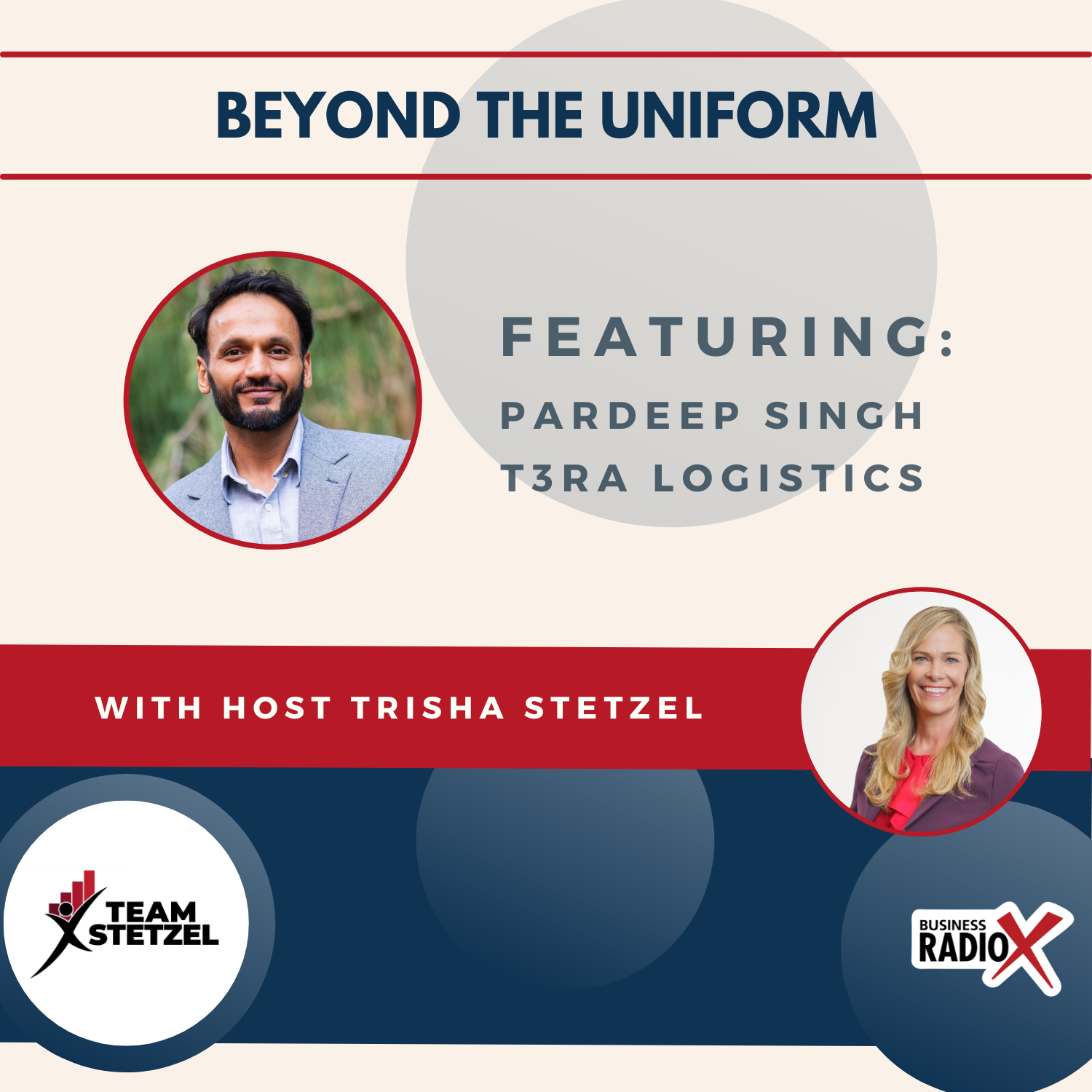


 Pardeep Singh is a U.S. military veteran and the co-founder of T3RA Logistics, a veteran-owned logistics firm dedicated to delivering precision-driven, technology-powered freight solutions.
Founded in 2021, T3RA was built on the values of service, discipline, and adaptability—traits deeply rooted in Pardeep’s military background and translated into a thriving entrepreneurial journey.
In his conversation with Trisha, Pardeep shared his transition from military service to business leadership, emphasizing the power of leveraging military-acquired skills in the civilian world.
He detailed his experience as a serial entrepreneur and seed investor, and how those ventures paved the way for the founding of T3RA Logistics. The company now serves as a key freight brokerage with a global footprint, focused on delivering seamless logistics solutions for businesses while actively hiring and uplifting fellow veterans.
Pardeep also spoke about his commitment to supporting transitioning service members, encouraging them to take advantage of veteran-focused career programs.
He highlighted T3RA’s efforts not only in business expansion but also in building community through mentorship, advocacy, and veteran hiring initiatives—cementing the company’s mission to make logistics smarter, more accountable, and more human.
LinkedIn: https://www.linkedin.com/in/pardeep84/
Website: https://t3ralogistics.com/
 This transcript is machine transcribed by Sonix.
TRANSCRIPT
Intro: Broadcasting live from the Business RadioX studios in Houston, Texas. It’s time for Houston Business Radio. Now, here’s your host.
Trisha Stetzel: Hello, Houston. Trisha Stetzel here bringing you another episode of Houston Business Radio. Beyond the uniform series, today’s guest brings discipline, precision, and leadership to the logistics world. I’m excited to welcome Pardeep Singh, founder of T3RA Logistics, a veteran owned company delivering cutting edge logistics solutions that help businesses operate smoothly and close sales more efficiently. Pardeep and his team know that logistics isn’t just about moving products, it’s about powering success behind the scenes. With a background rooted in service and commitment to innovation, Said he’s built a company that understands the mission critical role logistics play in today’s fast moving business world. I can’t wait for you to hear how T3 is redefining what great logistics partnerships look like pretty well. Welcome to the show.
Pardeep Singh: Thank you, Trish, for having me on the show. Looking forward to this.
Trisha Stetzel: Yeah, I am too. And thank you for your service my fellow veteran.
Pardeep Singh: Thank you. Yeah. Thank you for yours as well too. I’m, uh. I’m so glad to be serving, uh, one weekend a month. Friday, Saturday, Sunday. But, uh. Hey, glad to be wearing my uniform.
Trisha Stetzel: Yeah, absolutely. So let’s talk a little bit more about you. Um, and then let’s dive into your business and how you’re helping other veterans as well.
Pardeep Singh: Yeah. Thank you for that. Um, a little bit about me. I, you know, I someone 20 years ago had woke me up or, or said, hey, you know, one day you’re going to be doing this whole entrepreneurship and running a business that would have looked at him and said, no, you’re out of you’re out of your mind. I don’t think anybody wakes up and says, yeah, this is maybe some people do, right? I don’t think most of us do. We end up in I’m a firm believer life happens for you, not to you. Right. That’s kind of stuck by that quote. I spent four years active duty military, a United States Air Force. I mostly did calm. I was a beautiful. Was stationed at Kadena and Herbert. And then the best thing I’ve ever done is I joined the Air Force Reserves. I tell anybody who’s getting out after four years, six years, I’d say, look, stay committed. Uh, do the reserves thing. Do it for a year, two years. It’s one of the best choices I’ve ever made. I’ve been doing it for 15 years. So total 19 years. I’m a I’m a first sergeant. If you could tell in the back. Very proud of that. It’s the best rank I’ve ever worn. And, uh, a lot of people who know me, they will very quickly know I’m proud of it. Proud I am to serve. So that’s a little bit about the Air Force. And when I got out and one of the beauty about the Air Force or any, any I’ll keep saying Air Force. But I think to the listeners know I’m talking about the broader DoD, right. The entire spectrum Navy, Army, um, Marines and Air Force. I think when you’re getting out, what we don’t realize, we’re very much armed with a lot of skills that we just don’t know how to translate into the civilian world. I think that’s a that’s a key thing. A lot of veterans, uh, miss. So thankfully, I was able to join a company. Cisco. Everybody knows Cisco. And I’ll say Cisco dot Cisco. I always have to spell that out. Meeting logistics now. Right.
Trisha Stetzel: So we know.
Pardeep Singh: Yes. I’ll go Cisco. I spent 16 years of my life doing that and learned all kinds of different sales, engineering skills and whatnot, and actually amplified what I had already learned in the military. And the beauty about it is I was able to get back to the reserves, because in reserves we were using a lot of technology by Cisco, so it worked out great. Uh, but, yeah, that’s a little bit about me. Uh, military and civilian. How I ended up in the business will save that. Uh. Um, but, uh. Yep.
Trisha Stetzel: Yeah. So you talked a little bit about, um. Asking others or encouraging others to stay in and be in the reserve. So what? What really motivates you to continue to serve in the reserves?
Pardeep Singh: You know, and if you’ve been in for four years or six years, I think one should really reflect back at the change that you’ve, uh, the military has had on you from the time you’ve joined till the time 4 or 6 years has happened. If you take a piece of paper and you start writing, I promise you you’re going to need multiple sheets of paper. It’s a lot of people think, well, I’m more disciplined or, you know, I wake up on time or I’m PT and this and that. Military is a lot more than that. Look at your interpersonal skills. Look at the leadership. Leadership is distilled very early on E1, E2 and obviously I’m listed being a first sergeant. These are the skills that in the civilian world they just don’t exist. Military is a well oiled machine, right? We know that from boot camp onward. They have their system figured out for years and years. So they. And if you could, if military could do that for you for four years or six years, even if you could have a small piece of that and you could carry on. And if that sheet was filled out when you started writing for entire piece, imagine if you could continue writing to that sheet. Now, looking back, I can think about that, right? Honestly, if you’re active duty, not every day might be the day you want to wake up and you want to put your uniform on.
Pardeep Singh: But I’ll tell you what. When I left active duty, there was a part of me that was stolen. There was a part of me. I didn’t even know how to translate myself back into the civilian world. I moved in with my parents. So there was a lot of talk about PTSD That really kicked in. And I’ll never forget the first weekend I had to go back to reserves. Man, I stood in front of the mirror. I put my uniform on. I know this sounds very cliché, but I had me again. I had me again. That was somebody. Man, I almost teared up saying that because when I looked at myself, I remembered me. And I had my identity back in again. And that’s when that one week in the month will do for you. And you find the right unit. You’ll fit right back in and you’ll be back in your place. And that will give you confidence to start excelling further and further. And I’m talking to my folks. They’re only been in for four years or six years. And they said, look, active duty is not for me or even the guys that been in ten years. I know a lot of guys have done ten years and they moved on to reserves. So I don’t know if I really answered your question.
Trisha Stetzel: No, you did. Absolutely. And I love that you’re so emotional about this space of the identity that you had, because so many of us have that. And I think, you know, whether it’s in the reserves or for people who don’t have that opportunity, there are other organizations out there where you can get involved with other veterans who are excelling at what they do. Find a chamber or an organization where entrepreneurship is, um, uh, something that these organizations support or even leadership as a veteran. Because, you know what? In the end, we all speak the same language. We know exactly. We tell bad jokes. We make fun of each other. We make fun of the services that we’re in. Right. But we all it is. When I found the chamber, for me, it was finding home again, just like what you talked about when you put your uniform and stood in front of the mirror. I think that’s amazing. So thank you for sharing that. How do our skills, uh, being in the military, the things that you learn in the military translate to entrepreneurship and even leadership in the business world.
Pardeep Singh: Uh, that’s a great question. So, uh, leadership 360 is a book that I’ve had a chance to read multiple times, and it talks about leading up and leading down. So when you put on that E1 or E2 or it doesn’t matter what rank you are, there’s always someone that you’re going to be able to lead down and lead up. And obviously and you know, the listeners, if you get a chance, take a look at that book, especially if you’re a veteran. Leadership 360. Phenomenal book. Um, so I remember very early on and I had whether you’re again, I go back to E1, E2, you had responsibilities that necessarily you were not an NCO, you were not necessarily a supervisor person, but you were training someone. But you also have responsibility to ensure that the the NCO or senior NCO that’s preparing a slide, you had something to do with that slide. So now you’re leading up all of those little, little skills that you’re learning. I don’t care if you’re a CEO. I don’t care what you make. Right. We’re a small company. Uh, we’re a company that averages $50 million a year. But I always have an opportunity where sometimes I could do not. I feel like I am the janitor. Right. And. And so those little skills, when you’re younger and you’re thinking about e2’s, how did you work with the e-1s? Because now you might have someone coming into the organization that’s a little bit lost.
Pardeep Singh: Maybe they’re they’re not quite ready. Those skills that you learn at that time, they’re going to come and help you. Now, how did you lead up every person I don’t care what your founder, by the way. I’m a co-founder, so I have an amazing co-founder, Mukesh, with me as well too. He goes by Mac. I always like to put that out there. I don’t I you know, I that partnership is a big deal to me. So if you’re listening to me, we’re together in this now. I didn’t start this by myself. So, uh, it, you know, and, and, uh, and that’s another thing. You know, since I’m talking about partnerships, I feel like a partnership. And most of you guys, when you guys are looking at a business venture, will we’ll look at somebody and say, hey, look, I think this is a great business partner. I think partnerships are one of the hardest things in the business, the hardest things. But thank God to the military that they train you how to work with people, because every three years or every two years you’re going into a new base. You got to learn how to work with new people. And if you remember those skills, there’s times when you got to put your guard down. There’s times when you gotta you’re going to have a confrontation. So again, I wish I could go on and on about these skills, but one of the biggest things is military trains us.
Pardeep Singh: It makes us a subject matter expert on that one thing. So the listeners, I’ll tell you this, if you know you’re going to go into it and that’s where your heart desires will find a job in the military that’s focused on it or civil engineering, whatever you are, your heart desires to. And if you have that type of, uh, you know, if you have an outlook in your life and, you know, you could do a forward look in 5 to 6 years, they say, I’m going to do four years, I’m gonna do six years. And this is what I want to do. Make sure you go into that job because you’re going to train you quite well. And then before you even get out, use the commerce, use DoD skill bridge, use hiring our heroes. Use programs. There’s so many programs available to us who can teach you how to translate your skills. And because that’s the hardest thing most veterans don’t know how to do, they write resumes. You know, I spent this much time doing this, this and that. They don’t write resumes to cartel. To what? The civilian worlds. I think we’re getting better at that, obviously, with the AI era, but that’s, uh, and one thing, Trisha, about me is I will take off and start talking about other things again, because I’m one. I’m excited. And from bottom of my heart, I love just helping veterans. Yeah.
Trisha Stetzel: Yeah. And we’re going to dig into that, especially in your business in this space that, um, that you’re playing in Then and particularly T3, RA logistics. But first, we’re about halfway through our conversation, and I know that there are some listeners that want to connect with you. Would you share the best way for them to get connected with you or ask questions? Want to get to know you better?
Pardeep Singh: Um, I’ll make myself extremely vulnerable here. 20964875672096487567. If you’re listener, you want to connect with me. That’s my direct cell. Uh, deep spelled Delta. Edward, Edward, Papa at tango 3RA so tango three Romeo Alpha logistics.com. So deep at T3R logistics.com. Drop me an email or find me on LinkedIn.
Trisha Stetzel: I love that. Thank you for being so vulnerable and sharing. And by the way, you guys just tell him that you heard him on the show so that he knows where you’re coming from when you reach out to connect with him. Awesome. Thank you Pardeep, I’d love to dive into To how T3 RA logistics got started. A little bit about your partner and what you’re doing in that business, who you serve and why you’re so passionate about hiring veterans in that space.
Pardeep Singh: Perfect. So waiting for this this question actually. So I, I have an opportunity to go and speak at seminars or events that generally is mostly transitioning veterans. And I always tell them, hey, most of you guys are uh, and this will answer the question, most of you guys are going to get out of the military. You guys are going to have six figure jobs very quickly because we just we have those type of skills, right. And a lot of civilians want that. And today’s era, people can’t find discipline. They can’t find loyalty. And I, I witnessed that all the time in the business. So when they hire you, you’re excelling. You make your positions and you start making your, uh, your money. Don’t grow your lifestyle with the money that you’re growing into. So I’ll say it again. Don’t don’t start living. Don’t start buying the houses and cars and whatnot. Because we in the military are very used to living at a certain standard, especially we’re enlisted folks, right? We’re not paid a lot of money, so we know how to penny pinch. We know how to live there. So once you start making that big dollars, don’t go out and start blowing it. Learn the principles of putting your eggs in multiple baskets, whether stock trading, whether it’s trading in general, whether it’s real estate, whether it’s bonds or something else. So I started learning that quite early on. And this will again, this will answer you, tell you why I ended up where I am. So when I spent, uh, 16 years at Cisco, I was doing extremely well and spent a lot of time in real estate, acquired quite a bit of real estate.
Pardeep Singh: But one of the things that I was always interested in is looking at being a startup, or being a seed investor, or being an investor of some type into a business. So I invested into a logistics company that Mack, my current business partner, was co-founder of, so I didn’t even know at that time that I was what was called a seed investor. So I spent some money and got a little equity into the company, and they gave me a board seat. And that’s when I started to take a technologist and you put them in logistics. And I was always thinking, hey, how can I add value and whatnot? I think that’s one of the reasons they asked me to invest, and I sort of started learning how lucrative logistics was. And sure enough, me and Matt clicked together. We became really close friends and, uh, and the rest is history. We started T3 in 2021 and, uh, you know, no one has a book that says, hey, here’s a entrepreneur 101. Here’s how you start a business. Uh, we we struggled at it. We were bleeding quite heavily. But one of the things we did is we put enough pressure on us right out of the gate. And that’s something military teaches you as well, too. We leased a building, so we had, uh, money pouring out of the bank. So it was one of those, uh, you know, uh, sink or swim, but we we did some backflips.
Trisha Stetzel: That’s amazing. Well, and I it sounds like it was just meant to be, right? It was one of those spaces that you you were attracted to, the energy that was put out there. And then you and Mac became great partners. Tell me more about what, uh, T3 ra does.
Pardeep Singh: So T3 ra, uh, we’re a freight brokerage. Freight brokerage is essentially a middle person that works with companies that manufacture or anybody that’s looking to move freight. Moving freight owning trucks is a huge liability to anybody who’s manufacturing. So they rely on folks that either have their own trucks, or they rely on freight brokers like us to find them trucks. And generally when I say find them trucks, we’re not like it’s not like the Uber of the world where you get random, this guy shows up. We work with, you know, 40,000 plus carriers. When I say carriers, these are the guys that own trucks. And so we have a regular lanes we call lanes we’re talking about from Houston to California. We call that a lane, right. Somebody’s somebody manufacturing in Houston that needs to send a truck over to California every Monday, Wednesday, Friday. We’re sending in the same trucker and we’re the middleman. And when that trucker doesn’t show up, we’re finding another one we call recovery. It’s a very simple business. But the problem in logistics, there’s no ethics. There’s no discipline. Those are the things you’re missing in trucking. And so I think one thing that thrives on T3, RA and that’s what we always harp that were veteran owned and operated. I’m always hiring veterans first. Right. And whether they’re retiring, whether through DoD Skillbridge, whether through companies like Allegiant Vets or hiring our heroes because we want to provide that. We want to be the company, the logistics company that is, you know, we we are exposing, hey, we lost a truck. We’re very much, uh, sorry, I’m missing a word here. We’re we’re we don’t BS our way around stuff, and that’s what customers want. And I always think that logistics completes a sales cycle because somebody who’s in manufacturing and tell their product is on a shelf and in front of a customer at Costco or whatnot, you’re not making money. And logistics is the entity that makes and takes your product to that Costco or wherever it might be. And I’m using some live examples, right.
Trisha Stetzel: Yeah. That’s fantastic. I love this model that you have. And also I think you called it recovery where if the the truck doesn’t show up to pick up the goods to be delivered, that your team will take care of that. Right, and find another truck.
Pardeep Singh: Yeah, 100%. And we’re 24 over seven. So we have an office in India as well too. So, um, so my parents came to us, uh, when I was an infant, but Mac is, uh, rooted from India. And so thanks to, I mean, I’m going to give the credit where it’s due. I’m so glad he’s, uh, he’s got strong roots in India. We were able to stand up an office that works 24 over seven. So we have a pretty decent sized team here in the in the US, but a lot of our back end work happens in India as well too. Um, and I was looking for the word earlier transparent. We’re extremely transparent with our customers.
Trisha Stetzel: Yeah. And I could see that about you just in the conversations that we’ve had, um, prior to this. I’d love to hear why you’re so passionate about hiring veterans in your business or doing business with other veterans.
Speaker4: Um, all right, so let’s go down this rabbit hole.
Pardeep Singh: I would say, actually, no, I take it back. I won’t say rabbit hole. So imagine leaving Florida. You pack up all your stuff in a U-Haul. You were very proud. You were like the, you know, airman of the quarter, airman of the year, and military was everything you wanted to do. Sadly, back in those days, there was a thing called CGR Courier Reservation, something. So basically you couldn’t stay in your same job in the Air Force. So I decided to decided, hey, four years were enough. So I packed up my stuff in Florida, put it in a U-Haul. My parents lived in this little place called Turlock. So imagine being about an hour away from your parents house. I slept in the U-Haul. I purposely didn’t come home, and I slept at a truck stop because I think I did not know what was going to happen to me. I had no idea where I was going to work, how I was going to make ends meet. I just knew that I was going to become that 16 year old kid for my parents that I was, but I wasn’t 16 anymore. That lives with me.
Trisha Stetzel: Mhm.
Pardeep Singh: So if I could help just a few more veterans not feel that. So we recently hired somebody that retired 20 or 22 years senior math sergeant from the Air Force. Even he felt the same pain, but thankfully we were able to grab him through a DoD Skillbridge program. We have our own DoD Skillbridge program, and we partner with other companies to, uh, to work with veterans, as I mentioned, hiring our heroes and Allegiant vets. Um, so we picked him up. Or when I say picked him up, he did his internship with T3 and today he’s thriving. He’s one of the best we got. And you know what? That fulfills the part that was 21 at that time. That fulfills him deeper than just a PNL, deeper than anything else. So I always tell people that my, the people who I report to are the the wives and the kids, the husbands of the ladies that come to work. That’s who I report to. And then I also report to the veterans that are looking for a job, especially if they could fit into T3 RA. So it fulfills me at a deeper level. Trisha.
Trisha Stetzel: I love that it’s like the pebble on the pond. It’s that ripple effect. When you can help one person, it helps their families, the people they’re connected to the community, the state, the country. Yeah. Uh, which is amazing. I love that.
Pardeep Singh: And one last thing I was going to mention is being reserves and and running a business. You, uh. The best way I describe running a business, at least a medium sized company or small sized company is walking into a boxing. A boxing, um, uh, you know, boxing ring, and you don’t know where the punch is going to come from. You don’t know which one’s going to land on you and which one’s going to which one you’re going to land on. And I always I’m very, as you could tell, I’m an open book. And whenever I go to my, uh, military, uh, you know, one weekend a month, Friday or Saturday, Sunday. And I will expose those things and I’ll say, look, if you start trying to start a business, here’s some things. You know, you want to have a good CPA, you want to have a good this and that. I make myself vulnerable. So I’m still actively helping those veterans because that’s part of us serving. Right. You’re serving our other fellow veterans as well too.
Trisha Stetzel: Yeah. That’s right. What was the hardest part about starting your business or getting involved in or just being an entrepreneur.
Pardeep Singh: Hardest part about starting a business is, uh, is just the uncertainty that the business in itself presents versus what jobs do. Just just the uncertainty. Uncertainty of coming home and not knowing what the day to is going to look like. I don’t care how much you plan. And you you have a, you know, business plan and what all those things have their place. But uncertainty for me was the biggest. And maybe Trisha, that could be because I spent so much time at corporate America. I spent so much time at Cisco. And this was, you know, I’m older in age and, uh, at that time and, and I just didn’t know if this is going to work or not. I’m being honest with you. And every month we had 30, $40,000. And that was a bigger contributor, contributor of that money. Uh, that’s hard, that’s hard. You could only phantom that for so long. So I would say if I could go back in time, I would probably work a little bit more on a financial aspect of the company.
Trisha Stetzel: Okay.
Pardeep Singh: You know, um, is, is whether a startup fund or a loan or something like that, we just went nilly, Billy, into it. We just said, hey, look, we’re going to do this and we’re going to put our money together and let’s go.
Trisha Stetzel: Wow. Yeah. That’s scary. And by the way, you’re not alone. Uh, so for the listeners out there, you’re not alone. Often we’ll go into this, you know, new role of being an entrepreneur, and we just pour our own personal money into it. And had we had conversations with people who had come before us, we might have different knowledge when we get started. Right?
Pardeep Singh: I mean, there’s pitch contests. There’s other things. They’re out there, they’re available to you where you can go and raise seed funds. We could raise other people money. You can get loans, you can get SBA loans. There’s so many things out there. But but it’s it’s a it’s a double edged sword too, because when you’re using other people money, do you still have the same steam as if it’s your own money on the line?
Trisha Stetzel: Mhm. Yeah. It’s it’s different skin in the game. Right. When you’re using someone else’s money. Absolutely. So as we get to the back end of our conversation I have one last question for you. And, uh, it I’d like to know from your perspective how your military experience and ongoing military experience has set you up for success in the role that you play in your business today?
Pardeep Singh: Um, I think number one, it starts with every one of the company has a huge, uh, loyalty trust, uh, with me. And that is very much heartfelt all the time. I know I got a team that has my back, and they know they got a leader that has their back. And I think it has to do with the fact they recognize that I’m still serving. That means a lot to them while they take their weekends off, I will be wearing my uniform. I often send them pictures they love that they’re very passionate about, especially the veteran folks. It starts with that. Then it starts with our customers, our trucking companies. I’m always involving my customers. Uh, recently we just took, uh, two pallets of. Now, when I say two pallets, we’re talking massive two pallets of ice creams where one of my customers was able to work with Dreyer’s Ice cream. So I’m giving a shout out to those guys, and we were able to acquire two free pallets of ice cream. And one of our trucks took that over to Beale Air Force Base. While the airmen were going to work four days in 100 degree temperature around the clock. We can always I’m always thinking of ways to being able to get back. And how do you think my customers feel about that? What about the guy that drove the truck? He was very proud because he had an opportunity to go do something for the veterans. What about, uh, the airmen? How did they feel that somebody in a civilian company is looking out for them? Right.
Pardeep Singh: Somebody recognizes that they’re working in the heat. I think when you do these initiatives right, and I don’t really plan for those type of things, they just naturally life happens for you, not to you. Right. They come and we have done stuff, uh, when the LA fires happened. Right. Everybody in NorCal or other places, they sat back and. Ah, it’s too sad, you know. Oh, my God, everybody’s burning up. I landed in Irvine and my first thought was, what can we do? We sent six trucks, worked with our customers, six trucks of food, and we donated the trucks, paid for the transportation, and we sent them to various centers. We didn’t just sit back and say, oh, too bad, too sad. We did something. And that’s what military has distilled in us. Not just me, my business partner, and every single person that’s at the company. We’re always thinking people first. What can we do differently? And that echoes just like, you know, just like you got the lines on the back of the TV, right? That radiates Forward, and that has allowed us to gain more customers, gain trust with our customers. And that’s what made T3 where we are today. I mean, think about it. And starting in 21, we’re almost touching. We’re going to be passing over $50 million, uh, top line revenue. And I’m very proud of that. But it’s because our customers are able to back us up. They trust us.
Trisha Stetzel: Yeah. That’s huge. Oh my goodness. So I’ve had goosebumps like five times during our conversation today. All of the work that you’re doing is so meaningful, and you’re building a business and you have a great partner and you’re bringing in great clients and you have a partnership with them. And I know that that’s so important. I appreciate your time today. Would you one more time just tell people how they can connect with you so they can learn more about your business, or maybe even become a partner or a client of yours?
Pardeep Singh: We would definitely love that. If you could use a veteran team that has your six contact T3 logistics. Uh, so deep. It’s d e e p at t three logistics comm or (209) 648-7567 or look me up on LinkedIn and we’re ready to serve.
Trisha Stetzel: Fantastic.
Trisha Stetzel: Thank you so much for being with me. This has been a wonderful conversation.
Pardeep Singh: Thank you.
Trisha Stetzel: That’s all the time we have for today. If you found value in this conversation, share it with a fellow entrepreneur, veteran or Houston leader ready to grow. Be sure to follow, rate, and review the show. It helps us reach more bold business minds just like yours and your business. Your leadership and your legacy are built one intentional step at a time. So stay inspired, stay focused, and keep building the business and the life you deserve.














