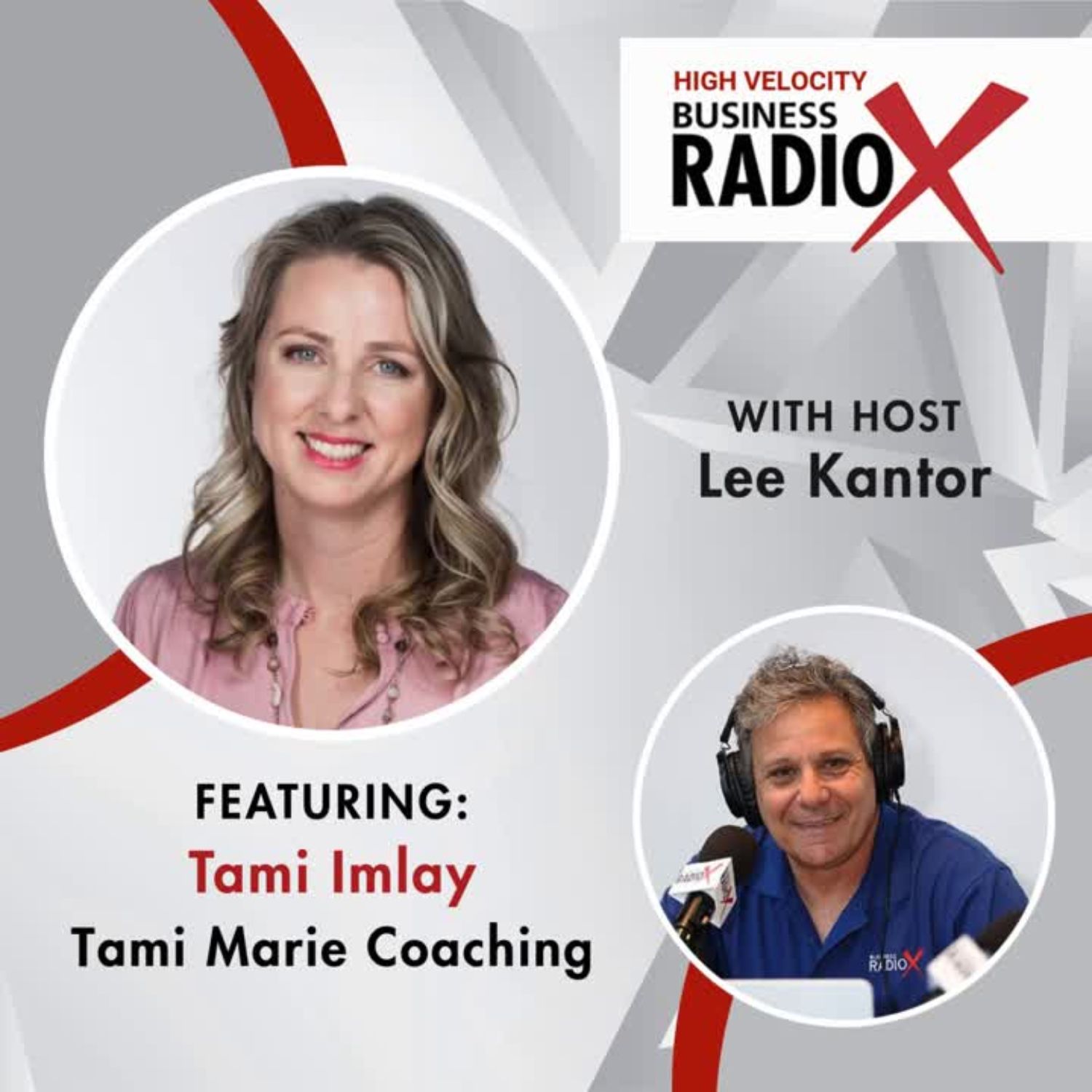

On this episode of High Velocity Radio, Lee Kantor welcomes Tami Imlay—International Women’s Achievement Coach, CEO of Tami Marie Coaching, and host of A Leader’s Purpose Podcast. A former U.S. Air Force Captain turned master coach, Tami helps leaders and entrepreneurs find clarity, confidence, and purpose so they can create lives of impact and joy.

 Tami Imlay is an International Women’s Achievement Coach, CEO of Tami Marie Coaching, host of A Leader’s Purpose Podcast and an Enneagram Expert. With a background spanning military service, therapy, coaching, and corporate training, she helps ambitious, high-level leaders and entrepreneurs gain clarity on their true calling, transforming their success into a life of impact and significance. Drawing from her own journey of resilience, she empowers women to step into their purpose with confidence, strategy, and joy.
Growing up on Air Force bases across the world—including Japan, Italy, and England—she learned the value of adaptability, leadership, and service from an early age. She followed the path of excellence, earning a BS in Information Systems at Auburn and an MBA in Organizational Management at University of Phoenix as well as participating in ROTC during college.
Rising to the rank of Captain in the U.S. Air Force, she later stepped away from military life to focus on her family. When her husband was tragically killed in action, she faced an identity crisis that led her to rediscover her purpose. She pursued a Master’s degree in Marriage and Family Therapy but soon realized her passion lay in coaching—helping others focus on their future rather than being bound by their past.
Now a Master Certified Enneagram Coach and Master Certified Neuro Coach, she has spent over a decade guiding women to embrace their strengths and align their experiences with their purpose. She is a sought-after speaker and corporate trainer, partnering with Tulsa Technical College to provide transformational leadership development. Her approach combines intuition, empathy, and strategic insight, equipping her clients with a clear roadmap to fulfillment and a lasting legacy.
Beyond her work, she is a devoted mother to two teenagers, whom she homeschools while traveling extensively and immersing them in global experiences. She finds joy in gardening, raising chickens, and cheering on her son and daughter in their sports endeavors. With a heart for adventure and a passion for seeing others shine, she is dedicated to helping women break free from limitations, step into their God-given purpose, and create lives of deep impact and joy.
Connect with Tami on LinkedIn.
What You’ll Learn In This Episode
Building a legacy of leadership: Blueprint for high-level entrepreneurs and leaders
 This transcript is machine transcribed by Sonix.
TRANSCRIPT
Intro: Broadcasting live from the Business RadioX studios in Atlanta, Georgia. It’s time for High Velocity Radio.
Lee Kantor: Lee Kantor here, another episode of High Velocity Radio, and this is going to be a good one. Today on the show, we have Tami Imlay, who is with CEO of Tami Marie Coaching, host of a Leader’s Purpose Podcast, and an Enneagram expert. Welcome.
Tami Imlay: Hi. Thank you so much for having me.
Lee Kantor: That is quite the resume. Before we get too far into things, let’s talk. Start with your coaching. Tell us a little bit about your coaching practice. Who you serving and how you doing?
Tami Imlay: Well, this has been a journey. And as anything um, it’s been a process. But I serve high level leaders, those who are ambitious, those who are go getters and help them figure out how to combine their There their love for what they do. How to bring in their core motivations and self-awareness and really get the life that they want. So it’s not just achievement, but it’s also fulfillment and legacy as well.
Lee Kantor: So what’s your backstory? How’d you get involved in this line of work?
Tami Imlay: Okay, well, let me take you back 13 years. 13 years ago, I was driving home from a four year old birthday party, and I was in the window. I was your typical, like, high. Well, type a mom. Like, I had just gotten out of the Air Force. I had two toddlers, and I was in the window of time of getting the kids home, getting them fed, and getting them through nap time. And most moms know that if you miss the window, then you’re done for the rest of the day. Like everything’s going to be more challenging. And well, I got home, started doing the things that I needed to do, and I got a knock on the door and I was like, who? Who knocks anymore? Who drops by? And I opened the door and there were three men in uniform. And at that moment I realized what was happening. My husband was on deployment and this was actually his first operational deployment. He’d been gone for two weeks. Two weeks in eight hours, actually. And I got the knock on the door telling me that he was killed in the line of duty. And that sent me on a a discovery like I it it broke me. But it also created this new fire inside of me. And what I, what I felt is I lost who I was. I not only lost my husband, my best friend who I went to high school with, lost the father of my child. But I also lost who I was in that moment because I was no longer a spouse. I was no longer a wife. And so I was like, okay, what do I need to do? Be in the action oriented, be in the gut instinct person? I am like I wanted answers.
Tami Imlay: I didn’t want to deal with emotions. I wanted to just get through it. I wanted to work it out. And so I started on this journey and I became a therapist because I was like, you know, that’s what you do. You become a therapist if you, uh, you are trying to work things out and which was great, which helps me. And then I realized when I moved from California to Oklahoma that I was really it wasn’t the the past that I really wanted to help people with. I felt my calling was really to help people with the future, help them get what they want and who they are now, because we we go through these things that shape us and we have two choices. We either allow them to make us bitter, we allow them to become not only part of our identity, but our whole identity. Or we take it and we’re like, okay, what can we take from it? Where can we go grow through it? And who am I because of it? And when I realized that that’s really what I wanted to help people do, and specifically like high level people, because who don’t slow down to figure things out. We like typically we bulldoze through and we just figure it out and stay busy until things fall into place. And that doesn’t typically work. And so that’s what I do, is I help people navigate these life defining moments in their lives, whether it’s life, whether it’s business, whether it’s family, and just help them take what they’ve been through and use it to become who they are meant to be.
Lee Kantor: So in your mind, you see, like that’s a line of kind of delineation between therapy and coaching is therapy is more backwards looking and coaching is more forward looking.
Tami Imlay: Yes, 100%. And this is um, this is one of the things that you, you learn in therapy because we always it’s working on, um, identifying and, um, coming to grips with or understanding the past. And I loved that work. And then I would get to the point of, okay, now we’re at health. Now it’s like we get to look forward. And that’s like ethically, that’s when we’re supposed to, you know, well, break up with them. That’s when we’re supposed to send them on their way. And that’s the part that’s like, this is when the real work starts. And so yes, that is the that is the delineation. That’s the moment of where coaching happens. And we no longer work on therapy.
Lee Kantor: Did you have a coach to kind of see it and feel it for yourself and have that realization? Or like how did how did kind of that evolution happen for you to say, okay, you know what, the therapy thing is great for a certain person at a certain time, but maybe there’s something that can be more focusing. And then you found coaching. Like how did that kind of evolution happen?
Tami Imlay: So multiple things happened. One is when you change states you have to start your therapy process all over. Um, I was already feeling some tension. Um, and, uh, oddly enough, my ethics are higher than the government’s ethics. And so there was a couple of things that I really didn’t agree with in therapy. And I have a mentor who is a coach who was a therapist, and she’s like, Tami, what you’re talking about is coaching. And I was like, no, because in the therapy world, Worlds. Unfortunately, coaching is looking is really talked down upon because those are the people who can’t hack it as a as a therapist until you find out what it really is. But yes, like I had someone who walked me through and then I, um, well, you’ll know from like, I take lots of classes. I want to understand. I want to, you know, I’ve done a lot of things because I don’t know a lot of things. Like, that’s when I find something I don’t know. Then I just like, let me learn about it. And so I dove into understanding coaching. And the more I realized how they really partner together and they’re not, you know, one is right and one is wrong. It’s how they work together and how sometimes you need therapy. But a lot of times what you really need and what you want is coaching and helping you move through what’s going, what you’re what you’re going through.
Lee Kantor: So part of kind of this evolution for you, it sounds like you were just trying to find the best outcome for your client, and you were kind of agnostic to what that whatever that is, is. Um, so this was kind of helping you, um, deliver that type of, uh, outcome that in a more efficient way.
Tami Imlay: 100%. Like when I embraced coaching and I. And really, um, I started doing Enneagram work. And with the Enneagram, it’s really talking about your core motivations, why you do what you do. And when I saw the power that coaching had, I was working with a client. And after three sessions, she says, Tammy, I have made more transformation, more growth, more process progress in the last three sessions than I did in five years of therapy. I knew I was on to something and I dove in completely.
Lee Kantor: So let’s talk about the Enneagram. Uh, to be honest, I hadn’t heard of this until I was listening to a podcast with Amy Poehler, and she mentioned it, and she’s a super fan of it. So can you explain it to a person who doesn’t know much about it?
Tami Imlay: Yes. So there’s there’s a lot out there If you start googling it, you’re going to find all kinds of information. And there’s a lot of things that we, um, well, we dub the trend diagram like a bunch of memes and things because there are aspects of the Enneagram, which as a whole it is nine types is what Enneagram stands for in Latin, and I believe it’s Latin and it’s really just nine. The best way of thinking about it is you have nine people who do exactly the same behavior, but for nine different motivations. So it’s the why we react, how we do instead of like the behavior that we that we do. And so it’s really understanding our core foundation why we do what our brain filters through, what, um, childhood memories and childhood, um, concepts and beliefs that we caught because it worked in what our motivation is. So I am a type one. I’m an approver improver. It used to be called the perfectionist, and then they realize that it’s really not even perfection that we’re looking for. It’s really we just want to improve things for people. And so, as you can imagine it, you know, it’s not always great to try to tell people what to do. Um, and that’s the other part of the Enneagram is we we first start looking at the negative because as humans, we have that negativity bias that we understand and we we relate to. So by understanding why we do what we do and understanding that, like I as the improver, I can walk into a room and I can see all the mistakes, which again, not a great party trick, but by understanding that and by understanding even how I grieved the fact that once I realized that I was trying to do grief well, instead of just, and I was trying to do grief right, instead of just following the process by understanding that I was able to step back and look at what what I really need instead of what my gut reaction was.
Tami Imlay: And so this is just a lens. It’s just a, a a mirror into our core soul of how we respond to things, how we react to things, how we see the world. And then it gives us this idea of like, doesn’t put us in the box, but it steps us out of the box. So now we can make the changes to be who we really want to be. And so I know that not everything or everyone needs to be improved. And so I can really lean into if I’m if I am looking at things through the eyes of, oh, how can I make this better? And this is not a situation or a person that needs to be better. It is. It’s like gives me that moment to say, okay, let me stop with my reactions and let me really be intentional about listening to listening to others. So it’s just a lens that helps us understand why we do what we do. Like it’s really that simple.
Lee Kantor: But is it something that, um, if I take an assessment and I, um, get they identify, um, what my type is, is it something that’s static, or is it something that can change over time?
Tami Imlay: So this is this is another beauty with within the Enneagram. So first of all, a lot of the assessments people don’t tell you how to take them. This is the one personality assessment that really does come with instructions. Like really when you answer the questions you’re supposed to answer when you were when you were in your 20s. And that’s because as we age, typically we become there’s more gray area. We learn that the world is not all black and white, but when we’re in our 20s, it really is a like this is my belief. This is the hill I’ll die on. This is what I see as right or just or, you know, that’s how you understand the world. And so it’s, it’s something that your, your number does not change. But the beautiful thing of the Enneagram is it gives you a path to growth. There’s, as you can see, the symbol. If you look it up, it’s like a circle with a bunch of random lines there. So seemingly random lines, and those are all paths to stress and health. And so it gives you a understanding and you say, okay, no, I’m I am acting out of stress right now. What do I need to do? How do I need to take care of myself in order to move to growth? So to answer your question, it is static in that we are the same number. It is nature versus nurture. It’s what the lens that our brain collects data, but it also doesn’t keep you there because it gives you that. It opens the the world up to you, to what’s possible.
Lee Kantor: So once you identify your number and and the meaning behind that, how does that help you moving forward? Like what? How do you take that and kind of activate it to to help improve your situation?
Tami Imlay: So the first thing you do is you come to grips with everything that you read that’s on the negative. Like you look to see because most people, when they see it, they’re like it is. They don’t want to share it because it’s vulnerable. First thing you do is you look to see what the negative traits are, because typically those are the things that you may not love about yourself, but then you get to start looking at them as, how have they served me? How have they helped me grow? And so by just understanding, bringing things to light of why you do what you do again, as an approver, if I like. Well, I have two teenagers. Um, one of the chores that they have to rotate is cleaning the kitchen. And I am pretty nitpicky when it comes to the kitchen. There’s a lot of the house. I’m a homeschool mom, so we are. We are not ever like company ready. But I’ve chosen, through my understanding of the Enneagram and my need to have things right that, you know, kindness and relationship is better than having a spotless house. And so but with the kitchen, there’s things there’s always things that you can do to make it look better. Like you can always wipe down the counters. Um. It drives me nuts when there are. I don’t mind dishes in the sink, but I don’t mind like dishes outside of the sink.
Tami Imlay: But with the Enneagram, what I’ve understood is like, okay, well, first of all, like 17 and 15 year olds do not even see the dishes next to the sink. Like, though they are materialized there and they’re physically there. They don’t see them at all. And it’s given me that grace to say, okay, is this something that I need to deal with? Is this something I need to bring up or. And do I get super nitpicky with them? Or do I choose grace because I understand they’re 15 and 17, that they did what they thought was was good, and now I say, okay, well, I’m choosing to choose in the relationship instead of making them get up in the middle of the night and fix it, which is kind of what my parents did to me, is if you didn’t finish it, you they woke you up and you had to finish it. And so just that idea of now we know what we’re doing and we get to choose a different response. I don’t have a knee jerk reaction as. As often when things are not going my way, I have an understanding of, oh no, this is my natural tendency. But this is how I want to respond in this situation. And so it gives you that that ability.
Lee Kantor: So now how do you kind of incorporate this? Um, the Enneagram into your coaching. Is that something that happens right at the beginning, that you try to help a person understand where they’re at, and you can use that as a roadmap for how to help them, um, get the outcome they desire.
Tami Imlay: Yes. So that’s probably one of the first things we do is and there’s I have several clients who we start with that and then they don’t want to go any further with the Enneagram than the core motivations. And really, you don’t need to. It’s not something that I, I will dive deep with unless someone’s really interested in it. However, once you understand your core motivations and your core desire. So that’s the first thing we do. Because if you understand what? Lindsay has been driving all of your decisions up until now. If you understand the the limiting beliefs that you have, then you get to put them together and you get to decide, do I want to keep them? Are they serving me? How did they serve me and how do I really want to be now? Like, who am I in this next phase of life? And so I love it so much, um, to do it right off the bat, because when it gets down and dirty, it gets to the, the like core of a person and it breaks that barrier of like, I don’t know what’s going on. I, you know, the I don’t know how many times a day do we stop ourselves saying, I don’t know. Okay. Well, if you did know and if you had a tool that can push past that and be like, oh, I see I’m in stress and I don’t want to be in stress anymore. And with that path to growth, it’s like, okay, now we can take action to start changing that.
Tami Imlay: So I find that by working with the Enneagram as the first thing I do with my clients, it really accelerates our our our program together, our product together, our time together. And it really helps them get the results immediately. Because once you bring things to light, even these things that you feel are your weaknesses. A lot of times understanding how they are actually strengths and then embracing them is a way to, um, well, shift your team, shift your leadership, shift your even the things that you’re doing and your the way you relate to other people. And so yes. So long story short, yes, we start with the Enneagram. We talk about core motivations, your core desire. Because one of the things I talk about as an Enneagram, one as the improver, it’s because I want the world to be the best possible. Like, I want my my kids to be the best version of who they’re who they are. Like, I want people, my clients, I want the best for them. And a lot of times it takes this self-awareness on my part that what I believe is best for them may not be. And so, as with the Enneagram work and with the clients work is they get to see that themselves. Oh, I just had a client who, um, he is an Enneagram six, a loyalist, and we were talking about because he he brought up a subject, a situation, and he’s like, he’s just so disloyal.
Tami Imlay: And I was like, why? Why is he disloyal? And I was like, well, he’s like, well, because he’s not he’s not acting in a loyal manner. I was like, okay, well, let’s first define terms. And I was like, you write what you’re what loyalty means to you. And I will write the definition of loyalty. And we did this and we I, I read mine first. And he’s like, that’s not how I define it. I was like, oh, well, how did you define it? And we started this conversation. And the revelation he had in that moment is the person who he was working with, his employee, his team member actually didn’t even understand, like he was not looking through the lens of loyalty. He was looking through the lens of data. He was looking at like, this is not the right, the right outcome. And so it may have been a similar words that they used, but loyalty to his employee was making sure that the result was right for the organization versus the to the person. And so just having that revelation completely changed how he related to this employee. And now he can by having that revelation, having that understanding, he comes to him with data questions versus people questions. And so it just changed the whole team dynamic when he realized that not everyone sees the world through loyalty or even has the same definition as him.
Lee Kantor: Yeah, I would think that having this kind of the structure of the Enneagram at the heart of what you do, at least then there is an agreement of terms, and then people are kind of calling the same things. The same things. Uh, and that that could increase clarity and communication 100%.
Tami Imlay: It’s so much clarity happens when we just understand because even like success, how you define success and how I define success and in fact, like how I define success in my 20s is not how I define it today. And so by even ourselves having the how do I define this? What is my value and what does it mean to me now helps us bring clarity to what we really want and who we really are.
Lee Kantor: Now, what are your clients struggling with right before they pick up the phone? Or get on the internet and contact you? What is typically the the pain point that they’re going through, where they where they raise their hand and reach out.
Tami Imlay: Typically there’s there’s a couple of a couple of ideas, a couple of issues here. But the main one is, is that there’s a there’s a change, there’s a shift, whether it is a promotion, whether it’s a loss, whether it’s they’re navigating some pivotal moment in their life. That and they come to the idea that I don’t know what to do. I don’t know what my next steps are. I have confidence in I, I know or I did know, but now I don’t. And so, um, what I do is I, I help them with whatever they’re bringing, whatever they’re bringing to me. And typically there’s an unknowing I’m I’m feeling stuck. It’s not typically a burnout because they may be exhausted, but high level leaders don’t identify with burnout really. Like they have to get really bad before they’re like, oh, I’m burnt out. They just keep going. But when they feel unfulfilled, when they feel that there’s a pivotal, a big shift in what they’re doing or their future, and they don’t understand what it is or what it could mean, that’s when they typically come to me.
Lee Kantor: Now, are they typically are you the first coach they’ve ever worked with or are they moving from a previous coaching experience?
Tami Imlay: So this is interesting because I would say it’s half and half. Um, and really they look at coaches, many of them have had like leadership training. And so they consider me as the next level of leadership training. And then I introduced them to coaching. And so understanding we start with the basics. But um, and then but they’ve had because they’ve read all the books, they are they’ve gone to the classes, they’ve done the webinars, they’ve done the trainings. And still they need that personal step. And then that’s when they contact me and they again, they they look and they’re like, oh, I just it’s just the next step of leadership training. And then I get to introduce them to really what coaching is now.
Lee Kantor: Are do you kind of lead with the Enneagram as kind of a hook for them, or is that something that you deploy as a tactic after you started working with them for a beat?
Tami Imlay: So I don’t I don’t lead with that typically. Um, when I do workshops for teams, like I have one coming up and we’re doing an understanding of core motivations and how understanding your core motivations can help the team dynamics. So I kind of pull out elements of the Enneagram. But people, when high level leaders come, when high capacity people come, they are ready for another strategy. They want, you know, tell me what to do and do it. And so I want and I try to break that mold because it’s really not what you do. It’s who are you becoming. It’s less of the action you need to take because all these people are Uber successful and they’re still feeling like there’s something missing. And so we get to step back, we get to and a lot of times, you know, it’s called imposter syndrome or um, different things similar to that. But we get to step back and um, and I just ask them a couple questions. First, get them understanding that they actually know themselves more than they realize. Or maybe they haven’t actually listened to the things that they’ve been saying. So we record all of our sessions because of that. Even our even the discovery calls, like the sales calls, which I don’t really enjoy, the, you know, actual term sales calls, but, um, it’s that that journey of let’s, let’s talk strategy, but then also let’s lean in with, you know, what does that mean to you? And if you could define more so we start defining terms and things. So no, I don’t lead with the Enneagram. But I do talk about okay, if you understand at your core what the purpose of self-awareness. And because when you are self-aware and you have those core motivations, then confidence can come whether you know what’s about to hit you or not.
Lee Kantor: Now, when they’re, um, they’re working with you and they see a change, is it something that is do they feel like that it was something that you helped them bring about, or was it something that they uncovered in themselves?
Tami Imlay: My goal is to help them uncover it within themselves and know that it’s always been within them. Um, I, I love having like, watching and being part of the journey of the aha moment of having them realize that they are the confident leader, they are the aligned leader. They are the person who they’ve always thought and always wanted to be. They just haven’t embraced it yet. And so I my goal is to really help them embrace that they are competent and confident and they have the foundation even without me. Now with that, there are times like I, I was working with a client, um, and he sent me a message today talking about, like, these are some things that are changing. My people are really uncomfortable with it. Is this a good thing? And I was like, well, what do you think? And so my goal is to really remove me from the process because though I’m, you know, I’m the coach and I don’t have all the answers, but I, I ask pretty darn good questions. And my goal is to help you see that you don’t need external validation, that you have it within you already. And so to answer your question, it is my goal is to help you embrace your awesomeness.
Lee Kantor: Now, are you working primarily with that one leader in the organization, or is the leader hiring you to work with their team or their organization as a whole? Or do you do some of both?
Tami Imlay: I do both. And so typically first steps like I will work. I’ll do like a workshop series I go in for um, they’ll hire me for like a, you know, 2 or 3 times I have, um, coming in October. I’m doing a six session series on communication with the team. And, um, but then from there it’s typically like, okay, like, I have a leader who really they’re in the right spot, but they’re they’re floundering. Or, um, my favorite is to work with leaders who are okay, I know I’m good at what I do, but I don’t know why. I don’t know how to keep doing it. And so if they want to take it to the next level that’s in the Enneagram work does wonders with that as well, but I do a mixture of both. I love one on ones, and I love working with small teams and just watching watching those light bulbs go on about like why things happen the way they do, um, within them. So I do a mixture and I really love one on ones, but I also love doing workshops and, um, in a group as well. And just like starting to turn on those light bulbs to what’s possible when you look at who you are and why you do what you do.
Lee Kantor: Can you share a story? Or maybe one of the teams you work with, maybe share what the challenge was that they brought you in for initially, and how you were able to get them to a new level, obviously. Don’t name the name of the organization, but just the challenge and then, uh, how you were able to help them?
Tami Imlay: Yes. So I work with well, it’s in the hospitality industry. It’s a well-known, um, a well-known hotel. And their, their leader, their GM brought me in because they had a lot of new leaders in director positions. And basically what was happening is they were everyone was trying to embrace their position, which caused tension in the in them together. And so as a leadership team, they were still so focused. They were like they had silos and they were not communicating well. And so one of the things he did is he brought me in. So that way we can talk about and again, like we talked about defining terms. First thing we did was start to define the terms. So that way they can start communicating better together. When we understood okay, what is the ultimate mission. And then the department’s mission and see how each of them play a part. Operations can’t work without HR and HR can’t work without operations. But seemingly like they have different missions. But they really didn’t. And so, um, what what we did is we broke down and we got everyone on one goal, one mission for the organization.
Tami Imlay: And then we broke it into how does your department play into this? What is your role in this department? And then say, say operations. And then how can HR help you achieve your goal? How can hospitality, um, work to achieve the operations goal? But by bringing the team together and realizing that they have one common goal, that they’re not in competition with each other, that they work in tandem, then at that moment, and really, it took the first session, it started, things started changing, and I would get texts from multiple individuals being like, I didn’t realize that I was so focused only on the numbers and that I was hurting hospitality because their theirs are the people and the experience. And so that’s what we we do is we break down. The issue was communication, the silos, the the using one definition, one term, but having multiple definitions based on the different organizations, not organizations, the different departments. And so we just broke that down. And then we got to build it back up together. And so now the team is flourishing.
Lee Kantor: And when they realize they’re all on the same team, it’s amazing what can get done.
Tami Imlay: It is. And then realizing that there’s no competitive advantage by you succeeding and the other department. Not like if you both succeed together then you can crush goals even faster, right?
Lee Kantor: Everybody wins.
Tami Imlay: Yeah. The. I love the saying that rising tide raises all ships. It’s like it really does. We don’t need to compete.
Lee Kantor: Uh. Good stuff. Well, if somebody wants to learn more, have a more substantive conversation with you or your team, what is the website? What is the best way to connect?
Tami Imlay: Best way is on LinkedIn. Um, Tammy. Imlay. Tammy, I’m l a y. And Tammy Marie coaching.com. Which just Tammy again. T a m. I’m a r I e coaching.com. So thank you so much for having me, Lee.
Lee Kantor: Well, um, on that website, they can get information about your coaching. They can learn more about your podcast and they can connect with you.
Tami Imlay: Absolutely. And, um, a leaders Leaders Purpose podcast is my podcast. You can listen to that anywhere that podcasts are. My favorite is obviously Apple along with millions of people. Um, but yeah, just reach out. I love connecting. Um, send me a DM on LinkedIn. It will be me responding to you. Um, I just love talking with leaders and listening to the things that they’re working through.
Lee Kantor: Well, Tammy, thank you so much for sharing your story today, doing such important work. And we appreciate you.
Tami Imlay: Thank you so much.
Lee Kantor: All right. This is Lee Kantor. We’ll see you all next time on High Velocity Radio.














