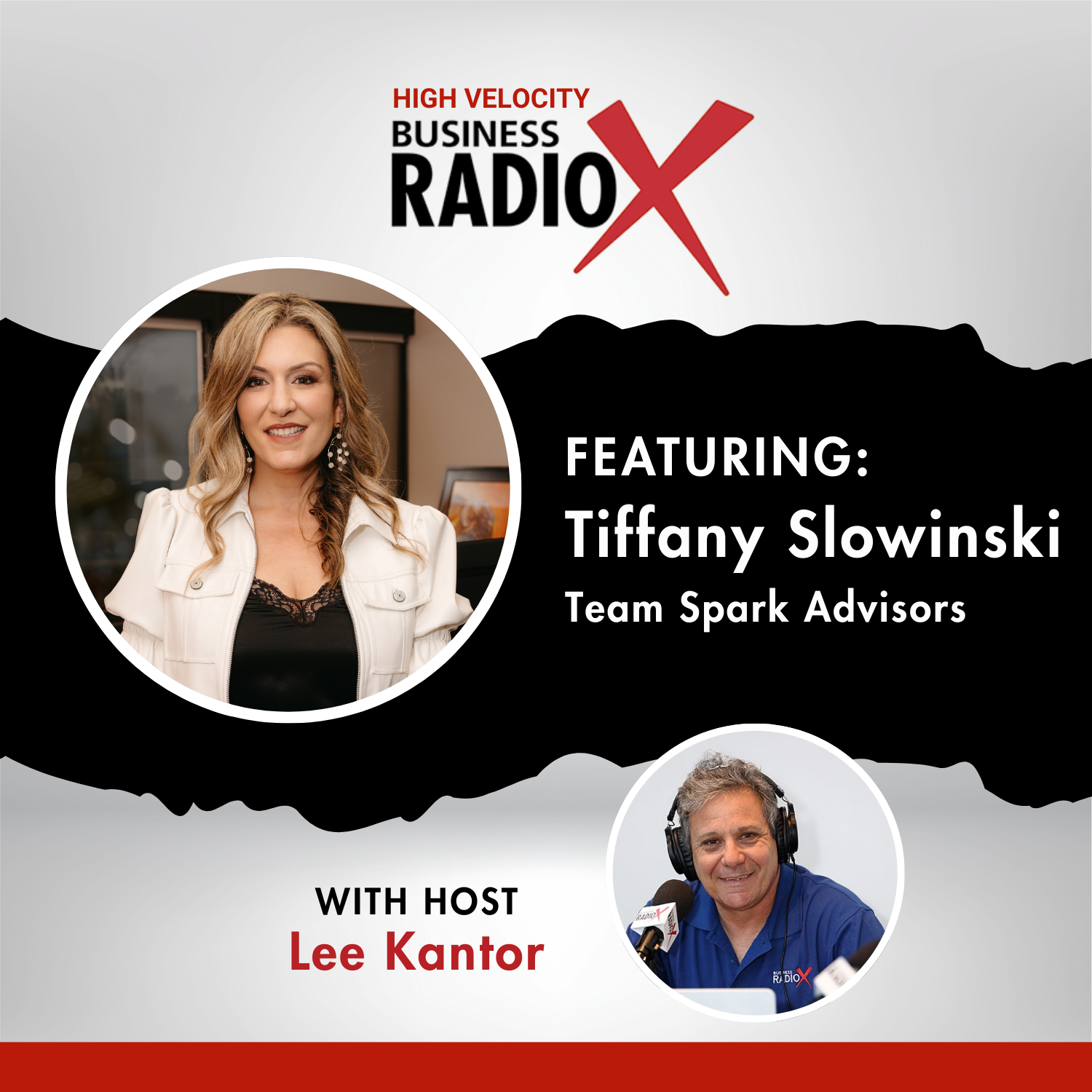

In this episode of High Velocity Radio, Lee interviews Tiffany Slowinski, CEO of Team Spark Advisors. Tiffany shares how she helps businesses optimize team performance by using the Culture Index, a data-driven tool that matches people to roles based on their natural strengths. She discusses the pitfalls of traditional hiring, the benefits of objective analytics, and practical strategies for aligning talent with business needs. Tiffany also offers actionable advice for business owners and highlights the importance of leadership buy-in for lasting team success. Listeners are invited to connect for a free consultation.
 Tiffany Slowinski is the owner of Team Spark Advisors and co-owner of seven successful franchises. A former VP of Sales overseeing 200 markets, she now helps businesses optimize culture and drive results by aligning talent with roles.
With a Master’s in Psychology from Columbia University and deep expertise in human behavior, she blends data with empathy to help leaders build high-performing, purpose-driven teams.
She’s also a mom of four spirited daughters and brings both insight and heart to every conversation.
Connect with Tiffany on LinkedIn and Facebook.
What You’ll Learn In This Episode
- Discovering Culture Index—and turning it into a business
- The most common mistake in hiring leaders
 This transcript is machine transcribed by Sonix.
TRANSCRIPT
Intro: Broadcasting live from the Business RadioX studios in Atlanta, Georgia. It’s time for High Velocity Radio.
Lee Kantor: Lee Kantor here. Another episode of High Velocity Radio, and this is going to be a good one. Today on the show we have Tiffany Slowinski and she is the CEO of Team Spark Advisors. Welcome.
Tiffany Slowinski: Hi, Lee, thanks for having me.
Lee Kantor: Well, I am so excited to learn what you’re up to. Tell us about Team Spark Advisors. How are you serving folks?
Tiffany Slowinski: Yeah. So with Team Spark Advisors, I help business owners put the right people in the right seats. So I use data and analytics to look at who somebody is naturally. And are they aligned in the right role. And then once we have them in the right role, how do we best work with that person? How do we communicate with them? How do we motivate them in a way that’s going to serve them to maximize their productivity and keep them happy, and serving your company longer and longer.
Lee Kantor: So what’s your backstory? How’d you get involved in this line of work?
Tiffany Slowinski: So I was actually a client first. Um, so culture index is the tool I use, and I was a VP of sales at a national magazine franchise. And we started using Culture Index to bring in the right franchisees, um, who are going to be these great salespeople who were hunters, who could go out and and close business and, and sign on new partners easily, who was made to do that? And so this made my job so much easier when I realized that there was a tool we could use to help align people into these roles, and then also then how do we build out the staff around them? These people who are often great at sales, were not the most detail oriented, weren’t the best at follow up and documenting and and taking care of clients. So who else did we need in that equation to make sure that once we got a new client in that they were going to be happy and and stay with us. And so I have a background in psychology, and I became so enamored with how well this was working that I eventually left that position to start team Spark Advisors and help companies use the culture Index to do what it had done for me.
Lee Kantor: So what were you doing before Culture Index? Was it kind of like gut feeling? Like how were you assessing people prior to working with Culture Index?
Tiffany Slowinski: Yeah. A lot of gut feeling. Uh, um, we used to call it the beer test. Is this somebody I would want to have a beer with? Right? I mean, it’s so rudimentary, but, yeah, I mean, the same things that a lot of companies are doing, right? You’re looking at resumes or do they have the experience you want and then they come in and do you like them? Um, how do they present themselves? Are they professional? Are they showing up on time? And those aren’t things you should ignore. It’s absolutely something you want to pay attention to. But what I learned through my experience with Culture Index is that social people are four times more likely to get hired for a position, regardless of whether or not they’re more qualified. And so for certain positions, yeah, it makes sense. You want social people, but there’s a lot of roles out there that, you know, you don’t need your accountant to be social. You don’t need your engineer to be social. And yet being social was getting people hired into positions that didn’t make the most sense for them. They’re kind of an obvious reason, right? Social people interview better. And so I love adding this data piece because this is what takes over when you can’t just get a hunch, right. I’m not 100% perfect with my hunches. Nobody really is. And now there’s a data point that can help you.
Lee Kantor: Now, there’s a lot of assessments out there that deal with, you know, personality and character and things like that. How is this different than some of those other ones?
Tiffany Slowinski: Yeah, there are a lot out there. And I had taken many of them throughout my career. And what I found different with the Culture Index was it was a couple of things. One, simplicity of the survey that we use of the tool. It only takes 5 to 7 minutes. So it wasn’t a big lift or ask for people to complete. Two. Um, it’s a free range response. So a lot of surveys out there will ask a question and then say, are you A, B, C or D? And there’s times you’re like, I don’t think I’m any of those things, or I’m more than one of those things, but I can only select one answer. So it’s sort of forcing you. It’s called forced choice response. With culture Index, the way the survey works, you could pick as many words or answers as you want. And so you could be a lot of something, a little of something, or somewhere in between. And so the way that the the surveys are measured is very different. It leaves all that gray area in there to not just stick people into these little boxes, but look at degrees of things, how people present you can be a little social or very social. Those are two very, very different humans who are going to present in different ways. So the way that the data is aggregated is completely different. And then the reliability rate is extraordinarily high at a 0.92, meaning, you know, if you take the survey 100 times, 92 times out of 100, it’s going to come back the same. So that was extraordinarily impactful to me.
Lee Kantor: So when you started using it, how quickly did you have that aha of, oh, this thing works pretty well.
Tiffany Slowinski: Day two. Um, I mean, my initial reaction to it was, okay, this really describes me really well. That’s that’s sort of fascinating, but I already know myself. So it wasn’t telling me anything about me. I didn’t know, but it was giving data to it. It was like, this is why I am the way I am. I’ve always felt this way, but I’ve never had another survey capture it quite the same. But then when I started looking at at the people who worked on my team and my colleagues, and starting to understand them through a different lens that I didn’t necessarily know everything there was to know about them. And then, even on the next level, I started surveying, you know, my family and close friends, and I was amazed at how many times I literally would get the results and think, this must be wrong. This is not my brother. This is not how he operates. And I would go through the results with him and he’d be like, that’s exactly me. And I’m like, how have I known you for 43 years and not known this was you? Even people close to me in my life. So that was really my aha moment, literally within a day or two.
Lee Kantor: Now, um, when you’re kind of getting these results, how does that kind of fit into the culture of the given organization? Because like, do you have to now modify the role based on the results? Or do you get rid of the person based on the result? Like how? How do you make this actionable?
Tiffany Slowinski: Yeah, it could be all of the above or none of the above. Totally depends. Situation dependent. So my goal is to come in and work with who you have. It’s not to give out a survey and say, well, we clearly have all the wrong people. Let’s fire every person who works here, right? That’s not real life. So some of it is in some ways. Do we have the right person in the right role? Is there a modification to the role that would make more sense? Or do I need to instruct them or mentor them differently, knowing that somebody is very low detail? Are there things I need to put into place to help them tackle some of that, of that detail work? Or there are certain things I should take off their plate because it’s not working for a reason, right? And so we learn how to work with who we have, but then we also hire better. So now as new people come in, who’s going to fit into this role. And it’s in two different ways. One who’s going to fit into the job description of the role. What does the person need to be able to do. But then also who’s going to fit in based on the personalities of the other people on the team. Who are you reporting to? Who’s going to work best with me is different than who’s going to work best with you, Lee. And so knowing the dynamics of who else is there will also help me guide my advice on who to hire.
Lee Kantor: Now, does the advice, um, kind of trickle down to this is how we write this ad to attract the right person. Uh, like, do you help in that area as well, or do you just say, okay, you need a more a less social person here and a more detail oriented person here, and then good luck.
Tiffany Slowinski: Exactly. No. You want to attract the right people, right. So even in the ad process, there’s words we can use. Right? So I help with that. If we’re hiring a salesperson and we want a sales hunter who’s aggressive and outgoing and is going to turn over every stone and be relentless, but then also social and connect with people. The wording we’re going to use in that ad description, or that job posting is very different than if I’m hiring an administrative assistant, right? So yes, absolutely. You want to attract the people you need. And, you know, I had one client who was hiring. It was a small business, right? And so he was hiring. He called the position business development administrative assistant. And I was like, okay, I need some clarification here. What exactly is that? And he’s like, well, I need an administrative assistant, but we go to trade shows, so I need someone to go to the trade shows with me. And I said, okay, well, how often do you go to trade shows? He said, 2 or 3 times a year. I said, you need to hire an administrative assistant. The second you throw the word business development on there, you’re attracting a bunch of salespeople. And truth be told, your administrative assistant can show up 2 or 3 times a year to a trade show and help you hand out tchotchkes, collect contact information, and make some follow up calls. But if you hire a true business development person, they’re going to make a lousy administrative assistant for you. So there is a lot of that sometimes really figuring out these roles, because particularly in smaller businesses, there’s times you wear a lot of hats, but what’s the hat that’s going to make the biggest impact for his world? It was having a better administrative assistant was by far going to be more important to his success than getting someone who’s super good at standing at a trade show.
Lee Kantor: Now, um, when you work with your clients, are they primarily you mentioned earlier that your background was in franchising. Are your clients mainly in franchising, or are there, uh, business people or entrepreneurs of all shapes and sizes?
Tiffany Slowinski: I work with all different industries. It’s this is not franchise exclusive whatsoever. I love working with with sales teams as well. But I mean, this is something that can apply to all businesses. All businesses need the right people. I’ve yet to meet a business who said 100% of my staff is perfect? Couldn’t ask for anything more from anybody.
Lee Kantor: And then. So what’s the kind of that pain that a person’s having right before they contact you? Or are they just having trouble hiring people or are they having a lot of turnover? Like what is the symptom that they may need help in this area?
Tiffany Slowinski: Yeah. So sometimes it’s turnover. I’ll have people call me when they’ll say, I’ve hired two office managers in the last six months. I’m so frustrated with this. Or I’ll have people who are in a growth mode and they know they’ve got to bring on a lot of people. Um, or there’s company culture issues. People aren’t getting along, there’s growth issues. They can’t get the right people in leadership. And so they’re battling with them because they don’t have visionary people. So it really depends on the business and what they’re trying to achieve of of where where do they need this?
Lee Kantor: Now, I know in business a lot of times people, um, you know, ah, as soon as there’s a fire, they look to solve the problem. But I would imagine that in this regard, in the work that you’re doing, just taking the temperature of your team would be a good idea. And just getting some sort of a baseline of what everybody is, no matter how well your team’s doing, because these are the things that if there could be some quiet quitting, there could be some some people in the wrong roles that are frustrated, that have a foot out the door you may not even be aware of because they’re not, you know, well matched to whatever the work, they’re they’re being done. So I would think this is something that everybody would benefit from using, but they probably don’t proactively use your service until something you know bad is going on or they need to.
Tiffany Slowinski: Yeah. Lee, you you get it 100%. So that is part of what I do too. I have measures where I can look for disengagement, probability of quiet, quitting. Right. Stress. Are people getting burnt out? That is all part of this as well. And so you can have the right person. But if they’re under the wrong. The wrong leader, if they’re not being treated the right way, those are also things to look for and get ahead of. You don’t want somebody just. And a lot of times, like when you do an exit interview, they’ll just kind of give you the simple answer, oh, I found a position for more money. Well, what made them start looking for that position to begin with? There was already a problem. The number one reason people quit their jobs is their direct report, boss. The number two reason people quit their jobs are their colleagues. So people really quit people? Sure, people want more money and all those things as well. I’m not not recommending you underpay your team, but the biggest motivators that lead for someone leaving their position and going somewhere else is they don’t like who they work for or who they work with. And so getting an early read on that absolutely can help change the game. And it doesn’t mean, oh, this is not the right boss. Okay, well, we got to fire them. No, but are we communicating the right way? Just sometimes even just understanding this is a person who doesn’t want to be micromanaged. They want more autonomy. Give them a little freedom. And having that in your head or knowing, okay, I got I’ve got to compliment this person more. They really are going to thrive off of that. There’s little tweaks you can do that can help improve the environment without making a major modification on your side either.
Lee Kantor: Now everybody is always kind of searching for these a-players and surrounding themselves with eight players. Um, obviously there can’t be everyone can’t be an A player in everything. And I would imagine the Bell Curve tells you how many players there are, um, just in general. So how do you kind of identify the A players in your organizations, or at least put the right people in the right seat until you can find the, the the A players.
Tiffany Slowinski: Yeah. So there’s there’s other tools we use within Culture Index to help us identify what does an A player look like here? For this role, I could be an A player in one role and a D or an F in another role, because that’s not meant for me. So there’s not a finite number of a players. Anybody could be an A player in the right position for them doing what they are meant to do. So you’re looking for a players within different positions, which leads to a lot of different types of people that depending on the size of your organization, you’re going to need. I like to say there’s no wrong people, just right people for right seats. Everybody has something they’re good at. Everybody in this world has a place that they belong. And I also view this in a humanitarian way. When you set somebody free, sometimes they’re free to go do something where they’re going to be happy, where they’re going to excel. Nobody wants to come to work and lose every day and be stressed out every day, and not be able to hit their mark every day. And so you need eight players for your company, which might be different eight players than another company needs. It’s not limited thinking. There’s enough eight players to go around when we align them correctly.
Lee Kantor: So um, so how does the process work? Somebody raises their hand and says, Tiffany, I’m struggling, or we have turnover or we have some issue. Um, let’s get started. So how do you begin?
Tiffany Slowinski: Yeah. So this is a top down program that starts with leadership. This is not I come in and just fix your company for you. Although plenty of people have kind of offered that because that seems like the simpler solution to them. They would love to hire me to just come in and do everything. But what I’m doing is I’m training leadership in surveying what to look for. You need to know what you need because a lot of times we’re hiring for the wrong things. We have a bias towards ourselves. And so a lot of times we’re looking for people just like us. And I’ll tell you right now, I’d be my own worst assistant. So it’s teaching them how to use the tool, what to look for now understanding their people. Who are they working with? And so it works its way down through the culture of the company. But if you don’t have buy in at the leadership level, it’s going to fall flat. And then the other piece is then also through that through training is they get better and better at doing this themselves. But I’m also there to be that accountability buddy, that little birdie on your shoulder who delivers the good and the bad news. I’ll tell you. One thing is that I’m not going to lie to you.
Tiffany Slowinski: I’m going to tell you what the data says, and you could try your best to talk me out of it. And people do all the time. But this, oh, this person is so experienced. And I will sit there and be that accountability buddy and say, this is what the data says. You are free to make your own choice about that. But I’m not going to fudge what I’m seeing here on paper. That’s what you’re paying me to do because it’s really hard to get out of our own way. I can struggle with this myself sometimes. When you really like somebody and you want to see the best in them, or there’s some reason there’s somehow connected to you in some way, and you want to give them the job. And when the data says otherwise, it’s having that self discipline to walk away and say, you know what, I’m going to gamble on data. Does it make it 100%? No. There’s other outside factors I can’t measure. You know what’s going on in somebody’s personal life or their ethics, right? There’s other factors out there. But when I’m looking at the data that that is a gambling point that I’m going to bet on every time.
Lee Kantor: So then the first step is kind of assessing the organization and seeing what the the roles are currently and what they could be. And then you plug the people into that to make sure the fits are correct.
Tiffany Slowinski: Yeah. So we start off by getting a baseline on who we already have there.
Lee Kantor: So you start with the people, not the role. Like I’m just trying to get the chicken and the egg here because, um, you know, like, they could have a person that is in a role just because, you know, when they were smaller, they were in the role and now they’re bigger and they’re still in the role, and they may not be the right fit for them. Like, I would think that you would have to get kind of an idea of what the roles are and then match the people to it. But you’re saying you start with the people before the role.
Tiffany Slowinski: Yeah, I’m looking at your people first. And or maybe I should phrase it this way, it’s being done concurrently. I’m looking at both people and roles at the same time. What’s the who’s the person and what’s their role? I’m not coming in and saying, let’s just okay, based off of let’s all just switch all your jobs tomorrow, right? We are looking at this by team. That’s why I want leadership in there with me. We’re looking at it by team. And so you might have a profile of someone who would make an excellent salesperson, but they’re killing it over in another department. I’m not going to say oh let’s just like put them over here because they’re fitting the criteria for another for another job you have. Right? Um, so it’s being done at the same at the same time. And there’s times, frankly, somebody’s going to come back and maybe they’re not 100% in alignment for a role, but they’ve been there a long time. They’ve learned they’ve they’ve adapted their their strengths to them. Okay. Are there things we could do to supplement it to get them up to an A player? Are there is there more training we need for this particular person, or is this a complete misfit where they’re totally, you know, in the wrong spot. And and depending on the position, there’s ones that this is a huge, huge issue to have. You know, when you’re talking about some of these higher level positions, having the wrong person align there could could be costing a company millions of dollars a year. So this is not one size fits all that I’m going to do the same thing depending on the position. Right. Um, it really is individualized and looking at what’s going on right now in that company, what’s what’s the most important pieces we have to get to first, and where does it make sense to make changes? And where does it make sense to focus on optimizing who we have at the moment?
Lee Kantor: Now, in kind of today’s working environment, everybody has to be kind of a salesperson to some degree. Um, how do you kind of maybe coach up a person that maybe that’s not their superpower, but it’s necessary in today’s business climate, especially in the smaller, leaner companies.
Tiffany Slowinski: How necessary is it to the role? Because I will tell you, having the wrong salespeople is really the number one factor that limits growth. These are the people who have to bring in your revenue, right? Um, so coaching up, it’s far easier to coach up somebody who innately has some of the traits of someone who makes a good salesperson than to try to take somebody who is absolutely not wired that way and tell them, okay, you got to go start selling to.
Lee Kantor: So that’s that’s.
Tiffany Slowinski: So much.
Lee Kantor: So that if you’re in any and every organization, the selling organization is that’s kind of the first thing you have to triage is to make sure you have the right kind of hunters on the team.
Tiffany Slowinski: Yeah. Well, depending on what there’s different types of sales. Right. Is this is this inbound sales? Inbound sales? Um, outbound sales, I mean, is like the word sales is thrown around pretty loosely. Um, but depending. I mean, do you need someone who’s cold calling and knocking on doors, or is this more of a relationship sale, people who are networking, or is this more of an order taker? People call in. Those are different people that could perform well in those roles.
Lee Kantor: And then, um, when you do the, uh, culture index, then you’re able to kind of, uh, discern between those. Maybe they’re subtle differences.
Tiffany Slowinski: So here would be an example. I work with a company that has a person who really great profile of someone who’s good at networking, absolutely relationship driven, lights up the room, knows everybody will call somebody they knew from kindergarten without feeling weird, but not a sales hunter in that they don’t like to ask for money. They’re not big on contracts. They’ll let people pay late. And when looking at I mean, this person brings tremendous value to the organization but is really struggling in some pieces of the role. And it’s like, okay, put him where he’s good, throw him in more networking groups, let him do that. But they’ve been trying for years and years to make this person good at collections. And he hates calling and collecting money. I’m like, grab one of your admin and throw them on that piece of it and let him just go out and meet people. He’s great at bringing in the leads. That’s where he’s going to better serve your company than him trying, you know, putting off all day that he’s got to call all these people and collect money. And now all of a sudden they’re literally hundreds of thousands behind because he just never seems to get around to doing that piece of the job.
Lee Kantor: And that goes back to what you were saying is aligning. Aligning the talent with their superpower, and then just filling in the gaps where they might struggle with somebody else’s. Whose superpower is closer to whatever that weakness is and that individual.
Tiffany Slowinski: Exactly. And in this instance, he’s strong enough in networking that this makes sense to, to to put somebody else in and take a little piece of this off his plate. If he was somebody who just innately was terrible at all of this, then the decision becomes easier to say, this is not an individual that belongs in this company, but he does have great strengths and is brought in a ton of business for them. So are we. Like, how many years can we sit there and pound on, like you’ve got to do money collection thing before realizing it’d be far easier to just slot somebody else in to do that, that small piece of his job.
Lee Kantor: So what’s something that a business owner right now could take today to get more out of their team?
Tiffany Slowinski: It can you repeat that? I don’t really understand your question.
Lee Kantor: Um, is there something that our listener. A listener right now could do, uh, to improve their team, to get more out of their team based on, you know, kind of the culture index and your, uh, expertise when it comes to just, um, kind of wringing out the most value from the people you already have.
Tiffany Slowinski: Yeah. I mean, anybody listening out there, I’m happy to do a free phone call with you to go over your team, give you some data points on them. I believe in the data because this will show you who people are, and it gives you a way to see it. Very clear. So happy to do that for any of your listeners. Because once you have that data, whether or not you choose to engage with me or not, I will give you information on your people that you’re going to be able to walk away from and immediately have insights to ways that you can improve their productivity.
Lee Kantor: Now, you mentioned that, um, any business can benefit, obviously, from this type of information. Is there a size company that is in your sweet spot? Is there kind of an ideal client profile for you?
Tiffany Slowinski: I like to say a minimum of ten employees. Um, but truthfully, I once had a client that only had it was a solopreneur who just wanted to build his team correctly from the very beginning. Um, so there’s not a specific size. If you value having the right people on your team, and sometimes with small businesses, it can be hard because if you only have a handful of people working there, one wrong person makes up a very large percentage of your workforce. There’s not a whole lot of room to absorb those missed hires, right? So there’s there’s really no no minimum. I’m happy to talk to anybody.
Lee Kantor: Now, do you work with kind of startups that are, you know, just at the idea stage and like you said, that they’re, you know, they have maybe they just got funding and there is a path, but they’re just not there yet.
Tiffany Slowinski: Typically, I’m not working with them as much. I certainly am open to a conversation, but usually the companies I’m working with, like I said, have a minimum of about ten employees.
Lee Kantor: And so they’ve been around for a minute.
Tiffany Slowinski: Mhm.
Lee Kantor: And then if somebody wants to learn more, have a more substantive conversation with you or somebody on the team, what’s the website. What’s the best way to connect.
Tiffany Slowinski: Yeah. You can look me up at Team Spark Advisors. Com or I’m happy to connect on LinkedIn as well. Tiffany Slowinski.
Lee Kantor: Well, Tiffany, thank you so much for sharing your story today. You’re doing such important work and we appreciate you.
Tiffany Slowinski: Thank you. Lee, I really appreciate you having me on.
Lee Kantor: All right. This is Lee Kantor. We’ll see you all next time on High Velocity Radio.














