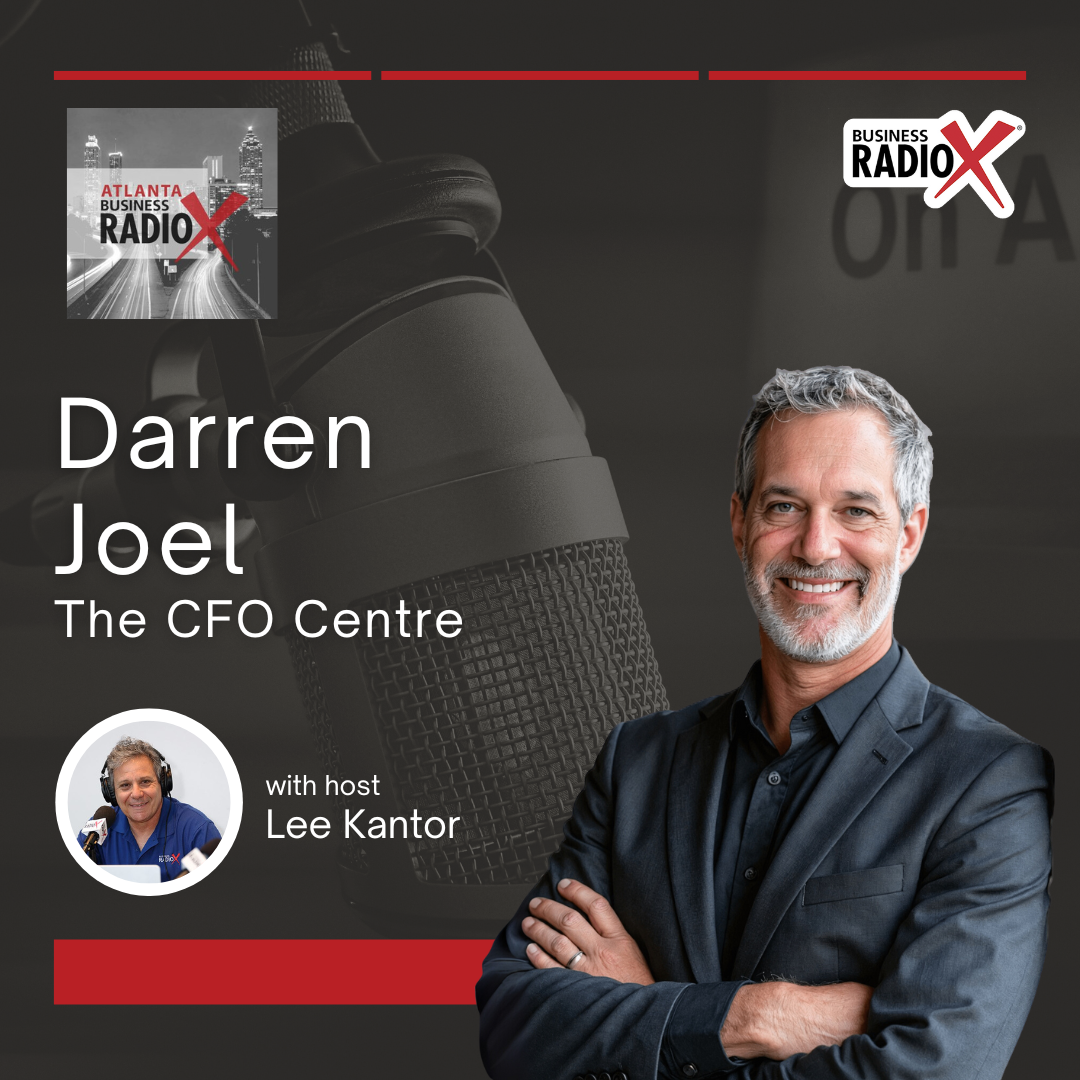

 In this episode of Atlanta Business Radio, host Lee Kantor interviews Darren Joel, Atlanta Regional Director of The CFO Center. Darren explains how The CFO Center provides fractional CFO services, offering experienced financial leadership to small and medium-sized businesses on a flexible basis. He discusses ideal client profiles, common triggers for seeking fractional CFOs, and the integration of AI in financial operations. Darren also highlights the importance of relationship fit, the flexibility of engagements, and the organization’s ongoing expansion. The episode offers insights into empowering business growth through strategic, cost-effective financial expertise.

 With a career spanning over two decades, Darren Joel, MBA, MPA, CPA, is a results-driven entrepreneur and business strategist who has built, scaled, and successfully exited multiple ventures.
As Atlanta Regional Director at The CFO Centre, he leads a team of experienced financial professionals, helping businesses optimize profitability, improve operational efficiency, and achieve sustainable growth.
His expertise extends beyond financial leadership—his background includes strategic consulting, process optimization, and business transformation across diverse industries. He began his career at Ernst & Young, honing his skills in financial modeling and operational audits before launching his own ventures, including Blackfire Signs & Graphics and TecnoSedia, a luxury custom upholstery business.
Beyond finance, Darren is also a security strategist, an accomplished voiceover artist, and an avid adventurer, bringing a unique blend of analytical precision, creative storytelling, and hands-on leadership to every endeavor.
Connect with Darren on LinkedIn.
What You’ll Learn In This Episode
- The shift in challenges business owners face now compared to previous years.
- Past ownership experience shaping today’s leadership in fractional CFO services.
- CFOs in Atlanta taking on bigger roles amid uncertainty, supply chain issues, and global risks.
- Atlanta companies and entrepreneurs rethinking financial discipline in a growth economy.
- Tech-driven change with AI transforming finance, but ROI still lagging.
- The growing need for data-driven financial strategies led by CFOs.
 This transcript is machine transcribed by Sonix.
TRANSCRIPT
Intro: Broadcasting live from the Business RadioX studio in Atlanta, Georgia. It’s time for Atlanta Business Radio, brought to you by Kennesaw State University’s Executive MBA program, the accelerated degree program for working professionals looking to advance their career and enhance their leadership skills. And now, here’s your host.
Lee Kantor: Lee Kantor here, another episode of Atlanta Business Radio. And this is going to be a good one. But before we get started, it’s important to recognize our sponsor, CSU’s executive MBA program. Without them, we couldn’t be sharing these important stories today on Atlanta Business Radio. We have Darren Joel, who is the Atlanta Regional Director with the CFO center. Welcome.
Darren Joel: Hi Lee, thanks for being here. It’s a real honor.
Lee Kantor: Well, I’m excited to learn what you’re up to. For folks who aren’t familiar, can you share a little bit about the CFO center? How you serving folks?
Darren Joel: Sure. CFO center is a company based out of the UK. It’s a global organization, though, and we provide fractional CFO services to small to medium sized businesses. I am the regional director here in Atlanta. Run a team of fractional CFOs. And yeah, that’s what we do.
Lee Kantor: So what was kind of the genesis of the idea? How did this get launched?
Darren Joel: Well, on a personal level, I have been an entrepreneur here in Atlanta for 25 years. Local, local grown Atlanta guy. I went to Emory, Georgia State, an MBA. I’ve worked at Ernst and Young, but for the last 25 years I’ve been an entrepreneur and have multiple businesses, the last of which I sold about a year and a half ago. And I was really looking to do something that can help local businesses grow and Drive and CFO center. And I found each other and and it’s just kind of grew from there.
Lee Kantor: So how did the CFO center start?
Darren Joel: The CFO center is actually the largest and oldest organization that’s providing fractional CFO services in the world. So it started about 25 years ago by our founding members. And we’ve obviously been around a while, um, we’ve served over 4000 businesses globally. Uh, we are we are an international organization, but we also are very local and regionally based as well.
Lee Kantor: So what makes CFOs, uh, good to be fractional members of the team?
Darren Joel: Well, um, you know, we are have experienced a significant shift in the, uh, in the workplace, especially when it comes to C-suite and senior level executives. And the move in the whole economy and industry is towards what we call a fractional or gig economy, where businesses and business owners are accessing intellectual and um, and expertise on a on an as needed basis. So that gave rise to this whole concept of the fractional employee who are coming into businesses and helping businesses who may or may not be able to, uh, bring in a full C-suite member to their team, but need that kind of operational and strategic leadership on their team to help with their business grow and scale.
Lee Kantor: So what is kind of that ideal client for the CFO, CFO, center, CFO, um, what’s, you know, the right size and the right number of employee fit?
Darren Joel: So, you know, we try to we seem to have a sweet spot of between, uh, 2 and $30 million in revenues. Um, that being said, uh, we have we have clients now here in Atlanta that are pre-revenue. So they’re really in the startup phase. So they are thinking strategically. They want to get their ducks in a row. Um, so we have everything from startups. And then on the other side of the, uh, of the scale, we also come into businesses that are that already have may have a CFO, $100 million plus businesses that may have a CFO, and they need some additional firepower and additional, um, member of that leadership team that can come in and perhaps manage a project or really kind of sit at the CFO, the the full time CFOs side. We call that a CFOs CFO or CFO. So we really run the whole spectrum from startup to significantly large businesses. But really, our sweet spot is the 2 to $30 million growth oriented, uh, business.
Lee Kantor: Now, is is there a trigger? Is there something that’s happening right now in these organizations right before they contact you? Uh, that is a, uh, kind of a trigger that lets them go. Okay. We may need help in this area. Maybe it’s an acquisition. Maybe it’s a succession plan or an exit. Um, is there something that’s happening in the organization that is a good kind of a prompt for a call to you and your team.
Darren Joel: That’s a great question. And there does seem to be these triggers that seem to precipitate the need to bring in somebody on a leadership team in the financial arena, like a CFO. Um, that could be anything, as you mentioned, to, um, growth and scaling challenges. You know, we’re growing fast, but we don’t have a financial strategy. Our revenue is up, but our profits aren’t. Uh, everything from that to major transitions or events. Uh, perhaps their existing CFO just left. They’re in the process of restructuring or perhaps pivoting. You know, a lot of companies are pivoting right now, especially in this technology, you know, in the current, uh, environment of AI, uh, or perhaps their fundraising, they may need, uh, they may need to look for, uh, investors. Um, perhaps they’re looking for a sale or an exit. So there does tend to be kind of precipitating issues that, uh, that inspire the need for a CFO or fractional CFO to come in. But, um, but again, it may just be that that business owner is overwhelmed and they’re just, you know, they’re out of their wheelhouse. Maybe they’re doing something that, um, they’re they’re involved in operations in a way that they are not familiar with or uncomfortable or maybe, um, they’re just out of their depth. So they need that, that kind of leadership in their business.
Lee Kantor: And, uh, when, when, uh, one of your CFOs is kind of deployed, what typically does that look like? What are they coming in? Um, just they have a meeting with, I guess, the CEO or the board, and then they’re coming in to triage something or they’re coming in as a more permanent fixture. Like what? What is kind of those early conversations look like and how are they, you know, kind of integrated into the organization.
Darren Joel: So we really strive we, uh, our goal is really to be a productive member of that leadership team in the company. So while we can come in and, uh, do something more transactional in nature in terms of maybe, uh, project based, um, solving a particular issue, maybe overseeing an audit, we certainly can handle those types of very specific, project oriented tasks, but we really strive and try to find opportunities where businesses need that leadership, uh, strategic leadership seat filled in their organization for the long term. Um, so, you know, whether it’s a board, uh, a board approved or board driven situation or an owner who just needs that kind of care. I’ve heard it called the CEO Whisperer. That person sitting by their side to be their trusted partner and advisor. But again, it’s we really strive to be that team leader and part of the, uh, the executive team in a in a business.
Lee Kantor: And then when you’re doing this kind of work, this is a roll up your sleeves and actually do work. This isn’t like a coach or an advisor, right? You’re actually kind of performing the tasks.
Darren Joel: Yeah. So of course it’s, um, we are we are certainly not the kind of, uh, we strive not to be that delivering ivory tower advice type of leadership. We really roll up our sleeves, get into the numbers and help owners make better decisions. You know, we talk all the time with our CFOs and with our clients. Um, that behind every number is a story. And families, employees livelihoods. So we really want to, um, to help that business and business owner. Um, you know, my background as a business owner really kind of allows me to understand, um, what it’s like to be a business owner. I’ve been in your shoes. Um, so I approach every client with that kind of empathy. I know what it’s like to have to worry about payroll, to stay up at night and worry about cashflow, or wonder if my new growth initiative will work, or what that new growth initiative might be. So I think from that perspective, it makes me very practical in how I lead my team. But the CFOs are very much a roll up your sleeves, get in the trenches type of personalities that get things done.
Lee Kantor: And then how do you attract new, new CFOs onto your bench? Um, ah, what does that kind of vetting and recruitment look like?
Darren Joel: So, um, obviously as a regional director, uh, here in Atlanta, you know, I’m not just in charge of business development and finding new clients and opportunities, but I’m very much involved in the recruiting process of new CFOs. So we are always looking for great talent. Um, we obviously strive to find people who have, uh, the right, um, financial intelligence. Right. They’ve got the expertise, um, and the experience from a financial leadership standpoint. We do not bring in CFOs, fractional CFOs that have not actually worn the hat of CFO in the business, in a business or multiple businesses. So we really strive to find somebody who’s actually sat in that seat. Um, and then a large part of what we look for is that emotional intelligence. You know, the ability of the CFO to have that high level of EQ, emotional intelligence, they’re going to be working very closely with multiple CFOs, multiple teams. Um, we call it the barbecue test. So we, we, uh, we strive to find someone who’s going to, uh, be someone who’s going to be welcome at your backyard barbecues, really be able to have a conversation, be able to communicate effectively with teams. And, um, and of course, the other thing we bring to the table, um, just not just from a CFO standpoint, but we also have a very team oriented approach company wide.
Darren Joel: So you’re not just getting the CFO or the fractional CFO that’s going to come into your business. You are getting this global team of CFOs. Um, worldwide, we have over 800 CFOs worldwide. So it’s again, it’s a global organization, and they have the ability to leverage into that intellectual, uh, network. So, for example, no CFO is going to know everything in a situation. So, um, they have this incredible network of CFOs. A great example is, um, we have a CFO who had an owner come to him and said that he wanted to take a certain amount of his money and invest in blockchain, um, technology for, you know, for his investments. And our CFO didn’t know much about that technology, but within an hour was able to have two individuals on the phone with that CFO who had a significant, you know, significant expertise in that arena to be able to speak intelligibly with that CEO. So that’s a perfect example of how our CFOs have this huge network that they can leverage into. As far as, as far as a as a team.
Lee Kantor: Is there a story you can share about a client? You don’t have to name the name of the client or the CFO, but maybe share the challenge they came to you with and how you were able to help them get to a new level.
Darren Joel: Well, sure. I mean, there’s so many. Um, one that pops to mind is, um, we had a client that, uh, we brought us in, and they were experiencing cash flow issues, which is often the case. You can have a very you can have a profitable company, but still not be able to pay your bills because you’ve got, um, an issue with your money coming in and going out in an untimely way. So, um, so they were they were a successful business, but having trouble paying their bills, and they really couldn’t identify what’s going on in their business. So our CFO came in and they really looked at the business carefully, looked at different profit centers, revenue centers, and they were able to identify specific area where the client had a had a large delay in their cash outlay, um, for the, for the, for their clients versus their cash collections. Um, so the CFO identified that and advised them that we need to readdress how we’re approaching this particular area of the business because it’s creating cash crunch and financial issues, uh, throughout the entire organization. I mean, that’s one of many possible examples that I could bring to the table.
Lee Kantor: Now, in your work in in the Atlanta market, um, I would imagine you’re kind of canaries in the coal mine. You’re seeing all the numbers and trends play, play out before everybody else. Is there any kind of thing that you’re seeing right now, uh, in the Atlanta market? Are you bullish, are you bearish, uh, optimistic?
Darren Joel: As a regional director, I get to talk to business owners every day. I obviously am also in my role. I’m always involved in the engagement. I’m not just a matter. It’s not just a matter of matching a CFO and putting them into the client. And I walk away. So I’m involved every step of the way throughout the relationship and and engagement. So I do have my finger very much on the pulse of what’s going on. Um, I think that we are obviously in a, in a, in a, in a environment of uncertainty right now, um, and have been for a while, uh, businesses are very cautious with the way they’re spending money. They’re very cautious in borrowing money. Banks are very cautious in lending money. Um, that being said, we’re also seeing a major transition right now in the worldwide with artificial intelligence. I mean, AI has brought to the table this incredible tool that people can leverage off of and our CFOs can leverage off of that brings in a tremendous Intelligence and, um. An access to this incredible tool and where we are today versus a month ago versus a year ago. It’s just incredibly changing environment. So it’s exciting and it’s fast moving. And, um, I would say that that overall is probably our biggest significant change and paradigm shift I’m seeing right now in the financial environment and, and globally.
Lee Kantor: Now because of all of that change, are you seeing, um, businesses behaving, behaving differently? Is there a different type of financial discipline?
Darren Joel: I don’t think I’ve spoken to a business or a business owner who hasn’t mentioned AI as a hot topic. Um, everyone is interested in seeing how this can help with their efficiencies and operations, and, um, it is really a game changer. Um, everything from, automating, automating repetitive tasks, automated reporting, um, predictive forecasting, uh, even something as simple as budgeting, um, looking at, uh, not just looking at your closed environment of the business, of what you’re where you’re operating, but also, um, how does how are you being affected globally? Um, an AI can bring this a very wide view to your business in a way that it’s never, never been, uh, never been before.
Lee Kantor: But if that’s the case, then why is a move to make, uh, hiring a fractional CFO? How is that? How is that going to help me leverage that technology?
Darren Joel: So that’s great. So you have the technology and you can have, uh, data and you can have output, but you have to have the human factor. So AI and the technology without the human factor is not going to amount to much. So you’ve got to have somebody who’s going to be able to use judgment and leverage off of the information that is provided by AI. And, you know, it’s still very early days. Ai is not perfect. I think I recently heard it called, you know, it can hallucinate, right? So it can create scenarios that may not be actually true. And of course, the data going into AI has to be good clean data. Um, so when data, you know, garbage in, garbage out, you put in bad data, you’re going to get bad, bad results out of it. So the CFO offers the the element of the human interaction, the human intelligence that, uh, that can leverage off of AI. But the two cannot coexist, cannot exist without each other.
Lee Kantor: So you’re finding in in organizations that AI is falling under the domain of the CFO.
Darren Joel: It certainly is. I mean, it’s not that it’s falling exclusively under the domain of the CFO. But, you know, a CFO as a chief risk strategist is can utilize AI in a huge way. So it definitely falls under their umbrella.
Lee Kantor: So when somebody works with CFO, center CFO, not only are they getting the expertise of that CFO, but they’re getting kind of the ability to tap into what’s happening globally among CFOs using AI.
Darren Joel: Yeah, AI and also globally amongst CFOs in terms of just what what they’re experiencing in their in their industry. Um, you know, I should also mention that especially here in Atlanta, um, Atlanta’s got a wide variety of businesses, everything from tech startups to manufacturing, um, a lot of construction, industrial related businesses. And we are industry agnostic. And while a CFO may have a specific industry expertise, we strive to fill our team with a wide variety of CFOs and an expertise that we do not focus on any particular industry. We really find ourselves running the gamut and helping the wide gamut of businesses with, uh, with, uh, our fractional CFO work.
Lee Kantor: And then, uh, while you’re the, the director here in Atlanta, are your CFOs exclusively from Atlanta, or is this kind of work that can be done remotely?
Darren Joel: Yeah, that’s a great question. So I’m I’m called a regional director, but it’s a bit of a misnomer. I not only, uh, have CFOs locally in Atlanta with my team here, but if I have a client, in fact, I do have a client right now, uh, that’s been fairly recent. That required a certain technical expertise that I did not have here on my Atlanta team. So we, uh, we engaged a CFO that’s with the CFO center out of Los Angeles because they had a specific industry expertise. And now my CFO, obviously, he’s able to work remotely and can periodically come to Atlanta, but he’s located in Atlanta, and my client is here. I’m sorry, he’s in Los Angeles and my client is here in Atlanta. And conversely, uh, I’ve had clients that are out of state and are being serviced or provided support by a local CFO. So I have the ability to leverage off of my any CFO that works. Uh, in fact, I had one situation where I had was trying to engage an international CFO for a client, but I’m not limited by region. No.
Lee Kantor: And what is kind of this arrangement look like in a practical standpoint? Like how many days or months? Or is it done by hours? Like what is kind of, uh, what is fractional? How are you defining fractional?
Darren Joel: Great question. So we um, we strive to remain very flexible. So we first of all, we have uh, our from a contractual standpoint, we don’t tie our clients into any long term contracts. Um, they can scale up and down the need of the CFO as needed. So that might be once a week, once a month, twice a month. Um, we also are engaged on a daily basis. But that’s also a bit of a misnomer, because our fractional CFOs again, strive to be a member of that team, of the leadership team, and they are accessible 24 over seven to that business owner and to its stakeholders as the CFO of that company. So again, it’s not just a contractor who’s coming in and clocking in and clocking out. We are the CFO of record for that company and they’re available 24 seven as needed. Now, as far as the actual engagement and working in terms of time again, it can be flexed up and down as the case dictates. Usually we try to have kind of a rhythm. So the CFO is coming in on a once a week basis. But if the CFO or the client is finding that that’s too much or too little, we can scale that up or scale that back as the need dictates.
Darren Joel: But again, there’s no long term contracts. The bottom line is, if the relationship is not working for the client, it’s probably not working for the CFO either. So and that’s also where I come in as a regional director is I help manage the engagement in terms of the relationships. So very much a relationship manager. So I offer that kind of third party, uh, objective, um, viewpoint and advice where a client can potentially turn to me and say, hey, you know, this is not really working out. We’re not meeting our objectives. Or maybe there’s a personality conflict. Um, can you help us perhaps find another CFO, and they can speak very objectively with me. And my job is to make sure that it works for everyone. But at the bottom line, if it’s not working for the client, it’s probably not working for the CFO. And so everyone can walk away clean without having any kind of long term commitment in terms of contract.
Lee Kantor: So what do you need more of? How can we help? You need more CFOs. You need more clients.
Darren Joel: Always looking for CFOs. And of course, we’re looking for clients. You know, um, the CFO center is, uh, strongly pushing into the Atlanta market and nationwide. Um, we again, we are a global organization, but we’re, um, we’re looking to grow and grow fast. Um, your people are going to start seeing a lot more of us. Um, part of my job is brand awareness. So I’m out there, um, beating the bushes, going to networking events, meeting people, talking to business owners. And, um, I think the CFO center is poised on the edge of something great and big as, uh, as this whole industry has kind of shifted towards this, this fractional gig economy and providing these fractional C-suite leaders that are really making huge differences to small to medium businesses in terms of their growth and their scalability and certainly profitability and all of our CFOs, without exception. And one of the qualities I look for when I’m hiring a CFO is somebody who truly wants to make a difference, right? So somebody who wants to come in, um, these guys are very, very experienced. They’ve often had a have a storied career with tremendous deep experience, but they want to help the entrepreneur and business grow. And that’s really a fundamental quality that I look for in a CFO and is and is part of the kind of personality makeup that we look for. But yes, always looking for CFOs, always looking for clients.
Lee Kantor: So if somebody wants to learn more, have a more substantive conversation with you or somebody on the team, what’s the website? What’s the best way to connect?
Darren Joel: Yeah. So we are W-w-w Center.com. That’s our website. They can always reach me at Joel on LinkedIn. Uh, both of those ways are great ways to get hold of me. And I try to be as responsive and as quick as possible getting back to people.
Lee Kantor: Well, Darren, thank you so much for sharing your story today. You’re doing such important work and we appreciate you.
Darren Joel: Yeah. Thank you so much. Appreciate the opportunity.
Lee Kantor: All right. This is Lee Kantor. We’ll see you all next time on Atlanta Business Radio.














