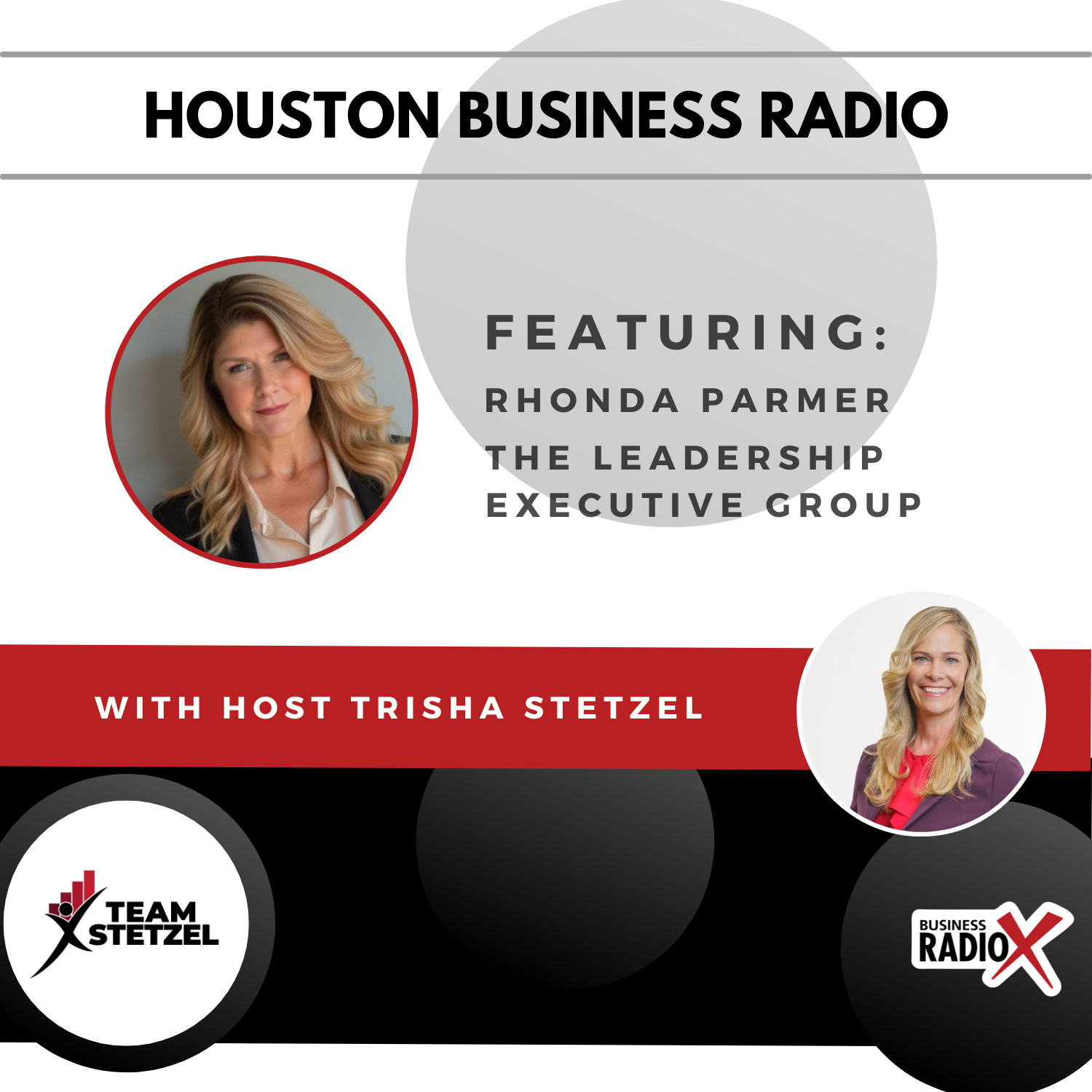

Dr. Rhonda Parmer is an executive coach and founder of The Leadership Executive Group, dedicated to helping high-potential leaders gain confidence, avoid burnout, and build high-performing teams.
After 31 successful years in public education—finishing as an associate superintendent—Rhonda now guides leaders across industries using her proven E.A.S.E. Framework. She’s a certified John Maxwell Coach, DiSC Consultant, Nationally Distinguished Principal, and author, known for turning stress into success in under 90 days.
In her conversation with Trisha Stetzel, Rhonda shared her journey from education to executive coaching, emphasizing the importance of balance, confidence, and setting healthy boundaries. She discussed how self-care, mindset shifts, and delegation are key to sustaining leadership success. 
Rhonda also offered personal insights, including her love of open-road auto racing and daily chats with her mom, as ways she maintains her own balance while helping others thrive.
Connect with Rhonda on LinkedIn.
 This transcript is machine transcribed by Sonix.
TRANSCRIPT
Intro: Broadcasting live from the Business RadioX studios in Houston, Texas. It’s time for Houston Business Radio. Now, here’s your host.
Trisha Stetzel: Hello, Houston. Trisha Stetzel here bringing you another episode of Houston Business Radio. It is my pleasure to introduce you to my Texas friend. We were having so much fun before the show. Uh, Rhonda Parmer, The Leadership Executive Group CEO. Rhonda, I’m so excited to have you on the show today.
Rhonda Parmer: Thank you Trisha. I am very excited to be here and it’s such a pleasure meeting you.
Trisha Stetzel: Such a pleasure meeting you as well. So first we need to know who Ronda is. So tell us a little bit about you.
Rhonda Parmer: Okay, well, I am Houston native. I’ve been here my whole life and born and raised, of course, and started out as a teacher substitute teacher, worked my way up all the way through to associate superintendent. Had 31 years in public education. I’m so proud of that career. And the last 12 years we’re working with, um, underperforming schools. And what we found is there was a confidence issue, a confidence issue with the teachers and with the students. So we figured, hey, let’s change this mindset. Students are not limited by their zip code or their parents income, you know, let’s believe in them. Just say you believe in them. Just say it out loud. Change your mindset. These students can learn. Every student can learn. He can learn. She can learn. This is a future CEO. This is a future doctor. This is a future lawyer. And let’s change our mindset and just see if it works. And it did. And so after years of seeing schools rated as F, go to B’s and A’s and teachers who were burned out feeling rejuvenated and students feeling proud about themselves and parents unbelieving. What was going on? I said, hey, what if we apply that same system to nonprofits or small business or big organizations, corporations? And so I started a consulting firm after I retired, and that’s what we’re doing.
Trisha Stetzel: Love that. So that is how the Leadership Executive Group was born. Tell us more about the work that you’re doing in that space, Rhonda. Now.
Rhonda Parmer: Hey so what we have eight amazing coaches who thank God they believe in me and I totally believe in them. But they are amazing. And we work one on one with clients. Or we also provide training to groups, teams and our main focus what we found. We work mostly with women, but we have a few guys too. But we’re looking at people who are ready to just take that next step. Perhaps something is holding them back. As I mentioned in the schools, you know, that could be a mindset. And so it’s not about never feeling fear or never having self-doubt. We all face that. And that’s a beast that all of us, even even your most successful athletes and successful CEOs, everybody has to, um, address that. But it’s about identifying it, knowing when it’s coming up and then backing up just a tiny bit from it. Okay. What is that? What is that belief or thought that’s making me hesitate? Pause. And so we work and coach directly with one on one, um, clients to help them break through to the next level. Uh, is it a promotion? Is it leading a brand new team? Is it mentoring one person who will come after them to be the next leader? All kinds of, um, you know, positions for one on one coaching. And then we also provide group coaching. And I found this is what we’re finding is we’re getting into a niche of working with pastors. And so pastors are in a unique position. They either have a very, very small staff or they’re working with volunteers. And so how can they get the confidence in themselves and the confidence in their team to help move and strategize to meet goals? And that’s us. That’s what we do. But we work with people in all sectors. And, um, what I’ve been doing is meeting people through speaking engagements one on one, I mean through workshops. And I’ll we’ll promote that later on in the show. But that’s that’s how we roll.
Trisha Stetzel: That’s amazing. I love that. And as you were, as you were talking through the work that you’re doing and even talking about, most of them are women. Uh, which is another connection that you and I have. We talked about that, uh, before the show. I have a lot of conversations around balance, and I think that you do as well as well. Um, so when you’re. I know that you work with high achieving leaders and many of them struggle to find balance. So what’s your advice to them when they start to feel that guilt? Or they haven’t taken a vacation or they’re afraid to take their PTO? What do you tell them?
Rhonda Parmer: Oh, that is so hard. And that’s that limiting belief too. So that’s a little bit of confidence. So it all boils back down to confidence. It’s confidence. Do you have the confidence to say I need a break. Do you have the confidence to say it’s time for me to take a quick vacation, a long weekend or even a full week, God forbid. Right. So I, I tell them, look, you we the world needs more leaders, whether that’s in organizations, communities or families. We have got to have leaders. And if you burn yourself out, we all miss out on your medicine. You have what we need. And if you burn out, we all lose out. So if you want to serve and fulfill your calling, you have to take care of yourself. And so I one of the things I do, Trisha, um, I have I’m a I’m a nerd, I love reading. I read everything if it’s a if it’s a book, a magazine, a blog, a something on Facebook that links to a, a research article. And what I’ve done is taken all those research gurus for leadership and put turned those into actionable steps. So I, I have not finished this book yet, but I’ll be back when I actually get it published. Yes, please. I’m writing a book. It’s a field guide for leaders, new and aspiring leaders, and it’s called ease into leadership. And ease is an acronym that basically everything that we have to do in leadership boils down.
Rhonda Parmer: You can boil it down to four steps and that is evaluate your priorities, have some accountability set. And for example, in this particular case with boundaries. I mean, with ballots set boundaries. And so we we have these tools. There are rubrics basically implementation rubrics. And they’re not designed as worksheets or homework or something to be filled out for compliance. They’re simply conversation starters. And so I ask the leaders to work with you know, work with me. Let’s look at set boundaries. What does this look like for you? Easily one of the best things I’ve seen people model. This was in a school district and they did it district wide in Pasadena. It was a, you know, 50,000 student and 68 campuses. What they did is before every break, they sent an email saying, during this break you will receive no emails. If you set if you send emails, please set. You set the system that it won’t even send it. It’ll be a delayed send until the day we get back. And that really created a true vacation, a true break for people. Because in this, in our world of just hurry, hurry, hurry, do it, do it, do it. Answer. I need an answer. Even when you’re on break or the weekend you think, oh, I got to answer those emails. But the first time we did that in Pasadena, it was just like, oh, I finally, truly, really have a break.
Rhonda Parmer: So modeling your expectations for boundaries of no email during this break? Um, another one is have an accountability partner at work. So your secretary, your partner, your assistant, somebody to say, hey, it’s five, it’s 530 or whatever your ending time is. Let’s go. This stuff will be here tomorrow. So just two easy ways to set boundaries. And then finally, what I do ask people, um, one of the very first things I ask people in our coaching session is, what is your nighttime routine? You would be shocked how many people don’t even know what I’m talking about. Like, what is your nighttime routine? You know, do you eat at home? Do you come home from dinner? Do you wash your face? You know, do you read a little bit? Do you watch TV? What is your routine? And so many people. We’ve just gotten to where we’re so reactive, and that’s what burns people out. They. Even though a lot my husband’s the worst, he’s like, no, no, no, nobody wants a routine. Nobody wants a schedule. But even he does want a schedule. And he is one of the most free thinking free, you know, no time schedule. But we like routine and we like predictability, and we like and our bodies like that, where you get into this rhythm of being able to do things and you feel better about yourself because you can predict what’s coming next. So those are the things I ask people to do.
Trisha Stetzel: Wow. Okay. So I stop work at 5:00 every day so I can go in and cook dinner with my husband. Does that count?
Rhonda Parmer: Yes, ma’am. Two stars for you? Yes. Awesome.
Trisha Stetzel: All right. I can’t tell you the rest of my routine, but that’s. That’s the beginning, right? We’re getting there. We’re getting there. Um, so there are some people listening right now, Rhonda, that are thinking. And. And you and I probably have had these same thoughts that if I’m not on all the time, people are going to see me as a slacker. So how do we shift that mindset?
Rhonda Parmer: Okay, this is going to sound almost ridiculous, but it literally comes to it comes down to identifying that thought. So first people need to identify that that’s what they’re thinking, because sometimes they don’t even realize that’s what they’re thinking. They’re just acting because they know that’s true in their head. So they have to slow down to realize, oh, I’m doing these things because I think people will think I’m a slacker. So it’s so it’s it sounds so easy and simple, but it’s. It’s not. You you have to realize that’s what’s driving you. And then once you realize that this is this is a physiological, neurological truth, putting your hand on your head and saying the opposite. So I am not a slacker. And it’s even better if you don’t use the word not. So phrase it in a positive way. If you think about when you you know, we used to when we’re, we’re when we’re teaching children don’t run instead of saying don’t run because all they hear is run, you say walk. Thank you for walking. So in your head I am productive, I am balanced, I work to get things done and I rest for myself so I can continue to get things done. And it’s literally putting that thing, putting your hand on your head.
Rhonda Parmer: I worked with a client one day and this wasn’t too long ago. She was so ridden with anxiety about needing to get something done that she could not. I mean, she could not even put her hand on her head and say, I am safe. And I was thinking, bless you. No, come on. This is just take a take it, take a deep breath. Let’s count to five. When someone is in anxiety like that. And we do this because we have these mindsets and so many, so many of these mindsets. Let me tell you about three ways that our our our our behavior is shaped. A third of it is pure genetics. We can’t do anything about it. It’s there. It’s in us. Okay. Another third of it. We can’t do anything about it because it’s already happened. It was from the time we were born, till the time we were about 12 years old. Things that were modeled, things we heard, things that were said to us. That’s that’s there. We can’t really do anything about it, but we can choose to overcome it. Let’s say, um, let’s say someone said, um, all you do is eat. Okay, well, I know everybody told me all I did was eat, but I choose to say I eat when I’m hungry, I eat for nourishment, and I don’t eat because I’m bored.
Rhonda Parmer: I don’t eat for entertainment. I don’t eat because I’m scared. And you, you have to. You can overcome some of those things, but they’re pretty much they’re to you. But that’s part of what we call childhood trauma. No matter what your childhood is that that is there. And then the other third is from like that same age, like age ten, 11 or so till now, all your experiences. So those things shape our behavior. So we’re still experiencing things that help us shape behaviors. And if you go back to your original question of how do you help a person who thinks I’m going to be a slacker, we first have to help them realize, okay, you’re acting because of an erroneous thought that’s in your head. Now let’s reverse that thought I am productive, I am balanced. I and it sounds again, it sounds almost ridiculous, but what happens is your thoughts turn into words. Your words turn into actions and your actions lead to results. It’s not that your words turn into results immediately. There has to be action in between, but you can’t start with that action until you start with the correct words in your head. Yeah.
Trisha Stetzel: A woman after my own heart. I love this law of self control that you were just talking about, right? Because the language, the words, the things that we’re telling ourselves become our beliefs and our feelings to our actions and our results. Okay. People are already interested in reaching out to you. I know this, Rhonda, so how can they best connect with you?
Rhonda Parmer: My my website is Rhonda Palmer. Com and remember Palmer rhymes with farmer, but it starts with a P. So I’m not Palmer. I’m Palmer. Rhonda Palmer, dot com. And you can check me out on LinkedIn, too. Rhonda Freeman Palmer.
Trisha Stetzel: I love that, and it’s Rhonda. If you’re looking for her. Uh, amazing. I, I know that people are going to want to connect with you and have a bigger conversation around the things that we’ve been talking about. So here’s what I would like to know next. This is a hard one, Rhonda. How do you create balance in your own life?
Rhonda Parmer: Oh, okay. So I will tell you quick backstory. Reader’s Digest version. Back in the 70s, you know, this wasn’t diagnosed as much, especially if you had some coping skills and you weren’t failing. But I we figured out I had dyslexia. Okay. And we didn’t call it that. We just said I wasn’t paying attention. Okay. So, so so I had to pay attention. So I forced myself to pay attention and do different things to to make sure I got things right, and it slowed me down, but it made it. It unintentionally turned me into a perfectionist. And then that turned into workaholic ism and and that lasted into my adulthood. Um, so I worked on my master. I got my my bachelor’s degree, master’s degree and doctorate doctorate degree. But the wake up call happened in my 30s when I was diagnosed with a double cancer. Um, I had double cancer diagnosis and breast cancer and thyroid cancer. And this just happened to be my first year as principal. And I don’t know if many listeners understand, but I’ll just go ahead and say it because I was one of them. A lot of principals are very, um, well, I’ll just say I was very egotistical and like, oh, I am the principal now we’re going to do this and we’re going to do this, and it’s going to be this, and we’re going to be number one in the nation, and we’re going to do this, this, this, this.
Rhonda Parmer: And everyone was telling me, um, when I was assigned this job. Slow down, slow your roll. Get to know people. Watch out, learn, watch and learn. Don’t do anything. Don’t change anything at this school for at least a year. I’m looking at him like, hey, man, these kids don’t have a year to waste. You know, but God told different. So I did slow down because I had to take medicine and do treatments and have surgeries. But what I found was, um, the ability to ask for help. And that was something I was very, very uncomfortable doing. So I, I, my husband helped me practice. We modeled at home asking for help, and I got help. And that helped me maintain the balance of taking my medicine and doing some work. I didn’t miss very much work. He took me a cot up to my office, so if I needed to, I could just lie down for a little bit. But anyway, um, that was a wake up call And it was like, hey, you know, you can do all this stuff and burn yourself out and be gone and not do anything for the world.
Rhonda Parmer: Or you can slow your roll and take this in doses and give this to people in the amounts that they can consume. Yeah. And that really helped change the way I lead and the way I coach others. And, um, what I do now. I first, this is what happened. I realized. This is so sad to admit, but a year had gone by since I talked to my dad. Like I talked to him on his birthday and Christmas. He didn’t live in the state. And I’m like, wait a minute. This is my dad. And then maybe a year had gone by since I saw my mom. She lives in the same town. I’d talked to her very frequently, but maybe I hadn’t seen her in a year. Like, really? I’m only spending time on Mother’s Day and Christmas with my mom. I’m fortunate enough to still have my mom here, and I’m not taking advantage of this. So now what I do? I talk to my mom every single day, and I. I travel with my husband. My husband has a trucking company. So I said, hey, I’m going to go with you at least once a week. Let’s go out in the town. He has a heavy equipment trucking company, so any big yellow things y’all see? Watch out for those truckers.
Rhonda Parmer: It’s so heavy they can’t shut down. If you cut them off, it’s hard to slow down 80,000 pounds. And then another thing I do, I think I mentioned this right before we started on air, I race cars. So as I mentioned, I did have that double cancer diagnosis. I was in my 30s. I didn’t have a lot of good insurance. I had the bare minimum plan. So my debt stacked up, and I looked at that one day over $100,000 of debt, and I said, man, if I’m going to be in debt because I’ve never been in debt up until that point, even through college, I worked my way through college. But I said, if I’m going to be in debt, I’m at least going to have something I like. So we went out and bought a vet and now I race it in the Big Bend Open road race. I’m one of the navigation trainers and one of the rookie qualifiers, and that is how I find balance. Totally get away from everything and do a whole different world. And as my husband says, we go out there for the week. We have a big family reunion and then there’s a race at the end of the week.
Trisha Stetzel: Oh my gosh, that’s so much fun. So you have to you. We did talk about this before we started recording. You have to describe the race like how does the race go down?
Rhonda Parmer: Oh girl it is amazing. So this is highway 225. It’s from Fort Stockton all the way down to Sanderson, Texas. So it’s just the west side of Big Bend National Park. They shut the highway down. So the State Patrol are out there. They have helicopters and airplanes sending little signals to make the animals all go away. They chain off all the ranchers gates so nobody can pull out on the road. And they announce it way in advance, and everybody supports it, because to this little town, it’s almost like the Super Bowl coming to town. You know, it brings in a lot of economic value. But basically the cars line up, you sign up for which class you would like to be in, which means what average speed you want to you want to maintain. And they let you go one at a time every minute. So ideally you should not pass or be passed. And I’ll tell you, Trisha, there is nothing better than coming up on a 55 mile an hour curve at 120 miles an hour. You got the whole road to yourself. So last year, my husband and I averaged 145 miles an hour. And we can go up to 168 to be able to do that.
Trisha Stetzel: Wow.
Rhonda Parmer: 59 turn. No, it’s 59 miles. One way you go down, everybody goes down, and then you restock and come back. But 59 miles, 59 turns and 59 elevation changes.
Trisha Stetzel: Oh my goodness, that sounds like so much fun. I so I love this whole idea of balance. And we’re getting to the back end of our conversation. But I have one more thing that I want to tackle because you talked about asking for help. This actually just came up for me with somebody that I was having a conversation with just earlier today. And I think oftentimes as strong women, we don’t like to ask for help. You mentioned that you went into this practice mode with your husband and getting help at home. How do you continue to use that mindset that you had there that it’s okay to ask for help? Listen, I’m a veteran. And those of us who are in the military don’t ask for help when we get out, right? Because we know we’re just going to go get stuff done. And so we do. And it’s really, really hard to ask for help. So how do we get past that? Rhonda.
Rhonda Parmer: First of all, thank you so much for your service. And I can only imagine, I, I know in high school I thought, oh, I want to join the Air Force. I’m going to do that. And then I chickened out. You know. No. Never mind. I’ll be a teacher. You know, I like teaching. My grandmother was a teacher. But anyway. No, um, I gotta tell you. I mean, that is. It’s one of those swallow your pride, you know, swallow your pride. And and I saw this graph one time that said, you know, it had these two little lines, and it was just like, this is what happens if I don’t ask for help. Here’s my outcome, and I can get to here and here’s my outcome. If I do ask for help, I can exceed that outcome. Because there is there’s a there’s a even if you feel so alone, there are people who want to help you. Um, this is a lesson from Simon Sinek. He says learn to ask for help because people are there reaching their hand for you. Most of the time you just have to see their hand. You don’t even have to ask for help. Their hand is already there. You just take their hand. So receive the help when they offer it. And then if you don’t think they’re offering it, ask for it. And I promise you, this is something that I continually do. I have a workshop next Thursday and I practice the intro and outro with my husband last night. I mean, this is it’s just it’s, it’s if we want to be the best versions of ourselves, that’s what we do, you know? And and people want to help us.
Rhonda Parmer: This is what I tell leaders. There’s some leaders who they have this thought that, hey, I’m the leader. I’m getting paid the most. I have to do the most. I have to do it all. And that’s not true. It’s simply not true. You have an assistant. Sometimes you have a secretary. Sometimes you have other people on your team. And we’re robbing them of their purpose. If we try to do everything. I’ll give this example. Um, let’s just say I’m working with this lady from a museum who works in a museum, and she’s the she’s newly appointed. And she does have that. It’s an accidental mindset of, well, I’m in charge. I have to do everything. But no, we have someone and we have someone in charge of marketing. And she used to be in charge of marketing. So if someone in charge of marketing, someone in charge of fundraising, someone in charge of ticket sales, someone in charge of summer programs, let them do their jobs because otherwise you’re robbing them. And we’re paying you to do what only you can do to make those tough decisions and build that vision and build cohesion and collaboration the way only you can do. The leader is the one who needs to notice. Recognize what’s happening with all the other staff members and team members so they fulfill their purpose and they one day are ready to step into the next CEO role.
Trisha Stetzel: I love that, so we have to allow them to fulfill their purpose by allowing them to do the work that we’ve hired them for, right, or that we’ve brought them on board for. I love that, okay. So, Rhonda, you’re going to have to come back because I see this whole idea of delegation coming to fruition here, and we’re going to have to have a whole nother conversation about delegation. Thank you so much for coming on today. Thank you for your service as a teacher, as a principal, as an administrator, such a hard job sitting on the outside looking in, having our son is much older now, but we had one, you know, come through school. So I get it. And thank you so much for your service to our community.
Rhonda Parmer: You, Trisha, it’s been an honor. I love meeting you and I would love to see you again.
Trisha Stetzel: Okay, fantastic. I will be in touch for sure. All right. Rhonda Farmer, thank you so much for being on with me. And that’s all the time we have for today’s show. Join us next time for another exciting episode of Houston Business Radio. Until then, stay tuned, stay inspired, and keep thriving in the Houston business community.














