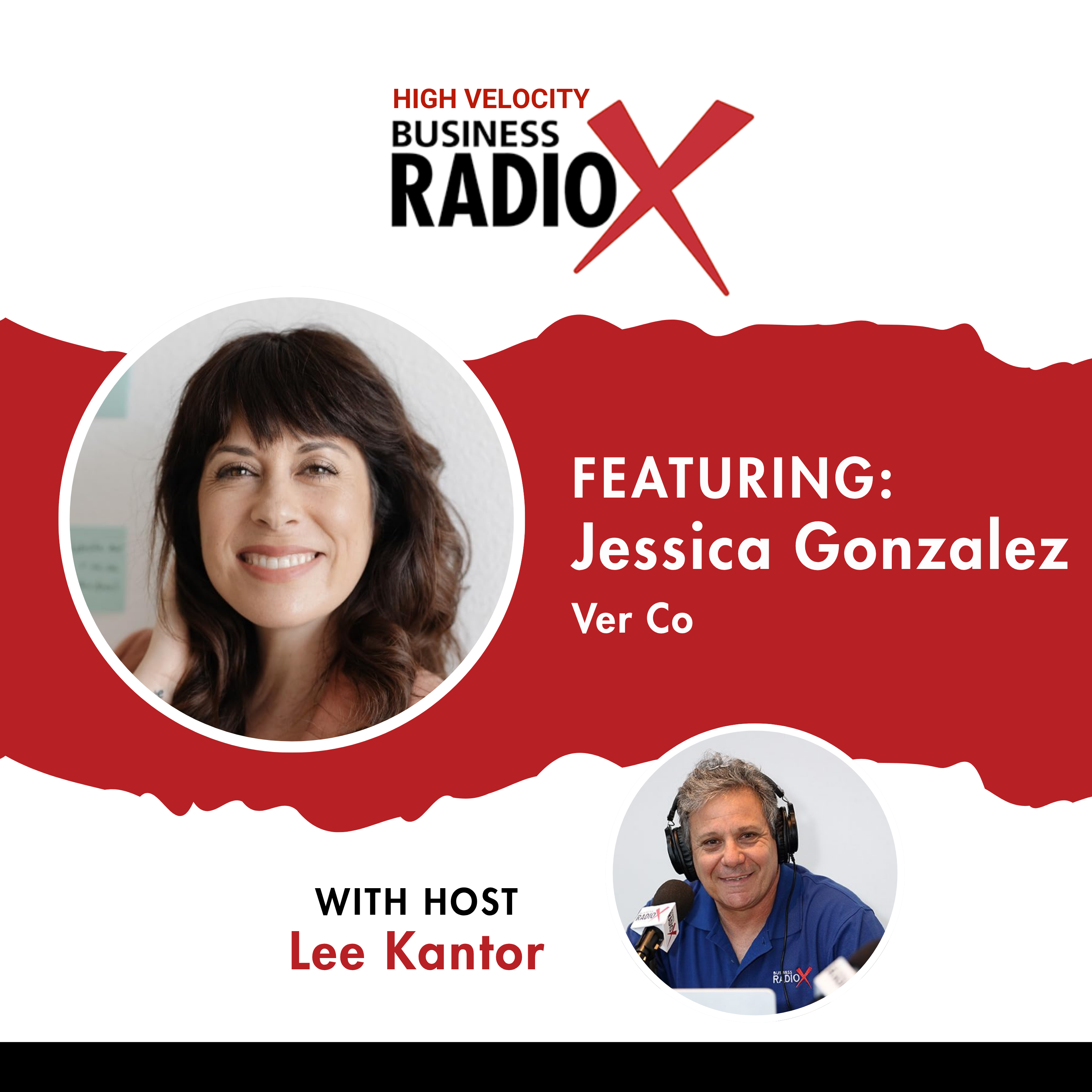

In this episode of High Velocity Radio, Lee Kantor interviews Jessica Gonzalez, Executive Coach and Founder of Ver Co. Jessica shares her journey from corporate consulting to coaching, discusses the importance of professional credentialing, and explains how her firm helps organizations enhance leadership and culture. She highlights the transformative power of the Enneagram personality framework in both individual and team development, emphasizing its role in fostering self-awareness, effective communication, and organizational growth. The conversation offers practical insights into leadership development, coaching best practices, and the impact of tailored talent strategies on business success.

 Jessica Gonzalez is an Executive Coach and the Founder and CEO of Ver Co., a boutique leadership development and talent strategy firm.
She has nearly 20 years of experience in program management, organizational development, and strategy consulting across a variety of industries and within a wide range of organizations, from non-profits to startups to Fortune 500 companies. She is passionate about helping create leaders and teams that inspire people to do their best work.
She is an ICF-credentialed coach (PCC-level) and has certifications in multiple different leadership and team development frameworks (e.g,. Enneagram, The Leadership Challenge, Energy Leadership, Design Thinking). She has been featured in Authority Magazine and was recently named as one of the top 15 coaches in Austin, TX in 2025 by Influence Digest.
Connect with Jessica on LinkedIn.
What You’ll Learn In This Episode
- Leadership development and its significance in organizations
- The role of executive coaching in enhancing leadership effectiveness
- Transition from corporate strategy consulting to coaching
- Importance of professional credentialing in coaching
- Types of clients and industries served by coaching firms
- Impact of coaching on organizational culture and employee engagement
- The Enneagram personality framework and its application in coaching
- Understanding core beliefs and motivations through the Enneagram
- Strategies for fostering effective communication and collaboration within teams
- The integration of coaching tools and assessments in the coaching process
 This transcript is machine transcribed by Sonix.
TRANSCRIPT
Intro: Broadcasting live from the Business RadioX studios in Atlanta, Georgia. It’s time for High Velocity Radio.
Lee Kantor: Lee Kantor here. Another episode of High Velocity Radio, and this is going to be a good one. Today on the show, we have an executive coach and founder and CEO of Ver Co., which is a boutique leadership development and talent strategy firm. Jessica Gonzalez, welcome.
Jessica Gonzalez: Hey Lee. How’s it going?
Lee Kantor: It is going well. I am so excited to learn about your firm. Tell us about Ver Co.
Jessica Gonzalez: So Ver Coo, as you said, is a leadership development and talent strategy firm. We offer executive coaching, workshop facilitation, strategy support, Offsites things of that nature to help leaders essentially be more effective in their roles.
Lee Kantor: So what’s your backstory? How’d you get involved in this line of work.
Jessica Gonzalez: So my background is in strategy consulting, and I was also in program management. And I really loved working in corporate. And until I didn’t, until I reached a point of a bit of burnout. And I looked at my boss who is a VP and sales and account management, and I was like, you know what? I actually don’t think that I want to be you when I grow up. And so an opportunity came up to work for my church, which was a hard pivot. Um, something that I never anticipated. Uh, but I so I left corporate, went to work for my church. That was a transformative experience. And while I was there, I looked at my calendar, and I realized that so much of my time was being spent meeting one on one with people who had asked for time to share Error. The challenges and struggles that they were experiencing. And here, some wisdom, some tough love, because the reputation that I had developed was one where I would create safe spaces for people to share and then mirror back to them. This is this is what I’m hearing. What do you want to do about that? And so once I had that realization, I thought to myself, I feel like I could monetize this skill. Classic Enneagram type three of me. And so I launched this little life coaching side hustle back in 2017. And then it just grew organically by word of mouth. I never marketed, I didn’t have a website for a long time. It’s just that my clients had such a positive experience that they, you know, told all of their friends and their coworkers and whatnot, and it just grew from there to the point where I could go full time at the beginning of 2022, and then at the beginning of this year, 2025, I made a new pivot with the firm to move away from just being, you know, a solopreneur who’s just responding to whatever comes to me to actually building out a a more full fledged business with a bunch of other coaches and consultants that I can pull in to longer term, broader scope work.
Lee Kantor: Now, prior to you being a coach, had you been coached before? Was there kind of a seminal moment when it came to coaching where you’re like, okay, I can do this. I have the skills. I’m doing this anyway. Or was this something that came after you made the decision to kind of get into the coaching game?
Jessica Gonzalez: I hadn’t been coached in a formal capacity. You know, I had had multiple mentors and really great bosses who had modeled coaching to me. I’d been in a lot of therapy, but it also just was more of an intrinsic, intuitive skill set. Like, I’m a deeply curious person, I desire to understand, and I also very much value meaningful connection. And so my my normal way of being in the world is to just hold space and really listen to what other people are saying, what other people are saying, for the purpose of helping them see something that they have never seen before. That unlocks a possibility that they never considered before and allows them to take action they would have never thought was possible. And so actually, the name of my company, Ver Co, Ver, V E R is the Spanish word for “to see”, um, because that fundamentally is what we do. We help people see things differently in a way that has a material impact.
Lee Kantor: So at some point, though, you said I have to get credentialed or was there something that came, you know, maybe that wasn’t the first move that you were thinking. I can just kind of this is how I am. This is my nature. I can, you know, I can do this. But at some point you thought, I need some structure or some understanding of kind of the process of coaching.
Jessica Gonzalez: Yeah, for sure. So I definitely just went rogue in the beginning, which I don’t necessarily recommend, but it worked out for me. Uh, so, you know, I was building out my practice while I was working full time. And then there was a moment where my, uh, family took me from California to Texas, and I was supposed to continue working in a contract capacity for my last boss. But then she ghosted me, uh, for a while, and what I thought I was going to be doing suddenly seemed like it wasn’t a possibility anymore, and I was. I remembered the exact moment when this happened. I was driving down the street in Pearland, Texas, and the thought came to me of, why wouldn’t you be pursuing the thing that brings you the most joy? And the thing in which you feel most aligned, which is coaching. And in that moment, I was like, I’ve never considered that that would be a possibility before I went home. I looked up, uh, coach training programs. I found the Institute for Professional Excellence in Coaching, also referred to as iPAC, and I enrolled that day and started three weeks later. So it was this kind of whirlwind experience and it was an incredible program. It normally takes a year. I really hustled and completed it in ten months, and it was a life changing experience. Actually go through the program and then I felt much more equipped and had new frameworks that I could then bring to my clients. So I do definitely recommend getting both certified and credentialed. If you are wanting to pursue coaching in a more professional capacity.
Lee Kantor: Well, so what do you think the biggest kind of, um, benefit of going through a credentialing program rather than just kind of winging it? Did it help you with that framework and structure? More? I would imagine kind of some of the skills that you were just intuitively good at, and it just came pretty naturally to you.
Jessica Gonzalez: Yeah, I would say there’s a couple of things. One, it was helpful to be affirmed in the fact that I am intuitively skilled at this profession, right at the, the, the, um, both art and science of coaching. Um, but I think that, uh, coaching in a way that is aligned with ICF ethics and competencies is quite important. Right. Coaching is an unregulated industry, and I think that as professionals, it is on us to operate in a way that is as professional and sort of within the context of guardrails as possible. Right. So the ICF, the International Coaching Federation, is our governing body that we have. So I think it’s helpful and important to align with the ethics and competencies that they’ve articulated. And then the third thing is that the the frameworks that I learned through the iPAC program have been extremely helpful to me as a person and then also to my clients. So learning the the tools and resources and frameworks, um, help to build out a more solid offering.
Lee Kantor: Now, does it help when you’re kind of working with corporate clients when they see an ICF certified coach or credentialed coach, is that something that gives them, you know, okay, I checked that box. Then I don’t have to worry about this person rather than coming in without that credential. Is that something that organizations ask for or expect?
Jessica Gonzalez: So I think it really depends. If there is an organization that is hiring external coaches to become internal coaches, they absolutely have a requirement that you’re at least ACC certified or credentialed through the ICF, if not PCC. You know, if you want to work for a coaching company like Betterup, for example, you have to have an ICF credential. I have never been asked about my credential or credibility by an individual leader who is hiring me, right? If I have a VP at a large corporation who has heard about me, they have never inquired about my credentials. And part of that is because of the reputation that precedes me. Um, but also, if you’re not in the coaching world, you don’t really know what you should be looking for or expecting. So I think that it really depends on the context in which you’re coaching. Sometimes it’s required, sometimes it’s not.
Lee Kantor: Now, what types of organizations do you work with? Um, you know, what’s kind of their problem they’re having right before they call you and your team?
Jessica Gonzalez: So I work with a wide variety of industries and organizational sizes, simply because of the way that most of my business comes to me, which is referral. Um, it has been concentrated in, uh, the healthcare space, in tech, and then in nonprofits. Right. Just sort of organically, um, come to those sort of three verticals. Uh, and there are really five primary reasons that people call. One is because they need to reset or establish for the first time their strategic drivers. Right? So vision, mission, strategy, culture, KPIs, etc.. Um, we just finished doing a talent strategy project for a professional services firm who has really wanted to scale and hasn’t been able to scale at the level they wanted to. And in our conversations with them, it became clear that they needed to take a step back and look at and establish for the first time a talent strategy so that they were aligning their human capital with their overall corporate strategy. Um, the second reason is when someone is promoted from an individual contributor to a new manager role. So many organizations do not have any support or do not offer any support to new managers. And it does such a disservice to those new managers, both in their new manager role, but then also as they progress in their career, because the skill set that gets you promoted is is the opposite skill set that you need to be successful. And so will come in and we’ll help to upskill and train and coach new managers to be effective leaders. Um, the third reason is when teams have a high potential employees that they want to invest in so that they can reach the next level in their career and we can, you know, do overall programs for that, or we can do one on one coaching to help bring them to the next level in their career.
Jessica Gonzalez: Uh, the fourth reason is if companies don’t do the first three and then they start having problems, right? Their, their their employee pulse scores are decreasing. And, you know, HR complaints are being lodged and good people are leaving the company. They’ll bring us in to diagnose what’s really happening here, and then create a plan to close the gap between where they are and where they want to be, so they can reestablish or perhaps establish for the first time, psychological safety and productive working environments. And then the last reason I would say is, um, when a senior leader just needs a safe space to process the struggles that they’re experiencing and then work through them with an objective, trusted third party, right? Like, as you probably know, the higher you get in an organization, the fewer safe spaces there really are where you can be like, I actually have no idea what I’m doing. Even I’m even though I’m the leader of this company. Uh, and so being able to create that, that neutral, safe space for them to share what they’re struggling with enables them to actually proactively solve some of the things that they’re struggling with. And then, of course, there’s many other reasons. Um, you know, I just want to do an off site. They want to do a team building thing, but those are probably the five most critical, um, that we hear from our clients around.
Lee Kantor: Now, are your is your work primarily in larger organizations, enterprise level organizations, or do you work with small teams or solopreneurs or, you know, a five person, uh, you know, ad agency?
Jessica Gonzalez: I would say they’re primarily with larger organizations, right? Like fortune 500 companies. We do some work with, you know, more boutique professional services firms. And then because I worked for church, um, I also, you know, personally have had many, uh, church clients where I’m coaching, um, you know, the lead pastors of our startup church or the lead pastors of a church that was never planned. I would have never in a million years imagined that I would be doing that work. But, you know, I, I got one one of my very first clients was this a married couple who were leading a church, a new church, and they had such a positive experience that they told everyone in their network about me. And then all of a sudden I had all of these church clients. Um, so that’s sort of a niche part of the business as well.
Lee Kantor: Now, um, can you share a story about what it was like to work with you, maybe share the challenge the organization had and how you were able to help them get to a new level? Obviously don’t name the name of the organization, but just the the problem that they were dealing with.
Jessica Gonzalez: Yeah for sure. So one of the clients that I had been working with in various capacities with team building, um, they had done a, a pulse survey where, you know, an employee pulse survey with their team and something that they do twice a year, every year. And for the last multiple rounds, their, uh, their pulse survey scores were decreasing. And then when they were sharing those results with the team, it came up that people were feeling a lack of psychological safety. And that felt very surprising to the senior leaders of this team. And through further investigation, they found that there were a handful of of individuals who were driving most of the experiences of psychological safety or lack of psychological safety. And so they brought us in to coach, one on one, the individuals who were identified and then to teach, um, the, the broader team, a particular framework for understanding how their, their individual and collective, uh, interpretations of situations were creating a certain feeling in the environment, right? Because our beliefs create our feelings, our feelings motivate our behaviors. And and then the combination of our beliefs, feelings, and behaviors creates a certain kinds of kind of energy.
Jessica Gonzalez: And so we were able to teach this team this framework, which then gave them a tremendous sense of agency to actually shift the felt experience and the overall level of productivity on the team. And then through the one on one coaching, we were able to shift all of the leaders who had been previously identified as creating psychological safety issues, to a point where that was no longer true, where everyone on the team was able to say, I no longer feel psychologically unsafe, and I, in fact feel psychologically safe. Um, And one of the one of the individuals that we had coached. At the end of that engagement, they said there is a significantly different felt experience on the team now, like the vibe is completely different. Um, since we’ve done this work and obviously whatever the the felt experience is, the culture of the team influences the team’s capacity to be productive, work together, effectively, collaborate, and ultimately achieve the goals of the organization. And so that was a really gratifying experience to be able to see, like a wholesale shift in the culture of an entire team.
Lee Kantor: And that’s an example where if maybe they didn’t have coaching, they might have just got rid of a couple people and then said, problem solved.
Jessica Gonzalez: Or. Yeah, well, and this is a fairly conservative organization where getting rid of people is quite difficult, so it’s more likely that good people on the team would have quit and the the problematic people would have continued causing problems.
Lee Kantor: Well, I mean, the impact of coaching is so real, and I just wish more and more organizations would kind of lean into it and at least try it out.
Jessica Gonzalez: 100% agree.
Lee Kantor: Now, early on, you mentioned it was kind of offhandedly, but this is a subject I’m kind of curious about and I’m learning about. Uh, you use the phrase Enneagram. Can you explain that to our listeners? I don’t know if it’s as kind of widespread as people, uh, as as as it could be, but can you share a little bit about what an Enneagram is and why it’s it might be useful for your organization to learn about it.
Jessica Gonzalez: For sure. So the Enneagram is often described as a personality typing assessment, but it is not that in its entirety. It describes nine archetypes of human beings and their associated ways of thinking, feeling, and behaving. So there are nine different types, and each type describes a particular personality, but it’s so much more than the personality. It actually describes the ego structure of each of these nine ways of existing in the world. Um, the word nia is a Greek word. It’s actually two Greek words. Nia is the Greek word for nine, and gram is the Greek word for something written or drawn. So the word enneagram actually refers to the nine pointed symbol that’s associated with the framework. And, you know, having been in the professional development, personal development and spiritual development space for a long time, I have had exposure to many different assessments and the Enneagram Am, along with energy leadership, which I learned through Ipek, um, is one of the single most helpful and compelling frameworks that I’ve ever encountered. Because once I know somebody Enneagram type, I’m an Enneagram teacher as well. Um, once I know somebody’s Enneagram type, I have this whole playbook into understanding what is motivating them at their deepest, most intrinsic level. You know, often at a subconscious or unconscious level, they are not even aware of it. Uh, but I know that it exists. And then we so much of the work that I do with my clients is getting to the thing beneath the thing. Right? Whatever it is that they bring to me or bring into their coaching. Um, it’s it’s almost never about that. There’s always something deeper and learning their Enneagram type, which we do in all of our one on one coaching, we always do an Enneagram type interview, so we figure out what their type is.
Jessica Gonzalez: Um, so much of the coaching process then becomes helping them understand how those core beliefs that are associated with their type are showing up in every part of their life. And in all of the organizations that we have taught the Enneagram to, and they’ve really adopted it and integrated it into the fabric of their culture. It has had a material impact on the the organization’s culture, because the Enneagram gives you a shared language with which to understand one another and why each of you show up the way that you do, and what the best way of working together and giving feedback and communicating, um, and motivating and inspiring each person on your team will be. It’s like being a parent if you have more than one kid. Generally speaking, you probably have to parent them a little bit differently depending on who they are and what their little personalities are. It’s the same thing as a leader, right? Like, every person on your team is going to be a little bit different and or materially different. So when you know the Enneagram type of every person on your team, it becomes a playbook for how you can optimize your interactions with them and best motivate them. So I very much recommend that teams consider learning the Enneagram. But if you’re going to do that, I think it’s really important to go deep with it and not use it as a means of just a fun one off team building event, because then it becomes about stereotyping and then it becomes corporate astrology, and it’s not leveraging the massive amount of wisdom and insight that the Enneagram has to provide.
Lee Kantor: And then when you’re doing your coaching, you sometimes include this as part of the your your playbook.
Jessica Gonzalez: No, we always do. So we we always do an Enneagram typing interview with our one on one coaching clients. And we always do an Energy Leadership index assessment, which is the framework associated with Ipek, um, at the beginning of every um, engagement as well.
Lee Kantor: So that so that everybody can be kind of on the same page, language wise.
Jessica Gonzalez: 100%. Yeah. And it’s just like they immediately will know so much more about themselves than before they did their typing interview, and we will immediately know so much more about them than before. Um, we did their typing interview.
Lee Kantor: When you do the Enneagram for an individual, if they have a family, do you offer it to their family as well?
Jessica Gonzalez: Um, I have not offered it to their family, but I do give them some recommendations on, you know, books that they can bring in or how they can start that conversation with their family.
Lee Kantor: Good stuff. Well, congratulations on all the growth and momentum. Uh, if somebody wants to learn more, I have a more substantive conversation with you or somebody on the team. What’s the website? What’s the best way to connect?
Jessica Gonzalez: Yeah, our website is WW Dash. So that’s v e r dash c o.com. You can always email me directly as well at Jessica at com.
Lee Kantor: All right. Well Jessica, thank you so much for sharing your story doing such important work. And we appreciate you.
Jessica Gonzalez: Thanks so much for the opportunity to share, Lee.
Lee Kantor: All right. This is Lee Kantor. We’ll see y’all next time on High Velocity Radio.














