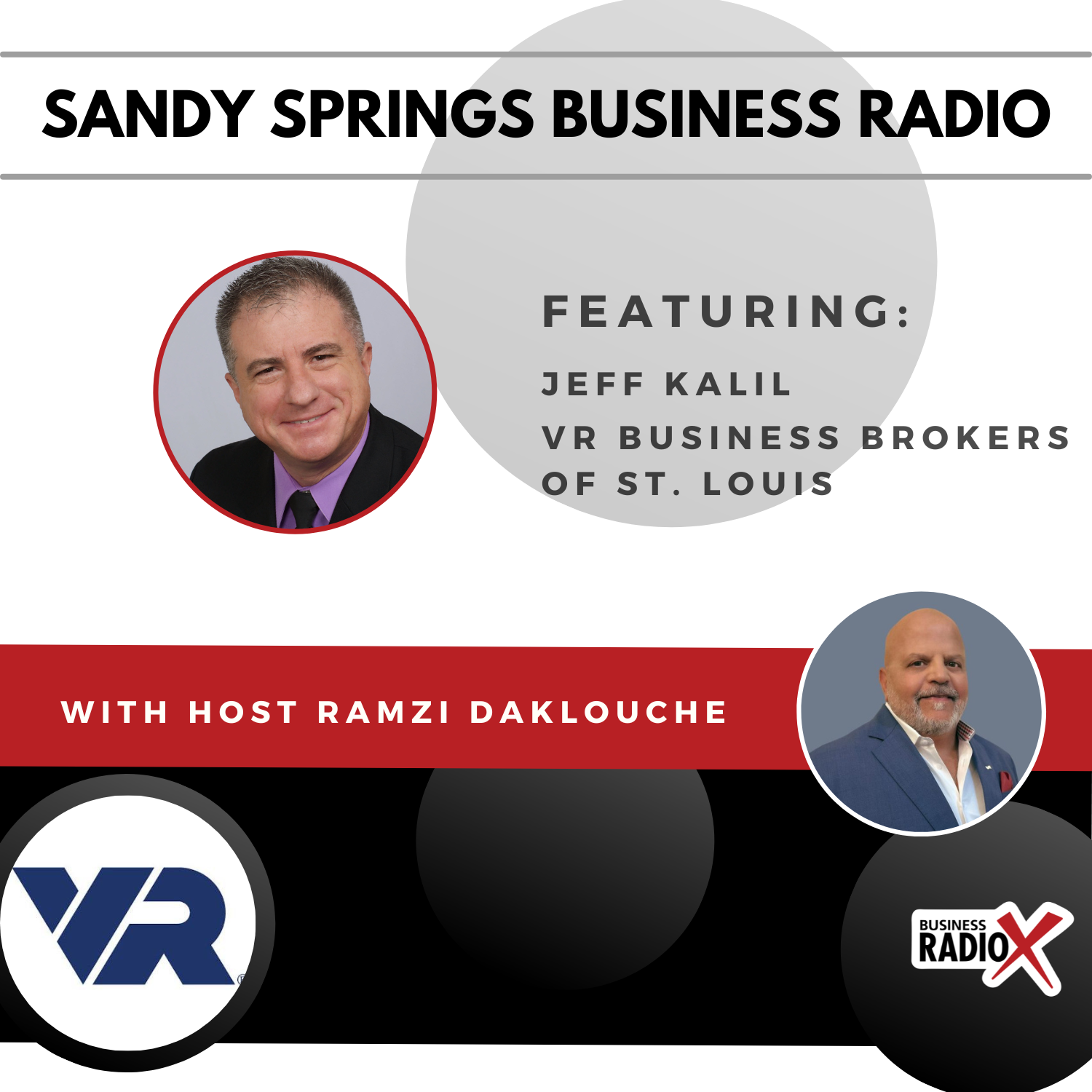

In this episode of Sandy Springs Business Radio, Ramzi Daklouche is joined by Jeff Kalil with VR Business Brokers. Jeff has a background in nuclear engineering, military service, and entrepreneurship. He shares his journey from aspiring astronaut to Army aviator, and eventually to business valuations. The discussion emphasizes the critical importance of understanding a business’s value, the optimal timing for obtaining valuations, and the differences between various types. Jeff advocates for regular valuations as part of strategic business planning, highlighting their role in informed decision-making and long-term success.

 Jeff Kalil is the owner, principal broker, and certified business valuation analyst of VR Business Brokers of St. Louis. “VR” stands for Valued Representation.
Jeff retired from the military as a Lieutenant Colonel in the Army Reserves with 35 years of service and he flew reconnaissance helicopters in the active Army. He has 20 years corporate experience as a Senior Program Manager where he led and managed aerospace and defense programs supporting the Department of Defense and corporate Mergers & Acquisitions.
Jeff is a Certified Exit Planning Advisor (CEPA), a Certified Mergers and Acquisitions Professional (CM&AP), a certified Value Builder Advisor (VBA), a Master Business Intermediary (MBI), a certified Program Management Professional (PMP) and a Missouri licensed commercial real estate broker.
He was recently awarded the 2024 Top M&A firm in St. Louis by Small Business Monthly and Jeff is the founder of the Mid-America chapter of the International Business Broker Association.
Connect with Jeff on LinkedIn, X and Facebook.
 This transcript is machine transcribed by Sonix.
TRANSCRIPT
Intro: Broadcasting live from the Business RadioX studios in Sandy Springs, Georgia. It’s time for Sandy Springs Business Radio. Now, here’s your host.
Lee Kantor: This episode of Sandy Springs Business Radio is brought to you by V.R. Business Sales Atlanta, guiding business owners and buyers through successful transitions with trust and expertise. Visit world.com or call (678) 470-8675 to learn more. Now here’s your host, Ramzi Daklouche.
Ramzi Daklouche: All right. Thank you, Lee. And with us today is Mr. Jeff Kalil, who is actually another VR owner, but not in Atlanta. And with incredible background. So I cannot do justice to introductions. So I’m going to just allow you to introduce yourself first of all. Happy holidays Jeff. Good to see you.
Jeff Kalil: Thank you, Mr. Ramzi. I do appreciate it. It’s good to see you again, too. Thanks for having me on the show.
Ramzi Daklouche: Awesome. So why don’t you tell us a little bit, go back a little bit, because your background is very exciting and interesting. Tell us a little bit about yourself. Tell us what you’ve done with your life. And where are you right now? Sure.
Jeff Kalil: So I guess to get started, you know, I’ll take you back to the days of little Jeff, just briefly. But, you know, when I was growing up, I wanted to be an astronaut. I thought going into space and going to Mars and seeing the universe was a cool thing to do. You know, as any other kid would want. And so as I, you know, was getting older and going through school, math and science was always, you know, my favorite subjects, I loved anything to do with it. I used to build a lot of rockets and little models for spacecraft and things, and so my mind was always occupied with that. But when I went to college, it turned out I needed some help to fund school. So I joined the Army Reserves, got the GI Bill and went to school on that. I was able to get my nuclear engineering degree, and along the way I had the chance with the organization I was a part of through ROTC that we had lunch with an astronaut one time, and I had asked him, I said, you know, that’s what I want to do. What would I have to do to be an astronaut someday? And he said, well, there’s three things that you need. And little did I know at the time, this was goal setting less than 101 for me.
Jeff Kalil: Right. But what he said was, you need to have a high tech degree. You need to be an officer in the military and you have to have flight experience. So those became my goals. So as I was going through college, I focused on nuclear engineering as my degree because that was at the time that was the highest tech degree field that I could find. I was in the reserves, so it was a matter of being becoming an officer. So I joined ROTC and was on my way to get commissioned in that. So the next hurdle I had was getting my flight experience. So as it happened, I ended up getting commissioned into the Army as an aviator, and I went off to fly Kiowa Warrior Helicopters, which is a reconnaissance helicopter back in the day. And that was, you know, I was on my way. But as life would have it, I never had the chance to go on and do the Army astronaut program like I wanted to, but I ended up having a lot of great experiences through the military. And along the way I had the chance, and I was recruited by companies out of corporate America.
Ramzi Daklouche: Before you go to corporate corporate, let me tell you something. I was thinking about it as you’re talking. Jeff, you were the first nuclear engineer I talked to, and I feel so dumb talking to you. I have no idea what to ask you. I’m looking forward to the conversation, but I’m kind of a little, uh, scared right now because I know a lot about you. But hell, if I knew you were a nuclear engineer. Which now I feel so dumb talking to you. But go ahead, keep going.
Jeff Kalil: No worries. Well, that’s why I like the math, which we’ll get into later here as we get into more of the the meat of the show, which is talking about, uh, business valuations and how can we improve that and so on. But um, but that’s where that background comes from. Right? So as I was, um, going through my career, you know, I ended up leaving active duty Army, uh, went into the private sector, worked for a aerospace and defense industry contractor, and I helped them with, uh, refurbishing aircraft from the Department of Defense and putting those aircraft back into service. So, uh, in between all that, I started to dabble in this thing we call entrepreneurship. And I started first by flipping a few houses here and there. This was in Texas, central Texas. And, uh, as I was building up my little portfolio of real estate, I would have people come to me and ask me, you know, here and there, well, oh, that’s interesting. How do you do that? I’ve always thought about doing a deal like this, or I’ve been wanting to start a business of some kind, and, uh, and, and I had a couple of other smaller franchises. I had a Tcby yogurt and Mrs. Fields cookies that I had picked up along the way too. So I was a pretty busy guy. I had my corporate job, which required a lot of travel, plus the programs that I managed. I was in the reserves still, so I still had that commitment every month and every year.
Jeff Kalil: And then I had my side business where I was doing some property management, some property flipping and then running these two franchises. So I was pretty busy and people wanted to know, you know, how was I able to do it? So what I did is I had a I would always go to Denny’s on Saturday mornings down there, and I’d get there early, like 5:36 a.m. I get my eggs and coffee and take my little laptop and I would just plan out my week. I was very disciplined about what needed to be done and try to make my agenda. And so I would tell folks, well, if you want to talk about what you got. Come meet me on Saturday at Denny’s. That’s the only time I really have. And let’s see what you do. So as time would go by, we outgrew the corner booth. You know, two people turns into four, turns into six and so on. So the lender, the bank where I did a lot of my deals from, they had a conference room. They let me use that room for a while that held about 15 people. We outgrew that. And then eventually there was a fellow that had a barbecue restaurant with an event center held about 50 or 60 folks, and we did a trade out where I was able to host my meetings there in exchange that I would encourage folks to, you know, buy the, the, the from the menu for the meetings that we held. And it worked out really good.
Jeff Kalil: At the peak of it, we had about 60 people a month that would come down for the the weekly meetings. And it was a range of everything related to entrepreneurship. It was basically like entrepreneurship 101. Most of them wanted to learn real estate, but others had, you know, ideas of starting their own business or they had a business. They wanted to learn how to grow it. Um, I would introduce them to, you know, the professionals in our industry, like the lenders, the CPAs, um, I kept the gurus out. I mostly focused on the education. And how can you can you become an entrepreneur? And what I recognize right away is that people were doing this because they their motivations were they wanted to change their lifestyle. They had passion behind helping, you know, their kids go to college. Maybe they wanted to change the trajectory, the trajectory of their lives. And most importantly, you know, this was um, this was before, during and after the recession in oh seven and oh eight when the real estate market crashed. So a lot of people, their economy had really changed and a lot of people went upside down. And so they were looking for a way to, you know, change that dynamic. And they saw entrepreneurship as a way to get there. So that’s what the flavor of the club was. And I really enjoyed, you know, helping people and seeing people find those successes that translated into helping their families live a better life. So to fast forward that, our industry started to lay off around 2014 as troops were getting withdrawn from Afghanistan and Iraq and the defense spending went down.
Jeff Kalil: So as our industry started to started to contract. I was worried about a layoff, so I ended up transitioning from Texas back here to Saint Louis and Missouri, where I’m from originally. And after I got here, turns out they laid us all off anyways. But those entrepreneurship conversations just seemed to follow me. It seemed like everywhere I went, somebody wanted to talk about real estate or starting a business or something of that nature. So one of the things I did in my corporate job is I did M&A work on mergers and acquisitions work. And so I had a, you know, a background in that as well. So I just thought, you know, after having all these conversations and I had and as you know, or folks on the on the show here don’t know, VR is a business broker franchise. So I had spoken with the folks there at VR a few years prior just to look for a veteran friendly business opportunity. Um, and so I ended up, I called him back and I just said, hey, if you don’t have an office or a franchise in the Saint Louis area, I’d be interested in taking a look at that. And with that, that was, um, you know, going into 2015 and then going into 2016. And I ended up opening up my VR office here. And one of the things that I ended up specializing in is business valuations.
Jeff Kalil: I got my certification through the SBA, which is the International Society of Business Appraisers, and got my certification right about the time Covid started. So, you know, kind of had the had the time to sit down and focus on that, then not much else was going on, but I’d been doing, you know, pretty detailed valuations prior to that. And I knew what it looked like in my M&A portion of my prior career. So I just wanted to bring something that was a little bit more, um, storytelling to the table as opposed to some of these generic broker opinion of values or broker price opinions that most people provide. And that’s what you get. I want to be able to show you not only what I think the value of your business is, but explain to you why. And lots of times you can’t tell that story when you get a generic, um, value from, uh, you know, a basic equation like a like a multiple of something. Yeah. So that’s where I sort of differentiate myself in that. And so that’s kind of where I’m at now. And then as you know, uh, for uh, VR as a franchise office goes, uh, I do their corporate training for new franchisees and I help bring them on board and, you know, give them the, uh, the first taste of the Kool-Aid so they get a sense of what is it like to be a business broker. And then I’m, uh, then I’m there as just their ongoing advisor. So that’s.
Ramzi Daklouche: Uh, trust me, I don’t envy you with that one. You had to put up with me and with Claudia for, you know, a few days. So I don’t envy, uh, you know, you having to do this, but I appreciate everything you’ve done. But I mostly appreciate your time and service. And thank you for your service. We all appreciate it. Of course. So, Jeff, before we go.
Jeff Kalil: To just real quick, Ramzi, I had, uh, 35 years altogether and I retired as a lieutenant colonel. So, you know, that’s incredible.
Ramzi Daklouche: That is absolutely incredible. Uh, what an honor to be talking to you. First of all, I’ve known you now for a little bit, but, uh, the more I hear your story, the more I more I learn more about you, which is incredible. And what you studied kind of makes me a little bit nervous talking to you, but it is what it is. It’s all good. So, uh, before we go into, you know, different valuation, all the stuff, you know, I’ve done merger, acquisition work for the past 20 years, and now I do more for, you know, smaller businesses and, you know, owning my own office. So a little bit different. Jeff, what I found out what I worry about is so many businesses have no idea what the value of the business is. And more important is when I ask ten people in any meeting how many people know the value of your house and they all raise your hand? Absolutely. They know the value of the house. So same ten people. How many people know the value of their business? Actually, 11 people raise their hand saying, I don’t know the value of my business. Uh, which is kind of scary because in some instances, it’s the second largest, uh, investment you have. And in some instances, also it’s the largest investment you have. And not knowing the value of it is kind of scary. Uh, for a lot of reasons in my in my book. So what are your thoughts on when should person understand the value of the business? One should start looking into this and how easy is it to get the value for your business?
Jeff Kalil: Yeah, ideally you know when you’re like, let’s say you’re planning a trip and you want to go say from, well, we’re in someplace cold right now because we’re having this mini snowstorm going on. But let’s say that you want to travel from New York to California. You know, whatever it is you want to do. Well, there’s some planning that you do that you do, you know, beforehand, you know, what do I need to pack? What’s my checking list look like? Where am I going to go, or am I going to stay? What’s my mode of transportation? Right. So as you’re making those pre-planning and maybe you got to take off work, maybe you got to coordinate for someone to care for the house, the yard, the dogs, whatever, while you’re gone, maybe you’ve got some other family responsibilities, like someone has to care for or check in on mom and dad and so on. As you think about how you plan for that trip and all of the pre-work. Then the work of the actual executions. Now you got the family in the car and you’re on the road. Well, we got to stop for restroom breaks.
Jeff Kalil: We got to stop for gas, got to spend the night somewhere and all that. As you’re doing that kind of detailed planning, that same level of detailed planning should go into your business plan. And you want to have that pre-planning of what is it that I’m going to do with this business and say, ten, 15, 20 years, if that’s my, you know, outlook, because you’re not going to be there forever. Something’s going to happen, whether it’s the economy, whether it’s your health, whether it’s external, um, something more internal, like family, uh, something’s going to cause you to not be able to do that business anymore. So when you’re doing your business planning, and I know it’s probably the last thing you want to think about or even the last thing that comes to mind. But somewhere on that checklist should be an exit plan or exit strategy or what is what is my out of the business scenario going to look like. So I would say that the short answer to that question is the day you plan the business, you should also be planning what that exit is going to look like.
Ramzi Daklouche: Perfect. Thank you. Yeah. I tell you, my experience is anytime you’re doing your strategy for the next year, you really should have the value. You understand the value of your business. So what are you basing it on? Right. And how are you going to grow the business? The value of the business makes a lot of sense to do that. So there’s always a there’s never a bad time in my book to do valuation for your business, not because you’re always going to sell it just to understand if something happens to me today or like you or, you know, God forbid, a divorce, death or anything like that, uh, understand the value. Now, there’s another conversation we can have about what should you do to prepare if something like this happens and, you know, prior to that. But right now we’re going to focus just on valuation of a business. Right. So now understanding this you know I’m not in valuation and I get asked that a lot. So what’s the what’s the difference between this valuation? You know, I got a valuation last year from this guy on my CPA or, you know, the, you know, my, uh, pastor at church told me this is my what my business is, you know, you hear from everybody, right? So tell.
Jeff Kalil: Me. Yeah, your Uncle Fred told you.
Ramzi Daklouche: My uncle Fred. I love Uncle Fred. He’s around all the time when you need answers, right? But what’s the right way of getting valuation? I mean, you know, I don’t want to. I’m a small business owner. Let’s start with that. Well, I don’t spend a lot of money on a valuation, or I shouldn’t spend money on valuation. What’s the fastest, best way to get, like, you know, a run of the mill valuation? And how do you go up from there? And why should we even go up from there?
Jeff Kalil: Yeah. So there so there’s a lot to to open from that. Right. So a lot of business owners assume that they need the value. They need a business valuation when it’s like a critical moment in the business. So for example, um, there’s a health issue with the owner. They believe that the solution is they have to sell the business so that the owner can step out and take care of their health. And the buyer comes along and now we need a valuation or there’s a corporate change of some kind, the board of directors. Either someone’s being bought out, someone’s being brought in. Maybe it’s part of a succession plan. It’s time for junior to step up or, um, or, uh, you know, someone else in the family has decided that they’re ready to take over the family legacy. And the board’s been looking for a while. Whatever that emotional event is that they typically or stereotypically might think that, hey, we need now we need a business valuation. There are those needs, and there are those instances. And you want a valuation that is going to speak to the purpose of the event. Um, a valuation will have certain premiums and discounts assigned to it in the course of developing it that are determined by the purpose of that valuation. So, uh, you can have a valuation for a bankruptcy or a partner dispute. And that valuation might be looking a little different because maybe there’s some animosity among the staff.
Jeff Kalil: Maybe there’s some issues with paying vendors and payments are late, and maybe that’s part of the issues that are driving the scenario around this business and why the partners are not getting along. So when you have, you know, like a negative scenario around a business, those discounts might be bigger and you may not have any premiums to assign. Whereas if you’ve got a business that is demonstrating very strong brand loyalty, very strong customer loyalty, you’ve got a high degree of highly motivated and excited workforce. And people love to work for your company, you will find that they can, uh, beef up the premiums on some of the goodwill, uh, characteristics of a business. So there’s a lot of reasons why a valuation can range in value and why it can be different, and what the purpose of that valuation is will determine a lot of that too. But what I try to share with business owners is you don’t have to wait for the emotional event to come around and say that. Now I got to get a valuation. Oh my gosh, what am I going to do? A valuation should be part of just your regular course of business, and an annual valuation is probably enough to give you an idea of a lot of things. It can tell you if you’re on track to reach that long term goal for your exit strategy.
Jeff Kalil: It can highlight areas where you might be bleeding money or bleeding value from your business, and it might also show you areas where. Hey, I’m doing really well in this and this is really giving me, you know, a big plus on my valuation. What other things can I do to get a better valuation out of this? But the valuation should be more than just a number. Lots of times the valuation that you get it could be a range or it could be a specific number, but it should be something that gives you that additional information, such as here, are the detractors or the things in your business that are holding the value back. And here are some things in your business that are actually making your valuation, you know, more attractive. And understanding those things is what a good valuation and a good business advisor can interpret for you. So that’s I think if there’s one good message out of all of this, the valuation isn’t something that you do just because you have to. The valuation should be a tool that you use as part of your overall business management. I mean, you’re as a business owner, you’re looking at financials, you’re looking at, um, work schedules, you’re looking at, uh, product, um, quality. Why not look at the value of your business in much the way that you look at these other metrics in your business, too?
Ramzi Daklouche: Yeah. I 100% agree with you. I think the valuation, especially the ones that are a little bit more thought through by somebody like yourself who is a certified Evaluator helps a business really directionally, and they can use a part of their writing, their strategy for the year, next year, or whatever strategy about a three year strategy or five year strategy, because you can talk about, you know, what’s good about your business. Here are some areas you can, you know, expand on or get better at so you can get a better valuation of the business. Right. So because I tell you and I’m sure you’ve dealt with it with the amount of years you’ve been doing it, especially with small business is the heartbreaker for me is when I’m talking to somebody who’s about to retire and say, listen, I need $3 million. I had a guy, $3 million to retire. I said, okay, great. Well, let me, you know, let’s do an evaluation. And it was way, way under that. And he said, I cannot retire yet. And he he has cancer. He has issues. So at that point kind of woke me up. Said, how do you kind of preach to small businesses, get a valuation, understand your business is don’t go blind running your business because it’s just, you know, blind leading the blind if it’s your stock portfolio, you know exactly where it stands every day on your phone.
Jeff Kalil: That’s why I was going to say, yeah, you know, you.
Ramzi Daklouche: Look at your house. You know, exactly where the house, you know, goes. And the house really, there’s not much you could do except put a pool, get $15,000 extra. Right? There’s not much painted and get another 2000, whatever. But a business is a completely different entity. Business is a completely different animal for you know what you have now contracts. So much goes into business valuation. So how do you know? Is there a way for business owners to kind of say, okay, I think I’m here or I think I’m there in valuation and you know, what are the things and explain valuation, the ABCs of it. Just simple. The simple valuation. What does it look like? What should a business owner look like? Look for.
Jeff Kalil: So so say you’re a small business owner and maybe you’re two, three, four, five years, give or take into your business and you have a sense of what your business does. You’ve got a sense of the cash flow. You have a sense of what your profit margins might look like, And you probably know, you know, a good handful of your customers. Maybe you know those customers by name. You know your vendors, you know who some of your contractors are and so on. So you’re humming along in your business and you feel like things are great. And somewhere in the back of your mind, you either, you know, hear a show like this or you come across an article somewhere and they talk about business value and you think, oh, my business is probably worth $1 million. Then you go and you get the valuation done and find out that it falls short of that number. Well, when you’re a few years into your business, hey, that’s okay. That’s information. You know, if you don’t agree with it, then dig into the numbers and understand where the numbers are coming from. Once you understand how the value is determined, then you know what to go in and tweak. Now you know what to go into your business and make adjustments on.
Jeff Kalil: But in that scenario, like you said, with the older gentleman who’s, you know, at the end of his 20 or 30 year business career and he’s ready to sell and he’s got to sell because, you know, he’s got to leave and take care of himself. You’re one your runway to turn that around and try to find that value that you want becomes a lot more difficult. So as with anything, like you said, you know, you might know the value of your house, the value of your stock. And we all watch gas prices every day. And I’m sure that on some level, we’re all paying attention to grocery prices and things like, we have a sense of those things. Then we go out, we spend the money, and we realize, here’s exactly what that looks like. Your business valuation as a as a business owner should be that same thing. You should have that regular pulse of what is the value of my business now, it doesn’t have to be the rocket science like on any random Tuesday. You shouldn’t be like, oh, my business is 1,547,060 $0.07, right? But you should know that not only is my value based on past performance, but I’ve got I’ve got these plans in place.
Jeff Kalil: I’ve got some some tactics or some strategies that are that are being implemented today that will add value in the future. And if those come to fruition, then I can anticipate that my value is going to be X at this future point in time. So the valuation is a should be looked at as like a living metric, a live metric. And if I was the small business owner, I would make that part of my annual assessment. And then that annual assessment would be what is the value of my business and what are my goals short term, long term, medium term and long term. And then I would weave in those value drivers in that valuation to make sure that those are part of those goals. That way, next year when I do my next assessment, I would naturally assume that my valuation would go up. But if my valuation doesn’t go up and maybe it dips, or maybe it stays flat, now I know that, hey, maybe I didn’t implement the right things, or what were the things that caused that valuation to not not move the needle, if you will. But it certainly is an indicator, and it’s an indicator that you want to have some visibility on.
Ramzi Daklouche: Great. Uh, Jeff, I don’t want to, uh, kind of talk a little bit about the process of but one thing that I found, uh, with valuation is when businesses at any level, right, any size business, they keep their financials in order, right. If they use CPA or bookkeeper or however they use will help with the valuation be more accurate. Right. And they may lose actually money if they don’t really do that, because we need to be able to kind of dig into all your, uh, spending, all your personal spending, um, and to get to really good valuation. So and hopefully they have years under their belt now with valuations of course, there are levels of valuations. And uh, you know, the one that scares me the most is when people only get valuation to sell the business. Right. Because they may go to three or 4 or 5 brokers, ten brokers, and they may have ten different prices. We’ve talked about that multiple times. Why does that happen? Why do you get I mean, if valuation is a valuation, why would ten brokers give you 12 different price different valuations.
Jeff Kalil: Yeah sure. So let me let me answer that by sharing a couple of stories. So first it’s going to be an Army story. And and Ramzi you know me I’m always I’m always full of army stories. I know there’s but there’s a moral to it at the end. Right. So as an aviator, we have to have certain weather to fly. Even in the military, you got to have certain weather to fly. And in the general sense, when we’re going out, just doing some training or just some normal, you know, kind of day to day, I would say flying and just building up our hours and getting in a little bit of experience along the way. If you’re at a certain airport and let’s say there’s a thunderstorm nearby and the clouds are low and it’s just not looking good, you can’t really see any sunshine. And there’s forecasts for rain. Well, if you can’t fly based on the conditions or based on the report that you’ve got for the type of aircraft that you have, I’m not going to get into all that, but different aircraft can fly in different weather conditions. But let’s say that you’ve got some minimums here. There’s this thing we call in the aviation community shopping for weather. So you’re at this airport. You see, the weather is what we call skoshi or, you know, it’s not great, but it’s such that it falls below the minimums you need and you can’t take off.
Jeff Kalil: So what you do is you call another airport that might be in your region, but their weather report is a little bit better, and maybe that weather report exceeds the minimums in such a way that that allows you to take off. So you file a flight plan using that weather report and you say, I’m going to travel from here to there under this weather guideline. It doesn’t mean that the weather that you’re at is going to change. You’re just using some other weather report and you’re not supposed to do that. But there are pilots that will do that. The valuation is much the same way. You go to appraiser A or broker A, and they give you a number and you don’t like it. So you go to the next one and you go to broker to broker until you find a number that you like. Here’s the thing. A valuation I tell everybody this. We probably had this conversation too. You can get ten appraisers in a room and give them all the same data, all of the valuation formulas that are out there and say, give me a value for this business. Out of those ten appraisers, you’re going to get 11 different answers. No one’s going to give you the same number. And even in there, there’s going to be a range you’re going to have.
Jeff Kalil: It’s going to be like a bell curve. You’re going to have some guys that are really low, some guys that are really high, and then some folks in the middle that might be within a ballpark of each other. The thing about the valuation is that the valuation methods, the approaches, the methodologies, those are textbook, you know, their formulas. It’s kind of like y equals mx plus b a squared plus b squared equals c squared. You know, the formulas are the formulas. Those by the way are not valuation formulas I don’t want don’t want people going out like that. But just as the example is that those formulas are locked in, like that’s the math. What’s different is two things the data set that you get. So okay, if we all agree that we’ve got the same data and the data is tax returns, income statements and balance sheets. If we can agree that we’ve got the same data, then the only other thing after that that can change are the assumptions. Well, I might go to one chart with a table and do some left, right, up, down and pick a number based on my opinions based on how I interpret the numbers. And that’s my assumption, is that we’re going to go with this number. Someone else across the table from me, she might go through the same thing and pick a different number from a different chart, from a different table.
Jeff Kalil: However, those assumptions are weighed in on the valuation is now where that subjectivity, that opinion driven side of the valuation kicks in. And now that’s where we get into the discussion, because we can’t debate the math, we can’t debate the data. Okay. I have had people. For example, I had a SBA loan recently where a bank was trying to get this deal done. It was around $4 million. I do the third party independent business valuation appraisals for those those banks. They couldn’t figure out, um, where the assets, the value of the assets lie. Now I do business appraisals. I’m not an asset appraiser specifically, but I use the information from the balance sheets. I told them that based on the information that you gave me, which, again, we don’t dispute the data. If that’s what you want, that’s what I’ll crank. But when I told them that the value of the business was driven by the assets listed on the balance sheet, all of a sudden the owner and the seller come back to the table and say, oh, wait, we have different, um, asset reports here that we failed to give to the bank. Can we still use those? And so they provided this, you know, authentic, uh, sheet of a printout of all of the assets that belonged to the to the business.
Jeff Kalil: But what they did is they went back through and they there were some vehicles that weren’t going to transfer. There were some tools that were not going to transfer. There were some private things that belonged to the owner that were not going to transfer. But we got a good list of the things that we’re going to transfer. And once we reconciled that list, then it made it. It was enough of a change that it justified a revision to the valuation that now the underwriter at the bank said, now this makes a lot more sense to us. And then they were able to get that deal through. So when you’re looking at this, it’s a matter of understanding what is what. I guess what is consisting within the deal, but also to how does that value get interpreted by the parties that are involved. If it’s just the business owner and it’s a routine, like they’re doing it annually, maybe semiannually, they know what they know what is going on. There’s a plan behind it. There’s strategy, maybe some marketing plans, maybe some product development, things like that. A new sales push, whatever. They know what’s going on. But when you got a sale going on, you don’t know what’s going on with the buyer. You may not know what’s going on with the seller. That valuation is the only point where they have to come together and agree on things like, what are the assets or what are we offering for goodwill? But I’ll add to that, valuations are confidential and we haven’t really touched on it yet here.
Jeff Kalil: But whenever you go out to get a valuation done, if you’re the one asking for it, it should be confidential to you. If you just want to know the value of your business, you don’t have to tell anybody unless you have an obligation, maybe to share the information with the board or with a partner. But that’s your number and it doesn’t go anywhere. Appraisers do not take that information and publish it on a website somewhere. The government doesn’t see it. Secret organizations don’t see it. That’s just a report between you and that appraiser. When you’re doing the deal through a bank and it’s part of an SBA loan, Alone. Then it depends on the scenario. But if it depends on who’s buying it. Now the bank is the client. The bank is the customer for that appraisal. But if the buyer is paying for it, then the buyer is going to be privy to the value. If the seller is paying for it, then the seller is going to be privy to the value between all those parties. They have to decide if they want to share that value or not. I would say most of the times they do, because everybody wants to know if the offer is going to get approved by the SBA underwriters.
Jeff Kalil: But that’s a scenario or that’s a special case there. But in general, when you get the valuation done, that’s just a number for you. What you want to do with that number, though, is that as you’re approaching your exit strategy milestone, maybe it’s 20 years in business. Maybe it’s a certain revenue goal you had. Maybe it’s a certain life marker, like maybe you want to when you’re 65, you want to sell the business, whatever that is. Then that valuation then becomes your tool to know what can I expect the market, these buyers to come to come to me and make me offers at. As long as you’re getting offers that are around that number and above, then you’ve done all the right things. But if you’re getting offers that are low, or someone is intentionally trying to lowball you or pressure you into a sale, a good valuation is something that’s defendable. You can hold your ground. You can plant your feet and say, nope, I’m sorry, my business is worth this as much as the day is long. Because here’s all the things we’ve been doing for the last ten years, and now this valuation is justifiable. So there’s a lot of ways that you can get leverage from a good valuation too.
Ramzi Daklouche: Jeff, this is amazing. I think, you know, you can write books about valuation. I probably should write a book about valuation. But besides that. So just to kind of, uh, you know, at the end of this, uh, podcast, if you have like two simple, um, advice, you know, about valuation for small businesses, what would they be? How would you finish this?
Jeff Kalil: Yeah, I would say that if you’re a small business that’s been in business for at least two years, get that initial valuation done, get a formal one as a baseline. You’re not ready to sell yet, of course, but you need to know what is the trajectory. What is the the the the path that my business is taking? And is that a path that I want? Because in most cases, at the two year mark, most businesses either fail or they’re just at the cusp of that. We’re probably going to make it phase, but is it going in the direction that you want it to go? So the valuation will help you understand that. The second thing is find a good business advisor that not only understands how to use a valuation as a tool, they don’t have to be a certified appraiser. But if they understand how to use the valuation as a tool to help you run your business, then that’s going to help you set up the best circumstances that will attract a buyer someday, so that now you can have an offer that is going to be something that you want. It’s going to be something that meets your needs, and it’s going to be something that makes you feel good, say a year after the sale, because there’s there’s a survey that was done out there that reported something like 75% of business owners regret the sale of their business post selling. And you don’t want to be in that category. You know, you don’t want to regret selling because you could have gotten more or you could have had a better offer. And the valuation really is at, you know, I guess out of all the things that you’re doing, if that’s the driver for determining value, then understanding how that’s done is going to be key. So it’s it’s a learning curve. It’s just like learning your your um your QuickBooks. You know, learning your operations plan, learning how your vendors get billed. You need to learn how your valuation is being determined.
Ramzi Daklouche: That’s awesome Jeff. Well, listen, thank you very much for your time. I appreciate it. And by the way, if anybody’s interested in valuation, you can always contact Jeff through the VR system or contact us in Atlanta and we’ll connect you with Jeff. Would be more than glad to. So again, thank you, Jeff, for your time. And uh, looking forward to an incredible 2025 with you.
Jeff Kalil: Oh you bet. Yeah. Thanks for having me. I know we could talk valuation and just business stuff all day long, but we’ve done that. Yeah, I hope this. Hope this tickles everybody’s interest enough to ask a little bit more. Uh, but certainly it’s an exciting topic. You know, there’s a lot of things that drive value of a business. And you’d be surprised what you uncover when you start taking a good, hard look at it. So thanks, Ramzi. Again, I do appreciate it. Uh, glad you had a good year last year, but looking forward to what you guys, you and Claudia are going to do this year too.
Ramzi Daklouche: Awesome. Thank you very much, sir.
About Your Host
 Ramzi Daklouche is Principal at VR Business Sales. His mission is to facilitate seamless transitions for business owners looking to sell or scale. The organization’s four-decade legacy in managing transactions, from modest enterprises to extensive mergers, resonates with his expertise in mergers and acquisitions. Our collaborative approach consistently unlocks the true value of businesses, ensuring sellers’ peace of mind throughout the process.
His journey began when he left corporate world to venture into the challenging realm of entrepreneurship. After running their own business for several years and earning accolades for their dedication to service and quality, he decided to establish VR Business Sales Mergers and Acquisitions Atlanta. Their mission is to provide unmatched value through transparency, security, diversity, service, and experience.
At VR Business Sales Mergers and Acquisitions Atlanta, they empower business owners and buyers with clear, honest guidance and exceptional service throughout every step of the transaction process. While their office is based in Atlanta, they offer their services nationally and globally, embracing diversity and engaging with a broad spectrum of communities and businesses.
With decades of industry expertise, they aim to build lasting relationships based on trust and excellence, enabling their clients to achieve their business goals with confidence and peace of mind. Whether they are transitioning from owning their business or moving toward ownership, they’re here to support every step of the way, navigating the vibrant landscape of Atlanta’s business community and National & Global markets for remarkable success.
Connect with Ramzi on LinkedIn.














