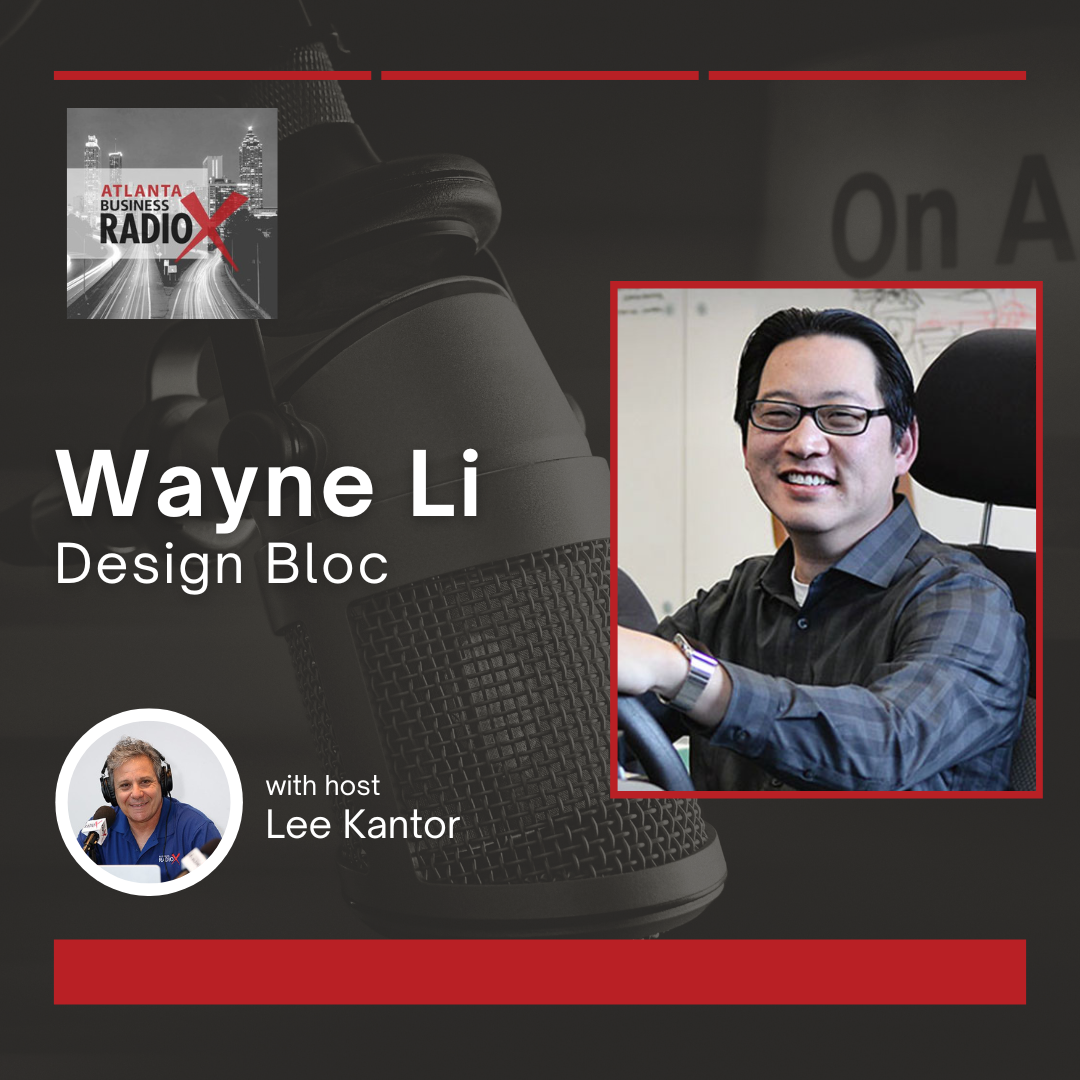

 On this episode of Atlanta Business Radio, host Lee Kantor welcomes Wayne Li, a senior product development and design leader whose career has been defined by turning ideas into revenue-generating businesses. With deep expertise in industrial design, brand management, and global product strategy, Li has helped Fortune 500s like Panasonic, Northrop Grumman, and Home Depot—and advised academic institutions worldwide—reshape their approach to innovation. Beyond driving profits and market growth, he also brings a unique perspective as an expert witness in intellectual property litigation, spanning consumer products to advanced technologies. Tune in to hear how customer-focused design, strategic differentiation, and design thinking can spark innovation and create lasting impact in today’s competitive marketplace.
 Wayne Li, Director at Design Bloc, he is a senior product development and design leader who specializes in turning ideas into profitable, market-leading businesses.
With deep expertise in industrial design, brand management, product differentiation, and product planning, he has a proven track record of driving innovation, expanding market share, and building strong global partnerships with vendors and manufacturing teams.
Beyond product leadership, he serves as an expert in intellectual property litigation, advising on cases related to product design, customer safety, and patent infringement.
His experience spans utility and design patents across diverse categories, including consumer electronics, vehicle and control interfaces, hardware, home décor, furniture, and baby products.
As a consultant and executive education trainer, he has helped Fortune 500 companies—such as Panasonic, Northrop Grumman, and Home Depot—as well as international universities including the Universidad de Concepción in Chile and the University of South Africa in Pretoria.
His work focuses on advancing design thinking, customer discovery, and innovative product development practices for both industry and academia.
Connect with Wayne on LinkedIn.
What You’ll Learn In This Episode
 This transcript is machine transcribed by Sonix.
TRANSCRIPT
Intro: Broadcasting live from the Business RadioX studio in Atlanta, Georgia. It’s time for Atlanta Business Radio, brought to you by Kennesaw State University’s Executive MBA program, the accelerated degree program for working professionals looking to advance their career and enhance their leadership skills. And now, here’s your host.
Lee Kantor: Lee Kantor here, another episode of Atlanta Business Radio. And this is going to be a good one. But before we get started, it’s important to recognize our sponsor, CSU’s executive MBA program. Without them, we couldn’t be sharing these important stories. Today on the show, we have Wayne Li, who is the author of the book: Design, Empathy and Contextual Awareness Frames of Reference for the 21st Century Creative. Welcome, Wayne.
Wayne Li: Thanks, Lee. Wonderful to be here.
Lee Kantor: Well, I’m excited to learn more about the book and also your work at Georgia Tech as part of the design block. Where would you like to start? Do you want to start with Georgia Tech or the book?
Wayne Li: Why don’t we start with Georgia Tech? Sounds great.
Lee Kantor: Sure. So tell us about the design block. What are you doing over there?
Wayne Li: Yeah, I’m happy to. The. So the design block is a joint initiative with the Colleges of Engineering and the College of Design. I was brought on to the campus or invited on the campus to be a professor here to bridge those disciplines. Right. To basically try to give our our highly trained, technologically trained students a sense of humanity and empathy and an understanding of how their technology is placed within society. So it’s a great initiative. You can consider it kind of like a lab on campus. We teach classes, we have workshops, we have social events and things like that. So we’re actually in a reconditioned cafeteria. We renovated a cafeteria between the Woodruff North and South dormitories here on campus. And so, yes, we hold classes and social events and all kind of related to what will be that topic of the book, right, is what are the things we can do day to day to really practice honing our empathy skill and our creative thinking. And so the Georgia Tech teaches critical thinking amazingly well. We just want to we want to couple that and supplement it with the creativity and kind of drive of understanding people and how to build for them.
Lee Kantor: Well, I’ve been working with technologists and startups for many, many years now, and I’ve seen a lot of times a disconnect between the most brilliant people and then really having kind of that human understanding of what they’re the thing they’re working on, how it’s going to work in real life and how people are going to accept it. And kind of the human side of the clever idea, and it’s great to see them being proactive in bringing you along to help. Kind of be that bridge. Are you sensing that elegant design is is almost a must have in today’s world that that it’s not a nice to have anymore?
Wayne Li: Yeah, I would agree with that. I mean, I think, you know, when we say elegant design, it becomes something about that is appropriate. It’s resonant. Right. It is, you know, beautiful in its simplicity, but at the same time has a certain level of sophistication in the understanding of how a person does that goes through their lives or has their activity. So if you’re designing for someone going through their life, right, let’s say they’re making food and you’re making and you’re designing kitchen utensils or something like that, you know, how do you understand their kind of makeup, what they’re thinking about as they go through about that activity? And then how do you provide the tools that are simple and effective? Right. It’s not technology for technology’s sake. Right. So I would agree with that. I think what you were saying before about sometimes technologists get enamored with their work is sometimes when you work inside a lab and it’s, you know, and it’s just about, can I prove this? Can I prove or advance this technology and this kind of way? And it’s like, Eureka! I was able to improve this 20% and that’s great. Or that’s, you know, you know, compared to the previous. That’s amazing. But then you forget that in that lab that’s a lab setting. And when then you bring it back out to the audience, they may not even care about that 20% improvement. Right. So it’s while it is interesting to prove that it can be done or unique or exciting because it pushes the boundary of what technology can do, it may it may not actually be what is relevant for the society’s use. So that’s that’s something where you have to kind of go back and go, yeah. Is this design elegant? Does it make sense with people?
Lee Kantor: Yeah. One of my favorite marketers is a guy named Rory Sutherland. And he brings up this point about technology in the train system in Europe. And he’s like, they spend billions and billions of dollars to speed up the trains, when if they would just take a fraction of that money and just improve the experience while you’re on the train, people would wouldn’t care that it’s saving you 30 minutes or 10 minutes or however long it’s saving you if you’re just enjoying your time there more.
Wayne Li: No. Absolutely. Yeah. And I can I can see that. I mean, I think one of the things we talk about, uh, that I teach is understanding that people like sometimes when people think they know a problem, like, oh, it’s just the speed of the train, let’s just make it faster. They forget that, like the product you’re introducing has infrastructure on it, right? So if you’re in a train system and then you’ve got crossings at certain places and you have to stop based on factors outside of your control or based on other factors within society, you probably can’t improve it to be faster anyway, right? Or if you did it, would you know they still have to stop for, say, like a boat crossing when the drawbridge moves up, right? So you still have to like even if you’re from A to B, quicker, if you have to stop and wait for the drawbridge to open. You’re not going to really move the needle that much, right? You’ll just get to the drawbridge quicker. Right. So part of that is understanding what is that true human requirement. Right. The the levels of human requirement. If you look at the psychology, there are many levels of people wanting something. And so the part of what I’m trying to teach is like you’re saying if I, if I enjoy my time there, if it’s more sociable, more, uh, I get to talk to my I get to meet a new person. Right? I won’t notice the time flying by because I’m engaged. Right. So in that situation, they’re they’re they’re addressing that need to socialize or be entertained, right. Rather than the need to say move or transport my body from point A to point B.
Lee Kantor: But that’s one of the challenges for technologists. You know, if they have a hammer, then everything looks like a nail.
Lee Kantor: A nail.
Lee Kantor: Um, so it’s sometimes they don’t have kind of that holistic view of kind of what really does the human want at the end of the day here? Do they want to go faster or do they just want to have a pleasurable experience?
Wayne Li: Right. And that’s yeah, I mean, that’s kind of like I said, what design Block does here is it teaches students how to identify those different needs. Maybe it categorize them, find out if there’s conflicting requirements, um, challenge the system, see where the infrastructure is going, like where the things that revolve around the product by changing your frame of reference, like all those things that we’re talking about, like you said, right. Where. Yeah. You know, again, if a technologist makes something in a lab and they’re enamored with the fact that it’s 20% more efficient, then everything they’re going to go around is like, I’ve got a hammer looking for a nail, right? And that’s not necessarily a good framework, right? If you only look at the object or the technology and the function of what it does right, like the primary function, if the nails like if the hammer’s primary function is to drive a nail and that’s the job there is like, hey, drive that nail. Um, then you forget everything else, which is the person that uses that hammer. Are they building? Are they a construction worker? Uh, building a home as part of their livelihood? Or are they a dad making a tree house for their daughter? Those are two different things. And based on that context, which is contextual awareness, do you understand that they would use a hammer in a different way?
Lee Kantor: Right. Is that is this a challenge for you to kind of open the mind of the technologists who, you know, a lot of times their ego and identity is tied to their brilliance and their great idea. And then if you start saying, you know, you start challenging them around the edges of this, uh, they might get defensive. How do you kind of create an environment that makes them comfortable and kind of appreciates their brilliance, but also kind of widens their lens a bit?
Wayne Li: Oh, that’s a wonderful question. Uh, I do. I mean, I always think about these kind of funny stories, too. About about about that. I mean, so on the one hand, I, I don’t want to cast technologists in the wrong light. Right? Obviously, designers can be just as egotistical, right? So, um, you know, if you think of a fashion designer who’s got a collection, they may not be going out and asking, what would you like to wear? Right? They’re just like, this is my vision. Deal with it. Right. So, um, you know, that would be the opposite of what, you know, kind of like. So if you look at design design’s a very broad spectrum, right? And what I’m teaching here is something that’s known as design thinking or human centered design. Right. And obviously the opposite of that would be ego centered design. So if you’re a high fashion designer who’s just I just love, you know, silver silk then. Okay, well, you know, you’re not really asking. You’re just exploring that color, that material, that type. It’d be the same for a technologist who’s just enamored with augmented reality, right? And so, so.
Wayne Li: And yes, their ego is based off of that, right? Their ego is based off of kind of how they define maybe who they are sometimes, but what I try to do is one use humor to kind of diffuse the situation, and then two ask, well, okay, great. Um, what happens if I take this technology out of the lab? Right. And so what I try to do there is to bring the community in, in some kind of way to engage with the lab or or if, if viable, bring that technology out to the people. And then I record it and turn it into what’s called an ethnographic film. And usually that when then when the design now it’s not me telling them. Right. It’s, it’s it’s society and its application telling them. And and instead of making it confrontational, I try to make it inspirational to say, look at what these people are doing and how they’re reacting to what you’re doing. How would how does that inspire you to modify, adapt, change? What would you do? And now I lead a discussion, hopefully inspiring someone to adapt, something that makes more sense.
Lee Kantor: And so far, how’s it going?
Wayne Li: Not bad. I mean, I think, um, with the with design block, we’ve got, uh, living learning community that, um, that students who are in housing get to do. And we work with local artists. We have several we created over, you know, 20 different touchpoints classes, lectures, workshops, things like that. Um, and yeah, that’s codified itself, at least, um, to a certain extent into a design minor for the entire campus.
Lee Kantor: Now, are people, um, I mean, this is where it gets tricky, where art and science and art and commerce kind of intersect. And you do want some artists out there that are just, hey, this is my vision, and I’m making this thing, and you’re coming along for the ride or you’re not, and that’s okay with me. But in a lot of times in especially, I’m sure the people you’re working with that are trying to be get a startup and get funding, and there’s going to be KPIs. And I got to get certain numbers and certain times there has to be, you know, more compromise, I would imagine, in that. And it’s harder to be that kind of all in artist. Um, is this becoming I mean, I think what you’re doing is so important. I just, I just don’t know if a person has that brain type that are usually the technologists, that they can open up their mind to this empathy side of things.
Wayne Li: Yeah. No, I mean, so I think there’s interesting things here, right? I mean, I myself have been in been in startups and some of them have been quite successful. Um, what I would say is this you have to find the right balance, and you have to remember that your development process is cyclic. It’s iterative. So yes, maybe you’re a vice president of design will have a distinct what we call point of view, right? Like, I have a distinct point of view about why I think this product should be right. But then you have to remember, you’re part of that startup process. And entrepreneurial process is a creative design or a creative process of design thinking. I tend to think of as design thinking process, right? That’s the one I adhere to. Um, part of that is testing with customers. So again, if you have a certain point of view, like it must be this way, and then customers either react to it and they buy into that way, they’re doing it. So again, like you might have said like I’m going to make an app for, um, you know, let’s take something simple that people can understand, like something like, you know, like a bus tracking app. You’re going to ride the bus, you’re standing on a motor station, and you want to know where the busses are. You know, something like this exists. That’s great. But let’s just take that example and you say, well, listen, my vision for this software is that you can see every bus on a giant map, and they’re all blue like little blue lights, and it’ll flash red if they are late, blah blah blah.
Wayne Li: And so that’s your vision for what this thing should look like. Then you go talk to people and go, well, I don’t need to see every single street in Atlanta. I really care about my route. Right. So now you have new feedback from customers. What are you going to do to change that? Right. Do you have two different views an overview map and a detail map. How are you going to change that? You can you can allow that flexibility right while still maintaining this vision. Ultimately your vision is your branding strategy, right? Your vision is we want you to know where you’re going to get your next bus. And it be on time every time. Like that. If that’s your vision statement, well, that probably will not change because that’s what you founded the company on. But the actual product you make could change. As long as that vision stays true. So that’s kind of how I try to counsel startups is that, you know, yes, there’s key performance metrics, right. Like you said, um, and you may have a point of view, but now engage with potential customers and get feedback. Get data about what it is they would like to engage with. Stay true to what you founded the company on, but be ready to pivot should your product or service not quite match up.
Lee Kantor: But how do you do that with kind of the major disruptions? Like if they were inventing the car and at that time nobody wanted a car. They didn’t know what a car was. They wanted a faster horse. So how do you kind of make kind of a major breakthrough and a big disruption when people don’t have any frame of reference of what you’re even talking about?
Wayne Li: Yeah, no, that’s a great question. I actually use that exact example because I used to design cars for Ford Motor Company and Volkswagen. Right. So, um, you know, they used that quote a lot to say, well, you know, Henry Ford said that and, um, that’s an interesting, you know, like, we don’t really know what what what? There’s a technique there that’s in the book called Design Abstraction. So you actually it’s kind of it’s very similar in engineering parlance to root cause analysis. So what you would do is say, okay, well, wait wait wait what? All right. Someone said, I want a faster horse. And obviously Henry Ford did this when he made the car. So you don’t want a faster horse, because, remember, a human need is not a noun. A human need is always a verb, right? A hammer can drive a nail as its primary function. It can also build a tree house for your daughter, right? It can also make you feel, uh, empower you to be creative. Right? Those are different human requirements. So if we were to say, well, this person said they would like a faster horse. Well, a, they don’t want a faster horse. What’s the human requirement behind a faster horse? I want to get somewhere quicker or I want I would um, I would not like to be soiled as I move from place to place. Or I would like a, I would like to move smoothly through space. Like now all of a sudden we have different human requirements that we’re asking you to creatively think and empathize with that person. When someone says they want a faster course, really empathize, what do they actually mean? And so if you’re able to abstract the human needs from the statement, now you’re able to obsolete the product, right? If someone says, you know, I want to drive a nail, but really what they want to do is to make a is to build a tree house or impress their daughter. Well, you actually don’t need to make the hammer. You could just make a tree house building service.
Lee Kantor: Now, when you’re working, it just strikes me that the people, a lot of the people that you’re dealing with kind of have a different brain type than maybe the the other the other brain type is the more design side of this and the more empathetic side. And it just I just find it fascinating to try to attempt to be this bridge. Like, is it difficult to find in one person kind of both of these qualities, or is this or is this kind of an argument for this is why you need more two people, uh, startups rather than one person founders.
Wayne Li: This is wonderful. I mean, okay, um, so, I mean, obviously it is tricky, right? You’re in we’re in a technology school. But let me answer the question that you’re talking about. One. My background is I actually do. I have I have a degree in a Bachelor of Fine Arts and Design and I have a bachelor’s I have multiple degrees in mechanical engineering. So, um, so, I mean, the good thing is, yes, you inherently and this is in the book where I describe the neuroscience behind it. Everyone, everyone, everyone has the capacity to be creative. It is not it is not a God given skill. It is not inherent talent. Yes, there are some things that make someone inherently talented, you know, in certain senses, right? Like if you were born to parents who are both musicians, then maybe there’s some things in the genes there. But the fact is that your parents played music since you were born is going to be the nurture argument to that, right? So everyone has the neural networks possible to be creative, period. The question is whether or not they exercise them. Right. And so, you know, creativity, art, science I mean arts, drama, music programs have been destroyed in public schooling, right? They’ve been nixed out every time there’s a funding cut. Right. So in those types of situations, like you’re talking about art, the opportunities to explore those neural networks versus reading, writing and arithmetic, right.
Wayne Li: Versus stem versus steam. Right. We have to provide those opportunities, right. We have to provide opportunities that make our students more creative, that give them more agency over their learning and provide flexibility in their assignments. Right. If all you do is give someone a problem set like here, solve these 15 math problems, you’re not you’re not addressing their creativity, right? You’re not addressing what the math means. You’re just making them do math problems. And so that’s not creative in that situation. Um, so absolutely like yes, everyone inherently has both. The question is whether or not in schooling they decided to pursue it. And so that I can you know, I can guarantee you, yes, you have both neural networks. You have both networks. We looked at the neuroscience between creativity as well as analytical thinking. And yes, that’s in the book. So in that sense, yes, everyone can cultivate those through exercises that we we give. Right. And then the book has some exercises as well to help push your creativity. Now yours. Now let’s talk about business because you’re talking about the team. So. Yes. Um, I’ve been in a couple of different startups, but, you know, having a founder, right? And this is really important for startups who create a diverse team. Right.
Wayne Li: Don’t pick a if the CEO you don’t want to pick a CTO exactly like you. Right. You you know, you want to you want to pick a CTO that will that can help challenge you, can help make you think about the technology in a different way. As an executive, you’re not a chief marketing officer who should be diverse or different than you, right? Who understands the customer so that you can have those lively discussions? It’s it’s a really important thing for a startup to have a very one focused founding team on the customer. Right. That’s critical, but that they also have diverse mindsets and skill sets that they bring to the table. If everyone is of the exact same type of mindset. And again, when I talk about mindset, we can talk about three different mindsets. Right. Empathy or empathetic mindset. Creativity, right. Um, a creative mindset and a critical mindset or an analytical mindset. Right. So that’s critical thinking. So if you look at those three types of mindsets, which are all governed by different areas of the brain, everyone has those areas of the brain. So the question there comes down is if someone tends to favor one side or the other, then do you have a founding team that favors the other types because they surface Workers themselves in different ways when you develop products.
Lee Kantor: Yeah. And and I think it’s so critical to have, um, you know, the team that has each of those qualities because it’s so easy to just fall in line and everybody just yes each other and then think that they’ve figured something out when they could have a huge blind spot or just some bias that they don’t even realize they have. And you see it so often in terms of technology, especially where all of these unintended consequences start bubbling up, where in hindsight it seems obvious. But while they were doing it, nobody thought of it.
Wayne Li: Yeah. Yes, I would agree that’s 100% true. I mean, again, like when you if you are developing a technology in the lab and you’re not engaging it with it outside, then yeah, those and again if you have like you said, if you have groupthink. Right. Right. Um, you know, part of this is how well you run a We very just quickly move into the kind of startup space. How egalitarian do you run your company? Right? If it’s my way or the highway and you don’t believe your founding team is equivalent to you, and then everyone just says yes to you like you just said, then you won’t surface those. Well, what if this happened? And then those situations where you said that cause problems down the road, you never identified them, right? But if you treat them all like everybody on this team is equivalent, everyone on this team’s ideas are welcome. And and now we are we are having a an educated discussion amongst equals who have different points of view. Well then now all of a sudden we’re able to identify those things, right. Because then that empathetic person was like wait, wait wait wait wait. I’m of the empathetic mind. Um, I really want to talk to about 5 or 10 different customers. I’ve got them on speed dial over here. I’m your chief marketing officer, and I want to see what they think about this.
Wayne Li: What can we do that’s publicly available that kind of hints at this lab technology. And how might we engage with those people? Right. And then the technology officer then kind of looks at and goes, oh, you’re engaging with people about this. Uh, let’s change this. Let’s make this a little bit easier and simpler. Instead of this technology taking 15 steps in 15 minutes to do, I can do it in two steps and only five minutes. So that way you can test with more people, right? So now all of a sudden you’re identifying those things that could be roadblocks in the end. Because let’s say you didn’t do that and you were the chief executive officer. Like, let’s just stay in the lab and let’s optimize this thing. Well, now you got a 15 step, 15 minute thing, then nobody really wants. And and no matter how fast you optimize that technology, it’s still 15 minutes and, um, and 15 steps because you didn’t ask your CTO what they could do. Right? And the CTO was inspired by the person because that’s what the CMO is doing. So in that sense, you have to have that. Yes. And culture. Right. Which is yes, I hear your idea and let’s build upon it kind of culture to truly make a startup work well.
Lee Kantor: Yeah, I agree 100%. And it sounds like you’re using some of, you know, uh, that was obviously a reference to Improvization. Um, and when you kind of start implementing those, um, techniques that make people think bigger and larger and outside of their normal frame, that’s when real creativity can happen. And you find those things, the unexpected things, the serendipitous things that a lot of people miss because they’re so kind of, you know, heads down, focused on just the task at hand and not looking, like you said, at optimizing to the bigger picture of what is the outcome we really desire, not how cool this technology can do something.
Lee Kantor: That’s right.
Wayne Li: Yes, absolutely. And I’ll just kind of wrap up that answer too, because I really do. You just I mean, you nailed it, right? Like when you are so task focused. That’s part of this neural network we talk about. Right. This kind of very like I got to get this done right now type of network. Right. And that’s one side of that brain. Right. That we’re we’re you know, that, you know, um, you know, that that’s just super task oriented, right? And that’s not necessarily the creative side. Right? That’s one that tends to be the more, um, task positive network. And so, yeah, I mean, the when technologists favor that too much, then they lose sight of that. And we teach we actually teach improv workshops at Design Block. Right. Because the improv. Yes. And that’s the opposite side. That’s that playful side, that creative side, that positive thinking side. The task positive network tends to be stress and anxiety ridden. It’s like, let’s get this done or or you don’t want to know what will happen next, right? Like that’s that side right now. The, you know, um, the other side of that, the other network is more playful, right? It’s like, hey, how might we do this? Yes, and let’s do that. And so that becomes this nugget of creative thinking that is that is key. So yes, that is leverages improvization, uh, that leverages um, ideas, brainstorming techniques. Right. Which also use. Yes. And as a technique right there, brainstorming rules. So all of those are focused on creative thinking, right. And Improvization. So absolutely I would agree with that.
Lee Kantor: Now, um, or is your work primarily with the students there Georgia Tech, or are you open to like organizations that want to play as well?
Wayne Li: Oh yeah, absolutely, I love that. So, um, so the short answer is yes. And both. Right. So, um, at tech here as a professor, um, obviously I teach classes, and so we work with undergraduate students and, and graduate students, um, in facilitating these courses and teaching them, but also just, you know, through the School of Industrial Design in partnership with engineering. Uh, we are also open to we have an executive management course. So I do teach in the MBA school. Right. We, uh, I have a design thinking course for graduate students over there for MBAs. And then we have executive training. So there is an executive education training. If you type in, uh, a Google search, you know, Georgia Tech professional education or GTP and design thinking, it’ll immediately pop up to that web page, which is, you know, we can work with outside companies on on a teaching contract where we will teach exterior external entities these techniques. Right? Well, yeah, we’ll make you do improv, right. Like we’ll, you know, we’ll do those types of things to shake people from that. I got to get this done right now type of mentality. Um, and so that that will help and also help with leadership skills. So absolutely we will work with outside communities. Um, and some will do in a nonprofit manner. Some of them will do with executive education. Um, and, and and there’s also and then yeah, those are, those are most of the things that we do in design. But just for kicks, I also have a transportation design lab just letting you know. Right. So because I used to be a car designer at Ford Motor Company, Volkswagen. Um, and so like, we we’ll, we’ll do research in automotive design as well, but, um, that tends to be straight up automotive design.
Lee Kantor: So if somebody wants to connect with you, learn more about design block or get a hold of the book, what are the best coordinates?
Wayne Li: Yeah. No that’s great. So obviously so my email is just w l I. And then the number 78 at Georgia Tech GA GA edu. Um, that’s the best way to get Ahold of me is just as far as direct email for the book. So yes, if you’re interested in this kind of book, I think this book is targeted for entrepreneurs, young professionals. You know, it’s targeted at college design students if you’re, say, in your second or third year, but definitely but it doesn’t you don’t have to be a designer, right? You can you can be a music producer. You can be, you know, a founder for a startup. You can be an MBA looking to get into marketing, right? So all of those and any or any creative professional, because we’re talking really about frames of mind mindsets and how you can shift and improve upon those mindsets when you’re so maybe used to only thinking in one. Um, this book is dropping. It’s already dropped in London. It is dropping on September 2nd, so just a couple of days from now on Amazon. So if you go to Amazon.com, type in my name, Wayne Lee, last name spelled L, I, and then the title of the book, design, Empathy and Contextual Awareness, should be the first one that pops.
Lee Kantor: Well, Wayne, thank you so much for sharing your story today. You’re doing such important work and we appreciate you.
Wayne Li: Thank you. Lee. It’s been a wonderful and a wonderful time and pleasure to talk with you.
Lee Kantor: All right. This is Lee Kantor. We’ll see you all next time on Atlanta Business Radio.














