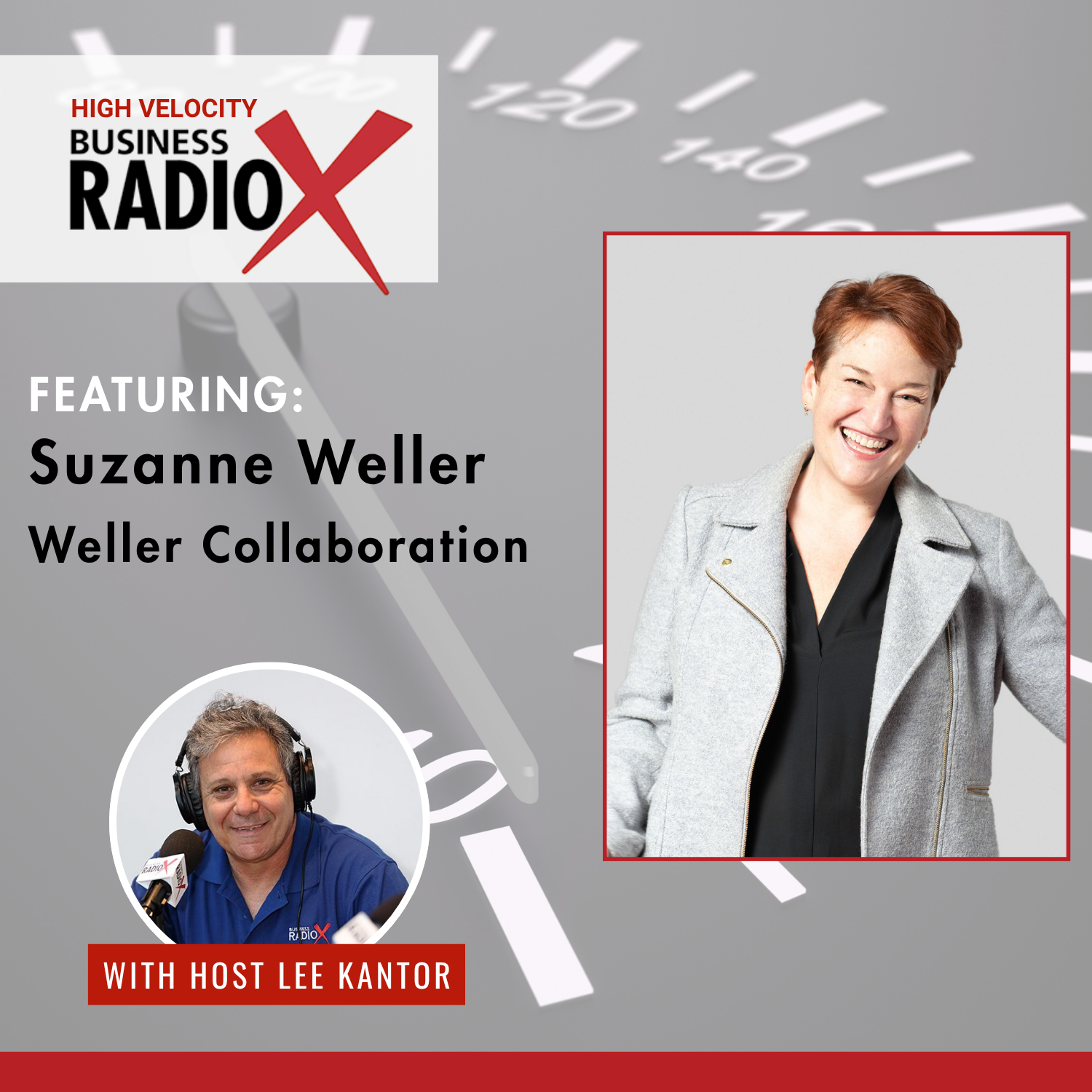

In this episode of High Velocity Radio, Lee Kantor talks with Suzanne Weller, founder of Weller Collaboration. Suzanne shares insights on courageous leadership, change management, and building trust within organizations. The discussion covers the challenges leaders face in adapting to rapid change, the importance of open communication, and the ethical integration of AI in the workplace. Suzanne emphasizes the value of “human skills” and the need for leaders to foster collaboration and experimentation. She also highlights her podcast, The Courage Effect, which inspires everyday acts of courage in leadership and organizational life.
 Suzanne Weller guides you to lead with courage over comfort so you can thrive in uncertain times. She’s a leadership coach, speaker, change practitioner, communication maestro, and host of The Courage Effect podcast. Through her firm Weller Collaboration – and her 20+ years of experience as a leader and entrepreneur – Suzanne helps executives and teams to challenge old scripts, rewrite limiting narratives, and spark real change.
An avid cook, singer, music lover, native Californian (and former New Yorker), Suzanne is based in Seattle, where she lives with her husband and their rescue dog, Bacon.
Connect with Suzanne on LinkedIn.
What You’ll Learn in This Episode
- Leading with courage over comfort
- Thriving in change, not just surviving it
- Communication to connect, not just transact
 This transcript is machine transcribed by Sonix.
TRANSCRIPT
Intro: Broadcasting live from the Business RadioX studios in Atlanta, Georgia. It’s time for High Velocity Radio.
Lee Kantor: Lee Kantor hear another episode of High Velocity Radio and this is going to be a good one. Today on the show, we have Suzanne Weller and she is with Weller collaboration. She is a Leadership Coach, a Speaker, a Change Practitioner and a Podcaster. So excited to be talking to you today, Suzanne. Welcome.
Suzanne Weller: Thank you Lee. Great to be here.
Lee Kantor: Well, for folks who aren’t familiar, can you share a little bit about Weller Collaboration? How are you serving folks?
Suzanne Weller: Sure. I founded my business. It was a side hustle for me, which I took full time right around the time of the pandemic starting. So that has its own story and interest. And essentially what I like to do is I encourage people to lead with courage over comfort. And what I mean by that is that I do thought partnership coaching, speaking, facilitation, consulting. That’s really all about what are the things that get in our way every day, and how can we as leaders and as leaders, I don’t necessarily see that as a title. It’s really about how we show up every day. What are our behaviors, what are our thoughts, how we can be more courageous and how we do that. So that’s really the goal of the work that we do is challenging some of the limiting beliefs and behaviors that we experience every day to realize what’s possible. So we have better work cultures, better communities and just, you know, happier existences overall.
Lee Kantor: So what was kind of the thinking when it came to naming the organization, whether collaboration instead of, well, or consulting or, you know, whether coaching or whether all the other things you do.
Suzanne Weller: So much of what I do is ultimately co-creation because and it really starts with collaboration. I mean, I like to say that, you know, my three core values and themes throughout my work are courage, collaboration and communication. And for me, it’s so much about how do we work together. It’s about partnership and that takes place on many different levels. So collaboration is about, you know, many people or two people, but more than one coming to the table and really working through issues, problems, situations together. And I liked I liked that word. And I deliberately chose it because it was a matter of whether it’s me or one of the consultants that is on staff for me, how do we truly collaborate and partner with our clients? It’s not just a one way street. We’re not just advising them or consulting them. It’s true partnership. And for me, collaboration goes even further into that. It’s how do we get in the mix together and the and do it, you know, do it as true co-creation.
Lee Kantor: So what’s kind of the issues or pains that your new clients are facing when they initially reach out to you?
Suzanne Weller: A lot of my clients who reach out to me are struggling with adaptability Stability overall. I mean, you know, we’re looking at a world where change is rampant as we are all experiencing. You know, wait five minutes, something else is going to change, not necessarily knowing what’s going to come down the pike, having it significantly impact how they lead their business, their organization overall, and getting to a point where the way that they’ve done things isn’t necessarily the way that they can continue to do things to realize success. So they’re bringing me in to work with individuals or teams or people on my staff to really take them to what is next as they look ahead. So it’s knowing that there’s a challenge ahead, or maybe they’re sitting in the middle of it. So it’s I have a lot of leaders that I work with that are challenged to either communicate effectively to get buy in and bring their people along. Sometimes I work with leaders who aren’t getting to the next level in what they’re capable of, or what the organization knows they’re capable of. How can we look at some of the patterns that they fall into that potentially get them caught up to recognize, you know, Okay. How do we get more self-aware? How do we have a better idea of where we might be getting in our own way so we can move beyond that? And that is. That’s about some unlocking. That’s. It’s hard. I mean, it’s vulnerable because it takes some questioning and looking at what you do and starting to do things differently. So that’s that’s really where the courage comes in.
Lee Kantor: But what does it like what’s kind of happening as boots on the ground in their organization. What are the clues or symptoms that, hey, something’s amiss here that we do need to get fresh eyes on this? Is there some thing tangibly that’s occurring? Like, are we not being able to hire for roles, or are we having lots of turnover or sales down or we lost a big client? Like are there things that are happening that they can point to and go, okay, this is not normal. We need some help here.
Suzanne Weller: Yes. All of the things that you talked about. So people are like, you know, people looking at, they’re Are looking at the broader teams, whereas dissatisfaction happening where people leaving the organization, if they’re not able to retain people, if they’re not able to hire good people as well, but also looking at the future of an organization as change is coming and you know the future, they don’t necessarily know what it’s going to hold, but they want to make sure they have the right people on staff, and they want to make sure that they’re prepared for what’s next. So how do you how do you look at your people to say, okay, our numbers aren’t where they need to be or we’ve hit we’ve hit a wall in some way, or we know that we’re going to need to do things a little bit differently for a new project, maybe, you know, a new technical implementation, maybe it’s also a reorganization of the company. So that’s really when they bring us in. But I, we tend to come in where they know there’s more that is possible. There’s some there’s burnout, there’s lack of performance. There’s there’s some sort of wall that they’re hitting or that they know that where they are is not going to take them to where they want to be.
Suzanne Weller: So we tend to come in where it’s a bit messy and, um, it’s not we’re not fixers, but we’re really about coming in to say, okay, if you really want to move through this in a way that’s going to serve you and serve your people and really serve your organization, these are the partners that you want to do it with, because a lot of people don’t really spend time on the change. You know, they think, okay, we’ll just get the right people in place and we’ll just move forward with what we’re doing. Not everybody is equipped for that, and not everybody has the skill set to communicate well with each other. Um, and to really bring what they need to, to the table and to express what they’re seeing, that might be not really working effectively. So it’s, it allows people to to come to the table to have that courage, to have the conversations and to be talking about, okay, there has to be a better way of doing this. Or maybe we know there is, but let’s take some time to look at the ways that we’re that we’re tripping up or that we’re holding each other back. So that can be teams that are stuck. It can be, you know, leadership teams. I mean, I, I also work with a number of different leadership teams where we coach them because they know, okay, we look ahead to what we want to do.
Suzanne Weller: We look at our three year strategic plan. What are we. What are we going to have to change to get to that point? And they see the challenges. They know that there’s they know they’re not having the conversations they need to be having. They know that there are opportunities that they’re missing. I mean, your question around, you know, maybe a client not coming through. There’s a lot of uncertainty in in many industries right now. So it’s I think it’s a humbling and a vulnerable experience for them to look at themselves individually and how they work together to really do some investigation, to look at ways that they might want to change that up or need to change that up before it gets to a breaking point. So hopefully we come in before the breaking point. After the breaking point is, is a more difficult situation for anybody, as you know. You know, you don’t want to get to that point. So our goal is to help them to look ahead, to prepare for what that’s going to be and minimize what what changes or what resistance? What problems might be on the road ahead?
Lee Kantor: Yeah. And I think what you’re saying, because change is happening at such a pace and it’s so disruptive. I, I can make a case for having coaching like as just part of the rhythm of a year. You know, we need to have fresh eyes to come in here. And let’s just start having these conversational conversations proactively rather than waiting until something happens. I’d like to talk about a little bit of something that’s out there now, and how you would kind of go about handling, um, kind of how this would work in an organization. So I is out there, obviously people are playing around with AI. People are using it in a variety of ways, but there are certain people out there that are are like, uh, you know, I’m anti AI. I think it’s cheating. And, you know, we don’t want people, you know, asking AI for something and then cutting and pasting the results and then they’re done like they’re there has to be some ways to implement it elegantly, effectively and maximize the use of it because it is such a powerful tool. How would you go about kind of having kind of an AI conversation with a client that was struggling with using it, you know, to get the most out of it rather than to be something that there may be a contingent that’s afraid of or doesn’t want or doesn’t believe in it.
Suzanne Weller: Yeah, a great example. And we we work with that almost consistently. So it is one of those things where a lot of organizations need to figure out how they use it and how they don’t use it. To your point. Right. I mean, because there’s very differing opinions on it, there’s security issues as well. So and what we try to do is like, how do you come to the table to understand what is AI going to be for your organization. So we’re we’re doing a program right now with a group of leaders where the company is bringing in. They’re establishing their AI guidelines, and they’re creating some tools internally to use AI because they don’t want people to just go out and use it on their own, you know? I mean, like, people are going to be using it. And that is one of the struggles that we see people that use it in their personal lives, but then aren’t able to use it in their professional lives. So there’s obviously some dissonance and just some challenge. But the organizations that I think right now are doing it the most, the the most intelligently are the ones that are looking at it to say, okay, this is not going away. How do we look at it, to say this is how we potentially use it? And these are the areas where, you know, we don’t feel this is safe.
Suzanne Weller: We don’t feel that this works in the best interest of the business or of our people and brings it in in a way that it’s a tool. Like if it’s, you know, automation on certain things. So there’s tasks and there’s different processes or there’s ways that you can do it to automate into create efficiencies. However, they are quite clear as far as what information, if you do go out and use, you know, whatever tool you’re using, ensure that you’re not that you’re not doing it on the company’s computers. I mean, there are certain guidelines and restrictions and regulations that they’re putting in place, um, around confidentiality and whatnot. But I see it as how do we have the conversations around just coming up with that decision? I mean, we talked to leaders about what what is the what’s the strategy that you’re going to be putting in place. How are you all as a leadership team making these decisions? What experts do you have at the table to help you to navigate that? And it’s changing so quickly. I mean, to your point, just even like over the course of a year, it’s it’s crazy how fast a lot of this change happens.
Suzanne Weller: So even if you put in a strategy now doesn’t necessarily mean that it’s going to stay the same in six months or even a year. So implementing those, those touchpoints with your team to come back and to say, how is this going? Is this working? Do we want to change this? That to me, is where this is going to be important. Because the speed, the speed at which it’s changing, we’re not going to be able to keep up with we can’t pretend it doesn’t exist. But we can be smart in how we choose to engage with it or not, and see if something is working. If it’s not. Um, it’s not going to go away. So in my mind, yes, there there is a certain amount of it that I think is the idea of cheating, but it can make big savings for a lot of companies, depending on what kind of work you’re looking at. So it’s it’s there. How do we use it for good. How do we use it to move us forward? There has to be some guidance and there has to be some guardrails around that.
Lee Kantor: But to your earlier point of kind of leading with courage over comfort, it takes a strong person, a confident person to kind of raise their hand. And, you know, as they’re learning about AI, for example, realizing pretty quickly that my position as is might be vulnerable, the better that our organization learns about what I can and can’t do. Um, how do you kind of help them build a culture of confidence and courage when it comes to things like this that might be exposing some vulnerabilities for some folks.
Suzanne Weller: Well, and I think it’s them having the conversations about coming together. And exactly as you said, there’s going to be differing viewpoints. And people get pretty passionate about this as well. But we need to come to the table to understand that we don’t just have the right answer. I mean, and that’s with, I think, everything in professional environments and most of the things in our relationships in the world in general, how do we come to a conversation to say, I don’t necessarily have the right answer? Let’s have a conversation and do what is within what’s in the best interest of our organization. That is hard because all of us need to understand that, you know, maybe we’re not the smartest person in the room. Maybe our answer isn’t the perfect answer, but we need to be open to co-creation, as we talked about before. How do we create that strategy for what’s in the best interest of the organization now, and do that collectively? And there will not always be agreement. And I always like to say you don’t have to be aligned to be in agreement. What are the areas? What are the things that you agree that okay, maybe we disagree on, but we’re committing to this being our plan for a period of time. Let’s come back in six months and see how it’s working and iterate as we need to. But there’s a certain amount of, you know, people need to come and not think that everybody knows the answer and come up with those decisions because, I mean, I’m coaching somebody right now who is a senior executive in data analytics, and they have very differing viewpoints on their executive leadership team about what they want to be doing and what they don’t.
Suzanne Weller: But they’ve all agreed that this is something that is going to be a work in progress. We want this tool to be something that we adopt. We don’t know exactly what it’s going to be yet, but they’re having regular conversations around where they’re willing to take some risk and where they’re not. And that, to me is the most important thing, is how do you have those conversations consistently? Because just because it’s something now again, doesn’t mean it’s going to stay that way. How do you consistently have those conversations to to better understand where you are and what you need and how the tool changes? It might change in six months. And you say, okay, what we did before that was helpful. But something, something now is different. Something is better. Or maybe it’s too risky, but we don’t. We tend to just make a decision and think, this is this is how it’s going to be forever. Things are changing too quickly for us to just put that, you know, draw that line in the sand and assume that it’s going to stay in that place. So that takes the courage, I think, to not always think you have the right answer, to be open to trying something different, but to also be to be diligent about coming back to the table and seeing how it’s going and to reinvestigate, you know, like as, as you’re going through.
Lee Kantor: Yeah. I think it’s such a challenging time for, um, kind of senior leadership when especially they, they come to the realization, you know, that they believe what you believe. I have to lead with courage over comfort. You know, I have to kind of lean into this change. I can’t just kind of triage my way through it. And then maybe they come to some realizations that maybe the culture of the organization isn’t as they thought it was, or they’d like it to be. And they realized that there isn’t the trust there that allows them to kind of implement some of these things going forward until they kind of shore that up. And I’m sure that’s where your coaching and your team of coaches can come in to really help everybody throughout the organizations kind of all kind of get in line here of what the goals are and the mission.
Suzanne Weller: Well, and I think you said the right word, which is trust. I mean, it’s, you know, it’s how do we put trust in the tools right now? I mean, a lot of us can’t. So it’s and but how do we put trust in each other. And I think one of the hardest things for us to do, I mean, as humans, but also as leaders is to say that we don’t know something. This is something where we really don’t know. And I think we have to be comfortable with that. And that’s hard. That takes courage to say I don’t know the you know, let’s see what we can find out. And there’s a certain amount of humility that we have to embrace as we go down that path, because it’s there’s so much unknown and it’s scary. And we as humans want control, right? We want to know exactly what’s happening. We want that control. Um, but we have to come to the table and say, this is something new. We can’t pretend that it’s not there, but let’s use it in a way that we can. We can make it work for us, as opposed to waiting too long and then having it bite us in some way.
Lee Kantor: Right. And I think that as organizations grow, the leader’s view of what the organization is might not accurately be accurate anymore, like it might have been at one point. But as it grows, it may not kind of have that culture may not have trickled down all the way. Um, and there could be gaps that they are just not aware of. You know, they see it a certain way, and it isn’t until a coach or some fresh eyes are on this that all of a sudden it becomes clear that, hey, this is really the problem.
Suzanne Weller: Yes, and a lot of it is, um, a lot of it is, you know, I mean, we as leaders also, you know, we know from a lot of research, I mean, from Brené Brown’s research, the number one fear of leaders is to become irrelevant. So if we think about that, then this is a scary time, right? I mean, it’s always a scary time. But now with AI, I think that that just puts it in overdrive. So the idea of what what isn’t working, how are we going to how are we comfortable in having those conversations without over indexing at the same time and talking about it because there’s so much fear about just not having conversations, not speaking things that we really want to. And sadly, I mean, we do that to protect ourselves, but then we just create these cultures that perpetuate, you know, like not trusting each other and not speaking to things. And that’s where change doesn’t happen. So when we have the conversations, when we can get more comfortable in, in, in speaking to what it is, then at least we can. We know it’s there and we it’s on the table. We can work through it together. I see that happening more, but it’s also scary now because a lot of people, you know, layoffs and otherwise, people are afraid. People want stability and they don’t necessarily want to rock the boat. But there’s also a matter of how do we show up for work every day within what’s best for ourselves and what’s best for our teams and our larger organizations? Because, as I said before, I think we need to be talking about these things now, as opposed to waiting for it down the line and then regret that we didn’t bring it up.
Lee Kantor: Yeah, like this is definitely one of those things where earlier is better. Even earlier. Messy is better than later. Perfect.
Suzanne Weller: Yes. And I think that’s the thing is that we’re so allergic to mess. Right? I mean, it’s just like, oh, I don’t I’m not comfortable with that. And that’s okay. But as long as we just acknowledge, like, okay, we’re in it. There’s a certain amount of it gets a little, it gets a little easier, or it gets a little bit, um, it just it takes us into a different place, and we know it takes our brains into a different place. We’re able to be more creative and not so, like, you know, tightening or grip and so anxious about what’s going to come down the pike.
Lee Kantor: Yeah. And that is not the way to handle the change with the tight grip. I mean, you got to kind of go with the flow and let some chaos in because it is this is happening so fast. It’s so interesting to be living at a time where change is happening so rapidly and, and a rhythm that is much faster than history, you know, than it has been in history. And you’re getting to a world where, I mean, there were never kind of billion dollar companies with, you know, ten people like that was to be $1 billion company. You needed, you know, factories and hundreds, if not thousands of people. And now, you know, a handful of people can be $1 billion company. It’s just there’s so much wealth. There’s so much change happening so quickly with so few people and especially few like regular classical employees. Like, you know, how many remote people are people managing nowadays? And that and to build trust amongst them when they have four other jobs they’re doing for other people. Like it’s it’s a tough, tough situation now for a lot of leaders.
Suzanne Weller: It is a it is a tough time. And it’s that’s the thing that I would also really anchor on in this conversation is, you know, yes, I can do certain tasks and it can replace certain jobs. The skills that it cannot replace are, you know, what they call the soft skills. I’m not a fan.
Lee Kantor: Right. You I’m I’m for human skills. These are you human interaction. It can’t do that.
Suzanne Weller: Yes. And I like that you call it that. These are the things that we need now even more.
Lee Kantor: Right?
Suzanne Weller: That’s more reliance on machines. Yes.
Lee Kantor: That’s how you differentiate by being a human. Yes. Instead of a form. Hmm.
Suzanne Weller: So now it’s even more important than it was before.
Lee Kantor: Right. And you need to you need to have trust and collaboration and courage to have human to human interaction, which a lot of people don’t even want to have.
Suzanne Weller: No. And it’s sad too, because of, you know, I mean, remote work is wonderful. And, you know, the technology has given us so many tools, but at the same time, it’s it’s it has made us not great, not as good at communicating, not as good as having conversations and reading each other and building connection. And that’s the thing. Now that I, I like to see people. You know, I’m not for all office work and I’m not necessarily for all remote work. I think you need to figure out what’s going to happen, but we need to find ways to connect with each other regardless of how we’re connecting. And we’re not so good at that. Now the pandemic, right. I mean, we all I think all of us got worse over the past five. Sure. Would you agree?
Lee Kantor: Yeah. Yeah, 100%. I mean, I remember when the pandemic was waning and they were the beginnings of trade shows and conferences. People were like so hungry for that kind of human to human interaction. And it spoke volumes in terms of how as human beings, we need that in order to really kind of be our best selves. But it’s easy to get into a comfort zone of, hey, I’m in my pajamas, I’m getting it done. You know, I’m getting paid. Well, I can, you know, live the life that I’ve always wanted, you know, all out of my house, you know, DoorDash in lunch.
Suzanne Weller: Yes, yes. And I mean, to your point, like, there are these large companies with fewer people and there are, you know, remote first or remote only companies. Um, I don’t necessarily think that that’s a bad thing, but if that’s how we’re going to work, then we need to figure out ways that we can connect in meaningful ways when we’re not in person.
Lee Kantor: You better be proactively building that in, because it’s not going to happen by itself, I’ll tell you that.
Suzanne Weller: Yes. And I and that’s the thing is that I, I respect the I respect companies and I respect individuals for wanting to find connection with each other and the ways that they. That they’ve been doing it or the ways that they’re learning. But it’s just like everything else we’ve been talking about with AI and otherwise, it’s all changing. We need to figure out ways to, you know, bend towards the light and the light’s going to be in different places depending on what, what day it is, depending on what year it is. I feel like these are the these are the times that we need to be looking at. Well, maybe, maybe I could have done that a little bit differently. Maybe I want to experiment with this, getting more comfortable in trying it and reaching out and experimenting. And that’s harder when you’re when you’re on your own. Right? I mean, like when you’re remote. But what are ways that you can connect with people? How can you get curious? How can you how can you just do it differently? That to me is, you know, it really comes down to challenging ourselves. The way that we’ve done things is not the way that we can continue to do things. And if we are okay with playing around and experimenting, that can be the game changer. And it really does come down to just trying something different and not expecting. I mean, that’s the other thing is like we think results. You know, we have no patience. We think results are going to happen immediately. That is not the case when you’re talking about these human skills. It takes time and you know the payoff will be massive. But you got to invest, right.
Lee Kantor: And you have to have a culture of experimentation. You can’t punish someone for doing an experiment that fails. That is not good mojo for your organization. You’re that’s not going to build the trust you desire over the long term.
Suzanne Weller: Exactly. And I love that you brought it back to trust. Because how do we build trust, not just connection, whether we’re in the room with somebody in person or not?
Lee Kantor: Right. And the thing I think you can get lazy when it’s when you’re making everybody go back to the office, those kind of serendipitous kind of interactions and collisions and popping into someone’s office for a minute, or standing over someone’s shoulder or being in a meeting. Those things happen a lot easier in person, and that’s what some of the leaders are trying to force into a remote world. But if you don’t have kind of those locations where everybody’s at and you are remote, then you have to build that in. You have to be mindful and proactive and build that in, or else it’s not going to happen by itself.
Suzanne Weller: Yes. Agreed. And I also believe that, you know, I’ve seen a lot of people now going to various events where they’re just getting out and meeting people, getting out of their comfort zone, even if they don’t work with them just to start practicing those skills. And I think that’s vitally important. Right. I mean, you don’t have to go out and network. I know that a lot of people hate that term, but the idea of, you know, there are a lot of people that still crave that in-person contact, especially if they’re sitting behind a computer all day. So you can go out and engage in the world and meet people and build relationships that will also help you cultivate your skill set. So then you are showing up differently when you’re on your virtual calls with your colleagues.
Lee Kantor: Right. Well, Suzanne, it’s been a joy chatting with you who is kind of that ideal client for you. Who’s the ideal? Do you have an industry, a niche that you serve more than? Not. Or is it kind of industry agnostic?
Suzanne Weller: Industry agnostic. So I mean, for us it’s really about, as I said, organizations or leaders that have gotten to a place where they want to do things differently, hopefully before they need to do things differently. But change is afoot. Either it’s coming down the pike or they see it right now. How do they want to upskill their leaders and inspire them to to do things differently for what’s next for their organization? So yeah, bringing us in for a coaching, consulting, speaking. We would love to have a conversation with you.
Lee Kantor: Is that kind of the early the way that they get to know you is through kind of a speaking gig or an assessment of some kind?
Suzanne Weller: A lot of the time it’s a speaking gig. I might do a workshop, or sometimes I’ll coach one leader in an organization, and then it goes more broadly than that. So yeah.
Lee Kantor: And then your podcast, The Courage Effect, uh, what is that about?
Suzanne Weller: The courage effect is my my mission is to spread courageous contagion. So I have interviews with people that are doing courageous things in their life, not just, you know, the big heroic acts. Like we you know, we think about courage, big heroic, brave acts like, you know, firefighters, etc. these are people that are just going out of their comfort zone, whether it’s a small move or a bigger move. To hear those stories and really just to talk about what does courage look like for us now and how can we inspire each other to to just be more courageous every day?
Lee Kantor: So if somebody wants to learn more about your firm, what’s the website? What’s the best way to connect?
Suzanne Weller: It is weather, collaboration. All the information is there.
Lee Kantor: Well, Suzanne, thank you so much for sharing your story today. Doing such important work. We appreciate you.
Suzanne Weller: Thank you. You too. Lee, I appreciate you.
Lee Kantor: All right. This is Lee Kantor. We’ll see you all next time on High Velocity Radio.














