Business RadioX ®

  • Home
  • Business RadioX ® Communities
    • Southeast
      • Alabama
        • Birmingham
      • Florida
        • Orlando
        • Pensacola
        • South Florida
        • Tampa
        • Tallahassee
      • Georgia
        • Atlanta
        • Cherokee
        • Forsyth
        • Greater Perimeter
        • Gwinnett
        • North Fulton
        • North Georgia
        • Northeast Georgia
        • Rome
        • Savannah
      • Louisiana
        • New Orleans
      • North Carolina
        • Charlotte
        • Raleigh
      • Tennessee
        • Chattanooga
        • Nashville
      • Virginia
        • Richmond
    • South Central
      • Arkansas
        • Northwest Arkansas
    • Midwest
      • Illinois
        • Chicago
      • Michigan
        • Detroit
      • Minnesota
        • Minneapolis St. Paul
      • Missouri
        • St. Louis
      • Ohio
        • Cleveland
        • Columbus
        • Dayton
    • Southwest
      • Arizona
        • Phoenix
        • Tucson
        • Valley
      • Texas
        • Austin
        • Dallas
        • Houston
    • West
      • California
        • Bay Area
        • LA
        • Pasadena
      • Colorado
        • Denver
      • Hawaii
        • Oahu
  • FAQs
  • About Us
    • Our Mission
    • Our Audience
    • Why It Works
    • What People Are Saying
    • BRX in the News
  • Resources
    • BRX Pro Tips
    • B2B Marketing: The 4Rs
    • High Velocity Selling Habits
    • Why Most B2B Media Strategies Fail
    • 9 Reasons To Sponsor A Business RadioX ® Show
  • Partner With Us
  • Veteran Business RadioX ®

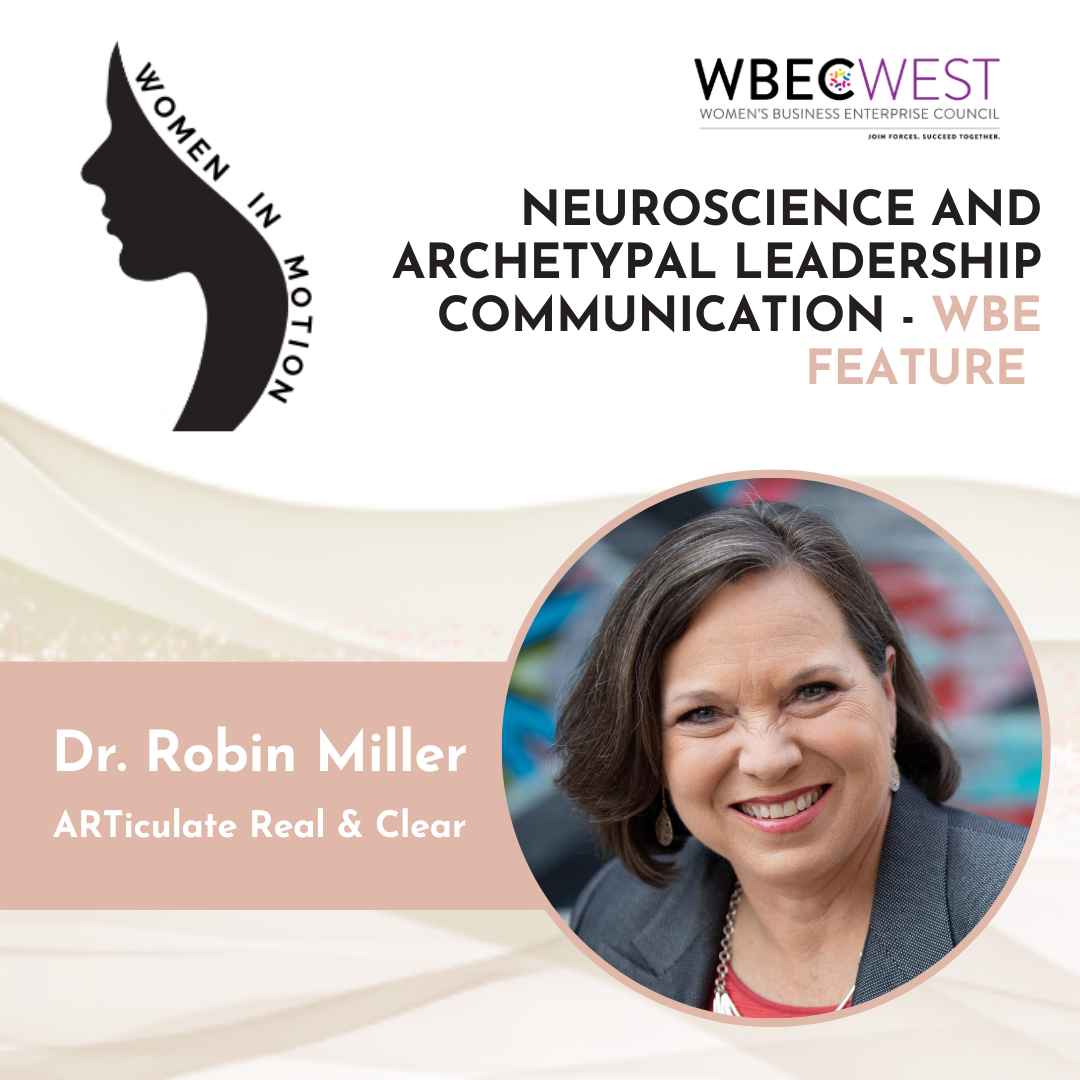
Neuroscience and Archetypal Leadership Communication – WBE Feature

June 4, 2024 by angishields

WIM-Articulate-Real-and-Clear-Featurev2
Women in Motion
Neuroscience and Archetypal Leadership Communication - WBE Feature
Loading
00:00 /
RSS Feed
Share
Link
Embed

Download file

In this episode of Women in Motion, Lee Kantor interviews Dr. Robin Miller, founder of Articulate Real & Clear, a firm specializing in teaching and coaching leadership and teams with a focus on artistic communication. Dr. Miller discusses the importance of effective communication in building corporate culture, the signs of communication issues, and the coaching process her firm uses, including the concept of “feedforward.” She emphasizes the measurability of their work’s impact on employee engagement and retention. The episode also touches on the firm’s involvement with WBEC West to support women and supplier diversity.


Articulate-logo

Robin-MillerDr. Robin Miller is an Executive Coach grounded in neuroscience and archetypal leadership communication. She focuses on leadership and teams – how they communicate – how they work and how they resolve conflict to move forward.

Robin is a cofounder and COO of ARTiculate Real & Clear. She holds a PhD in Musicology from The University of North Texas, an MDiv from Iliff School of Theology, and is credentialed through the International Coach Federation (PCC).

Connect with Robin on Linkedin.

Music Provided by M PATH MUSIC

Transcript-iconThis transcript is machine transcribed by Sonix


TRANSCRIPT

Intro: Broadcasting live from the Business RadioX studios. It’s time for Women in Motion. Brought to you by WBEC West. Join forces. Succeed together. Now here’s your host.

Lee Kantor: Lee Kantor here, another episode of Women in Motion and this is going to be a good one. But before we get started, it’s important to recognize our sponsor. WBEC West. Without them, we couldn’t be sharing these important stories. Today on the show, we have Dr. Robin Miller with Articulate Real & Clear. Welcome.

Dr. Robin Miller: Hi. Good morning everyone.

Lee Kantor: I am so excited to learn about your firm. Tell us a little bit about it. How do you serve folks?

Dr. Robin Miller: We are actually product service company, meaning that we teach and coach leadership and teams. We’re service because we serve leadership and teams, and we have specific areas that we focus on which is product. So we have a combination of two. We’ve been in business over 13 years and we’re artists. So we bring the artistic energy to any kind of organization, mostly corporate and some associations to help leaders move forward faster and help teams get along better.

Lee Kantor: So what’s your backstory? How did you get into this line of work?

Dr. Robin Miller: Oh wow, Lee, that’s that’s what I call the Renaissance woman story. I got into this line of work by getting my education, moving into it as a customer relationship manager, moving into a service line of work with going to Iliff School of Theology here in Denver, and then meeting up with my business partner, and decided that we wanted to bring our artistic skill set to the corporate environment. So we started articulate, real and clear so that we could, as artists, go in and use all the tools and the skills that we’ve learned to go in and help others move forward in their business and move forward in their teens.

Lee Kantor: So you use the word art several times, and it’s obviously part of the word articulate. How do you kind of view art in the business world?

Dr. Robin Miller: It’s an art to communicate well and we focus only on communication. So whether it’s facilitation, whether it’s executive presence, whether it is team building, we are constantly focused on communication. And if you’re building a culture in an organization, you can’t do it without communication. And to do it well, you have to do it artistically, which means finding out what works, how to make it work better, and moving it forward. So as artists, we bring that to the world.

Lee Kantor: Now, how do people realize they have communication issues? Is there some symptoms or some clues that maybe they aren’t communicating as effectively as they think they are?

Dr. Robin Miller: Sometimes I spend a lot of my time with the team doing executive leadership coaching, and sometimes people are sent to me for coaching because in their three 60s, they’re getting information that says they could do some things better. So we go on a coaching journey together and we explore what those things are, and we work on things of so that they can communicate better. It sometimes people want to do a keynote at a conference for an organization, and they don’t feel comfortable getting up. In the past, a lot of people have used the word fear of public speaking to motivate people. And we say, you know what? If you don’t have nerves getting up on the stage, you should get off the stage because we also have nerves as artists. So a clue could be, I want to give keynotes. I want to give some public speaking. I don’t feel comfortable doing it. They would come to us. And then if you have teams that are having difficulty communicating with each other, maybe you were just promoted out of that team to be a leader, and you don’t understand the type of communication that’s needed now, and the role and the strategy that’s needed to be that leader. We also work with those individuals as well as well as the teams.

Lee Kantor: So when you work individually, can you share a little bit about what maybe those first conversations or sessions are like, what do you give them homework to begin? Or like how does it how does it start?

Dr. Robin Miller: We’ll do an intake with individuals and find out from them what they say their goal is, because we’re always driving toward their goal, not our goal as coaches. And as I’m listening to the intake, because I will do the intakes with individuals, I’m finding what else is showing up. And so we call it feedforward. We ask people if they would like the feedforward. They usually say yes, and I’ll say here’s what I’m also noticing as well. Then we will create a journey map for them, for their coaching experience, for the goal that they have and the additional things that showed up. And then they move toward accomplishing those things by the end of their coaching retainer.

Lee Kantor: Now you use the word feed forward instead of feed back. Can you explain?

Dr. Robin Miller: I do use feedforward. I believe that you can’t go back. You can only take information and move it forward. So we’re always feeding forward, feeding the individual forward rather than taking them back. And if I know what wasn’t working well in the past, then I have information that I can change the way that I’m doing something, the way that I’m saying something, and I feed it forward so that I can make a difference.

Lee Kantor: Now, you mentioned that a lot of your work is around, um, helping people speak is do you believe that anyone could be a good speaker or is this something you’re born with?

Dr. Robin Miller: I believe. Yes, we can all learn to communicate better. It doesn’t matter if you’re on a conference stage or if you’re one on one talking with your manager, or if you’re a CEO that has never had any kind of presentation executive presence. We can all learn to do things some better. And I will also say, are we all meant to be on the main stage? Probably not. Okay. There are individuals that are driven toward that, and if I have a passion to do that, we can actually help that individual with tools and techniques and coaching to get them on that stage. And then it’s up to them.

Lee Kantor: Is there any kind of low hanging fruit for individuals that maybe the listener right now that, um, has some anxiety around speaking or even leading? Is there some easy things that they can be doing, any actions they can be taking right now that can help them?

Dr. Robin Miller: Yes, I’m going to say, as a coach, we come into this world with breath and we go out of this world with breath. And the thing that that actually supports us to stay connected to our thoughts and the thing that actually gets our voice up and out of our body, and the thing that actually keeps us from. From allowing the cortisol spike to take us over is breath. So we have to pay attention to our breath. Are we holding our breath high and tight? And if we are, then we need to exhale. So many people tell you to inhale, and all that does is, is provide tension up in your shoulder area and gives you a shallow breath. We say it articulate. Exhale first. And then bring the air in and sit with that. It’s a good meditation technique and it’s also a good speaking technique. It all depends on the breath. So first notice what’s happening for you. Is your breath working for you or is your breath working against you?

Lee Kantor: Let’s switch gears a little and talk about maybe the beginning of your journey. Um. Uh, what was it like going after that first client? Um, when you’re an entrepreneur, you say, okay, I’m going to be an entrepreneur. I’m going to go down this path. Was it difficult to communicate that how you were doing things is different than maybe how they have done things in the past, like was that can you share a little bit about what that was like early on as you were kind of, um, crafting your messaging?

Dr. Robin Miller: Yeah, for us, because we had worked in the arts world prior to starting the company. And I say us, my co-owner and I, people knew about us. And so it was the first clients were people who already knew and wanted and knew that we were credible and that we, our team, we and our team were gifted and that we could give them what they were looking for. So they came easily. And I have to say that prior to the pandemic, we call it the dandelion effect. People love the work that we do, and people love the change that they actually experienced. And as they move from company to company, they would bring us into those companies. Now the dandelion effect is starting to show up again, and there were a few years, pandemic wise, where the dandelion effect didn’t work anymore. And you really do have to rely on marketing. So what I’m going to say to people is regardless of your your dandelion effect or your first initial clients getting a really strong marketing program underneath you and getting a really clear message is going to go a long way.

Lee Kantor: Now when it came to your message and your marketing of your message. So how do you go about, um, doing that? Do you lean on education? Do you lean on your own speaking?

Dr. Robin Miller: I’m not sure I so I’m going to practice what I would have my client do. I’m not sure what you’re asking with that question.

Lee Kantor: Well, when you’re transitioning from, uh, getting clients from reputation and referrals and other clients, and now you’re saying I’m going to lean on marketing, how do you, as a firm say, okay, now how do we begin this process to market? Are we going to do it by educating? Are we going to be doing this by going out and speaking more in general to kind of drum up business? So how do you how do you begin your marketing kind of journey?

Dr. Robin Miller: Yes, speaking. It’s what we do and it’s what we coach our clients to do. One on one we have Hillary, the co-owner, is a fantastic, fantastic keynote speaker and she loves to do breakouts and take the main stage. She was just on the ATD stage yesterday down in New Orleans. So we get the word out by actually practicing and doing what what it is that we do, which is speaking and networking, going out and continuing to meet new individuals and finding out what their needs are and building a relationship. Article is about relationship. So as a company, we always let our clients know we are not one and done. We are connected and we’re here to support them during the training, prior to the training and after the training. So for us, we really do walk the talk and believe what we say when we tell our clients. It’s all about relationship and it’s about connection. So keynote speaking, doing podcasts, going out and networking are things that we consider part of our marketing effort.

Lee Kantor: Was there a moment, uh, maybe early in your career that you had that. Aha. Like, this is what I’m meant to do. This is why I do what I do.

Dr. Robin Miller: Yes there was. I was just speaking with one of my teammates this morning, Courtney Cawthorne, and thinking about this podcast. My journey has been one between the balancing act of how do I care and serve others, and how do I learn more about business. And as I made that journey to being part of this company, I’ve realized that I can get bored easily. And the fact that I get to learn and continually learn about business to improve our business, and I get to coach and support other people. The Aha is I’m in the best of both worlds. Constant learning and continuing to take care of others and help them become the best that they, they can and want to be. So that feeds me. And that’s where I thrive.

Lee Kantor: Now is the kind of work that you do when you’re speaking somewhere, or you’re coaching someone to speak. Is this something that is measurable? Is there a way to go, okay, that we have an ROI that I can point to because of that?

Speaker4: You started. You’re starting to sound like my corporate clients.

Dr. Robin Miller: Lee. Yeah. There is. Everything can be measured. And if you have a starting point, if we take a video of you doing one on one coaching and you say, these are my goals, and at the end of the coaching, we take another video of you, then we can see the difference in what you got coached on and how you’re showing up. That can be measured. We just coached with a company here in town in Denver, and they wanted their leadership to understand more about how to deliver feedback in a way that it could be received better and it would improve employee engagement. So a measurement would be we went in and we trained, and we’re supporting them on finding the best way that they can deliver feedback to the individuals on their teams. And at the end of that, we can measure, hey, how have your employee engagements improved and how has the the ease for your managers improved in delivering feedback with the different tools that we offer to them?

Lee Kantor: Is part of the measurement like things. Such as, um, less turnover or, um, you know, more engagement with the employees. Like, what are some of the things that are you are able to measure.

Dr. Robin Miller: I think if someone does an employee engagement and they ask their employees. Do you feel that your leadership is being more transparent with what’s happening in the company, and do you feel that you’re getting the feedback that you need from your leader in a way that speaks to you? That is going to lead to more retention. And it is going to lead to a more engaged workforce. Because if I feel you’re being transparent. Then, and I feel like you’re delivering feedback, which we call feed forward to me, so that you care about me and I can improve more. Then I’m going to stay with that company. If your people are more. Especially in the last year, we’re finding that there are fewer people being driven by money and more are being driven by belonging. And so what are the ways that we can shift things in our communication as leadership and teams to help people feel like they do belong and that they matter and that you are listening.

Lee Kantor: And is an offering a service like yours to the team. A demonstration of the character and culture of the organization.

Dr. Robin Miller: Absolutely. Absolutely. I’m surprised by how many organizations. Find it difficult. To actually open up clearer lines of communication. And the ones that actually do step into it are the companies that I find that are thriving. Because they do care about their employees, and they’re not afraid about what their employees are going to say, because that’s all feed forward for me as an organization. And if I have truth for my employees, then I know what I can shift to make it matter.

Lee Kantor: Yeah, I was always a believer that the culture is going to happen whether you’re proactive about it or not, so you might as well be proactive about it and build the culture you you know, you’re proud of and you want.

Dr. Robin Miller: Absolutely. Yeah. And finding out from people what’s going to matter to them that their working relationships have improved, because it’s not always about the leader. We hear a lot about the leaders in writing and in the media. It’s not always about the leader. Sometimes it’s about the people that you work with. And if those relationships improve for them, then that makes it more desirable for them to stay there as well, because they feel like they have a family or a community or a workforce that they click with. So we’re about that as well. How do you make your teams thrive so that people want to stay?

Lee Kantor: Now, why was it important for your firm, uh, to be involved with we back west?

Dr. Robin Miller: It’s important because early on, I realized that one of the ways to help businesses thrive is through diversification. That’s one of the first businesses principle business principles that I learned. And so by joining this organization, the first thing was I get to diversify my business. The second thing was it’s a women’s organization and it matters to be a part of it and to be credentialed through it. And I, I have a lot of friends and colleagues that are credentialed through this organization. So if I can support women moving forward, uh, supplier diversity moving forward, then I’m going to support that.

Lee Kantor: So what do you need more of? How can we help you?

Speaker4: I need more people to know about.

Dr. Robin Miller: Us and to get the word out that articulate is a woman owned business. We’ve been in business for 13 plus years, that we are a diverse supplier, and we are here to help support them, communicate them, get them up on a main stage if they want to be on the main stage and help make them better or help work with their teams. So getting the word out about us and that we are a vendor that you can trust, and your we are a vendor that we stand behind our word. So. Reach out and we’ll reach back because we want to build relationships and connections that matter. We also want to build partnerships. So if you have a way that we can partner with you, we’re artists, we partner, we collaborate, we want to partner with you.

Lee Kantor: Is there a niche? You mentioned associations, but do you work in certain industries or is it across all sectors?

Dr. Robin Miller: We do work across all sectors. And I just got back from a program. The Tuck Executive Education Program, and I’m bringing all the learning I have from that. I was able to go to that because we’re a diverse supplier and we have that through WebEx. And so, um. Using that to move the business forward and and asking the team if we’re going to niche, what is that niche going to be? And we understand that we work with people really well that want to shift, want to make changes. They’re really bright. They’re usually engineers, they’re it folk. They’re uh. But entrepreneurs that have grown their business and want to take the next step with a new team. We’re part of small business organizations through Vistage, and so these are the individuals that haven’t grown so large that they’ve lost sight of the human being, uh, and need that extra support.

Lee Kantor: So if somebody wants to learn more, have a more substantive conversation with you or somebody on the team. What’s a website?

Dr. Robin Miller: Where w w w. Articulate. A r t I c u l a t e r c like rc cola. But it stands for real and clear. Articulate. Wrc.com. Go out to our website, find out what we do and how we can support you. And we would love to reach back and create a greater, stronger relationship.

Lee Kantor: Well, Doctor Robin Miller, thank you so much for sharing your story today. You’re doing such important work and we appreciate you.

Speaker4: Thank you. Lee.

Lee Kantor: All right. This is Lee Kantor. We’ll see you all next time on Women in Motion.
 

Tagged With: Articulate Real & Clear

BRX Pro Tip: 2 of the Most Important Skills for New College Graduates

June 4, 2024 by angishields

BRXmic99
BRX Pro Tips
BRX Pro Tip: 2 of the Most Important Skills for New College Graduates
Loading
00:00 /
RSS Feed
Share
Link
Embed

Download file

BRX-Banner

BRX Pro Tip: 2 of the Most Important Skills for New College Graduates

Stone Payton : And we are back with Business RadioX Pro Tips. Stone Payton, Lee Kantor here with you. Lee, what in your opinion are the most important skills for new college graduates?

Lee Kantor: Well, it’s that time of year, people are graduating. I think that if you can master these two skills, you will never be lacking for opportunity. The first skill that I think that you should learn about is the ability to sell. If you can learn how to sell, you will never not be employed somewhere. The ability to convince someone to buy something from you is like literally having the ability to print money. If you can sell, you will never have to worry about money, because you can always make more money by selling something to somebody else. So invest in learning how to sell. Super important. And everybody is a salesperson no matter what your job is.

Lee Kantor: The second skill that will help you in life immeasurably is the ability to create. If you can create things of value for other people, and then you can complement that with the ability to sell it, you will always have a way to generate revenue.

Lee Kantor: So those two skills can be adapted to any industry and any interest you might have. So focus in on learning how to sell and focus in on learning how to create value for other people. And you will be set for life.

Zachary Steele with Broadleaf Writers Association

June 3, 2024 by angishields

FF-Broadleaf-Writers-Association-feature
Cherokee Business Radio
Zachary Steele with Broadleaf Writers Association
Loading
00:00 /
RSS Feed
Share
Link
Embed

Download file

FF-Broadleaf-Writers-Association-bannerZachary-Steele-headshotBroadleaf Writers Association Founder & Executive Director Zachary Steele is the author of four novels, including The Weight of Ashes, nominated for Georgia Author of the Year in 2021, and Perfectly Normal.

He has been featured in the Atlanta Journal-Constitution, Publisher’s Weekly, Writer’s Magazine, Shelf Awareness and City Lights with Lois Reitzes on NPR.

Currently, he is hard at work on The Fallen Hero, the first in a series of fantasy novels.

You can follow his ramblings on writing and life at http://zacharysteele.com/.

Transcript-iconThis transcript is machine transcribed by Sonix.


TRANSCRIPT

Intro: Coming to you live from the Business RadioX Studio in Woodstock, Georgia. This is Fearless Formula with Sharon Cline.

Sharon Cline: And welcome to Fearless Formula on Business RadioX, where we talk about the ups and downs of the business world and offer words of wisdom for business success. I’m your host, Sharon Cline. And today in the studio we have the founder and executive director of Broadleaf Writers Association. He is also the author of four novels, including a novel called The Weight of Ashes, which was nominated for the Georgia Author of the Year Award in 2021. He has been in the AJC, the Publishers Weekly, Writer’s Magazine, Shelf Awareness, Great Name and City Lights with Lois Reitzes, which I listen to, uh, humbly. We’re so happy to have you in the studio. Welcome, Zachary Steele.

Zachary Steele: Thank you so much. I’m happy to be here.

Sharon Cline: Are you Zachary or Zach?

Zachary Steele: Um, it depends on what I’ve done that day. Um, no, I go by Zach most of the time. Professionally, I’ve stuck to Zachary. I think it makes my mom happy.

Sharon Cline: So only when you’re in trouble, you get called Zachary.

Zachary Steele: Only when I’m in trouble. So maybe I’m in trouble all the time. I really don’t know.

Sharon Cline: Today you’re Zach. How about that? So far? Yes.

Zachary Steele: On on most call centers, I’m Zachary. Oh, if that matters much. Interesting. So I don’t know okay.

Sharon Cline: That’s like when Siri calls Bucky’s busses. I don’t know if you’ve ever said not heard. Yeah. It’s like how do you get there. And it’ll just say busses on the left. You’re like, what?

Zachary Steele: Like I’m going somewhere. That is not where I think I’m going.

Sharon Cline: Well, I’m excited to have you here in the studio. You’re obviously an author, published author, successful, and you also really champion other authors, which is so great, which is kind of what I’m excited to talk to you about because it’s a bit of a passion project, like what I do with Fearless Formula. So why don’t we start with what Broadleaf Writers Association is about and how it got started for you?

Zachary Steele: Well, I’ve, um, I’ve been in the writing game for most of my life, and part of being a writer is going to conferences and getting involved in writing programs and things of that nature, and I found a few writing communities outside of the state that I really loved, and I loved the energy. I loved how much they inspired and assisted and supported one another. And I wanted that. And though we have pockets of some writing communities in Atlanta, I didn’t have that kind of defined, supportive, um, unit that, that I wanted so much. So I just started it, you know, I spent a year trying to figure out, okay, what is a nonprofit and how do you run one and and then found some people to help start with a board. And in 2015, we formed the organization and started running an annual conference and started slowly adding programing to it, which is now a podcast called Right Now. W-r-i-t-e W-r-i-t-e. Right now, right now, right now.

Sharon Cline: Um, amazing that you actually took a year to set it up properly and you had a lot to learn. I imagine, like you said, with the four one or what is it, 41C yeah.

Zachary Steele: It’s A50105011I.

Sharon Cline: Can.

Zachary Steele: Remember. It’s okay. It’s got some numbers.

Sharon Cline: Some numbers. Yeah. Nonprofit. So I don’t know anything about starting that. So what were the resources that you went to.

Zachary Steele: There’s um there’s a book by Bill Bryson called A Short History of Nearly Everything. And I love it because in the foreword, he talks about writing his book before that called In a Sunburned Country, and he was flying over the Pacific and seeing how big the ocean was and feeling very small, and suddenly had this desire to write this comprehensive book about everything. And so, in his words, he went around the world asking the smartest people the dumbest questions, and voila, there was a book. And I think that was my approach to starting broadleaf is I found people who run writing organizations who I consider to be the smart people, and went and asked them just pages of dumb questions until I got a grip on what I was doing. And that grip might have been like, you know, a greasy pole kind of grip, but but I had enough to get started. And, um, and we were able to get going. And I think it’s just been a learning process since then.

Sharon Cline: Your goal with broadleaf is to educate writers through seminars, webinars, programing and annual conference peer groups and networking events. So if I were a writer on my own, my little fledgling, whatever story, but I really want the support. That’s your sort of ideal person to be associated with the. Yeah, I mean.

Zachary Steele: I’d like I’d like to think we I mean broadleaf, the name comes from a couple of different things. Broad. We want to have a broad reach, genre, style, age, cultural background. It doesn’t really matter what it is. And the leaf is a page. And Georgia is home to the largest broadleaf forest. So it worked. And, um, and I like to think that we, we take that approach in everything we do. You know, we want to have, um, a large level of diversity. And I don’t just mean that as far as race or ethnic background or anything like that, I mean that in terms of what is written, what, what style, genre, age, it doesn’t really matter where you are in the process, whether you’ve just written your very first word or just want to write a novel, or whether you’ve published several books, we want everybody to be involved in this community and to have it be an inclusive place where you can come and be supported.

Sharon Cline: I saw on your Facebook page you have about 1500 people who follow.

Zachary Steele: Is that true?

Sharon Cline: Yes, that’s a lot. Well, I don’t know. Is that true? Wait, no.

Zachary Steele: No, it’s more of a social media thing where I’ve. I’ve kind of handed some of that off. But I also stopped paying attention to that number because I didn’t know what it meant in the end. Right.

Sharon Cline: I don’t I don’t even know exactly 1300. That’s a.

Zachary Steele: Good number. It means there’s 1500 people are somewhere in the algorithm.

Sharon Cline: That’s right. Which obviously touches that many lives. That’s important. What is the most satisfying part of being the founder and executive director of broadleaf?

Zachary Steele: Um, I don’t even know if it has anything to do with being the founder or executive director, other than I have a lot of communication with people, but my favorite time is when it’s the conference time and I’m there with a room full, or rooms full of writers who are pursuing this dream, this passion, and seeing the happiness as they as they connect. You know, for those who have never been to a conference and for me, when I went to my first conference, walking into that building is an eye opening experience. And instantly you are in a group of people who are you? They’re your people. They they share your joys. They share your failures. You know, they share the struggle of just trying to put words together, not to mention get published. And so being able to see them connect and then to have conversations with people who talk about how much it means to them to to be there with, with these people and to have learned what they learned and how inspired they are and ready to get back to write. And then the emails that I get throughout the year from people who are, um, anywhere on their journey and just looking for guidance, assistance, support, whatever it happens to be. Um, I love that part of it. And I don’t know if that’s because I’m the founder and executive director, or if it’s just because that’s what a writing community is.

Sharon Cline: What it sounds like you’re saying to me is, is the fact that there are that that feeling that you’re not alone because writing obviously seems to be such a singular, um, um, activity, but to have groups of people who only they, if they are in that same state of writing, can really understand and connect. That feeling of not being alone is powerful.

Zachary Steele: Yeah. And that’s one of the things that I say a lot is even though, um, making a book is not a solitary thing because you have a group of people who are helping you, when you sit down to write, you’re by yourself. It’s you and the people in your head. And that’s it. The friends that you have created and you exist by yourself, doing something, by yourself and going through a lot of the process by yourself. And it makes it all the more important to then get around other people who also do this by themselves, so that you can share and connect and make friends and mentors and find critique groups and beta readers and everything like that. I mean, you can’t do that in your room, you know? And so it’s it’s it’s a great part of it.

Sharon Cline: How exciting to see the lives that you affect and the potential legacy that gets left because of, um, being inspired as you were and you weren’t afraid to, to do it.

Zachary Steele: Um, I was terrified to do it. Okay. If you’re talking to me. Yes.

Sharon Cline: You felt the fear and you did it anyway.

Zachary Steele: Exactly. I felt the fear and did it anyway. I did it, um, because of the fear. I did it in spite of the fear, whatever it happens to be. But I feel like that’s that’s a lot of life is is. It’s okay to be afraid. That’s why I learned it took me a long time to learn that. But, um. But, yeah, I mean, I, I think my mom always put a. This way. We are like the bumblebee. She. She has done a lot of this in her life too. Just like. Well, I don’t have that. I’m going to just do it. We don’t know. We’re not supposed to fly. You know, physically, we’re not supposed to be able to do this. But. So we just do it. And and I feel like that’s kind of the approach that I took. And then somewhere along the way, I was kind of like, oh, wow, this is this is a lot. And and I certainly never do it because I want to have a legacy or so that I can be recognized. Right? I do love that. You know, I just just had an experience where I was at a Starbucks and somebody stopped random in the middle of nowhere, and somebody stopped. And they knew me from Broad Leaf and wanted to talk writing. And that was a cool thing. And that wouldn’t have happened without it. And for me, it wasn’t the recognition. It was being able to talk about writing with somebody that that knows that I’m a safe person to talk writing about. Um, and more. So, I mean, I just want it to live on beyond me. I want it to be something that isn’t about me. Never was about me. It was about the writing community. And then now the writing community is doing the work. You know, the board of directors that I have for Broad Leaf, they’re doing the work. And and that makes me smile. That’s another thing that makes me smile. And that is because of being in the position I’m in.

Sharon Cline: But I think the same way about this show because I don’t like it to be about me. I actually want to ask you a lot of questions. What’s it like to be you? What’s it like to be in your world? It’s exhausting. Yeah.

Zachary Steele: That’s what it’s like to be me.

Sharon Cline: Well, let’s go back to why it’s exhausting. Let’s go back a little bit. You’ve been okay. You’re from Florida, but you also did your high school years here in Georgia, um, in Forsyth County. Um, during that time when you’re in your formative years, did you always know you wanted to be an author? Did you always have stories in your head?

Zachary Steele: Yeah, I, I remember vividly, you know, when I started writing, I was 12. And, um, though I was probably a little young to be reading Edgar Allan Poe, Edgar Allan Poe stories, really, and loving them. I loved the short story, and I started writing a lot of short stories at that time, and just I loved the creative side of it. I loved being able to tap into what is a very busy mind even then, and to pull things from it and create stories from it. So I, I always knew that that’s what I wanted to do. Um, like every writer, I’ve had many professions along the way. Um, but nothing that drove me as much as the the writing side of it. Hence, broadly, for I do freelance editing. I write, you know, I mean, it’s just like it’s an all encompassing thing that brings me joy. And it has since I was 12.

Sharon Cline: What other avenues like you were saying. You you do editing. And so what other ways are you in the writing world?

Zachary Steele: I mean, it’s all connected. It is. Right?

Sharon Cline: It’s huge. Right?

Zachary Steele: I mean, you know it. I whether I’m having just conversations with people about their work and trying to be a sounding board and offering feedback, or doing the freelance work, or doing the broad leaf side of it, or sitting down and writing my own stories, or going to conferences or festivals and having conversations about writing about the publishing industry. I’ve done several talks at local colleges for students that are in the writing programs about the publishing industry, or about writing. It’s kind of incredible how much there is attached to just the love of writing that has become part of my life.

Sharon Cline: You do a lot of interviews.

Zachary Steele: I do, I do. We have the podcast. Um, I’ve done, uh, writing programs in person, virtual. We have the conference. I was in the bookstore world for a long time and did author programs. I love being on your side of things for the same reason. It’s not about me. I just loved being able to get into why people are the way they are, why they do what they do.

Sharon Cline: That must be an interesting aspect of character development as well, because I’m so interested in people, other people, not so much myself. Let me just let me just clarify. Yeah, but in in having a love of, of human, you know, that must be part partly informs your way of making characters too, because I’m so interested in why people do what they do and with no judgment behind it, because everybody’s got their own way to live. And that’s great. Yeah.

Zachary Steele: You like, like me seem to enjoy channeling your inner five year old and and y y.

Sharon Cline: Yeah.

Zachary Steele: Y y. You know, you just keep asking because there’s always an answer to it. And when you’re talking about creating characters, I love the the frailty and and flaws of humanity as much as I love the good sides of it, you know, the great sides of personality and stuff like that and being able to take. What is from me, a living person in my head and build out what their history was, where they came from, and none of it ends up in the book. None of it ever sees light of day. But I understand them better. You know, it’s no different than sitting down as we did, you know, and just saying hello and then getting to know one another. Um, it’s my favorite part of creating stories is being able to create characters. And I guess I do okay with it, because I hear a lot from readers that talk about how the characters felt alive to them.

Sharon Cline: Have you ever met a person that sort of embodied the basic archetypes of some of the characters that you’ve made?

Zachary Steele: I think all of my characters have some element of many people that I’ve met. They’re never based off of one person, right? But they’re more of an amalgamation of of the many people that I have met, I though I’m much better about it now. I was never a talkative person as a child or even as an early adult. Um, I even still will sit quietly at a Starbucks or in a room and just watch people or listen. Um, not in a creepy kind of way, but in a I don’t really want to talk kind of way. So I’m just going to listen. And, and it’s interesting how much you can learn about not just the person, but about the human being that they are, that that we are.

Sharon Cline: Have you had to, through broadleaf, um, become more of an extrovert because of that? Or is it just as you’ve gotten older because I’m equal parts, I’m equal parts introvert, introvert and extrovert? I’m both. I’m 50%. So I do this. But then I shut down for a little while.

Zachary Steele: Yeah, I am, I am entirely an introvert and this will exhaust me to no end. Oh no kidding. Yes. And, um, I’ve I’ve said this so many times to people who have probably gotten tired of hearing this, but when I was a kid in school, if you were sitting next to me and you sneezed, I would blush because I knew everybody was about to turn around and look at me. I would not raise my hand in class because then I would have to actually use my voice. Um, I was just quiet, I was shy, I was awkward, I was all the things that a person who stands in front of 2 or 300 people and gives a speech is not. And I think that person, that kid, would have been terrified to know that this is what we’re going to be doing. And, um, and yet, as I’ve done it, as I’ve grown into it, um, I find that I love it, I love this, I mean, I do it’s and it’s not because I enjoy talking about myself. I’m like you. It’s like, I really don’t want to talk about myself, but I do want to talk about broadleaf, and I do want to talk about the characters I create and the stories that they live as if I not really the one that wrote it. I just want to talk about them, you know? Um, and, and I have found that I really thrive when I get that opportunity. I love it. Um, and then I go quietly, sit in a chair and, and try to recoup.

Sharon Cline: Some of the other authors that I’ve had on the show have talked about how much their characters start off one way in their mind, but as the story has developed, they they take on a life of their own. Have you found the same?

Zachary Steele: Um, the. Okay, so here’s another great advantage of being a writer going to a writer’s conference. This is a room full of people that are guaranteed to not look at you. Strange when you talk about characters like they’re real people. Yeah. And, um, and so when I say things like, well, I thought the story was going this way, but my character just refused to go. And so we ended up going this way. Or when I say I got stuck. So I stopped and I did a stream of consciousness interview with one of these characters, and she said something I’d never thought of before. The word never came to mind before, and it ended up being the answer. And so to answer your question, yes, because, um, and it’s part of a fantasy series that I’m working on is I very much believe that as writers, we are creating real world somewhere with real people in them. And, um, that doesn’t have to be true for me to love that and to to to live by it. So I the story and the characters will always guide where it’s supposed to end, even if I think I know where it’s supposed to go.

Sharon Cline: I’ve written songs before where I’ve had like, I have the melody already, and then I’m writing the song and I think I know what the theme of the song is, and it becomes something completely different. And it’s almost like why? You know who’s in charge here. Yeah, it’s a very interesting, uh, experience. Yeah. You know.

Zachary Steele: The, um, The Wizard of Oz is is a is largely it’s a book about grief. And, um, I didn’t realize until about halfway through it, and actually I had to stop for about 2 or 3 months, but I didn’t realize that I was processing grief from my childhood and having a best friend that committed suicide, and I just had never addressed it. And I started writing this book, and this all started pouring out, and I was like, oh my gosh, I didn’t even know I was carrying this with me. Um, what.

Sharon Cline: That must feel like. Yeah.

Zachary Steele: And so. So it’s very interesting to to then begin to dive into where stories come from and how we get the themes and the emotion into them, like, what are we drawing from?

Sharon Cline: So your book Weight of Ashes was nominated for the Georgia Author of the year in 2021. How did that happen?

Zachary Steele: Um, interestingly enough, um, that particular award used to be an open submission for writers, but then switched to publishers have to submit. And so my publisher submitted The Weight of Ashes for consideration, and it made it to the final ten. Wow. Um, in literary fiction in that particular category. And, um, I don’t know where it ended up in the voting. It wasn’t number one that I know.

Sharon Cline: How did that feel?

Zachary Steele: You know, just to be recognized. It felt fantastic. Um. I. Much like every writer, I still struggle with imposter syndrome. There’s still those moments where I feel like, ah, I don’t know if I’m supposed to do this or, you know, if I’m any good at this. I feel like I’m good at it. But having that level of validation always makes a difference. With my new book coming out perfectly normal, I have this list of authors that are like really big names, you know, that have given me these fantastic blurbs and sent me messages otherwise talking about how much they love this book. And I think that felt better than having, you know, the validation of being part of an award process or.

Sharon Cline: Do you feel like authors in general have to have or. Excuse me. Um. Maybe have a natural disposition of appreciating. The human experience. And loving the human experience, in other words. Connecting to different characters and making them so many themes unite us, you know, and are pervasive across the board of being a human. Do you believe that to be true? The thing.

Zachary Steele: That I. The thing that I believe most about writing and it may be it may not be universally true with every writer. But the thing that I believe the most about writing is that it it forces us to have a sense of empathy that we maybe didn’t have before. Because if you’re going to write a viable, believable, memorable character, it it has to have, um, it has to come from that character’s point of view. So everything, even if it’s polar opposite of the way I might think it has to come from that character. And so I begin to understand, even flawed, I begin to understand why people like in my characters sense anyway, why they make the decisions that they make, what led them to this situation. And, and I, I think personally have found that it’s created more patience with people than maybe I had when I was younger. And I don’t know if that’s a product of age of the writing, but maybe both. Yeah, but it for me, it’s a sense of empathy that it has generated and that I see that and hear that in conversations with writers more than I don’t.

Sharon Cline: Interesting. Because I was thinking, you’re sort of have a natural disposition, predisposition to have empathy, and that’s why you write, but you’re actually saying the opposite.

Zachary Steele: It may be that it existed before. And like I said, I don’t know if age has something to do with it. You know, just I’m maybe I just don’t have that knee jerk reaction that I might have when I thought everything meant the world was ending, um, more.

Sharon Cline: More fully realized empathy, maybe.

Zachary Steele: But I definitely in the last two books that I’ve written and the one that I’m working on now, I definitely feel like it has opened me up to people more than than I was before.

Sharon Cline: It’s really beautiful.

Zachary Steele: Oh, well. Good. I’ll write it down, so I’ll remember to say it again.

Sharon Cline: Do you have characters that you miss?

Zachary Steele: Um, yeah. And the fun part is, what I’m doing right now is the this third book that I’m working on with the publisher I’m with now, the Story Plant. Um, all of them take place in a fictional Georgia town called Hogan, and which is loosely based on my life in Georgia, but also in my life in Florida. So it’s a little bit of both. Um, and though I don’t have continuous stories with the same characters over and over, every story loops back with somebody else, or there’s some throwaway line about a character, or there’s something where you get a little bit more about what happened to the characters before. Um, and it’s allowed me to not necessarily have to let go of characters. Um, it’s it’s not. I think there are some where I’m fine. Um, this one coming up perfectly normal. My main character’s name is Nate, and I think I’m fine if that’s the last story I tell with him. I love him dearly, and he’s one of my favorite characters, but, um. But I don’t feel like I could miss him because he’s just always present. They don’t leave my head. They just don’t end up on the page again.

Sharon Cline: Do you? Feel like I’m trying to imagine if I were writing a character that I didn’t really love. Do you feel like you could embody those characters if you wanted to, because they’re so real to you in your mind?

Zachary Steele: You’re talking about the bad characters? Yeah. I’ve met some truly horrible people in my life. And, um, I think putting those kind of people on the page, it makes it easy to, for me as a writer to dislike them. I’ll never go as far as hate, because I feel like if I hate a character, I’m not going to want to write them truth. Um, and I think that’s where kind of digging in a little bit as to why is this character this way, and is there a path to redemption or are they hopeless kind of thing. But, um. I feel like the horrible people in my life helped define the bad people in my books. Mhm.

Sharon Cline: Well, living any, any place, any time. You’ve got some dark people that come in and out of your life. So state of the world. Yes it is. Yes. What do you think people generally don’t know about what it’s like to be a writer? The average person who isn’t a writer, what do you think they would really appreciate knowing.

Zachary Steele: That it that it’s harder than living itself? You know, I feel like I can I feel like I can do life a lot easier sometimes than I can accept the challenge of actually creating a story. Um, not to say that it’s so challenging that I can’t do it, obviously, but it is a hard, hard process. And you don’t just create a story and then, you know, if you have a publisher, if you’re fortunate enough to and then it’s in a book, even as somebody who has published work, I create a book and I might I might have my editor come back and say, no, this doesn’t work. Wow. Or you need to go rewrite this part of it, or we need more on this part of it, or this character doesn’t make sense right now. And so you have to go back through. And if you’re if you’re a reader and you’ve gone to author talks before and you’ve, you’ve countlessly, I’m sure heard an author say, I’m just tired of reading my book. And it’s true because you write it and then you go edit it, who knows how many times, and you have to read it through every single time. Then if you’re fortunate enough to get an agent or an editor to get it published, you have to go through three levels of edits with the publisher. The first is a story, the second is, you know, going through, um, the characters and all that kind of stuff. And then the last one is the dreaded grammar and punctuation, which, sorry to say, I am not a great, great person, but, um, but you read it. You read it so many times that you know it. It’s one of those things you’re just ready to move on. So it’s not it’s not just you sit down and create it and then it’s a book. There’s so there’s so much involved. And that doesn’t even speak to everything that’s involved in between that.

Sharon Cline: So if I were an author who didn’t have a publisher, if I was a self published. Person. Can you tell me the positives and negatives? I get the financial aspect of being a published author and having the backing. I understand that part, but I’m imagining me feeling like I’ve written a really good book and I’m happy to publish it on my own. And then an editor telling me all the things I need to to change. I’d be so mad. Yeah, that would be hurt, probably.

Zachary Steele: And that’s, you know, they talk about thick skin and all that, but you have to get used to it. You have to get used to the feedback. And one of my go tos is always you have to get past the hurt and hear the words, because nobody wants to write something and then have somebody tell you, no, there’s something in there. It doesn’t work because in your head you’re like, yeah, no it’s great.

Speaker3: Yeah. Right. No, you know I love this, you know.

Zachary Steele: And so and it doesn’t really matter how many times you’ve been published, you still have those moments where an editor or an agent comes back with, like, this doesn’t work. And in those moments, it’s a gut punch and it’s not something you ever get used to. Um, you just have to learn to, to take some time to process it and to see that, you know, their ambition is the same as yours, to create the best book possible. And it doesn’t mean that all of their opinions are correct, but it is part of the process for you to hear it and see if there is something that you need to do.

Sharon Cline: What an ego check that would be for me.

Zachary Steele: Oh, it’s difficult for people who can’t check their ego, I will tell you that.

Sharon Cline: Do you have to develop the skill of being able to put yourself aside? Because it’s a it’s a it’s a part of your soul.

Speaker3: It is, you know.

Sharon Cline: So it’s so precious.

Zachary Steele: Yeah, exactly. I mean, it is um, I equate it to losing somebody in your life, you know, taking something out of you and putting it out into the world. It’s obviously a very different thing, but it is part of you that no longer exists anymore. You know, in that working state, it is something that is beyond you. Maybe it’s better to equate it to a child growing up. I don’t know, but you know, it is part of you that exists in the world that you no longer have any control over. So yeah, child is better than. Yeah. And less morbid.

Speaker3: Um, but.

Zachary Steele: But yeah, it, um, it’s one of those things you have to, you have to be able to, to distance yourself from it at that point.

Sharon Cline: I wanted to talk to you a little bit about the independent booksellers and as opposed to the big booksellers. I saw that you had posted that an article from ABC news about independent booksellers continued to expand in 2023, with more than 200 new store openings. That’s so exciting to hear.

Zachary Steele: I think you know. It’s interesting that the independent book community was thriving. Late 90s early 2000. Barnes and Noble borders, you know, sort of aid into that. And then independent bookstores started to die off. And, um, while the rest of the world is going the opposite way, where big corporate stores are the dominant ones over local like Amazon. Yes, over locally owned things, bookstores have started to grow. And that’s a fantastic thing, because it tells you there are still enough readers to support that. But but also it means that people are relying more on their community for, for that that entertainment for the books. Um, and, and I love that. I love seeing the independent bookstores growing again, because, I mean, I came from the independent bookstore world. I owned one for a brief time, and I saw that.

Speaker3: Yeah.

Zachary Steele: And and I still am very much indebted to them, not just personally, but professionally as well. And I want to support them and see them do well. So those stories make me very happy. Wordsmiths, wordsmiths.

Speaker3: Books, books.

Sharon Cline: How did you own wordsmiths books? Um, was 2000.

Speaker3: It was.

Sharon Cline: 7 to.

Speaker3: 2009. We opened.

Zachary Steele: In 2007, which was a wonderful time to open, because in the fall of 2008, the economy.

Speaker3: No right.

Zachary Steele: And so much like people who opened a business a year before Covid, there’s not much you can do when an entire economy collapses and there’s not people shopping, especially as a bookstore, because you run on razor thin margins. It’s not, you know, you don’t make a lot of money in a bookstore, right? And so when you when you have something disappear that large and yet you still have to pay people and you still have to pay rent, and you still have to pay utilities and pay for the books that come in. It can you can get underneath really quick. And we.

Speaker3: Did. Did you always.

Sharon Cline: Want to own a bookstore then?

Zachary Steele: I it was always a dream of mine. And I love that we, we had enough of an impact that I still, um, 15 years later and it’s been 15 years since it closed. Um, I still have people who will talk to me about that bookstore, and we we were there for a very short period of time, but I loved what we did because we were we were a bookstore, but we were also a music venue. And we would bring in, we would bring in I had this one, this great person, Russ Marszalek, who did all my programing, and he would bring in great authors, but also bring in these bands and, and we would have little intimate, you know, little.

Speaker3: Mini 40.

Zachary Steele: 50 person concerts. And some of these people actually went on to something. And so it was really it’s really cool.

Sharon Cline: Did you find that the pandemic really impacted authorship?

Zachary Steele: I can answer that from two sides. The Weight of Ashes came out during the pandemic. So yes, um, that publication was delayed twice because of paper shortages. And then when it came out. It was right in between the first phase of Covid and the Delta phase of Covid. There was about four weeks when that book came out that I could do. I did like 3 or 4 events and then I couldn’t do anything else. And so, um, that was unfortunate because again, it’s something I’m proud of and I want to be able to share with people. And I had people interested in doing events and stuff, but who was going to do them in person when you had Covid, you know. So, um, and then from a, from a broadleaf standpoint, um, yeah, absolutely. Because we could only do virtual programing and virtual programing is great because you can sit and watch an author talk or a conference or anything in your PJs, you know, whatever it is that makes you happy at home, popcorn dog, whatever. You know, you’ve got everything you need to feel comfortable and entertained. But the one thing you’re not going to do is buy a book because you don’t have them in front of you. And so if we had a book event or if an author was going to a bookstore that was doing a virtual programing where they might have sold ten, 15 books, they were selling 1 or 2.

Speaker3: Wow.

Zachary Steele: And and that’s just the people that were willing to actually then contact the store and say, hey, can you ship this to me? So it became very difficult on authors and therefore on bookstores and everybody in the industry because, um, the books themselves, the physical books weren’t selling. Now, that said, audiobooks and ebooks spiked and and that was good. Those weren’t because of programs necessarily, but because people were at home and they needed to absorb that, that that.

Speaker3: Passion.

Sharon Cline: Because broadleaf started in 2015. So you had five years of normalcy and then an immediate change. So you were able to compare and contrast what what the pandemic did.

Zachary Steele: Um, we were prepping for our fifth conference at that time and had to pivot. And, um, we like other because I stay connected with other executive directors and like other writing organizations, with the virtual conferences, we had one third the attendance of what we did in person. And then when we got back in person, we’ve had to build like this past year. We were getting to 2019 levels of attendance, and I think we’ll finally get there again this year. So it’s basically a five year period of of I don’t stalling and then having to push yourself downhill, you know, to get going again. And so um, we’re still and bookstores are no different with program. We’re still feeling the impact of it.

Sharon Cline: What does that say about physical presence?

Zachary Steele: Um, it says a lot, you know, I mean, it says one, that there is a very large portion of people who are very, very happy not leaving their home, especially think about, like, the Atlanta area, I mean, ten miles away. May as well be two days. You know, you’re not going you’re not going to go halfway across town for something when you can just sit at home and enjoy it. Um, and that speaks to our culture of the way we absorb things now. Um, but also, you know, seeing the attendance start to grow again. And I think, you know, we’ll get back to our levels and exceed it, that there’s still that hunger to have that personal connection, that personal contact. And, and I think that will never go away, even if like with our conference, we’re now doing a hybrid approach, the virtual side will still continue to grow. While the in-person part is is getting back to levels and then growing above it.

Sharon Cline: Will you tell me a little bit about the story plant? I see that you are. That’s your publishing company, correct? That is. Yeah. I read a little bit about it was founded in 2008. Um, and it’s been dedicated to publishing quality fiction and developing authors. How did you get associated with them?

Zachary Steele: Um, broadleaf, actually.

Speaker3: Um, interesting.

Zachary Steele: Yeah. Because through connections, I’m always looking for publisher representatives, editors, agents to whatever to bring into the conference. And, um, through a mutual friend, I was connected with Lou Aronica, who is the the main dude at the Story Plant. And honestly, as a man who knows more about storytelling than anybody I’ve ever met and has a tremendous history in the publishing industry dating back into the 80s and being personally responsible for starting a line of books, uh, that have to do with Star Wars novelizations when that didn’t exist. And so, um, you know, I have complete trust and faith in him. And when he said he was interested in the weight of ashes, I was like, I don’t want to talk to anybody else, you know, because I wanted it in his hands. And it became a much better book, much as perfectly normal did. It became a much better book dealing with him and his editing staff.

Sharon Cline: Will you tell me a little bit about how you said there’s a bit of a love story involved with the pandemic?

Speaker3: Oh, yeah.

Sharon Cline: So I’m such a romantic. I’m really excited.

Speaker3: To hear about this. It’s it’s.

Zachary Steele: Uh. You know, I, um, the pandemic will always be what it is, and there’s a lot to look back at that and go, oh, that was such a terrible time. Uh, my love life was not one of them, and I’m so. It was so random. I connect with people through broadleaf that are associated with other writing organizations. And at that time, actually, on this day, according to Facebook, five years ago, I connected serendipity. I connected with Jess, who was who was actually, um, overseeing Georgia writers through Kennesaw State University. And, um, we never communicated. I just, I sent a friendship. She took it. And then two years passed. Yeah, two years or so passed. And no, it’s like the way the algorithms work, this should not have happened. But she posted something about The Queen’s Gambit, and I saw it and commented on it. And then the next thing I know, we’re talking in messenger and then we’re meeting up and, um, and she’s like my other half. I mean, she’s just the most wonderful, supportive person that I could have ever asked for. And I love her and and her daughter. You know, as if we’ve always been together. And so. So for me, the pandemic pandemic forced me more on social media, which led to this random thing that turned into a relationship that has essentially redefined what my life is. And I don’t know, I mean, I guess I owe Facebook.

Speaker3: So people can say what you say.

Zachary Steele: About Mark Zuckerberg, but, you know, I owe him. I owe him my relationship.

Sharon Cline: You couldn’t have made that happen, though. Do you know what I mean? Like there’s no way to contrive that, um, it’s just, uh, serendipity.

Zachary Steele: Yeah, I think so. I think it was. I mean, we we talk about it all the time. It’s like it’s something that was supposed to happen, and it was beyond our control.

Speaker3: There’s something other than.

Zachary Steele: Other than to, you know, be able to talk to one another afterwards.

Sharon Cline: There’s something nice about that. Like a surrender in a little bit to me in that, like there are forces beyond our control that have, you know, ideas about what our lives are going to be like. There’s only so much we can control. Yeah, it’s kind of nice.

Speaker3: Yeah, I like it.

Zachary Steele: I like I like the idea of thing of the world and of life being bigger than we see it.

Sharon Cline: I’m glad I it’s not always the best to see it.

Speaker3: No. If it if.

Zachary Steele: It was all up to me, my, my world and the world itself would be in a total.

Speaker3: Mess.

Sharon Cline: My world would be have anxiety, like, riddled through it. Um, where would you like to see yourself? Like, what are your like five years from now? Ten years from now? What would you like your life to look like?

Zachary Steele: That’s tough because that’s a different question than it was 20 years ago. Just, you know, because I was thinking more about the professional side of my life. And though I am not where I want to be, you know, success as a, as a, as an author, it’s a personal definition. Um, I could say I’m successful in that. I’m working on my third book with the same publisher, and, you know, that’s success. It doesn’t matter what the numbers are. Um, where I would like to be is in 5 to 10 years, I would like to personally be able to sustain me and my family on my writing world, whether that’s, um, just the writing or writing and editing, whatever it happens to be. Um, I would like that to be. I’ve been kind of like, you know, a hoarder of things. I will carry a bunch at one time, um, and stay very busy. But I would like to simplify at this point and just focus entirely upon the thing that brings me the most joy professionally, obviously, personally as well.

Sharon Cline: Do you ever want your books to become a movie? Because in my mind, I’m picturing the story that I would write is like a movie in my mind, right? Yeah.

Zachary Steele: I mean, we are we’re a we consume visually, most of it, you know, I mean, you have podcasts, you have radio programs, things like this that, that are very auditory. But everything else is visual. Reels, TikTok, YouTube, everything that we consume is visual. And so when I write, I try to write visually. And so there’s a cinematic sense to the approach that I take. And I would love if they were handled correctly. I would like to say that that is a qualifier. I would love to see them as films or a series or whatever it happens to be that allows a story to get out there. So yes.

Speaker3: Absolutely.

Sharon Cline: So exciting. Because the fact that you already write cinematically, it’s like a step ahead, you know, where it wouldn’t be that difficult to then.

Zachary Steele: And I go back to to Lou Aronica as well, because he, he very much preaches detail and sensory detail and, and when you start to put a lot of sensory detail into a story, you start to evoke a visual. You start to evoke this sense of of being in that place while it’s happening. And, and I’ve very much taken that and run with it. And, and so I don’t there’s not a lot of rambling narrative in my work. There’s, there’s a lot of dialog, there’s a lot of action. There’s a lot of movement in, in not short chapters, but but short enough that, you know, you see the quick scene and then we move on kind of thing or carrying you to the next one. So I, I like writing that way.

Sharon Cline: Usually I look this up before the show, but I didn’t this time. Um, shame on you.

Speaker3: I don’t even know what we’re talking about.

Sharon Cline: Audiobook wise, do you have an audiobook for your books.

Zachary Steele: For Perfectly Normal? I do, and that was the first one, and it was such a surreal experience to we. I was able to listen to the final four candidates do a sample chapter. They all did the same chapter and and hearing four different interpretations of the same one. And I was out there with Jess, and we listened to him and listened to him and listened to him. And we finally chose Tyler Pirrung, who did his pirrung who did the narration or did the audiobook for Perfectly Normal and did a fantastic, fantastic job. But being able to listen to something like, I talk about not wanting to read my book again, but dang it, I listened to that thing. I downloaded it from audible and I was like, hmm.

Speaker3: This is great.

Zachary Steele: Um, so it’s a really surreal experience and I hope, I hope all of my books get that going forward.

Sharon Cline: I imagine when you’re hearing another voice, not your own, in your head, read your words. It’s like hearing it for the first time. I know I’ve done some books for some authors for their very first time. Hearing their story come from someone else’s voice. Yeah, how interesting that is and how legitimate it sounds as well. Like it’s this is a real story, right.

Zachary Steele: And and as somebody who does this, you know, and has done this, you know, before, um, you get to you get feedback, obviously the author gives you information about the characters and everything, but you still get to interpret it in some sense your way. And when Tyler did perfectly normal, there was one character in there that he interpreted in a way I had never envisioned.

Speaker3: Wow.

Zachary Steele: Just completely like he turned this character who’s like this YouTube, you know, wannabe viral person, a very high energy sort of thing. And he turned him into a lack of better phrasing, a New York Jew that, that and I listened to it, and at first I was like, what is that? And I started listening to it more and I was like, no, that’s that’s right. That’s what he is. And it was great because I hadn’t he’s, you know, a secondary character that appears in a few scenes. So it wasn’t central to my story, and I’d never really given it much thought. But being able. To hear somebody interpret a character and then the other characters as well. But this character in particular, in a way that I had never imagined it and will never be able to unimagine it now was it was really fun, I enjoyed it.

Sharon Cline: People ask me when I’m reading a book, doing the audio book narration, if I’m, like, really absorbing the story as I’m reading it. And it’s interesting. I don’t know if everybody does this because I don’t talk to anybody else that does these books. I probably should, but in my little booth, I’m reading the sentence, and it’s the energy behind the sentence that is most important to me. The words are obviously the way you get the energy out, you know, but they’re the vehicle for it. But like, is this sarcastic moment? Is this an angry moment? Is this a reticent moment? All of those different emotions are what is most important to me as I’m reading like a sentence or the paragraph, what is the point of this paragraph? You know, it’s to move the story forward. Well, what’s the, you know, the overall theme of it? And so it’s interesting to me because these characters, um, they’re very real to me as well, because they are different aspects of me I get to tap into. And it’s um, and I do know the story, but it’s more the emotion behind it. Like, I can tell you about the emotions, what drives this person as opposed to this person. The details of the story don’t seem as, at least as far as my narrating, aren’t like the most important thing. It’s more like I want the audience to feel what this whole sentence is all about. And yeah.

Speaker3: And I think.

Zachary Steele: That’s that’s a vital part of that particular job. Um, and I think it’s no different than looking at it from a movie standpoint or a television show, whatever series is that, you know, the, the actors portraying them. I don’t know why I said.

Speaker3: Actors as I turn into.

Zachary Steele: David Cross from Arrested Development. Um, anyway, the actors, the actors are putting that emotion into the characters, and they’re drawing everything out of who that character is for that moment. And I appreciate that you say that because, um, that’s such a vital component to that art.

Sharon Cline: Well, my goal always is for the author to feel like I’ve reflected what they wanted, you know, like, again, it’s sacred work in my mind because this is a part of your your mind and your soul and your energy and time. And I just like I know that, of course, the audience is who you’re ultimately wanting to please. But my goal is, are you happy? Is this what you imagined? Do you want anything different? Because I’ll do it. You know, I’m just such a pleaser regarding that. But it works for this.

Speaker3: So what you’re saying.

Zachary Steele: Is you turn into a party host.

Speaker3: So basically, is everybody happy? Yeah.

Sharon Cline: Are you good? Do you like that? Because I can do it different.

Speaker3: Do it differently.

Sharon Cline: I can do it better. I could do it better. I always feel like I can do it. I’m not stressed.

Speaker3: No no no no no.

Zachary Steele: You’re not an anxious person at all I don’t relate.

Sharon Cline: Well, Zachary Steele, I can’t thank you enough for coming to the studio and sharing what it’s like to be on your side in your world, and I admire so much that you have such a love of writing that it’s not about the popularity of yourself or the money. It’s more about encouraging other people to appreciate writing as much as you do. And that’s that’s such a beautiful mission. And like, I know that you’re like, it’s not about you, but it’s so exciting to imagine where all of this will end. Some, you know, someone’s life can be so impacted by a book that was encouraged to be written because you said a couple words that you would have never known. It’s it’s one of those things where it lands, where it’s supposed to, but it’s so exciting to imagine where it lands. Yeah. Because you have such good intentions behind it.

Speaker3: Yeah, I.

Zachary Steele: Try I don’t know what else to.

Speaker3: Say.

Zachary Steele: I try talking about me again.

Speaker3: I don’t know.

Zachary Steele: Um, no, but I look, I enjoyed this this has been a fantastic conversation and I’m, I’m glad to have had the opportunity. And any time I can talk about Broad Leaf and talk about myself a little bit.

Speaker3: Throw yourself in there a little. Just a little bit. Um, then.

Zachary Steele: You know, it’s it’s it’s a joy. And so and if we can do anything and I will always say we if we as an organization can do anything to help people find their way on their dreams, and even if that writing and that education that they gain helps them personally or professionally otherwise, then then we’ve done a good thing. And based on what we hear, I feel like we’re we’re on our way.

Sharon Cline: Well, if anyone wanted to get in touch with you, what would be the best way?

Speaker3: Go out of.

Zachary Steele: Your door and just scream my name, I’ll come running. Um. I’m always.

Speaker3: Listening. Superman hearing?

Zachary Steele: No. Um. Uh, broadly, Reuters.com is where you’re going to find Broad Leaf. Um, I’m. I’m easy to find. There’s contact points on there. Um, Zachary steel.com is where you can find information about me again. There’s there’s contact points on there. I’m also on social media and easy to find because I don’t have privacy settings. I don’t know if that’s good or bad.

Sharon Cline: No, I’m the same way.

Zachary Steele: I think professionally I feel like I have to leave the doors open, you know, for people to come in.

Speaker3: It’s unnatural.

Sharon Cline: Isn’t it, though? I don’t like.

Speaker3: It.

Sharon Cline: It’s I do the same. And I’m just like, who’s looking at this?

Speaker3: Like I’m also.

Zachary Steele: That person at home is like, are the neighbors?

Speaker3: Coming over.

Zachary Steele: I don’t know if I want that.

Speaker3: Um.

Zachary Steele: But, um. But. Yeah. So, no, I mean, I’m very easy to find, and the weight of ashes is already out. Perfectly normal is coming out later this summer. Um, I hope people will experience Nate’s journey.

Sharon Cline: Well, I would love to have you back some time if you were ever interested. And and talk about more of the things that you’ve learned along the way. Um, I just really appreciate your being so candid with me, and thank you for taking the time to come to the studio.

Speaker3: Sure.

Zachary Steele: Thank you for inviting me.

Sharon Cline: Sure. And thank you all for listening to Fearless Formula on Business RadioX. And again, this is Sharon Cline reminding you that with knowledge and understanding, we can all have our own fearless formula. Have a great day!


Tagged With: Broadleaf Writers Association

WBE Feature – Women’s Health Awareness: Empowering Nurses to Navigate the Legal Field

June 3, 2024 by angishields

WIM-Silvia-Aninye-Feature
Women in Motion
WBE Feature - Women's Health Awareness: Empowering Nurses to Navigate the Legal Field
Loading
00:00 /
RSS Feed
Share
Link
Embed

Download file

In this episode of Women in Motion, Lee Kantor talks with Silvia Aninye from Weber Legal Nursing Consulting. They discuss the company’s role in providing legal nurse consulting to various attorneys, advocating for clients during defense medical exams, and offering case management and training. Silvia, who has written a book on the subject, shares her journey from a certified nursing assistant to starting her own business in 2014. She emphasizes the need for legal nurse consultants to be detail-oriented, assertive, and unafraid to confront aggressive doctors.

Silvia-AninyeSilvia Aninye RN, AS, CDP, CDSGF, CADDCT, CLNC

Silvia’s skill-set and industry expertise are comprehensive and up-to-date. She makes it her top priority to see that all jobs are done well and efficiently.

Her career has also seen its share of achievements; while working as a Legal Nurse Consultant at Weber Legal Nurse Consulting Inc., she’s helped a lot of attorneys find testifying experts for different specialties to help support their individual cases.

Silvia has learned and accomplished a great deal in her 8 years of Legal Nursing Consultant. One of her proudest moments to date occurred while she was an RN at LAC-USC. In this capacity, she was responsible for making sure that the language on Vaccination protocol was legally correct and comprehensive.

On one occasion, Sylvia helped educate the patients on the legal language on vaccination protocol, which led to a positive outcome because the patient was allergic to eggs and as such could not take the flu vaccine.

Sylvia is motivated, task-oriented, and efficient, and her knowledge of the Personal Injury and Worker’s Compensation industry is comprehensive and current. While working as Medical Case Manager at Crawford and Company she was responsible for field case management duties.

She’s been able to use her expertise to help the company remain within the guidelines of most laws and protocols and helped prevent legal issues with clients during her time there, The company has saved a lot of money in costs being able to have a Registered Nurse who is also qualified to work as a Legal Nurse Consultant.

Sylvia is an executive Advisory Cloud Network advisor.

Connect with Silvia on LinkedIn and follow Weber Legal Nurse Consulting on Facebook and X.

Music Provided by M PATH MUSIC

Transcript-iconThis transcript is machine transcribed by Sonix


TRANSCRIPT

Intro: Broadcasting live from the Business RadioX Studios, it’s time for Women In Motion. Brought to you by WBEC-West. Join forces. Succeed together. Now, here’s your host.

Lee Kantor: Lee Kantor here, another episode of Women In Motion and this is going to be a good one. But before we get started, it’s important to recognize our sponsor, WBEC-West. Without them, we couldn’t be sharing these important stories. Today on Women In Motion, we have Silvia Aninye with Weber Legal Nurse Consulting. Welcome.

Silvia Aninye: Thank you.

Lee Kantor: I am so excited to learn what you’re up to. Tell us about Weber Legal Nursing, how are you serving folks?

Silvia Aninye: We’re serving folks on a variety of fronts. The first and foremost service that we provide, I am a legal nurse consulting company that has a lot of female nurses that work for me. And what we do is we actually work with personal injury attorney, med malpractice attorneys, and tort attorneys. We attend defense medical exams to advocate for the clients to make sure that during the exam the doctor does not ask questions that he’s not supposed to ask. And, you know, to protect the clients from making the defense medical exam another deposition. We usually audio record this exam and we provide reports to the attorneys and we also provide audio links.

Silvia Aninye: On the other hand, we also provide case management in workers’ compensation. And we also provide training for nurses on how to do defense medical exams. And, also, we provide continuing education as well. And I also have written a book recently, in February, Defense Medical Exams Made Easy: A Painless Guide For LNCs, for people to learn how to do defense medical exams, mainly nurses. And that is kind of a available on Amazon. And that’s kind of in a nutshell of what we do. If you want more information, our website is www.weberlegalnurse.com.

Lee Kantor: Now, is being a legal nurse consultant, is that something a nurse can do while working as their job as a nurse? Or is it something that after they leave nursing, then they get into this side of the business?

Silvia Aninye: No. They can do this while they’re working because, generally, most of the subcontractors I have work part-time. First of all, the subcontractors are not fulltime employees. They are 1099 employees. We give them cases on a case-by-case basis, so kind of like it’s more or less unless you actually have your own attorneys, do your own marketing and have your own attorneys. It’s just, you know, like a supplemental income for them that they can do in between what they do at the hospitals during the week. And a lot of nurses I have do that. And currently, we have 60 nurses nationwide.

Lee Kantor: Now, what are the qualities of a good legal nurse consultant?

Silvia Aninye: A good legal nurse consultant has to be detail oriented, has to be meticulous, has to be assertive. Because when you work with the doctors, the doctors are kind of aggressive in these exams and try to get information from the clients that they’re not supposed to get. Because usually when the lawsuits are filed, they are provided with all the medical records and everything they need. But most of the time they try to get everything from the client itself, which is not appropriate. And that’s what we’re there for, to stop that, to stop the attorney from – not the attorney, sorry, the doctor from asking questions that he’s not supposed to ask.

Silvia Aninye: So, in other words, to be a good legal nurse consultant that does defense medical exams, you have to be one that does not shy away from confrontation, passive-aggressive confrontation. If you’re one of those people that is easily intimidated by whatever goes on, you probably wouldn’t be a good legal nurse consultant or a defense medical exam observer. So, the first and foremost is the fact that you are the type of person that’s not easily intimidated.

Lee Kantor: Now, is that part of the training that Weber provides, is preparing a nurse to have, you know, those kind of conversations and confrontations?

Silvia Aninye: Yes. We train the nurses to do this during the training. And our training compromises of, you know, brochures, training manuals, books, testing. And we also offer mentoring as part of the training to where I mentor them while they’re on their journey until they get comfortable during their exams. And we also offer a physical exam component where the nurses actually get to shadow me. They go to an exam with me, and I do the exam, and they get to observe and shadow me and see everything that happens.

Silvia Aninye: And when the exam finishes, we have a little 15, 20 minute meeting where they get to ask any questions that they need to ask in terms of what they saw, how to proceed. And they also have access to me during the exams. When they’re in their exams, I am connected to them via SMS messaging. So, if they have questions, even if they’re actually in the exam with the doctor, if they get stuck on something, they can easily text me. And usually I respond because the SMS I gave them is a cell phone where I can reply very fast.

Lee Kantor: So, what’s your back story and your journey into this line of work? It seems this isn’t the traditional path for most nurses.

Silvia Aninye: Yes. My line of work when I originally started was, I would call it, one of perseverance, determination. I started as a certified nursing assistant. I did that for 19 years and then I went to nursing school. And when I went to nursing school, I worked at LAC USC Medical Center for nine years, six years as a nursing assistant and then three years as an RN.

Silvia Aninye: And after that, I did not feel comfortable in the hospital setting, and I decided to branch out and create my own company. Because, initially, before I even became an RN, I always was interested in the legal field and was looking for ways where I could combine my nursing skills with the legal field and be able to serve the community that way. And hence, because of this, working at it and doing a lot of marketing, being a subcontractor myself also for two years to raise funds to do my marketing, Weber Legal Nurse Consulting came into being. And we have been here since 2014 and have some of the biggest law firms. So far as clients, we have Brian Ryder, the Wilshire Law Firm, Jacob Emrani is one of our clients, and a host of others. They have been with us over the years.

Lee Kantor: Now, do you remember that first time you were in a room with a doctor that was kind of scrutinizing or saying stuff to you that required you to be confrontational?

Silvia Aninye: Yes, sir. I have. I’ll just give one main example, because in my book, there are tons of examples. But I’ll give one main example. I had a confrontation with a doctor. This was a neurologist. I will not mention any names or offices.

Lee Kantor: Right. Don’t mention any names.

Silvia Aninye: Yes. I’ll just, you know, share the story of what happened. This was an older neurologist, and it was at the beginning of my career, like within the first two years. And this doctor, I came there with the client and we started the exam. First of all, the exam was not supposed to take more than two hours. This doctor decided to lengthen the exam even though he knew by law he wasn’t allowed to do so.

Silvia Aninye: Now, during the exam, he asked a lot of questions about the personal history of the client, employment history, workers’ compensation history, prior injuries, prior surgeries. And I had to interject and let him know that he wasn’t allowed to ask those questions and that we were deferring those questions to the medical records and deposition of the client. And at this point, the doctor got extremely upset, called me names that I won’t repeat on the podcast, and told me I was obstructing his exam.

Silvia Aninye: And towards the end of the exam, he actually threw a chart at me. And when he threw the chart at me, I had to indicate that this was more or less assault by him taking that action. And when we eventually finished the exam, I had to call the attorney that hired me and inform him of what was going on. And the attorney – because we’re allowed in California to audio record the exam – asked if I would advance the audio recording to him, and I did that evening.

Silvia Aninye: And the next morning, he called me and he told me that he was going to file a motion to have that doctor disqualified from doing these type of exams and actually disqualify that particular defense medical exam. But I was able to stand my ground and handle myself professionally, even though the doctor did not.

Lee Kantor: And that’s the advantage of working with a firm like yours, right? Because if the patient is in there, the patient doesn’t know what they don’t know, and they could easily be manipulated or bullied by an aggressive doctor.

Silvia Aninye: Exactly. And that was what my role was there. And when I came out with my client, the client was so grateful, “Oh, my God. I’m so glad you were here with me. I could never have handled this doctor on my own.” And I explained to them, don’t worry about it. This is what your attorney is paying me for, to make sure that these type of incidents don’t happen. And I was able to save the defense medical exam. But because of the doctor’s actions in terms of physically throwing charts at the nurses, the DME got disqualified and he got removed from the list of IME doctors by his medical board.

Lee Kantor: This must be such rewarding work for you.

Silvia Aninye: It is because when I was working at LAC USC Medical Center, I was working as a nurse, but I extremely enjoyed the role of an advocate. I had also advocated for a lot of patients in the hospital as well on an ethics committee and other committees that we had there. I was always one of those people that the hospital sent when patients had issues with the hospital. So, more or less kind of like an arbitrator or a mediator type of job where you were helping settle conflicts or settle situations.

Silvia Aninye: So, before I started this job, I was pretty much very much conversant with conflict in general, because I’m also trained as an arbitrator and a mediator in the State of California – no. I’m trained as an arbitrator on the federal level for Athena, and on the mediation, I’m certified in the State of California as a mediator.

Lee Kantor: Now, can your clients come from all over the country or are they primarily in California?

Silvia Aninye: They come from all over the country, but a lot of our clients, because there are a lot of cases in California, Florida, Nevada, Arizona, New York, these are the states where there are a lot of lawsuits, they primarily come from most of these states. But every now and then we do get cases from other states on the East Coast, hence we have 60 nurses nationwide. But half of those nurses are mainly in California and New York and Nevada, because we get a lot of cases from those states.

Lee Kantor: Now, why was it important for your company to become part of the WBEC-West community?

Silvia Aninye: I decided to join the WBEC-West community because I’m a woman-owned business, I’m 100 percent women-owned business, and I felt like if I joined WBEC, I might have opportunities to be able to network more and meet more people that I can work with and I can network with, or get clients from, or provide other services for other companies that other women owners might need. So, mainly, I did it because I wanted to do a lot more networking.

Lee Kantor: Now, what do you need more of? How can we help you? Do you need more nurses around the country? Do you need more attorneys? What do you need?

Silvia Aninye: We need mainly more nurses and, of course, more attorneys, yes.

Lee Kantor: And if somebody wants to learn more, where should they go? What’s the website?

Silvia Aninye: The website is www.weberlegalnurse.com.

Lee Kantor: And that’s weber, W-E-B-E-R, legalnurse.com?

Silvia Aninye: Yes, sir.

Lee Kantor: Well, Silvia, thank you so much for sharing your story today. You’re doing such important work and we appreciate you.

Silvia Aninye: Thank you very much, sir.

Lee Kantor: All right. This is Lee Kantor. We’ll see you next time on Women In Motion.


Tagged With: Weber Legal Nursing Consulting

BRX Pro Tip: Keep Suiting Up and Showing Up

June 3, 2024 by angishields

BRXmic99
BRX Pro Tips
BRX Pro Tip: Keep Suiting Up and Showing Up
Loading
00:00 /
RSS Feed
Share
Link
Embed

Download file

BRX-Banner

BRX Pro Tip: Keep Suiting Up and Showing Up

Stone Payton: And we are back with Business RadioX Pro Tips. Stone Payton and Lee Kantor here with you this morning, Lee, a piece of counsel that you and I have reminded each other of, keep suiting up and showing up.

Lee Kantor: Yeah. There’s a reason that that’s important and it works is because people connect frequency with trust. And so, it’s important to keep consistently showing up and serving the people who matter most to you just over and over relentlessly, tenaciously. And how you do this is extremely important. So, are you running expensive ads that your potential clients are going to see? That’s some people’s strategy. You know, they have the billboards and they’re running expensive ads so they see the brand over and over. And they’re hoping that when it’s time for those people to make a decision, they choose that person who’s investing in a lot of expensive advertising.

Lee Kantor: At Business RadioX, our studio partners become the voice of business in the markets they serve, and they help their clients become the voice of business to the people that matter most to them. And we do that by interviewing all the people in that niche, whatever the niche is. We keep showing up at events where those people are. We’re showing up at conferences, trade shows. We’re showing up at, even, chamber events.

Lee Kantor: So, that’s what we do to keep being visible, and consistently there, and consistently telling the stories of business in the markets that we serve. And that’s why what we do is so effective when it comes to business development, because we’re always there. Our content is being shared on social media. Our brand is getting out there on a daily basis. And we are consistently showing up to the people that matter most.

3 Signs to Quit What You Are Doing

June 3, 2024 by angishields

Please log in to view this content

Filed Under: Uncategorized

BRX Pro Tip: What is Your Time Worth?

May 31, 2024 by angishields

BRXmic99
BRX Pro Tips
BRX Pro Tip: What is Your Time Worth?
Loading
00:00 /
RSS Feed
Share
Link
Embed

Download file

BRX-Banner

BRX Pro Tip: What is Your Time Worth?

Stone Payton: Welcome back to Business RadioX Pro Tips. Stone Payton and Lee Kantor here with you. Lee, of all the questions we should be asking ourselves, I think one of the most important is, what is your time worth?

Lee Kantor: Yeah. I believe that your time is your most valuable resource and you have to kind of really guard it and protect it and invest it wisely. And you have to ask yourself, am I doing the most important things that move the needle in my business? Is this something I should be doing? Is this something I should be delegating? Am I kind of squeezing the most value out of my superpower? And am I doing only the things that I should be doing and handing off any of the other things?

Lee Kantor: I think one of the biggest investments you can make as soon as you can afford it is to delegate kind of the non-moneymaking tasks to other people. The more time you can spend leveraging your superpower and doing the activities that move the needle in your business, the sooner you will be on your path to making more money and your business will become a success.

Lee Kantor: So, do some sort of audit. Make sure that you’re investing your time in the right places and make sure that you’re not just doing things just because you used to do them or no one else can do them. Invest in other people, delegate as much as you can, and just focus on the things that are going to move the needle in your business. That’s time well invested.

WBE Feature – Women’s Health Awareness: Postal Petals

May 30, 2024 by angishields

WIM-Postal-Petals-Feature
Women in Motion
WBE Feature - Women's Health Awareness: Postal Petals
Loading
00:00 /
RSS Feed
Share
Link
Embed

Download file

On today’s episode of Women in Motion, Lee Kantor is joined by Talia Boone, founder of Postal Petals, a company that delivers fresh cut flowers for DIY arranging as a form of wellness and self-care. Talia explains the concept’s origin, its therapeutic benefits, and the challenges of educating consumers. Postal Petals offers national shipping and various subscription options. Talia also discusses her involvement with WBEC West and the advantages of being a certified women-owned business. She advises entrepreneurs on collaboration and using earned media for brand building.

Talia-BoonePostal Petals® Founder & CEO, Talia R. Boone, enters the floral industry after a groundbreaking career in sports, entertainment and social impact. She brings with her over 15 years of experience in brand strategy, communications, marketing, public relations, promotions, sales and strategic partnerships.

In addition to Postal Petals®, she is the Managing Director of INTER:SECT, a tactical solutions agency that serves as a catalyst for pioneering ideas, collaboration and creative opportunities that exist at the intersection of sports & entertainment, business, technology, consciousness, culture and the arts to promote socially and culturally relevant conversations leading to collective action resulting in measurable social impact.

Talia’s passion to help drive efforts to achieve long-standing, systematic social justice spills over into anything she does and that includes Postal Petals®, where messages encouraging consumers to register to vote and highlighting the frequent injustices against underrepresented communities can be found throughout the brand’s site and its social media platforms.

A native of a Los Angeles suburb, Talia is a graduate of San Diego State University where she earned a degree in communications with an emphasis in public relations. Talia is an advocate of civic engagement and collective social change as well as a lover of facts, experiences, art, culture and of course flowers. Postal-Petals-logo

Follow Postal Petals® on LinkedIn and Facebook.

Music Provided by M PATH MUSIC

Transcript-iconThis transcript is machine transcribed by Sonix


TRANSCRIPT

Intro: [00:00:07] Broadcasting live from the Business RadioX studios. It’s time for Women in Motion. Brought to you by WBEC West. Join forces. Succeed together. Now here’s your host.

Lee Kantor: [00:00:27] Lee Kantor here with Women in Motion. We have a great show today, but before we get started, it’s important to recognize our sponsor. WBEC West. Without them, we couldn’t be sharing these important stories. Today on Women in Motion, we have Talia Boone with Postal Petals. Welcome.

Talia Boone: [00:00:46] Thank you so much, Lee and I appreciate you for having me. Super excited to talk to you today.

Lee Kantor: [00:00:51] Well, I am excited to learn what you’re up to. Tell us a little bit about Postal Petals.

Talia Boone: [00:00:56] Yeah. So Postal Petals is an immersive wellness and self-care company that uses fresh cut flowers and do it yourself flower arranging as a tool for creative expression, mindfulness, and therapeutic exercise. And so what we do is we partner with domestic flower farms to ship boxes of fresh cut flowers to our customers all across the country for them to create their own arrangements. Then we also do virtual and in-person floral design workshops. We’ve got some corporate offerings, a few other kind of key audiences that that we solve with our wellness solution.

Lee Kantor: [00:01:34] So let me get this right. Like it’s a subscription box that like, you know, some people do snacks or, you know, skincare, but this is flowers.

Talia Boone: [00:01:44] Yeah. So the best way that I can describe it is I think about like a mail delivery service where they send you all of the ingredients and then it’s left to you to make the meal with the ingredients that they ship you. That’s ultimately what we do. And you’re able to we offer it in three box sizes and you can purchase on demand, meaning you can do one time purchases. But we’re primarily a subscription model where people can subscribe to have rather than, say, subscribe to have flowers delivered to you once a week, every other week, or once a month. We we say, you know, subscribe to have your, um, your, your wellness experience, um, scheduled. So again, it’s a three subscription option, either weekly, bi weekly or monthly.

Lee Kantor: [00:02:26] And then the flowers come kind of loose. And then the individual just kind of uses them, maybe in multiple vases or however they want to arrange it.

Talia Boone: [00:02:35] However they want to arrange it. And typically that that’s the number one most consistent feedback that we get from our customers is that you get a lot of flowers when that box shows up. So you’re typically making multiple arrangements. And we have some people that, you know, have really big vases and are able to make a single arrangement with all of the flowers in the box. But typically what we find is that people make multiple placements to go around their homes or offices.

Lee Kantor: [00:03:01] Now, what was the genesis of the idea? How did this come about?

Talia Boone: [00:03:05] Uh, you know what? This was one of those ideas that came out of, um, a hobby turned, um, profession, but really came out of necessity. So many years ago, I started arranging flowers. Really. My first entry point to it was as a friend activity. Just something to do. Kind of different with a friend that, you know, was different from, you know, coffee or dinner or lunch or something. And I found it immediately just really relaxing. It just resonated with me. And I started to, you know, whenever I would feel stressed or anxious in any way, I would go down to the LA flower market kind of mill around, never knew the names of flowers, just would mill around and, um, just kind of pick whichever flower spoke to me which the colors of that that made me feel good for that day, the shapes, what I thought would look good together. And then I would go home, put on, you know, some, you know, kind of like soft music, pour cup of tea and just kind of lose myself in the process of arranging flowers. And it just really became kind of my go to form of self-care whenever I’d feel stressed or anxious, have, you know, a lot of kind of emotional weight on me. I would just arrange flowers and I could just instantly feel that pressure just start to relieve itself from me in the process of prepping them and arranging them stem by stem.

Talia Boone: [00:04:20] It just was always very therapeutic for me. And then fast forward to the very early days of the pandemic. You know, here in LA, we’re based in LA. Um, you know, we went on lockdown about the second or third week of March, and it was, remember, only meant to be for two weeks, and that two weeks turned to four weeks, turned to six weeks, turned to, you know, a year and a half. But by the sixth week, it was becoming really clear that this was not a temporary situation like immediately temporary situation. And, you know, I just, like everyone else, started getting really nervous and anxious around the uncertainty of it all. What does that mean for me, for my family, for my livelihood, all of these things. And I was stressing. The walls were starting to close in on me. And, um, you know, I was, you know, meeting with my therapist twice, sometimes three times a week at that point. And she was the one who actually suggested she was like, you know, Talia, I haven’t heard you talk about arranging flowers in a few months. Why don’t you try that and see if that helps you to calm down? Because I’ve been really successful using that as a tool previously, and I thought, oh, that’s a great idea.

Talia Boone: [00:05:25] Um, the main. Problem was that the LA flower market was closed because of the pandemic lockdowns. And so I figured, uh, you know, I’m sure everybody’s you can ship everything at this point. Anything can be delivered. I’m sure I can find a company that could ship me fresh cut flowers that I could arrange myself. But as I looked, I really I couldn’t find it. People were shipping finished arrangement, which is traditionally what what people are used to, um, when engaging with flowers. But I just could not find a company that would just ship me, you know, a bundle of roses, a bundle of dahlias, a bundle of sunflowers that I would then, you know, break apart and create my own arrangement. And so, um, long story short, it was really that journey that led me to recognizing that there was a hole in the marketplace and that based on my background and, you know, marketing, PR, branding, brand strategy, I knew that that I had the expertise, um, to, to fill that gap. And so that’s how the Postal Petals was birthed back in, um, early May of 2020 is when I came up with the idea. We launched in beta by July, uh, of 2020. And we’ve been we’ve been, um, going and growing ever since.

Lee Kantor: [00:06:34] Now, is it something that, um, you have to invest a lot of energy and time in kind of educating the consumer of this is even a thing to do to create these wellness outcomes that people desire. Like, because I wouldn’t think that this is top of mind. Like you said, it was difficult for you to find kind of a mixture of cut flowers just sent to you.

Talia Boone: [00:06:55] Yeah, yeah. Lee. And that’s a really great question because that’s exactly one, probably one of our biggest challenges, right. Like I always say, just again, going back to my experience in in branding, I always say, you know, there are two major obstacles that any new brand typically comes up against when they’re coming into market. First and foremost, is brand recognition, right, making sure that people know that you exist. Um, the second thing is help, um, you know, kind of making people understand why they would prefer you over the alternative. Right? And this is typically apples to apples, like, why I would choose Pepsi over Coke or, you know, something like that, like a kind of even comparison for us. We had a third obstacle, which to your point, Lee, is, you know, why would I even want to do this? Right? Because as I, as I, you know, um, alluded to earlier, you know, people are traditionally and really generationally conditioned to experience flowers as a ready to use product and buy ready to use product. I mean, professionally designed by a florist, typically just either, you know, picked up at, you know, a retail space or delivered right to your door. You, you know, you kind of sit it down on your table, maybe you take a few pictures and throw it up on the gram.

Talia Boone: [00:08:06] But that’s really the extent of your engagement with flowers. You don’t really think about them as an interactive experience, and you definitely don’t think about them as as an interactive self-care or wellness experience. So a huge part of of what we’re doing right now is really educating people on the benefits of arranging your own flowers, right? The idea of, you know, this being the floral, um, version of, you know, when people will say, oh, you, you know, you need to go touch grass, meaning go and connect with nature, right? And, you know, talking about gardening as a comparative for flower arranging, you know, both being, you know, when people talk about touching grass, it’s really what they’re saying is you need to go and connect with nature because that’s, you know, that those are those things like are scientifically proven to improve your, your well-being. And gardening is is also a known therapeutic. People who garden talk about how incredibly meditative it is and how therapeutic it is just to have their hands in the soil and, and just be working with the earth.

Talia Boone: [00:09:07] And so we a lot of our, our kind of messaging, um, with, with our flowers has really been around finding comparisons that people can understand. And, and then we do a lot of work in the community. Right. We host regularly, uh, what we call our free community wellness events. And it’s typically kind of curating an experience so that people begin to associate flowers in this way of, you know, of self-care and wellness. So we’ll typically start with movement, which is usually walking, hiking, or a gentle restorative yoga session followed by either a guided or sound bath meditation or a, you know, breathwork exercise. And then we have them take that peaceful energy into just a really relaxing, um, floral design experience. And we find that when people are kind of guided, um, through that journey and kind of culminating with that floral design experience, they get it right away because it is incredibly, incredibly relaxing. But that is that’s an obstacle that we, you know, are constantly coming up against and trying to find new ways to educate people on, um, not just, you know, the art of flower arranging, but really why why it’s a wellness and self-care benefit to them.

Lee Kantor: [00:10:24] Now, um, when you’re out in the marketplace, are you selling primarily locally, or is this something that anybody around the country can, uh, go to the website and order?

Talia Boone: [00:10:37] Oh, yeah. We we absolutely ship nationally. So the way that our that way that it works is we partner with domestic flower farms. Um, and then we ship the boxes of flowers all across the country. So we are an e-commerce platform for consumers. So they’re able to go onto our website and then select the flower recipe, um, that they like best based on the flowers that are curated in that recipe. They tell us what box size they want, and then they let us know, do they want just a one time purchase, or do they want to subscribe to receive that box again, weekly or bi weekly or monthly? And then we ship those boxes to them overnight via Fedex. Um, and we ship anywhere in the continental United States. And then when they receive that box, they open it up and right away they’ve got, um, they’ve got some instructions on what to do when they get their flowers. First thing is always, you know, give them a little trim and put them right in water and let them, you know, kind of hydrate and perk up for at least 2 to 3 hours. And that’s really because because we ship, you know, usually the flowers have been out of, of water for, you know, at least at least 18 to 24 hours by the time they arrive to their recipient. And so we give them some quick care tips to get their flowers to perk up. And then once their flowers have rehydrated, they’re able to scan a QR code on the box that takes them right to our website, where we start to kind of give them, um, some more specific design tips, uh, for, for those specific recipe that they have.

Lee Kantor: [00:12:04] So on your website, there’s kind of instruction or education about how to, you know, attractively design. Of Acer because I would imagine people haven’t had this experience before, so they don’t even, you know, they don’t want to necessarily. There’s probably no right or wrong, but they want to look good. So there’s probably techniques to make it look as good as it can. Right.

Talia Boone: [00:12:27] That’s exactly that’s exactly right. It’s it’s interesting. I appreciate you asking that because we’re actually in the process of, of redesigning our website and having it be one that will support a design app that we’re ultimately build, that we’re working on building out now, that’s really intended to kind of show people all the different ways they could design that one recipe. So they may have one recipe, and we may have, you know, 5 to 7 different design videos that they can tune into, um, that can show them different ways that they could arrange the flowers, you know, in their vase. Right. So it’s to say, you know, our box is for the three sizes that they get will come with, you know, six, 9 or 12 bundles of flowers. We will we always say to people, don’t feel like all of those flowers have to go together in a single vase. If you like two of the flowers together, maybe it’s a you have one arrangement that just has two types of flowers, one arrangement that only has one type of flower, one arrangement that has, you know, four of the six or, you know, just kind of showing people that they don’t really have to be, um, just because we curated them together in a box doesn’t necessarily mean that they all have to go in a single arrangement together.

Talia Boone: [00:13:36] It’s really kind of a more, um, holistic, uh, esthetic curation to say that these flowers, when placed in proximity, will all look good and we’ll all look good together. And so, um, yes, they can go on to our website and see, um, design tips. And, you know, within the next I think probably I think 4 to 6 weeks, we’ll have the new site up where they’ll be able to see even more design videos and tutorials for the recipes that they have. We’re actually really excited about that because, you know, again, that’s one of the things that that we’ve heard from our customers most is that they’d love to see more tutorials, more videos that kind of support them, um, through that design experience. Because to your point, uh, for the most part, most of them have not, you know, they’re novice. They’re very new to this experience. And so the more that we can support them, um, the more they’re willing to to give it a try.

Lee Kantor: [00:14:26] Now, can you share a little bit about the reason you decided to become part of WebEx West?

Talia Boone: [00:14:33] Oh, wow. Yeah, that’s an easy one. I’m all about finding your community and finding your people. And, um, I just I met a couple of of women who were, um, a part of Webrequest and, and, uh, um, were, were certified women owned businesses, and they just, you know, really raved about the way the women worked together, the way they collaborate, but also the way, um, we bec uh, overall, we bec West in particular, really goes out of their way to curate, um, experiences and opportunities to get you in front of, um, your in front of corporate clients, which is, you know, again, when I talked earlier about, you know, we we have several key audiences, one of which being um, corporate partners. And there’s the, the opportunities that exist when you become a certified WebRTC, uh, member just cannot be matched. Right? Because when it’s almost like giving you an extra leg up and, and point of entry when you’re trying to get connected to brands that you may not currently have, you know, relationships with, they they set up opportunities for us to, you know, pitch them on our products and services, actually talk to them about how we can make our offering more compelling, you know, so that we can, you know, be, um, more likely to, to land contracts and those kind of things, they, you know, help us with, you know, creating capability statements so that we we know that the, you know, kind of initial, um, presentation explanation of capabilities and services are being presented and laid out in a way that, that, um, that corporate, um, um, partners and potential clients would, would want to see. So it’s just, um, it’s been a really, really incredible experience. I actually just earlier this week, um, uh, submitted my renewal, um, for them, we renew every year, and I don’t anticipate a time when I won’t be a member of, um, of WebRTC, in particular WebRTC West. I think that their, their programing and the way that they support their members is, is bar none.

Lee Kantor: [00:16:34] Now, um, it would be remiss for me not to ask you, since you are a marketing and branding expert, any advice for the entrepreneur or aspiring entrepreneur out there? Like, what are kind of foundational elements of branding and marketing that you would recommend somebody explore if they have a new venture like yours was new in a space, and you were kind of creating that space. Um. Any advice?

Talia Boone: [00:17:00] Yeah. You know what the the two main pieces of advice that I give any, um, any new founder, any new entrepreneur is first and foremost ask for help because you’re likely going to be doing something that you’ve not done before. And it’s there are so many people that want to help you. They just need to know that you need help. So absolutely, absolutely ask for help and allow people, um, allow people to be of service to you by helping you to grow the business that you’re that you’re, that you’re building. The second thing would be collaborate, collaborate, find other people to collaborate with. Right. I always, I always say one of the core, um, value tenets of, of postal petals is that African proverb that says, you know, if you want to go, um, if you want to go fast, go alone, if you want to go far, go together. And I just believe strongly in the power of collaboration, you know, cross, um, cross branded, uh, collaboration on social media for giveaways, those kinds of things. Whenever we do giveaways, we always do them in partnership with at least one, but sometimes up to 3 or 4 other other, um, emerging brands.

Talia Boone: [00:18:08] And that’s because when you’re when you cross promote, you’re able to introduce your product and service to their audience and they’re able to introduce, um, their product and service to, to your audience. And it’s just a really great kind of cost effective way for you to expand the visibility, um, of, of your brand. And then the third thing that I’ll say, and this, this probably comes from my, you know, kind of professional training as a, as a, as a, as a publicist is never underestimate the power of earned media. You know, most of the time when you’re starting a new company, you know, you’re bootstrapping, meaning that you have very limited resources and earned media is an excellent way to gain brand recognition and to get the word out about, um, your story and what and what you’re doing. So, um, I would say, um, ask for help, collaborate and really, really, um, you know, focus on earned media in the early days as much as you can.

Lee Kantor: [00:19:06] So, um, what do you need more of? How can we help you?

Talia Boone: [00:19:11] Uh, you know, this is this being on right now is a huge help for me because, you know, for us, it’s all about continuing to, you know, to spread the message. You know, right now we’re in the throes of Mother’s Day promotions, and we’ve got a really exciting workshop that we’re that we’re rolling out for Mother’s Day that we’re super excited about, where we celebrate, you know, not just traditional moms, but, you know, people who are mother figures, you know, um, women who are aspiring to be mothers and really curating a space that’s safe for moms in all walks from all walks of life, in all stages. And so for us, it’s, you know, just continuing to push our message out, continuing to, um, to let people know that we exist, let people know that, you know, there’s a new way to experience flowers, there’s a new way to experience, um, self-care and its postal petals. And you know, where, uh, postal petals. Com and at postal petals across all, um, digital platforms. And so we’d appreciate people, you know, visiting our pages, liking our pages. Subscribe to our newsletter. Um, and, you know, purchase our box for themselves for a friend. Um, and just, you know, continue to spread the word about about floral healing and floral wellness.

Lee Kantor: [00:20:21] Well, thank you so much for sharing your story. You’re doing such important work and we appreciate you.

Talia Boone: [00:20:26] Oh, thank you so much, Lee. I truly appreciate it. Thank you. Thank you again for having me.

Lee Kantor: [00:20:31] All right. This is Lee Kantor. We’ll see y’all next time on Women in Motion.

 

Tagged With: Postal Petals

BRX Pro Tip: Launch Conversation with Lee & Stone

May 30, 2024 by angishields

BRXmic99
BRX Pro Tips
BRX Pro Tip: Launch Conversation with Lee & Stone
Loading
00:00 /
RSS Feed
Share
Link
Embed

Download file

BRX-Banner

BRX Pro Tip: Launch Conversation with Lee & Stone

Stone Payton: Well, Lee, I think it’s fair to say that we’re beginning to hit our stride in terms of expanding the network, bringing on entrepreneurs in various communities across the country, bringing them into the Business RadioX family, setting up these new Business RadioX markets for these licensed studio operators. And I wanted to ask you, just getting started launching a new Business RadioX market, what are some things you’d be thinking about? What are some of the first few steps you would take? Let’s talk that through a little bit.

Lee Kantor: Yeah. I think at the heart of our business, it’s always the guests, right? It’s important to identify who the right guest is for the show. So, the first thing I would do if I was launching a studio in a new market would be to build this kind of dream list of guests. And that would be business associations that were in the market. I would identify referral partners. But, ultimately, it’s who are the businesses and the business people that I want to invite on the show to be a guest, to have them come on and share their story.

Lee Kantor: And I try to build this list both via build an email database of all these people and a LinkedIn database, so I have access to these people so I can ask them to come on a show without having to pay money to attract them. So, I would be connecting with them on LinkedIn and I would be building an email list in a CRM system so I can periodically send them content and send them invitations to come on shows. So, that would be my first move is kind of building this database of ideal guests for my house show.

Stone Payton: Yeah, and I’m the same way. And I would complement that with the activity I’ve already have some history doing. If it is my local community, which is typically the case when we’re setting up a new licensed studio operator, but I would start to socialize the idea that we’re launching the studio, and so the people that I’m already in relationship with, that’s another way to serve them and to get some buzz and some energy around it.

Stone Payton: So, while I would want to think through very carefully who I need to be in relationship with that I am not, I would also want to capitalize on those relationships I already have with people who, of course, have their own network. It’s kind of a balance, right? Like make sure you have a critical mass of people that you want to be in relationship with, but at the same time don’t be too scared to cast a little bit of a wide net. Have other folks from the community in there, give them a chance to share their story, promote their work, because one thing we have learned over the last 20 plus years is guest flow. I mean, that is the machine. That’s the cog that makes this whole machine work, isn’t it?

Lee Kantor: Yeah, it’s so important to build that pipeline. And that’s always a great place to start is to start with people you already have a relationship with and just kind of, like you said, evangelize to them in saying, “Hey, I’m doing this thing, I would love for you to be a guest. And oh, by the way, do you know any other business people that are doing interesting things that I can connect with so that I can invite them on as a guest?”

Lee Kantor: Because, like you said, a good guest usually turns into two or three other good guests because you don’t know who your friend knows and your friend doesn’t know who their friend knows. So, it’s a great way to elegantly and organically build up your potential guest list is you start with people you already know and then just kind of ask people for referrals for other interesting guests.

Stone Payton: So, that’s a great start on a path to genuinely serving, actually helping people. What do you think the lead playbook would be? Again, you’re not brand new to the community, but you’re brand new as a licensed studio operator, what do you think the lead playbook would be in terms of beginning to actually make some money with this thing?

Lee Kantor: Right. You have to have, I think, two offerings to begin with. You need kind of a low price offering for people who can’t afford what, really, you want to sell is this higher ticket sponsorship. So, I would create some sort of a community partner program that sells a low price kind of a branding opportunity.

Lee Kantor: People who want to attach their brand to the Business RadioX brand locally in the marketplace, and that could be $100, $200 a month thing where their logo or their link to their website is on all of our email communications or on the website, things like that. Some digital branding opportunities for community partners. Give them access to the platform in terms of they can invite guests. You know, do things that don’t cost a lot of money, so that all of that initial money is pretty much just pure profit. So, I would have some community partner offering at go.

Lee Kantor: And, also, I would have some done for you, done with you business type show offering the associations, the chambers, the executive MBA programs, some of these larger institutions that we can be doing interviews of their clients or members or their students on their behalf and sell that at a good price, you know, usually in the $2,000 to 5,000 a month range. So, something that they can afford, something that is very tangible. It’s done for them for the most part.

Lee Kantor: Also, give them a chance to come on and be smart and create the thought leadership, and then also spotlight their existing customers or members or clients, so that you create a flow of content that’s shareable, that their people can share, that their sales people can share, that their organization can share, and that you can execute pretty easily on their behalf. So, those would be my first two moves until I had enough revenue to graduate to having my own physical studio in that market.

Stone Payton: So, going back to that done for you offering, I mean we’ve got some good use cases, maybe talk a little bit more, dive in a little bit more on because you’re actually the lead on executing it for one of our clients and it really is almost entirely done for you. And they’re getting tremendous benefit and we’re making a nice margin, yeah?

Lee Kantor: Yeah. So, like I said, we work a lot with associations and membership groups where we’re interviewing their members. This provides a tremendous value to the members. It helps keep them sticky. It helps them feel good about the relationship. And one of the deliverables back to the association is, during the interviews, I typically ask for some sort of a testimonial, like, how has this group helped you or impacted your business? And they are happy to share an anecdote.

Lee Kantor: And so, we’re able to capture, you know, tons of this type of content that’s super important for the association because they don’t get that kind of organically. And then, we’re able to elegantly deliver that to them as a standalone piece of content that’s just part of the interview that we just kind of sneak in there. And so, that’s a big part of the offering.

Lee Kantor: And then, also, we periodically facilitate some sort of a roundtable or a discussion with the executives of the association that allows them to be the thought leader that they are, and to share their wisdom and knowledge, and facilitate a kind of robust conversation about their work and their mission and things like that. And that’s also an important deliverable back to them in terms of content that might be difficult for them to create on their own and then to have it being facilitated by us.

Lee Kantor: This third party established business talk network is important for them in terms of credibility and then it creates a ton of content. I mean, we’re just creating so much content for them to use in a variety of platforms throughout their whole kind of media mix. So, we’re creating the audio, we’re creating digital text, and then they can use that for video. We’re posting it everywhere. So, it’s just a tremendous amount of value and it’s pretty much done for them.

Stone Payton: And another core revenue stream for us that I’m going to ask you to dive into in some detail here in just a moment is the done with you in studio but, of course, it pretty much requires having a physical studio. But I’m thinking a good half step between what we’ve talked about, the done for you and kind of the community partner revenue streams, a good half step before making that commitment to establish a physical studio.

Lee Kantor: There’s equipment available now that’s pretty darn portable. And there are facilities now, you know, co-working spaces and other places that would be delighted to have you come in whether you’re in it or will you strike some kind of deal. You come in every Friday or two Thursdays a month, and you could actually take this portable equipment, you know, have radio day down at the local chamber or the bank or the co-working space, and you could start to ease into that physical studio kind of dynamic.

Stone Payton: What do you think about that as a half step before going to what I know I want to talk about and the company was actually founded on, which is, you know, a full physical studio?

Lee Kantor: Yeah. I think that that’s a great half step. And the equipment that you use for this kind of portable situation can easily transfer to that, you know, full-blown physical studio. So, it doesn’t have to be an or, I mean you can use the same equipment for both things. So, it’s one of those things where that could definitely work. It just requires you to then start feeling comfortable in and around this type of recording equipment and make sure you have your redundancy and all that stuff, which obviously we teach all of that.

Lee Kantor: But I think that that opens up and unlocks way more revenue streams. Now, you’re doing live events. Now, you’re showing up. Like you said, you could show up at golf tournaments. You can show up at trade shows, conferences. You can go into their office and just interview their people or their customers. So, radio day is a great half step to go in and start unlocking more and more of the revenue streams you get with Business RadioX.

Lee Kantor: I mean, when you look at it at the end of the day, there’s dozens of ways to make money with our platform. And the more tools you have at your disposal, the more of them you can access. So, yeah, that’s definitely a great way to go about taking the brand that you’re working with and then giving more and more people the opportunity to share their story in a variety of places and ways.

Stone Payton: Okay. Let’s talk about the bread and butter way of helping people and making money. The company was founded on this. You’ve got it pretty well baked, man, and very transferable. But let’s walk through some of the key tenets of that.

Lee Kantor: Yeah. At the heart of our work and the way that it began was helping B2B professional services, people in local markets meet those hard to reach people in person, face-to-face in an elegant, non-salesy way. It was helping them differentiate themselves from everybody else because they were creating a show that was spotlighting and supporting and celebrating the work of the niche that they work in.

Lee Kantor: The people that are the most important to them are invited on as guests. They come into the studio. They get a full-blown studio experience with microphones and headsets inside of a studio. It’s a photo op. They take a million pictures. It’s just a really intimate, great way to build and deepen relationships with the people that are most important to you.

Lee Kantor: And that is our bread and butter. This is what we do for folks in all of the studios all around the country. And this is where we help in those local markets. Those professional service experts who might feel like they’re a commodity, they’re just like one of a bunch of them, this helps them differentiate themselves and position themselves as that indispensable leader in the community that are doing the hard work of telling the stories of the folks that are in their niche and in the industry that they’re working in.

Lee Kantor: So, that’s the bread and butter. That is really the heart of the business in a lot of cases that have physical studios, because every day we’re interviewing real people in person, face-to-face, and helping people build and accelerate their relationships with those people who are most important to them.

Stone Payton: Well, this has been a refreshing and revitalizing conversation for me, man. I’m ready to ramp up and do it all over again. But, yeah, anyone who’s listening, if it’s a conversation you’d like to have and you would like to explore the idea of joining the Business RadioX family, becoming a licensed Business RadioX studio operator, let’s talk it through. There’s a tremendous opportunity there, first and foremost, to leverage the platform, just like you would do with your clients – and we’ve done for 20 plus years – to grow your existing business.

Stone Payton: And as Lee has described, I think, very well, there is also tremendous opportunity to genuinely serve, to help people, and make a very comfortable living while you’re doing it there in your local community. If you’d like to have that conversation, just reach out. My direct line is 770-335-2050. My email is stone, S-T-O-N-E, @businessradiox.com. And we’ll set up some time and talk it through.

  • « Previous Page
  • 1
  • …
  • 131
  • 132
  • 133
  • 134
  • 135
  • …
  • 1333
  • Next Page »

Business RadioX ® Network


Our Most Recent Episode

CONNECT WITH US

  • Email
  • Facebook
  • LinkedIn
  • Twitter
  • YouTube

Our Mission

We help local business leaders get the word out about the important work they’re doing to serve their market, their community, and their profession.

We support and celebrate business by sharing positive business stories that traditional media ignores. Some media leans left. Some media leans right. We lean business.

Sponsor a Show

Build Relationships and Grow Your Business. Click here for more details.

Partner With Us

Discover More Here

Terms and Conditions
Privacy Policy

Connect with us

Want to keep up with the latest in pro-business news across the network? Follow us on social media for the latest stories!
  • Email
  • Facebook
  • Google+
  • LinkedIn
  • Twitter
  • YouTube

Business RadioX® Headquarters
1000 Abernathy Rd. NE
Building 400, Suite L-10
Sandy Springs, GA 30328

© 2026 Business RadioX ® · Rainmaker Platform

BRXStudioCoversLA

Wait! Don’t Miss an Episode of LA Business Radio

BRXStudioCoversDENVER

Wait! Don’t Miss an Episode of Denver Business Radio

BRXStudioCoversPENSACOLA

Wait! Don’t Miss an Episode of Pensacola Business Radio

BRXStudioCoversBIRMINGHAM

Wait! Don’t Miss an Episode of Birmingham Business Radio

BRXStudioCoversTALLAHASSEE

Wait! Don’t Miss an Episode of Tallahassee Business Radio

BRXStudioCoversRALEIGH

Wait! Don’t Miss an Episode of Raleigh Business Radio

BRXStudioCoversRICHMONDNoWhite

Wait! Don’t Miss an Episode of Richmond Business Radio

BRXStudioCoversNASHVILLENoWhite

Wait! Don’t Miss an Episode of Nashville Business Radio

BRXStudioCoversDETROIT

Wait! Don’t Miss an Episode of Detroit Business Radio

BRXStudioCoversSTLOUIS

Wait! Don’t Miss an Episode of St. Louis Business Radio

BRXStudioCoversCOLUMBUS-small

Wait! Don’t Miss an Episode of Columbus Business Radio

Coachthecoach-08-08

Wait! Don’t Miss an Episode of Coach the Coach

BRXStudioCoversBAYAREA

Wait! Don’t Miss an Episode of Bay Area Business Radio

BRXStudioCoversCHICAGO

Wait! Don’t Miss an Episode of Chicago Business Radio

Wait! Don’t Miss an Episode of Atlanta Business Radio