
Business RadioX ®

  • Home
  • Business RadioX ® Communities
    • Southeast
      • Alabama
        • Birmingham
      • Florida
        • Orlando
        • Pensacola
        • South Florida
        • Tampa
        • Tallahassee
      • Georgia
        • Atlanta
        • Cherokee
        • Forsyth
        • Greater Perimeter
        • Gwinnett
        • North Fulton
        • North Georgia
        • Northeast Georgia
        • Rome
        • Savannah
      • Louisiana
        • New Orleans
      • North Carolina
        • Charlotte
        • Raleigh
      • Tennessee
        • Chattanooga
        • Nashville
      • Virginia
        • Richmond
    • South Central
      • Arkansas
        • Northwest Arkansas
    • Midwest
      • Illinois
        • Chicago
      • Michigan
        • Detroit
      • Minnesota
        • Minneapolis St. Paul
      • Missouri
        • St. Louis
      • Ohio
        • Cleveland
        • Columbus
        • Dayton
    • Southwest
      • Arizona
        • Phoenix
        • Tucson
        • Valley
      • Texas
        • Austin
        • Dallas
        • Houston
    • West
      • California
        • Bay Area
        • LA
        • Pasadena
      • Colorado
        • Denver
      • Hawaii
        • Oahu
  • FAQs
  • About Us
    • Our Mission
    • Our Audience
    • Why It Works
    • What People Are Saying
    • BRX in the News
  • Resources
    • BRX Pro Tips
    • B2B Marketing: The 4Rs
    • High Velocity Selling Habits
    • Why Most B2B Media Strategies Fail
    • 9 Reasons To Sponsor A Business RadioX ® Show
  • Partner With Us
  • Veteran Business RadioX ®

BRX Pro Tip: Search Engines Other Than Google

October 14, 2022 by angishields

BRXmic99
BRX Pro Tips
BRX Pro Tip: Search Engines Other Than Google
Loading
00:00 /
RSS Feed
Share
Link
Embed

Download file

BRX-Banner

BRX Pro Tip: Search Engines Other Than Google

Stone Payton: [00:00:00] And we are back with Business RadioX Pro Tips. Lee Kantor and Stone Payton here with you. Lee, we are so blessed in so many ways here at the Business RadioX network, one of which is we get a great deal of traffic. There’s so much in the way of search results from our guests, our hosts, but there are other search engines than Google.

Lee Kantor: [00:00:23] Yeah. I think it’s important – for anybody that’s doing any work on the Internet or using search engines to find things that they’re looking for to know some other resources other than Google. Obviously, Google is a great search engine and YouTube is, you know, a close second when it comes to the most popular search engines.

Lee Kantor: [00:00:40] But an underutilized search engine is also Reddit, and that’s R-E-D-D-I-T, .com. If you put a search term in Google in quotes and then you add the word Reddit, what you’ll get is a Reddit result. And Reddit is a place where more human beings go and argue about things. And it’s a great way to get kind of a human perspective. And obviously, you’re going to get whenever there are humans involved, there’s going to be some people that are going to be, you know, obnoxious and rude and things like that. So, it is kind of the Wild West when it comes to that. But you’re going to get more unfiltered opinions about things.

Lee Kantor: [00:01:15] So, it’s a great way to identify, like if you’re thinking of buying a new product, you put it in the name of that product in Reddit and you’re going to get a bunch of people arguing about the pros and cons of that, or a new restaurant, or a new expert you’re thinking about listening to or hiring. You’re going to get a real person’s opinion about all these things. And obviously, you don’t have to take their advice. But it’s interesting to hear a human being’s opinion rather than that website’s sales content.

Lee Kantor: [00:01:44] And, another search engine for young people that they’re relying on more than Google or YouTube right now is TikTok. So, a lot of young people are going to TikTok for information about what to buy or where to go and things like that. So, if you have a product or service that is geared to young people, then you better be showing up on TikTok.

Lee Kantor: [00:02:06] The bottom line to all of this is that people are looking for things in a lot of different places than they were even just a few years ago, so you have to adjust accordingly.


Speaker and Author Marty Strong

October 13, 2022 by angishields

Marty-Strong-Headshot
High Velocity Radio
Speaker and Author Marty Strong
Loading
00:00 /
RSS Feed
Share
Link
Embed

Download file

Marty-Strong-HeadshotMarty Strong is a retired Navy SEAL officer and combat veteran. He is a consultant, speaker, the author of nine novels, and a practicing CEO.

Marty is also the author of the business leadership books; Be Nimble: How the Creative Navy SEAL Mindset Wins on the Battlefield and in Business and Be Visionary: Strategic Leadership in the Age of Optimization, set for release in December 2022.

Marty’s spent a lifetime meeting challenges head on, succeeding in three professions, anticipating crisis, and leading through chaos.

Connect with Marty on LinkedIn, Facebook and Instagram.

This transcript is machine transcribed by Sonix 

TRANSCRIPT

Intro: [00:00:04] Broadcasting live from the Business RadioX studios in Atlanta, Georgia. It’s time for High Velocity radio.

Stone Payton: [00:00:15] Welcome to the High Velocity Radio show where we celebrate top performers producing better results in less time. Stone Payton here with you this afternoon. This is going to be a fantastic conversation. Please join me in welcoming to the broadcast consultant, speaker, author and retired Navy SEAL. Mr. Marty Strong. How are you, man?

Marty Strong: [00:00:37] Doing good. How are you doing?

Stone Payton: [00:00:38] Stone? I am doing well. It is such a delight to get a chance to visit with you. I know you’re a prolific author. You’ve got a new book out Be Visionary Strategic Leadership in the Age of Optimization. Tell us about this thing, man. What compelled you to put this one out?

Marty Strong: [00:00:57] Well, I wrote the first book, Being Nimble came out the first of this year that focused on leadership mechanics, mostly in kind of chaotic crisis environments. Obviously, the pandemic created that for everybody, but in normal cases, it’s companies either struggling to survive or companies that are trying to figure out how to scale and grow because they’re extremely successful. So I’ve got a lot of experience in that kind of crucible of leadership. So the first book discussed that, talked about that, and a lot of people that read that book said one of the chapters that discussed strategy and vision and kind of a vision quest for leaders could be its own book. So that kind of turned the light bulb on my head. And so I wrote a book that completely focused on creating a vision and then taking that vision and structuring it, you know, building it into an actual workable business strategy.

Stone Payton: [00:01:49] So writing as many books as you have, do they come together pretty easily for you, or do you still sometimes have a challenge with certain chapters or certain aspects of a book when you’re getting it together?

Marty Strong: [00:02:03] The fiction books come very easy, I’d say up to the first one. I think there’s nine out there now. After the first one, the the flow. I’m a stream of consciousness writer, which essentially means I have kind of a general outline theme. I have characters kind of fleshed out, and then I start seeing the movie in my head and I just try to keep up with it as I’m typing. And the more you do it, the more you practice it, the more you trust your your instincts with all of that. And sometimes the characters take me in weird places that I didn’t plan, but it works out. So that’s cathartic and fun writing. But the the business books are a little bit different, as you might assume. It’s any business book is kind of like a fancy business card, but it doesn’t just have your name and your address on it. It has pretty much all your thoughts and ideas and instincts, stupid, noble or otherwise. So you’re really kind of laying it out there and you really start to understand that when you start to actually write the chapters, you say, okay, what do I think about this? Does that sound stupid to somebody? Should I write this? What’s what I think? But is it stupid to say, you know, there’s a lot of second guessing and and the whole the business book writing process.

Stone Payton: [00:03:10] So one of the topics that you approach is disruption and managing disruption under, you know, different situations, different environments. Can you speak to that a little bit?

Marty Strong: [00:03:21] Yeah, I think I go a little bit more. I think a bolder step. I try to get people to feel comfortable mastering chaos and disruption and taking advantage of it. You know, disruption is part of the universe. You know, I spent a couple of years in high school in Oahu. You know, that that island is beautiful, but that was created by the chaos of volcanic activity and all those islands, all the islands in the Pacific, pretty much. So nature tends to destroy before it creates. And that’s kind of the normal the normal order of things. And human beings and human endeavors really aren’t any different. So it’s kind of an anathema to to think that a business. We’re even an organization that’s not profit motive, so to speak. It’s just going to stay static year after year after year. That would assume that everything around the business, everything that that feeds into the business, the customers that that receive the output or the outcomes of the business are all going to stay exactly the same. Know, you say it’s 1962 forever or it’s 1978 forever. It’s 2014 forever. And you know, that doesn’t make any sense when I say it. But it’s incredible how business managers and business leaders come out of school or mentored and trained in organizations that try to keep the status quo in place. And anything that disrupts the status quo is kind of seen as a bad thing, an enemy, and has to be crushed and mitigated and put everything’s going to be put back in its box. But in reality, that’s just the way it’s going to go. So you better get good at figuring it, figuring out, anticipating it, and then dealing with it and kind of seizing the opportunities which when things get broken up, there’s also opportunities laying all over the place for four leaders.

Stone Payton: [00:05:00] So have you found that when it comes to to leading in crisis, that you really can apply some some structure, some some discipline, some rigor, a process for, okay, this thing is popping up. Here’s how we deal with it. And then here’s how we I don’t know. Course. Correct. If that’s the right phrase.

Marty Strong: [00:05:21] It’s absolutely something that you can apply. One of the things that does convey from leading SEALs is the SEALs and all special operators have a very quick turnaround when they do missions. And the mission is that they’re going to do are not well defined. That’s why they’re special. That’s why they’re called unconventional missions or special operations missions. So what you have to do is you have to constantly plan for the unexpected. You have to plan for Murphy to come in and disrupt whatever it is that your assumptions are. And the way you deal with that is you prepare your team and you prepare your leaders to lead a team in a way that’s very responsive and flexible and adaptable in the moment. Sure, you can put a plan together, but the weather changes. The information about where the bad guys are, changes, all kinds of things change and you have to be able to deal with that, adapt to that. And the way you do is you train everybody to have a mindset that’s comfortable with that, that adaptation, that flexible reaction. You can do the same thing in business, although it’s not done in my experience, I can count maybe one or two companies in the last 20 years that I’ve run into. They actually set the leaders down and essentially go through the equivalent of a business fire drill.

Marty Strong: [00:06:31] What do we do if this happened, what we do if our key vendor failed to supply us with materials or a key service? What do we do? If we lost our number one customer? They never even wargame this stuff out and figure out what the what the outcome would look like. And so they’re all basically. Frozen in time in their mind. So the shock of a change is even that more difficult to handle and deal with. So it’s a trainable, a trainable skill. We used to call it contingency planning. You have standard operating procedures that you teach everybody. If something bad happens, you get into a room, everybody knows what you’re going to do. You’re going to go through an assessment. What’s the information, not what you think it was, what you hope it to be. And then you start pulling all the minds together and you reinvent your reimagine. It may be one division, one product, or maybe the entire company. Same kind of thing that could have been applied at the beginning of the pandemic. But there’s a there’s some kind of a big change, like a pandemic that happens to businesses all over the United States all the time.

Stone Payton: [00:07:32] Okay. So it goes well beyond writing. You’re actually out there consulting. Talk a little bit about the work, because you are in the halls, you’re in the boardroom, you’re talking to these folks. What is that like?

Marty Strong: [00:07:45] It’s a it’s not so much therapy. It’s much, much more like medical practice, I would think. You know, the Hippocratic Oath of of organizational design. And I always kind of throw those together is, first, do no harm. And if you’re a consultant or you’re advisor, mentor, coach, whatever, whatever level of engagement you’re involved in, or in my case, I’m also the CEO of of an organization that has two operating businesses. You have to sit back and listen and gather information and assess whether the people that are telling you the information are using information that’s old, worn out. Steele challenged the source of that information input. Who are they being influenced by internally? There’s a lot of a lot of kind of diagnostic work that you do. You know, it’s not just cut measure twice, cut once. You basically sit there and really try to get your hands around. Do they understand where they are and where they’ve been and where they need to go? And once you figure all that out, the rest of it kind of shakes out based on experience and just, you know, repetitions of just like a doctor, repetitions of being in that situation. It may be a senior leadership issue or challenge. It may be a funding resources issue or challenge. It may be that what they’re doing is just not a good business model anymore. Maybe somebody has trumped them or leapfrogged them in some way and, you know, they go on to a complete gig approach and you’re still in brick and mortar with employees and and you can’t cut your your prices enough to be competitive in the market. And so people aren’t buying your products because they’re too expensive. So if you don’t completely reinvent yourself, you’re going under. So some of these things jump out when you’re talking to leaders and talking to management and companies. So it’s a lot more like being a doctor than anything.

Stone Payton: [00:09:34] Else, huh? So do you ever find that maybe executive leadership either intuitively or because of the discipline of applying their energy and effort to to learning and getting better at this kind of thing? They’re in pretty good shape. The rank and file will literally fall in line, but sometimes that those mid-levels can really, I don’t know a better way to say it, So slow it down, screw it up, misinterpret it. Do you ever find that in organizations that it’s it gets lost in the translation sometimes.

Marty Strong: [00:10:08] Yes. And, you know, I could be kind of flippant and say, well, in SEAL teams, you know, we always everybody has a say. Everybody has a voice. The lowest enlisted guy can input something that becomes one of the major, major drivers of the mission plan. And that’s great. But it’s a small organization. So in big organizations, that middle layer you’re talking about, it can either be a an accelerator for for communications and insights coming from the base of the organization, the people that are actually doing the work in the trenches. Or it can be a blocking force, it can be a filter. And unfortunately, most of the time they’re blocking force or a filter because they’re either have they have senior leaders that don’t really accept new ideas well coming from below. And so they’ve learned over time it’s best not to bring up ideas. So they just kind of stifle all of that or they themselves don’t feel philosophically that anybody below their pay grade has a brain cell that’s functioning when it comes to strategy or competitive insight. And quite frankly, that’s that’s really shortsighted, because if you have 80,000 employees or you have 80 employees, they probably know a heck of a lot of ground truth that they’re out there in the market as buyers.

Marty Strong: [00:11:20] They’re out there in the market listening to people’s opinions about their company. They’re watching people buy other people’s products, the competitors products, and they know where they’re falling down. And they know when people when they have a bad perception in the marketplace. So there’s a lot of input that could be shared, kind of like a hive mentality flowing up from below. It should be galvanized and packaged and then driven up to the senior leaders by the middle layer. But that’s a transformation in communications. And quite frankly, that’s a very mature approach to leading an organization, which isn’t necessarily the way the most senior leaders and middle managers were trained. It’s not their fault. They’re just they came out of the box, whether it’s business, school or their first couple of jobs as managers. And they’re just they’re just practicing and repeating what they saw and they’re emulating that. They don’t know any difference.

Stone Payton: [00:12:08] It just yeah, it just occurs to me that if you don’t crack that code and get that mid-level trained properly, even if you have a very responsive rank and file that mid-level one, train them quicker and you can train them.

Marty Strong: [00:12:21] Right. And if you don’t, then it depends on, you know, like in higher technology organizations, the lower rank and file are extremely valuable, talented people that could migrate to someplace else if they’re not listened to, especially if they think it’s a critical insight. You know, there’s something that they can do with the gee whiz, 5000 that would make it twice as fast or twice as late. And and they’re just being ignored. So they just they just migrate. They get up and they move. Middle management, you can have people that are also open minded, more visionary, more willing to take risks, or at least throw the risks up on a whiteboard and discuss it. And then they get frustrated because senior leadership doesn’t want to hear it. So then they migrate. So one way or the other, those kinds of organizations eventually start squirting out their top talent. What I mean by top talent, I don’t mean resume talent. I’m talking about the kind of talent that can really drive creativity and an explosive growth rate for an organization, you know, creative, visionary, innovative type of minds that are willing to collaborate and work on projects together as opposed to people that love the the the stovepiped kind of organization structure and positional power and authority that they thrive on that. So, yeah, it’s a it’s a rare thing than it should be. But you can change, you can change it. It just takes time when you try to do the entire organization.

Stone Payton: [00:13:40] This must be this got to be very rewarding work. Man. What are you enjoying the most?

Marty Strong: [00:13:49] I think any time you you benefit a client or any time even my my senior direct reports, any time that I come up with an insight that they didn’t think of or that connects the dots for them, then I feel like I’ve delivered something of value. And that’s kind of what drives me. It’s not the money, it’s it’s, it’s influencing in a positive way or positive direction. And I found that the more I’ve been. Alien to the processes that I’m I’m brought into, the better or the bigger the impact I make. Because if you’re objective, it’s an asymmetrical brain coming in to a group of people that are, you know, let’s say they’re sous chefs or something and you know nothing about, you know, being a sous chef, but maybe know a whole lot about what people like in a restaurant. And they aren’t thinking that way. They’re so focused on being chefs that they don’t realize that the rest of the equation is the restaurant ambiance, the size of the restaurant, the speed of the service, you know, all those kinds of things. So even somebody who doesn’t know anything about the high technical component of a business can be a great sounding board, because as a construction general contractor, they may see something or have some skill set or knowledge base that applies that you wouldn’t apply because you just don’t think that way. And I find that’s that’s where the most rewarding part of this is. The more I try to become a generalist and a little bit more objective and try not to become an expert or a student of everything I’m looking at, actually, the more the wisdom and judgment and the life experience as applicable.

Stone Payton: [00:15:27] So as the work with a specific client evolves and this this entire effort matures, is there any analogy at all that can be drawn to, I don’t know, like muscle building? Like, does it does it build up resilience and capacity to respond? And do they do they get better over time? I would think they would with a few wins.

Marty Strong: [00:15:50] It’s. The difficulty. And why it’s easier and say a special operations group or an elite say an elite athletics group. You. You keep the team together for a long enough time that the team gels and the team starts operating in the way that you’re trying to get them to operate, that they’ve optimized their skills and their communications and their their collective body of movement across whatever the playing field is or the business marketplace, etc.. But in most companies, especially bigger companies, there’s quite a revolving door, especially nowadays. So the the lament of people that focus on training internally in corporations is, you know, is it even worth putting any money into anybody? Because every year we’re losing 25% of the people and and we can monetize how much money we put into them and they just walk across the street to our competitor. And so now there’s a dampening of of focus on investing on people and companies across the country because they realize that people are leaving. Well, I already told you why. You know, one reason they leave is because training is nice and training is wonderful to get. But if nobody’s going to listen to your ideas, you’re going to you’re going you’re going to leave. So there’s a lot of things you got to do to make an organization coherent. It’s got to be fun to be a part of. It’s got to be exciting. People got to get sucked into the excitement in a forward looking way. Not just these are the rules. This is the way we’ve always done it, you know, traditions, etc.. And then you have to challenge all those brain cells. You’ve got to challenge middle management and all the technical support. What do you guys thinking? What are you guys seeing? What do you guys what do you guys suggest about this? It’s an engagement approach as opposed to issuing directives. Follow the OR chart and an email interaction which is impersonal and really, really tough to grow morale and culture through an email.

Stone Payton: [00:17:47] Yeah. Say a little more about the structure of this book and what I’m really headed with this is maybe some counsel from you on how we can get the most out of it.

Marty Strong: [00:18:00] So be visionary is set up in a way that kind of walks you through. First. An understanding of your own, I guess, the baggage that you’re carrying around. Some of the stuff that I’ve already alluded to, you are a creature of habit and you are a reflection of of the training or the exposure you’ve had to becoming a leader. And it may it may be flawed, it may not be flawed, it may be perfect based on that static risk mitigation kind of model like I outlined earlier. And and this is kind of holding the mirror up in the first part of the book. What do you do? How are you doing it? And why aren’t you opening your mind? Why are you why did you buy into this KPI approach to running running the world? Do you ever just look out over the horizon and wonder, What are we to look like in 24 months? I talk a lot about that. It’s kind of a self awareness, self evaluation. Steering them to a point where you can’t lead an organization creatively in a visionary way unless you fix yourself first as a leader and then the rest of the book kind of starts walking through. What do you do when you when you have an idea? How do you how do you look out to the horizon? What does it feel like? What are you looking for? What are you looking for? Threats.

Marty Strong: [00:19:19] But you’re also looking for opportunities. Then how do you prepare for it? So the mechanics are in there. Eventually, you get to the point where you’re you have what I call the dream team in the book, the people that are very excited about, you know, crazy ideas and all that. Then you have the other group, kind of the naysayers. If it ain’t broke, don’t fix it group. And instead of saying, Well, they’re just not getting on board, you use them to actually be that hard stone that you that you sharpen the idea against. You basically let the creative people flesh out the vision into an actual strategic concept, and you let the other kind of naysayer people punch holes in it because that’s a good thing, right? It makes it stronger, it makes it more resilient. Then I talk to how you go and you pitch it to the senior people, the the the resource agents that have to fund the crazy idea and how that pitch session goes and all that. So it’s kind of like a primer walking you through. First self, self awareness, self assessment and what you have to kind of how you have to clear your mind to be intellectual and have intellectual humility, to get intellectual curiosity and then to achieve intellectual creativity. That’s kind of the three step process. Once you can do that, then how do you get an organization to do that?

Stone Payton: [00:20:30] All right, man, let’s make sure that we leave our listeners with some coordinates. I want them to be able to get their hands on this book if they’d like to reach out and have a conversation with you or someone on your team. I just want to make it easy for them to get connected. Whatever you feel like is appropriate. Website LinkedIn. I just want to make sure they can get connected and continue to to follow your work.

Marty Strong: [00:20:52] Sure. So Marty Strong Be Nimble is my author website. There’s links to both my novels and being able to my first business book and and be visionary. Be Visionary is available on Amazon right now and presale and then it comes out one January 23. And then you can also just Google Marty Strong. I think the first ten or 11 pages are all my books, articles, podcasts, all kinds of different things about me. So. Those are the ways.

Stone Payton: [00:21:22] All right. Well, Marty, it has been an absolute delight having you on the show this afternoon. It’s been informative, inspiring. I sincerely appreciate you investing the time to visit with us when you’re doing good and important work. And we we sure appreciate you.

Marty Strong: [00:21:40] Well, thanks for having me, Stone.

Stone Payton: [00:21:41] All right. Until next time, this is Stone Payton for our guest today, Marty Strong and everyone here at the Business Radio X family saying we’ll see you in the fast lane.


Tagged With: Marty Strong

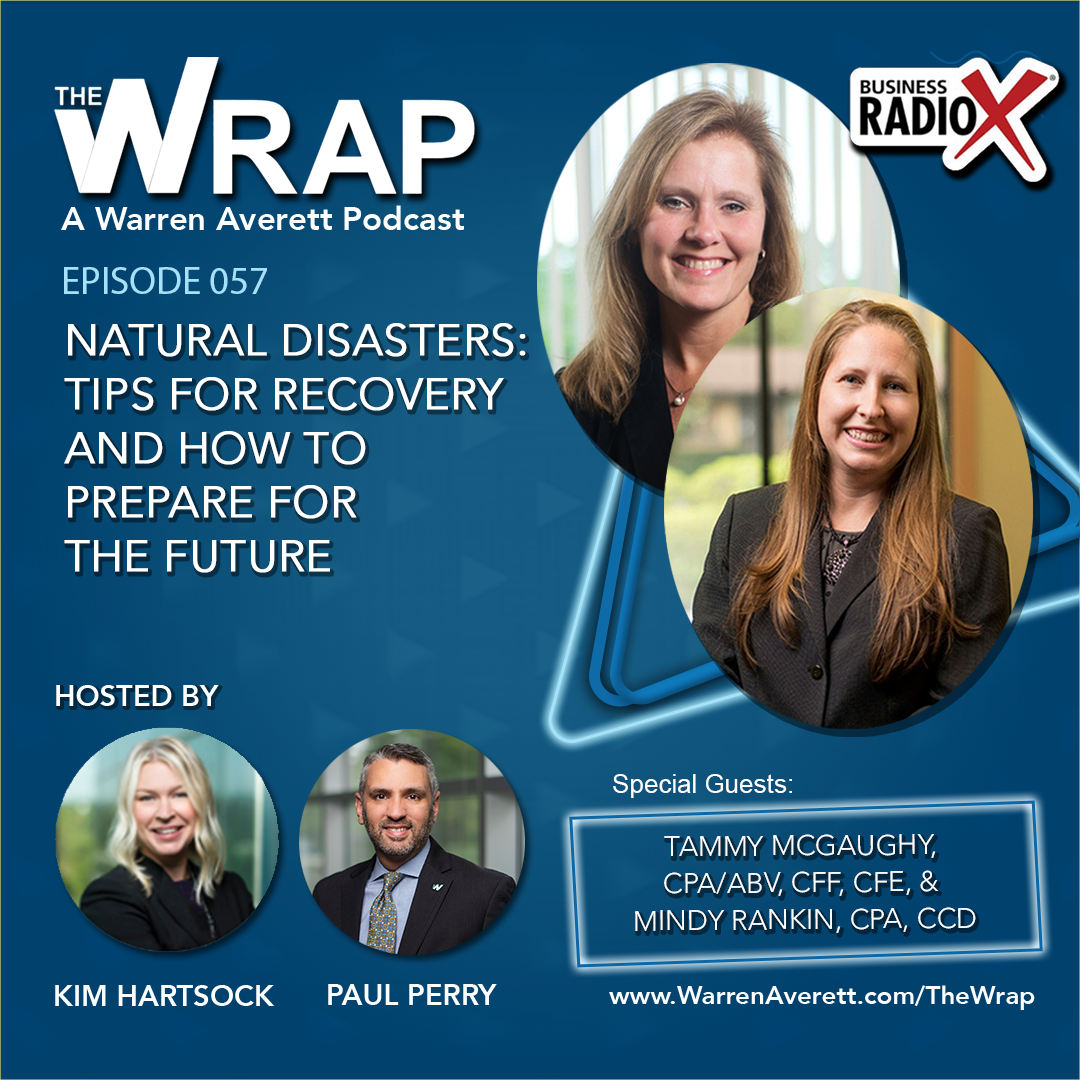
The Wrap Podcast | Episode 056 | Natural Disasters: Tips for Recovery and How to Prepare for the Future | Warren Averett

October 13, 2022 by angishields

The-Wrap-Ep-27
Birmingham Business Radio
The Wrap Podcast | Episode 056 | Natural Disasters: Tips for Recovery and How to Prepare for the Future | Warren Averett
Loading
00:00 /
RSS Feed
Share
Link
Embed

Download file

Natural disasters happen. Oftentimes, they are sudden with no way to prepare.

After a disaster, business owners are not only faced with property damage but  also with business closures, damage to their employees’ properties and other aspects that make it hard for their business to stay afloat.

But what if you could put a plan in place to keep you and your business sailing smoothly?

If you don’t have a plan, are there steps that you can take to ease your recovery?

In this episode of The Wrap, Warren Averett’s own Mindy Rankin, CPA, CCD, and Tammy McGaughy, CPA/ABV, CFF, CFE, join our hosts to discuss how businesses are impacted by natural disasters, how they can recover and what steps can be taken to prepare and prevent future losses.

After listening to this episode, you’ll be able to:

  • Understand what a casualty loss is, as well as the requirements and who is excluded.
  • Know what a qualified disaster is, how it could benefit your business and the steps you need to take to rally for this special designation.
  • Better understand business interruption claims, and how you could get insurance to help prevent money loss.
  • Prepare for natural disasters by picking out the best insurance policy to help you through.
  • Test your disaster recovery plan to ensure everything is ready in case of another natural disaster.

Additional Resources:

  • Casualty Losses: What You Need to Know to Help Your Business Recover from a Natural Disaster
  • 5 Steps to Make a Business Interruption Claim
  • How to Prepare Your Business for a Natural Disaster
TRANSCRIPT

(00:00:00) Commentators: Hey, I’m Paul Perry. I’m Kim Hartsock, and you are listening to The Wrap, A Warren Averett podcast for business leaders, designed to help you access vital business information and trends when you need it, so you can listen, learn and then get on with your day. Now, let’s get down to business.

(00:00:21) Paul Perry: Hi, everyone, and welcome to The Wrap. Today, we are talking with two of our own experts on how you, as a business owner, can not only recover from a natural disaster, but also prepare for one.

Now, obviously, your first focus is checking on your people, making sure everyone is safe and have what they need to take care of themselves and their loved ones. But in this episode, we’re focusing more on the business side of a natural disaster and the approach you can take to both recover and prepare.

(00:00:45) Kim Hartsock: Yes, and while we record this, we are certainly thinking of our friends down in Florida who have been significantly impacted by Hurricane Ian. We have offices down along the coast in Florida, and we were certainly keeping an eye on that. We are grateful to be able to report that all of our teammates made it out of the hurricane without any significant damage.

We felt like it was time to talk again about what we need to do to recover from a natural disaster. But also, for those of us who haven’t experienced one, it doesn’t mean we won’t experience one. So, it’s always a good idea to revisit this and think about what are some lessons learned and what are some things that we can do to make sure that we’re prepared in the event that we do have to face a natural disaster.

(00:01:34) Paul Perry: Good information to be shared. Today we have two of our own that are going to be joining us. We are welcoming back Mindy Rankin, out of our Panama City office, and Tammy McGaughy. Welcome back and glad to have you with us today.

(00:01:49) Mindy Rankin: Hey, Paul. Hey, Kim. My name is Mindy Rankin, and I’m a Tax Member in the Panama City office. I have been with the firm technically since I started out of college. I started with O’Sullivan Creel, and we merged in with Warren Averett. Then I was with Jay & Moody, and we merged in with Warren Averett. I’m a Warren Averett lifer, technically.

(00:02:11) Tammy McGaughy: Hi everyone. My name is Tammy McGaughy. I am an Audit Member in the Fort Walton Beach office. Like Mindy, I’ve been with the firm for a long time. I work on forensic audits, litigation support, value businesses and a lot of consulting-type work. I’m really happy to be here today.

(00:02:31) Kim Hartsock: Mindy, you were on the podcast the last time that we recorded one of these. Unfortunately, you and your teammates down in our Panama City office had some real experience with this topic with Hurricane Michael, which as we know was about four years ago. We’re glad to have you back and look forward to hearing things that you’ve learned through that experience.

(00:02:53) Mindy Rankin: Yeah, Kim, it’s hard to believe. October 10, 2022, will be four years to the day that Hurricane Michael devastated us in Panama City. It’s crazy, but we are actually still working on rebuilds. We still have some clients that are in litigation over insurance claims. So, it’s really been a very eye-opening experience, and I’m so glad that we’re on the other side.

(00:03:18) Paul Perry: Glad to have both of y’all on the podcast, but at the firm as well. So, let’s talk about some of the first steps businesses should be taking. Let’s define, what is a casualty loss?

(00:03:27) Mindy Rankin: A casualty loss is damage, destruction or loss of property resulting from an event that is sudden, unexpected or unusual. In 2018, you could only take a casualty loss if it was in a Presidential Declared Disaster Area. So, it’s really important when you’ve experienced some kind of event like this, that you get the Presidential Declared Disaster Area. Most major hurricanes and even small hurricanes get this special designation.

So, the first thing is, if you’re not in a Presidential Declared Disaster Area from 2018 to 2025, then you can’t take a casualty loss. So that’s a little bit of a change in the tax law. But really it just has to be a sudden, unexpected event. It can’t be something that’s like built up over time.

Any kind of hurricane, natural disaster, wildfire or any of those activities would put you in a position to possibly claim a casualty loss on your tax return.

(00:04:30) Kim Hartsock: Now, is there any benefit, Mindy, to say you’re in the fringe area? Obviously, there’s direct impact places that would get that presidential declaration pretty immediately.

If you’re in the fringe area and you feel like you should have gotten that presidential declaration, but you haven’t, what should you do? Should you just sit at home and take that? Is there any benefit to writing a letter or making a phone call? What should you do?

(00:04:54) Mindy Rankin: Yeah, so not only do you need the Presidential Declared Disaster Area, but there’s also a special kind of loss that’s called a qualified disaster, and those provide you even bigger benefits.

If you’ll think back to Hurricane Harvey, Irma, some of the California wildfires and even Hurricane Michael, getting the qualified disaster designation…that is huge, because when you get that qualified disaster designation, it opens up employee retention credits for you. There’s a limit on normal casualty losses, that’s 10% of your adjusted gross income. The qualified disaster loss actually removes that limitation, so you don’t have to worry about putting subject to 10% of your income. So, you can just claim it. Then, it also lets you just add it to your standard deduction.

So, if you’re somebody that has a pretty simple tax return, and you just claim the standard deduction every year, you can actually add your casualty loss to the standard deduction.

It’s really a huge benefit to get that designated as a qualified disaster, and you have to wait for Congress to do that. Basically after Hurricane Michael hit, it took them quite a while to give us that designation. So, I would highly recommend that you go ahead and start contacting your local congressman now to rally for that special designation.

Usually, it’s done in December when they’re at the end of the year, and they’re working on the tax laws. They like to pass tax laws in in December. So, a lot of the negotiations and stuff happens in December. Start now. Reach out to your local congressman, state senators and everybody that you can, to try to get that designation.

(00:06:34) Paul Perry: So, Mindy, what kind of things are included in a casualty loss?

(00:06:38) Mindy Rankin: You have to be the owner of the property. You actually have to have some damage, so you have to be out of pocket. The first thing that you would do is: if you’re a homeowner or if you own a building or a business, you would want to contact your insurance company immediately and go ahead and file a claim.

What they do is, they’ll send out an adjuster and the adjuster will examine your property for damage and then make an initial payment to you. A lot of times, it’s really confusing because you get this really thick document that says, “Here’s all your losses.” Then, they take out recoverable depreciation; they take out nonrecoverable depreciation; they take out your deductible.

You end up with a net check, but you really have damage. What happens then is you have to get a contractor or someone to actually do the work. A lot of times, it ends up being more than what the insurance company initially provides you. So, then you would want to start negotiations between your contractor and your insurance company.

There are public adjusters available to people. You know, we had several clients that definitely hired a public adjuster. Now the problem with that is, is they get 10% off the top. If you can do it yourself, it’s always a good idea. But some people just don’t have time or energy to negotiate between the contractor and the insurance company.

I really, really think that the important part is making sure that you know your coverages. There’s coverage A; there’s coverage B; there’s all these different coverages. You have limits on them. Personal property has a limit. The structure itself has a limit. You know, your fences and stuff like that has a limit.

You really have to be familiar with what your insurance company is supposed to cover versus what you actually have damage for.

(00:08:24) Kim Hartsock: Now, Tammy, I know that in addition to the physical property loss and claiming for that, there’s also a loss to your business being closed, right? If there’s damage to your business, and you can’t open. If there’s damage to your employees’ homes, or there’s damage to the road, and no one can get there. No one can come visit.

You know where these places are (where the hurricanes come) are very big tourist destinations, right? If nobody can get there, and there’s no hotels for them to stay in, then there’s a loss of business. Talk to me about that. How does that process work?

(00:09:00) Tammy McGaughy: Absolutely, Kim. You’re absolutely right. People don’t realize that they can get covered for this type of loss. But essentially, it’s called a business interruption loss. What that means is a business is not able to have normal operations.

They’re not able to have sales. They’re not able to pay their employees. They actually lose money during the disaster that has occurred. They’re down for a period of time, but if you have business interruption coverage in your insurance, then it will help replace that lost income during the period that you are shut down.

A lot of people may not know that they have this in their policy, but it will be helpful to recover if you have that coverage.

(00:09:47) Paul Perry: How do you know if you’re covered or not? Are there some tips or quick things that we can let our listeners know that they need to be focusing on?

(00:09:53) Tammy McGaughy: Yeah, absolutely. First, you just want to make sure you review your insurance policy. You know, there is a provision that will say business interruption. There could be some extra expense provisions.

If you are incurring extra expenses during this to try and clean up debris or something like that, there’s provision in your policy for that debris removal. So, your policy is a good indicator of what is actually covered. That’s one thing. Policies are really big and sometimes are difficult to understand.

So, you might want to check with your insurance agent. They should be able to identify exactly what’s covered under part of the comprehensive package, whether it’s physical or a business interruption. Then sometimes, the last thing that people don’t realize is that insurance can penalize you if you are underinsured.

You may have a business interruption provision in your policy, but if you’re underinsured, they’re going to penalize you. If you’re overinsured, they’re going to penalize you. So, there is a co-insurance provision. The insurance agent should be able to guide you as to what you know and what coverage you have.

Sometimes, people want to lessen their premiums throughout the period of time, without really realizing the effect that that could have when you experience a disaster. You know, from that type of event.

(00:11:33) Mindy Rankin: Tammy, just to piggyback on that, we had several clients during Hurricane Michael that thought that they had wind coverage. It turns out that they had a lot of buildings in downtown Panama City, and it just turned out that they did not at all have wind coverage. So, they were devastated. I mean, there was so much damage. They were just under the impression all along and through all these years that they had the coverage and when they confronted the insurance company, they told them that several years back they’d dropped the wind coverage.

You have to be very careful when you’re reviewing those packets. I know that they come, and they’re huge packets that are hard to read, but you really just need to get an expert in to review that for you.

(00:12:18) Kim Hartsock: Yeah, it seems like that’s one of those things that we should do every year is just have someone review our policy.

Ask us if any situations have changed and make sure they understand what we need and that we’re covered with not only the right policy but at the right amounts. As Tammy mentioned, we could get penalized if we’re under or over. You wouldn’t expect things to stay the same year after year. So, if you haven’t done that in several years…now is probably a good time to meet with someone and have them review your policy.

(00:12:51) Commentators: Want to receive a monthly newsletter with The Wrap topics? Head on over to warrenaverett.com/thewrap and subscribe to our email list to have it delivered right to your inbox. Now back to the show.

(00:13:02) Mindy Rankin: If you’re listening to this, and you’ve just been through a hurricane, I just want to tell you that it is going to be a difficult process, like you will be passed on to so many adjusters.

Just for my personal claim, there were probably at least six or seven people that I talked to over time. You have to retell your story over and over again. You just have to stay on top of making sure that you’re getting reimbursed for what your coverage is. Tammy has a good story about a business interruption claim. One of our clients, the insurance company sent the estimate to them where they did the calculations and said, “Here’s what we think that you should be given.” It was a dentist. When Tammy reviewed the claim, it was out of whack. Tammy, do you want to tell that story?

(00:13:48) Tammy McGaughy: Well, yes. It was the insurance adjustor or the insurance company when they were evaluating production. So, one of the things that we look at is: when we’re trying to calculate what the business interruption is, we’re looking at what’s called a “But For” analysis.

They’re looking at what does the period look like before the storm, versus what does the period look like after the storm? In this specific case, their production was impacted by one of the dentists that was on maternity leave, and so they were making it seem like the production loss was a lot less than what it really was.

Once we pointed that out to them, they were able to claim more in the business interruption piece because of the correction of that production. So, it’s really important to understand the financial information that they’re looking for and to really analyze what they’re looking at.

(00:14:48) Because it is a “But For” analysis, we’re always looking at what position were you in prior to the disaster, and then compare that to the position you ended up in. So, the delta between that is really the business interruption piece that you get reimbursed for.

You know, if you are trying to figure out what information that you need for a business interruption calculation, I’ll just highlight some of those things. Financial information obviously is really, really important. Some reports that we looked at as we’re reviewing and/or calculating some business interruption claims are looking at production reports, monthly profit and loss reports, or it could be wage reports.

Depending on your policy and the length that you were down, you may need to look at that from a daily perspective. It could be a monthly perspective or even an annual perspective. So, the financial information is really important. As you’re going through anything that you can identify as far as extra expenses that you have above and beyond your normal operations, you may be covered under provision.

Making sure that you identify those expenses is good as well. One last thing is the insurance company will want to make sure that you identify any mitigating activities that you’re doing to try and minimize the loss. They will take that into consideration when you’re determining your loss if you have any mitigation.

Say you have some revenues that you normally wouldn’t have had to try and help mitigate that loss. That will go into consideration on the over amount that you’ll end up getting from your insurance claim.

If you think about a “But for”, what were you doing before? How were you doing operationally? What was your net income? What did that look like before the storm or disaster? What does that look like now? That’s pretty much what your business interruption piece would look like.

(00:17:02) Kim Hartsock: This is all really helpful to know. I think, you know, Mindy, you’ve dealt with so many business owners going through this with Hurricane Michael, and what should I know now as it relates to casualty loss.

Are there any words of advice that you would give me? Is there anything that you would say, if I’m right in the thick of this, dealing with it? Or if I’m somebody that’s saying that I’m really grateful that I dodged a bullet, and I don’t have to deal with this, but it’s something that I need to know in the future. What would you say to the business owner that’s listening?

(00:17:34) Mindy Rankin: Yeah, I mean, we talked a lot about insurance, but just another thing is disaster recovery preparation. So, if you have computer systems, and your files are out there, and your building is damaged, and your servers are flooded, that’s one of the things that some of our clients were not prepared for.

One of the things that’s important is, and something that you don’t think about: Did I take a backup home? You know, when I left, when I’m preparing for a hurricane, did I make a backup and just take it home with me, put it in my pocket? You know, anything that you can do to make sure that if you get to your office, and it’s completely wrecked, you have got to be able to get back into your computer systems and get them back up pretty quickly.

There are actually insurance policies that help with that from a technology standpoint. We did have a client that had gone through all of those trainings and had done disaster backup plans. The one thing that got them was that that nobody thought about the location of their backups. It was expected to be run on a generator.

The generator actually required natural gas, and it was hooked up to the city’s natural gas line. Well, the city shut down the natural gas. So, they had no access for days to their data, and it was a pretty big place that really needed access to that data. That was just one small hiccup. I mean, they had done tons of planning, and you know, it’s just one thing you don’t think about.

(00:19:06) Paul Perry: That’s some good information, Mindy. What I really say to folks a lot in that space, when we talk to them, is you need a backup of the backup of the backup, right? You need to have two or three things that you’re prepared for. You talked about planning. I think that a lot of companies will put together a disaster recovery plan, and they’ll say, “This is how we’re going to do it.”

(00:19:27) But if you test that…if you don’t even do a tabletop exercise. Let’s sit around a table for three hours, let’s talk about and think of every possible issue that may come up, and let’s walk through it. Get everybody at the table. There may be people thinking about things that others aren’t.

You want to know, “Hey, what happens if natural gas is cut off? How would we handle that?” That may come up during that discussion that would’ve been documented somewhere. But yeah, definitely something important there.

Mindy, Tammy, this has been really good information for the folks listening to this. You know, here on The Wrap, we like to wrap it up in 60 seconds. What is it you want to leave the listeners with? Tammy, we’ll start with you.

(00:20:16) Tammy McGaughy: Oh, sure Paul. Thank you. If you’re unsure what to do, and you want to have someone calculate a business interruption claim, go reach out to an advisor. You know, someone can either help prepare a claim for you or even review a claim. As we mentioned before in reviewing a claim, you have a fresh set of eyes, and there may be something that somebody hasn’t considered.

Just reach out to an advisor. I know Warren Averett has done that type of work in the past, but just reach out to your advisor and try to get some input from them.

(00:20:49) Mindy Rankin: I think that the biggest thing from a tax perspective is documentation. There’s going to be a lot of work that is going to go into rebuilding property, rebuilding your house and stuff like that. There are a lot of people that show up in a disaster area that want to be paid in cash, and they don’t have proper documentation. I can assure you that when it’s time to claim your casualty loss or even to submit to your insurance company, you definitely are going to need documentation.

Even if you use someone that wants to be paid in cash, or they’re just random people that are helping you clean up, just get something from them like their business card or some kind of documentation so that you have proof. Because, you know, to be able to claim the loss on your tax return and get money back, you definitely have to have the actual repairs, receipts and everything to get reimbursed from your insurance company.

(00:21:45) Kim Hartsock: Just a couple of things before we wrap up… Mindy, I know that the IRS did just give an extension. Could you tell our listeners where to go to see if there are any extensions on any reporting that they need to do, or where should they check to make sure that they know the latest and greatest of filing deadlines and things like that?

(00:22:05) Mindy Rankin: Yeah, the IRS just recently released that all residents of Florida qualify for Hurricane Ian Tax Relief. I believe, yesterday they actually added North Carolina and South Carolina. So, basically if you had a tax deadline in Florida between September 23 and February 15, 2023, you are extended until February 15, 2023.

Any filing deadlines that were going to be due on October 17, all of that was postponed. You do have some time to gather your paperwork and get all that stuff together before you need to file.

(00:22:50) Kim Hartsock: They can always just check irs.gov for any latest announcements there and also our website. We typically post all of those things there as well, which is warrenaverett.com. So, Mindy and Tammy, thank you so much for being with us today. I know that you both are very busy right now, and we appreciate you taking time to talk to our listeners.

(00:23:11) Mindy Rankin and Tammy McGaughy: It’s great to talk with you again. We hope to see you soon. Thanks.

(00:23:15) Commentators: And that’s a wrap. If you’re enjoying the podcast, please leave a review on your streaming platform. To check out more episodes, subscribe to the podcast series or make a suggestion of other topics you want to hear, visit us at warrenaverett.com/thewrap.

Tagged With: Natural Disasters, Prepare for the Future

WBENC 2022: Anita Davis with Praxis Strategic Solutions

October 12, 2022 by angishields

Anita-Davis-GWBC-WBENC-National-Conference
GWBC Radio
WBENC 2022: Anita Davis with Praxis Strategic Solutions
Loading
00:00 /
RSS Feed
Share
Link
Embed

Download file

Anita-Davis-GWBC-WBENC-National-ConferenceAnita Davis, Praxis Strategic Solutions

TRANSCRIPT

Intro: [00:00:04] Broadcasting live from the Business RadioX studios in Atlanta, Georgia, it’s time for GWBC Radio’s Open for Business. Now, here’s your host.

Lee Kantor: [00:00:18] Lee Kantor here, broadcasting live from WBENC National Conference 2022. And we’re inside the GWBC booth, booth 1812 if you want to stop by and see us. Right now, we have a great guest, Anita Davis, President, Chief Funding Matchmaker with Praxis Strategic Solutions. Welcome, Anita.

Anita Davis: [00:00:38] Thank you so much for having me. I’m excited to be here.

Lee Kantor: [00:00:40] So, how’d I do with the name? You challenged me.

Anita Davis: [00:00:43] I did. I did. Don’t get tongue-tied, so say it slow. You did excellent.

Lee Kantor: [00:00:47] Alright. Well, tell us a little bit about Praxis. How are you serving folks?

Anita Davis: [00:00:51] So, I serve clients that are ready to scale and grow their companies. I work with clients that need capital to be able to fund the growth of their business strategic growth.

Lee Kantor: [00:01:04] So, there’s one or two people out there that probably need capital. Does anybody say, no, I have enough capital, I don’t need anymore?

Anita Davis: [00:01:11] You’d be surprised, some people like to grow organically, and I think organic growth is fine if you want to grow slowly, but I believe that women business owners, in particular, need to consider rethinking growth and to think about growing through acquisitions or maybe growing through a expansion of territory, buying a competitor, doing things like that that make them accelerate their growth. And here at the conference, we’re focusing on corporate contracts. And so, they really do need to have some funding secured to be able to execute on those contracts.

Lee Kantor: [00:01:50] So, let’s think about this from a strategic standpoint. I’m a small business owner. I always thought, oh, I’m going to just grow organically. You’re saying think bigger than that, because maybe I’m aiming too low, maybe there’s a lot of opportunity out there if I just kind of open my eyes to what’s around me, talk about that conversation you’re having with that person who hadn’t even considered strategic growth and using capital to grow in that manner.

Anita Davis: [00:02:13] Those are great questions, and that conversation is my favorite conversation to have with clients. I want you to rethink the way you think about debt. In most cases, most companies think, oh, debt is bad, and debt can be a dirty word for some people if you’re not a smart business owner. But these women here at WBENC, they are brilliant business owners, and they have thought about how to scale their companies, and that’s why they’re looking at corporate contracts, but you do need to have resources available to you to fund that growth.

Anita Davis: [00:02:49] And so, sometimes, you may need to consider, what would it be like if I bought another company that can give me those complementary services or solutions that a corporate officer may be looking for, but I don’t have in-house right now, and that can allow you to accelerate your growth, versus someone who’s saying that, okay, this year, I’m going to grow 5% year over year, it may not enable you to execute on a corporate contract.

Anita Davis: [00:03:20] And some clients don’t really even think about, well, what would it be like if I strategically purchased another company and made an acquisition? What would it be like if my competitor is thinking about retiring, because they’re in that silver tsunami and they haven’t even thought about it, but they’re ready to exit. And then, if you position yourself with the right capital, then you might be able to make a strategic acquisition, buy a new territory, get into a new market. So, those are the solutions that Praxis will help a client work through.

Lee Kantor: [00:03:55] So, your clients, what could they be doing today to make them a perfect fit for you tomorrow? What are some of the activities they have to do to kind of clean up their books, maybe to show that, hey, you can trust me with this capital, I’ll use it wisely?

Anita Davis: [00:04:11] What a great segue, because at the conference, we have a solution called our financial funding assessment. And assessment basically walks the client through, are you ready for funding now? Are you close, but not quite there, or are you not ready for funding? And then, we will—through either one of those scenarios, we can walk a client through the process of positioning their company for funding. So, we help you either with some education, some financial literacy education, some strategies, some tools in our tool kit, so we offer a resource kit. So, if you come by booth 2312 here at the conference, then you can talk with our team about strategic growth.

Lee Kantor: [00:05:04] And talk about the show for a second. Is this the first WBENC show for you or you’ve been coming to these for a while?

Anita Davis: [00:05:10] So, I actually launched my business at WBENC in 2016, didn’t know what I was doing. I just used to be a banker, and I’m like, oh, these people must need money. Yeah, this must be my jackpot. Okay. Life doesn’t work that way. And so, I have come to—I think this is my fourth or fifth conference, and I’m on the host committee with Roz Lewis. And so, the host committee, we basically are here to help anybody who is from out of town and sponsoring this event, but also to make sure that they know what’s happening here in Atlanta.

Lee Kantor: [00:05:44] And then, for folks that are from out of town, how would you kind of attack the show? And maybe around town, what are some things you’d make sure to see?

Anita Davis: [00:05:55] I think at the show, you need to be prepared for who you want to meet. You can’t meet everybody, and everybody is not necessarily a fit for your company, even though they may have a big corporate name. So, you really need to decide, do you have the solutions that the corporations are looking for and have a strategic plan on how you’re going to convey that in a brief nanosecond, because that’s about all the time you’re going to get?

Anita Davis: [00:05:55] And when you do that, then that’s the best strategy for being prepared to be able to address what the conference is going to mean to you. And also, make a plan to meet all of these other brilliant business women owners around here. So, I tell people, it’s the 25th anniversary, make a plan to meet 25 people a day. If it’s not 25 people a day or that’s too aggressive for you, but make a plan for the whole conference to meet at least 25 people. Just go with the theme.

Lee Kantor: [00:06:55] Yeah, it’s right there for you. So, now, talk about GWBC. For women who haven’t joined yet, tell them why they should join.

Anita Davis: [00:07:04] I would tell you that this whole organization here, GWBC, from Roz, who is the president, all the way down to her team, the certifying team, they all want us to be successful. And I’ve had nothing but really great support from the organization and the people in it. They know me. I know them. And they want to see us grow. And if you’re in business here in Atlanta, you need to join GWBC. I just brought somebody over here with me just now to introduce her, because she wasn’t certified. I said, let’s go over here and let’s meet the team.

Lee Kantor: [00:07:40] That’s right. It’s one of those things. There are a lot of women businesses out there that haven’t taken the time to be certified. Talk to that. That’s an investment worth making. It is strategic solution.

Anita Davis: [00:07:52] It is a great investment. It was hard because I’m in the financing business, and I’m like, maybe these corporations don’t need me, but I’ve strategically figured out how to be able to provide solutions for them, for their suppliers that are in their supply chain that need—that might be creating some financial risk to the supply chain. So, you really just need to be able to think through, how can you serve the client? And it’s really about the client. With GWBC, they help you move along that track to be able to offer solutions for corporate, and then tell you how to make that strategy work for you.

Lee Kantor: [00:08:32] So, if somebody wants to get ahold of you, learn more about Praxis, what’s the website?

Anita Davis: [00:08:37] The website is, it’s a brand new fancy website, you guys, but it’s under Praxstra, P as in Paul-R as in Robert-A-X as in Sam-S-T-R-A. So, we, praxstra.com. If you go to praxstra.com, it’s a little bit unique, then you can have access to our site and see what we have to offer you as a business owner.

Lee Kantor: [00:09:05] Well, Anita, thank you so much for sharing your story, doing important work. We appreciate you.

Anita Davis: [00:09:09] Thank you very much for having me. It’s a pleasure to be here.

Lee Kantor: [00:09:12] Alright. This is Lee Kantor, broadcasting live from 2022 WBENC National Conference, live from the GWBC booth, booth 1812. We’ll be back in a few.


About WBENC

The Women’s Business Enterprise National Council (WBENC) is a leading non-profit organization dedicated to helping women-owned businesses thrive.WBENC-Logo

We believe diversity promotes innovation, opens doors, and creates partnerships that fuel the economy. That’s why we not only provide the most relied upon certification standard for women-owned businesses, but we also offer the tools to help them succeed.

About GWBC

The Greater Women’s Business Council (GWBC®) is at the forefront of redefining women business enterprises (WBEs). An increasing focus on supplier diversity means major corporations are viewing our WBEs as innovative, flexible and competitive solutions. The number of women-owned businesses is rising to reflect an increasingly diverse consumer base of women making a majority of buying decision for herself, her family and her business. GWBC-Logo

GWBC® has partnered with dozens of major companies who are committed to providing a sustainable foundation through our guiding principles to bring education, training and the standardization of national certification to women businesses in Georgia, North Carolina and South Carolina.

Tagged With: Praxis Strategic Solutions

BRX Pro Tip: Are You a Jerk?

October 12, 2022 by angishields

BRXmic99
BRX Pro Tips
BRX Pro Tip: Are You a Jerk?
Loading
00:00 /
RSS Feed
Share
Link
Embed

Download file

BRX-Banner

BRX Pro Tip: Are You a Jerk?

Stone Payton: [00:00:00] Welcome back to Business RadioX Pro Tips. Stone Payton and Lee Kantor here with you. Lee, here’s a fun question, or you know what? Maybe it’s not so fun. But it’s one of those self-awareness exercises that perhaps we should all engage in. The question is, Are you a jerk?

Lee Kantor: [00:00:16] Yeah. Here’s the test. If you met a jerk today, you should ignore them because, you know, that’s just part of life. But if you find yourself meeting a jerk every single day, then guess what? You might be the jerk. It might be you that’s the problem.

Lee Kantor: [00:00:35] So, in life, I find that people don’t realize that it isn’t as hard as they make it seem. And sometimes you do meet somebody who’s a jerk. But if it’s happening every day or it’s happening lots and lots, and every day you’re telling somebody about some jerky thing that has happened, then it could be you. It could be the way that you’re approaching things.

Lee Kantor: [00:00:58] So, if things are frustrating you every single day, this might be a you problem, not a somebody else problem. So, start looking at yourself a little more introspectively to see where you might be sabotaging yourself. There aren’t jerks out there every day trying to mess with you and ruin your day. I promise you, most people are going about their business doing the best they can. So, if you’re meeting people every single day that are frustrating you, that are making you angry, the problem might be you.

Nisha Lehmann with Confidential Conversations

October 12, 2022 by angishields

Confidential-Conversations-logo
High Velocity Radio
Nisha Lehmann with Confidential Conversations
Loading
00:00 /
RSS Feed
Share
Link
Embed

Download file

Confidential-Conversations-logoNisha Lehmann with Confidential Conversations does UX Design by day, and is a Mental Health advocate by night.

Helping people find communities around mental health issues by facilitating anonymous online peer led support groups.

Confidential Conversations is an app that offers peer led online support groups for a wide array of mental health issues that is anonymous, affordable and available.

Follow Confidential Conversations on Facebook, Twitter and Instagram.

This transcript is machine transcribed by Sonix 

TRANSCRIPT

Intro: [00:00:04] Broadcasting live from the Business RadioX studios in Atlanta, Georgia. It’s time for High Velocity radio.

Stone Payton: [00:00:15] Welcome to the high velocity radio show where we celebrate top performers producing better results in less time. Stone Payton here with you. This is going to be a fantastic conversation. Please join me in welcoming to the broadcast with confidential conversations. Ms.. Nisha Lehmann How are you?

Nisha Lehmann: [00:00:37] I’m great, thanks for having me.

Stone Payton: [00:00:39] Stone Oh, I have really been looking forward to this discussion and I think the topic of the day, the broad stroke is, is mental health. But maybe share with our listeners a little bit about mission purpose. What are you out there trying to do for people.

Nisha Lehmann: [00:00:57] Trying to save the world? No. Well, kind of. Basically, this app stemmed from a very dark period in my own life. I think anyone that has struggled with mental health issues can relate to feeling alone, isolated, feeling like you have no place to turn. And and even if you do want to talk to someone about your problems, you know, the closest people to you, they can’t sympathize or understand you the right way or the same way because they’re not experiencing what you’re experiencing. And I think the realization, the kind of aha moment came for me when I really needed to connect with people who were going through the same thing, who are going through depression or anxiety or grief or whatever it is, right? Because those people, you already have a baseline for the conversation. You don’t have to explain or justify or try to wish your feelings away or something. I mean, when talking to people that are experiencing what you’re experiencing, you can be more raw, be more authentic, and I think get get more concrete steps in terms of help. And so what I really wanted to accomplish with this app was to be able to facilitate online support groups that are completely anonymous, because that for me was incredibly important. I still, unfortunately, really believe in the stigma around mental health. I think it’s there for a lot of mental health issues, although it’s it’s dying down for some.

Nisha Lehmann: [00:02:30] But I think it’s it’s it’s a big inhibitor in talking about mental health. And so having a place where you can go that, you know, is a safe space that is completely anonymous, that it’s private. Now, we cannot nor will we ever collect PII data about our customers or about our users, because this is this is your own it’s your own private issue. And we absolutely respect that. But being able to connect with others who are experiencing the same thing you are and hopefully be able to walk away a little bit more educated a little bit more, or at least having a bit of the pressure relieved on you that you’ve at least talked to someone, You’ve gotten some ideas, maybe some routines, things to try that a therapist would never be able to tell you, because it’s not as if every therapist has gone through what you’re going through as well. So I think I think there’s an incredible potential for success in this space. And honestly, the goal for me was to create it for others like me who were struggling at that time, who were struggling and continue to struggle, I would say, with with mental health related issues in a in a small effort or small steps toward recovery.

Stone Payton: [00:03:39] So have you observed any interesting dynamics or shifts with with regard to pre and post pandemic?

Nisha Lehmann: [00:03:50] For sure, I think the pandemic well, I don’t have to say this. Probably the pandemic did a number on all of us, right? Yeah, I think isolation and loneliness were never really classified as mental health issues until after the pandemic. But of course, if you can’t leave your house or you have to distance from people, that really impacts your ability to be social, your ability to really connect with others. So for sure, pre, pre and post pandemic, you saw a lot of issues related to work, specifically burnout, stress, panic attacks, high anxiety. I mean, but that was probably existing pre-pandemic as well. But you really saw it come to a head post-pandemic when people started leaving their jobs in the great resignation. They were not going to tolerate the work life balance. They were not going to go back to how things were, you know, and if it means making less money, but being able to shut off your computer at five and spend time with your family or spend time working on your passion projects, that became more important. And I think that’s an incredible step for people and for employers to also learn that actually mental health is is is a real issue when it comes to employees in the workforce. Beyond that, I think. There are a number of mental health issues that really came to the forefront. You know, grief. It’s it’s I mean, I never thought of it myself as a mental health issue. For me, it’s it’s something that you will experience at some point in your life.

Nisha Lehmann: [00:05:15] Everyone will experience grief because at some point you will lose someone close to you. And you know, what does that feel like and how can you cope with that and how differently people cope with That is what I found so interesting. But that’s a big one post-pandemic, because of course we all know someone who we either lost someone ourselves in the COVID pandemic or we know someone who experienced loss during the COVID pandemic. So, I mean, it wasn’t a small number of people that died during this pandemic. So, I mean, I think grief was a really big one as well. And also the ability to shut off the the ability to be able to have addictions that are completely unorthodox now in addiction to your screen, addiction to mobile phones, addiction to social media, and the kind of also the meanings and the stigma that comes around being attached to the number of followers you have, the number of likes you get on a particular post. I think all of these are only going to proliferate in the future. And so I think it’s just we have to be cognizant and mindful of the fact that social media is a platform, but it’s not an integral really part of our lives and we need to be able to turn it off and live our lives. And so I think maybe those would be some of the takeaways. Pre post.

Stone Payton: [00:06:30] Yeah, well said. You mentioned employers and awareness. Are there some actions employers, mid-level managers inside larger organizations can take or or things that they should be reading or keeping in in mind to to help this?

Nisha Lehmann: [00:06:51] I’m so glad you brought this up. It was it’s such a fantastic segway. So I actually just wrote a piece of thought leadership specifically about this, about what employers can do when it comes to mental health, what they should be doing. A lot of studies have been released specifically on the ROI of investing into your, investing into mental health, investing into resources for mental health. I think the biggest thing that managers or people in in, let’s say, positions of power can do is try to stem cultural cultural shift in the organization, because that actually has a very, very low monetary cost. But if you can make the workplace a safe place for people to be able to talk about what they’re feeling without feeling like there’s retribution to that action, I know I know a lot of people in large and large consulting firms, in large enterprises, they feel like they can’t talk about mental health because if their manager finds out that they have depression or if their manager finds out that they are struggling with something, then they think it will impact negatively their career. And so being able to really foster a work environment that is that where it’s okay to talk about these things and where managers can kind of recognize when when one of their employees or when one of their team members is is going through a mental health problem, I think is also a huge a huge step in the right direction. So if you want to know more information about this, please visit the website config convos and you’ll find some thought leadership there on some ideas about this.

Stone Payton: [00:08:25] So this app you were describing, I’m operating under the impression that it provides anonymity, but the structure in I’d like to get that validated, but the structure is like these peer led kind of it’s sort of a peer to peer thing isn’t it.

Nisha Lehmann: [00:08:41] Exactly. Yeah. It’s peer led online support groups. Exactly. And it’s an interesting point you bring up because, you know, these discussions are not really facilitated by any moderator or, you know, anyone else. One, because we want to protect the privacy of the people in the group for sure. I mean, it doesn’t make sense to have a moderator that isn’t experiencing the same things that you are just listening to the conversation. But we wanted it to be a bit more free flowing as well because it can be difficult to talk through these things. And I think if there’s a moderator pushing you to talk about these things, the conversation becomes kind of fake. It becomes a bit superficial. People have to be able to on their own terms as they become comfortable with the dynamic of the group, as they become comfortable within within their the frame of their own mental health issue, or as they become become more aware or they recognize and aware they are on the mental health spectrum, they need to be able to talk about these things on their own. And I know for sure being a bit more introverted myself, it was very hard for me to do this. And the first many in the first couple of sessions, I was just listening. I was just listening to what other people were experiencing, what other people were going through, smiling and nodding and trying to kind of be brave to talk about this myself, because it can be a huge step for people. Who really come in a way, come clean, write, admit that they have a problem and talk about it out loud with others. It’s it’s a big step and it can’t be pushed or forced in any way. And so we want people to get there on their own terms. And that’s why we kind of wanted the conversation to be a bit more free flowing and unstructured. And from there, you know, we take into consideration what we do with that in the next steps.

Stone Payton: [00:10:28] So it’s one thing to build an app, clearly another to get a critical mass of people utilizing it in returning their learning back to the organization so you can continue to improve and and enhance it. How did you crack that code?

Nisha Lehmann: [00:10:47] It’s a work in progress. It’s definitely not complete for sure, and I think we don’t really have that many users. And I will say very bluntly from the beginning, you know, the goal of launching this app was not to have 5 million users or even 500,000 users. This app is designed for the people who need it. It’s designed for people who want to explore on their own terms, their own mental health, or they can’t afford a therapist for whatever reason. And they want to still get proactive about doing something in terms of their mental health. And so I think it’s not for everyone to be sure, but the people that use it, I believe, find value in it because they’re using it for their own intents and purposes. And they’re they’re exchanging with each other. They’re trying to learn from each other. And whatever learnings we can get because we cannot be involved with every single group, right? So we can only take the learnings from the groups that we’re actually in because we designed this selfishly, we designed this app also for us for, for the like for, for me and my team. We, we needed this outlet ourselves too, because we, we all found ourselves kind of struggling with mental health issues around the same time. And so we can bring feedback about app performance and how to improve things and how to make this more fruitful for our users. And we’ve already gotten a lot of really good ideas and suggestions from users that just interact directly with us through the website or through through the app itself. But I think there’s a lot more to do.

Nisha Lehmann: [00:12:30] I mean, what I will say about the app is that it’s pretty barebones. It’s not very fancy. It’s much more substance over style, I would say. So the UX is it definitely can be improved. I would say it’s definitely not perfect, but the point of this app was to get it out there as soon as possible. So we had to do a lot of prioritization in terms of figuring out what functionality did we really like was must have in the app and what could wait. And so for us being able to facilitate the conversations, being able to do it in a way that’s private, being able to make the app accessible and affordable to those people who simply can’t afford a therapist or professional help, those are really the key drivers to get this out the door. And, you know, we take we take what we can and we definitely want to do a lot more with it. So be looking out for the next version of this where we integrate, we integrate some multimedia, There’s some incredible games that we’re that we’re thinking about, including into a like a digital library, because I think we I also truly believe that games are the future when it comes to mental health treatment and mental health sourcing. So being able to really experience an immersive and immersive multimedia content that where the avatar actually struggles with a mental health issue, but it’s not some kind of caricature of the mental health issue. That for me is really the next step in terms of trying to make this a bit more progressive and a bit more intuitive for our users.

Stone Payton: [00:14:04] Well, and I think you’re up to the task because you’re in UX design by your daydream, right?

Nisha Lehmann: [00:14:11] Yeah, Yeah, exactly. That’s that’s what I do every day. Yep. So, I mean, it’s, it’s definitely, I mean, shame on me that the UX is not brilliant on the first go around. But like I said, we were in a rush. And if you want the UK to be very, very, very good, then it takes a long time to get that right. And my, my clients and myself will tell you that it’s a it takes a while to do this and there’s always improvements and iterations that come later. So I think the beautiful thing about app development is that you can iterate on it so you can get out one kind of almost proof of concept out the door and then build on it and improve things and add features granularly rather than having to have a full blown new app that’s completely redesigned or something. So that’s, that’s the strategy that we’re using and hopefully you’ll see some changes coming up with it.

Stone Payton: [00:15:02] I’m an entrepreneur. So many of our listeners and our clients at Business RadioX are entrepreneurs. Do you find that there are mental health? I don’t know what the right word is issues, topics, dynamics that are unique or more prevalent in the entrepreneurial community. Can you speak to that a little bit?

Nisha Lehmann: [00:15:28] That’s an interesting question. I don’t know if it’s specific to entrepreneurs, but there’s definitely a subset of mental health issues that are specific to high stress jobs. What what people don’t often think about is having financial duress, which I think every entrepreneur has experienced at some point that has incredible ramifications on your mental health, you know, because you’re constantly having to deal with the pressures of. I want to follow this dream and I want to be able to give back something. But I also need to pay the bills. You know, I’ve got I’ve got financial obligations in my house to my family, to my kids, whatever. And that can cause a lot of stress, which, of course, is a well-established mental health issue. So there are definitely a few that I can think of that that definitely lean more toward the entrepreneurial space. You know, I mean, I don’t want to make light of this too much, but also, you know, VC funding and things like that typically goes more to men than it does to women in this space as well. And so I think there’s an inherent gender bias that exists in the entrepreneurial space as well, where where if you’re competing directly with a man and you have the same idea, it’s unlikely that you would get funded simply because of your your sex. And so there’s also these things to take into consideration as well. No, specifically for women entrepreneurs, I think that’s why there are so many organizations specifically devoted to promoting female entrepreneurship, because this is a recognized problem, and I hope it’s changing given all of the the movements we’ve had within, you know, female, you know, female rights and pay parity for women and things like this. But I hope it’s moving in the right direction and I hope this becomes a thing of the past soon.

Stone Payton: [00:17:20] Now, am I remembering my notes correctly that you have a radio show of your own, don’t you?

Nisha Lehmann: [00:17:27] I don’t know. That’s not me. Okay, I don’t. I don’t have time for a radio show and maintenance.

Stone Payton: [00:17:36] See me after class. We’ll get you set up.

Nisha Lehmann: [00:17:38] So. Fantastic. Yeah. You know, I mean, I think it would be an interesting. I mean, the number of people that have said, you know, you should do a podcast of your own. It’s more than a handful, but. What? What people don’t tell you is how time consuming it is. It is an incredible I mean, I think you, you and your team, they do an amazing job because the amount of research that goes into these episodes and being able to ask tailored questions specifically around particular topics, it’s not easy. And yeah, between between a full time job and the app and other things. No, there hasn’t been enough time to to add a podcast on top of that, but maybe one day in the future.

Stone Payton: [00:18:18] Yeah, maybe. And I will tell you, it’s a lot of fun. And for me personally, there’s there’s just so much I don’t know, the questions come pretty easily so maybe fun is the that’s okay.

Nisha Lehmann: [00:18:32] So maybe then it is right for me because I don’t know that much either. So maybe then it’s okay.

Stone Payton: [00:18:39] So in your career and in in this pursuit, have you had the benefit of a mentor or to to help you navigate some of this terrain, or is it pretty much been been you?

Nisha Lehmann: [00:18:55] Well, in terms of the app development itself and just generally in my career, yes, I think it’s incredibly important that women help other women, especially in the tech field, because there’s it’s sounds so cliche to say it, but it’s still true. There are so few of us actually working in the tech field and trying to do things in the digital space. That mentorship becomes incredibly important. And one of the things I actually am thinking about is to is, you know, what what impact does this have on your mental health, people who have mentors versus the people who don’t? Hmm. But in the mental health space, it’s hard it’s hard to find this. You know, it’s hard to find. I mean, I’m thinking about the equivalent of like a sponsor or something like this. I think it’s I think it’s hard to find it because so many people are just kind of unsure about where they sit when it comes to having good mental health versus poor mental health. And it’s what I think people need to realize is, is that it’s not binary. It’s a spectrum. You know, you can have you can be in the 3% of individuals that have absolutely no mental health problem. But that’s pretty rare. Everyone is struggling with something and it’s okay to struggle with something. The problem is when that struggle kind of overtakes you and then you can’t get the help that you need for whatever reason. Whether that help is a therapist or an online support group or whatever it might be. Right. And so honestly, the point of this app was really just to give people another option. I think in the mental health space specifically, it’s it’s really kind of binary. It’s like you have a mental health problem or you don’t.

Nisha Lehmann: [00:20:33] And if you do, you see a therapist and that’s really it. And if you can’t afford a therapist or you, there isn’t one you know that you like or it’s not the right thing for you. There aren’t really a lot of other options other than to ignore the mental health problem. And we all know what happens when you do that. So hopefully this app will just allow people another choice where they say, okay, well, maybe I’m fine now, but maybe one day, you know, I may need to talk to someone and not a professional, but just someone like me, someone struggling with with issues like me. And I think it’s particularly important when you talk about Gen Z and you talk about Gen Alpha and the next generation’s right, because they’re going to be struggling with mental health issues that we, you and me, cannot understand. You know, the cyberbullying, the cache, the gaslighting, the catfishing, you know, these things that are relatively new, I would say. I mean, to Gen Xers like myself, but they need to be able to have an outlet to speak with others like them, because if they if my kid comes to me one day and, you know, tells me that he’s struggling with this, I don’t know if I’m going to be able to help him properly, but I know if this app is on his phone, at least he’s talking to someone. It doesn’t have to be me necessarily, but I would take some comfort in knowing that, okay, he’s talking to other people who get him, who he can relate to, who’s going through the same thing. So, you know, maybe that’s already a step in the right direction.

Stone Payton: [00:21:58] All right. Let’s make sure that our listeners can get their hands on this app and leave them with any other coordinates that you would like to leave them with or want them to be able to follow your work, connect with you, and get access to to this app.

Nisha Lehmann: [00:22:11] Okay. Well, the app is called Confidential Conversations. You will find it on the App Store on Google Play. It does cost. A little something to download it. So at the moment it’s paid simply because we didn’t want ads in the app. That was really the big fear on our end, because you’re already talking about a vulnerable population. And then suddenly if you throw ads in there, it’s it’s not the model that we were looking for. So you do have to pay a little something for it. And I’m sorry, there is a small barrier to entry. Probably in the next version we’ll we’ll try to make it for free because the point of this app is that it really should be accessible and affordable for everyone. You can visit our website that was confit convos. There’s thought leadership there. There are a couple of other podcasts that have I had the privilege of doing as well, so feel free to check them out. And our social media handle is at config convos where on Twitter. We’re on Pinterest, we’re on Facebook, we’re on Instagram. You can pretty much find us on your favorite social media. Feel free to follow us. We’re always posting things that we think will be useful. Other podcasts that are talking about mental health or thought leadership within mental health, or no new research that’s coming out in particular areas. So please follow us and feel free to learn and reach out directly To me. It would be great to hear from from some of the people struggling with mental health issues if this app has helped you or not. Right? Both of them, it would be great to get some feedback just so we know whether we’re in the right direction or whether we really do need to do a complete overhaul.

Stone Payton: [00:23:43] Well, Nisha, it has been an absolute delight having you on the show today. Thank you so much for investing the time and the and the energy and thank you for the work. This is important work and we sincerely appreciate you.

Nisha Lehmann: [00:23:59] Well, thank you so much. And I really hope that the app is is going to help people that that was the whole purpose going in because it helped. It helped me. And if it helped me, maybe it can it can help others. And that’s really my contribution to humanity. I guess so. But thank you. Stone It was it was a great conversation.

Stone Payton: [00:24:20] My pleasure. All right. Until next time, this is Stone Payton for our guest today, Nisha Leamon with confidential conversations and everyone here at the business Radio X family saying we’ll see you in the fast lane.


Tagged With: Confidential Conversations

Speaker and Purpose Consultant Genevieve Piturro

October 12, 2022 by angishields

Genevieve-Piturro
High Velocity Radio
Speaker and Purpose Consultant Genevieve Piturro
Loading
00:00 /
RSS Feed
Share
Link
Embed

Download file

Genevieve-Piturro-logo

Genevieve-PiturroGenevieve Piturro is all about Purpose and The Human Connection. She was a successful television marketing executive until she dramatically changed the direction of her life. She found her true purpose when a sudden inner voice challenged her life as she knew it.

In 2001, she founded the hugely successful national non-profit, Pajama Program, when a question from a six-year-old girl in an emergency shelter changed her life forever and she jumped off the corporate ladder. This year, the Program celebrates its 21st anniversary, having delivered more than 7 MILLION magical gifts of new pajamas and new books to children through its 43 chapters across the U.S.

Genevieve is now a professional speaker and purpose consultant inspiring individuals, groups and companies on The Transformative Power of Purpose & The Human Connection. She created the Purpose ACER business training program to help leaders create a shared culture by aligning the goals of the company and management with the goals of its employees.

Her first book, sharing life and leadership lessons she learned through her Pajama Program journey, is an Amazon best seller and the winner of five (5) awards. The book, Purpose, Passion and Pajamas: How to Transform Your Life, Embrace the Human Connection and Lead with Meaning, debuted during the Covid shutdown to rave reviews. The book’s message dovetails perfectly with our Nation’s growing interest in finding purpose.

Her TEDx talk: “1 Idea + The Human Connection = 7 Million Pajamas” debuted at the same time. Genevieve has been interviewed on and in many local and national media including Hallmark’s Home & Family, The Huckabee Show, OPRAH, TODAY, GMA, The Early Show, CNN, Fox & Friends, O Magazine, Forbes, The Wall Street Journal, and Parenting Magazine.

Genevieve rang the Nasdaq Stock Market Opening Bell in 2016. She has been the recipient of many local and national awards as she inspires others to listen to their heart-voice in pursuing their passions.

Genevieve is a graduate of Fordham University and lives in Irvington, N.Y. with her husband, Demo DiMartile. If you can’t find them, check the beach.

Connect with Genevieve on LinkedIn, Facebook, Twitter and Instagram.

This transcript is machine transcribed by Sonix 

TRANSCRIPT

Intro: [00:00:04] Broadcasting live from the Business RadioX studios in Atlanta, Georgia. It’s time for High Velocity radio.

Stone Payton: [00:00:15] Welcome to the high velocity radio show where we celebrate top performers producing better results in less time. Stone Payton here with you this morning. You guys are in for such a real treat. Please join me in welcoming to the broadcast. Author, speaker, consultant and founder of Pajama Program. Ms. Genevieve Piturro. How are you?

Genevieve Piturro: [00:00:39] I’m great. Thank you for this invitation.

Stone Payton: [00:00:41] Stone Well, I am delighted to have you on the show. I got a ton of questions. We won’t get to them all, but I’m thinking maybe a good place to start is if you could share with our listeners. Mission. Purpose. What are you really out there trying to do for folks?

Genevieve Piturro: [00:00:58] Well, you know, I never no one ever asked me what my purpose was or no one ever suggested I might have one and consider it when I was thinking about a career. And I think that’s true for a lot of people who’ve entered who are in the business world now for ten or more years, 20 years even, You know, I thought lucky people found their purpose, you know, famous people I didn’t know we all had one. So when I sort of tripped on mine and it appeared out of nowhere, I thought this this is something that I want to share, that we all have a purpose because nothing felt more right for me to be doing than when I jumped off that corporate ladder because something stimulated me finding my purpose.

Stone Payton: [00:01:46] And what is the back story? How did you find yourself in this line of work? Was it a catalytic moment or did it sort of just evolve?

Genevieve Piturro: [00:01:56] I like that word. It was definitely catalytic. I was climbing the corporate ladder, always wanted to work in the world of television, and I did. I was behind the scenes in marketing and I started in radio and I loved it. It was a fast paced world. I for 12 years, I worked my way up to vice president of marketing for several television syndication companies. And it was my dream, or so I thought. And I really was not paying attention to my roots. I was an Italian first born daughter, first born here in the US, and family was very, very important to my family and I just didn’t have that get married and have children vibe. I had that businesswoman vibe, vibe. But one day, 12 years into this corporate career, I heard a voice in me, asked me a simple question, and it asked me if this is the next 30 years of your life, is this enough? And stone That stopped me cold because I never heard a voice from in me. I’d never considered anything else or really what I was missing. And the answer came just as quickly. You missed something really important. And I realized that although I didn’t want to get married and have kids right then and there, I needed children in my life. And I started reading in shelters and I never felt more grounded than at night after a crazy busy work day.

Genevieve Piturro: [00:03:28] To sit on the floor with these children who were brought in by police and social workers because of being hurt in so many ways. And I felt connected to them. And I felt connected to me. And I’d never felt that before. It took me a while to even use that word. I felt connected to them and to myself. And over time, reading to them, I got to know a little bit about the process. And when I saw them sleeping in their clothes for the first night, they were brought in and huddled together on futons and they had nothing. They were so afraid. I wanted to bring pajamas because I saw the bedtime I had flashed before me and when I did and I handed them out. Most of the children took them quietly, and one little girl was just afraid to take them. And in a moment or two, when I just gently prodded her to take them, she whispered to me, What are pajamas? And that changed everything. I nearly nearly fell over and I went right to the core of me. And I just realized I’ve been I’m the founder of Pajama Program. Now we’re celebrating 22 years. The experience of living. Your purpose has changed everything in my life. And I started talking and speaking on it, and that’s what I do now.

Stone Payton: [00:04:46] Yeah. So. So you’re out there, you’re speaking, you’re consulting. So who are you speaking to and consulting with?

Genevieve Piturro: [00:04:53] Well, it’s so funny because I was doing this while I was still executive director of Pajama Program, and I wanted that position to start to grow us. And after 20 years, I decided to go out on my own to speak about this experience and further it. And so I speak and I have always spoken to groups who are maybe looking for chapter two, who are unfulfilled in general about how to find your purpose and how it changes everything and how we have one. Every single one of us has one. It’s not just for the lucky few. And then in and after the pandemic was at its high, we all were reconsidering what we were doing. And even if you love your job, there’s a way there to communicate with your coworkers and the leaders of the company how to make it purposeful for everyone there to grow the company’s bottom line, to grow the companies camaraderie, to feel inspired. So even if you have a job, you can find your purpose.

Stone Payton: [00:05:56] It must be. It’s got to be incredibly rewarding work.

Genevieve Piturro: [00:06:03] You know. Yes. Rewarding. I don’t. There’s got to be a better word than rewarding because you feel like you belong exactly where you are. You feel like you are in the right skin. You feel like there are forces outside of you that are supporting you. The right people come. Now, when I started Pajama Program and I jumped and left my job, I had I had very little I was not a saver and it was very frightening. I had a lot of nights where I cried myself to sleep, afraid that what did I do and could I get all these children pajamas? And I didn’t even know what a 523 was. So I did it. I did it in a way that probably wasn’t easy. And I coached people on both. You know how I got through that and how to do it a little with a little less stress. But you still always feel like you are where you’re supposed to be and you will get through it. There’s just that knowing when you on your purpose.

Stone Payton: [00:07:03] So how does the whole and I recognize that that this is a nonprofit pursuit, but I still think this applies. How does the whole sales and marketing thing work for for an organization like yours? Like how do you get a chance to get to do the work?

Genevieve Piturro: [00:07:20] Well, you have to balance doing the emotional work because I think for the most part, founders of nonprofits are are doing it because of an emotional experience and emotional attachment to what they’re doing. Right? So there’s balancing the need to tell people how important it is. Share your story, because all founders have a story of why they’re doing this with growing the financial aspect. It is a business the IRS is watching. People want to know the financials. People want to know how they’re making a difference. So there’s a balancing there that takes place. And you need and I needed we all do professionals, professional attorneys, professional CPAs, professional fundraisers, people who know how to run the business part with you while you’re telling the story and really working the mission part of it. And of course, you can make a living working in nonprofit. It’s a little different. You know, it’s different in a lot of ways, but it is a business.

Stone Payton: [00:08:25] So what has it been like moving through the pandemic, coming out of the pandemic? Has that had an impact on the way that you and your clients go to market?

Genevieve Piturro: [00:08:39] Definitely. I think leadership is changing. I think that was a very big part of the pandemic’s effect on all of us. I think I would say it’s used to be more of a military. When I was in my beginnings of the career, very military, like in a boss, said what he wanted you did with the boss wanted. And that’s how I accepted it. And I think over the years and certainly my starting something brand new, I was developing different leadership styles. And I think in the pandemic we all reflected on is that what I want to do? Going to work every day. Is that how I want my day to go? Is that the relationship I want with the people I work with and work for? And I think we’re all looking for more compassion and leaders who inspire us. And I think that that’s a very big difference now today versus three years ago and certainly versus ten or 15 years ago, the different leadership styles for us all.

Stone Payton: [00:09:43] Well, yeah, I suspect some things that may have worked very well for us before pre-pandemic. Now, these are terms, right? Pre-pandemic, but before maybe don’t services as as well now are trying to go forward. Yeah.

Genevieve Piturro: [00:09:59] Yes. Yes. I think we’ve all we all have our stories and they’re very valuable and I don’t think that we were raised, many of us, to share those stories. They were private, but people are sharing now and I think that’s a good thing. We want to find where we connect with each other. I don’t think we want to be on two sides, You know, the leaders over there and everyone else over here. I think we want to connect and interconnect and and intermingle and share and find the commonality because leaders want their teams to rally for them. And the teams employees all want to feel that they’re seen, that they matter, that somebody knows about them and values what they want and includes them. So I think in order to feel included on both sides, the leaders feeling they’re included in their entire team base and the team, the employees feeling like people see them and that they matter. I think that communication and that sharing is key more than ever now.

Stone Payton: [00:11:03] So are you finding that that the client is also seeking something different or or more from the the sales person and those relationships as well?

Genevieve Piturro: [00:11:15] Yes, I think I think all of us are looking for more from each other. Any relationship, personal or business? I think it’s about connection. And I talk a lot in my book about the human connection and how that’s the key to our success. Once you find your purpose, that human connection is going to take you home.

Stone Payton: [00:11:34] So this book, Purpose, Passion and Pajamas, I got to ask, did it did it come together for you pretty easily or were there some parts of the book that were more of a struggle to get committed to paper and articulating things the way you wanted to? What was that experience like writing this book?

Genevieve Piturro: [00:11:54] Well, I tried over the years many times, but Pajama Program took my attention 100%. So I started and stopped a while. And that’s one of the reasons why I wanted to pass the baton of executive directorship and the salary to someone who could take it. So the next 20 years and I wanted to write the book. So that’s what I did. The hardest part, I knew the message. I knew that I wanted to tell everyone, You have a purpose. Promise me you will. Look, I know. I promise you, you have a purpose. And if they feel there’s something missing in your life, there is. And go find it. And I’m here if you want to brainstorm. But the hardest part was the particulars of Pajama program and the children. I wanted to. I wanted everyone to understand the plight of these children and why it brought me to my knees and why I cried and why I didn’t want to to I wanted to take them all home, but I didn’t want to fill it with all of the devastating stories I heard and learned about. So that was that was difficult because I wanted to share so much and I wanted to be really sensitive to to everyone.

Stone Payton: [00:13:02] And so let’s offer the listeners a little bit of counsel, if we can, when they get their hands on this book. Do you do you have some recommendations on how to get the most out of it, how to how to utilize the the book?

Genevieve Piturro: [00:13:17] Sure, it’s a chronological story, but at the end of every chapter are a heart of the matter lessons and in the chapter proceeds it. There are two, three or four key points I want the reader to really own, and I list them at the back of every chapter. So it’s the heart of a matter of lessons that I learned that I want to share at the end of each chapter.

Stone Payton: [00:13:43] So you’ve done something that I’ll confess has been on my bucket list. You’ve conducted a TEDx talk. Say a little bit about that, what it was like to prep for it, what the experience was like, and and what you’ve found to to unfold after doing that.

Genevieve Piturro: [00:14:01] Well, I did it during the pandemic, which was very odd. So I do want to do another one live. And I was set to do one live. And then the pandemic hit and Ted came around and said, okay, hold on all the Ted X. So everybody held. And then when the pandemic didn’t end in six months or even a year, they came back and said, okay, we need to continue. Ted, is there need to be inspiring do them on video? Get a cameraman, do the professionally. Here’s the logo or whatever. We’ll will approve them once you send them in and then we’ll run them. That’s how I did mine. So it was a very surreal experience. I had did what they said. I got a professional cameraman, but I only had that person and my husband cheering me on. And my story is emotional as most Ted is, I think are you you want that feedback from the audience. You want to feel connected because you have a very personal message. So that was strange that I only had my husband and a cameraman there, and I was used to and still love speaking in front of an audience because of that feedback. But but I did okay. They approved it. It’s out. It’s gotten a decent amount of views. And it dovetails with my book and my story and my messages.

Stone Payton: [00:15:17] You are so well accomplished in your in your passion for for the work. It just it really comes through. Did you have the benefit of one or more mentors in your corporate career and or as your entrepreneurial journey was unfolding? Did you get a chance to work with some mentors that helped you navigate some of that terrain?

Genevieve Piturro: [00:15:43] I did. I did. I had a couple of them, but and I had a very good one in constant one whenever I needed to hurt in the nonprofit world when I started that. But early on, somebody gave me the best piece of advice that I give people because we all struggle when we’re trying to grow ourselves and our careers. We’re all trying to do that for the most part. And in addition to one person telling me, get paid on time, no excuses from anybody. And it sounds funny, but I stuck to that and it’s always worked. So that was a very simple piece of advice that I don’t know. Most people hear that from their mentor, but he said that to me and I promised him I would. But a very important exercise that someone told me about. I use it to this day and I’m actually looking at it right now. Stone They said, you know, those days when you think you can’t do it, when you’re doubting yourself, take out a piece of paper and handwrite every accomplishment that is impressive to you that not everyone else has done.

Genevieve Piturro: [00:16:48] Well, If you do that, if any of your listeners do that, I promise you you will be amazed at the list of things you’ve done that you would never have thought a year before, two years before you could have or would have done. And you know what? Most of those things on your list other people don’t do, most people don’t do. And I add to that list. And when I get down and I doubt my next move and I get paralyzed because I’m afraid to take a step and look at that list. And it just it just gives me inner strength to say, Oh, my goodness, look at that. Look at that. I walked out on that job because of something, the way that they were running it or or look at this thing I did when I didn’t think I had any money. How in the world that I all of a sudden get the money to do that? And it’s just empowering, empowering, and I will forever be grateful for that person telling me that.

Stone Payton: [00:17:45] Well, I am so glad that I asked because.

Genevieve Piturro: [00:17:48] I know if you haven’t yet.

Stone Payton: [00:17:51] That is an absolute pearl. So as I understand it, in your work with companies, you’re helping leaders really get a get a handle on this idea of shared culture and and goal alignment. I’d love to leave our listeners with a with a few I’ll call them Pro Tips. The number one pro tip is reach out to Genevieve. But you know between now and then maybe a few actionable items things we should be thinking about, things we should be reading or just some things to be thinking about if we want to be serious and focused. In intentional. Those of us who do have responsibility for generating results with and through other people. Are there some things that we can begin kind of doing on our own before we get our hands on your book and listen to your talk and reach out to you?

Genevieve Piturro: [00:18:44] Well, I created the Purpose Acer program, which I facilitate for leaders and teams, and there are several exercises in there and suggestions and things that I facilitate with them. But I think the communication and the sharing has been missing. I think that there are there’s a group in every organization of the up and coming leaders. They’re in the middle and the top brass can identify them and that group. Honestly, I can tell you where your leader’s going right, and where the leaders might be going off course, because they’re in a great position to either continue and make that company successful or take everything they’ve done in that place where they’re riding high and take it somewhere else. If they don’t feel seen and that their ideas aren’t being considered. So I think. A really great place to start is with your up and coming leaders to make sure they’re on board, to listen to what they need to stay and what they think you’re doing right and wrong. And it’s a scary thing. And it has been for many years for the leader to take a chance and sit down and get that personal. But that is an incredibly powerful group in your organization, Those up and coming leaders and then those that are hired have been hired within six months or a year of report card. How are we doing together? And people are clearly demanding that they be considered. That we see it in the job market. We see it in the change, we see in everything we read about corporate America. And I put that now in quotes. So I think those two groups we really have to pay attention to.

Stone Payton: [00:20:37] Okay, let’s make sure that our listeners have an easy path to have a conversation with you or someone on your team where they can access that TED talk, get their hands on this book, whatever you feel like is appropriate, whether it’s a LinkedIn or a website or email. I just want to make sure that folks can can reach out and connect with you.

Genevieve Piturro: [00:20:58] Thank you. Stone Well, my website has everything Genevieve Pinterest.com and Short LinkedIn has everything to.

Stone Payton: [00:21:07] Well, Genevieve, it has been an absolute delight having you on the show. Thank you so much for for investing the time and energy to join us. And thank you for the work you’re doing. Incredibly important work, and we sincerely appreciate you.

Genevieve Piturro: [00:21:24] Oh, thank you. And thank you again for asking me to share share my story. I so appreciate it.

Stone Payton: [00:21:30] All right. Until next time, this is Stone Payton for our guest today, Genevieve Petro and everyone here at the Business Radio X family saying we’ll see you in the fast lane.

Tagged With: Genevieve Piturro

Michaell Magrutsche with The Smart of Art

October 11, 2022 by angishields

Michaell-Magrutsche-The-Smart-of-Art
High Velocity Radio
Michaell Magrutsche with The Smart of Art
Loading
00:00 /
RSS Feed
Share
Link
Embed

Download file

Michaell-Magrutsche-The-Smart-of-ArtMichaell Magrutsche is an Austrian/Californian multidisciplinary artist, speaker, educator and author.

He works on raising the awareness of our limitless human potential and its wisdom through art creation.

Michaell is an advocate for helping understand neurodiversity like his dyslexia and dysgraphia. Because of his dyslexia he never fit into systems. This forced him to develop an awareness of seeing the world purely from a human perspective. The-Smart-of-Art-Podcast-logo

Connect with Michaell on LinkedIn, Facebook, Twitter and Instagram.

What You’ll Learn in This Episode

  • Today, we are unconsciously driving/shaming humans against humans through blinding us and hiding behind systems.
  • We use your superpower of creativity and adaptability to allow systems to flourish above humanity and our habitat nature.
  • By catering and submitting our limitless human abilities to systems we negate our inclusiveness to raise our human potential.
  • Creating art is one tool to make us aware and conscious of what we do. It is the language of wisdom and the one common language on this planet.
  • We need to rethink art from a product to its real power, the process of creation to unveil our inner inherent worth to us instead of our system value.

This transcript is machine transcribed by Sonix 

TRANSCRIPT

Intro: [00:00:04] Broadcasting live from the Business RadioX studios in Atlanta, Georgia. It’s time for High Velocity radio.

Stone Payton: [00:00:15] Welcome to the High Velocity Radio show where we celebrate top performers producing better results in less time. Stone Payton here with you this afternoon. Oh, you guys are in for such a real treat. Please join me in welcoming to the broadcast artist, speaker, educator and author, Mr. Michaell Magrutsche. How are you, sir?

Michaell Magrutsche: [00:00:39] It’s a pleasure. It’s such a pleasure. Stone After our last talk, I’m looking so forward to this.

Stone Payton: [00:00:46] We did have a good time. We probably could have just hit the record button and it done our show. Then we had such a great conversation. I found it inspiring, informative And your perspective? It is so unique. We’re going to get a chance to talk about the power of art and creativity. Maybe a good place to start so that we can give our listeners a little bit of context. Mission Purpose. What are you really out there trying to do for folks?

Michaell Magrutsche: [00:01:18] Because they could never fit into a system. I was a sick child and I’m dyslexic and as a neurodiverse and this graphic, but I can’t read my writing and I could never fit into systems, really. I was never a system navigator. And what my mission is, is to only give awareness to to make people aware. No steps, no. You’ve got to do this. You’ve got to do that. Everybody has the things. Just listen to this podcast a couple of times and you’re good. That’s it.

Stone Payton: [00:01:53] So I recognize fully that there are certainly situations where we are imposing those kinds of restrictions and those barriers maybe even intentionally. But do you find that a lot of times we’re doing it, but we’re doing it unconsciously and it’s. Yes, yeah, say more about that.

Michaell Magrutsche: [00:02:16] Yeah. So I think it’s not, you know, oh my God, the system is horrible or the people are horrible. It’s our unconsciousness that we don’t are where we’re not aware of what we’re doing and we are not aware we have an also an instinct, an instinct. Our DNA says, hey, be part of the tribe belong. That’s our drive. Right? But you know, the draft that we have. But then the system says, okay, we need to separate between genders because we the system is too limited. When the king was ruling that, they said, okay, I can’t handle man and woman. They’re too complicated. I need to separate them. Oh, my God. Now we have races. I need to separate them. Oh, now we have sexuality. We need to separate it. So in systems, everything has to be separated. And humans don’t work like that. Humans have flow. They are fluid. They are not having you know, they’re not just male or female. That’s very masculine woman and very feminine man. And the same with race. And we are fluid beings because we are unlimited. Everybody is one of one.

Stone Payton: [00:03:28] And it’s it’s all too easy to sort of hide behind some of these systems, don’t you think?

Michaell Magrutsche: [00:03:34] I think, yes. You know, once the system takes over, see, if you and I, we we try to handle a garden together. We have a garden together, you and I. We don’t need a system. We don’t need a calendar. We just say, hey, I take it Saturday, Sunday, you take it the last. The rest of the days it’s done. But once, once we say, Hey, I’m going to get my family members and then our friends, all of a sudden we need a calendar, we need an organizer. And sooner or later we have a mayor of that garden. Right. And so the effort it’s to the effort gets too intense to enjoy the garden. You know, you and I had the we had no problems. And I want to switch your day with you. No problem. But now there’s a calendar and you can if you miss out, you miss out for weeks and there’s a mayor. And if you misbehave, you plant the wrong things. We can’t use the garden. And that’s what happened with most of our systems. They should give us safety, enjoyment, pleasure. And they did pivot that that became too big.

Stone Payton: [00:04:48] So do you think the master key to to penetrating through all this and rising above it is creativity? Is that the right word?

Michaell Magrutsche: [00:04:58] I think it’s the awareness that we humans kind of frightened by our possibilities, by limitlessness. So and that’s why you say that’s witch hunts and days people were ousted and and so the system tries to to to create an artificial safety. And and we don’t want to see really we are a possibility or that we are limitless that we can create the good and the bad, which you see in the world. We can create extreme good and extreme bad. And I think that is the big fear that we have to That’s why we have system to slowly get eased into that limitlessness that that we can do anything. But at the same time, the sad thing at the same time, we don’t have a definitive answer for what is the meaning of life supposed to be or is. So those two are going is a teeter totter and all the humans are, you know, not secure about that because through systems we have seen our limitlessness, but that has turned into more and more of a limit because every thing that we created is limit has limits. It’s only God created us in nature. So we are the highest priority. But we we pretend we are not. We pretend, you know, a multinational company or a CEO that hides behind a multinational company or a star that is elevated by the system to that is is more averse than you and I. And in nature, as you know, nature never lies in nature. You are valuable because you exist. That doesn’t mean you have system value, but you you worthy that because you exist.

Stone Payton: [00:07:04] So you touched on your background early in the conversation. Was there a catalytic event, a turn of events that compelled you to pursue art, or was it more of an evolution? How did you become an artist?

Michaell Magrutsche: [00:07:21] It was an evolution. I wasn’t aware. And most artists, even famous artists, are not aware, you know, uncomfortable to call themself artists, even if they are by society deemed as such. And when I was 30, I think there was around 30 when I looked at my resumes. When I was obviously into art, I knew that saved my life. I knew when I couldn’t understand anything in school and I had to do everything. Self-taught, I, I realized with 30. Really that I am an artist by. By not trade, by being. I am just an artist because every job that I had was art related, creativity related. All my the fact that I survived was because I’m creative and I was dyslexic and this graphic. But I wrote five books. You know, I worked with Robert Evans, who did The Godfather and and I worked with. So I, I kind of tried to be part of the system without being the part of the system.

Stone Payton: [00:08:33] So what was that very first book like? Did it come together pretty easily or was it a real struggle for you when you wrote the first one?

Michaell Magrutsche: [00:08:43] It was not a struggle at all. So none of the books were a struggle. They were actually a self exploration. Because my creativity, you know, I loved movies. I wanted to be a big movie producer and I love movies. And that was my escape to to feel human, you know? And when I had that, I was I looked at stories. And when you look at a lot of movies, you you get a feel for stories. And then I did the, you know, the course that Spielberg does on screenwriting or did and then I. I learned how to to to navigate a script. And my first book is a script. So and then I said, No, I want to do a story about humans. And I was always interested in humans and about how family societies or systems say families, everything. But at the same time, you have that paradox that nobody other than family would do things to you that your your friends wouldn’t do. Your friends would never do what your family would do. So it can be the best and the worst.

Michaell Magrutsche: [00:10:03] So the whole potential, again, it could be family, could be the best thing that you can have. But at the same time, it can be the worst that you have. And we know and we reveal that right now, you know, oh, my God. And unknowingly, this stuff happens. Obviously, when you beat up somebody that doesn’t happen that that is not unconscious. But but, but but you but we are not conscious of the effects that certain things have. I want to strengthen my boy. I’m going to be hard to him that that really is that is that really what that kid needs? Some boys might be really hard at it. We are too. You can’t put us in systems. You can’t put us in boxes. And we try and we adapt. Our superpower, which I say the third superpower is, is adaptation. We adapt that systems work because systems could never work because they created mouse, but we adapt to systems to the tribe so that we actually all function in unison, which is driven by our drive to belong and be inclusive.

Stone Payton: [00:11:15] So what I think I’m hearing here is try not to do this to other people, but for God’s sakes, don’t put yourself in a box. Right?

Michaell Magrutsche: [00:11:24] Exactly. Exactly, exactly. Be open and and say everything is a potential. And since nobody knows this, the meaning of life and what it’s supposed to be, just be in the moment. Enjoy the moment. I mean, I’m milking you and our conversation right now. Yeah, I’m totally engaged in that. I’m not thinking, Oh my God, what bills do I have to pay? What needs to do for my friends or whatever I’m thinking about right now, I’m here with you and you are you with me? I mean, people can hear that. And also people can gauge that, you know?

Stone Payton: [00:11:58] Absolutely. Okay. So subsequent books do are you out there in the world with this vision, this mission, this ethos, this mindset? And then you you see a gap or you see some dynamic and you think to yourself, okay, something more has got to be said to that. We’ve got to get that. We’ve got to talk about this more and get it to more people. Is that how subsequent book concepts have come together for, you.

Michaell Magrutsche: [00:12:23] Know, they they’re not they’re not interrelated because the first book was a screenwriting play, the second was a product. And our project that I did, where did I think 300 paintings in three days?

Stone Payton: [00:12:38] Wow.

Michaell Magrutsche: [00:12:39] And so so I’m exploring it, my explorer, because I couldn’t if I would have just fit into system, be good in school, I would have gone the way everybody else does. Yeah, I couldn’t. And I discovered curiosity. I you know, I don’t try to fit in a system anymore. I do what I do and I make people aware and I become aware. So I just, you know, I just listen before you I just listen to another podcast because I was curious what these guys say.

Stone Payton: [00:13:14] And does this. I know the answer is yes, but I want to explore how this carries itself into the professional speaking work you do because you speak in front of groups as well on these topics and others.

Michaell Magrutsche: [00:13:28] Yeah, it is. It is just it came automatically. I did I did a couple of docs and now that people want to talk to me, you know, it just, it just organically I didn’t I’m not a marketer at all. I have nothing to sell. Stone I mean, I told you that. I mean, you can go into websites, but I have nothing I have nothing to sell other than being with engaging other humans and experience my humanity with them. You know, I’m not rich. I’m not, you know, I’m system wise, I’m not I’m not a navigator or a successful person system wise, you know.

Stone Payton: [00:14:08] So for those of us who do have something to sell, I still think there’s tremendous value in what you’re describing. Because if I’m running a business and incidentally, I am, I own a pretty good piece of the business radio network and I run a studio here locally and they are they’re both viable businesses and I want to grow them. But so much of what you’re saying still resonates with me because I feel like I can bring that to that profit making pursuit. Do you agree?

Michaell Magrutsche: [00:14:39] Absolutely. But I’m not a guy that. So my super strength of of of, you know, the dyslexia makes me see context. But at the same time, everything is figures and every system, even economic and business. I can give you the wisdom what you need to look for system. So I do a lot of consulting too, so I’m giving you a sense of that. But I can talk figures, numbers or whatever, you know, I said because I believe, for example, even example, I believe that in the future every business, if it wants to survive, has to be. In service. In service to human nature. Not in those two systems. So. That’s that’s it has to be humane. So, for example, you just buy your radio, which is you don’t have to reinvent yourself, but you buy your radio. You do the second superpower that I define, a second superpower after creativity, which is human, healthy, human discourse. Well, it’s not about right or wrong, this or that. It’s all about. Human potential. We talk right now. This whole talk is not about, you know, how are we going to navigate the system better, because I wouldn’t know that, but I would know how how to do a talk that helps human potential, that whoever listens to this talk doesn’t need two steps.

Michaell Magrutsche: [00:16:20] Just listen to the talk. And because once you’re aware of something, you change automatically. See, in the systems, it has to sell you something to change in the with you and me. So, for example, if you if you say if I say your wife is pregnant. You can either say, okay, I get the divorce, but you have to do something. You have said, I don’t care. You know, the moment I give you a conscience, I make you conscious of something that affects you. You have to change. If you want or not. And it’s not hard to change is not hard when you realize it. You just you know, it might feel a little uncomfortable if you say, Hey, Stone, you just said something that really hurt me. Then you can contemplate that and you might feel a little uncomfortable, but then you can see it or you can’t see it, but you have to do something.

Stone Payton: [00:17:15] This vehicle, this this having a platform, a channel. I don’t even know what you would call it to express your creativity. I guess I’ve been incredibly blessed because for me, it is the microphone, right? I get to meet fascinating people who are bright and passionate, excited about what they’re doing. And the conversation is because above and beyond all of the benefits that you’re describing, Michael, it’s just a heck of a lot of fun.

Michaell Magrutsche: [00:17:46] But that’s but look at nature. Look at nature. Which animal is serious system make you serious because they want you to focus all your attention to serve them. With your adaptability. And therefore you need to concentrate and concentrate. You say I’m serious, but that’s control and manipulation because you know, the creative, most creative songs or whatever, you know, any artwork took 20 minutes. I mean, the Think Yellow Submarine took 20 minutes to write Jumpin Jack Flash or Satisfaction, 15 minutes or an hour. It is we are disturbed, disturbed and distorted humans to humans because behind systems are humans too. We are just not aware that we fighting each other with creativity. And that’s the that’s the sad. This is the bottom line of the sad thing. We fight each other humans to humans through systems. We experience our human being through the systems doing we we are not. We are born in the hospital and from then it’s always system. So we experienced. And now with the pandemic we are social through systems. You know, it would be much better if you and I sit together and have a beer or something. This is the sad thing, you know.

Stone Payton: [00:19:15] So you’re reaching people who are running organizations. You’re you’re reaching people who have a bit of an innate curiosity for this. They’re on a search. Have you have you found a way to start reaching young people? I don’t know, like people who are in the university system or coming up through school. Have you have you found a way to reach them early?

Michaell Magrutsche: [00:19:40] I do it a lot with educators. I work on an educational I’m all over, you know, I mean, I do so many things because they all have the same essence. It’s all about human nature. But when you go and look at the human perspective of anything we do. So I’m building a house. How does it affect me? Humanly. Is this human? Is this okay when it’s noisy? Is this okay when it’s totally coronary? When it has no natural environment in that housing? You can. Is is when you go to a practice, medical practice. Is that good to be all sterile? They know for four years that green is the best color for healing. They know for years that when you have a window and look in nature, that the healing goes much faster. I mean, there’s so many things, but it’s the cost that determine everything and the awareness that all these systems that we have. Are based on a financial system, even religions and everything else, because they have to run on something and that’s why they always go. Bottom line. Financial static. Financial. And humans are fluid, They are organic, they’re fun. Like you said, they’re fun, they’re humor. That’s like animals. Just look at animals. Animals. They always play, always their whole thing. Elephants, everything. Everybody plays. So it’s. Go ahead.

Stone Payton: [00:21:12] I was just going to say. So if I find myself in a system, you know, in my case, I actually own a pretty good piece of of an ongoing concern. And there’s some systems there. But I’m thinking about like that mid-level manager who has some responsibility for for generating some results through other people. Even if I find myself with some of those constraints, I got to believe there are some things that I can do to loosen the strings a little bit to to to promote some of these ideas and give my folks a little room to to express some of these some of these things. Yeah.

Michaell Magrutsche: [00:21:47] You’re absolutely right. What this is, is the easiest thing static systems to make. You just have to say, how would I feel on the receiving end? If you are middle manager, you you have to deal with the boss and you have to deal with the with with your workers or with your colleagues and. When you say OC, a good example, you know what? They always say that in hospitality the customer is king. The customer is always right. The biggest lie ever. That’s when the system. This is the truth. Now. This is the human truth. If the team works harmoniously and has fun and is happy. They can do the maximum best job. And the customer feels like a king because he gets what the company is selling.

Stone Payton: [00:22:48] I got to tell you, I had the pleasure of interviewing Haus Schultz, who is responsible for the that whole idea of ladies and gentlemen, serving ladies and gentlemen, with the Ritz Carlton. And when you describe that environment, I know that’s at least what he was what he was striving for. Also, his accent is similar.

Michaell Magrutsche: [00:23:12] Yeah, I’m from Vienna. From Austria. So? So. So, yeah, I mean, stolen you. You totally get it. And I think the whole world is waking up and get it that we are. But. But we don’t, you know, we want to save the nature. Save nature doesn’t need saving. I’m not saying we should dirty it, but it doesn’t need save it because it’s so much more intelligent than we are. It always grows over. Look at Chernobyl. Look at the Mayans. They say these and humans have extinct themselves 100 times or whatever, you know. And it. And the nature is as long as one cell lives, they just grow growing over it. We don’t need to save nature for nature. We have so little value as humans. We have conditioned ourselves of our own value and limitlessness self self that we we said, Oh, we need to save nature. No, we need to save nature to save humans. We need to save humans so that when whoever comes afterwards and wants to visit this planet for a short time, they have a good time. It’s like everybody goes to Hawaii and throws everything away, burn stuff and whatever, and then just leaves. We kind of take care of of the environment. So we and our heritage and everybody has a and can enjoy this experience. It is experiential life is we don’t know the sense of meaning of life, but it is an experience. And when we distracting ourselves into systems, we don’t have that sit that that experience of being a human being, a human being not at doing.

Stone Payton: [00:24:56] It is abundantly clear that you so thoroughly enjoy your work, your pursuit. What are you finding the most rewarding these days? What are you enjoying the most?

Michaell Magrutsche: [00:25:09] Stone. The most rewarding is for me. To become aware and that you you become automatically so less. Less thinking, more being in the moment. Trying to be in a moment. And, you know, the awareness that I get talking to you. There’s a lot of things. I haven’t talked to people about this, and I’ve given up 90 interviews or something, so. So. You know, there’s a lot of things that went. That’s why I say it’s the superpower. Healthy dialog where it’s not about system discussion, you know? System betterment, yes, but not system discussion. Who is right? You know, which party is better? Republicans or Democrats? That is not that’s not a healthy discussion. It’s about. It’s about. Into action because there’s so much going on between you and me, which you feel and I feel, and probably the listeners feel too, that, Oh my God, there’s this revelation. Look at stolen. Look at Michael. Oh my God, You know, this back and forth. It’s a superpower. That’s why podcasts, people are sick and tired of hearing news that are fabricated by systems where 100 people try to manipulate you to stay on the news and other ones try to get the gist out of the news and not a satisfied because you just talk to each other. That’s what that energy, the humanity is, is is is so much looking for and nobody has ratings but the. The start of doing this movement of podcasting is a good one because it shows us that we don’t want to be prefabricated. We want to be human to human human nature. Our environment value our human potential, not systems. I mean, this is the best episode. This is the best. This episode is the best proof of this, you know?

Stone Payton: [00:27:20] Speaking of podcast, I went and I viewed and listen to some of your other interviews, but I also came across the podcast. You do, and I love the way you do it. It’s just these short little bursts with some very insightful comments. That’s a that’s a really interesting way to leverage this this platform. Do you know where you came up with that idea?

Michaell Magrutsche: [00:27:46] By default, Because I’m dyslexic, I couldn’t do what you do. I couldn’t have a staff and organize everything. First of all, I’m an artist and I could never fit. So I’ve not built up any wealth or whatever where I could even employ somebody. But I because I’m dyslexic and this graphic. It just my brain wouldn’t. I would it would take me to do an episode probably a week or two to, to, to organize it and cut it and edit it and or get somebody to do it and converse with it. And I feel. That because I’m a writer too. So I feel that when you condense certain things that people haven’t talked about, like that’s why you find me interesting, you know? Yeah. When I condense certain things just to one get deep, just to one sentence, which is every podcast is a quote and a question too, to make this quote work. It’s 30 seconds. People have no time anyway. And and you. It seats seeds of wisdom that just percolate in you. So whatever I have experienced and found and uncovered because wisdoms you can’t invent or create like a system, you can uncover the wisdom. And then I put it into quotes and I found this out to through art. Because to us creating not through the art product, product through art creating, I found this and I found all everything. My whole wisdom is from creating art and and interacting with other humans like you.

Stone Payton: [00:29:25] Yeah. So what’s next for you? Or do you even know?

Michaell Magrutsche: [00:29:31] I don’t know. I don’t have goals and I don’t know. Stone I live in the moment. I’m being. I’m being right now. And if I start going into buying constructs about the future, I can’t enjoy it now. Because that’s what the world is sick of, because we are in my constructs, because the systems are promoting. Oh, in the future, you’re going to be rich, you’re going to retire. You’ve got and that people are so exhausted, they retire and die. So so and have not experienced anything. I work hard. I’m not leaving basically. I’m not saying not working hard. I work hard. You know that I work all the time. But. I have fun. I enjoy what I do. Every moment I try to. Every moment to enjoy.

Stone Payton: [00:30:23] Well.

Michaell Magrutsche: [00:30:24] And if I don’t, I don’t know.

Stone Payton: [00:30:28] Well, you’ve certainly made this conversation a joy for me. So if our listeners would like to follow your work, maybe tap into these books or access the podcast that we talked about. Let’s make sure that we leave them with whatever you think is appropriate, whether it’s a website. But I just want to make sure that we make it easy for them to connect with you.

Michaell Magrutsche: [00:30:51] Mm hmm. Yeah. It’s Michael. M dot com. Michael with two L’s. Michael Morcombe and you. All your social my phone number, my emails, my books, my music, my engagement everything is up there. So you can, you can connect with me. And it takes, you know don’t feel intimidated by this episode. It’s about the exchange. It’s not about the knowledge or wisdom. We we say it’s about that, you know, like Stone and I, we connected and we just chatted. That’s it. We have no idea what we’re talking about. I mean, we said, you know, it’s got to be art and systems, but this is this is it.

Stone Payton: [00:31:39] Well, Michael, it has been an absolute delight having you on this show. I can’t thank you enough for investing the time and energy to join us. You’re doing important work and we sincerely appreciate you, man.

Michaell Magrutsche: [00:31:53] Thank you. Stone And any time you want to talk about a specific, we can do this again.

Stone Payton: [00:31:58] All right. This is Stone Payton for our guest today, Michael McGurk and everyone here at the business Radio X family saying we’ll see you in the fast lane.


Tagged With: The Smart of Art Podcast

Sherita Buford with Euphoria Noir

October 11, 2022 by angishields

Sherita-Buford-Euphoria-Noir
Buy a Business Near Me
Sherita Buford with Euphoria Noir
Loading
00:00 /
RSS Feed
Share
Link
Embed

Download file

ThinkPInk-logo

Sherita-Buford-Euphoria-NoirSherita Buford is with Think Pink Hot Shot & Transportation Service LLC, a woman-owned, full service logistics company located in the Houston Metroplex area.

Over the last 20 years Think Pink has grown into a diversified, multi-state logistics and fuel provider, delivering highly professional services and resources to its ever growing customer base.

Think Pink Hot Shot & Transportation Services has a combination of experience and expertise within the industry which allows us to provide the quality and assurance to maximize the best results in the market for our customers.

Connect with Sherita on LinkedIn and follow Think Pink on Twitter and Instagram.

This transcript is machine transcribed by Sonix

TRANSCRIPT

Intro: [00:00:07] Broadcasting live from the Business RadioX studios in Atlanta, Georgia. It’s time for Buy a Business Near Me, brought to you by the Business RadioX Ambassador program, helping business brokers sell more local businesses. Now, here’s your host.

Stone Payton: [00:00:32] Welcome to another exciting and informative edition of Buy a Business near Me. Stone Payton here with you this morning. This is going to be a fantastic conversation. Please join me in welcoming to the broadcast with Euphoria Noir Ms.Sherita Buford. How are you?

Sherita Buford : [00:00:51] Oh, I am great. How are you guys?

Stone Payton: [00:00:53] Oh, we are doing well. And it’s such a pleasure to get a chance to visit with you today. You have so many irons in the fire, as my daddy would say. So many plates spinning. But today we’re going to get a chance to talk a little bit about the green rush. But before we dive into some specific questions and topics, maybe it would be a good idea to share with our listeners, You know, mission purpose, What are what are you and your team really out there trying to do for folks with this effort?

Sherita Buford : [00:01:22] Well, we’re just trying to make sure that everyone that’s getting into this green rush is properly informed on the policy and procedures and most of the laws and the guidelines. So we’re just trying to give them a starting point and make sure they’re educated and kind of, you know, cultivate what they’re doing. Kind of do a little mentorship and make sure that this green rush is what they call and it gets out to the right people, the right resources, the right banks, the right financial institutions, just basically some good old fashioned just starting it up from the ground up.

Stone Payton: [00:01:57] Well, I’ll tell you something else that would be helpful for me personally, and I think it would be good for the listeners as well. Maybe you can help us get a handle on some different terms, like hemp. Then there’s CBD and there’s these Delta nine strains. It’s all it’s a lot. So can you give us a little bit of an idea about those people?

Sherita Buford : [00:02:17] Label it different ways. I think that it’s all a derivative of hemp is sort of speak when you say the CBD, the Delta nine, the Delta eight and the few different strains they have. It’s all a derivative of the health. And so people have their choice on, you know, some people like the Delta eight because of the smoother taste or the way it makes you feel. Some people like the calming effects of the Delta nine, So it’s really a personal preference, but they’re all derived from one plant, which is the hemp. And so it’s just became a little bit more popular to say, Hey, I like the Delta eight strand versus the seven versus the nine, or there are a few additional new strands out. I mean, we really can’t keep up. These guys are very creative with these strands and and they’re healing properties and their medicinal and non medicinal reasons as well. So it’s basically it’s the same thing. People just have their preference on what they like.

Stone Payton: [00:03:12] Now it’s my understanding there are some regulatory things still in place. You got to jump through a few hoops and get some things organized before you can get into this business. Is that the case in Texas and what does it take to get your.

Sherita Buford : [00:03:28] Definitely, definitely. So what our group does is basically we sit you down with a consultation and we make sure, one, that you’re lawfully able to achieve the goals that you set forth. So there is like some legalities that you go over just to make sure that, you know, you’re in compliance. And then once we go through that, we basically develop a business plan starting from the basically the bottom bottom on getting their retail license, making sure there are spaces. We just basically go over a plan. And so once we do that, we start with the licensors for first. After we do that, then we just basically we follow the plan that we came in and they put together. So if they say, Hey, I’m looking to get into this business, we first go over the legalities with just checking the state website. I’m proud to say Mr. Miller and his team has a very mapped out on the website. They have YouTube videos, basic instructions. I mean, our Department of Agriculture really supports us when it comes to getting in this line of business. So that is a very good place to start. But if they don’t know how to start, even on those websites, they can come to us and we can walk them through the whole process.

Stone Payton: [00:04:34] So how in the world did you get started in this line of business? What’s the what’s the back story on you?

Sherita Buford : [00:04:43] Well, the back story is, as you can see, the name Euphoria in the war. It’s basically I started out doing brokering. And so I’m a very, very, very strong advocate of breast cancer and cancer survival survivalists. So now the new term that we use is warrior. So after going in some conversation with some warriors we were looking for, I guess you would say, a holistic approach to cancer treatments. And so what we came on was a lot of our holistic doctors were using CBD, hemp and THC to combat some of the symptoms before and after chemo treatments. And some of them they didn’t even receive chemo treatments. They also said that they received benefits. So after searching it for the. Answer. I found out that there was a lot more things as far as building materials, construction properties, just basic. It’s a sustainable resource for us as well. Not only does it have holistic approaches to alien symptoms, so that’s basically how I got into it, consulting with some of my warriors who were survivors and they they introduced me to this. And so we started out with taking shakes, edibles to naturals, oils, and it actually helped me as well. And I’m using it based off a holistic approach. So that’s how I got into it. Just basically looking for a healthy alternative.

Stone Payton: [00:06:08] Yeah. And with your background in brokerage, you probably have a pretty good handle on helping people even get funded. Yeah.

Sherita Buford : [00:06:20] Oh, definitely. So there are several. What people don’t understand is that it’s several different programs that they can go to that offer grants, sponsorships. There’s a lot. So when you deal with the help, it depends on what phase or what your plan is or what your goal is. I should sort of speak because we all start with the plan, but we have to have a goal. They have so many resources through the United States Department of Agriculture because you’re actually saying that you want to produce on the United States land. So they will help you. They will give you the resources that you need. You just have to know what you want because it’s such a broad area, but you’re actually cultivating soil. Our partner with some of the local colleges that do agriculture, and they’re always eager to help to send volunteers. So there’s there’s a lot of good stuff involved in it. It makes you feel good, too, because you’re actually growing. And I’m not a growing person. I like to go to the grocery store and it’s all done for.

Stone Payton: [00:07:18] Well, it does sound like very rewarding work. What do you enjoy the most about it?

Sherita Buford : [00:07:26] What I enjoy most is I get to be a cool kid. I never was the cool kid. I was a nerd kid. So when you start talking about CBD and THC with the kids, I have college kids that actually call me and say, Hey, you know, I want to know if I take this class. Will you be able to help me, you know, when I’m finished? So it kind of puts you on a cool rush with your college kids. If you have them or their friends, it gives you something different to talk about because not many people are easy with talking about it, but it’s something that they’re doing and, you know, pretty much every state. So now that Texas has taken a part in it, I think it’s actually an interesting conversation, which makes me kind of like the conversational piece now amongst my peers.

Stone Payton: [00:08:09] So as you’re sitting down with folks, some who may be very knowledgeable about the product in May or may not have a great deal of experience getting a business off the ground, I bet you see some patterns like some of the same things that are missing or the some of the same questions or misconceptions. Has that been the case where you where you see some things over and over and you’re like, Yep, I’ve heard this before and here are some things you need to think about.

Sherita Buford : [00:08:39] Yes. So we get a lot of people to come in and they come in like, hey, I seen about seven retail stores. You know, this is what we want to do. They have a misconception of just jumping in and putting it on your shelf. Like I said, there’s policy and procedures. We sit them down, we consult with them. They can come by our office, they can come by our location. We have a full staff that they do an intake interview and based upon their intake interview, then we, you know, like I said, we call them back in or real soon, and we’ll basically go over that plan and show them what they’re missing or basically how to put the pieces to the puzzle together so they can see their pathway on how to get started.

Stone Payton: [00:09:17] So in this business of yours and in consulting in the past with with other entrepreneurs and brokering businesses, did you have the benefit of a of a mentor or two that kind of helped you learn the terrain?

Sherita Buford : [00:09:34] Well, actually, not really. The mentors, I would say, would be probably my holistic guide. And these were just a group of ladies who have a group and they were basically we just got together and we self-taught. And by me having a background dealing with government services for procurement and brokering, it just kind of like fell into place. I just kind of start looking around. And maybe for the last two years I’ve just been doing my research, following up with my organizations, making sure I stay in the network with all of the groups. The advocates were actually on board. This month, we’re going to Austin for a two day training and sessions. So you just have to basically it’s self taught because it’s not really many people out here right now that can share the information or even have privy to knowing the information. And I’ve just been on this board for so long because I do do projects through the USDA that it just so happened to be that this was just maybe just a door I just had to open in the room that I was already in.

Stone Payton: [00:10:33] So how does the whole sales and marketing thing? It’s kind of a two part question. How does the whole sales and marketing process work for you in this business of helping launch these businesses? And then how does the sales and marketing thing work for for these businesses?

Sherita Buford : [00:10:56] Well, I’m not really a sales and marketing manager, but from what I’m hearing, word of mouth in social media is like 90% of how these people are taking like rocket into the top. So I think you have to have a really good social media presence and then you have to know your audience. And I think they just go after them because these places are I mean, if you’re in Texas and you’ve been here for a little while, you know, within the last year, there’s one at least every 90 days you’re seeing a new location open up. So the way that I believe, like I said, I’m not a marketing specialist, but I do know that social media and word of mouth is just it’s running rampant right now.

Stone Payton: [00:11:35] Well, it makes perfect other thing. Yeah, go ahead.

Sherita Buford : [00:11:38] You’re right. And so the second part of your question.

Stone Payton: [00:11:43] Yeah. I was just wondering how how the sales and marketing worked for you. Like, how do you get to have conversations with these people and, and maybe it’s the same way.

Sherita Buford : [00:11:53] Yeah, it is. And then too, like I say, I stay in the emails, I stay in the network, I stay in the know how or, you know, I, I consult them once my peers, basic email texts, group chats, the group chats and the social media are awesome. So basically I don’t do any promoting, so to speak, because everybody that I know is is really pretty much a heavy social media presence and they kind of do the promoting for me or say, Hey, if you’re looking into this industry, you know, go holler at my girl over here in Missouri City or Sugarland, Texas, and she can help you guys. You know, she’s offering consulting this week or they’ll pretty much they’ll just give me the I guess, the marketing ploy so I need so I really don’t do anything. What then? It’s guys like yourself that are opening up people as well.

Stone Payton: [00:12:43] What a fantastic strategy. And it’s you know, I know for me, if I’m shopping for anything, I’m going to go to my circle and I’m going to ask their recommendations. So, I mean, that sounds like a solid approach to me.

Sherita Buford : [00:12:57] Yeah, you have to. You have to look to your team and look to your inner your inner circle for your Zen, because, you know, you might have somebody that you think like, hey, you know, they’re just a manager over here, but they might know ten people that actually, you know, might have something to offer. So you have to just basically take stock of your inventory because sometimes your biggest network are your peers.

Stone Payton: [00:13:19] So we touched on this formal process and I would certainly advocate, look, if you’re going to go through any kind of process that involves regulation and credentialing work with with someone like Sarita who has the the experience base and the skill set to help you navigate that, It’s just a that makes all the sense in the world. Now, is there as part of that, is there a a pre-approval piece to this at all where you can at least sort of stack the deck in your favor a little bit?

Sherita Buford : [00:13:50] Yes. If you come in or if you call or if you email, there’s a criteria based list. What I was telling you about where it’s some standard things that are government regulated, where you have to meet that criteria for us to even accept you. And we also involve that in our in our intake interview as well. We let them know, hey, if you guys can get past this point, then we’re welcome to accept you as a client. But we can’t do anything about the government regulated part. But should I say, it’s not that hard? I mean, this program is actually open to a lot of people who think like, hey, you know, I’ve done something in my teenage life or, you know, we’ve all had those college nights up and, you know, we’re saying, oh, God, you know, we don’t care about 20 years in the future. Now we’re about 20 years in the future. Hey, it’s nothing to worry about. It’s just a basic guideline. If you are like someone like me and had a good time and you’re, you know, five or six years in college, don’t worry about it. I’m pretty sure we’re grandparents and we’re, you know, we’re grown at this point. So I tell people, don’t get discouraged. Just let me send you the criteria list.

Sherita Buford : [00:14:57] And so far, we’ve had maybe like two out of ten that didn’t meet the criteria. I mean, it’s really, really easy. The state of Texas wants people to get involved. The Department of Agriculture wants you to get involved because we’re sustaining ourself on American soil. So that’s like if you’re somebody like me who, you know, we love making products that we make on our on our own soil and we manufacture, we sell, then you would love this. And like I said, the criteria are basic. We’ll send you a list of all the government rules and regulations and what the do’s and don’ts were in your intake interview. And like I said, maybe two out of ten. So I always tell people, Hey, give it a shot. It doesn’t cost you anything but an email or a phone call and we’ll send you what they have on the website so you don’t have to look for it. We have it all downloaded for you. You can send us an email or book an appointment and we’ll give it to you. And like I said, as long as they can pass the criteria, they’re pretty much good to go. We’ll hold their hand through the whole process.

Stone Payton: [00:16:01] So are there opportunities evolving for someone like me maybe, who may want to invest in a startup like that? Because I see the market potential, but I don’t really want to run my own chopper or anything. Is there a platform or a channel or a way to invest in some of these startups? Have you have you seen that?

Sherita Buford : [00:16:24] Yes, Yes. We have a lot of people who have representatives that approach us and they just want to know how could they be? How could they get involved? We have an affiliation program. We’re not franchising because of the industry that it is. You have to be careful. But we do offer an affiliation program which allows you to come in and speak with our team. They will show you the legalities of it. They’ll sit down and they’ll strategize. They’ll show you the funding that you have available. They’ll show you basically, we’ll give you the structure set up so you’ll know what your risk is, whether it’s on the low end or the high end, or show you the financial institutions that get involved with us will show you all the regulations, because what a lot of people don’t know is when you get into this industry and you’re on it on the medical side, there are split spending accounts that will cover your bills. There’s also insurance plans that will cover your bill. But you have to know how to go into the system. You have to know the doctors and the network. So we show them all the back end so they’ll know the risk coming in. And then we also show them the people that have already been set up by the government who can consult, pass what our knowledge is.

Sherita Buford : [00:17:35] We also give them referrals to those as well. We show you the financial institutions that will offer you services like delayed page or payment plans because there’s a lot of people, you know, like let’s just say the average guy goes out, he’s a maybe a garbage collector, he’s jumping on it off that truck. He didn’t realize that, you know, after 40, you know, your bones don’t work the same as they did ten years ago when he started. So he may want some CBD oil, but hey, he doesn’t have the extra, but he has an insurance plan that might cover some of them. And that’s what we have people in our office to sit down and go over insurance policies until those as well. So a lot of investors get in on the medical or the wellness side and they find it very lucrative to what they’ve already been doing. And that’s what we offer you guys. Like it’s it’s so it’s so many ways that you can go down this avenue for the green rush. That’s why we always do an intake interview and we find out if you’re on the investor side or if you’re just looking to, like you say, just put a little money up to see what turns out.

Stone Payton: [00:18:35] Before we wrap, this question is a little more about entrepreneurship in general. So many of our listeners on the business radio network are early stage entrepreneurs, aspiring entrepreneurs. So my question really, it’s about inspiration. When you I mean, you’re obviously a very upbeat person, you’re very passionate about what you’re doing. But but I know you’re human. And when when it’s time to recharge the batteries, where do you go? How do you how do you sort of rekindle the fire when it’s time to do that?

Sherita Buford : [00:19:08] Well, I looked at the statistics, so if I look at something, um, I look at the statistics and I look at what it can do. So a lot of people have a misconception. So when I look at something, I say, Hey, let me find out for myself. Let me see what good this can do. Let me see how it makes me feel. And, you know, honestly speaking, what’s the minimum cost to get involved? So that’s the big thing, too. You say, hey, to invest in this product, it might take 25,000 or to invest in CBD and help. You know, I can start out with under $5,000 while, you know, or it may be something that someone said to me like they say, hey, you know, I had a you know, one of euphoria shakes, which is a dragon fruit, immune boosting shake. And it was, you know, line with CBD that’ll give me like, hey, well, maybe it was a CBD or maybe it was the dragon fruit. It’s just self interest. How much sweat equity you’re willing to pour into something that you have. And I just tell people just, you know, go for your dream, find something that you like. I’ve never been anywhere that they didn’t say we have any CBD products.

Sherita Buford : [00:20:16] You can walk into your gas station, your Walmart, your your massage parlor, you know, everywhere, it said. And so that sparks my interest. And that’s the stuff that keeps me going. Like, Hey, I want to know what’s going on. It’s everywhere. But I don’t hear it talked about a lot. So that’s something that I go after. I don’t know if that answers the question, but, you know, that’s the way that I go after it. I’ve seen it. It’s, you know, my kids come home from college, Hey, we want a CBD bath bomb to take a better bath. You know, I’m interested. I’m actually investing in a product that I don’t know about. And, you know, my from my kids to my peers, they’re like, hey, you know, you should try the shampoo or, you know, there’s hemp clothing. You know, it’s just something that you have to have a self interest in. And it’s not a heavy startup. So that makes it enticing. And it’s just something that you you know, like I said, it’s very interesting to go into it and find out that it has so many medical properties as well as the medicinal as well.

Stone Payton: [00:21:16] Oh, no, it absolutely answers the question. Okay, let’s make sure that our listeners have a way to learn more, get in touch with you or somebody on your team. So let’s let’s leave them with some coordinates. Whatever you feel like is appropriate, whether it’s email or website or LinkedIn. I just want to make sure that folks can connect with you and learn more.

Sherita Buford : [00:21:36] Yes, yes, yes. So actually, I do have a LinkedIn and I have all the social media platforms and we have people that activate them. So if you guys want to go ahead and follow it, sink pink, hot shot service on every platform, you can also search for Sarita Buford on LinkedIn or you can look for a think tank hot shot service across all boards LinkedIn, Twitter, Instagram and Facebook as well.

Stone Payton: [00:22:09] Well, Sarita, it has been an absolute delight having you on the show today. Thank you so much for investing the time and energy.

Sherita Buford : [00:22:19] Thank you so much for having me. And like I said, thank you so much and I really enjoyed it.

Stone Payton: [00:22:25] All right. Until next time, this is Stone Payton for our guest today, Sarita Buford with Euphoria and and everyone here at the business Radio X family saying we’ll see you next time on Buy a Business near me.


Tagged With: Euphoria Noir

  • « Previous Page
  • 1
  • …
  • 239
  • 240
  • 241
  • 242
  • 243
  • …
  • 1334
  • Next Page »

Business RadioX ® Network


Our Most Recent Episode

CONNECT WITH US

  • Email
  • Facebook
  • LinkedIn
  • Twitter
  • YouTube

Our Mission

We help local business leaders get the word out about the important work they’re doing to serve their market, their community, and their profession.

We support and celebrate business by sharing positive business stories that traditional media ignores. Some media leans left. Some media leans right. We lean business.

Sponsor a Show

Build Relationships and Grow Your Business. Click here for more details.

Partner With Us

Discover More Here

Terms and Conditions
Privacy Policy

Connect with us

Want to keep up with the latest in pro-business news across the network? Follow us on social media for the latest stories!
  • Email
  • Facebook
  • Google+
  • LinkedIn
  • Twitter
  • YouTube

Business RadioX® Headquarters
1000 Abernathy Rd. NE
Building 400, Suite L-10
Sandy Springs, GA 30328

© 2026 Business RadioX ® · Rainmaker Platform

BRXStudioCoversLA

Wait! Don’t Miss an Episode of LA Business Radio

BRXStudioCoversDENVER

Wait! Don’t Miss an Episode of Denver Business Radio

BRXStudioCoversPENSACOLA

Wait! Don’t Miss an Episode of Pensacola Business Radio

BRXStudioCoversBIRMINGHAM

Wait! Don’t Miss an Episode of Birmingham Business Radio

BRXStudioCoversTALLAHASSEE

Wait! Don’t Miss an Episode of Tallahassee Business Radio

BRXStudioCoversRALEIGH

Wait! Don’t Miss an Episode of Raleigh Business Radio

BRXStudioCoversRICHMONDNoWhite

Wait! Don’t Miss an Episode of Richmond Business Radio

BRXStudioCoversNASHVILLENoWhite

Wait! Don’t Miss an Episode of Nashville Business Radio

BRXStudioCoversDETROIT

Wait! Don’t Miss an Episode of Detroit Business Radio

BRXStudioCoversSTLOUIS

Wait! Don’t Miss an Episode of St. Louis Business Radio

BRXStudioCoversCOLUMBUS-small

Wait! Don’t Miss an Episode of Columbus Business Radio

Coachthecoach-08-08

Wait! Don’t Miss an Episode of Coach the Coach

BRXStudioCoversBAYAREA

Wait! Don’t Miss an Episode of Bay Area Business Radio

BRXStudioCoversCHICAGO

Wait! Don’t Miss an Episode of Chicago Business Radio

Wait! Don’t Miss an Episode of Atlanta Business Radio