

 Larry Williams is President and CEO of the Technology Association of Georgia. He brings more than 25 years of experience in global branding, international trade and finance, public and industrial policy, and administration and management to TAG.
As the former president and CEO of The Beacon Council, Miami-Dade County’s official economic development partnership, he helped facilitate local, national and international business growth and expansion programs.
Under his leadership The Beacon Council created and executed a new economic development framework to help the area grow and secure investments in today’s innovation economy. This is resulted in $687 million in new investment, 119 company relocations or expansions, and more than 4,500 new jobs. From 2011 to 2014, he helped shape the vision for Atlanta’s tech sector as vice president of technology development at the Metro Atlanta Chamber.
He provided leadership and direction to the Chamber’s Mobility Task Force, positioning Atlanta as a global hub of mobile technology, and to the Technology Leadership Council.
Connect with Larry on LinkedIn.
 This transcript is machine transcribed by Sonix.
TRANSCRIPT
Intro: Broadcasting live from Fintech South 2025 at the Woodruff Arts Center in Atlanta, Georgia. It’s time for Atlanta Business Radio. Now. Here’s your host.
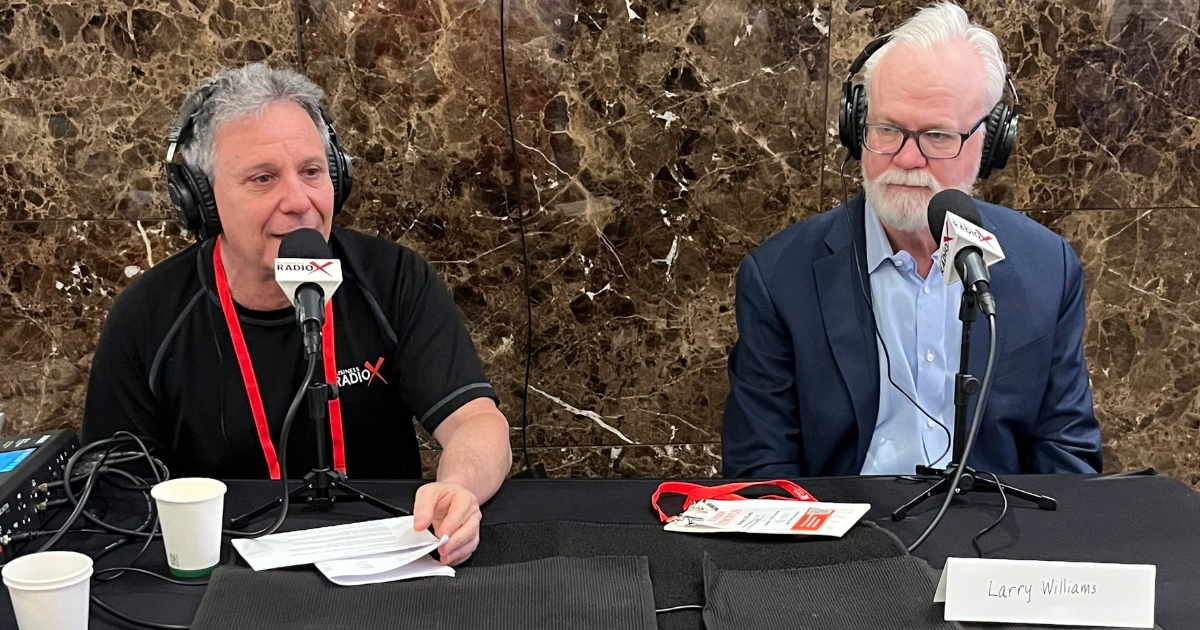
Lee Kantor: Lee Kantor here, broadcasting live from Fintech South 2025. Talking to Larry Williams with Tag and Fintech South. Larry, how’s it going?
Larry Williams: It’s going great.
Lee Kantor: Uh, we’re kicking off the event here, uh, today. Uh, can you let us know a little bit about a sneak peek of what’s ahead?
Larry Williams: Sure. Well, this is day two, actually. So we kicked off yesterday. We had a wonderful, wonderful agenda. Um, everything from, um, Sean Nale talking about the future of payments, the future of the rails, how things are going to really, um, be fueled transforms the effect of AI. Um, we had a great guy. We had, um, um, Alicia Abate, A futurist come in and talk to us about not only the future of payments, but how the world is changing and how technology is transforming. And we got to kick the morning off with our own mayor, Andre Dickens, that came in and really set the tone for the day. Um, so now we’re rolling into day two. As you can see, there’s already a lot of energy in the room. There’s a lot of noise. People are getting excited about the day. We’ve got some great breakouts, and we’re going to be talking about everything from payments, uh, how our transaction processors are continuing to do a great job and dominate that industry here in Atlanta. You know, 70% of all debit credit reward card transactions or processed right here in Georgia. And that’s exciting for us. But we’re also going to be talking about the future. So everything from cryptocurrencies, we’re going to be talking about stablecoins. We’re going to be talking about what the future is, um, and how Georgia is going to continue to lead.
Lee Kantor: Now, how is kind of the Atlanta fintech Community is. How have you seen it growing over the years? Like you mentioned, there’s all the payments and stuff. But now with the advent of all these crypto and all these other alternative investment opportunities, how are you seeing Atlanta embrace that change?
Larry Williams: You know, one great thing about Atlanta is we didn’t become number one or dominate in the fintech industry by accident. It’s because that we’ve helped. We helped digitize the whole check processing system. So remember checks. Remember every one of those? Yeah.
Lee Kantor: So it’s with my rotary phone.
Larry Williams: Yeah. Exactly, exactly. So, um, we help actually create the technology that, that, that allowed that to go digital. So that’s very important. And why that’s important is because we’ve always stayed ahead of the curve of innovation we’ve helped develop. We’ve helped build every layer of the onion when it comes to what fintech looks like today and how Georgia has really led the way. So as we go into new technologies and new processes, whether it be in cryptocurrency with great companies like BitPay, who’s been a leader in that for a decade, um, uh, or other areas. And what we do in our, you know, at DC, our advanced technology development centers. Um, in other areas, we have people that are continuously thinking about what’s next. Um, not only in the usages but also the technologies that’s going to support it. You know, yesterday we also did our innovation challenge. We had nine, uh, startups that really, uh, went through a process and we ended up with one on stage yesterday and we awarded them a $25,000 non dilutive prize to help them get on their way, get a leg up and put them on the road to success. That’s why it’s important for us because we’re always thinking about what is that next generation of ingenuity when it comes to fintech.
Lee Kantor: Now are you seeing that the leaders of the enterprise level organizations, are they investing back into the community, or is this a situation where they are just kind of dominating like you mentioned, but they’re not like kind of looking to help kind of the startup or the the young firm emerge and launch.
Larry Williams: Oh I think that you’ll see that they’re very, very engaged. Uh, it’s very important for them to be able to think about, you know, what are the you know, they need solutions. They have problems that they they want help. They need fresh ideas. Um, they need people that are creative and that can be nimble and stand things up. And they’re always looking to, you know, you know, one hand, perhaps, you know, be a customer of these of these companies. And, you know, a customer is all important and a great way for these companies to get revenue to go ahead and build their business. But they’re also looking to invest or even pull them in for the knowledge exchange. Hey, what are these? Here’s your your product, here’s your service, here’s what we need, and here’s how it can help us.
Lee Kantor: So how is tagging Fintech South helping, uh, create that ecosystem of collaboration rather than looking at this as kind of a zero sum game where there’s winners and losers?
Larry Williams: Well, by all means. So one is it’s staying ahead. So the content we’ve got over 20 hours of world class content that’s on our stages throughout these two days. Um, we have over 100 speakers that are all world class. You know, the one thing that is a great advantage for us here in Atlanta is our friends and neighbor that are in fintech, are global leaders in fintech. They’re not just thinking about this from just their companies point of view. They know they’re running global businesses and they know what the global trends are, and they bring that to us. So the content that’s here, the knowledge that’s here, the exchange of ideas, you know, so whether it be in a smaller breakout session where people can actually engage more in the conversation or what’s on the main stage, it’s all very, very important. I mentioned the, um, innovation challenge yesterday, the fintech innovation challenge. That process was throughout the year. Those nine went through mentoring. They were helped, uh, had helped building their pitches, uh, how they should present themselves and then also interacted with with the industry leaders to be able to understand what they’re doing and how they can be effective. So it’s really about building that collaboration, building that community, and it’s just super exciting for everybody.
Lee Kantor: Now when tags started, what was it 2530? How long has tag been around? 26, 26 years have been around. Uh, the region wasn’t as robust as it is today. How are you finding the southeast when it comes to kind of growing the whole market for everybody? I know there’s a lot of growth in other cities around the southeast that maybe weren’t around 26 years ago when tags started.
Larry Williams: You know. Lee, I think, you know, I’ve worked all over the country and all over the world. I don’t see anything going on anywhere, like right here in Atlanta. Um, the amount of expansion that we’ve been seeing in our economy is all driven by technology. A lot of that is fintech. So you can drive down I-85 right now and you know that our skyline has changed. You know, we now have Cisco, Microsoft, Google, uh, NCR are all big names on that skyline, and it’s continuing to evolve. Um, people are finding us. Uh, people are moving here. They, uh, they really see us as really a global hub of innovation, because that’s what our companies do. We we have local solutions, but with touches the world. We also have world class talent. So, you know, li yesteryear in economic development, people used to move to where the jobs are today. And age companies are moving to where the talent is. And that’s what’s bringing them here. Fueled by Georgia Tech, fueled by Georgia State University. Emory. All of the the the Atlanta names. But our universities across the state are world class. And the talent that we’re creating through the universities or our technical schools or other apprenticeships and training is world class, and that’s what people need to be successful.
Lee Kantor: And then how does tag and fintechs out specifically help in that manner? I know you’re working with a lot of the universities and you’re creating curriculum and and courses along that way, but how do you all work arm in arm to make sure and ensure that pipeline of talent stays there?
Larry Williams: You know, um, that’s a great question and something that we’re highlighting this year. We have a room that’s sponsored by Prime Revenue this year. That’s for mentors. And so we’re getting people in the room students to talk about what the careers are in fintech. You know, whenever I was growing up we all wanted to be, you know, you know, star athletes or rock stars, you know, but we find out there, uh, other avenues to, to actually build careers and have a great, um, a great job and a great career. So we’re mentoring people about what these options are. And we’re also partnered with the Fintech Academy that we help start probably about a, you know, eight years, maybe going on a decade where Fintech Academy really focuses with our university system of Georgia and many of the campuses around the state to actually train and develop people and give them the skills they need to be successful in a fintech career.
Lee Kantor: Now, what trends are you seeing? What are people talking about here at this event that you’re most looking forward to? Moving ahead.
Larry Williams: You know, again it’s what is the future. It’s one how do we continue to maintain, um, this dominant area that we need to be in as far as transactions as they are today, but what are the future options that people are going to be able to utilize? So it’s still a lot around frictionless payments. How do we reduce the amount of steps for for our for our consumers and our users? Um, but also what is the effect that AI is going to have a lot of these, uh, on a lot of these current processes as well as cryptocurrencies and stablecoins? All of this is extremely important. We also have to pay attention to the cybersecurity side of things, privacy, um, so that we make sure that we continue to protect the rights and the privacy of our consumers, um, going forward. The other big opportunity for us. Lee is really around B2B transactions. So that is still, you know, a lot of businesses still pay with checks. And so this evolution of how people are going to be able to utilize, uh, financial technologies to actually be able to complete, uh, financial transactions at a B2B level is really going to be a big transformation, a big opportunity for our for our companies.
Lee Kantor: Now, if somebody wants to learn more about what’s happening in the fintech world or what tag, what is the best way to connect Lee?
Larry Williams: The best way is through tag online. I’d love to see you. Um, you can also follow us on LinkedIn and then, you know, Fintech South Comm. We’ve got some content there. And you know, we still have a day. Come on by. Come see. Come check us out today.
Lee Kantor: All right. Larry, thank you so much for sharing your story. You’re doing important work and we appreciate you.
Larry Williams: Thank you. Lee.














