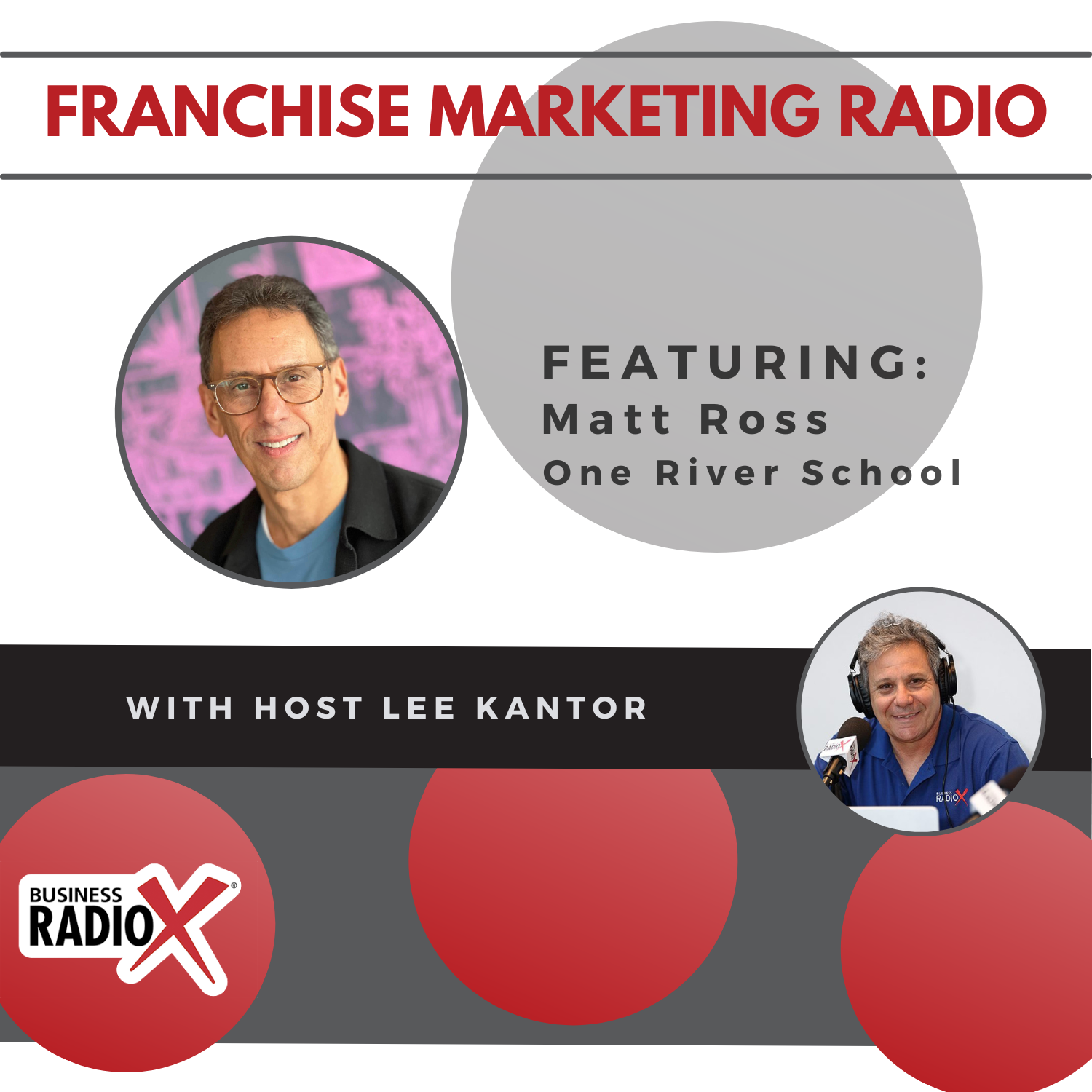

In this episode of Franchise Marketing Radio, Lee interviews Matt Ross, CEO and founder of One River School, a modern art education franchise with 15 locations across six states. Drawing from his experience scaling School of Rock, Matt built One River to fill a gap in relevant, contemporary art education for K-12 students and adults. He discusses the hybrid corporate-franchise model, the school’s membership-based structure, impressive profit margins, and how COVID-19 shaped their growth strategy. Matt emphasizes the importance of community-focused franchisees who prioritize delivering high-quality, hospitality-centered experiences over passive investment returns.

 Over the last 20 years, Matt Ross has built two of the most innovative consumer education brands in the world, while establishing himself as an innovative entrepreneur who combined his passion for growth and creativity to achieve substantial personal and professional success.
Since 2012, he has been the Founder and CEO of One River School, a company whose mission is to “Transform Art Education” in America. Prior to One River School, Mr. Ross was the CEO of School of Rock, where he led the company from an early-stage venture into the world leader in music education for kids.
He holds an MBA in Finance from the Stern School of Business at NYU and is a Cum Laude graduate in Marketing from SUNY Albany. He is also a former member of the board of trustees for Art 21 and the Bergen Performing Art Center. Matt and his wife Susan reside in Cresskill, NJ and recently celebrated their 30th wedding anniversary.
Follow One River School on Facebook and Instagram.
What You’ll Learn In This Episode
- Origins and founding of One River School
- Focus on modern and relevant art education for K-12 students and adults
- Hybrid franchising model combining corporate-owned and franchised locations
- Adaptation of the business model during the COVID-19 pandemic
- Importance of creativity and community in art education
- Membership-based model with recurring revenue and summer camps
- Annual art exhibitions to motivate and showcase student work
- Incorporation of contemporary art forms and digital design in the curriculum
- Characteristics and profiles of ideal franchisees
- Emphasis on delivering a high-quality, hospitality-centered experience for students and families
 This transcript is machine transcribed by Sonix.
TRANSCRIPT
Intro: Coming to you live from the Business RadioX studio. It’s Franchise Marketing Radio.
Lee Kantor: Lee Kantor here. Another episode of Franchise Marketing Radio and this is going to be a good one. Today we have the CEO with One River School. Matt Ross, welcome.
Matt Ross: Hi, Lee. Thank you for having me.
Lee Kantor: Well, I’m excited to learn what you’re up to. Tell us about One River school. How are you serving folks?
Matt Ross: Yeah. So we’ve been in business for 15 years now, and I had this idea after I left my role as CEO of school of Rock, which was a system that I scaled early on. I had this idea that how come there were no cool art schools, and I just decided I was going to throw my whole body into it to sort of create an art education experience that felt current and relevant, as opposed to studying art from 200 years old, and we wound up building a system now with 15 locations in six states. And we’re we’ve just pushed play on a on a plan to scale nationally.
Lee Kantor: So was it built with franchising in mind?
Matt Ross: So interesting. Good question. So built with a hybrid sensibility in mind. So we’re good operators today. We own 12 units. We started we started strategically franchising on a one off basis early on to learn. And at the time they were, we’ll call it investors in the company who also were patrons and decided, hey, I’ll open a school here, there and everywhere. But then what happened was, is before we really got to roll up everything and to then push scale, we went into Covid. So I have a lot of operating experience. And I decided, let me slow down the fast franchise model, make sure that we get smarter, better and healthier through that whole Covid experience, which was challenging for everyone. Right? And we did. We got out. We came through it really well. Our schools do phenomenally well from an economic standpoint. They serve communities with unique product service. And but I also like owning and operating. So so we’re of the mindset where we find great operators. We will franchise and we’ll have strategic corporate owned locations across the country to help support the franchise system.
Lee Kantor: Now, starting with school of Rock and now moving into One River School, are you trying to fill the void of how, um, public schools have kind of stopped focusing in on music and art, and you want to kind of take that role?
Matt Ross: Yeah, to a degree that’s true because the arts are just underfunded everywhere. And I kind of think that we are a sports crazed society. And part of that is because sports are great and they’re fun and they build, you know, teach people to collaborate and work within a team. But there’s a lot of folks who would do creative things if there was an inspiring place, and it’s really good for your brain and your development to do creative things. So, so we’ve built this program that’s really good for K through 12 after school and serious artists, but also people like you and me, adults who need to do creative things to continue to grow and challenge our brain to grow as we age. So we have a, you know, good percentage of our students are also adults.
Lee Kantor: So now are the schools set up in the traditional kind of alignment with the school, you know, like with traditional schools? Or do you have a different kind of model on how a person, uh, takes advantage of these classes?
Matt Ross: Yeah. So it’s a slightly different model. It’s a member based experience and there’s a recurring revenue model. So for franchise partners, they have the ability to, when they enroll people to know that there’s some recurring revenue that they can count on month to month. So if you were to sign up or your kid was to sign up, they would participate in a weekly project that changed probably once a month. So every 3 to 4 weeks you attend weekly once a week, and every 3 to 4 weeks there’s a new project and you pay monthly. And then it’s our job as an operator to deliver a great experience so that you decide to stay for a long time. We do have, um, a whole bunch of folks, you know, particularly on the K through 12 side, who in the summer they do other things. So we put their membership on hold. They come back in the fall, but we also have built probably the most compelling creative camps, summer camps in the country. So again, as an operator, we sort of whatever revenue we’ve offset through the loss, of course, students in the summer, we more than make up for it with this incredible summer camp.
Lee Kantor: Now is there, I would imagine, in the school of Rock, I don’t know for sure, but you tell me if, like in the school of Rock, there’s some sort of a performance after a period of time. Do you did you kind of create a similar type of experience with One River School?
Matt Ross: We do. Lee and it’s so funny. You’re going down my playbook. So we are, um, one of the things I loved about school of Rock and to this day I do. And my son went there forever too. And he’s a professional musician. Is that what made you better? Was the motivation periodically to get on a stage three times a year, you would learn a body of music, you’d get on a stage, and I wanted to drag some of that with us into one river. So what we decided was two times a year there would be an art exhibition. So we didn’t want to overburden people with having to be stressed out about exhibiting their work all the time. So but in January, we’ll exhibit all our students work, and then we do it again late May, early June. And what that does, it allows us to tell our students, hey guys, we’ve been having lots of fun. You’ve been getting better. Now this next project is even more serious. You know why? Because we’re going to exhibit your work. And then what you see is the the intensity and the quality and the focus improves. So there’s something about education. When there is a tangible goal that forces you to work harder, like an exam, right? You study for that test. So in this case, we get a chance to exhibit the work. Now, I’m not sure if you see my screen, but there’s an object behind me. And this is the artwork of an artist named Daniel Heidkamp. So nationally, in the month of June, as part of these exhibitions, we have chosen to do task our teen artists with a project to make an artwork that’s similar to Daniel Heitkamp’s. We have the largest teen art exhibition in America happening in June. 1500 students making work to honor this professional artist. So, I mean, it’s just such a beautiful way for people to have fun and then periodically to reflect on a more serious project and look at their peers work side by side in an exhibition format.
Lee Kantor: Now, when you kind of had the idea of this coming out of school of Rock, were you getting success? Were you getting signals from the public right away that that parents and people are hungry for this type of enrichment?
Matt Ross: You know, it’s it’s it’s funny. No, I had to really a do a few things. I had to go and study myself. I had an inkling that art education was stuck in the past. So so Lee, I’m 65 years old. And people say to me, you know, the arts are broken, the arts are broken. I say, hey, when have they not been broken? You know, when I was a kid, I couldn’t. Every important artist was a dead artist. And as I started to really investigate contemporary art in the art of today, I realized that there’s 2 million living artists, but most people couldn’t name two of them. And I thought it was a shame. You know, I had just spent five years well, prior to school of Rock. I was in radio and I ran the classic Rock station. And I my whole life was invested in music. And I was thinking like, God, you know, it’s amazing how we can name so many musicians, but we can’t name artists and we can’t honor them. Maybe I could build a curriculum and a method that put them on our shoulders and honored the artists of today and taught through the lens of living artists. So. So it’s been somewhat organic the first 2 to 3 years I was on the ground as the general manager. You know, I was cleaning the bathrooms. I was running the front of house. I was installing art exhibitions because we also have a cool gallery. And, and over time, it clarified itself when we figured out how best to deliver the experience, which took a minute.
Lee Kantor: Now, as part of the art that it’s being taught, are you exploring kind of the anime and the, the more popular, um, art that’s now or even fashion, uh, the drawings and sketches of fashion, the things that it seems that young people enjoy being part of, but maybe haven’t really made the leap that it is something they can do themselves.
Matt Ross: Yeah. So there’s a bunch of different, um, genres now that are really important. Clearly the root of traditional art making is drawing and painting and some mixed media and sculpture. But each of our, um, each of our spaces have a college level digital design lab. And so we basically teach animation. We teach, you know, digital drawing and digital design, and we teach cartooning and manga and anime and all those things. We have a class, actually a summer camp called cosplay. You mentioned costuming and this is something that, you know, my, my product team and my education team, they’ve created this and it’s unbelievable. In summertime, our summer camps fill up when people just love this idea of the role play around building a costume and playing a character. So for me, it’s just so cool because I get to see like this organic, artistic, creative community that we’ve created both through our employees and teachers and our students.
Lee Kantor: Now is the deliverable to the, um, Student is it? Do you have to physically be there in a classroom, or is there something that can be experienced online?
Matt Ross: So it’s all a brick and mortar in person. One of the, um, explorations that I did when I was thinking about the concept is I was kind of thinking like, well, I said to you earlier, there were no cool art schools. What I meant by that. There were no places where it felt visceral and interesting for that really creative 15 year old, you know? And if we could basically make it feel that way, feel cool, there’s going to be a social experience that comes with that. I saw it at school Rock, you know, the 13 to 18 year olds, you know, when it was right for them. We can get the little kids aboard and their parents would love it. So when we built this, I wanted to make the place not feel cutesy and babyish. I wanted to feel sophisticated and adult like and cool in a way in which creative kids and teens and adults could really enjoy coming there because the experience felt differently in person, and the people that they would meet would be people maybe that weren’t always from their school or their community. So they would have new people to sort of get to know and be inspired by.
Lee Kantor: So having an in-person space was kind of a must have. There wasn’t any time where you were like, this is this could be a national online experience, and we can do this all via Zoom or some remote learning.
Matt Ross: That as a, as a, as a future opportunity, um, through a custom app. And, you know, I think we’ve learned through that Covid experience because we actually did do that pretty well during Covid. And we were, I thought we were a net positive to our community by giving them an experience where they could feel some engagement and community and do some creative things from home. But I do think when, when, when you go to a place that makes you feel great, that’s hospitality centric, and you’re connecting with teachers who become mentors. You really feel different about that hands on experience, and I hope that we could accelerate something long term that’s complementary online to what we do, and maybe we will build something direct to home that in the communities that we don’t operate in, we could serve globally.
Lee Kantor: So now what makes a good franchisee? Have you figured that out? Is it similar to the person from school of Rock? Is that the same type person or is it a different person?
Matt Ross: It is. It is because what I learned at the school of Rock, there’s probably 2 or 3 prototypes. There’s a business oriented person that wants to change careers, and they see the concept idea, and they’re going to be general manager, if you will. They’re going to run the front of house. They’re going to be responsible for building the team and creating hospitality service, but they’re not going to be teaching the art. They’re going to deploy a director of art education. Like at school of Rock, we would have a director of music education. Um, so that would be prototype one. Prototype two would be a professional arts educator who actually wants to be in the classroom and is super skilled at that and is going to hire someone to manage front of house and all things customer centric and engagement. And I would say the prototype three would be some sort of hybrid. Somebody who may not be world class arts educator, wants to dabble a little bit at it and is going to sort of straddle both fences. You know, we look for people who might be interested in multi unit. Um, and it was really funny because when I was scaling school of Rock, you know, I got there, we had no franchise schools, we had five corporate schools and I built it to 55 schools in three years and another 50 under contract. So I really rapidly accelerated the growth of the network, but I also got to I got a sense of what would work. So not just around those profiles, but how willing people were to throw their body, heart and soul into it. You know, it’s hard work and I don’t I don’t tell people it’s a get rich easy scheme. You have to love to build something and you have to love caring for community and customers. I no matter whether you are in the classroom or the front of the house, you know, if you want to build something, you have to show up and you have to lead. And that’s really important.
Lee Kantor: So you’re your first choice isn’t somebody who’s kind of just focused on the math of this. They’re, you want them to be kind of immersed in the community and, and kind of roll up their sleeves.
Matt Ross: I think so, because also, if you’re going to do multi-unit, you know, we have built a unique model. It’s different. There’s no, it’s not just another quick serve restaurant. So you have to really, I think, learn the essence of what drives excellence so that if you then pulled yourself out to open multiple, you might be now we’ll call it CEO over three or 5 or 10 of these. But you’ve built it by being on the ground. Look, I never ran an art school, and when I opened the first one, I said, I’m going to do this for a few years myself because I needed to taste the food. Does that make sense? So you could see people and see the experience they’re getting and get a feel for what’s building a great team, looks like, etc. now, there are people who really do have real professional leadership skills, and they’ve got the economic capacity to open multiple and they want to build it through GM. So I’m not saying that’s a hard no. Like if you if you don’t want to run one and you want to open many. As long as you are invested in working and guiding and coaching those general managers and really being in the trenches with them to make sure the experience is good, that could be another option.
Lee Kantor: Yeah, I’ve just I mean, I’ve interviewed lots of franchisors over the years, and it just seems to be that there’s now a tier of professional franchisees where they are just, this is a spreadsheet and we’re just doing math and the actual caring of the customer, I think sometimes slips when they’re so focused exclusively or primarily on the numbers rather than the experience.
Matt Ross: I think you’re spot on. Um, I don’t disqualify those folks when they call us, but I want them to really understand that the essence of what we’re doing is different. It’s unique and you have to talk to customers. You have to talk to students. You have to observe a class. Periodically, you have to sit in the front of house and watch the flow. You have to listen to how your team is responding to phone calls. I mean, if you’re running a hotel or a chain of hotels, you still want to understand what that hospitality service feels like. And if you’re not in the trenches ever, you may not be the best coach to build the best team. That’s the way I would describe it. The economics. I want people to really be excited about that. You know, our our gross margins are 84%. Our net margins are better than 30. The schools make money and they do great. But it’s not a rubber stamp.
Lee Kantor: Right? I mean, and that’s what a lot of people buying a franchise think it’s an ATM machine that they put money in and money’s going to come out right.
Matt Ross: And it’s not. And, you know, one thing that we do really well is we, we built a great marketing model that generates inquiries and leads and signups and trials. So we we also offer as a service to assist franchise partners, but we’re not in the building operating, and we’re just doing the best we can to identify people who are passionate about making money. We want that to be part of it, but equally passionate about delivering a high quality experience.
Lee Kantor: Yeah, I think a lot of franchises miss out on just the their current customers. If you just serve the heck out of them and just make them raving fans, they’re going to solve a lot of your sales problems.
Matt Ross: You’re right. I think part of it is that, you know, they also they push play and they’re trying to scale so fast. So, you know, for me, the next phase here is we’d like to go from 15 to 50 units and we’d like to get better along the way. I’ve just expanded my team, um, double and we’re investing in our technology suite and we’re building a custom app and we’re building better data reporting. And so we’re building all of our tools to be better franchisor. And I know over the next tranche of operators, we’re going to get better and we’re going to challenge ourselves to be better. And I want franchise partners who challenge us, who are really good and really committed and give us feedback and help us build something. So we’re all in net positive to each other.
Lee Kantor: So is there an example you can share of maybe a franchisee, um, sharing an idea with you that you’re like, oh, that’s a good one. Let’s start doing some more of that.
Matt Ross: You know, I mean, it’s happened because our right now, our system is largely corporate owned units. And I’m proud of that. And the reason I’m proud of that is when a franchise potential franchise prospect looks at us, you know, a lot of franchisors don’t own any. They don’t put any money at risk. They’re just looking to build a royalty stream. We love operating. So I could tell you about my employees who’ve been.
Lee Kantor: Yeah, that’s what I’m talking about. Somebody that was. Yeah, that was boots on the ground that saw something and learned and then shared the learning back to the system because that’s, to me, that’s one of the biggest values of being part of a franchisee is that exchange of knowledge that you didn’t have to get the scar tissue from.
Matt Ross: I’ll give you a couple examples. Here’s one example. We used to do a lot of our initial trials with consumers, where we had a form online and we’d say, try a free class. And we thought that the free class model was the best way to get people to kick our tires, come in the door, and then we’d give them a good experience. But then what my people told me is they said, hey, Matt, you know what? We think that consumers are not always emotionally engaged on that one time free experience. We would rather give a cash discount for the first month, so at least we have far more experiences for weeks. They build one project and they could get comfortable with the teacher, comfortable with the classroom depending upon what their skill level was. If they were advanced or beginners, we would get to know them better and cultivate them. And I said, you know what? That’s great. Let’s switch it up. So we stopped doing the free trial lessons. Another thing was we had a we had a really loose experience for makeup classes. We just said, hey, show up at any time. What happened is if your kid showed up or if you showed up and we didn’t know you were coming, uh, we’re trying to get the class started. And then we might have three people there for makeup and the plane doesn’t take off on time really well. So that’s another example. We built a model now where all makeup classes are curated. We know they’re coming. We’ve got their project out. We’ve we know exactly where they are. And they could just get into it right away because they may not always come on Tuesdays. They may not know those people. They may not even know that teacher. So, so, so much of what we’ve built and the modifications we’ve made are all focused on this hospitality experience, where customers really feel and students really feel like the experience has been tailor made to make it easy to learn about them, and easy to build this trajectory over time with them as students.
Lee Kantor: Yeah, that’s great advice and especially I really appreciate the one example of your instinct was to go with a free offer, and the better result was from a paid offer that gave him more time to experience the. Have an experience there that was truer to what they would get if they did buy. So a lot of times, a lot of our listeners kind of lean on free first. And that’s not always the best answer. And, and you’re the marketing guru. So that was kind of counterintuitive to you, obviously.
Matt Ross: It was. And you know, I spent 20 years in media sales and media solutions prior in the radio business prior to getting going to the school of Rock. And I always made sure that when I recommended ideas to advertisers, they would tell me what occurred. And I wouldn’t just say, hey, well, let’s keep doing what we’re doing. My job was always to vet them, to learn how to modify. So as a founder and by the way, I have a CEO now that I’ve developed who was my CEO. So I stepped away from the CEO. I’m in this founder chairman role, But I. My job is to make sure that I’m a net positive by asking good questions and doing it systematically, systematically across the network so that we are rolling up ideas from franchisees and from our operators. Um, because, you know, at the end of the day, when you’re, when you’re serving food in a restaurant chain and you’re not getting feedback on how people are liking that new chicken parm sandwich, then you’re making a mistake, right? You need to, you need to make sure you’re hearing from customers and your operators.
Lee Kantor: Yeah, 100%, 100%. Well, congratulations on all the momentum. Thank you. Uh, and it must be so exciting for you to be doing, uh, this kind of work and then serving this clientele, which obviously is important to you because you’re serving kind of a subset of this overall young art, art, artistic people that are truly underserved. Is your next venture going to be acting as they’re going to take on the drama program.
Matt Ross: I don’t know how you you have a little wisdom about you. You’re scaring me a little bit. I’ll tell you why. I wrote a book that came out in January called Grow or Fold Transform Your Life Yourself in Midlife and Beyond. And it reflected on my mid-career midlife transformation and challenges and what I learned about myself and the plan that I built. So I’ve been out there doing talks and helping people. My job now is to be a net positive, to help my leadership team and help others. But I just signed up for an improv acting class. So how did you know that?
Lee Kantor: Well, I’ll tell you. Um, that was the missing part of this little triad you’ve got going is obviously drama, but, um, maybe off air. I’ll tell you, my son is an improviser at Second City, so maybe I can share some.
Matt Ross: Unbelievable.
Lee Kantor: Some. Maybe that’s a good connection for you to, to get some advice from the horse’s mouth there.
Matt Ross: I’m taking a cabaret singing class too. So there’s a chapter in my book called Creative Growth is the X factor and what I learned over 20 years in Creative Education. I think I’ve had a different seat than most people. Is there something about doing it that improves how you feel about yourself? Because if you tap into a creative side that you didn’t know existed or it did exist, and you reinforce, it just allows you to think more optimistically, to think differently. And particularly for people like us who are I’m getting older. I just turned 65. You know, it might maybe push back against neurodegenerative disease and stuff because I’m keeping my mind looser and my brain more adaptable. So. So I really am a spokesperson for the importance of creative growth for all ages.
Lee Kantor: Yeah. And as someone who has raised a creative child, um, we need our own support group. So, uh, you know, that’s a, it’s a different kind of animal when you’re your kid goes into the arts than they are with the traditional business career.
Matt Ross: Without a doubt.
Lee Kantor: So if somebody wants to learn more about the opportunity. What’s the website? What’s the best way to connect?
Matt Ross: Yeah. So One River School and you would spell the word one or I’d take emails directly, Matt at oneriverschool.com. And I’d be grateful just to, just to share any thoughts I have that might help people better understand what we do, how we do it, and why it might be good for them or not. I’m not salesy. I really believe if there’s a match, then it’s a natural sort of order and a natural flow.
Lee Kantor: Good stuff. Well, congratulations on all the momentum and thank you so much for the work that you’re doing. It’s so important and we appreciate you.
Matt Ross: Thank you so much. Thanks for having me.
Lee Kantor: All right. This is Lee Kantor. We’ll see you all next time on Franchise Marketing Radio.















