Business RadioX ®

  • Home
  • Business RadioX ® Communities
    • Southeast
      • Alabama
        • Birmingham
      • Florida
        • Orlando
        • Pensacola
        • South Florida
        • Tampa
        • Tallahassee
      • Georgia
        • Atlanta
        • Cherokee
        • Forsyth
        • Greater Perimeter
        • Gwinnett
        • North Fulton
        • North Georgia
        • Northeast Georgia
        • Rome
        • Savannah
      • Louisiana
        • New Orleans
      • North Carolina
        • Charlotte
        • Raleigh
      • Tennessee
        • Chattanooga
        • Nashville
      • Virginia
        • Richmond
    • South Central
      • Arkansas
        • Northwest Arkansas
    • Midwest
      • Illinois
        • Chicago
      • Michigan
        • Detroit
      • Minnesota
        • Minneapolis St. Paul
      • Missouri
        • St. Louis
      • Ohio
        • Cleveland
        • Columbus
        • Dayton
    • Southwest
      • Arizona
        • Phoenix
        • Tucson
        • Valley
      • Texas
        • Austin
        • Dallas
        • Houston
    • West
      • California
        • Bay Area
        • LA
        • Pasadena
      • Colorado
        • Denver
      • Hawaii
        • Oahu
  • FAQs
  • About Us
    • Our Mission
    • Our Audience
    • Why It Works
    • What People Are Saying
    • BRX in the News
  • Resources
    • BRX Pro Tips
    • B2B Marketing: The 4Rs
    • High Velocity Selling Habits
    • Why Most B2B Media Strategies Fail
    • 9 Reasons To Sponsor A Business RadioX ® Show
  • Partner With Us
  • Veteran Business RadioX ®

Search Results for: regions business radio

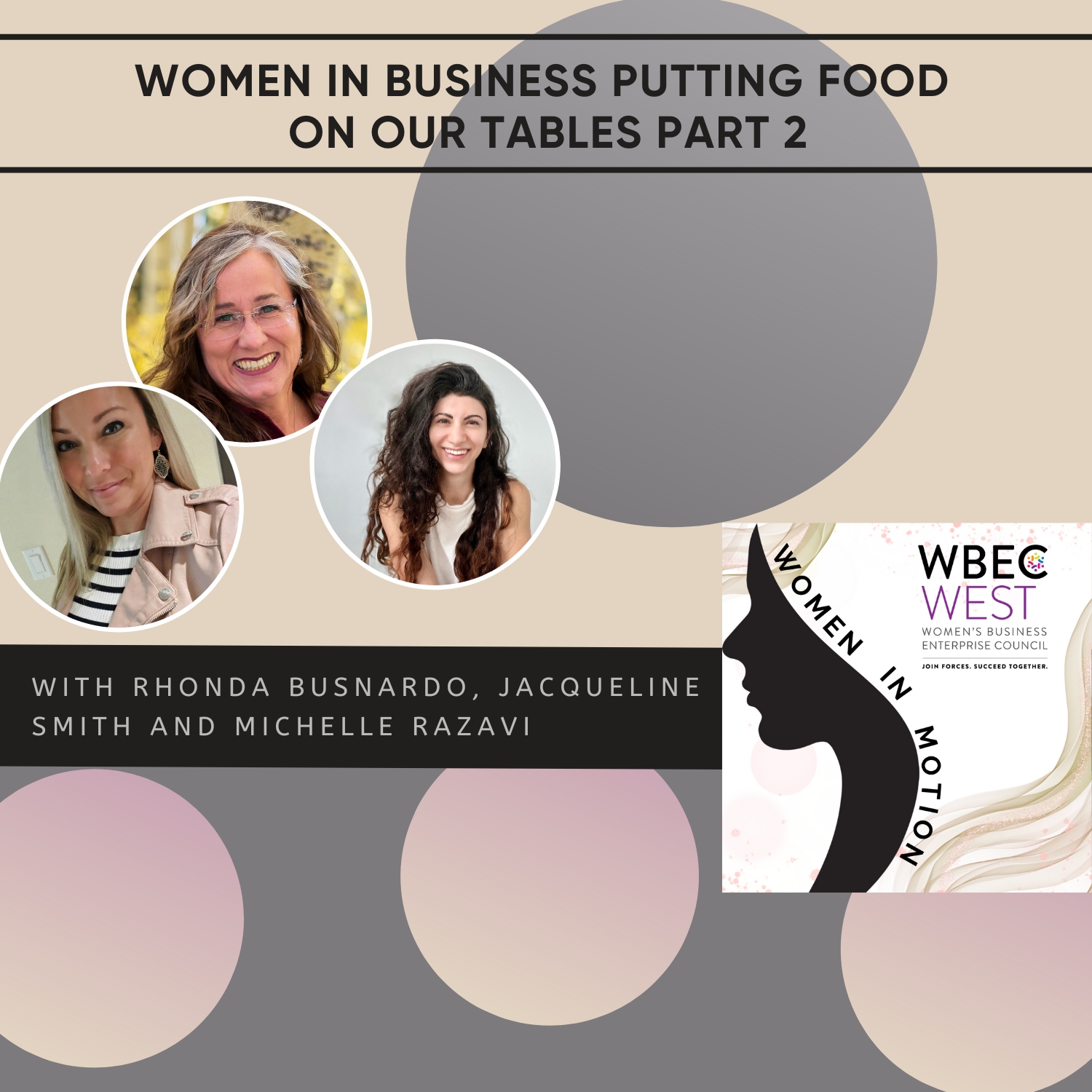
Women in Business Putting Food on Our Tables Part 2

August 9, 2023 by angishields

Women in Motion
Women in Motion
Women in Business Putting Food on Our Tables Part 2
Loading
00:00 /
RSS Feed
Share
Link
Embed

Download file

In this episode of Women in Motion, Rhonda Busnardo, Jacqueline Smith, and Michelle Razavi, discuss their roles in the food industry and the challenges they’ve faced in their careers. They talk about their companies and the unique products they offer.

The conversation also touches on the impact of the pandemic on their businesses, their approaches to digital marketing, and their go-to-market strategies and the opportunities available in the industry.
Rhonda-BusnardoRhonda Busnardo has worked in the Food sector most of her career starting off in retail, moving into food and beverage manufacturing and distribution, and currently in the Gaming and Entertainment industry.

Rhonda grew up in Southern New Jersey. Rhonda and her husband, Anthony, have 4 boys aged 20, 14, 12, and 6.

When Rhonda isn’t working, she enjoys family time and being at the beach. Rhonda enjoys kayaking, boating, dancing, and is currently working on her long game in golf.
Jacqueline-SmithJacqueline Smith has built Go Energy Foods from the ground up. With healthy products on her mind, Go Energy Foods created E3 Energy Cubes, a protein bar that not only tastes amazing, it’s actually good for you.

Jacqueline & her husband, Cleve, are passionate about using the finest ingredients to give you the highest nutrition and the most amazing taste.

They work tirelessly to see their products make it into your hands.

Michelle-RazaviMichelle Razavi is the Founder and CEO of ELAVI, a wellness company that offers gut-friendly designed by fitness trainers.

She brings a professional background in e-commerce working in sales, digital marketing, and online retail having worked at tech, digital marketing, & most recently the Sephora Innovation team.

Michelle is also a certified fitness instructor and yoga teacher at Equinox and Alo, based in Los Angeles.

About our Co-Host

Pamela-Williamson-WBEC-WestDr. Pamela Williamson, President & CEO of WBEC-West,  is an exemplary, dedicated individual, and has extensive experience as a senior leader for over twenty years.

She has served as the CEO of SABA 7 a consulting firm, overseen quality control at a Psychiatric urgent care facility of a National Behavioral Health Care Organization where she served as Vice President and Deputy Director,and has served as the CEO of WBEC-West, since 2008.

Her extensive experience in developing and implementing innovative alliances with key stakeholders has enabled the organizations to reach new levels of growth and stability. Her ability to lead and empower staff members creates a strong team environment which filters throughout the entire organization.

She takes an active role in facilitating connections between corporations and women business enterprises and sees a promising future for WBENC Certified women-owned businesses.

Dr. Williamson holds a Doctorate in Healthcare Administration, a Master’s degrees in Business Administration, and bachelor degrees in both Psychology and Sociology.

Connect with Dr. Williamson on LinkedIn.

Music Provided by M PATH MUSIC

This transcript is machine transcribed by Sonix

TRANSCRIPT

Intro: [00:00:07] Broadcasting live from the Business RadioX Studios. It’s time for Women in Motion. Brought to you by WBEC West. Join forces, Succeed Together. Now here’s your host.

Lee Kantor: [00:00:27] Lee Kantor here another episode of Women in Motion, and this is brought to you obviously by WBEC West. And we couldn’t be sharing these stories without their support. Today’s topic is women in business who are putting food on our tables. This is a food and beverage special edition. And today’s guests are Rhonda Busnardo with Caesars. we have Jacqueline Smith with Go Energy Foods and Michelle Razavi with ELAVI. Welcome.

Rhonda Busnardo: [00:00:57] Thank you. Excited to be here for having us.

Lee Kantor: [00:00:59] Well, I’m excited to learn about each and every one of you. Let’s first go around the room to share kind of a little bit about your firms. Let’s start with you, Rhonda. Tell us about Caesars, how you serve in folks over there.

Rhonda Busnardo: [00:01:12] Yeah, my name is Rhonda Busnardo. I’m a director of strategic sourcing on the food and beverage side. My job is basically finding the best price and the best foods to bring to the customer’s table and create a wonderful experience for them across the nation.

Lee Kantor: [00:01:29] Jacqueline, you want to tell us a little bit about what you got going on?

Jacqueline Smith: [00:01:33] Absolutely. My name is Jack Smith. Refrigerated protein bar that actually tastes good. So that’s our claim to fame.

Lee Kantor: [00:01:42] And Michelle.

Michelle Razavi: [00:01:44] Yeah, I’m the Founder of ELAVI. We make gut friendly snacks designed by fitness trainers. And we have two product lines, gut friendly collagen protein bars and these low sugar dessert cashew butters.

Lee Kantor: [00:01:55] Well, welcome to everybody. This is an exciting episode for us. This is a lot of folks are getting into this industry and a lot of folks want to learn about it. Let me throw this out to everybody. Maybe some of the early challenges in your careers. Was there any hurdles that you had to overcome to get where you are today?

Michelle Razavi: [00:02:15] I mean, I’ll go first. How long do you have? So what’s unique about our story is that we launched just two months before the pandemic in January 2020? So that in and of itself was a huge challenge in terms of trying to overnight overhaul our business and go to market strategy and really funding cycle because we were bootstrapping this thinking we could launch and then in six months we would be able to fundraise after showing some product market fit. And so having to operate on an extremely lean budget and build a brand online with no opportunity to sample and do events, that was really the most extreme form for a small business to kick off, but really encourage and force us to flex our digital marketing muscles and became a blessing in disguise. But yeah, that was that was really difficult to navigate in our in our early first year.

Jacqueline Smith: [00:03:11] Yeah, we had a very similar experience. We launched our brand in 2019 and we had one year under our belt and we were just getting ready to grow when the pandemic hit. And like she said, in-person events ended and people weren’t meeting with new products to put them on their shelves. Everybody just just kind of stopped. And so we survived that process. And really it took until 2022 for us to really have in-person meetings again. So that was probably our biggest challenge, was kind of waiting until we had an opportunity again to meet with buyers for in-store brands.

Lee Kantor: [00:03:55] Now, Rhonda, in your role at Caesars, I would imagine you’re constantly looking for vendors doing interesting things. How do you kind of go about that process?

Rhonda Busnardo: [00:04:08] Well, for me, what I do is I attend food shows, of course, and then I collaborate with our chefs at the property and see what they’re looking for and what their needs are. Um, and, you know, reach out to local markets that way.

Lee Kantor: [00:04:26] Now, is there anything you look for Like, are there some kind of must haves and nice to haves when it comes to a vendor?

Rhonda Busnardo: [00:04:36] Well, with vendors, obviously, depending on if it’s a regional need or a national need. Um, I’m obviously looking for volume. Um, if it’s a national need, of course. And then if not, then I like to really look into our regions and different, um, you know, local foods and produce and different diverse markets. Obviously women owned business is great for us. Seizures really supports that. So anything innovative is always, you know, what we’re looking for.

Lee Kantor: [00:05:14] Is there anything a vendor can do to stand out?

Rhonda Busnardo: [00:05:18] Um, really just become a part of any anything out there that’s diverse or innovative and really put yourself out there networking, going to these shows, attending events. There’s a lot of not only, you know, food shows, but diversity events and different things that make you stand out and stand above, you know, maybe another vendor or company.

Lee Kantor: [00:05:43] Jacqueline how do you go about standing out?

Jacqueline Smith: [00:05:48] So one of our of our biggest things that we’ve done is we’ve created this protein bar that is different because it comes in three squares. Instead of just being a big bar, it’s three different cubes. That’s where the name energy cubes comes from. And then we’ve really gone into the really amazing ingredients, like it’s soy free, it’s dairy free, it’s gluten free, everything’s non-GMO and everything’s all natural. So it’s really good for you. And that’s something that, when we were in our R&D process realized was happening. There were a lot of people who claim health benefits or healthy products, but their their ingredients don’t always say that when you really dig into the ingredient labels. And we wanted to make sure our ingredients were the top of the line.

Lee Kantor: [00:06:37] Michelle, how do you stand out?

Michelle Razavi: [00:06:41] The way we like to stand out is a couple of things. One is innovation in our product set. We’re the first and only company to have developed and launched a line of colorful dessert cashew butters. I like to. We just got into Costco for a Costco roadshow, and that has been an eye opening experience in terms of product positioning. And the number one thing people tell us is like, wow, this is like a healthy dessert that’s, you know, diabetic friendly and low glycemic and the colors attract people. So we have dessert cashew butters that are blue and pink and chocolate. And the innovation in that is how we stand out where, you know, for us to catch the eye not only in social media, but of like large retailers that are dream accounts so early in our in our brand like lifetime that’s that’s been really key for us is just like create a really innovative different product like we have a bar line as well and I’m sure Jaclyn can attest to this. It’s a very competitive category. And yeah, there’s like a million bars that, you know, people say it’s better for you for this and that. And so we’re like, okay, how do we push boundaries and really wake up and shake up a sleepy category of of nut butters? And so we kind of create something that’s like next level but cashew butter based. And second to that, I would say we stand out a lot in our digital marketing footprint. So have a digital marketing background, so very active on TikTok, on social media, on Instagram.

Michelle Razavi: [00:08:09] We do a lot of collaborations with influencers, and that’s really generated a lot of buzz. We’re in pop up Grocer in New York, and we also did a Mermaid Smoothie bowl with Juice Press, which is the Equinox Cafe in New York. So we love innovation. We love partnerships because it’s just such an opportunity to really combine audiences and get people excited to see that, you know, you’re you’re pushing boundaries and thinking outside of the box. And then lastly, we do, you know, put ourselves in front of the company, you know, not many brand founders are comfortable putting themselves on social media on their website. And we from day one have been full force about that because I’m a firm believer that people buy from people and that authenticity and trust that we have established from day one as fitness professionals, as health professionals who understand and know what happens to the body when you consume certain things and how important nutrition is, that’s really allowed us to generate that that trust with our consumers that, you know, we know what we’re talking about and we’re creating the best products that we personally put in our bodies every single day. And so that’s allowed us to really take market share from other incumbents and stand out that, you know, we’re we’re proudly women owned. We’re proudly bipoc owned. We’re, you know, proudly, you know, putting ourselves out there to really help people be healthier and feel better in their bodies.

Lee Kantor: [00:09:36] Now, any advice, Michelle, for folks that are aspiring food entrepreneurs is to really stand out in digital marketing? Did you kind of go heavy in one channel or did you kind of repurpose content content amongst the many channels? Like what are some do’s and don’ts in regard to digital marketing for food entrepreneurs?

Michelle Razavi: [00:09:59] Yeah, I love this question because for, for different channels you you can repurpose to a certain extent, but each channel really does have its own vibe. So for instance, TikTok, it’s it’s shorter, it’s faster, it’s leans towards a slightly younger demographic. So just even the editing style is significantly different and the value propositions and the hooks vary greatly. People want to be entertained on TikTok, they don’t want to be sold to. Whereas on Instagram and a little bit of Facebook, the content, you know, doesn’t have to be as choppy or as entertainment focused. It could be more product focused or storytelling. Then you can take that onto YouTube or Pinterest. You know, those are also different channels. So the way I approach it is, you know, have your value propositions where, you know, you stand out on. For us, it’s, you know, our dessert cashew butters or low glycemic and vegan compared to like a Nutella. So we’re helping people have less sugar without the sugar alcohol that upset your gut. So all of our products are gut friendly, so we double down on our content tentpoles really based on, you know, the value that we provide. I also in any content creation strategy for entrepreneurs, I highly recommend leading with value people do not want to be sold to, right? So, you know, there’s there should always be, you know, a storytelling aspect behind your behind your company of like, why you why did you start this? What was the pain point. But mostly what’s in it for them? What is the consumer gain from interacting with your product? How are you helping them? How is your life better with your product than versus without? And I think so many people make the mistake of saying like, buy us or we’re on sale or, you know, this is why we’re better or, you know, me, me, me versus like, no, no, no point it to the. Somewhere. It’s. This is how we help you. This is the pain point we solve. This is where we come in. And so that’s really, you know, how we position digital marketing and content is, is really consumer focused.

Lee Kantor: [00:11:55] Now, when you say consumer focused, is it something that you and your team have kind of said, okay, this is the focus, or is it when you had an opportunity to talk to consumers, listen to them, maybe take in some of their words that they’re using to describe your product and then integrate that as part of the message?

Michelle Razavi: [00:12:17] Yeah, no, that’s a great call out. So we do a lot of testing. So the way we kind of get that feedback to then reintegrate back into our marketing is by looking at reviews. So we do a 360 holistic view of how people are talking about our products and our company. So we look at everything from Amazon reviews to reviews. After submitting a review on buying from directly our website, we have a chat box on our website through Shopify where people can chat in and anytime they have a question. We also follow up with How did you hear about us? Would you like to see what you know excites you kind of thing like that? And then we also do a lot of field in-store demos and so we keep a log of any feedback or, or really just asking people, Hey, what resonated with you? What made you pick this up? What made you put it down? What do you like about it? What don’t you like about it? And so integrating all those different data points helps us create even stronger content. And look, people are vocal. Like anytime we’ll run an ad, people will type in questions, comments. And so then that integrates back to us of, Oh, okay, people don’t understand what Blue Spirulina is or why. Like people don’t believe that things can naturally be blue. And so then that, you know, helps me reinforce, okay, this is something that we can lead with or this excites people from an engagement standpoint. Um, but at the same time, we also, I think in person is people are just so open and excited to share feedback. And so I encourage entrepreneurs to just be curious. And if someone gives something negative instead of being defensive or taking it personally, just kind of dig deeper and be like, Oh, okay, like what would you like to see? What would get you excited and use it as an opportunity to get curious?

Lee Kantor: [00:13:57] Jacqueline, can you share?

Jacqueline Smith: [00:14:00] Oh, I have to say that I just love everything she said. And it’s so many of the same things that we’ve been doing as well. Um, so one of our biggest things is educating people. A lot of people want to eat healthy, but they don’t know why it matters so much and people don’t understand, you know, if you get half your daily fiber in a bar, how much that helps their mental health, their gut health, and why most of the foods that are processed out there now don’t have fiber in them. And so people have eliminated fiber from their diet. And that fiber is actually the lack of fiber is actually affecting their mental health. And so educating consumers on why what we’ve put in our bar matters helps them recognize, oh, there is a really big health benefit to this. And I actually like how it tastes. And so it gives them that that reason of their why behind what they already know they love and it gives them an additional reason. And I love that she talked about sugar alcohols because that’s something that I was talking to my team about just the other day, because we’re very careful as they are to not put sugar alcohols in our product. And so a lot of things that claim health benefits often have the sugar alcohols to keep their sugars down. But it is a gut buster and it is really hard on people’s guts and they don’t understand why they’re in pain or why they have that bloated feeling or why their stomach just in knots after eating something they thought was healthy for them. And so educating them on those kinds of things really makes a huge difference in how the consumer responds to your product and why they can see that it’s actually not just a product they enjoy eating, but why it’s actually good that they’re eating it.

Lee Kantor: [00:15:45] Now you’re using the word health and healthy a lot. Is that a term that it’s kind of lost some meaning in terms of it’s almost in the eye of the beholder. A lot of people are defining health and health healthy differently, and they’re not really educated on what’s truly healthy. And there’s a lot of things, especially in these larger brands, that they make it seem like it’s that healthy. But it really the bottom line, it really isn’t very healthy. And you got to educate folks on the difference between this kind of fake, healthy and real healthy.

Jacqueline Smith: [00:16:21] Right. So there’s different kinds of help. So some people are looking for something that maybe doesn’t raise their glycemic index. And so they think, well, that’s healthy for me if it doesn’t raise my glycemic index. What they don’t realize is the sugar alcohol is still producing an effect for their body. That’s that’s going to be painful or or more difficult for their body or it doesn’t help their digestion. And so when we’re talking about a healthy product, we want it to fit as many of the categories as we can for their health. We don’t focus on fads like keto or or paleo, but we’re focusing more on a macro, balanced, balanced diet rather than just a product that fits a fad that will come and go and that won’t maintain a long term health plan.

Lee Kantor: [00:17:12] Now, any advice for the consumer in this regard? Because I would imagine there’s some legal and regulatory requirements when using terms like healthy natural. Well, things like that. Or is it kind of still the Wild West?

Jacqueline Smith: [00:17:26] That’s a great that’s a great question. Yeah. So as far as I know, it’s the Wild West in terms of healthy. Now, you cannot make those same claims. When you say natural, something to be considered natural does have to be a truly natural product and it can’t be artificial colors or artificial flavors, but healthy. That’s kind of a anybody’s game. Some people may call it healthy when it’s maybe not for someone else.

Michelle Razavi: [00:17:55] Yeah, there’s there’s a couple different words, so I’m not sure if everyone’s aware with like kind bar with that long running lawsuit over the the word natural on their labels. Healthy might not be regulated. It could be regulated in the future. But at the same time I feel like consumers are becoming more educated and more discerning. You know, even at a Costco like I was having so many people ask me questions that I never thought people would ask me. And and there is this curiosity and and general interest coming out of the pandemic that people are having about their health, whether it’s from social media that they’re learning about things or their family members that are educating them, you know, it is really exciting, this overall general movement of people trying to just be healthier in general, how we dissect that and how people really try to, you know, slice and dice, that does vary. Some people think anything keto is healthy and that’s you know, it’s doctor pointed out not necessarily the case or just because it’s vegan. That does not mean it’s healthy because it could be pumped with a ton of sugar to taste good. And so I think, you know, the responsibility of the consumer is to do what’s best for them and and their specific body and health goals. But then also for the brands to just be transparent of what you’re not and what you are and drawing a line in the sand because you can’t be everything to everyone. And if you were, then you’d be paralyzing trying to run that kind of a company. But really just trying to find your tribe and, you know, aligning your value proposition with with their health goals.

Lee Kantor: [00:19:30] Now, Ronda, are you seeing that as a trend in your industry? Are you looking for the healthier when given a choice? Are you picking the healthier choice more of the time?

Rhonda Busnardo: [00:19:43] Yes. I know that a lot of our chefs are looking for health conscious choices for their menus. Not necessarily. Every single thing on the menu is going to be that way unless it’s that type of restaurant that’s, you know, of course, following that completely. But for the restaurants, I know that they do look for more health conscious. You know, you’re always going to have somebody that comes to a restaurant no matter what restaurant that is. Right. That might be at the table. Half the table might not care. Most of the table might not care, but there might even be just one person at that table that does care. So we try to fit and meet the need of everyone that’s attending and make sure that they have a good experience as well.

Lee Kantor: [00:20:23] Now, Rhonda, when you’re out there looking for vendors and folks like Jacqueline and Michelle are people that I’m sure would love to get their stuff on your radar. How do how would they go about doing that?

Rhonda Busnardo: [00:20:42] Really? Like, you know, most of my networking is done at the food shows as I’ve spoken. Um, you know, and really just it’s, it’s the need, right? The need of, of what our chefs are looking for and the innovation and, and what makes them stand out. Just like these ladies are both talking about, you know, all of the things that they’re saying are things that I look for, you know, something different, something that maybe you can get somewhere else or, you know, just having ideas as well of what you can use these products in different applications, you know, not just, okay, this is a really great cashew butter, right? But okay, what application can I use this cashew butter in? And just different ideas, samples and things like that are are very helpful in looking at different products. So sometimes, you know, there’s bases and and different things that the chefs can use these things for that, you know, may not be something. My brain doesn’t go there. That’s not the part that I do. I’m not an expert on on these different types of things. But if you can show different applications and ways of use for them, that’s really helpful.

Lee Kantor: [00:21:52] And then so you’re walking kind of the aisles at one of these shows and you’re looking for brands that catch your eye or have ingredients or, you know, variety of purposes so that you can connect your own dots and go, okay, I can see where this would be useful, or hey, maybe I’ll learn more about this one, because Chef had mentioned this to me recently.

Rhonda Busnardo: [00:22:13] Yes, absolutely. And then getting that information to bring back to my chefs or different category managers to see if it’s something that fits a restaurant profile or a whole casino. Possibly it could go to the whole nation or it could go go to one restaurant. It doesn’t matter how big or small the everyone thinks Caesars and they think the largest, you know, gaming, entertainment industry. And hey, we’re you know, I have to be able to have the volume for, you know, all of these properties and all of these restaurants that might not necessarily be the case. You can be a smaller vendor. That’s something, you know, just for a region or just for a restaurant. Um, you just never know, you know, what kind of platform, you know, you may have for that.

Lee Kantor: [00:22:56] And you’re actively looking for like women owned businesses. That’s part of what you’re charged with, right?

Rhonda Busnardo: [00:23:02] Yes. Caesars is a very, very big supporter. All women owned businesses, diversity, sustainability, a lot of these things. So, um, you know, and some of the regions, it’s something that we really, really push for and, you know, and look for and any anywhere we can really bring in any type of diverse spend we really support and push for that.

Lee Kantor: [00:23:30] Now, Jacqueline, where do you go for advice and collaboration?

Jacqueline Smith: [00:23:38] Oh, heavens. I do a lot of research on the Internet, and I listen to a lot of podcasts that are about business, but a lot of my collaboration happens with my team. But when we’re really looking for new ways to innovate, we only have five flavors right now. And we just launched our fifth flavor just this month. And so we’re still in the infancy of our business. And so our business is still doing a lot of the the groundwork to really lay everything out. We recently went to a natural products expo in Anaheim. We went two years in a row and that’s been a really big thing, which is probably similar to what she’s talking about when she talks about going to these food shows. That’s a really great show to attend to meet with all sorts of people from all walks of life and get a lot of information about new and innovative ingredients that we could add to our products, different ways we could raise our protein content or lower our sugar levels or maybe go with an apple juice infused, you know, fruit instead of a sugar dried fruit. A lot of different things. Just you just stay really up on it when you attend these shows. The Ift show in Utah happens once a year, and that’s a really great show as well. Michelle.

Michelle Razavi: [00:25:08] I would say in addition to like trade shows like National Expo West is a fantastic place just to get your your gear spinning and and your brain outside of like the normal day to day of like, operating a company. I also love to just go to the field of like grocery stores and just look and see what other categories are doing for inspiration, what are beverages doing? What are chips doing, what are, you know, other topics doing. So that’s where I look to get inspiration. And then we’re very fortunate to have some amazing advisors that are in CPG as well. So some of them are active investors, most of them are. And so they’ll, you know, share with me what they’ve seen or some ideas for like interesting ingredients or collaborations. I was also recently selected as a Stacy’s Rise grant recipient. And so I’ve built a great relationship with my PepsiCo mentors and so still have a really strong relationship with them where they’ll send me, you know, industry reports and trade news that are coming across their desk from like an innovation standpoint. So I really try to stay as plugged in as I can, both like proactively through my network, but also just going out into the field and being a kid and and seeing what kind of lights me up and gets me excited and seeing how that can inspire me.

Lee Kantor: [00:26:31] Now, what are some of your goals? What do you how do you see this story progressing?

Michelle Razavi: [00:26:38] So, yeah, I can go first. For us, it’s growing, our team growing our distribution. Rhonda, I’d love to connect with you after this because this would be a fantastic dream account. We have began begun building our food service channel tremendously. So as I mentioned, we do smoothie bowls with our dessert cashew butters because they’re so fun and colorful as a smoothie bowl topping for confectionery and for pastries and chefs and stuff. So we’d love to continue building out our our food service channels just because it’s such a fun way to collaborate and then continue building out our distribution. So a dream for us. We’re doing a Costco roadshow in California and SoCal. I’d love to get our jar formats that are launching in August out into Costco and more retail because a lot of our customers have been asking for them since we launched the packets first and build out our team because my co-founder and I are just literally running everything full time with some contractors. But we need some extra folks to help us out to support our growth. So that’s what’s next for us. Jacqueline.

Jacqueline Smith: [00:27:45] So our goals are fairly lofty. We expect to ten X next year and then ten x again the following year and then we’ll probably hit some slowdown and maybe two x and then two x. And our goal at the end of all of this is to eventually sell our company. And I’m older, so I’m not a young entrepreneur. I’m an older entrepreneur. I’m 58 and I do want to retire at some point and let let my children either run the company or pass it on to somebody else. And we’re excited to go nationwide with this protein bar and let people eat a protein bar that’s absolutely delicious and really does make them feel good on the inside.

Lee Kantor: [00:28:31] Now, Jacqueline, you mentioned I don’t know if you were kidding or not, but you like your children to take over the company at some point is that.

Jacqueline Smith: [00:28:40] I have five children and they are working with me right now. My daughter is the one who did all of our design work for our bars and our boxes. And she does an amazing job. I mean, she started when she was 17 and she’s just done so well. And and I have other kids that work in the kitchen and we just we make them ourselves. We don’t co-pack. We do everything ourselves. So we are as entrepreneurial of a family as we could be. And it’s it’s a blast to work with everybody. My son in law’s in charge of my warehouse. We just have a family environment that’s really cohesive and conducive to creating the kind of energy that we want behind the bar so that it’s it’s not just about, you know, that end result. Bottom line. It’s about creating an environment that feels good to work in as well.

Lee Kantor: [00:29:32] Now, do you have any advice for other kind of family owned businesses, for folks that are considering doing that? A lot of people don’t understand kind of the the intricacies of balancing, you know, a business with a family and especially when you’re all doing it together.

Jacqueline Smith: [00:29:51] Yes. The advice I would give is to let go. Let go of the way you think it’s supposed to look and let it flow the way it’s going to look and and really make sure that you have everybody on the same page emotionally, that there’s going to be days when it’s it feels harder than it’s ever felt. And there’s going to be days when it feels amazing. But to not let those days when it’s hard get you down and to really just see see it as as a process of learning like, okay, this happened. So what can we do to prevent that from happening in the future? And always look at it as a way to learn rather than to beat yourself up or beat each other up, because that’s kind of easy in a family anyway. And it really does make a difference to just keep people on a positive note and let them see that the end result is going to be worth it for all of us. We just have to stay focused on enjoying the journey.

Lee Kantor: [00:30:51] Now, Michelle, you mentioned investors. Can you give a little bit of advice of how to attract and manage investors?

Michelle Razavi: [00:30:59] Yeah, I mean, I would say putting your name out there and posting on LinkedIn, sharing your story, investors are now looking for brands that are. Great at storytelling because when you think about it, you have to storytell to your consumers. You have to storytell to your retailers, you have to storytell to investors. So if you can tell a great story and get your consumers excited, you know, I’m getting more and more investors asking like, what is your social media look like? I have investors follow me. My existing and prospective investors follow me on social media. They they really do like to see, you know, the ethos and 360 brand of of like how you’re executing. So I would say like that’s I’ve been using a lot of social media candidly and then just tapping my network of you know if one person says no trying to ask them if they can connect me to someone else. And so I found investors through LinkedIn, through Twitter, through clubhouse, through Instagram. And I’m just learned that I’ve had to be very proactive, persistent. And, you know, there’s there’s value to someone who can pleasantly follow up, have a sales background. So I think that’s helped me, you know, navigate this very difficult journey because I don’t have candidly and like like family support. I don’t have a network.

Michelle Razavi: [00:32:23] I don’t have like a lot of access that a lot of entrepreneurs do have entering the space. And so I’ve I’ve been self-made from day one, and my co-founder and I, we self-funded our company with our personal savings. We didn’t have any parent family money to to help us get off the ground. And that’s something that both we’re proud of. And investors notice, like, okay, they know how to manage their money, they hustle, they are fighters. And I think that’s also what’s attracted investors knowing that who they’re investing in is someone who will fight to the very end for their company and is pretty relentless. So that’s what I would, you know, suggest for entrepreneurs looking for investors is get really clear on, you know, your story on your brand, on your value proposition, especially in food and beverage. It’s so competitive. So whatever you can do to stand out, whether it’s, you know, you as a team of why you’re the best founder to lead this company or your product or your go to market strategy or just the timing of the market. You know, investors, you just have to get into their psychology of like they get so much deal flow and they get so many brands pitching them. So however you can stand out is really the key.

Lee Kantor: [00:33:38] Now, were you always going after the consumer or are you going after distributors like and the marketing, I would imagine, would be different depending on the path or that you went.

Michelle Razavi: [00:33:51] Yeah. So in terms of our go to market strategy, you know, we were forced to go direct to consumer, you know, by just the sheer reality of being in a pandemic. So we first, you know, built a relationship with our consumers. We didn’t think about retail until we really got that validation from the market. And our first product, candidly out of the market, you know, wasn’t our current one. We had to fail and make mistakes. And I think the fact that we were open to doing it publicly endeared our community to us. They felt like they were along the journey building alongside us. And, you know, once we’ve tested and because we’re creating products that don’t use preservatives, that don’t use synthetic ingredients, sugar alcohols, fiber sirups, anything that upset the stomach, and that’s something no one’s ever done before. So we’ve had to really pressure test it in a lot of different ways from both operations and from marketing. And starting with consumers first is allowed us to really build that that confidence and that that traction. And then from there, then we’ve taken that to retailers buyers and build out our strategy to other channels.

Lee Kantor: [00:35:00] Jacqueline, did you go direct or did you go were you targeting stores?

Jacqueline Smith: [00:35:07] So we did it. We did both. So we did the direct. We were we were going to fitness shows and direct to consumer shows where people could get it in their mouth and taste it. And we were also meeting with the retailers, but just like, um, and I apologize, your name just completely went left my brain. Michelle. Michelle Just like Michelle, because of the pandemic, we were kind of forced to do a lot more online work because we couldn’t we didn’t have those in-person events for either the retailers or the consumers. There was just almost nothing. We did a couple of events that they did outdoors during the pandemic in Utah. That was nice and it was great that they did that. It kept our doors open. It kept it the products in people’s hands, and it helped drive online traffic to us during the pandemic. But we absolutely did both. And and I just want to tell you a quick story. When you were talking about investors, we did have an investor come to us and mine was so different than Michelle’s that I just have to share it. I think that what she’s doing is exactly what you should be doing. But for me, I live in such a different like thinking that I’m always about it will just show up if it’s supposed to. And I really believe that.

Jacqueline Smith: [00:36:23] And because of that, I was I was teaching on stage at an event in Utah a couple of years before I started this company. And I’d been through the, you know, his classes tons of times. And I had this thought I should go to his class this weekend. And I’m thinking, why should I go? This is ridiculous. I know every single thing that happens at these events. I spoke on the stage, but I trusted my gut and I went anyway. And while I was there at his event backstage, there was a gentleman eating one of my protein bars and I said, Do you like that bar? And he said, Yes, I like this bar better than any protein bar I’ve ever had in my life. And if I knew who owned this company, I would invest. And I said, Well, hi, I’m Jacqueline Smith. I’m the president of the company and his name is Norris Cole. He played for the Miami Heat and he was a two time NBA champion with the Miami Heat. He just got inducted into the Hall of Fame in Ohio where he played. And it’s just amazing to me how that introduction happened without any real push. I wasn’t trying. I was just listening. And I was aware of my surroundings. And he did invest in our company and it’s been great.

Lee Kantor: [00:37:48] Wow, That’s amazing story. Congratulations.

Jacqueline Smith: [00:37:51] Thank you.

Lee Kantor: [00:37:53] Now, Rhonda, what do you need more of at Caesars and how can we help you?

Rhonda Busnardo: [00:38:02] I need more of everything. You know what? Right now, like I said, we’re health trends are huge, So we. We definitely, um, always look into that. Um, we’re looking at natural faces and different, you know, sources and just natural ingredients overall. Um, we’re also looking at vegan. The vegan market is huge right now, so looking at things like that. I also want to just give a little bit of advice too. So something like a power bar or, you know, you wouldn’t really think to come to Caesar’s and try to look for selling a power bar at Caesar’s restaurants or anything. But, you know, there’s not just restaurants within our casinos. We have a lot of different outlets, a lot of different, um, you know, just breakfast restaurants or little stop, you know, stop and go or, you know, we actually have what they call an ADR at Caesar’s, which is an employee dining room, that there’s always something where you can, you know, look to market your items no matter what they are. So just always think outside of the box and where we might be able to utilize your products as well, not necessarily just in a in a restaurant, but maybe one of our shops or our grab and goes or our offices. Everyone forgets that we actually have offices behind these beautiful casinos. You know, they’re out on the floor and everybody’s, you know, out there gambling or going to restaurants or seeing shows. And then, you know, there’s people that work in the background. So there’s a lot of different avenues. And just always, always think outside the box. It’s a it’s a big thing.

Lee Kantor: [00:39:53] And don’t self-select out before you even have a conversation. Right? It’s worth having a conversation.

Rhonda Busnardo: [00:39:59] Absolutely. There’s never anything wrong with having a conversation.

Lee Kantor: [00:40:03] And.

Jacqueline Smith: [00:40:04] And we should have a conversation. Rhonda. I think that would be awesome.

Lee Kantor: [00:40:08] Now and there’s a ton of employees like how many employees? Caesar’s has thousands and thousands of employees. Just that aspect of the business could be lucrative for a lot of folks.

Rhonda Busnardo: [00:40:18] Yeah, you have your front of the house, your back of the house, your restaurants, your, you know, your gaming floors. Just it’s there’s just countless opportunities for so many different avenues.

Lee Kantor: [00:40:30] So if somebody wants to learn more about Caesar’s or connect with you, what’s the best way to do that, Rhonda?

Rhonda Busnardo: [00:40:35] Yeah, I don’t know if you can all see, but I did share my email on chat and you can actually find me on LinkedIn. It’s my real name, so always feel free to connect with me there, even if it’s a category that I don’t necessarily manage. I know all the category managers and how to get in contact with them, so I can definitely put you in the right direction to see if there’s anything you know that we can do for you guys.

Lee Kantor: [00:41:00] And that’s caesars.com would get them if they want to find the Caesars near them if they want to check that out.

Rhonda Busnardo: [00:41:06] Yeah you can definitely go on Caesars on the internet or like I said go on LinkedIn and if you go on Caesars Entertainment on LinkedIn, they’ll you know obviously there will be a lot of different things that you can look at. But um, you know, obviously if you’re looking for something specific, you can just send me a message and, and we can connect.

Lee Kantor: [00:41:28] And. Michelle, what do you need and how can we help?

Michelle Razavi: [00:41:34] Ryan, can you say that one more time? You cut out a little bit.

Lee Kantor: [00:41:36] What do you need and how can we help?

Michelle Razavi: [00:41:39] I would love I mean, Rhonda, I got your email, so I will definitely be following up. But for anybody listening to this would love anyone support at our retailers at Lifetime Fitness. If you’re in New York, please go check us out this summer at Pop Up Grocer and our Smoothie Bowl or Mermaid Smoothie Bowl with Juice Press and yeah support your local woman owned businesses like Jacqueline and mine. We’re online as well so we have everything on Amazon Prime. So we’d love support just in getting the word out of our of our product and our company. And if anyone’s interested in doing food service or, you know, corporate purchases, we’re available for that and are fully able to support that.

Lee Kantor: [00:42:23] And what’s a website?

Michelle Razavi: [00:42:25] Our website is l.o.v. That’s l a v as in Victor i.com.

Lee Kantor: [00:42:32] Great. And Jacquelyn. How can we help you?

Jacqueline Smith: [00:42:36] So the best way to help me right now is to visit Walmart. In about two weeks. We are launching in 150 Walmart locations with three of our most popular flavors, and they will be in the Utah and Southern California areas. So we’re excited about that launch. You can also visit us on our website at E3 Energy cubes.com. You can preorder our peanut butter and jam strawberry Flavor, which is fantastic. We’re just getting ready to ship that out soon and or you can order any of our other flavors as well. And they’re all good and they’re all good for you. They’re all gut friendly and you can feel good about letting your kids eat them, eating them yourself, sharing them, saving them, whatever you want to do. And that’s what that’s what we’re doing.

Lee Kantor: [00:43:25] Well, thank you all so much for sharing your stories today. You’re all doing important work and we appreciate you. This is Lee Kantor.

Jacqueline Smith: [00:43:35] Thank you so much.

Lee Kantor: [00:43:35] You got it. You got it. This is Lee Kantor. We will see you all next time in Woman in Motion.
 

Women in Business Putting Food on Our Tables Part 1

August 2, 2023 by angishields

Women-in-Business-Putting-Food-on-Our-Tables-Part-1-feature
Women in Motion
Women in Business Putting Food on Our Tables Part 1
Loading
00:00 /
RSS Feed
Share
Link
Embed

Download file

In this episode of Women in Motion, we’re joined by three guests from the food and beverage industry: Rhonda Busnardo from Caesars, Jennifer Reynolds from Sauce Goddess Gourmet, and Sashee Chandran from Tea Drops. The guests share their experiences and challenges in the industry, discussing marketing strategies, distribution, and networking.

They also talk about current trends in the industry, such as natural and plant-based products, and the demand for cafe-style experiences at home. The guests offer advice for aspiring entrepreneurs, including starting small and utilizing resources like cottage food licenses. They also discuss the importance of collaboration and finding support within the industry.

Jennifer-ReynoldsWith over 20 years in the food business as the proprietor of Sauce Goddess, a gourmet sauce and spice rub company, Jennifer Reynolds has created the overall vision of the company: that food does not have to be made from anything other than food. We can recognize what we eat and it’s delicious.

Her responsibilities and skills include product formulation, allergen awareness, ingredients research and recipe creation.

She has been featured on numerous regional TV news shows cooking live and providing recipe suggestions. She has taught cooking classes at various locations, in person and virtually. She has been a presenter at several Gluten Free events throughout the country.

All sauces, spices and dip mixes are certified Gluten Free. The dip mixes and spices are certified Kosher. Everything is made from real food only, no additives, preservatives, or flavorings.

Connect with Jennifer on LinkedIn.

Rhonda-BusnardoRhonda Busnardo has worked in the Food sector most of her career starting off in retail, moving into food and beverage manufacturing and distribution, and currently in the Gaming and Entertainment industry.

Rhonda grew up in Southern New Jersey. Rhonda and her husband, Anthony, have 4 boys aged 20, 14, 12, and 6.

When Rhonda isn’t working, she enjoys family time and being at the beach. Rhonda enjoys kayaking, boating, dancing, and is currently working on her long game in golf.

Sashee-ChandranSashee Chandran is founder and CEO of Tea Drops, which creates bagless whole leaf teas.

She wrote her own patent for this new category innovation, which sheds less waste than traditional tea bag packaging.

Tea Drops has become a favorite among new and experienced tea drinkers alike, launching innovative tea experiences that merge flavorful blends, food art and innovation.

Tea Drops are now available in 2,000 retailers — and are loved by Oprah Magazine, Chrissy Teigen, and former first lady Michelle Obama.

Sashee is a 2021 Inc 100 Female Founder, a 1st place $100K Tory Burch Fellow Grant winner, and the 1st place $50K PepsiCo WomanMade Challenge winner. She has also raised over $8.4M in VC funding for Tea Drops.

Connect with Sashee on LinkedIn.

About our Co-Host

Pamela-Williamson-WBEC-WestDr. Pamela Williamson, President & CEO of WBEC-West,  is an exemplary, dedicated individual, and has extensive experience as a senior leader for over twenty years.

She has served as the CEO of SABA 7 a consulting firm, overseen quality control at a Psychiatric urgent care facility of a National Behavioral Health Care Organization where she served as Vice President and Deputy Director,and has served as the CEO of WBEC-West, since 2008.

Her extensive experience in developing and implementing innovative alliances with key stakeholders has enabled the organizations to reach new levels of growth and stability. Her ability to lead and empower staff members creates a strong team environment which filters throughout the entire organization.

She takes an active role in facilitating connections between corporations and women business enterprises and sees a promising future for WBENC Certified women-owned businesses.

Dr. Williamson holds a Doctorate in Healthcare Administration, a Master’s degrees in Business Administration, and bachelor degrees in both Psychology and Sociology.

Connect with Dr. Williamson on LinkedIn.

Music Provided by M PATH MUSIC

This transcript is machine transcribed by Sonix

TRANSCRIPT

Intro: [00:00:07] Broadcasting live from the Business RadioX Studios. It’s time for Women in Motion. Brought to you by Wbec West. Join forces, Succeed Together. Now here’s your host.
Lee Kantor: [00:00:27] Lee Kantor here another episode of Women in Motion. And as always, this one is brought to you by our good friends at WBEC West. Without them, we couldn’t be sharing these important stories today on Women in Motion. We’ll be talking about women in business who are putting food on our tables. This is about the food and beverage industries. I’m so excited to be introducing our guest today. We have Rhonda Busnardo with Caesars. We have Jennifer Reynolds with Sauce Goddess Gourmet and Sashee Chandran with Tea Drops. Welcome.
Jennifer Reynolds: [00:01:03] Thanks.

Rhonda Busnardo: [00:01:04] Thanks for having us.

Lee Kantor: [00:01:05] Well, let’s kick things off with Rhonda. Let’s start out generally is working in the food industry. Is that a fun career? Was that a good choice?

Rhonda Busnardo: [00:01:16] Yeah. I mean, food is fun, right? Everyone loves it. So I would say yes, it’s fun. It’s very challenging at times, especially in today’s world, but I definitely enjoy it.

Lee Kantor: [00:01:29] Now. Was that always your objective to be in the food industry or did you kind of accidentally get involved with Caesars?

Rhonda Busnardo: [00:01:38] No, I actually started in insurance and investigations a very different and less exciting world. But I always worked on the retail side of food and, you know, Waitress worked as a bartender when I was younger going to school and then later ended up, you know, with a career change. And most of my life worked in the food sector. I moved on to food and beverage manufacturing and distribution and was there until my current role in the gaming and entertainment industry.

Lee Kantor: [00:02:11] Now, Jennifer, what’s your back story?

Jennifer Reynolds: [00:02:14] Well, my back story is I have a degree in printing management and I used to operate printing presses and sell people ink and solvents and digital imaging equipment and and I love to cook. And I used to I used to throw these lunches for my customers. They would buy a buy a plate setter or something. And on training day, I would come in and I would bring pizza or pizza turned into, Hey, let me bring a grill and I’ll cook some chicken. And then it turned into I’m enjoying this part of it much more than the other side of it. So I made the transition and just jumped in with both feet into an industry I knew nothing about.

Lee Kantor: [00:02:53] And Sashee, your backstory.

Sashee Chandran: [00:02:56] Yeah. So I first want to correct you. It’s the company is called Teardrops Not My Teardrop. For those listening. And I started Teardrops about seven years ago. I didn’t have any experience in food and beverage. I just had a huge passion for tea and the ritual of tea. My background is my mom is Chinese and my dad is from Sri Lanka. My dad was actually born on a tea estate in Sri Lanka. Both my parents are immigrants, so Tea culture was a huge part of my upbringing, and I just realized that the process of making tea is very cumbersome, especially loose leaf tea. And most tea bags in the market are filled with microplastics. So that just kind of sent me on this journey of exploring what was on the market, realizing there wasn’t anything that met my current needs, and that’s how the creation of my product started. And then I ended up patenting the idea and selling at farmers markets, and the rest is history.

Lee Kantor: [00:03:52] Now, has there been any, let’s say, unintended learnings along the way, or has it been kind of a smooth path for you? Sashi.

Sashee Chandran: [00:04:07] Um, I feel like that’s a trick question because, of course, there’s been a huge amount of challenges, um, in, you know, any, any endeavor, but especially in the food and beverage industry. Um, so no, it has not been smooth. I think that there’s a lot of unexpected surprises and a huge learning curve and things to uncover. But the one thing that’s really wonderful is the, the food and beverage community I feel are very generous with their time and their knowledge and their support, and I’ve been very lucky to benefit from that.

Lee Kantor: [00:04:39] Now, Jennifer, for you has it is is what you’re doing now the way you envisioned it when you started?

Jennifer Reynolds: [00:04:46] Not at all. Not at all. And and I can totally second what she’s saying. It’s you know, the interesting thing is everyone in this industry is very generous with their the lessons they’ve learned. And I try to do the same thing with young up and coming companies. You know, I’m like, okay, listen, this is the way to do it. Don’t want to do it this way because that’s the way I did it and it was wrong, you know? So you kind of want to want to help others with the, you know, mistakes so they don’t make the same mistakes because it’s a it’s a complicated industry when you get in there. It’s it’s one thing to have a good recipe and it’s a completely different it’s a completely different operation to to take that turn it into a product, get it labeled to go on the shelf. And then get customers to want it and get retailers to want it. And, you know, all of that is so complicated. There’s plenty of opportunities for success and failure both.

Lee Kantor: [00:05:49] Now, Rhonda, your lens on the industry obviously is a lot different. Is there any advice you could share with them from your perspective of how you see companies like theirs be successful working with companies like yours?

Rhonda Busnardo: [00:06:06] Um, really, the, I think the hard part and the hard part for Jennifer and probably Sashi is there are so many other products and items out there like Jennifer just mentioned. Um, you know, the only thing that I could say is just really get out there, you know, go to food shows. Find out what shows are popular and that we’re showing up to bring your innovative ideas and samples and, you know, everything that you have to have available and show while you’re there at those shows and really just keep reaching out and find the right person. Um, a lot of people will contact me for a category that I may not manage, but just finding that right go to person and just really networking and getting yourself out there is, is, you know, my advice.

Lee Kantor: [00:07:01] Now, is it.

Jennifer Reynolds: [00:07:03] If I can just add on to that, if that’s okay.

Lee Kantor: [00:07:05] Yeah, please.

Jennifer Reynolds: [00:07:06] You know, when I I’ve been in business 23 years and so about. I just along the way, there have been key people, Rhonda, that, you know, they’ve they’ve come in and they’ve helped, just like you said. You know, you find one person and they may not know the answers, but they’re they’re they’re like the connector that can go, well, let me find the right person for you in here and here and here and especially in the community. And it’s it’s the amount of of assistance in trying to find that connection. Everyone wants to connect everybody else up with someone that could be a good a good match. And so it’s really it’s really neat to have that.

Lee Kantor: [00:07:51] And and it is it is it the dream when you started, Jennifer, to kind of get a partner with one of these enterprise level organizations to really kind of multiply your efforts? Was that a goal or was it always kind of selling to the end user, you know, kind of one at a time, but grow it over time?

Jennifer Reynolds: [00:08:12] No. Well, in the in the printing industry, I came out of the distributor network, so I already knew that there was this middleman in between the people making the stuff and the people using the stuff. Whatever the stuff is in between is the distribution network and there’s people that are selling on manufacturers side and and distributor side. And I knew that existed. And that’s that’s a network that some people that get into the business if they haven’t been exposed to the distributor side of any business, they wouldn’t know that that necessarily exists. But I already knew that existed. So for me, I knew I had to have some big companies that would help give me the volume to have it make sense for everything else I was doing. I knew I needed that. And and we’re we’re continuing to grow every year. So it’s it’s really neat. I mean, we’ve had our little hiccups here and there and but but, you know, just having that base of some some good, some large, you know, customers and a lot of them, we actually got through webbank and we, you know, we’re we’re in Kroger and Macy’s and we’ve got a meeting with Target coming up and and we’ve got, let’s see, Whole Foods and Sprouts. They’re not necessarily in the, you know, Webbank community. But yeah, we’ve got Safeway, Albertsons, Myer. So we’ve got we’ve got some, some some big base customers that have helped us along the way for sure.

Lee Kantor: [00:09:56] And Sasha is your customer that distributor level or the enterprise level or is it the end user consumer?

Sashee Chandran: [00:10:05] It’s actually a little bit of both. So our business is structure and maybe a little bit differently than most. Not most food CPG brands, but different in the sense that we have a direct to consumer, pretty sizable direct to consumer business where we sell directly on our website and Amazon. We also have like alternative wholesale accounts we call them. So those are kind of the spa, some hospitality accounts, small boutique type of retail. And then we also have grocery retail, which, you know, we’re in a subset of Whole Foods, Natural Grocers, Target, and we’re expanding into Sprouts National and Walmart this year. So it’s a little bit of everything, a multichannel omnichannel approach, but it keeps us on our toes. It’s definitely it’s like running kind of a couple different businesses under one roof.

Lee Kantor: [00:11:07] So when you say a couple of different businesses, it’s because each of those customers you kind of market to differently and you communicate differently. Is that right?

Sashee Chandran: [00:11:17] Yeah. I think what I’ve learned over the years is that, you know, the way that you obviously direct to consumer digital marketing and content creation for for web is very different. It’s a very different skill set than selling into grocery, retail and knowing all the players. When you get into grocery retail, you have a distributor, you have maybe a broker to then you have the retailer and then you have to engage in different types of promotional opportunities, whether it’s, you know, directly with that retailer or outside of that to drive traffic and velocity at the store. So it’s it’s just a kind of a completely different business makeup each channel, you know, and I could say the same for how Amazon operates or how these small boutique retail operates. So that’s what I mean.

Lee Kantor: [00:12:08] Now did you always start as kind of multichannel or did you kind of kind of grow into each channel individually when an opportunity presented itself?

Sashee Chandran: [00:12:20] Well, when you’re first starting out, I mean, I didn’t have a ton of capital starting out, so I kind of just had to really focus my efforts of where the lowest hanging fruit was. And for us, that was getting into boutique retail. So going, you know, I would literally walk to small retail shops and pitch my product. And the great thing about them is, first of all, you’re you’re talking directly to, you know, a consumer or someone who really understands kind of buyer interest. But then also the net terms on when they pay are also much more favorable than larger retail. So, you know, you might get paid immediately or within 30 days. So that would help with cash flow. And then I would use those proceeds to then explore and experiment on on opening our own website. And I had a background in digital marketing. Marketing. Um. Uh, my prior life was working at eBay in Silicon Valley, so I worked in some social media digital marketing team. So I kind of understood the foundation of how e-commerce worked and that that definitely helped to start creating a presence online. And then basically online became a huge focus of ours for the next several years until we felt we were ready for retail.

Lee Kantor: [00:13:39] Jennifer, did you follow a similar path?

Jennifer Reynolds: [00:13:42] Yeah. Yeah. It’s it’s it’s surprisingly similar, but. But yeah, I was going into, you know, neighborhood places in San Diego. I walked into a, you know, gourmet cookware store and said, Hey, what do you think? I did that before. I actually had a real product. And the owner calls me back and says, Can you have actual product for me by January 20th? And I’m like, Sure. And I’m thinking to myself, I have no idea. But yeah, sure. Say yes. Figure out the details later, you know, that kind of thing. And, and yeah, that just started it. And then one person, you know, I go into one meat market and sell my product and they say, you know, you should really talk to so and so over over there. You know, she really likes new products. And I get my product in there and she says, you know, have you been over to talk to so and so? And they’re all telling me who else to talk to in the little town of San Diego in the gourmet grocery end of things, whether they, you know, they sold sold it in the gift area. Most of them sold it in the grocery area. But, you know, I had the cookware store sold it. And obviously, you know, they’re just cookware and gourmet foods.

Jennifer Reynolds: [00:14:51] So they weren’t really a grocery. But yeah, that’s that’s how it started. And then, you know, you get one, you know, a little bit larger retail and then another one and then all of a sudden, you know, you could maybe you could do distribution, but then you have to get that big fish that the distributor wants to be able to say, Yeah, we’ll buy some of your product, but you have to bring them the big fish. Um, and, and so that’s, that’s kind of how, how that went for, for us. And then yeah, we just progressed and we were starting to sell online maybe, you know, 15 years ago or something like that. And we do have a presence online and on Amazon, but it doesn’t come close to matching what we sell wholesale, which that’s actually one of my goals for this year, is to flip that the other way around. So it’s about half and half because there’s just much more control and much more margin in the direct sales. And we can offer we can offer a good value and get some direct feedback as well to what’s going on with our products. What do customers like, What do they want to see more of from us when it comes to innovating? So that’s valuable.

Lee Kantor: [00:16:01] Now, Rhonda, is there kind of some do’s and don’ts that you see when there’s an emerging brand entering a marketplace that’s maybe gotten on your radar or somebody on your team’s radar? Is there something, you know, some of the things that people should be doing and not doing in order to give their brand the best chance at Caesars?

Rhonda Busnardo: [00:16:24] I wouldn’t say really do’s and don’ts. I would just say more of, you know, seeing what your options are to make yourself stand out. Um, you know, like diversity. You know, I know that our company is very strong in support of diversity. Um, women owned businesses, you know, different socioeconomic and cultural, um, diverse owned businesses, even in some markets. Um, you know, they, they really follow that. Um, just seeing what makes you be a step above the rest and something that, you know, we’re looking for. Um, as far as don’ts, the only thing that I could say is just don’t sit back and wait for someone to contact you. It sounds like these ladies are. They already have learned that and they know what they have to do to get out there and have their presence out there. Um, and yeah, I mean, I think that, that that’s very important.

Lee Kantor: [00:17:23] So are there Rhonda, are there current trends that you’re keeping an eye on that you’re looking for to fill kind of a void?

Rhonda Busnardo: [00:17:33] Um, obviously, you know, anything more natural. You know, the vegan market is really big right now. Any type of plant based products are huge right now in the market and being sought after. Um, anything innovative that can be helpful in the back of the house for, you know, talking about sauces, even bases, you know, a soup base, a sauce base, anything to help the, the chefs not have to do as much prep work in the back, you know, for obvious reasons, not only to keep them, you know, to be helpful when they’re busy, but also to help with just having enough sous chefs in the back. I mean, as we all know, through Covid and through everything, we’ve things have changed. You know, it’s harder to find help. And some people have changed their whole careers in the food industry. We’re running into, you know, executive chefs that have been doing that for 25 years, changing their whole careers and moving into a different sector. So, you know, anything to help make that process go faster for the chefs in the back of the house is what we’re looking at a lot right now.

Lee Kantor: [00:18:54] So, Jennifer, go ahead. We’re going to say something. You know, the food industry is so complicated and there’s so many moving parts. Can you share a little bit maybe to educate our listeners who are maybe considering getting into it? Because a lot of folks with the advent of this kind of whole Food network culture where everybody sees chefs now and sees cooking and it’s a hobby that gravitated or has grown exponentially among home cooks and home chefs and everybody has recipes and and different products that they’re enjoying themselves, but to make that transition into a business. Can you talk a little bit about maybe some of the complexity and some of the issues regarding safety and health and just all the the stuff you don’t really kind of see on the surface but is happening in the background if you want to be successful in moving it from a hobby to a career. Jennifer, can you share a little bit?

Jennifer Reynolds: [00:19:59] Oh, I’m sorry. I wasn’t sure who you were directing the question to. Well, for us. I chose from the very beginning to use co-packers. So we use contract packagers to do all of our manufacturing and we have requirements of our manufacturers. We require that they be Sqf or BRC certified, which means they’ve been inspected on an annual basis and and food safety is top of mind. So that’s kind of how we we address the food safety end of things. I will say the interesting thing about using co-packers is that I, you know, initially I’m creating a recipe at home, testing it out of my dear friends. And and you know, I come up with a a formula, but it’s not actually a formula until my co-packer gets Ahold of it and uses the the industrial type of of products. So what I mean by industrial is the tomato paste that we buy in the grocery store that we use in our sauce is nothing like the tomato paste that our manufacturer uses. There’s so much less water in it that you could, you know, it’s more the consistency of a thicker peanut butter than normal peanut butter.

Jennifer Reynolds: [00:21:23] I mean, it’s really thick. And so all of the measurements that I might have in my home recipe are off when, you know, because the water is different. So they they have a formula they use for manufacturing it and then they make test batches and that kind of thing. But that that kind of that takes care of some of the food safety for us. One of the things we do do is all of our products are certified gluten free. So we do have our products tested so that we know they’re under five ppm, which is parts per million of gluten, which is to celiac standards. So our products are certified for Celiacs. They’re okay. And Rhonda, they are vegan and they’ve always been vegan. Actually, for 23 years ago, I made a big a vegan barbecue sauce. Actually, I had a vegan steak sauce for a while and that was pretty funny. And people were like vegan steaks. So but I don’t know if that answered all of, all of your, your, your question. Lee or.

Lee Kantor: [00:22:26] Yeah. Sashi what’s your take on that?

Sashee Chandran: [00:22:32] So is it is the question around like trends we’re seeing or what?

Lee Kantor: [00:22:36] Well, the question is kind of about the. All right. Let’s start start with trends from from your from T drops. What trends are you seeing in the tea industry?

Sashee Chandran: [00:22:49] Well, we’ve seen a huge shift in kind of the the modern day tea drinker, if you will. You know, traditionally, if you go to your grocery store and look at your tea, I’ll it’s filled with very legacy tea brands, I would say single flavor profiles like a black tea or a Earl Gray or, you know, some kind of herbal blend. But I think that the tea consumer today is very multifaceted. You know, they’re looking for drinks that very much mimic the cafe style experience when they go into their local coffee shop. And so that’s why you see the the kind of growth of of different types of lattes like a matcha latte and even bubble tea drinks like boba and milk teas. And I think that’s more in alignment with what we’re seeing with the modern day tea drinker. And so what we try to do is create these cafe style experience kits for retail so that you can make, you know, a cafe quality chai latte, mocha latte, even a Ube latte, which is new to market. And, you know, in the kind of comfort of your own home at a great price point. And we were the first to bring a shelf stable bubble tea, boba tea kit to target. And so we’re really trying to. Bring these more innovative experiences that this this this kind of modern day tea drinkers looking for in the aisle and just reinvigorate it a bit. So those are kind of the main trends we’re seeing, very much influenced by kind of coffee shop culture and some of the big trends from Asia, you know, in the the huge growth of bubble tea, boba tea.

Lee Kantor: [00:24:28] Now, the second part of that was about the entrepreneur out there that maybe is the home chef or the home baker that has some recipes or kind of has this itch to see if this could be a thing. Do you have any advice for that person on how to navigate some of the complexity and maybe share some of the things that maybe are obvious to you now, but maybe wouldn’t be obvious to that aspiring food person?

Sashee Chandran: [00:24:58] I think I think the great thing about food and Bev is you could start anywhere. I think that all of us are probably a testament in some way that you don’t have to have true experience to do this in a traditional sense or formal education. I was I learned about the cottage food license. Early in my in my in the start of starting my company. So, you know, you may not have the the resources to go right away to co-packer like Jennifer did, but you may want to just start something in your kitchen. And there is a law, at least in California called the Cottage Food License, where it enables you to make you have to obviously get your your kitchen or your home kitchen permitted, but make up to a certain amount at home, up to a certain revenue threshold. So you can sell whatever you’re making locally at farmers markets or in retail shops just to kind of test out, you know, get a proof of concept of your idea. So that’s one thing. And then the second thing, I spun my wheels around learning about upcs, which like unless you’re in this industry you don’t know anything about. But so I remember going online and like literally Googling up like how to create a UPC. And that led me to this like, you know, kind of off market site. And so the standard for all upcs is gs1. So that is just a piece of knowledge I’m passing on. But those two things, a cottage food license and UPC Gs1 really helped me out in the beginning.

Lee Kantor: [00:26:33] Now, are there any resources? I’ll put this out to the group. Are there any resources that you turn to to get some kind of industry knowledge? Are there groups that you joined or associations that you became part of that were kind of food specific in your niche or was it something you just kind of went boldly forward and, you know, may maybe Googled some stuff and just went for it?

Sashee Chandran: [00:27:00] The. You sure?

Jennifer Reynolds: [00:27:05] Yeah, go ahead. Okay.

Sashee Chandran: [00:27:06] There are some Facebook groups and Slack groups that exist. One is called Startup for Slack. A lot of different food. Cpg business owners are on it. A great advice and resources. And there’s a Facebook group called OMG, CPG, I want to say. Um, and if you join that group, it’s a lot of early stage food and beverage operators that share a lot of resources and knowledge. So those would be my two to start.

Jennifer Reynolds: [00:27:35] Jennifer And, and well, there’s the Specialty Food Association. All right. And, and they’ve got a lot of publications you can get as a member and membership actually isn’t that expensive. It’s like $300 a year. Um, and so even if you just starting out and you want to see what the business is about, getting membership in Specialty Food Association gets you access to the fancy food show, which is in Vegas now. And, and you can go there and see all of the different companies that exist and see how they show. And there’s a lot of classes that they have there like, you know, food, food, Business 101, I think is one of the classes they’ve had for probably 20 years. And it just kind of goes through the licenses you need and and all of that kind of stuff. Um, the other thing is, I know you can do searches online for things, but you know, the nutritional panels, you have to find someone that can do those for you and you’ve got to find someone good that knows the laws, not that can just do the panel for you. You have to find someone that knows what’s the minimal typeface you can have on your label and things like that. And as you’re a small company, it’s not as important if you have, I believe, under $100,000 in sales, you don’t actually even have to have a nutritional panel on your product. But once you reach over that or if you want to go for retailers, you have to have the UPC, you have to have a nutritional panel on there. Um, no one, you know, no retailer that’s really looking to grow and help you grow is going to want a product that doesn’t have either of those.

Lee Kantor: [00:29:21] Now, Ronda, what events or associations are you part of?

Rhonda Busnardo: [00:29:28] Um, well, I know that there’s also I mean, of course LinkedIn is always a good reference. The Food and Beverage Association of America is on there and just being a member of that, you can just see what they’re posting and different things that are coming up in events. A big one that I am involved with is market vision. They have two shows a year, one in the fall and one in the spring. Um, they have just a very different group of people from the restaurant side to, you know, like me, the gaming industry. So many different sides of the industry from, you know, personal little restaurants to fast food industries to group purchasing organizations. Pretty much every different side of this business. So they’re a really good one that I attend and I meet a lot of great, you know, different reps there from, you know, just retail to different restaurants that, you know, maybe just a friendship and someone to talk to about what’s going on in the industry, in the market. And they also have great speakers that really can help you with what what’s going on in the market, in your industry and the specific product that you’re making or the ingredients that are in that product that you’re purchasing. Um, you know, it’s a lot of great information and great people to be involved with, not just the sale of it, but the whole part of it and the business side as well.

Lee Kantor: [00:31:07] Now how important is webrequest and Webbank and associations like that to you? To you, Rhonda, when it comes to introducing your firm to these kind of up and coming businesses and these other resources that maybe wouldn’t be on your radar or any other way.

Rhonda Busnardo: [00:31:26] It’s actually very important to us. I mean, seizures is very, you know, involved in a lot of other things other than just gaming and restaurants and everything. We support so many things. You know, I’m dealing with everything from diversity to sustainability to, you know, cage free products and things like that, laws and where it’s not mandated by law. So there’s a lot of different things that are very important to us that might not be on the radar for some other companies.

Lee Kantor: [00:32:06] And is it is it sometimes that they say, okay, this is an initiative that’s important to us, go find some vendors that, you know, can do this. And then this is where something like a Quebec West or Webbank is helpful and you can find a pile of them in one place pretty easily.

Rhonda Busnardo: [00:32:26] Yes, absolutely. We have a whole department that does that and manages that and reports back to us as reports back to our category managers and directors on the food side and other sides as well. So having that information all together is is really helpful for us as an industry.

Lee Kantor: [00:32:48] Now, Sashi, how important is kind of a membership in a group like a Quebec West in terms of helping you get into some of these larger firms? Has that been useful and helpful for you or was that something that I.

Sashee Chandran: [00:33:05] Know it can be. And we’re and also I would just say, you know, the certification itself is just so helpful to have conversations with buyers. I think buyers and the industry really respects the Webbank as an organization efficacy of the organization. So I think that’s just one great talking point to bring up when you are having conversations with prospective buyers. I will say that I think my goal this year is to utilize the Webbank community more in terms of the relationships and the you know, there’s just like a plethora of advice here and connections to larger retailers. So while I haven’t necessarily utilized it as much in the past, it’s definitely something that I, I see the value in. I already I see so many other business owners who derive so much value from eBay that I’m excited to get more entrenched this year.

Lee Kantor: [00:33:57] So where do you go for support and collaboration right now?

Sashee Chandran: [00:34:02] So a lot of them are other founders that I know in the space, food and beverage founders, local founders and ones that I meet kind of in the online sphere and that we we kind of create in-person events together. So I would say that my the biggest source of of Intel I get is from other other founders in the space.

Lee Kantor: [00:34:27] And that just the people that you’ve kind of proactively found on your own or have found, you.

Sashee Chandran: [00:34:32] Know, they’re part of some of the groups I mentioned earlier, like Startup, CPG or that Facebook group. There’s also industry events, as Jennifer mentioned, like Specialty food Organization. There’s also a big one called Natural Products Expo that happens and that community. So by going to more trade shows and just being exposed to more founders, you end up you end up meeting a lot of great people.

Lee Kantor: [00:34:57] But that’s that’s a good advice for someone. You can’t kind of passively attend these events and join these organizations. You have to kind of proactively go in there with the intention to to find kind of like minded people to work with and partner with and to share with. Right.

Sashee Chandran: [00:35:16] Exactly. No, that’s exactly right.

Lee Kantor: [00:35:19] Now, Jennifer, where do you go for support and collaboration?

Jennifer Reynolds: [00:35:23] Um. You know I to go to you know founders that that I know in in the space I have. Um. I have a business group that I’m in that I also talk to, but they don’t know anything about the food business, so it does me no good when I need, well, not no good, but it has limits when I need when I have industry specific questions and things like that. But I have a network of people that I’ve met through years of doing in-person shows, consumer shows. I’ve done a lot of gluten free expos throughout the country, and some of those founders I’ve kept in touch with. Um, I do a lot of hot sauce shows actually, or several of them hot sauce barbecue shows. I’ve done barbecue competitions and we keep in touch, whether it’s through Facebook or because we see each other every year in New Mexico at the fiery food and barbecue show, you know, that type of thing. We keep in touch. And, um, you know, we, we can connect that way and help each other in some ways. But a lot of those, a lot of those companies aren’t in the CPG space in in terms of distribution to retailer. They’re direct to consumer in a lot of ways. And so it’s a different space. And is that something that I want to grow? It’s been nice to be able to talk to them about, well, how are you doing this and, and how are you how are you handling handling a particular issue that you’ve got and that kind of thing.

Lee Kantor: [00:37:02] So it sounds like you feel it’s important, but you weren’t you didn’t have kind of a go to group. You formed your own kind of tribe.

Jennifer Reynolds: [00:37:10] Kind of ad hoc. Yeah, yeah. We all just sort of reach out to each other when we need when we need help. Yeah.

Sashee Chandran: [00:37:17] Well, I see, Jennifer, you’re in the San Diego area, and I am, too. And I didn’t. I didn’t even realize that we’re local. Yeah. There’s also a great group called Naturally, and it’s localized to different areas, but naturally is like a CPG based organization. I know they have naturally San Diego. That’s an active group, naturally. La Naturally in Austin, I believe. So that’s also a great organization to check out.

Jennifer Reynolds: [00:37:44] Okay, good idea. Thank you.

Rhonda Busnardo: [00:37:47] Yeah. And on my side, I also, you know, I collaborate with my chefs a lot too. So having chef friends are a great, great resource because they’re in that front line. You know, they are talking to everybody. They’re dealing with the customer, the consumer, the distribution centers, you know, the products, everything first hand. And they have a lot of great information and sometimes very demanding information. But it’s very helpful. And what we do, you know, I live in New Jersey and, you know, I’m on one coast. I travel a lot. I’m all over. But what may work here on the East Coast and what’s going on in the West Coast are two totally different things. So, you know, they’re really, really great at collaborating and helping with ideas and what’s going on nationally. So getting out there and talking to different chefs, even if it’s going in a different restaurants or anything, I think is is also a great resource for everyone.

Lee Kantor: [00:38:54] Now, Sashi, is there a story you can share maybe your most rewarding part of the journey so far? Is there something that stands out for you in the growth of your company?

Sashee Chandran: [00:39:09] Yeah. I mean, I feel like there are so many great milestones that kind of keep you excited and reinvigorated. Um, I think for us, you know, we’ve had, um. A lot of great experiences of getting into kind of retail dream accounts. Like Target was a big one for us and we actually had our teas in a gift basket for. A certain speaker group at a convention, and little did we know it ended up in the hands of Michelle Obama. And she ended up writing a note to us thanking us for the tea. And, um, and just kind of a note about the type of business we were building. And so that was obviously like I thought the mail was, was truly spam. I didn’t realize when it said Office of the President.

Speaker6: [00:39:56] That was.

Sashee Chandran: [00:39:57] For real. But, you know, there’s moments like that that you’re just like, what? Like, you can’t make this stuff up. Um, or when another celebrity, Chrissy Teigen, unsolicited, we did not pitch her, although we were trying to get her as an influencer, just tweeted about our organically, you know, there’s just certain moments that are pretty are pretty transformational for you and also the business that I will remember forever.

Lee Kantor: [00:40:23] Jennifer, for you.

Jennifer Reynolds: [00:40:25] Wow. I don’t have any of those moments.

Speaker6: [00:40:26] That’s fabulous. Super cool.

Jennifer Reynolds: [00:40:31] Um, you know, for me. I love the random phone calls I get from consumers that are like, oh my gosh, you know, I can’t find Moroccan twist in the store. I moved out of the area and, you know, what am I going to do? And I’m like, Well, you can shop online, first of all, you know, but it’s just so nice hearing that. They’re like, oh my gosh, I love your product. I can’t make chicken without it. You know, whatever whatever the product is, it’s just that that phone call, because our phone number is on our website, it dials to a phone that actually gets answered by a real person. And, you know, most of the time it’s me. And it’s it’s it’s neat to hear those. It’s neat to hear that we’re making a difference in people’s lives because that’s really the end. The end of it. The big thing that I want to do is make a difference in people’s lives and get people back to the dinner table together, eating, telling stories and enjoying a really great meal that is made with great ingredients. There’s no, you know, no junk, no additives or flavorings. It’s just food, you know, and and just enjoy enjoy that time and that that food. And so for me, when I hear those stories, it’s it’s neat. It makes me all warm and fuzzy.

Speaker6: [00:41:50] Yeah.

Lee Kantor: [00:41:51] Rhonda, is there a story that you can share about your career thus far that’s been rewarding? Rhonda. You’re muted, Rhonda. Rhonda, is there a story you can share about your career thus far that got you high fiving your team and you can share with us? Uh, well, it sounds like something’s wrong with Rhonda’s audio. But before we wrap, I’d like to go around the room to get, um, maybe kind of the elevator pitch for each of your firms. I want to make sure that we get that on the show. Sasha, can you share a little bit about Teardrops in a nutshell? Tell us about the products that you serve and offer and where people can get it and get a hold of you if there’s a website or social media.

Sashee Chandran: [00:42:58] Yeah. So we are the creators of a bagless tea called Tea Drops, and it’s actually made with whole, whole leaf, loose leaf tea compressed together and fun shapes like hearts, stars, flowers. We make the ritual of tea time easy and convenient. And we just recently launched these cafe quality inspired kits that enable you to make a chai latte, matcha latte, even Ube latte and bubble tea conveniently in the comfort of your own home. And you can find that at Target and soon sprouts Walmart and also on our website at wwlp.com.

Lee Kantor: [00:43:39] And Jennifer.

Jennifer Reynolds: [00:43:42] Um, we make obscenely delicious gluten free sauces and spices and dip mixes that will transform your meals. Everything that we make is free of any preservatives, additives, colorings, flavorings, and. And that means our sauce has no xanthan gum. Our spices have no anti-caking. It’s literally just food, which even in the natural space, is surprisingly unique. There’s a lot of organic sauces that still have organic xanthan gum or organic rice powder. Um, same thing for the seasonings. There’s there’s a lot of that. Our, our products are all certified gluten free, as I mentioned earlier, to celiac standards. So that opens the door wide open that they can safely serve, serve sauce and spices with their their meals and what they’re cooking vegetables or meat or fish or whatever. Um, our products can be found at Sprouts nationally. We’re in four regions of Whole Foods. So the Northeast, mid-Atlantic, Rocky or not, I’m sorry, Midwest and in Southern Pacific region. And then they can be found at at Fred Meyer and QFC in the Pacific Northwest and King Soopers and City Market in the mountain area in the Denver area. And oh, my gosh, let’s see. I’m going to miss somebody. Maya in Michigan took our spice tins on, which is super cool. And yeah, we’re just we’re growing like crazy. Central Market, this really cute little gourmet store in Texas has it. And then you can go to Amazon and walmart.com source Us.com Macys.com all over the place. So got a lot of different gift packs and things like that to get.

Lee Kantor: [00:45:38] Good stuff now, Rhonda. If somebody can you share I know there’s obviously Caesars does a lot. Is there kind of a website the best place to connect with Caesars to learn more about what’s going on there?

Rhonda Busnardo: [00:45:56] Yes, I would definitely say Caesars Main website is the best way. Also on LinkedIn, you can search, um, you know, profiles of people that work with Caesars and the food and beverage sector and reach out directly. I know myself, I’m very helpful in directing you to the right person to get in contact with. Obviously, we’re very large, so I would say be patient, but you know, that’s a really good resource as well.

Lee Kantor: [00:46:29] Well, thank you all for participating in this roundtable. You’re all doing important work and we appreciate you. This is Lee Kantor. We will see you all next time on Women in Motion.
 

Investment Strategy with Alan McKnight, Chief Investment Officer with Regions Bank

July 18, 2023 by Mike

Gwinnett Studio
Gwinnett Studio
Investment Strategy with Alan McKnight, Chief Investment Officer with Regions Bank
Loading
00:00 /
RSS Feed
Share
Link
Embed

Download file

Alan McKnight and J.D. Mealor

“Regions Business Radio” covers financial topics such as banking and lending, mortgages, wealth management and more. The program also allows listeners to get to know some of the top executives from Regions Bank.

Hosted by J.D. Mealor, Senior Vice President and North Georgia Market Executive, all episodes of “Regions Business Radio” are available for download on Apple iTunes, iHeartRadio, Spotify, Google Podcasts, or wherever you enjoy your favorite podcasts.

On this episode, J.D. discusses investment strategy with Alan McKnight, Chief Investment Officer with Regions Bank.

Alan McKnight/Regions Bank

Alan McKnight joined Regions Asset Management as Chief Investment Officer in March of 2015. He oversees the Asset Management group’s portfolio design, implementation, and asset allocation processes. In addition, he oversees third party manager research and proprietary investment strategy for the firm. He serves as Chair of the Asset Management Working Group, Investment Working Group, and sits on the Wealth Management Business Risk Committee.

Alan began his career as a sell-side analyst with Wachovia Securities covering the specialty retailing sector and later served as large-cap growth portfolio manager at Morgan Stanley. Throughout his career, Alan has taken on increasing responsibilities, including being named Chief Investment Officer of SunTrust Institutional Investment Advisors, LLC. He also served as a partner and Director of Global Investment Strategy at Balentine, LLC, managing asset allocation strategies and supervising the firm’s manager due diligence and selection efforts.

Alan is a graduate of Washington and Lee University with a bachelor’s degree in Economics and earned his MBA from the University of Texas at Austin. He holds the Chartered Financial Analyst (CFA®) designation and is a member of the CFA Institute.

You can watch the video of this episode by CLICKING HERE.

About Regions:

Regions Financial Corporation (NYSE:RF), with $145 billion in assets, is a member of the S&P 500 Index and is one of the nation’s largest full-service providers of consumer and commercial banking, wealth management, and mortgage products and services. Regions serves customers across the South, Midwest, and Texas, and through its subsidiary, Regions Bank, operates approximately 1,400 banking offices and 2,000 ATMs. Regions Bank is an Equal Housing Lender and Member FDIC. Additional information about Regions and its full line of products and services can be found at www.regions.com.

This information is general in nature and is provided for educational purposes only. Regions makes no representation as to the accuracy, completeness, timeliness, suitability or validity of any information presented and Regions does not accept liability for any direct or indirect loss stemming from the application of any material. Information provided and statements made by employees of Regions should not be relied on or interpreted as accounting, financial planning, investment, legal or tax advice. Regions encourages you to consult an appropriate professional concerning your specific situation and irs.gov for current tax rules.

Tagged With: alan mcknight, investing, investment strategy, j.d. mealor, jd mealor, regions, regions bank, regions bank podcast, regions business radio

THE BUSINESS OF BASEBALL: Live Broadcast from Gwinnett Stripers Game at Coolray Field

June 28, 2023 by Mike

Gwinnett Business Radio
THE BUSINESS OF BASEBALL: Live Broadcast from Gwinnett Stripers Game at Coolray Field
Loading
00:00 /
RSS Feed
Share
Link
Embed

Download file

“Gwinnett Business Radio” was on site at Coolray Field in Lawrenceville, GA, home of the Gwinnett Stripers, the Triple-A affiliate of the Atlanta Braves.

Learn about the business side of sports and what happens behind-the-scenes of a baseball game as hosts Mike Sammond, Steven Julian, Harper Lebel, and producer Dan Braverman spoke with members of the Stripers front office about what they do before, during, and after every game.

2nd Inning: McClain “Mac” Murphy, Director of Field Operations (Interview starts at 7:00)

McClain enters his seventh year overseeing sports turf for the Gwinnett Stripers in 2023. This year will be his 12th in professional baseball. Gwinnett’s Assistant Sports Turf Manager for three seasons from 2012-14, he rejoined the club in March 2017 following two seasons as the Sports Turf Manager for the Altoona Curve (Double-A, Pittsburgh Pirates) from 2015-17. He got his start in baseball in 2010 as a Seasonal Sports Turf Assistant with the Myrtle Beach Pelicans (Advanced-A, Texas Rangers).

4th Inning: Kyle Kamerbeek, Manager of Marketing (17:50)

Kyle enters his fourth year with the Gwinnett Stripers in 2023, his second leading the team’s Marketing efforts. He spent the previous two seasons as the Promotions Coordinator. Prior to joining Gwinnett, he served as the Promotions Assistant for the Corpus Christi Hooks (Double-A, Houston Astros) for three seasons from 2017-19. His previous experience includes positions with the Houston Astros (Street Team and Mascot Handler from 2012-16) and the NFL’s Houston Texans (Promotions Team and Tailgate Judge from 2012-2020).

5th Inning: Dave Lezotte, Public Relations Manager and Radio Broadcaster (27:45)

Dave enters his 12th year with Gwinnett in 2023, his third as the “Voice of the Stripers.” He has handled the team’s media relations/PR functions since November 2011, and previously served as the No. 2 broadcaster from 2013-19. On the air with Gwinnett, Dave has handled the play-by-play for over 400 games, including the team’s playoff-clinching wins and resulting playoff runs in both 2016 and 2019. In addition to his role on the radio, he also served as the color analyst during Gwinnett television broadcasts from 2013-14.

Dave’s baseball career spans 23 seasons, including 17 in Minor League Baseball. Prior to joining Gwinnett, he spent six seasons as the Director of Broadcasting and Media Relations for the Clinton LumberKings (Class-A, Midwest League). He got his start in baseball in 2000 as a member of the Milwaukee Brewers Grounds Crew and went on to work parts of seven seasons at Milwaukee County Stadium and Miller Park. He eventually moved up to the press box as the research intern for Brewers Baseball on Fox Sports North (2003-05), and briefly rejoined the Brewers as a Ticket Sales Representative in the fall of 2007.

6th Inning: Avery Kesler, Manager of Stadium Operations (41:15)

Avery enters his first season leading the Stadium Operations department for the Stripers in 2023. He previously served as the Stadium Operations Coordinator in 2022, the Stadium Operations Trainee from 2020-21, and as a member of the Coolray FIeld parking lot staff from 2016-19.


7th Inning: Erin McCormick, General Manager (49:25)

Erin enters her second season as the Gwinnett Stripers’ General Manager, named the fourth GM in team history on October 1, 2021. She previously served as Gwinnett’s Assistant General Manager from December 2018 through September 2021. In her four seasons with the Stripers, she has assisted in all facets of the club’s operation, directly overseeing all advertising, sponsorship implementation, ballpark entertainment, digital and social media, media relations, community relations, and merchandise.

With 15 years of Minor League Baseball experience, Erin previously spent one season with the Birmingham Barons (Double-A, Chicago White Sox), three seasons with the Sacramento River Cats (Triple-A, San Francisco Giants), five seasons with the Memphis Redbirds (Triple-A, St. Louis Cardinals), two seasons with the Northwest Arkansas Naturals (Double-A, Kansas City Royals) and two seasons in her native Corpus Christi with the Hooks (Double-A, Houston Astros).

8th Inning: Chopper the Groundhog (Mascot) and Handler Josh Stevens (1:02:25)

Chopper the Groundhog is proud to be the official mascot of the Gwinnett Stripers. Chopper was born on September 15, 2008 in Gwinnett County, GA and is a descendant of General Beauregard Lee, Georgia’s famous weather prognosticator. Catch him cheering with fans throughout Coolray Field all season long. When he’s not at the games, Chopper can be found at public events all over Gwinnett County and beyond.

Gwinnett Business Radio is presented by

Tagged With: avery kesler, chopper mascot, chopper the groundhog, Coolray Field, Dan Braverman, Dave Lezotte, Erin McCormick, Gwinnett Business Radio, Gwinnett Stripers, gwinnett stripers baseball, harper lebel, josh stevens, kyle kamerbeek, mac murphy, mcclain murphy, steven julian, stripers mascot

Women-Owned Businesses: Why Do They Matter?

June 7, 2023 by angishields

Women-Owned-Businesses-Why-Do-They-Matter-feature
Women in Motion
Women-Owned Businesses: Why Do They Matter?
Loading
00:00 /
RSS Feed
Share
Link
Embed

Download file

In this episode of Women in Motion, hosts Lee Kantor and Dr. Pamela Williamson talk with Vaughn M. Williams III, Principal Supplier Diversity Advisor for SoCal Gas Company, about their supplier diversity program and how they serve underserved groups, such as women-owned businesses. Vaughn shares advice for potential suppliers and tells a success story of a woman-owned business that he mentored and helped grow.

Marianne Ellis, CEO and Founder of CEO Success Community, also joins the conversation to discuss the importance of women-owned businesses and shares her own success story of coaching a woman-owned business to win a contract with a utility company. The show emphasizes the importance of investing in underserved groups and building relationships with corporations and fellow women-owned businesses.

Vaughn-WilliamsVaughn M. Williams III currently serves as the Principal Supplier Diversity Advisor for SoCalGas Company. In this capacity he is responsible for ensuring the advancement of small, minority and underrepresented businesses.

This position coincides with his passion of service and economic development. Previously he served as Category Manager for Southern California Gas Company (A Division of Sempra Energy), his responsibilities included management of all staff augmentation, contracts negotiation and management, fostering long-term client relationships in the areas of engineering, food services and Human Resources.

Prior to assuming this role, Vaughn worked as the On-Site Client Services Manager (Sempra Energy Utilities) under the auspices of AgileOne Vendor Management Solutions. He was responsible for the management and integrity of all data utilized under the Vendor Management Tool (Acceleration VMS).

While based in Los Angeles, the Sempra Energy Utilities Account covers all of Southern California to include San Diego and San Luis Obispo.

Connect with Vaughn on LinkedIn.

Marianne-EllisMarianne Ellis is the CEO/Co-Founder of CEO Success Community–the source for Women & Diversity Owned Businesses seeking Corporate Contracts with Fortune 500 companies. Our mission is to show CEOs the fastest path to increased revenue and growth.

We are a CEO Community membership offering the following business tracks: Get To The Buyer, RFP/Proposal To The Win, Business Innovation, Sales Accelerator, Virtual Conference Maximizer, Business Succession Planning and more. We are proud to have coached thousands of Diversity CEOs.

Major Corporations hire us to coach their Rising Suppliers like SCE, CDW and Martin Harris. Diversity Associations WBENC, WBEC-West, WBEC-Pacific, NAWBO, count on us to run their signature workshops sponsored by IBM, Bank of America, UPS, T-Mobile, Walmart, Accenture and more. CEO Success Community was built on a successful sales practice that averaged more than $100 million in new billing growth in less than 18 months.

We have both sell side and buy-side experience running Fortune 500 RFPs.Marianne is an Amazon #1 Best Selling Co-Author-Women In Business Leading The Way, Member of the Television Academy—annually attending The Emmy’s, Nominee LA Times Inspirational Women of the Year, Two-time Winner WBE Advocate of the Year, Community Impact Award and sought after speaker.  

Connect with Marianne on LinkedIn.

About our Co-Host

Pamela-Williamson-WBEC-WestDr. Pamela Williamson, President & CEO of WBEC-Westhttps://wbec-west.com/,  is an exemplary, dedicated individual, and has extensive experience as a senior leader for over twenty years.

She has served as the CEO of SABA 7 a consulting firm, overseen quality control at a Psychiatric urgent care facility of a National Behavioral Health Care Organization where she served as Vice President and Deputy Director,and has served as the CEO of WBEC-West, since 2008.

Her extensive experience in developing and implementing innovative alliances with key stakeholders has enabled the organizations to reach new levels of growth and stability. Her ability to lead and empower staff members creates a strong team environment which filters throughout the entire organization.

She takes an active role in facilitating connections between corporations and women business enterprises and sees a promising future for WBENC Certified women-owned businesses.

Dr. Williamson holds a Doctorate in Healthcare Administration, a Master’s degrees in Business Administration, and bachelor degrees in both Psychology and Sociology.

Connect with Dr. Williamson on LinkedIn.

Music Provided by M PATH MUSIC

This transcript is machine transcribed by Sonix

TRANSCRIPT

Intro: [00:00:07] Broadcasting live from the Business RadioX Studios. It’s time for Women in Motion. Brought to you by WBEC West. Join forces, Succeed Together. Now here’s your host.
Lee Kantor: [00:00:27] Lee Kantor here with Pamela Williamson. So excited to be kicking off this Women in Motion show. Welcome, Pamela.

Pamela Williamson: [00:00:36] Hi. Thank you. We’re excited to be here today.

Lee Kantor: [00:00:39] And who do we have today in the show?

Pamela Williamson: [00:00:42] Today we have two amazing guests. We have Vaughan M Williams III, who is currently the principal supplier, diversity advisor for SoCal Gas Company. And we have Marianne Ellis, who is the CEO and founder of CEO Success Community.

Lee Kantor: [00:00:58] Well, welcome, both of you. Let’s start the show off with Vaughn Vaughan. Tell us a little bit about SoCalGas Company, how you serving folks.

Vaughn M. Williams III: [00:01:07] So good morning. First and foremost, SoCalGas is one of the largest natural gas utilities in North America. And we are servicing folks in a variety of ways. But in my capacity, we are serving them through supplier diversity. We are working with individuals of many minority distincts, women, LGBTQ service, disabled veteran persons with disability and minorities in general, helping them to really understand the fundamentals of business, helping them to identify opportunities in business, specifically with SoCal Gas from everything from washing a window to building a pipeline throughout the Southern California Basin. And so we are really servicing them in many capacities to afford them the opportunity to create economic strength, to create development, to generate wealth, but most first, mostly to ensure that their business aptitude is such that they can compete with some of the largest companies in the world.

Lee Kantor: [00:02:12] Now, why is it so important to serve groups like women owned businesses and all those underserved groups that you mentioned? Why is it important to dedicate resources specifically to help them, you know, enter the ecosystem?

Vaughn M. Williams III: [00:02:27] Well, I think you hit it with the lead in, which is the underserved. If you look at statistical data across the nation, you’ll see that minorities in general are the most underserved in terms of business opportunity. They can get to the front door, but they can’t always get in or they can put the key in the door, but it may not turn. And my job and my goal is to make sure that that door opens, that that table is set for them to sit at and partake amongst those who they normally would not be able to. It’s important to me personally, as a minority and as an individual from an inner city community where opportunities were not at the forefront to make sure that people have that opportunity to grow and thrive. I always tell people, somebody gave me a hand up and it is my fiduciary and my community duty to ensure that I do the same for others.

Lee Kantor: [00:03:21] So what is some advice you can give a person that wants to work with SoCal Gas Company? What are some of the primary drivers of a successful supplier for you?

Vaughn M. Williams III: [00:03:32] So a successful supplier. One understands the business of socalgas. A successful supplier goes to our annual report on the SoCal Gas website, or they go to the California Public Utilities Commission and they review the projects that Socalgas has done will do and continues to do. They understand the framework, They understand procurement, they partake in the technical assistance and training programs that we offer, and they seek knowledge even when it’s not right in front of them. They ask for that mentorship, they ask for that development, they ask for that feedback, be it positive or negative, because it can only strengthen them in terms of their growth. They actually want to work with you and they bring something to the table. They bring certification to the table, they bring their knowledge, they bring innovation, they bring the tools necessary to take our company to the next level. Because let’s face it, we don’t know everything. But what we do know is that there are suppliers out there who have a wealth of knowledge and experience that can really take us to another plateau. And so a successful supplier for me does just that. They look within to understand what SoCal gas needs are and then they create a solution to some of those needs.

Lee Kantor: [00:04:49] Now, if there’s someone out there listening that thinks they might be a right fit, is it possible to connect with you or somebody on your team to, you know, have a back and forth and really discuss ways that you can work together? Or is this something that they have to come to the table already knowing everything?

Vaughn M. Williams III: [00:05:07] No. If you come to the table already knowing everything, my job is eliminated. To be honest with you, I would really like to have an opportunity to meet with the supplier, to nurture them, to groom them, to identify ways, to help them build capacity, to help them understand what areas of need we have and how they can fit. I would love the back and forth because I consider that mentoring, I consider that development, I consider that job shadowing and I consider that an opportunity to make an impact on them, introduce them to the right purchasers or buyers of goods and services within the company. But I also consider an opportunity to establish relationships that we normally don’t get an opportunity to develop with individuals of such caliber. And so, yes, I welcome that opportunity and I embrace it primarily because it allows me to help an individual grow.

Lee Kantor: [00:06:06] Is there a story you can share? Don’t name the name of the company or the individual, but maybe explain where they were coming from. And then after partnering with you, help how you help you achieve your objectives and help them grow as a business owner.

Vaughn M. Williams III: [00:06:21] Certainly I have several, but I will just go with a company that I met 13 years ago in a hotel lobby in downtown LA. It was a woman owned business and she ran into me and she says, You look familiar. What’s your name? And I told her my name and where I worked for. And she says, Yeah, I saw you at a conference a while ago and I’ve been wanting to talk to you because we provide a valuable service that you need. I said, Really? What’s that? She said, Well, we provide sleep. I said, Well, that’s pretty generic. Can you be more specific? Well, she couldn’t at the time, but she had enough courage to talk to me. So it brought it piqued my interest and we began to talk and develop. She went through several technical assistance workshops. She learned the fundamentals of business. She learned how to introduce her business to others, which we call an elevator pitch. So she finessed it. What I didn’t know at the time was that she knew nothing about business. She just had a product. And so over time, we got her to a point where she could compete for contract opportunities. I’ll be honest with you. The first two years I knew she wasn’t going to win because we were still developing her. But by year three, she was in the game. Year four, she obtained a contract. That contract was for $6 million, which is pretty much unheard of. Most people get a $75,000 contract their first time out the gate. But she nailed it. And all of the business owners or business units, rather, were so impressed, they said, we’re going to give her a chance. And they allowed her to purchase a majority of the fleet for one of our regions. So that to me was success, because she came to me. We met not knowing anything about each other. We developed a relationship. She was mentored. She was trained. She learned the business acumen. She understood SoCal socalgas culture and needs, and she became innovative in the way she approached solutions to that need.

Lee Kantor: [00:08:19] And that’s a great lesson for the listener. Patience is an important component here, right? Like you, even if you come to the table with certain skills, you it takes a while to build the trust and to build the expertise you need to serve that specific supplier that you’re looking for. Right? Like patience is an important component. This is not an ATM machine where you just put your card in and money comes out right.

Vaughn M. Williams III: [00:08:49] Patience is a virtue, and I had to learn that myself. And I’ll tell you why. Because my first few years at SoCal Gas, I too was in procurement, and I didn’t really understand why people of minority background weren’t getting opportunities knowing that they had the skills and expertise. But what I had to learn through the hard lessons of life was that sometimes the opportunity was not uniquely designed for a particular business. Sometimes the opportunities that are before you are not the ones that will really allow you to shine and succeed. And so with being patient, you land that right opportunity, you land something that’s going to allow you to nurture yourself, to create that economic stimulus for the community that you’re serving, and it’s going to allow you to sustain. What I also learned about patience is that when you have patience, you end up in situations that create long term opportunity. Sometimes when you’re just quick to draw or you want to jump right in, you miss out on a long term blessing.

Lee Kantor: [00:09:52] Now, how important is Quebec West and other associations like that as part of the ecosystem?

Vaughn M. Williams III: [00:10:00] So for me, the ecosystem would not be complete without the bequest of the world. Because they create those suppliers. They really take the time out to nurture those suppliers. They take the time out to identify the strengths and weaknesses of a supplier, and then they take the time out to create programs that prepare suppliers for success. They prepare women who are maybe on the cusp of doing something great, but they’re missing either the financial acumen or they’re missing the knowledge, or they’re even missing that proper business plan. We Beck West prepares them for those things so that when they come to me, they are a complete package. Without those organizations, I would spend my wheels just trying to get suppliers to even understand basic fundamentals like time management, accounting, preparation, capability statement. I mean, let’s face it, a lot of people can tell you what they do, but it’s a whole nother thing to have it put on paper or in print for others to see. We Beck West does all that for me, it’s an amazing partnership. And without people like that in my organization, I just don’t know that as supplier diversity professionals, we would have the bandwidth to create so many success stories.

Lee Kantor: [00:11:20] Now, can we talk a little bit about your procurement life cycle just to educate our listeners if they want to plug in and so they understand kind of the lay of the land?

Vaughn M. Williams III: [00:11:32] Absolutely. So our procurement life cycle is very unique. Some people tell you, Oh, just sign up on the portal. I don’t tell people to sign up on a portal because it could get lost in the abyss for our procurement life cycle. It starts with a sit down conversation with myself and others in Supplier Diversity. We then personally try to get you registered in our Ariba system by sending you an invite. We then take you on to meetings with the procurement agents and the business units. Then you’re invited to some bid opportunities, but not always, because sometimes there are some sole source opportunities or standalone opportunities. So with that, we help you to understand terms and conditions. We help you to negotiate the right terms for your company, and we also work with you to get the right payment terms from there. The contract itself is negotiated, it’s initiated and executed. After the contract is executed, then the fun begins because then we kind of mentor you and make sure that the mistakes that others have made you don’t make. If we see you going in the direction that you shouldn’t be, we kind of pull your coattail so that you are successful. From there, we make sure that your payments are submitted, your invoices are submitted on time, and then we make sure that if there are any errors that you know about it. Also, within the procurement life cycle, we have what’s called SRM supplier relationship management. That means that we work with you, the supplier, to cultivate a relationship that is tangible with the business unit. We have quarterly meetings where we have both sides to tell what they’re experiencing, what is the successes and what are the failures. And then we talk about solutions and then we have a go forward plan. This creates a full procurement life cycle as it allows you to go from cradle to grave in your contract opportunity, but it also allows you to stay within the cycle for future contract opportunities.

Lee Kantor: [00:13:29] So if somebody wants to connect with you or somebody on the team to learn more, what are the coordinates?

Vaughn M. Williams III: [00:13:35] The coordinates are for individuals who are already a part of Quebec West. My information is there, but for those who are just listening and wanting to to meet me, two things they can do. They can reach out to me via email at V williams@socalgas.com, or they can contact Dr. Pamela Williamson and her tremendous staff who work tirelessly to make sure that we remain in contact and to make sure that opportunities avail themselves. And so my personal recommendation is being a part of Quebec West because you get only not only the life cycle, but you get the exposure to people like me on a regular basis. And I talk to the Quebec West team very consistently, and so I know who’s for the company. I know what suppliers will make an impact, and I pretty much know which suppliers I need to work with on a more consistent basis. So I would say either option, but my preference is directly through Quebec West.

Marianne Ellis: [00:14:37] Well, this is Marianne. Before Vaughn signs off, I just want to do a big shout out and thank you to Vaughnn. I am a woman owned business and I have been part of and was hired by Dr. Pamela Williamson for her platinum supplier program that Vaughn just spoke of. I next year will be my 10th year of doing it. Von has showed up every year for a decade as one of the corporations, year after year, to listen to these newly certified women owned business owners, share their capability statements and do their 92nd pitch. So to both Pamela and Vaughn, I want to thank them both and please continue.

Lee Kantor: [00:15:15] Well, Vaughn, thank you so much for sharing your story today. You’re doing such important work and we appreciate you.

Vaughn M. Williams III: [00:15:22] It’s my esteemed pleasure. I appreciate the time and I look forward to future encounters with both you and the organization. Have a great day.

Lee Kantor: [00:15:30] All right. Well, next up, Marianne Ellis with CEO Success Community. Welcome, Marianne.

Marianne Ellis: [00:15:38] Hi. Thank you.

Lee Kantor: [00:15:39] Well, before we get too far into things, tell us about CEO success community, how you serving folks?

Marianne Ellis: [00:15:46] Well, first of all, I’ll tell you what I do, but I have to thank Dr. Pamela Williamson. I wouldn’t be in business if it wasn’t for her. So I’ll tell you what I do and then I’ll thank her again. So CEO Success community is the source for women and diversity owned businesses seeking corporate contracts with Fortune 500 companies. We help them make the connection and be prepared to go and pitch to a Vaughan Williams at SoCal Gas. So we have workshops like Get to the Buyer RFP proposal to the win business innovation, sales, accelerator, business, succession planning and more. We are so proud next year will be our 10th year working for Wiebach West. We also work for Webbank Pacific. We Bank National, we’ve been hired by Southern California Edison, PGA and CDW. So it has really been an honor to serve this community and my background has everything to do with being in sales and new business, helping companies close over $100 million in less than 18 months. And I was a buyer for for almost five years in a $16 billion spend pool. So I’ve been on Vons side. I’ve been on the small business owner side. I’ve never been on the association side like Dr. Pamela Williamson, but she runs an amazing organization now.

Lee Kantor: [00:17:14] Why do you think it’s important to have resources dedicated to serving women owned businesses? Why should organizations really invest in these underserved groups like they do?

Marianne Ellis: [00:17:28] Um, first, let’s go by the numbers. Women owned businesses in the United States represent 11.6 million firms. They employ 9 million people, and they generate 1.7 trillion in sales. So there is a very important economic reason. And then what? But what troubles me. So I’m going to do a little shout out to American Express. They did a state of the women owned business in 2019, and I’ve been begging them to update their study. They broke it out not just by women versus men, but they also broke it out in various components. And I think this is an area that needs to be examined. But by the number women business owners matter. The other point that I would make quickly, Lee, is since the start of the pandemic, women have become the leading drivers of business creation in the United States. So in 20 to 2020, 20 to 2021, women accounted for 49% of new business launches, compared to 42% for men, and that was up 28% since 2019. And that was a study done by Giusto and HR Software Company.

Lee Kantor: [00:18:40] Now, sadly, a lot of women owned businesses, while they exist and they’re growing and they’re launching, they’re not achieving kind of that million dollar RR, a level that some of the male owned companies are. Are the stats still that way? I know I read about this a while ago. Is that still the case? And if it is, what can be done to improve that?

Marianne Ellis: [00:19:06] Um, first of all, there’s a lot of mega women owned businesses, so I want to also congratulate all of those that are over 50 million and over 20 million. But yes, we do have a challenge right now. Again, according to American Express, only 4.2% of all women business owners have gone over the 1 million in annual sales. Mark, I think there are five areas, my areas, business coaching and business development. I’m really a growth coach machine and I think there are five things that women business owners need to do to accelerate up to a million. One is having a one page business plan, believe it or not, having a plan with metrics that you check quarter over quarter, year over year that will get you to grow investing and hiring. There is seems a bit of reluctance, a bit too conservative on hiring, investing smart. And we can also have quite a dialog about the struggle for capital. I also feel that the women business owners need to take more calculated risks and I really think they need strong advisors around them. So that’s maybe a bit broad, but I’ve probably coached over 3000 women and diverse business owners and these are the consistent things that I see that are missing, that if they were in place that would help them accelerate and grow to up and over a million.

Lee Kantor: [00:20:35] Do you find that at some level the women business leaders are just not dreaming big enough?

Marianne Ellis: [00:20:46] I have to really pause. I think women and I don’t like to do gender. I don’t like to paint people into corners. But there was a study recently done in the VC community and they were talking about why does 80% of the funding, VC funding, venture capital funding go to men? And one of them was the issue that women are too realistic on their projections. And so if you take that as an anchor point and you say that is realistic and pragmatic, they’re not exaggerating enough when they go out and ask for funding. So I don’t know if that’s a function of not dreaming big enough or just trying to be realists. Um, that’s a that’s a very hard question. I don’t want to paint women in a corner that way because there are some real big visionaries in our industry. I mean, I could name so many. I want to be careful not to name any company names, as you advised Von, but there are some extraordinary women business owners that can compete against the big companies and win. So I think perhaps they’re just they just need to stretch more and have the right advisors and take the right calculated next steps.

Lee Kantor: [00:22:08] Yeah, I’ve interviewed many women leaders and coaches and something that stuck with me about one that was a recruiter is when they were offering a woman a job. They would not they would kind of self-select out if it wasn’t an exact match, whereas a man sometimes will just take the job and say, I’ll figure it out when I get there.

Marianne Ellis: [00:22:32] That’s a very famous study. Lee That was done by HP many years ago, and there are so many studies in this area. I try to always anchor anything that I say and do, and that is actually correct. I think it was if men can do 60% of a job, they will go for it. Women feel they have to be able to do 120%. So I think this is, again, about being realistic, practical, pragmatic. And I think sometimes we just need to go for it a little bit more. And that, I think, is the role of having good advisors around the woman business owner also true for diversity business owners that they can do it with the right steps in place.

Lee Kantor: [00:23:16] So now is there any advice you can share other than, I guess, having a good partner with you or an advisor that’s kind of watching your back and helping you? But if a woman says, You know what, I want to kind of get into this corporate contracting world, is there some advice that you found is effective when entering that space and succeeding in that space?

Marianne Ellis: [00:23:41] I think in the area of corporate contracting, I think there’s I call it the three R’s. It’s relationships, reputation and being relentless. And the first R is no one’s going to buy from you until they know you and until they trust you. So there is a degree of relationship building that is very, very important. And, you know, I again, think about men in the golf course and how they build the relationships. You know, how can we parallel that so that relationship we have opportunities at. There’ll be a September event that Dr. Pamela Williamson will be hosting with Reebok West, I believe it’s going to be in Tucson, where she’s going to bring all these corporations together with the women business owners. So these are important times, whether it’s in a virtual event or an in-person event where we can build the relationships with these corporations. And then the second area is reputation in what are you doing as a business owner so that the the buyers know that you are best in class, that they know that you are innovating and that you’re worth the cost of change. We have to be realistic. Every corporation right now probably has a one, 2 or 3 suppliers in the area that we do business. What are we doing to communicate that We have innovated, We have a better solution. And I think Vaughn touched on some of that. And then the last area is relentlessness. Um, I found a study by the National Sales Institute that 80% of all sales are made between the fifth and 12th contact with a corporation. But most business owners give up after the third or the second. And I think you have to be relentlessly relevant, constantly providing information about how your company can serve SoCal Gas as an example, what you’ve done for other utility or gas companies, how you are delivering in the marketplace. And I think Vaughn said it can take 18 months, two years, three years, four years. You have to stay at it now.

Lee Kantor: [00:25:59] Pamela, can you share your take on how a woman owned business person can be successful in corporate contracting?

Pamela Williamson: [00:26:11] Yeah, I’m going to end up echoing a lot of what Marianne said, but I do think it takes some tenacity. And she is absolutely right that a lot of people give up after the second or third encounter, and you really have to go beyond that. I also think part of it is truly building authentic relationships. They need to get to know you. And and that echoes what Mary Ann said about are you worth the cost of change? Because corporations already have contracts in place. They have built trust in their existing supplier. So you’re coming in saying to them, I have a better product or service and I’m worth the cost of change. And not only am I worth the cost of change, I am also a sustainable change. So the hardest thing for a company to do is switch an existing supplier. So it is really important to be able to show up. Make sure that you show up reliably, consistently, and that you’re able to communicate what makes you better, quicker, faster. And are more effective.

Lee Kantor: [00:27:20] Is. Can either one of you share a story that kind of illustrates that, where somebody came out and and really made a mark for themselves where they hadn’t been doing this before, whether they were part of Quebec West or a story, Marianne, that you might have found from one of your coaching clients, were you able to help them kind of insert themselves and really get to a new level?

Marianne Ellis: [00:27:47] Um, I can share a recent story and then I know Pamela has so many because all the corporations look to Weboc West for referrals. And if anybody’s listening, please make sure that Dr. Pamela Williamson, Jamie Lomax, who is a wonderful vice president there, and her whole team, makes sure that if you are a small woman business owner and you’re certified with we back West, that they know about you because the corporations count on them. So I’m going to go to a supplier that was in the construction field and she was trying very hard to connect with the utility company. And she repeatedly showed up at the Platinum Supplier showcase that’s offered by Wiebach West. And finally, from repeatedly showing up, she received a capability presentation. And then you have to start to what I call go down the gantlet. So first you make a connection. Then this person connected at a networking event online, and then this person connected again at a networking event in person. And then they showed up. The next year, they took the platinum supplier course again and showcased and then they got asked to do a capability presentation. So again, this is the period of time because when they first presented that corporation already had a supplier that they were very happy with.

Marianne Ellis: [00:29:17] But over time, not only did this business owner build a relationship with supplier diversity, but also with the buyers in the business unit. So she had a friend who knew a friend who gave her an introduction. So when the time came for an RFP, she had to earn it the hard way. But we went through the process. She filled out the RFP. She was competitive on her pricing. I mean, there must have been 40 to 43 questions she had to answer, and she did all that. She scored in the top. Then she had to negotiate her terms and conditions. So I would call this Lee a journey. If you want to do corporate contracting, this is not a quick hit one and done. You are on a journey to build a relationship, to get known, to create. And also many times you need to know multiple individuals within that company supplier diversity procurement, the buying unit. So I would say it’s been a pleasure to watch so many of these women business owners win in corporate contracting, but it’s been a journey.

Lee Kantor: [00:30:31] And as part of your work kind of explaining and managing the expectations for your clients because it isn’t something that you just put your name on a list and wait your turn right? You have to make the investment in time and energy in showing up, like you said, probably take leadership positions in the different groups so that people get to know you and watch you so they can trust you.

Marianne Ellis: [00:30:54] So I would say absolutely. I mean, if anyone’s listening, when you are certified with Webrequest, you have the chance to join the forum. So they in each city, they have forum leadership. And that’s a great opportunity for corporations to see you and for you to showcase. We go to trade shows where we just got back from a big trade show in Nashville. There’ll be an opportunity also in September in Tucson, so there are lots of chances to increase your visibility and that important are of reputation. So I think there are opportunities out there. You have to grab them and take them. You cannot be invisible and passive.

Lee Kantor: [00:31:35] Now, what’s your backstory? How did you get involved in this line of work?

Marianne Ellis: [00:31:39] I. I never expected to be in this line of work, so I have to chuckle. I spent my first part of my career in advertising, which is why I get to go to the Emmys every year and wear an incredible dress. So I’m a member of the television academy, so I did commercials in the in that in that space, and I thought I was going to retire. So that was my first retirement. Um, I had a friend of mine who said, Hey, I have this certification, but I don’t know what to do with it. She was one of the largest women owned advertising agencies in the country. And so I left the big agency world and I helped her learn how to use her certification. And the first client was Allstate. And she bet that she said for years she’d been trying to get business from them. So I said, I bet you in three months I can do it. And I went to an event and I was meeting with Allstate and I was able to create a meeting opportunity for this company. But really, how I got into coaching has everything to do with a crying woman on the couch who didn’t know how to do a matchmaker meeting with a corporation.

Marianne Ellis: [00:32:47] And since I’d been in selling, I was able to show her how to do that. And she didn’t leave the trade show crying. Instead, she wound up getting a capability presentation which led to a contract. And because of that experience, we back Pacific said, Well, wait a minute, can you do matchmaker success? And suddenly I was doing webinars with Amgen and Disney on how to speak to corporations and how to pitch corporations. And so this was kind of a side job. At the same time, a friend of mine who had a buying consultancy said Marianne Porsche needs someone to help them by product placement. Would you like to go on the buy team? So I went on the buy side for four years while I was trying to help some diversity business owner. So it’s I’ve been a seller, I’ve been a buyer and I know how to coach, and here’s where I am today with CEO Success community. So it’s it’s been a journey for me. I never expected to be here, but I’m very grateful to be of service.

Lee Kantor: [00:33:53] And when you’re working with women owned business leaders, is there some mistakes you see them making maybe kind of over and over again where you’re like, here we go again?

Marianne Ellis: [00:34:05] Um, I think the mistakes that I see over and over again is going to go back to what Dr. Pamela Williamson just said. Not enough tenacity they need to really. Respectfully stay on it until they win a contract once again when they’ve made when, you know, we work very hard to make sure you target the right companies that you’re qualified for and that are that you can provide a service better than what they have right now. So I think the mistakes that I made, that I see time and time again is not being providing relevant information in a relentless way and and an impressive way. So just giving up too soon.

Lee Kantor: [00:34:47] Now, over the years you’ve been doing this, Is there been a story that has been kind of most rewarding where you saw that, hey, there, They’ve been working really hard. They’ve been trying really hard. Their efforts have really paid off. And not only will this impact them and their firm, but this is something that might even impact their community.

Marianne Ellis: [00:35:07] I see a lot of business owners giving back to the community, I mean, if that’s what you’re talking about. So a story of where I mean, a lot of these business owners, they help each other and that’s truly magical. So some of these business owners will get a big corporate contract. And then over time, when they I think it’s so I think Jamie Lomax came up with that phrase, hook a sister up. So a great story is where one business owner had a big automotive client and they were successfully working with them. And a fellow business owner said, I’ve always wanted to work for them. And at the right time and at the right moment, one business owner allowed another business owner to meet this big automotive client, do a capability presentation, and now they both work for this automotive client. So again, the relationships are both two ways with corporations are important and equally important. The relationships with your fellow women, business owners and diversity business owners.

Lee Kantor: [00:36:13] So is that your favorite part, like seeing somebody that you’ve worked with go on to great things, or is it, you know, is that as rewarding for yourself to individually get a new client?

Speaker6: [00:36:28] And what’s most.

[00:36:29] Exciting to me is when business owners win, it is so hard to win, and win comes in many ways. You can win by making a key strategic hire, and I see that you can win by getting capital funding for new machinery that you need or a new division. I get excited when I see them win. Just a capability meeting which done right will hopefully lead to a contract opportunity. So to me, there is so many ways to applaud the small business owner because it does take a journey and every step of the way. These are the decisions. One company since I’m hired by Southern California Edison is a business coach. It was really rewarding to watch the the business owner go from 12 employees to 500 and then sell their company.

Lee Kantor: [00:37:29] So what do you need more of? How can we help you?

Marianne Ellis: [00:37:34] Um, I to me right now, every opportunity that I have to help business owners, I’m grateful. I just most recently have been asked to help do more workshops. So, you know, being funded by major corporations for workshops and getting the word out. Um, the opportunity to continue to work for Dr. Pamela Williamson. I’m grateful. So to me, I would say if there’s a corporation that’s hearing this right now, there are a lot of business owners that can’t afford a business coach. And so if you can sponsor a small business owner for coaching, that would be a huge ask that I would make the business owners, they have so many things they need to pay for. So whether you sponsor the platinum supplier program through We West or you come to me as CEO success community and say, I want to sponsor a business owner in your program. Um, I say help a business, help a small business owner. That’s what I would like to ask for.

Lee Kantor: [00:38:41] Well, good stuff. Thank you so much for sharing your story. If somebody wants to connect with you or somebody on the team, what’s the best way to do that?

Marianne Ellis: [00:38:48] I think the best way to reach out to me because my inbox is constantly flooded. I am most responsive on LinkedIn. So for your listeners, if you go on LinkedIn and say, I, you know, I heard you with Lee and Dr. Pamela Williamson on Women in Motion or I heard you on the radio and then you go to instant message on LinkedIn. That’s the easiest way to reach me. I also have a website SEO SEO success community.com. Um, but I just again I want to thank Wiebach West. I wouldn’t have SEO success community without them.

Lee Kantor: [00:39:26] All right. Well, thank you, Mary, for sharing your story. You’re doing important work and we appreciate you.

Marianne Ellis: [00:39:31] Thank you.

Lee Kantor: [00:39:32] Pamela. This is a wrap for this episode of Women in Motion. What do we have to look forward to in future episodes?
Pamela Williamson: [00:39:41] So what we have to look forward to in future episodes is we have some more exciting WBE’S talking about how they are increasing the economic vitality in the communities they serve. We have corporations coming to talk with us a little bit about what they do and how they impact the ecosystem of women, business enterprises. And just a lot more stories, you know, stories. I think the sharing of stories help to motivate others to step outside of their comfort zone and to try a business or to at least pick up the phone and make a call to either a Mary Ann or to Webc West. And that’s what this is all about, just providing information and inspiration.

Lee Kantor: [00:40:26] Absolutely. And and it takes them taking action in order to make this all go. So we’re giving them the information and the education, but they have to take the action, definitely. Well, Pamela, thank you so much for allowing me to be part of this. This is Lee Kantor for Pamela Williamson. We will see you all next time on Women in Motion.

Tagged With: CEO Success Community, SoCalGas Company, WBEC-West

Duffie Dixon with Gwinnett County Public Library and Jess Villegas with ACUITY Business Consulting

May 25, 2023 by Mike

Gwinnett Business Radio
Duffie Dixon with Gwinnett County Public Library and Jess Villegas with ACUITY Business Consulting
Loading
00:00 /
RSS Feed
Share
Link
Embed

Download file

Steven Julian, Duffie Dixon, Jess Villegas, Harper Lebel

Duffie Dixon/Gwinnett County Public Library

Gwinnett County Public Library is the largest system in the state and of the most robust in the nation. There are 15 library branches in Gwinnett County serving more than 2 million customers.



Jess Villegas/ACUITY Business Consulting

The mission of ACUITY Business Consulting is to demystify the challenge of business excellence for Leadership Teams by bringing actionable clarity and execution resources to the areas of Strategic Design, Execution, and Leadership Development. ACUITY’s typical client will be managers requiring an improved profitability plan, a business turnaround, or preparation for a business acquisition or sale.

Gwinnett Business Radio is presented by

Tagged With: ACUITY Business Consulting, duffie dixon, Gwinnett Business Radio, gwinnett businesses, gwinnett county public library, gwinnett library, harper lebel, Jess Villegas, steven julian

Building a Team to Serve and Protect Your Business

May 18, 2023 by Mike

Gwinnett Studio
Gwinnett Studio
Building a Team to Serve and Protect Your Business
Loading
00:00 /
RSS Feed
Share
Link
Embed

Download file

Daniel Sosebee, Adam Frangos, J.D. Mealor, Kyle Jassmann

“Regions Business Radio” covers financial topics such as banking and lending, mortgages, wealth management and more. The program also allows listeners to get to know some of the top executives from Regions Bank.

Hosted by J.D. Mealor, Senior Vice President and North Georgia Market Executive, all episodes of “Regions Business Radio” are available for download on Apple iTunes, iHeartRadio, Spotify, Google Podcasts, or wherever you enjoy your favorite podcasts.

On this special episode recorded at the Mitsubishi Electric Classic at TPC Sugarloaf, J.D. is joined by Daniel Sosebee with Moore Stevens Tiller, Kyle Jassmann with Sandstone Insurance Partners, and Adam Frangos with Regions Bank to discuss how to build a professional team around you to serve and protect your business.

About Regions:

Regions Financial Corporation (NYSE:RF), with $145 billion in assets, is a member of the S&P 500 Index and is one of the nation’s largest full-service providers of consumer and commercial banking, wealth management, and mortgage products and services. Regions serves customers across the South, Midwest, and Texas, and through its subsidiary, Regions Bank, operates approximately 1,400 banking offices and 2,000 ATMs. Regions Bank is an Equal Housing Lender and Member FDIC. Additional information about Regions and its full line of products and services can be found at www.regions.com.

This information is general in nature and is provided for educational purposes only. Regions makes no representation as to the accuracy, completeness, timeliness, suitability or validity of any information presented and Regions does not accept liability for any direct or indirect loss stemming from the application of any material. Information provided and statements made by employees of Regions should not be relied on or interpreted as accounting, financial planning, investment, legal or tax advice. Regions encourages you to consult an appropriate professional concerning your specific situation and irs.gov for current tax rules.

Tagged With: Adam Frangos, daniel sosebee, gwinnett bank, j.d. mealor, jd mealor, Kyle Jassmann, Moore Stevens Tiller, regions bank, regions bank podcast, regions business radio, Sandstone Insurance Partners

J. D. Mealor – Regions Bank

February 19, 2023 by Rose

North Georgia Business Radio
J. D. Mealor - Regions Bank
Loading
00:00 /
RSS Feed
Share
Link
Embed

Download file

How do you build a great team? How do you bring out the best in people? How do you help your team flourish?

J.D. Mealor, Senior Vice President – Commercial Banking Manager at Regions Bank, joins Phil Bonelli today to talk about team building and what it takes to become a leader that helps others evolve into a highly cohesive, productive team.

Connect with Phil Bonelli:

https://www.facebook.com/Hopewell-Farms-GA-105614501707618/

https://www.instagram.com/hopewellfarmsga/

https://www.hopewellfarmsga.com/

Connect with Beau Henderson:

https://RichLifeAdvisors.com

https://www.facebook.com/RichLifeAdvisors

https://www.facebook.com/NorthGARadioX

Tagged With: beau henderson, Hopewell Farms GA, jd mealor, Leadership, north georgia business radio, phil bonelli, Regions Banks, RichLife Advisors, team building

Fraud: How It Can Impact Your Business and How to Prevent It

February 9, 2023 by Mike

Gwinnett Studio
Gwinnett Studio
Fraud: How It Can Impact Your Business and How to Prevent It
Loading
00:00 /
RSS Feed
Share
Link
Embed

Download file

Regions Business Radio” covers financial topics such as banking and lending, mortgages, wealth management and more. The program also allows listeners to get to know some of the top executives from Regions Bank.

Hosted by J.D. Mealor, Senior Vice President and North Georgia Market Executive, all episodes of “Regions Business Radio” are available for download on Apple iTunes, iHeartRadio, Spotify, Google Podcasts, or wherever you enjoy your favorite podcasts.

On this special episode, J.D. is joined by Jeff Taylor, Senior VP of Commercial Fraud Forensics & Payment Strategy at Regions; and Randy Wilborn, VP of Treasury Management & Senior Product Manager at Regions. The panel discusses the different types of banking fraud, what to look out for including preventive measures you can take, how it can impact your business, and what to do if your business becomes a victim of fraud.

Randy Wilborn/VP of Treasury Management & Senior Product Manager

In his current position, Randy serves as a product manager for the bank’s treasury management disbursements products, fraud prevention solutions, and payroll card services. With over 25 years of banking and financial services experience, he has held a variety of banking roles. Prior to his current position, he served as as product manager for ACH, EDI (Electronic Data Interchange), and Wire Transfer. Earlier in his career, he worked with BNY Mellon as a product manager for business banking solutions, and at BBVA Compass, he managed commercial retirement and investment accounts, as well as served as a market research analyst.

Jeff Taylor/Senior VP of Commercial Fraud Forensics & Payment Strategy

Jeff leads the bank’s efforts to evaluate, mitigate, and educate commercial clients regarding fraud and the development and execution of the bank’s commercial payments strategy. Prior to this role, he led the treasury management products and services team responsible for payables, receivables, and fraud solutions. Prior to joining Regions in 2014, he held positions in treasury management with SouthTrust and Wachovia, as well as gaining experience in sales and management in other industries.

About Regions:

Regions Financial Corporation (NYSE:RF), with $145 billion in assets, is a member of the S&P 500 Index and is one of the nation’s largest full-service providers of consumer and commercial banking, wealth management, and mortgage products and services. Regions serves customers across the South, Midwest, and Texas, and through its subsidiary, Regions Bank, operates approximately 1,400 banking offices and 2,000 ATMs. Regions Bank is an Equal Housing Lender and Member FDIC. Additional information about Regions and its full line of products and services can be found at www.regions.com.

This information is general in nature and is provided for educational purposes only. Regions makes no representation as to the accuracy, completeness, timeliness, suitability or validity of any information presented and Regions does not accept liability for any direct or indirect loss stemming from the application of any material. Information provided and statements made by employees of Regions should not be relied on or interpreted as accounting, financial planning, investment, legal or tax advice. Regions encourages you to consult an appropriate professional concerning your specific situation and irs.gov for current tax rules.

Tagged With: bank fraud, fraud, j.d. mealor, jd mealor, jeff taylor, randy wilborn, regions bank, regions business radio

  • « Previous Page
  • 1
  • 2
  • 3
  • 4
  • 5
  • …
  • 81
  • Next Page »

Business RadioX ® Network


Our Most Recent Episode

CONNECT WITH US

  • Email
  • Facebook
  • LinkedIn
  • Twitter
  • YouTube

Our Mission

We help local business leaders get the word out about the important work they’re doing to serve their market, their community, and their profession.

We support and celebrate business by sharing positive business stories that traditional media ignores. Some media leans left. Some media leans right. We lean business.

Sponsor a Show

Build Relationships and Grow Your Business. Click here for more details.

Partner With Us

Discover More Here

Terms and Conditions
Privacy Policy

Connect with us

Want to keep up with the latest in pro-business news across the network? Follow us on social media for the latest stories!
  • Email
  • Facebook
  • Google+
  • LinkedIn
  • Twitter
  • YouTube

Business RadioX® Headquarters
1000 Abernathy Rd. NE
Building 400, Suite L-10
Sandy Springs, GA 30328

© 2025 Business RadioX ® · Rainmaker Platform

BRXStudioCoversLA

Wait! Don’t Miss an Episode of LA Business Radio

BRXStudioCoversDENVER

Wait! Don’t Miss an Episode of Denver Business Radio

BRXStudioCoversPENSACOLA

Wait! Don’t Miss an Episode of Pensacola Business Radio

BRXStudioCoversBIRMINGHAM

Wait! Don’t Miss an Episode of Birmingham Business Radio

BRXStudioCoversTALLAHASSEE

Wait! Don’t Miss an Episode of Tallahassee Business Radio

BRXStudioCoversRALEIGH

Wait! Don’t Miss an Episode of Raleigh Business Radio

BRXStudioCoversRICHMONDNoWhite

Wait! Don’t Miss an Episode of Richmond Business Radio

BRXStudioCoversNASHVILLENoWhite

Wait! Don’t Miss an Episode of Nashville Business Radio

BRXStudioCoversDETROIT

Wait! Don’t Miss an Episode of Detroit Business Radio

BRXStudioCoversSTLOUIS

Wait! Don’t Miss an Episode of St. Louis Business Radio

BRXStudioCoversCOLUMBUS-small

Wait! Don’t Miss an Episode of Columbus Business Radio

Coachthecoach-08-08

Wait! Don’t Miss an Episode of Coach the Coach

BRXStudioCoversBAYAREA

Wait! Don’t Miss an Episode of Bay Area Business Radio

BRXStudioCoversCHICAGO

Wait! Don’t Miss an Episode of Chicago Business Radio

Wait! Don’t Miss an Episode of Atlanta Business Radio