Business RadioX ®

  • Home
  • Business RadioX ® Communities
    • Southeast
      • Alabama
        • Birmingham
      • Florida
        • Orlando
        • Pensacola
        • South Florida
        • Tampa
        • Tallahassee
      • Georgia
        • Atlanta
        • Cherokee
        • Forsyth
        • Greater Perimeter
        • Gwinnett
        • North Fulton
        • North Georgia
        • Northeast Georgia
        • Rome
        • Savannah
      • Louisiana
        • New Orleans
      • North Carolina
        • Charlotte
        • Raleigh
      • Tennessee
        • Chattanooga
        • Nashville
      • Virginia
        • Richmond
    • South Central
      • Arkansas
        • Northwest Arkansas
    • Midwest
      • Illinois
        • Chicago
      • Michigan
        • Detroit
      • Minnesota
        • Minneapolis St. Paul
      • Missouri
        • St. Louis
      • Ohio
        • Cleveland
        • Columbus
        • Dayton
    • Southwest
      • Arizona
        • Phoenix
        • Tucson
        • Valley
      • Texas
        • Austin
        • Dallas
        • Houston
    • West
      • California
        • Bay Area
        • LA
        • Pasadena
      • Colorado
        • Denver
      • Hawaii
        • Oahu
  • FAQs
  • About Us
    • Our Mission
    • Our Audience
    • Why It Works
    • What People Are Saying
    • BRX in the News
  • Resources
    • BRX Pro Tips
    • B2B Marketing: The 4Rs
    • High Velocity Selling Habits
    • Why Most B2B Media Strategies Fail
    • 9 Reasons To Sponsor A Business RadioX ® Show
  • Partner With Us
  • Veteran Business RadioX ®

Scaling with Distributed Remote Teams, with Adam Houlahan, Prominence Global

January 29, 2025 by John Ray

Scaling with Distributed Remote Teams, with Adam Houlahan, Prominence Global, on The Price and Value Journey podcast with host John Ray
North Fulton Studio
Scaling with Distributed Remote Teams, with Adam Houlahan, Prominence Global
Loading
00:00 /
RSS Feed
Share
Link
Embed

Download file

Scaling with Distributed Remote Teams, with Adam Houlahan, Prominence Global, on The Price and Value Journey podcast with host John Ray

Scaling with Distributed Remote Teams, with Adam Houlahan, Prominence Global (The Price and Value Journey, Episode 120)

In this episode of The Price and Value Journey, host John Ray interviews Adam Houlahan, CEO of Prominence Global, about building and scaling businesses with remote teams. Adam, a LinkedIn expert and author of The Distributed Teams Blueprint, shares insights from his experience in creating a globally distributed team. He discusses the challenges, and solutions of managing remote teams, including cybersecurity, cultural differences, and maintaining trust. The episode also highlights the benefits of leveraging remote team members, such as cost savings and access to a broader talent pool. Adam further discusses strategies for effective team communication, the role of technology and AI, and tips for business owners looking to expand globally.

The Price and Value Journey is presented by John Ray and produced by the North Fulton affiliate of Business RadioX®.

Adam Houlahan, CEO, Prominence Global

Adam Houlahan, CEO, Prominence Global

Adam Houlahan is a renowned LinkedIn expert and entrepreneur who has made significant contributions to digital marketing and business strategy. In 2014, he founded Prominence Global, an award-winning agency dedicated to developing cutting-edge lead generation and personal branding strategies. The agency was recently voted Australia’s most Innovative Social Media Marketing Agency for 2024 in the Australian Enterprise Awards.

He is a prestigious Top Voice on LinkedIn and an international keynote speaker specializing in LinkedIn strategies for entrepreneurs. Houlahan has authored four Amazon bestselling books, including Social Media Secret Sauce, The LinkedIn Playbook, and Influencer. His latest book, The Distributed Teams Blueprint: Leveraging Remote Teams to Scale Your Business, provides insights into effectively managing and integrating distributed teams. Prominence Global also hosts the world’s largest free online LinkedIn training event, which attracted over fifteen thousand registrants in 2024 and is considered one of the most impactful training events for leveraging LinkedIn for business.

LinkedIn

Prominence Global

Prominence Global, founded in 2014, helps clients establish themselves as industry leaders on LinkedIn. In 2024, the company launched Remote Team Connect, enabling businesses to build distributed global teams at 75% less cost than hiring for similar roles in Western countries. Prominence Global, dedicated to authenticity, transparency, and integrity, creates intelligent lead generation strategies that effectively navigate the complexity of social media. Ethics are embedded in its DNA, ensuring that marketing efforts align with principled business practices. The company prioritizes continuous improvement through innovation and tailors its solutions to meet the specific needs of each client, instead of providing generic programs.

With a belief in the power of entrepreneurs to drive meaningful change, Prominence Global creates powerful LinkedIn presences that expand and accelerate clients’ global footprints. By 2025, the company is set to surpass 12 million global impacts created. Prominence Global provides the LinkedIn La Carte Program, the LinkedIn Corporate Program, and the Remote Team Connect Program to assist businesses in optimizing their LinkedIn strategy and expanding their global reach. Each program delves deeply, utilizing a cutting-edge, results-driven methodology to construct high-performing lead-generation sales funnels across various industries. Additionally, the company provides affordable, highly functional distributed teams worldwide, helping businesses scale efficiently.

Company website | LinkedIn

Topics Discussed in this Episode

00:00 Introduction and Welcome to The Price and Value Journey
00:41 Meet Adam Houlahan, Prominence Global
02:47 The Inspiration Behind the Book
04:20 Transition to a Fully Remote Team
08:45 Building Effective Remote Teams
17:59 Overcoming Challenges in Remote Work
25:53 Cybersecurity in Remote Teams
30:32 Maintaining Trust and Relationships
34:59 Leveraging AI and Future Trends
38:36 About Prominence Global and Services
43:34 Conclusion and Contact Information

About The Price and Value Journey

The title of this show describes the journey all professional service providers are on:  building a services practice by seeking to convince the world of the value we offer, helping clients achieve the outcomes they desire, and trying to do all that at pricing that reflects the value we deliver.

If you feel like you’re working too hard for too little money in your solo or small firm practice, this show is for you. Even if you’re reasonably happy with your practice, you’ll hear ways to improve both your bottom line and the mindset you bring to your business.

The show is hosted and produced by John Ray and the North Fulton studio of Business RadioX®. The show can also be found on all the major podcast apps. The complete show archive is here.

John Ray, Host of The Price and Value Journey

John Ray, Author of The Generosity Mindset and Host of "The Price and Value Journey"
John Ray, Author of The Generosity Mindset and Host of The Price and Value Journey

John Ray is the host of The Price and Value Journey.

John owns Ray Business Advisors, a business advisory practice. John’s services include business coaching and advisory work, as well as advising solopreneurs and small professional services firms on their pricing. John is passionate about the power of pricing for business owners, as changing pricing is the fastest way to change the profitability of a business. His clients are professionals who are selling their expertise, such as attorneys, CPAs, accountants and bookkeepers, consultants, coaches, marketing professionals, and other professional services practitioners.

In his other business, John is a podcast show host and producer and owns the North Fulton (Georgia) affiliate of Business RadioX®. John and his team work with B2B professionals to create and conduct their own podcast using The Generosity Mindset™ Method: building and deepening relationships in a non-salesy way that translates into revenue for their business.

John is also the host of North Fulton Business Radio. With over 800 shows and having featured over 1,200 guests, North Fulton Business Radio is the longest-running podcast in the North Fulton area, covering business in its region like no one else.

John’s book, The Generosity Mindset: A Journey to Business Success by Raising Your Confidence, Value, and Prices
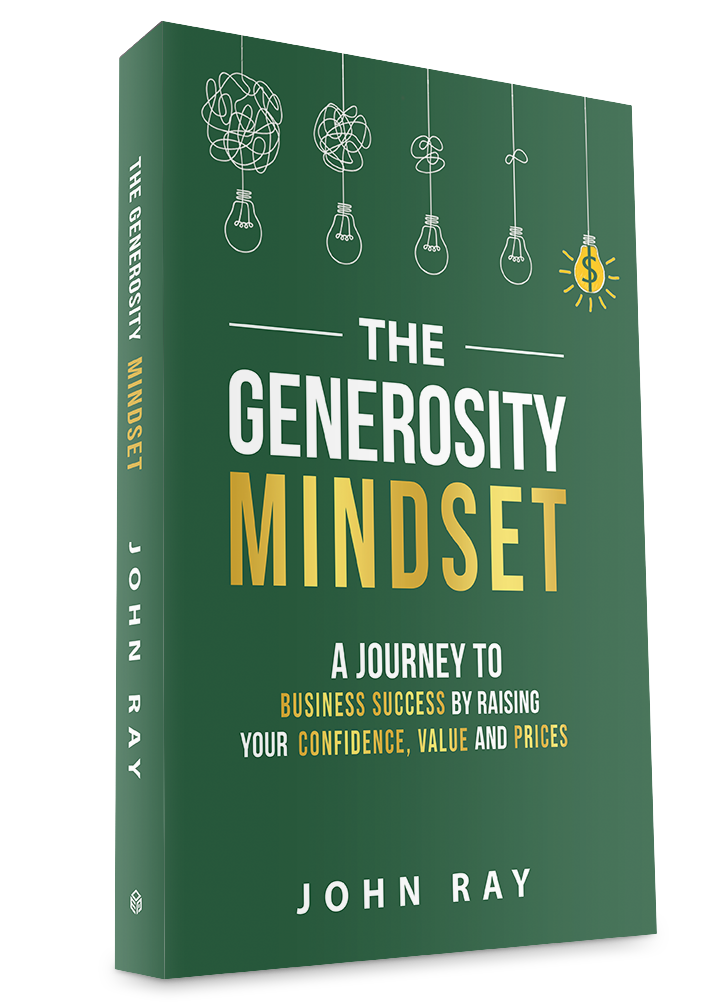
The Generosity Mindset, by John RayJohn is the #1 national best-selling author of The Generosity Mindset: A Journey to Business Success by Raising Your Confidence, Value, and Prices.

If you are a professional services provider, your goal is to do transformative work for clients you love working with and get paid commensurate with the value you deliver to those clients. While negative mindsets can inhibit your growth, adopting a different mindset, The Generosity Mindset™, can replace those self-limiting beliefs. The Generosity Mindset enables you to diagnose and communicate the value you deliver to clients and, in turn, more effectively price to receive a portion of that value.

Whether you’re a consultant, coach, marketing or branding professional, business advisor, attorney, CPA, or work in virtually any other professional services discipline, your content and technical expertise are not proprietary. What’s unique, though, is your experience and how you synthesize and deliver your knowledge. What’s special is your demeanor or the way you deal with your best-fit clients. What’s invaluable is how you deliver great value by guiding people through massive changes in their personal lives and in their businesses that bring them to a place they never thought possible.

The combination of all these elements is quite different for you compared to any other service provider in your industry. Therein lies your value, but it’s not the value you see. It’s the value your best-fit customers see in you.

If pricing your value feels uncomfortable or unfamiliar to you, this book will teach you why putting a price on the value your clients perceive and identify serves both them and you, and you’ll learn the factors involved in getting your price right.

The book is available at all major physical and online book retailers worldwide. Follow this link for further details.
Connect with John Ray:

Website | LinkedIn | Twitter

Business RadioX®:  LinkedIn | Twitter | Facebook | Instagram

Tagged With: Adam Houlahan, John Ray, professional services, Prominence Global, remote teams, The Price and Value Journey

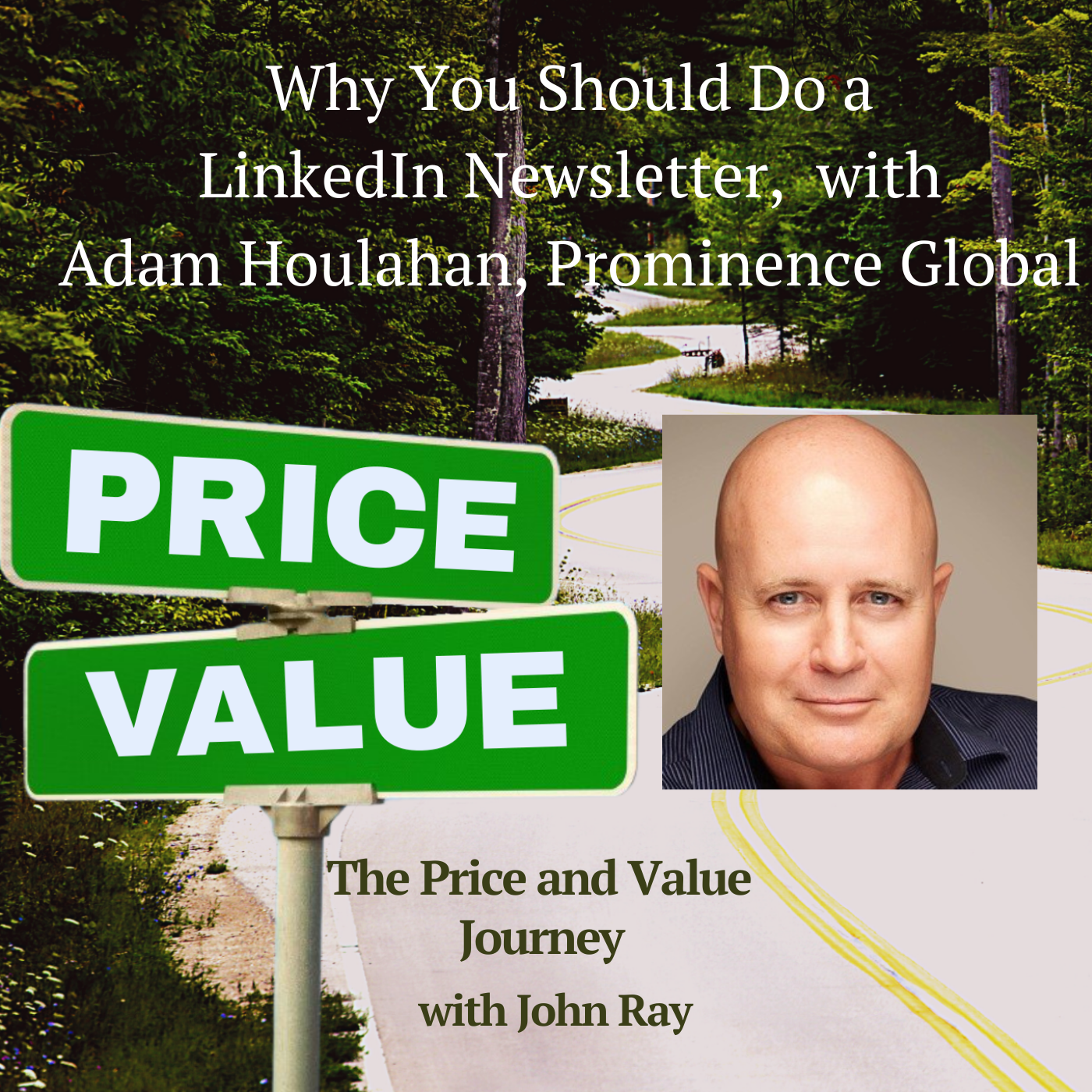
Why You Should Do a LinkedIn Newsletter, with Adam Houlahan, Prominence Global

June 1, 2023 by John Ray

Adam Houlahan
North Fulton Studio
Why You Should Do a LinkedIn Newsletter, with Adam Houlahan, Prominence Global
Loading
00:00 /
RSS Feed
Share
Link
Embed

Download file

Why You Should Do a LinkedIn Newsletter

Why You Should Do a LinkedIn Newsletter, with Adam Houlahan, Prominence Global

Adam Houlahan, CEO of Prominence Global and best-selling author, was the guest on this edition of The Price and Value Journey, discussing why you should do a LinkedIn newsletter. He and host John Ray covered how to make them impactful, what makes a LinkedIn newsletter unique, how often to post a newsletter, repurposing content, aligning with LinkedIn’s current algorithm, and much more.

The Price and Value Journey is presented by John Ray and produced by the North Fulton studio of Business RadioX®.

Prominence Global

Prominence Global is, you’ll find, very different. They help their clients position themselves as industry leaders who are the envy of their peers.

Their mantra is authenticity They create intelligent strategies that cut through the noise that is social media. They do that by being authentic, courageous, and committed to make a difference in their world too. They value transparency More is learned from their mistakes than successes, sharing both is their commitment to honesty and truth. They operate with Integrity Ethics in marketing is in their DNA, they are not afraid to say ‘no’.

Prominence Global seeks continuous improvement through innovation They’re constantly curious in growing themselves, their team and the service they provide. They’re personal. They understand there is no cookie-cutter program that suits every business. They develop solutions that are as individual as their clients are.

They make a positive difference. They believe real and meaningful change comes through the world’s entrepreneurs. They create a powerful on-line presence for each client that grows & accelerates their global footprint, so that together they really can make a huge impact.

Through their Premium Partnership with the global giving movement www.B1G1.com they impact the lives of millions of people in need just by doing what they do every day.

They developed a range of support services to cater to every need. ☞ Free web events ☞ Free Community you can join ☞ Free Profile Optimisation Course ☞ Inner Circle Solo ☞ Inner Circle Academy ☞ Inner Circle Legends.

Their programs are an intensive ‘deep dive’ — a superb, results-producing methodology that creates a cutting-edge, lead generation sales funnel for almost any industry.

The difference is simply how much support you need from their team of dedicated professionals.

Company website | LinkedIn

Adam Houlahan, CEO, Prominence Global

Adam Houlahan, CEO, Prominence Global

Adam Houlahan is an International Keynote Speaker specializing in LinkedIn strategies for entrepreneurs, and CEO of the highly successful LinkedIn agency, Prominence Global.

He hosts arguably the world’s largest free on-line LinkedIn training event with thousands of people registering every 10-weeks and is considered to be one of Australia’s leading experts in harnessing the power of LinkedIn for business.

Adam is also the author of three Amazon best-selling books Social Media Secret Sauce, The LinkedIn Playbook, and Influencer. Adam co-authored a fourth international best-seller Better Business, Better Life, Better World. His purpose is to positively impact 12 million people in need and has surpassed 10 million on the way to that target.

LinkedIn

TRANSCRIPT

John Ray: [00:00:05] And hello again, everyone. I’m John Ray on the Price and Value Journey. Today, we’re going to talk about whether and why you should have a LinkedIn newsletter. It’s a rather narrow topic, but one that I got interested in, thanks to Adam Houlahan.

Adam is an international keynote speaker who specializes in LinkedIn strategies for entrepreneurs, and he’s the CEO of the highly successful LinkedIn agency Prominence Global. He hosts arguably the world’s largest free online training event, with thousands of people registering every ten weeks. And he’s considered to be one of Australia’s leading experts in harnessing the power of LinkedIn for business. I think it’s beyond Australia, but that’s just my opinion.

Adam is also the author of three Amazon bestselling books, Social Media Secret Sauce, which I have not read, but I have read the LinkedIn Playbook and Influencer, both of which I recommend. Adam co-authored a fourth international bestseller called Better Business, Better Life, Better World. And that comes from his belief that real and meaningful change comes through the world’s entrepreneurs. His purpose is to positively impact 12 million people in need, and he has surpassed 10 million on the way to that target. Wow. Adam, thank you for coming on the show.

Adam Houlahan: [00:01:36] John, it’s an absolute pleasure and really looking forward to today.

John Ray: [00:01:40] Yeah. Thank you so much. And thank you again for your work. And before we get into LinkedIn, though, I want to just give you a shout out for your work here on the positive impact you’re trying to make on a worldwide basis. So describe that for everyone so they know exactly what we’re talking about.

Adam Houlahan: [00:01:59] Yeah, sure. I think it’s one of those things, John, that all of us, small to medium sized business owners understand. Our governments aren’t really going to make a significant change in the world, and it’s up to us to do what we can to effect that change. And right from day one, when we started Prominence Global, we had an alignment with an organization called B1G1.

And through those guys, we make sure that everything we do, so every, like you mentioned, the events that we host, every time someone comes to one of those events, we make sure a child gets access to a day’s education. When people join some of our programs, we build wells for families, so they’ve got access to drinking water. All those types of things, lots of great things, environmental things, all aligned with the Sustainable Development Goals for 2030.

So we feel like we’re just doing our little bit to make a bit of an impact in achieving that Sustainable Development Goals on time in 2030.

John Ray: [00:02:57] Thank you for that. And I would encourage those of you listeners who are interested, go to the Prominence Global website. You can see it all detailed there and see it all counting almost live. So it’s pretty cool. So thank you for that work, Adam. Yeah.

So let’s get into talking about Prominence Global, specifically in terms of your LinkedIn expertise and how you’re serving entrepreneurs and executives that want to amp up their LinkedIn presence.

Adam Houlahan: [00:03:30] Sure. And like you mentioned at the start, John, yeah, today we’re mostly talking about a very niche topic of newsletters for LinkedIn, as LinkedIn is a multi-faceted platform, serves lots of different needs. Again, as far as us as an agency, we’re very niche. We don’t work with sales teams or people looking for new jobs or people recruiting for jobs, that type of thing.

We very much focus on how business owners or leaders can use LinkedIn to create a really highly engaged personal brand and how they use that personal brand to then generate new business and revenue for their businesses. Very, very niche within the big sphere of what LinkedIn can do.

John Ray: [00:04:13] Yeah. And you’re pretty tied in to LinkedIn in terms of the features that are coming and knowing a lot about kind of what the architecture of LinkedIn and what their overall business strategy is, which gives you an advantage, right?

Adam Houlahan: [00:04:32] It’s something we choose to make sure we keep on top of. Within our team, we have a team that that’s all they do. They just continually monitor all the changes. LinkedIn, you might be surprised, John, we’re like, what, halfway through 2023 and there’s been almost 90 updates to the platform already. The only thing is LinkedIn doesn’t come out and tell us all about them. They create these new tools and things and then leave us all to work it out for ourselves.

So yeah, we see it as a great, great way to just keep the LinkedIn community updated on those changes. And that’s what those events are about, is there’s enough changes every ten weeks to host an event that lots of people choose to come along to.

John Ray: [00:05:14] Yeah, for sure. So as you mentioned, this is a pretty niche topic. And here’s the irony of the topic. I got — I’m a subscriber to your newsletter. I got interested in the topic in part because of your newsletter. One of which was should I have a LinkedIn newsletter? So let’s talk.

And there were some interesting points in that made me think this would make a really good topic for this audience of solo and small professional services providers to hear about LinkedIn newsletters. but let’s do some definitions before we dive in further detail. So what’s the difference between a regular post and a LinkedIn newsletter?

Adam Houlahan: [00:06:02] Yeah. It’s a great question. Good place to start. So think of it like your normal status post, which is probably if you’re checking through your feed, that’s what you’re going to see the most of. And that will consist of might be a short bit of text-based content with maybe an image attached. It might be like a video, a bit of copy attached. It’s all fairly short form content.

A newsletter is different in two important ways. One, it’s actually long form content. So as far as your audience, there’s some of them that like just that short, punchy bite size content and then when they really buy into what you or your business is about, they will definitely be interested in a longer form of article and just you have a blog on your website. They’re going to be somewhere in that 800 to 1200 words, and your newsletter on LinkedIn can be exactly the same. It can be longer, John, but I wouldn’t go longer than that. That’s probably about the sweet spot for them.

Second really important part, as you just mentioned, you subscribe to my newsletter. So people can actually, apart from just being connected with you on LinkedIn, they can actually subscribe to that newsletter. And that means that whenever you upload a new article, they’re going to get notified in their notifications on LinkedIn, but also by email that you’ve released something new. And of course, the visibility of people engaging on that as a general rule is always higher.

John Ray: [00:07:34] Yeah. And so are there any particular individuals, professions that should have a LinkedIn newsletter? Are there some that shouldn’t even worry about it? Let’s qualify those that really ought to have one.

Adam Houlahan: [00:07:50] Yeah. Basically, if you’re going to share content on LinkedIn, and I should preface that by saying high value, highly niched content. So there’s a lot of people that — just to maybe give you some rough numbers, John. Current, we’re coming close to 950 million members on LinkedIn right now. Of that 950 million, only one percent share content on a regular basis. By regular, say, once a week.

But only one percent of that one percent create content that’s niched within a very narrow field of expertise and that’s the content LinkedIn really likes. They want you to create content that just stays in the narrow lane because it makes it really easy for them to know who in the link of those 950 million people likely to be interested in it.

And that’s what they’re trying to do. They’re trying to get our newsfeeds filled with the type of content we really like. Newsletters give a lot of signals to LinkedIn as to how engaged you are on that content, and that allows them to organically show that content under the right circumstances to a much wider audience than maybe just your first-degree connections or the subscribers to your newsletter.

John Ray: [00:09:07] Yeah. And before I started, in part because of the newsletter you wrote about LinkedIn newsletters before, I’ve had a newsletter now for, I guess, five or six editions. I went and looked at a lot of them and they vary widely in terms of quality, like anything else. So let’s talk about that. What makes for a high quality LinkedIn newsletter?

Adam Houlahan: [00:09:36] Yeah, it’s a good question. So the first part is it’s just copywriting 101. Good headline, good imagery, things that capture people’s attention. And then, as I said, probably something in that 800 to 1200 word count. If you make it too short, then of course, you’re not providing the value that a newsletter is able to provide, which is that deeper insight onto a topic. Go too long and, of course, people get a little turned off. Staying somewhere in that 800-to-1200-word character count, word count I should say, a few visual, exactly the same as you do on your own personal blog. You’re going to have a few images that highlight the points.

And the most important thing always, John, is a call to action at the end of it, give people a next step that they should take. And as on the end of those, we will say, look, here’s a few other ways we can help you and links off to other resources that just like these events that we run and other free resources that people can go and consume.

And of course people, if they’ve enjoyed or found value in the content that you’ve shared, then they’re very likely to want to know more and go deeper into what it is that you offer. And I’m sure we’ve all heard the old 711 principle of seven people need to have at least seven touch points and probably 11 hours of content sort of thing before they’re really invested in you and who you are. So the more you can get people engaging off one piece of content into another, the more you deepen that know like trust factor that people tend to have in you.

John Ray: [00:11:12] For sure. Now, Adam when you — the term high quality, I guess, is a term that everybody’s got their own opinion of what high quality is, right? So I think what — and this is a question. I think what you’re getting at is it’s not the place to put a press release. It’s not the place to put something that’s something less than generously helpful content, right? It’s not the promotional piece of it, if you want to call a call to action, promotional is at the very end where if people want to engage with that, they can, but you lead with what’s helpful.

Adam Houlahan: [00:11:54] Oh, exactly. And further to that, John, is probably more high value, probably a way we could, a better way we could say that is highly niched. And if I use my letter as an example and as I mentioned earlier, we don’t have solutions for people using LinkedIn for job search or recruitment or all those other things that the platform can do.

So none of our content is ever talking about those things. We serve the smallest small to medium business owners who use that platform for personal branding and lead generation. And so our content just always stays in that lane. So that’s probably a better way of saying high value is highly niched.

John Ray: [00:12:38] Yeah. It’s like in your case too, it’s not confusing. I mean, if you did a post on or a newsletter on Instagram influencers, that would throw everybody off, right? What’s Adam doing here?

Adam Houlahan: [00:12:50] Exactly. And we all probably are on multiple platforms, but I never profess to be an expert or know a lot about Instagram or Facebook or TikTok or any other platforms. I know how to leverage LinkedIn really well, and that’s why I just stay in that lane. And I never, newsletters or any other content for that matter, ever talk about anything other than how you can get as a small to medium business owner, how you can get value out of the LinkedIn platform.

John Ray: [00:13:18] So I’m sure there are a lot of folks that listen to this conversation and wonder, hey, I’ve got an existing newsletter. It seems like people are reading it. Why should I start a LinkedIn newsletter?

Adam Houlahan: [00:13:35] Yeah. So you most likely should and should have a newsletter or blog or whatever on your website. But your — and you can definitely have like one newsletter on your personal profile on LinkedIn and you can also have one on your company profile. If there’s a reason for you to ever need to talk about more than one thing, that’s how you can split that into two different topics.

But the reality is there’s a certain market that knows how to find and interact on your personal newsletter or your blog, and you’ve got a whole another LinkedIn community who most likely there will be some crossover, of course, but the high majority of them probably never go to your website or your blog for that matter. So you’re just exposing information, good information to a whole new audience.

John Ray: [00:14:25] And let’s say I decide I want to get started. Do I need a certain number of followers to make it work or a certain amount of reach? When should I start?

Adam Houlahan: [00:14:39] John, it’s a wonderful old saying is when was the best time to start? It’s probably like three years ago. When’s the next best time to start? Today. If we wait until all the ducks are aligned, we’ll never get started. So the point being, yes, obviously, if you had more followers or whatever, then it’s going to get more immediate impact. But it doesn’t mean to say if you don’t have a lot of followers, you shouldn’t start one today.

One little thing you should know, or your audience should know is that when the very first time you create your newsletter on LinkedIn, LinkedIn will send a notification to everybody you’re connected to on LinkedIn and say, “Hey, Adam. John’s just started a new newsletter about this. Would you like to subscribe to it?” So they give you this one off nice little boost of visibility. So you’ll pretty much guarantee that you’re going to get a few followers right out of the gate.

The second thing is, now, this wasn’t the case when they first started, but all new people that follow or connect with you from now on also get that, not a mass one like the very first one, but individual by individual. You get an invitation from LinkedIn to follow your newsletter if they’re following you or following you. So you will build a following.

Now, of course, what that really should be a red flag to everyone is make sure that very first newsletter that you put out is your best stuff because that’s the first one people are going to see and where you’ll get this influx of new people.

We’ve had some of our clients, John, and in fairness they probably have 10,000 connections or whatever on LinkedIn or maybe more. And when we help them first launch their new newsletter, got 1500 to 3000 followers to that newsletter within seven days. And that’s because of LinkedIn doing that initial big push for you.

John Ray: [00:16:34] Yeah, that’s fantastic. And by definition, they opt in, so everyone opts in. Unlike folks, your email newsletter, which may or may not have opt ins. Let’s be honest about this. You may be emailing folks that really didn’t ask to be put on your email list, but LinkedIn does not allow that.

Adam Houlahan: [00:17:01] No, they don’t. And so that’s the thing that people that opt in for your newsletter, they’ve made a willing decision to do that. As the author of your newsletter, you kind of have an obligation to serve those followers in a powerful way. I see it personally. I see it as an absolute privilege to be able to have people want to follow my newsletter and engage on that content. I’ll be honest, John, it just inspires me to give them my best stuff and that’s where they’ll always find it.

John Ray: [00:17:30] Yeah. And how often do you do your newsletters? Biweekly, is that correct?

Adam Houlahan: [00:17:35] Yeah, biweekly. Look, there’s no right or wrong. There is a wrong, it’s never. And I think to be honest, John, I feel once a week is actually too much for a long content. I think biweek — look, this is just my personal opinion. I think biweekly is the best cadence.

However, I’ll be fair, I’d say that’s one of those questions you could ask 10 different experts and get 11 different responses. But in my opinion about biweekly is a good cadence for that good long. And keep in mind that there’s a bit of work in putting together a good quality piece of information like that. So don’t put a noose around your neck of having to create that every single week.

John Ray: [00:18:12] Yeah, for sure. Now, in making that decision, does it make a difference in terms of how often you post? Would that play into how often you do a newsletter? In other words, you’re posting every day, right? Or every weekday? What’s your cadence on posting generally?

Adam Houlahan: [00:18:32] Yep. So again, our sort of recommendation and what all of our clients work to and we do as well is three times per week. So Monday, Wednesday, Friday. And on a calendar month, John, that’s 13 pieces of content. And so two of those are going to be newsletters. So we don’t add more. We just have that as part of our overall 13 pieces of content that we share every month.

John Ray: [00:18:57] Gotcha. Gotcha. And but the most important thing I take it is not the number, it’s the consistency.

Adam Houlahan: [00:19:07] A hundred percent. That’s it. Consistency wins every single time. I would rather see people start with once per month and then build that up to biweekly when it suits. Equally with the rest of their content. So when we say three times per week, we don’t necessarily say start, try and start there. Start at once per week. And then when you’ve got a bit of a rhythm around that, then you can move to twice a week and then eventually three.

But the key thing is, what a big mistake I often see made is people come out of the gate really hard, find it’s really hard to maintain that and then become inconsistent. And it’s very interesting. I wanna share a very quick story with you, John. I was in a meeting on the weekend just gone down in Melbourne, which is a couple of hours flight from where I live.

And one of the people that was there said, oh, by the way, I got a message from someone the other day because I normally post a video on a Friday and I was getting ready for this meeting and I forgot to post it and I got a message saying, oh, I was looking out for your video because I know you post every Friday.

So if you start creating really good content, people will know the cadence of where you post it. Now, some people will love your newsletter, some people will love your videos, some people will love your other content. Rarely will they love all of it. Sometimes they do, but they will know the cadence of your newsletter. And if you start getting inconsistent, then their desire to keep interacting on it will drop away.

John Ray: [00:20:39] Let’s talk about the interplay between if you have an email newsletter now, your blog, and your LinkedIn newsletter. So should you repurpose the content that you are already developing for your blog? Or even more importantly, your email newsletter? Can you put that both places?

Adam Houlahan: [00:21:01] Yeah, 100 percent. Again, remember, you probably have different audiences that consume that content in different places, so not all of your LinkedIn audience are going to see your newsletter. Not all of your email database are going to see all of your email newsletters or your blog. So a good way — you’re going to take a bit of effort to create a good quality newsletter. So by all means, repurpose it across a couple of channels.

Now the key thing there, John, is you probably say, for example, what we do is we’ll post it onto our company blog first. And then a month or so later, we will repurpose it onto our LinkedIn newsletters. So don’t post them at the same time. There’s a bit of a SEO play there as well, so it’s okay to repurpose it. Just give it a good four to six weeks in between different platforms.

John Ray: [00:21:53] Got it. And are LinkedIn newsletters indexed, speaking of SEO, indexed by Google? And are there any preferences that Google has toward LinkedIn newsletters versus post?

Adam Houlahan: [00:22:07] Yeah, 100 percent. They will index on Google and every piece of content that you create on LinkedIn now has its own unique URL. So part of that is the reason for indexation. So yeah, look, definitely because your newsletter is long form, it is going to index better than your standard posts because as hopefully your audience knows, Google has a preference for longer form content than really short punchy stuff.

So yeah, one, yes, it will index. And two, it will index better than your other content because of its longer form, which is again one of those reasons why you don’t want to go short. Don’t short your newsletter, so to speak. Give it enough algorithmic juice so that Google wants to index it.

John Ray: [00:22:56] Yeah. So how do I know that my newsletter is resonating with my target audience, this niche that I’ve put a flag in, if you will, for myself?

Adam Houlahan: [00:23:07] Yeah, it’s pretty reasonably easy. One, you’ll see that, month after month, your people subscribing to the newsletter will grow. And of course, part of that growth comes to promotion as well. So one, when you put out your newsletter, it is getting seen by not only your subscribers, but people will come across it in your feed. And you might want to, if you’re doing some email marketing, you certainly want to at times share about a link to your newsletter, that type of thing. But growth in subscribers is one way to tell that.

The second is, of course, LinkedIn will give you some analytics on that. It’ll show you how many impressions, how many people have liked it or comment on it or shared it. So just, you would gauge that by the growth in those things. To be honest, I don’t get too concerned about likes and shares. LinkedIn is not a big lover of shared content because it’s already on the platform.

Now, having said that, it’s no downside to us if people share our content, it’s great, but the real metrics you want to follow is the subscriber rate that that’s growing. And what I really follow is the number of people that are interacting on the newsletter and like commenting on it and leaving their opinions.

To me, that’s the biggest indicator of anything, is if people are starting to interact on your content by going out of their way to leave their views or thanking you for sharing it or whatever. That’s one of the best indicators for sure.

John Ray: [00:24:35] One of the things — I think I’m hearing a lot of things here, which is very helpful. Thank you. But one of the things that strikes me, Adam, is I think a lot of people have the notion because they get an invitation to a newsletter pretty frequently right now. Is that, hey, there are so many newsletters around, right, why should I start one? And the stats that you quoted right at the top of this episode would indicate there’s still a lot of folks that may never do a newsletter a lot more than or doing one.

Adam Houlahan: [00:25:12] Oh, 100 percent. That’s definitely right. LinkedIn’s own goals are to have about 3 billion members on the platform, so they’re only about A one-third of the way there themselves. So it’s like I said, when was the best time? A little while ago. When’s the next best time? Today. Yeah, just start.

John Ray: [00:25:29] Yeah, for sure. I would be remiss if I didn’t ask you to just talk in general about what you’re seeing on LinkedIn today, what some of the things that people need to pay particular attention to. I noticed you were talking about some enhancements to Sales Navigator that were pretty interesting. But talk about what’s on your mind these days and what you’re sharing with your clients about LinkedIn.

Adam Houlahan: [00:25:57] Yeah, look, it’s a never ending learning curve. There’s no doubt about that. Though, having said that, obviously those changes transcend all parts of LinkedIn. So you don’t need to be staying across all of those 90 changes that have happened in the last six months. But the things to really focus on is I think the most important thing is to start with an end goal.

Why are you on the platform? What is it you want to do? Who is it you want to be interacting with? And do you want to be seen as a marketer or as a, the term we like to use, John, is a sage. The term most people use is thought leader. I think that term is a little overdone these days. And but the reality is, I think the real value is to be seen as that real authority within your field of expertise.

You don’t have to dominate the whole LinkedIn platform. You don’t have to be Gary Vaynerchuk or Elon Musk or those people who transcend all audiences. You just need to be known and liked and trusted within your area of expertise. And if you can do that job done and LinkedIn wants to help you do that and how they help you, that is still LinkedIn probably gives better organic traction on content than any other platform as long as you understand the rules, so to speak. And if you stick by them.

In simple terms, what that rule is stay very, very niche. Don’t be trying to talk about all things to all people, and that helps LinkedIn to understand who’s your audience. Remember, they know a lot of information about all of us, so they know what you’re interested in. They want to give you content in your feed that is really interesting to you, where what might be in my feed would be completely different to yours.

And that’s okay, because if we’re all getting fed the information that we like and enjoy, we’re more likely to stay on the platform. So the end goal, in my opinion, is to align with LinkedIn’s goals. If you can align your goals with theirs, then it’s a win-win. And LinkedIn is very good at supporting those who support them, if that makes sense.

John Ray: [00:28:10] No, it makes perfect sense. And just to encourage those folks out there that really have not participated on LinkedIn, it occurs to me back to the newsletters that starting a newsletter may be a great way to put your toe in the water. If you’re already developing content for an email newsletter, why not get your toe in the water and start a newsletter on LinkedIn and see where it goes?

Adam Houlahan: [00:28:35] Absolutely, John. The other thing is that, and this is a reasonably new release from LinkedIn, is that you can actually schedule your newsletter. So around consistency, you don’t have to — there’s a little bit of work in formatting your email newsletter or your blog, and it’s the same on LinkedIn. But you can do that in advance, and you can schedule it so that — let’s say you’re doing it biweekly.

You can say, I want this to go out on exactly this time and this day in the future. And so that’s how you can keep that consistency and your audience knows, gets to know when you’re going to post. I think it literally has only been available — by the way, you can do that for all your other content types on LinkedIn as well, but only very new in the last month or so where you’ve been able to do it for newsletters.

John Ray: [00:29:22] We’re getting to the end of this interview, and I want to give you a chance for a call to action. So talk about what you’ve got going right now that our listeners might want to know about and might want to dive into and learn more about you and your work, how you can help them.

Adam Houlahan: [00:29:38] Sure. There’s two things, really easy. Either go to our website, which is prominence.global or just follow me on LinkedIn. That’s where we’re always going to let you know when we’ve put out, we have lots of free events and things where we just love to help the LinkedIn community. There’s literally probably almost one every month of different formats, but we’ll always let you know if you’re following us on there. And that’s the easiest way to make sure that you stay up to date with every, not every single change that’s happening on LinkedIn, but the important ones relative to small to medium business owners.

John Ray: [00:30:15] Terrific. Adam Houlahan from Prominence Global. Adam, thank you so much for taking the time to come on and share your expertise. We appreciate you. And again, I encourage everyone out there to follow you.

Adam Houlahan: [00:30:28] Thank you, John. As I said, it’s an absolute pleasure to be with you again today. And I look forward to doing it again sometime very soon.

John Ray: [00:30:36] Something tells me we’ll have a reason to — LinkedIn will give us a reason to, right?

Adam Houlahan: [00:30:41] For sure.

John Ray: [00:30:41] Yeah, for sure. Thank you again. And folks, just a quick reminder as we wrap up here, that if you want to know more information on this podcast, this series, go to pricevaluejourney.com. You can find our show archive there. You can also, of course, find it on your favorite podcast app.

And you can also sign up to receive updates on a book I have coming out this year. I’m trying to catch up with Adam, 2023, later in 2023. It’s called The Price and Value Journey, Raising Your Confidence, Your Value and Your Prices Using the Generosity Mindset Method. If you want to know more about that book that’s coming and I’m featuring some little pieces on that in my email newsletter, by the way, go check it out.

So for my guest, Adam Houlahan, I’m John Ray. Join us next time on the Price and Value Journey.


About The Price and Value Journey

The title of this show describes the journey all professional services providers are on:  building a services practice by seeking to convince the world of the value we offer, helping clients achieve the outcomes they desire, and trying to do all that at pricing which reflects the value we deliver.

If you feel like you’re working too hard for too little money in your solo or small firm practice, this show is for you. Even if you’re reasonably happy with your practice, you’ll hear ways to improve both your bottom line as well as the mindset you bring to your business.

The show is produced by the North Fulton studio of Business RadioX® and can be found on all the major podcast apps. The complete show archive is here.

John Ray, Host of The Price and Value Journey

John Ray The Price and Value Journey
John Ray, Host of “The Price and Value Journey”

John Ray is the host of The Price and Value Journey.

John owns Ray Business Advisors, a business advisory practice. John’s services include advising solopreneur and small professional services firms on their pricing. John is passionate about the power of pricing for business owners, as changing pricing is the fastest way to change the profitability of a business. His clients are professionals who are selling their “grey matter,” such as attorneys, CPAs, accountants and bookkeepers, consultants, marketing professionals, and other professional services practitioners.

In his other business, John is a Studio Owner, Producer, and Show Host with Business RadioX®, and works with business owners who want to do their own podcast. As a veteran B2B services provider, John’s special sauce is coaching B2B professionals to use a podcast to build relationships in a non-salesy way which translate into revenue.

John is the host of North Fulton Business Radio, Minneapolis-St. Paul Business Radio, Alpharetta Tech Talk, and Business Leaders Radio. house shows which feature a wide range of business leaders and companies. John has hosted and/or produced over 2,000 podcast episodes.

Coming in 2023:  A New Book!

John’s working on a book that will be released in 2023:  The Price and Value Journey: Raise Your Confidence, Your Value, and Your Prices Using The Generosity Mindset Method. The book covers topics like value and adopting a mindset of value, pricing your services more effectively, proposals, and essential elements of growing your business. For more information or to sign up to receive updates on the book release, go to pricevaluejourney.com.

Connect with John Ray:

Website | LinkedIn | Twitter

Business RadioX®:  LinkedIn | Twitter | Facebook | Instagram

Tagged With: Adam Houlahan, John Ray, LinkedIn, LinkedIn Newsletters, Price and Value Journey, pricing, professional services, professional services providers, Prominence Global, Social Media, solopreneurs, The Price and Value Journey, value, value pricing

Decision Vision Episode 107: Should I Actively Use LinkedIn? – An Interview with Adam Houlahan, Prominence Global

March 11, 2021 by John Ray

LinkedIn
Decision Vision
Decision Vision Episode 107: Should I Actively Use LinkedIn? - An Interview with Adam Houlahan, Prominence Global
Loading
00:00 /
RSS Feed
Share
Link
Embed

Download file

LinkedIn

Decision Vision Episode 107: Should I Actively Use LinkedIn? – An Interview with Adam Houlahan, Prominence Global

Adam Houlahan of Prominence Global joined host Mike Blake to discuss his journey to recognition as a LinkedIn authority, why using LinkedIn can be so rewarding for business owners and professionals, why so many users get LinkedIn wrong, how to effectively use LinkedIn to build relationships, and much more. “Decision Vision” is presented by Brady Ware & Company.

Prominence Global

Prominence Global is, you’ll find, very different. They help their clients position themselves as industry leaders who are the envy of their peers. Their mantra is authenticity. They create intelligent strategies that cut through the noise that is social media. They do that by being authentic, courageous, and committed to make a difference in their world too. They value transparency. More is learned from mistakes than successes, sharing both is their commitment to honesty and truth.

Ethics in marketing is in their DNA, they are not afraid to say ‘no’. They seek continuous improvement through innovation They are constantly curious in growing themselves, their team and the service they provide.

They understand there is no cookie-cutter program that suits every business. They develop solutions that are as individual as their clients are. They believe real and meaningful change comes through the world’s entrepreneurs.  They create a powerful on-line presence for each client that grows & accelerates their global footprint, so that together they really can make a huge impact.

Company website | LinkedIn | Twitter | Facebook

Adam Houlahan, CEO, Prominence Global

Adam Houlahan is an International Keynote Speaker specializing in LinkedIn strategies for entrepreneurs, and CEO of the highly successful LinkedIn agency, Prominence Global. He hosts arguably the world’s largest free on-line LinkedIn training event with thousands of people registering every 10-weeks and is considered to be one of Australia’s leading experts in harnessing the power of LinkedIn for business.

Adam is also the author of three Amazon best-selling books Social Media Secret Sauce, The LinkedIn Playbook, and Influencer. Adam co-authored a fourth international best-seller Better Business, Better Life, Better World. He believes real and meaningful change comes through the world’s entrepreneurs. His purpose is to positively impact 12 million people in need and has surpassed 4 million on the way to that target.

LinkedIn | Twitter

Mike Blake, Brady Ware & Company

Mike Blake, Host of the “Decision Vision” podcast series

Michael Blake is the host of the “Decision Vision” podcast series and a Director of Brady Ware & Company. Mike specializes in the valuation of intellectual property-driven firms, such as software firms, aerospace firms, and professional services firms, most frequently in the capacity as a transaction advisor, helping clients obtain great outcomes from complex transaction opportunities. He is also a specialist in the appraisal of intellectual properties as stand-alone assets, such as software, trade secrets, and patents.

Mike has been a full-time business appraiser for 13 years with public accounting firms, boutique business appraisal firms, and an owner of his own firm. Prior to that, he spent 8 years in venture capital and investment banking, including transactions in the U.S., Israel, Russia, Ukraine, and Belarus.

Brady Ware & Company

Brady Ware & Company is a regional full-service accounting and advisory firm which helps businesses and entrepreneurs make visions a reality. Brady Ware services clients nationally from its offices in Alpharetta, GA; Columbus and Dayton, OH; and Richmond, IN. The firm is growth-minded, committed to the regions in which they operate, and most importantly, they make significant investments in their people and service offerings to meet the changing financial needs of those they are privileged to serve. The firm is dedicated to providing results that make a difference for its clients.

Decision Vision Podcast Series

“Decision Vision” is a podcast covering topics and issues facing small business owners and connecting them with solutions from leading experts. This series is presented by Brady Ware & Company. If you are a decision-maker for a small business, we’d love to hear from you. Contact us at decisionvision@bradyware.com and make sure to listen to every Thursday to the “Decision Vision” podcast.

Past episodes of “Decision Vision” can be found at decisionvisionpodcast.com. “Decision Vision” is produced and broadcast by the North Fulton studio of Business RadioX®.

Visit Brady Ware & Company on social media:

LinkedIn:  https://www.linkedin.com/company/brady-ware/

Facebook: https://www.facebook.com/bradywareCPAs/

Twitter: https://twitter.com/BradyWare

Instagram: https://www.instagram.com/bradywarecompany/

TRANSCRIPT

Intro: [00:00:01] Welcome to Decision Vision, a podcast series focusing on critical business decisions. Brought to you by Brady Ware & Company. Brady Ware is a regional full service accounting and advisory firm that helps businesses and entrepreneurs make visions a reality.

Mike Blake: [00:00:22] Welcome to Decision Vision, a podcast giving you, the listener, clear vision to make great decisions. In each episode, we discuss the process of decision making on a different topic from the business owners’ or executives’ perspective. We aren’t necessarily telling you what to do, but we can put you in a position to make an informed decision on your own and understand when you might need help along the way.

Mike Blake: [00:00:40] My name is Mike Blake, and I’m your host for today’s program. I’m a director at Brady Ware & Company, a full service accounting firm based in Dayton, Ohio, with offices in Dayton; Columbus, Ohio; Richmond, Indiana; and Alpharetta, Georgia. Brady Ware is sponsoring this podcast, which is being recorded in Atlanta per social distancing protocols. If you like this podcast, please subscribe on your favorite podcast aggregator, and please consider leaving a review of the podcast as well.

Mike Blake: [00:01:06] So, today’s topic is, Should I actively use LinkedIn? And, you know, this is an interesting topic, I think, from so many levels. One, the pandemic has created opportunities and necessities that I think are far-ranging. And I don’t need to lecture people by now, at least here in the United States, it’s been a year since this thing has really hit. And we know what kinds of changes that it has created. And one of them has been that, you know, we’re just not selling and marketing the way that we once were. That will likely come back as we enter sort of a trans- pandemic and then a post-pandemic world. But for the time being, if you want to talk to people, for the most part, at least in the United States, it’s going to be in some digital virtual format.

Mike Blake: [00:02:01] And then, when we consider that there’s been massive displacement in our country and elsewhere with respect to employment, people are turning to LinkedIn once again in droves because that is, at least, one way that you’re going to get your next job, particularly if you’re in a technical or a professional field. And then, finally, it’s good to kind of touch base because, you know, the social media landscape is changing so rapidly and evolving that, you know, while LinkedIn has maintained its space and, of course, Facebook has maintained the space where it is, and YouTube, and so forth, yet we’re seeing new entrants such as Clubhouse, that is all the rage. We’re seeing the the ascent of TikTok and so forth, which is setting the world on fire. And, you know, that’s probably going to be the way the things are for a while, that we’re going to have to kind of touch base and take a look back and make sure the things we are using are as useful as we thought they were and that we’re achieving the same goal. And for a lot of people, I still think they need to be convinced candidly that LinkedIn is a viable platform.

Mike Blake: [00:03:24] And I had a conversation with somebody not that long ago, and I will not sell them out here online, but, you know, they did tell me sort of very dismissively, they thought that LinkedIn was basically a method by which we’re told by which their competitors could simply poach their employees. And that’s a pretty cynical view, but it’s not a uniquely held one. And so, I happen to be a LinkedIn fan. I’m an active user of it. I like to think that I’m a Power User, although I think our guest is going to find holes in the way that I use it because he’s the expert and not mine.

Mike Blake: [00:03:57] But we’re very fortunate that joining us today from Surfers Paradise, Queensland, Australia – and I’ve got to ask you about that – is Adam Houlahan, who is CEO of Prominence Global. Adam is an international keynote speaker, specializing in LinkedIn strategies for entrepreneurs and CEO of the highly successful LinkedIn agency, Prominence Global. He hosts arguably the world’s largest free online LinkedIn training event, with thousands of people registering every ten weeks. And is considered to be one of Australia’s leading experts in harnessing the power of LinkedIn for business. Adam is also the author of three Amazon bestselling books, Social Media Secret Sauce, which I’m reading right now; the LinkedIn Playbook, which I have read and led me to invite Adam to the program; and Influencer, which is on the queue. Adam co-authored a fourth international bestseller, Better Business, Better Life, Better World.

Mike Blake: [00:04:51] Prominence Global, as you’ll find, is very different. They help their clients position themselves as industry leaders who are the envy of their peers. They developed a range of support services to cater to every need. They host free web events. There are free community that you can join, a free Profile Optimization course, an Inner Circle Solo, Inner Circle Academy, Inner Circle Legends, and maybe Adam can tell us exactly what those mean. These programs are an intensive deep dive, a superb results producing methodology that creates a cutting edge lead generation sales funnel for almost any industry. The difference is simply how much support you need from their team of dedicated professionals. Adam, welcome to the program.

Adam Houlahan: [00:05:29] Thank you. And a very, very comprehensive introduction there. Well done. Thanks, Mike.

Mike Blake: [00:05:36] Well, thank you. That’s probably a very kind way of saying long winded, but I’m just going to take it at face value. So, I do want to ask you about Surfers Paradise. Are you a surfer yourself?

Adam Houlahan: [00:05:49] Interestingly, no, but where I live is a bit of a surfing mecca in the world. It’s kind of like the tourist capital of Australia, I suppose. And, fortunately, here in Australia, we can still travel around the beach, not so much international people. But I get to live right on about ten beaches within about a half-hour drive, which is fantastic.

Mike Blake: [00:06:16] So, I’m curious, so you are able to travel fairly freely within the country, but international travel, I guess, is shut down as it is in most places.

Adam Houlahan: [00:06:26] Yeah. So, it’s not easy to travel outside of Australia, but, fortunately, we seem to have the pandemic under control. There’s very few cases here in Australia. And they can still go on holidays and travel around. And our economy’s doing quite well, so we’re very blessed. I suppose it’s one of the advantages, Mike, of being an island nation in the middle of nowhere, it’s easy to close your borders.

Mike Blake: [00:06:51] I suppose that’s true. Well, well done and bravo. And, hopefully, we’ll catch up to you guys sooner rather than later. So, Adam, I’d love it if you could tell us your origin story. How did you become involved in LinkedIn? And then, could you sort of take us from that point to how you became one of the world’s leading experts on the platform?

Adam Houlahan: [00:07:15] Yeah. I’d love to. So, it all started about ten years ago now. And for the very first time in my life, I actually worked for somebody else. I was running a company based here in Australia that is a bit of a global player. And we’re exporting organic skincare products to about 64 countries around the world. At that time, I didn’t really know much about LinkedIn, or any other social media for that matter. But what I did notice was that, we were doing a little research on why other companies in that same space around the world were doing well. And it turned out to be that they were really good early adopters of social media from a business perspective. And that kind of piqued my interest on how that could be used for really high quality business.

Adam Houlahan: [00:08:03] And so, I just really immersed myself into learning about it, social media in general. But the more I did, the more I just personally resonated with LinkedIn. It seemed like a very difficult platform to master, and it is. Yet it just kind of made sense to me. And so, I just kept trying different things and learning. As I said, this is the only time I’ve ever worked for another company, and I got to the point where I really wanted to get back into my own thing. And I thought, I’m doing pretty well with LinkedIn myself. I can probably help other people do that.

Adam Houlahan: [00:08:41] So, I started really as just a consultant, just myself coaching a few people. And the interest in it was surprising. And we just kept growing and growing, and we had varying team members to sort of deliver that. And, now, we’re a global team of amazing people. We have a team in North America, in the Philippines, and UK, here in Australia, and we get to work with amazing, amazing people all over the world. And we just specialize in this base of a platform called LinkedIn.

Mike Blake: [00:09:15] So, what did it take to go from user to active user to an expert? Was it intense study? Was it a lot of trial and error? Do you know people who wrote code at LinkedIn? What did it take to develop that level of expertise that you now have?

Adam Houlahan: [00:09:32] I guess it’s that old saying, the ten thousand hours of putting in your time as well as funny things. I often get asked the question like, “How did you become an overnight expert?” Well, I didn’t. I mean, I did my time. It’s a lot of hard work. And as you said, a lot of trial and error, and it still is. We have people on our team, a data scientist, and all they do is kind of monitor algorithms and what’s working and what’s not, and find patterns and commonality and things. And as you’re aware, not only LinkedIn, no social platforms really share their algorithms. So, we spend a lot of time working this stuff out and, eventually, came up with a process that just worked. And we’re fortunate enough to work with over 200 people around the world. And so, it’s not just now, where it’s just what I see in what I’m doing, we get to see the results of what hundreds of accounts are doing. And, of course, that exponential sort of data capability is what helps us to really hone down on what actually is a methodology that works.

Mike Blake: [00:10:58] So, of course, LinkedIn is now one of many social networks. What made you choose to focus on LinkedIn? And I mean, are you active at all in other social networks as well?

Adam Houlahan: [00:11:13] I have other accounts like Twitter and LinkedIn – sorry – Facebook and Instagram. But to be honest, I spend 95 percent of my time on LinkedIn. And I think the differentiator there is that LinkedIn, it wasn’t the social platform. It’s very much a social platform from the business perspective as opposed to many others have a more social – they certainly have a business aspect to them. And there’s certainly industries and businesses that are better served by other platforms – but it’s the general SME, B2B market. There’s really no comparison, in my opinion, anyway.

Mike Blake: [00:12:00] And, you know, it’s interesting how LinkedIn has managed to more or less preserve its status as a network for professionals as opposed to personal purposes. And one example I have, as I’m sure you’re aware, in the United States, we have an unusually polarized political culture. I cannot remember in my 50 years seeing anything like it. And even so, when you see something spill over into the political on LinkedIn, it feels like nails on a chalkboard. I mean, it stands out right away. You can feel sort of the uncomfortableness of it being there. There’s something about LinkedIn, the culture of the users, I’m not sure, but they’ve managed to sort of keep it away. Whereas, with Facebook and Instagram and the others, it really is kind of a free for all.

Adam Houlahan: [00:12:51] You’re right. And interestingly enough, algorithmically, it’s one of the things that LinkedIn sort of manage well. So, I wouldn’t say you don’t see any of that type of content on LinkedIn. It’s certainly there. But the difference really is that they’re suppressing a lot of that out of their feeds. So, let’s be honest, there’s 750 million-plus users on LinkedIn, and probably 95 percent of them don’t really know exactly what is best practice and what works. And it’s not uncommon that it gets used like other platforms. The difference is that LinkedIn’s algorithms can spot a lot of that and actually cut it off before you see the high majority.

Mike Blake: [00:13:48] So, you said something I wanted to dive into a little bit. And you sort of answered the question and that is, it sounds like you think that most people are not using LinkedIn correctly or at least anything approaching the fullest capabilities of the platform.

Adam Houlahan: [00:14:03] Exactly. And I can give you a more specific number than that. In my opinion, it’s probably about the top 0.02 percent of people truly understand how to leverage it to its greatest capability and are rewarded by it. It’s interesting, you sort of mentioned earlier about someone you had a conversation with that had that view that it was just a place to poach team members and things like that. And I’m not saying that that type of thing doesn’t happen, it certainly does. But the real power of LinkedIn is – and I’m going to get some pushback on this one. But what I’m going to say is, it’s actually not a great sales platform and that’s what most people try and use it for. And the people who truly get the results from it truly understand its power are not actually trying to use it as a sales platform. However, because they know how to do it well, they enjoy more sales off the back of that process than 98 or 99 percent of people on the platform.

Mike Blake: [00:15:16] And I’m curious – you may not have specific insight, but I’m curious. Do you think that LinkedIn was designed to be as complex as it is, where there’s only a very small number of intelligency, if you will, or the Illuminati that really understand LinkedIn to its core? Is that the intent or is that something that simply evolved over time as new ideas, new functionality, new data has become available?

Adam Houlahan: [00:15:45] Mike, it’s a great question. And I think the reality is, I think, it’s just evolved over time. If you really go back to LinkedIn’s early days, it was a jobsite, to be honest. It’s a place where you pass your resume. And while it’s still used for job placement – and very, very well, some of them are successful clients, are recruitment agencies – but the reality is – and I think if you kind of put a line in the sand of where that really accelerated, it’s probably around the time Microsoft shelled out $26 billion dollars to buy it. Clearly, a company the size of Microsoft, again, have the resources and the capability to do whatever they wanted with the platform. And I think they’ve actually done more good than bad.

Adam Houlahan: [00:16:43] However, as you point out, in that process, it has become a little bit of a degree of complexity in how the algorithms treat different things that happened on there. And let’s be honest, the old platforms are algorithm-driven. Everything is algorithm-driven. LinkedIn just is what we call hyper-driven by their algorithms. So, the difference between really leveraging the platform well and not so well, it comes down to what we call algorithm intelligence.

Mike Blake: [00:17:20] Now, this may be an unfair question. And if it is, tell me and I’ll talk about something else, but I’m going to throw it out there anyway. Because of that, I wonder what your view is on that complexity of LinkedIn relative to other platforms. Let’s just say Facebook, for example. Facebook can be used to accomplish something similar, but an entirely different way about it, an entirely different business model in a lot of respects. You know, in your view, assuming that you sort of were at a flat footed start with knowledge of LinkedIn versus Facebook or other platforms, where do you think LinkedIn ranks in terms of complexity among the other platforms that are out there? Is it about average? Is it harder than most? Easier than most? Do you have an opinion on that?

Adam Houlahan: [00:18:07] Definitely. I’d say, definitely, it’s harder. Comparing to Facebook, it’s quite normal. Like you said, you have that flat foot stand and start. Really, the difference that I would suggest is that, with Facebook, even if you had a flat foot stand and start, yes, you can do some courses and educate yourself on how the ad platform works. And the reality is, the only way you can leverage real value from Facebook is through marketing budget. So, if you don’t have marketing budget, then you can have all the know how in the world. You’re just not going to get traction on Facebook.

Adam Houlahan: [00:18:53] Conversely, on LinkedIn, if you invest that time in that same education process, you can actually get around amazing results with no budget. You actually alluded to the reason, which you said, was a difference in business model. LinkedIn’s business model is incredibly different to Facebook. Facebook is a pay to play. It’s just that simple. It seems driven around the ad platform. With the LinkedIn, LinkedIn actually generates very high majority of their revenue through subscriptions. Meaning, that people have a subscription to the Premium platform sales navigator, the recruiter licenses, and there’s a whole bunch of other ones out there as well.

Adam Houlahan: [00:19:40] So, they have a, in my opinion, a much better model because it’s – what we call -a recurring profit model. They get paid every month regardless of the value event. They do have an end platform, as you know, but it’s really not the main driver of the revenue. So, what they really want is amazing content creators. So, if you want to dominate the platform, you’ve got to up your skill in content creation, and that’s what they really want. Because they want conversations that stay on the platform and want it to be a place where you come to it for.

Adam Houlahan: [00:20:18] If you think about why people go onto social platforms, in the simplest sense, it comes down to two things, they’re there to be entertained or educated or informed. So, LinkedIn wants to be that place for education and information. Not so much the entertainment part of the process. And it’s done a really good job at doing that. But, as we said, getting the traction on that is not simple.

Mike Blake: [00:20:46] So, you touched on something that I wanted to make sure to ask, of course, LinkedIn now does have fee-based services that do something. Each one kind of does something a little different, which is interesting. It’s not just a tier, but it’s a scope. What’s your view on the fee-based LinkedIn services? And do you think that the typical Power User would ought to at least strongly consider investing in one or more of those services?

Adam Houlahan: [00:21:12] Again, if you’re saying for Power User, then 100 percent you are going to have a Sales Navigator subscription. Now, in the U.S., I think that’s at around $65 a month. It’s around AUD 100, they’re kind of converts as the same thing, £50 in the UK. that sort of thing. So, it’s not a big investment. Realistically, if you’re really going to leverage a platform for high-level business use and success, $60 a month is not a big investment. As you said, there are other higher-level subscriptions. But the reality is the high majority user, you can do incredibly well with that subscription.

Mike Blake: [00:22:00] What do you think is the most understood thing about LinkedIn? What do a lot of people get wrong?

Adam Houlahan: [00:22:07] Most misunderstood, did you say?

Mike Blake: [00:22:08] Yeah. Most misunderstood.

Adam Houlahan: [00:22:10] Yeah. So, I think one of the most misunderstood thing is that, there’s this belief that it’s an amazing tool for sales. And reality is, it isn’t. What it is an amazing tool for is positioning yourself as a subject matter expert. And using that platform to reach out and educate and inform a marketplace that leads to having conversations off the platform. What the high majority of people are doing, as you mentioned with everything that went on in 2020, there was a massive amount of people that moved to LinkedIn. Some of them are already there, there’s a lot of people that would have a LinkedIn profile because someone just told them they should have but they never really used it. So, a lot of those people started using that account or they came across to set one up for the first time.

Adam Houlahan: [00:23:14] And through a mixture of not really understanding how the platform works, and desperation, or having to develop a new business model of how to get conversation, how to network, so to speak, they really missed the true value of what LinkedIn is all about. And interestingly enough, LinkedIn actually had to react. There was so much, let’s just say, low-quality activity that they actually introduced a spam filter into even – what’s called – messaging. So, you know, in the old days – when I say the old days, I mean about 2019 and even 2020 – a lot of people just thought that you connect with people and then you just kind of message and pitch them. And even these low-level programs around you’ve probably seen that say, “Oh, we can automate doing all this stuff.” And so, LinkedIn reacted to that and they introduced the spam filters, which again, algorithmically could detect a lot of this stuff. So, a lot of people are still punching at all these direct messages and not realizing that nobody’s actually even seen them because they’re just getting directed into the spam filters.

Mike Blake: [00:24:38] So, how much time does one have to invest to use LinkedIn in your mind properly? I know that’s a loaded question, because I imagine your answer might be that, theoretically, you can invest every minute, every day in it. But from sort of a typical Power User’s perspective that doesn’t have banks or armies of data analysts and personal assistants and so forth. But somebody just says, “Look, I want to become fluent in LinkedIn. I want to make it a big part of how I position myself in the market.” How much time do you think a typical person who wants to accomplish that needs to budget, say, on a weekly basis?

Adam Houlahan: [00:25:19] It’s a good question. And what I would suggest is, there’s a big difference between the terminology you’re using. The Power User is going to be a different level of use than to the majority of people that just want to get some good results. What I would say is, someone in that top 0.02 percent that we were talking about earlier are really doing this at a high level. On a monthly basis, it takes about 75 hours per month of work to make — happen. But the reality is that, you don’t necessarily need to be at that level to get results and you can certainly get results at a lower level. And the reality is, if you’re very strategic with your time and you sort of work to a plan, you can really get good results if you invest about an hour a day.

Mike Blake: [00:26:14] Okay. So, I mean, it is something that realistically somebody could embark on themselves and do something useful of, it sounds like.

Adam Houlahan: [00:26:24] Yeah, 100 percent. You don’t have to just be those Power Users to get results. It’s not like a deadline and saying you’re above it and you’re getting results and below it if you’re not. It’s a diminishing sort of level of result as you tee down to that. But we’ve proven it many, many times, so many people, as you mentioned, some of the programs, their solid programs, that’s what’s it designed for. Hence, the name. It means doing so. But if you follow the methodology and you diligently implement that hour or so a day, you can get very, very good results.

Mike Blake: [00:27:03] So, when you embrace LinkedIn and you’re moving towards expert level, what was it about your LinkedIn experience that made you feel like, “Okay. I’m on to something. I’m successful using this platform. I’m becoming a Power User.” What was the feedback, if you will, that LinkedIn was giving you that told you that you were really on to something and you’re getting good ROI on your time invested?

Adam Houlahan: [00:27:31] There’s probably two different versions of that. So, one part for me was, actually, being invited by Microsoft to become one of their Australian based ambassadors. So, obviously, that gave me a lot of insight, intel, into probably levels that many other people didn’t get. I still regularly get contacted by them for my thoughts on certain things. So, that certainly is at a different level. But in the more general sense, I think it was just the fact that I was able to take a company business events of around four or five companies prior to this. I wouldn’t say I’m a beginner as far as building a business. But I was certainly a beginner as far as building a LinkedIn business. But to how quickly we got traction and how quickly we were able to get growth, and then, clearly, we were using our own sort of IP, and we were using LinkedIn as the platform to generate all of that business. So, the success we had from me being a single sole consultant to a team of 18 people, that’s certainly a consistent journey. And that’s still a growing journey now, so that was really the validation for us, I suppose.

Mike Blake: [00:29:04] So, I’m going to steal one thing from your book, and I hope that you don’t mind, but I just think it’s a critical question for the podcast. And that is, for a LinkedIn user, what should be their KPIs or key performance indicators they’re looking at to ensure or track whether or not what they’re doing is a right thing so that, you know, they keep doing it if it’s doing well or they do something else if they’re not getting results? Realizing it’s not a sales platform, so judging it by the number of sales you generate is neither appropriate nor fair, what would be the appropriate KPIs to look at as a LinkedIn user?

Adam Houlahan: [00:29:42] It’s a great question. I would suggest that it’s still appropriately fair to track those sales conversations and conversions, albeit that they happen often – they should be happening off the platform. But the KPIs are what generates those conversations, and sales, the back side. So, it really boils down to a few key things. It’s not a lot of stuff that you don’t want to bog down in spending all your time on, either analyzing metrics or whatever.

Adam Houlahan: [00:30:17] But what you should be tracking on a regular basis is not only your growth in first degree connections, but more importantly, it’s the acceptance rate. So, how many connection or question you send are being accepted? If that’s below 30 percent, then there’s a problem there. It means that the market is not resonating with what you’re doing. It means that even your profile needs some work. Or, your messaging and connection strategy need some work. So, that’s the number one thing, you’ve got to maintain above 30 percent acceptance rate, whether you send ten connection requests or 100, it doesn’t matter. It’s the acceptance rate reaction that matter.

Adam Houlahan: [00:31:07] And then, the second thing is, you have to be creating content. If you want to get traction on LinkedIn, you’ve got to be a content creator. So, you need to be sort of across what level of tractions that a content is getting. So, how many views are you getting? Where are those views? LinkedIn is trying to make a connection between your profile, who you’re connecting with, and the content you’re creating. And if they can understand that, then they’re going to show it to the right type of people. So, you’ve got to look at some of the metrics, who is viewing your content and where they are, and is that aligned with the type of people who want seeing your content. So, they’re the two key ones in that area.

Adam Houlahan: [00:31:54] And then, of course, the final one, in my opinion, is how many people are willingly moving from LinkedIn into your database? Meaning, your CRM, your email list, whatever. And, again, I don’t mean these cheesy sort of platforms and bots and things that go and scrape a whole bunch of people’s information, apart from the ethical issue of that. There is no true credibility in what you’re doing if you do that. It’s how many people are willing to go from the interaction with you on LinkedIn into your CRM. And then, of course, the growth in your CRM that’s specifically attributed from LinkedIn. And, of course, how many sales conversations are you generating of that process? Because, clearly, you do need to have a sales process that is part of your LinkedIn sort of strategy. It’s just that it’s going to happen off LinkedIn, but you still need to know what it is. It’s still made world class and you still need to be able to track it.

Mike Blake: [00:33:07] So, you mentioned a couple of things I thought, for me, they’re extremely great takeaways from the book. And one of them is that, LinkedIn use is active. It’s not passive. And I imagine – and please correct me if you think I’m wrong – a common mistake made about LinkedIn is, you put up your profile and you aggressively wait for people to follow you and connect with you. And that’s probably not particularly effective. And then, the second is conversion – which I haven’t thought about until you mentioned it, until I read your book – which was, you need to then take a next step to get people to agree to get off of LinkedIn and onto something kind of more proprietary that you can control and have more direct communication with the user and with your network.

Adam Houlahan: [00:34:02] Well, yeah, exactly. I mean, at the end of the day, the only thing you truly are in control is your website and your database. All of your social platforms, whether it’s LinkedIn, Facebook, Instagram, Snapchat, Clubhouse, any of them, you actually rent access to those. You have no actual say on what happens. You may leverage it better than others, but you’re still at the mercy of those who control that as to what happens. And I can tell you, every week, we get contact by people who have lost their link access to their LinkedIn accounts for numerous reasons and said, “Oh, this is my main source of lead generation. I’ve just lost it. How do I fix that?”

Adam Houlahan: [00:34:46] One, to have lost it, you must have been kind of doing something bad anyway. But the reality is that, if you’ve been building your database off LinkedIn and you’ve got a lot of activity happening there, it should be a blip in the road. It shouldn’t be the detriment of your business.

Mike Blake: [00:35:09] So, how are a lot of people misusing LinkedIn? What are most people doing wrong that they think that they’re doing right and they should change right now?

Adam Houlahan: [00:35:19] How long have we got? Let’s look on the 80-20 rule. Let’s look at the 80% of the outcome. The first thing is, it’s in their messaging strategy. So, it’s that spray and pray approach. You’re connecting with everyone and everyone and then just pitching. I’m sure you’ve had it happen to you plenty times, you might be connected with somebody, then the very next day, you get some sales pitch about – I think your background is being an accountant, which in your world would be fine. But just recently I had somebody connect with me and then send me a message saying, “We got the most amazing program for accountants -” true story “- and we’d love to help your firm to generate new leads for a [inaudible].” “Well, great. Except we’re not accountants.”

Adam Houlahan: [00:36:28] So, it’s this sort of untargeted process. So, it’s a different course frame. You just punch it out to everyone, whether they’re interested or not, hoping that one percent of those people would engage on that. And the reality is that, if you got a one percent actual conversion on that, you’d be doing incredibly well. If you think that through, one percent, you sent out 100 messages tomorrow and one person engaged about that, I think you’d be happy. If you got a [inaudible]. That’s great. I’m going to do that everyday. So, that’s what I would do. But the reality is, it’s way, way, way lower than one percent. It’s, like, less than one in a thousand. And the point, though, is that if you got one in one thousand, you’ve also really annoyed 999 people. So, it doesn’t position you as someone with credibility and authority, that sort of thing. So, that’s the big one.

Adam Houlahan: [00:37:29] The secondary one is the content strategy. So, they’re using it like they probably got a buffer account, or Hootsuite, or one of those scheduling platforms, and they’re punching out the exact same content across multiple platforms because somebody said it was really cool to do that. The reality is that, LinkedIn doesn’t like content that has links to external content. So, if you’re sharing content that takes people off the LinkedIn platform, it doesn’t matter where you take them, whether on your website or landing page – I mean, you could write a post and link to an article on LinkedIn’s blog. And so, this is the greatest piece of content ever created and everybody should read it – LinkedIn will still suppress it because they’ve got some algorithms, are not looking at what the content is. Just if it doesn’t have a link there, yes, this is not quality content.

Adam Houlahan: [00:38:29] And I guarantee you right now, if you went and scrolled through your LinkedIn profile, you wouldn’t have to go past two or three before you’d see one with exactly that type of content. But the interesting part of that, Mike, is, even though you see that one, there’s a hundred for every one you see being suppressed that you don’t see because the algorithms are just torturing them out.

Mike Blake: [00:38:53] You know, that’s interesting. I tend to rely on outside information when I do my posts. I happen to have a chart of the day, and I don’t write these charts myself. So, I want to give due attribution to the people that created it. And I do link, and that probably is undermining my visibility. But at the same time, since I am, in effect, ripping off somebody else’s content, I feel like that’s a price I have to pay ethically to give credit where credit is due, frankly.

Adam Houlahan: [00:39:26] And you’re right. I mean, if it is someone else’s content, you should be attributing them or giving them the kudos for it. Probably the message here is, it’s not really the best use of content falling in. If you want to really get traction, you need to be the author. You need to be the creator of the content. You need to be the one with the opinion.

Adam Houlahan: [00:39:52] And, again, touching on something you said earlier about the political scene in the U.S. with the polarization, the very truth is that, actually, in some ways you can use your content for polarizing an audience in a positive way. And what I mean by that is that, at the end of the day, there’s thousands of people potentially viewing that content, not every one of them are going to be in alignment with it. So, by having a bit of an opinion about something, you can polarize an audience. And the ones who are not your tribe, so to speak, say so. And then, you know the ones who are, so you keep sort of interacting and engaging with those ones.

Adam Houlahan: [00:40:44] I’m sure your previous president, let’s just say, was very, very good at polarizing audiences. But he was also very, very good at then leveraging the part of that market that didn’t resonate with his message. He wouldn’t have been president if it hadn’t been. And the reality is that, your content strategy really has to be as you, the author, more so than someone else’s content. Because, basically, what you do is transfer that authority to the author of that content.

Mike Blake: [00:41:19] Right. We’re talking with Adam Houlahan, CEO of Prominence Global. And the topic is, Should I actively use LinkedIn? We just have time for a couple more questions then we have to let you finish your day and at least another work week. How do you keep up with all the LinkedIn algorithm changes? These algorithms change with some kind of periodicity. And if we don’t keep on top of them, you very quickly fall out of date. How do you stay on top of that?

Adam Houlahan: [00:41:51] Well, for us, it’s not difficult because we have a team of people, but that’s their job to do that. I’d be quite open and honest with you, it’s not me sitting there doing that all day. So, for us, the size of the company that we are, we have that ability to do that. For an individual to do that, I would suggest it’s near impossible. And I often see this modeling team. I shouldn’t laugh when I say this, but, often, people say, “I’ve tested this and it works.” And I would say, “Well, how many accounts did you test that across?” “Oh, mine.” “Great. You think that means it’s the same from all 750 million of us. I guarantee you, it isn’t.” And so, to really do that effectively, you need a much, much wider test base than one single account. So, be very, very careful of the information that you see that suggests that this is being well-tested and proven if it hasn’t been well-tested and proven across 50 plus LinkedIn accounts.

Mike Blake: [00:43:07] So, as we wrap up here, I suspect at least some of our listeners, they’re thinking very, I think, critically about their LinkedIn profile right now. What’s one thing you would suggest that people go look at first just on a LinkedIn profile to make it more attractive, to make it more impactful on the platform?

Adam Houlahan: [00:43:28] Mike, the easiest thing would be, go on our website. We have a free Profile Optimization course there. Over 17,000 people around the world have used that to improve their profile. But, again, we did the 80-20 rule. You’ve got to have a really good background image. You’ve got to have a good profile image. You’ve got to have written your About section and a thing that talks about yourself really, really well. But what is really well? It’s well-documented and outlined in that free course, and I highly recommend that. I guarantee you, you comment what’s in there, and it will put you in the top five percent of that 750 million profiles.

Mike Blake: [00:44:13] Adam, this has been wonderful, and I cannot thank you enough for being so generous with your time. If people want to contact you for more information or maybe your organization, what’s the best way for them to do that?

Adam Houlahan: [00:44:26] One, I spend a lot of time on LinkedIn, so if you’re going to connect with me, though, make sure you leave me a message and say, “Hey. I listened to Mike’s podcast and I want to connect.” Otherwise, I probably won’t accept it. But other than that, just go even to my personal website, adamhoulahan.com, and you can link off to our company site and everything there.

Mike Blake: [00:44:49] Well, very good. That’s going to wrap it up for today’s program. And I’d like to thank Adam Houlahan so much for joining us and sharing his expertise with us. We’ll be exploring a new topic each week, so please tune in so that when you’re faced with your next business decision, you have clear vision when making it. If you enjoy these podcasts, please consider leaving a review of your favorite podcast aggregator. It helps people find us that we can help them. Once again, this is Mike Blake. Our sponsor is Brady Ware & Company. And this has been the Decision Vision podcast.


Tagged With: Adam Houlahan, authenticity, Brady Ware, Brady Ware & Company, LinkedIn, linkedin coaching, Michael Blake, Mike Blake, networking on LinkedIn, Prominence Global, using LinkedIn

Business RadioX ® Network


Our Most Recent Episode

CONNECT WITH US

  • Email
  • Facebook
  • LinkedIn
  • Twitter
  • YouTube

Our Mission

We help local business leaders get the word out about the important work they’re doing to serve their market, their community, and their profession.

We support and celebrate business by sharing positive business stories that traditional media ignores. Some media leans left. Some media leans right. We lean business.

Sponsor a Show

Build Relationships and Grow Your Business. Click here for more details.

Partner With Us

Discover More Here

Terms and Conditions
Privacy Policy

Connect with us

Want to keep up with the latest in pro-business news across the network? Follow us on social media for the latest stories!
  • Email
  • Facebook
  • Google+
  • LinkedIn
  • Twitter
  • YouTube

Business RadioX® Headquarters
1000 Abernathy Rd. NE
Building 400, Suite L-10
Sandy Springs, GA 30328

© 2025 Business RadioX ® · Rainmaker Platform

BRXStudioCoversLA

Wait! Don’t Miss an Episode of LA Business Radio

BRXStudioCoversDENVER

Wait! Don’t Miss an Episode of Denver Business Radio

BRXStudioCoversPENSACOLA

Wait! Don’t Miss an Episode of Pensacola Business Radio

BRXStudioCoversBIRMINGHAM

Wait! Don’t Miss an Episode of Birmingham Business Radio

BRXStudioCoversTALLAHASSEE

Wait! Don’t Miss an Episode of Tallahassee Business Radio

BRXStudioCoversRALEIGH

Wait! Don’t Miss an Episode of Raleigh Business Radio

BRXStudioCoversRICHMONDNoWhite

Wait! Don’t Miss an Episode of Richmond Business Radio

BRXStudioCoversNASHVILLENoWhite

Wait! Don’t Miss an Episode of Nashville Business Radio

BRXStudioCoversDETROIT

Wait! Don’t Miss an Episode of Detroit Business Radio

BRXStudioCoversSTLOUIS

Wait! Don’t Miss an Episode of St. Louis Business Radio

BRXStudioCoversCOLUMBUS-small

Wait! Don’t Miss an Episode of Columbus Business Radio

Coachthecoach-08-08

Wait! Don’t Miss an Episode of Coach the Coach

BRXStudioCoversBAYAREA

Wait! Don’t Miss an Episode of Bay Area Business Radio

BRXStudioCoversCHICAGO

Wait! Don’t Miss an Episode of Chicago Business Radio

Wait! Don’t Miss an Episode of Atlanta Business Radio