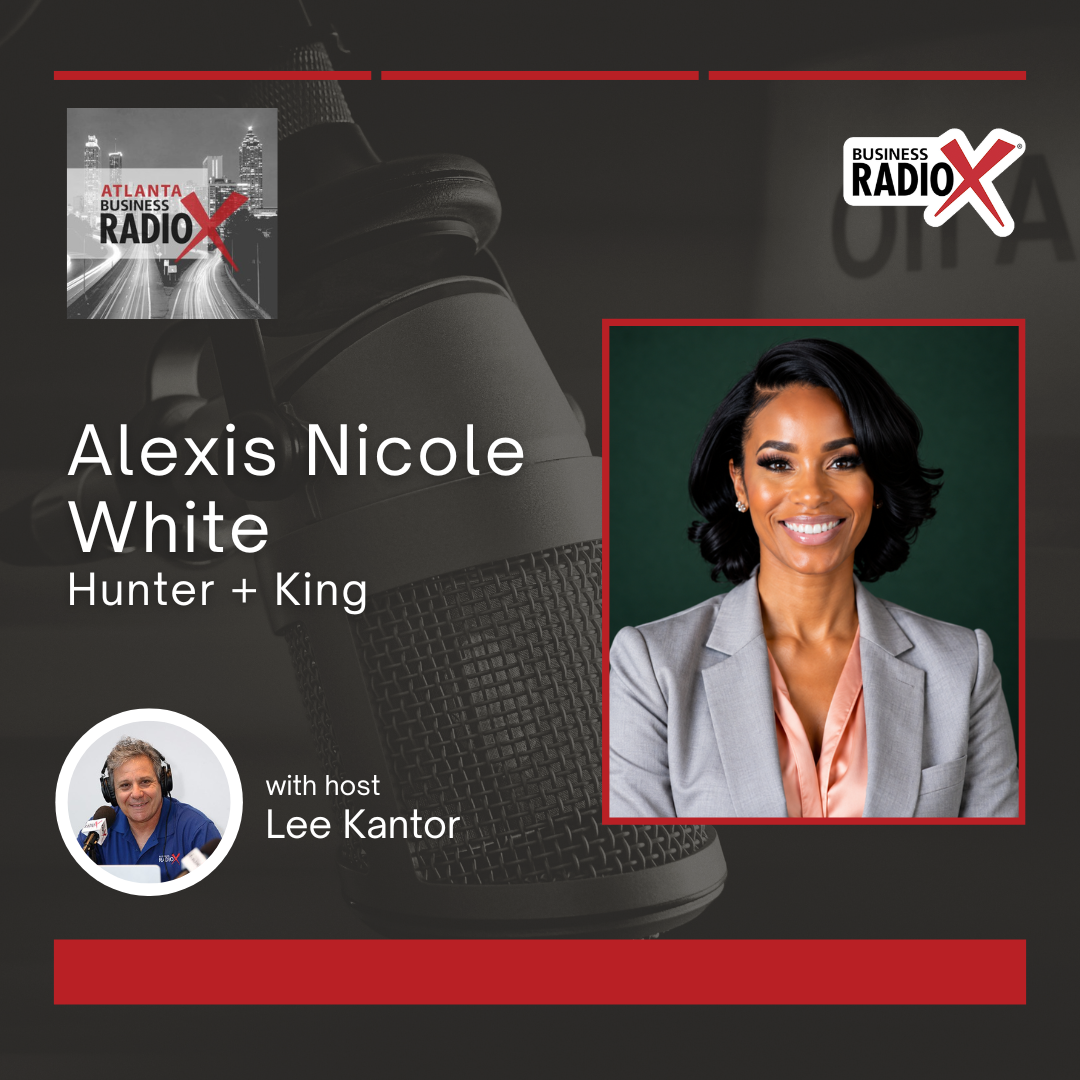

 In this episode of Atlanta Business Radio, Lee Kantor interviews Alexis Nicole White, Fractional Chief Transformation Officer at Hunter + King, about helping businesses turn strategic ideas into measurable results. She shares how founders and growing companies can overcome operational challenges, align their teams, and build strategies that support long-term growth. The conversation also explores strategic AI implementation, change management, organizational transformation, and the importance of connecting business initiatives to clear objectives and measurable outcomes.
 Alexis Nicole White, PMP, is the Founder and Chief Transformation Officer of Hunter + King, an Atlanta-based firm that helps growing companies turn great ideas into real results.
With 15+ years of experience across Fortune 200 and private equity-backed organizations, she has worked on both sides of the table, building strategy and leading its execution. Her work includes identifying $80 million in cost savings across $210 million in vendor spend.
Her message to leaders: Change Comes. Transformation Stays.
Connect with Alexis Nicole on LinkedIn.
What You’ll Learn In This Episode
- Bridging the gap between business strategy and execution.
- Identifying operational inefficiencies and opportunities for sustainable growth.
- Aligning people, capital, and resources with organizational goals.
- Implementing AI strategically while maintaining human oversight.
- Measuring technology investments through clear performance indicators and ROI.
- Managing organizational change and successful mergers and acquisitions.
- Empowering teams through delegation, accountability, and effective leadership.
- Building actionable business strategies that drive measurable results.
 This transcript is machine transcribed by Sonix.
TRANSCRIPT
Intro: Broadcasting live from the Business RadioX Studio in Atlanta, Georgia. It’s time for Atlanta Business Radio, brought to you by My Global Presence, the award winning Atlanta public relations agency that elevates brands and nonprofits through authentic storytelling and national media campaigns. Find them at myglobalpresence.com. Now, here’s your host.
Lee Kantor: Lee Kantor for another episode of Atlanta Business Radio. And this is going to be a good one. But before we get started, it’s important to recognize our sponsor, My Global Presence. If you want global visibility and meaningful impact, go to myglobalpresence.com. Today on the show, we have fractional Chief Transformation Officer with Hunter and King, Alexis Nicole White. Welcome.
Alexis Nicole White: Thank you so much for having me, Lee.
Lee Kantor: Well, I’m excited to learn about your firm. Tell us about Hunter and King. How you serving folks.
Alexis Nicole White: Hunter and King is a management consulting firm. We are on the boutique end where we specialize in partnering with founders all the way up to lower mid size companies and developing their strategy and bridging the gap between that and their execution to deliver long term, sustainable, measurable results.
Lee Kantor: So what’s your backstory? How did you get involved in this line of work?
Alexis Nicole White: Absolutely. So I actually started out my career in the tech space, being a project manager for the first leg of my career. And after stalling in the middle of very expensive and long projects, I started to get frustrated, honestly, and I wanted to know more about the decisions that were made leading up to these moments where I had a scope that I couldn’t deliver or implement. And so I started to become curious. I went ahead and grew my career in different levels and tapped into the senior leadership side of strategy that developed the projects on the back end. And so I realized after I sat in ample meetings, listening to the decisions that were going into this, that there are other people outside of fortune 500 companies and private equity owned companies that need this information as well, because their goal is to grow and everyone wants to be competitive, but not everyone knows how to go about being competitive. So that’s how I’m here.
Lee Kantor: So have you landed on kind of an ideal client fit for your firm? Is there a sweet spot that you’re exceptional at?
Alexis Nicole White: Yes, I love working with founders and startups going up to mid-size. What I find is that these individuals are hungry for success, but they’re also willing to take the risk that the. In. And believe that we can build a strategy that is going to help them win. Strategies are changing every day. We live in a volatile market, and even the largest companies are having to revisit what their strategies are in order for them to remain competitive. And so what I enjoy most is being able to look at what their capabilities are, help them build the capacity and map it out in a way that they know that they can execute.
Lee Kantor: Now, how are you defining like strategy? Is this kind of a true north for the focus of the business? Because can you define it? Let’s start there.
Alexis Nicole White: Yes. So when we talk about strategy, we talk about developing the North Star. As you begin to lead to we need to develop what is that plan of action and what does it look like across your business? How are we aligning our strategy with our capital, with our talent and how are we sponsoring these changes? One thing is for sure. Change comes, but transformation stays. And the only way that you’re able to do that is if you plan for the resistance, if you plan for the volatility, if you plan for the things that you don’t even know that are possible, that are going to happen, you have to be able to manage the risk and all of this. So by developing a strategy, we’re evaluating not only who your competitors are, we’re looking at where you measure up to them, and we’re looking forward to who you want to be in the near future.
Lee Kantor: So, um, what is kind of the problem that your company solves? Like, are there signals at the organizations, like right before they contact you? Are there some signals or signs that, hey, something might be amiss? We should call up Alexis and her team to look at that. Is there a precipitating event or a trigger?
Alexis Nicole White: Well, sure. Right now everyone is looking at their numbers because revenue is kind of flat across the board. So one of the signals would be leaking value, not understanding where your money is going. Feeling like you’re running your wheels in a circle, you’re doing the work, but you’re not seeing the return. And it is so often, more often than not, where everyone is in agreement and in alignment with the strategy and an approach to going about it. But once you get in the thick of moving it, you don’t understand where it is benefiting, how it’s benefiting, or why it’s costing more than what you projected for it to cost. And when you are a company of a smaller size, you don’t have that threshold to waste millions of dollars trying to get a software service implemented. Trying to remain competitive with artificial intelligence is the main one that everyone is installing in their in their workplace now. But you want to make sure that you are always moving at the right place, at the right time and evaluating the things that you need to start doing it in the things that you need to stop doing. So those are some of the signals that may tell you as an indicator that you need to revisit your strategy and look to finding ways to reinvest in your business and transform for the long run.
Lee Kantor: So how does a customer or potential customer know that maybe we should get fresh eyes outside eyes on this, rather than just kind of rely on the team?
Alexis Nicole White: Sure. So one signal may be your revenue is flat. You’re not attracting the customers or retaining the customers that you initially began to attract. Another 1st May be that there is a direct competitor that is starting to pick steam up, right? And then also when you feel like your team is not cohesive and there’s a lot of conflicting views and opinions about how to move forward with one approach, that’s when you definitely want to get someone else in to come and partner with you as the leadership team, but to also collaborate with the senior leaders and to help direct those tactical teams with the right way and the right approach and the way to go.
Lee Kantor: So say that they all that happens, they raise their hand, they’re like, okay, I’m going to call Alexis and her team. What does an engagement look like? How do you how do you begin your work?
Alexis Nicole White: Sure. So after having some type of conversations to develop an assessment and to be able to review the results with the client, I will then scope out what that engagement looks like. If you prefer for us to be just a short term engagement and give a recommendation, we can do that. But preferably what makes us different is that we stay with you throughout the engagement to ensure that you are delivering the things that you sought out to deliver. If we just handed you a recommendation and said good luck, then it’s not really effective for your behalf. Because in that instance, if you knew how to do that, you wouldn’t have called us to begin with. So what we do is like, we like to stick with you. We do periodic check ins. We will come in, we will help you do the work and teach you how to do the work so that when you need to do this on your own in the future, you’re well able to do so.
Lee Kantor: So it’s a combination of coaching and consulting where you’re going to have deliverables as well. Or is it just advice?
Alexis Nicole White: Well, it depends on what they want the engagement to be. So absolutely, if they need a little bit of coaching, we can help with that. If they need us to produce the information that’s going to result in deliverables and take action to do that work, we can do that as well. It just all depends on what that particular business needs at that time and what they’re willing to absorb.
Lee Kantor: Now, in your work, I think you’ve I think on the website, it says something to the effect of good ideas don’t fail. They get abandoned. Can you talk about, um, first, how did that kind of aha moment come to you? Did something happen in your career that you were like, hey, maybe this is happening a lot or. And what can firms do about it?
Alexis Nicole White: Well, yes, it has happened many a times, but to me that is the new normal. And what I mean by that is when you look at how companies take on their corporate strategy, you have to do various analysis. And one of them is the Pestel analysis. And the P in that stands for political. So as laws and regulations continue to change, those influences are external items that are outside of your control. And in order for you to become competitive, you have to adapt to what those political forces are. With that, you may have had a great idea about how your your approach. We could use tariffs for an example. You may have had an approach about you going to source an item from China, but then the tariffs came about right. So that was something that you did not see coming. Now you have to re restrategize what that is going to your approach is going to look like. And so what typically happens in instances like that, although I’m using that as an example. People just say, never mind, or they’re not seeing the immediate results of what they thought was going to be the right approach, or they start to look at their EBITDA and they’re like, okay, this is costing me way more than what I thought it was. So we need to stop doing this or something totally left field comes and now that’s the new thing to do. So we see that a lot within the embedding of artificial intelligence in tech spaces now, where everyone is jumping on the bandwagon, because that is being a pushed agenda politically. However, what is also starting to happen is they’re not seeing the returns. And so you have to have that patience. And what starts to happen when you don’t have that patience, people just say, never mind. They go find something else to start focusing on.
Lee Kantor: Now. Do you have any advice for the leader of an organization that might be thinking about exiting? Is there some things they should be doing, some do’s and don’ts in order to, um, you know, cause a successful exit.
Alexis Nicole White: Well, when you talk about successful exits, that’s an interesting question because a lot of leaders are leaving their current post and going on to other organizations for various reasons. And when a new leader comes on board, they’re going to bring their own strategy as well. So my recommendation is for a leader that is replacing a new leader or starting a new role is to look at what has already been done. As critical questions about what has already been done, and try to find a common ground so that you’re not wasting what the work that has already been delivered prior to your arrival, and having those conversations where you’re also partnering and collaborating with other business leaders. And I have this saying about going from the suits to the boots. But I feel like when you keep people in the forefront and have that people centricity, you get the real deal on what’s going on on the front line level, and that information is vital input for any strategy that is being developed. So with through that collaboration, I would say if you’re coming in that those are the things that you need to do. And if you’re preparing to leave, make sure that you’ve stood up your strategy or your program, whatever you want to frame, whatever the body of work is that you were doing. Make sure that you leave it in a place that someone behind you. If you don’t hand it off, they can come back to figure out where you left off.
Lee Kantor: So how do you help that? Um, maybe the founder of the organization or the leader of the organization, um, not be the bottleneck and not, um, you know, be an obstacle for the rest of the team.
Alexis Nicole White: Well, you know, that’s a really good question. And I understand that everyone wants to protect their precious baby, right? So your, your, your business is your baby, but at some point, you have to start being able to trust the other people that are there to help you so that you’re not the bottleneck. And if you find that you’re not able to stay on top of your meetings, you’re not following up in a reasonable time. You know, things are slipping. Things are not moving forward. You definitely need to put some processes in a way that that allows the other people that are there to help you and have the authority to make those decisions within a reasonable threshold and have those check in points with your team where you’re following up with them, and also allowing them to give you recommendations and suggestions based on what their eyes and ears are telling them about the situation. Because you cannot possibly be everywhere and do everything all the time. If so, you wouldn’t have health there. So relying on your help, hiring good help. I know a lot of people say it’s hard to find good help, but it’s ample talent out here right now, and people are looking to partner with other people and collaborate and work and do all the things in the various ways within other organizations. So find talent that aligns with you and trust them to do the job that you’ve hired them to do.
Lee Kantor: Now, earlier you mentioned AI and everybody is kind of, Um, at least playing around with it. Maybe they’re not doing everything as well as they would like, but any advice around AI in terms of implementing some strategies and policies around it? Because to me, AI, it means something different to everybody. Ai in the HR department might be used differently than AI in the sales and marketing department, or the IT department, or even in the C-suite. Can you talk about how you help companies implement AI in a strategic manner?
Alexis Nicole White: Absolutely. So one thing I want to clarify is that a lot of people think that AI is this add on thing, and many of us are already using technology platforms that have AI already embedded in it. So whenever you’re creating a strategy, oftentimes leaders are looking at it as a cost savings and how they can reduce headcount and have people, um, routed to doing other bodies of work while they let this automation work. And what we’re seeing is that that’s not technically true. You still need a human in the loop. So my recommendation for people that are looking at embedding tech AI to help offset those costs or even to create other efficiencies with the business, get clarity around what that use case is for that particular function before you just go and buy some software. Understand how they’re using it. Understand the functional benefits from implementing artificial intelligence within your processes and systems. And also think about future growth. Once they have automated this and you still have a human in the loop, but they’ve gained some efficiencies in time, what else are they doing with that extra time? That’s one thing that leaders are not calculating. Once you freed up two extra hours in a day, then what else are these individuals going to do for those other two hours of the day? Also, I want to caution leaders when making decisions to make these capital investments in AI.
Alexis Nicole White: Right now, it looks like a cost savings because you’re just getting started. But prepare for those cost increase as you go through the renewal periods. And what we’re finding is that companies have that have laid off, people are calling them back to work, maybe not at the 100% rate that they were hiring or had the staff before, but they are hiding hiring back because they need these humans in the loop to help remediate issues, be able to verify data, uh, document other points, and still do some work that is affiliated with it. So I would tell any loser, any, any user, uh, of executive leadership that before you implement artificial intelligence, understand the use case for why you’re putting this technology in your business, what are you hoping to get and actually do a baseline so that you have something to measure against to see if it’s, if it’s successful and it’s giving you the return on investment that you forecast it for it to give you.
Lee Kantor: And how often should you do that kind of auditing?
Alexis Nicole White: I would say on a quarterly basis. Now, I understand that you won’t have immediate results, especially when you’re in flight with getting it in place. But again, if you use that baseline as a measuring point to tell you, okay, this is where we’re starting, we know that it takes this particular individual on this team, you know, 60 hours a week, I’m making something up to do, you know, X, Y, and Z. But by embedding AI, we anticipate that that’s going to reduce down to an actual 40 hours. Start taking those measurements. And once you have that software in place, I would say that you should have some type of monthly reporting so that once you get to the quarterly basis where you’re doing your review on, on what is working or not working in your strategy and look at your finances, you have three months worth of data that you can aggregate and then synthesize to understand if this is a value add. And if it’s not, then perhaps there’s something that you need to do to like refine what your approach and your strategy is for how you’re expecting for those results to take place, or what you can do is start to reinvest that human capital individual that is there in some other area of the business that can benefit from that support with that difference in time.
Lee Kantor: Now, how do you help the teams, um, kind of explore the things that they couldn’t plan for once they start leaning into AI because AI is not a calculator where you just go, oh, look at it. It helps me add those numbers faster. So that saved time. But it can also help you in a lot of creative ways that maybe you couldn’t have anticipated until you start actually using it.
Alexis Nicole White: Right? So before we get to that point, I would encourage any leader that’s thinking about going through this to do a user case where you do like an employee mapping journey and go through there every day. It may come through job shadowing and just map out what are the functional uses for why they have these gaps or these needs before we just assert that AI is going to be the problem solver. Once you have that, you can look at the specific task and say, okay, this can be automated. Then the question is, how can this be automated? What are we expecting for this to do in terms of a savings? Are we going to see a savings at all. Um and then sometimes you can also look at it where you find out that you freed up another so much time that another person can be hired to do something else in place of those differences. So I look at exactly what is that team doing? What is the functional use case for that particular roles, that role that’s already there? What is their actual job? Because there is always a vast difference between what you think a person is doing and what they’re actually doing every day, and map that out and present that back to the leadership team so that we can have real conversations about what the current state is and what we want the future state to be.
Lee Kantor: Now, does your organization work with, um, venture groups or private equity, um, to help kind of in the, when, when a merger acquisition happens to help the people get on the same page.
Alexis Nicole White: Yes. And that is a major piece of transformation that is often skipped. When we think about transformation. There are several different types of transformation. You have organizational transformation, cultural transformation, and then you also have a business transformation. And in those cases, when you deal with mergers and acquisitions, it is imperative that you not only acquire, but that you integrate. And a part of that integration deals with transformational work that comes in different lenses and spaces. And from the most part, it’s around people. And a lot of people are forgetting that people centricity is the motor behind your business. Without people, you have no business. People buy people complete tasks. People call people. Right. So people are so important. But with that, you need to have a change management strategy in place to help people understand what’s in it for them, what is happening, why it’s happening, and what is going to be done differently to prepare for that resistance of the company that is being acquired, but to also be able to prepare the people who are going to be integrating with these other people, the different cultures, the different languages, all of the things that people seem to miss, in addition to all of the technicalities of an acquisition and a merger that occurs.
Lee Kantor: Is there a story you can share that maybe illustrates how you work with a team? Don’t name the organization, but maybe share the challenge they came to you with and how you were able to help them get to a new level.
Alexis Nicole White: Absolutely. So I have a client right now who is going through a strategic transformation where their business model is starting to shift from their, their startup day to day. They’ve gotten a better opportunity and a better clientele of their own, where they can reroute their whole tire business and but still operating under the old business model. And so what I’ve been doing recently is having them to understand, listen, you don’t have to avoid one side of the business for the other. This is where you grow and you expand. So I’ve been mapping out for them what their operating model is going to look like. I’ve been projecting out some of the forecast about what their revenue will look like over the next six months to help them understand that this is a win win situation. And so a lot of times, and I brought this to their attention, just because you’re a smaller company doesn’t mean you have to shut off when you don’t think you don’t have the capacity. This is the opportunity for you to partner with someone else and to be able to get them to some business, right? So that’s some of the things that I do when I meet with clients. This client is a particular six $600,000 revenue company. So, you know, it seems like that small and scalable when you’re thinking about them growing in a different direction and how much more money they’re making in this strategic transformation, it’s worth the partnership with someone else.
Lee Kantor: So before we wrap, is there any advice you can give an owner like right now? Is there anything actionable or recommendations you can make right now? Some moves that can help them, um, end the year with a bang?
Alexis Nicole White: Absolutely. If you have a thought in mind and a strategy in place, we should not be taking on anything that does not map back to that strategy. I understand that this is the time of year where everyone is recalculating their budgets for next year. They’re looking at their strategies and their initiatives, and I will tell you, there should not be any strategy or initiative that is not connected with one another that does not have an objective, a key result, a, a key performance indicator, as well as a owner tied to it. When you have all of these things in place, that not only ensures that every investment is meaningful and has purpose, but it also shows you how to make sure that you’re getting the delivery and value add out of that item. And you want to also be able to hold people accountable when they’re not doing what they said that they would do at the rate and speed that they thought that they would be able to do it.
Lee Kantor: So if somebody wants to learn more, have a more substantive conversation with you or somebody on the team, what’s the website? What’s the best way to connect?
Alexis Nicole White: You can find me at hunterandking.com or contact me on LinkedIn at Alexis Nicole White I do read every message, so reach out to me.
Lee Kantor: Well, Alexis, thank you so much for sharing your story today. You’re doing such important work and we appreciate you.
Alexis Nicole White: Thank you so much for having me, Lee.
Lee Kantor: All right. This Lee Kantor. We’ll see you all next time on Atlanta Business Radio.