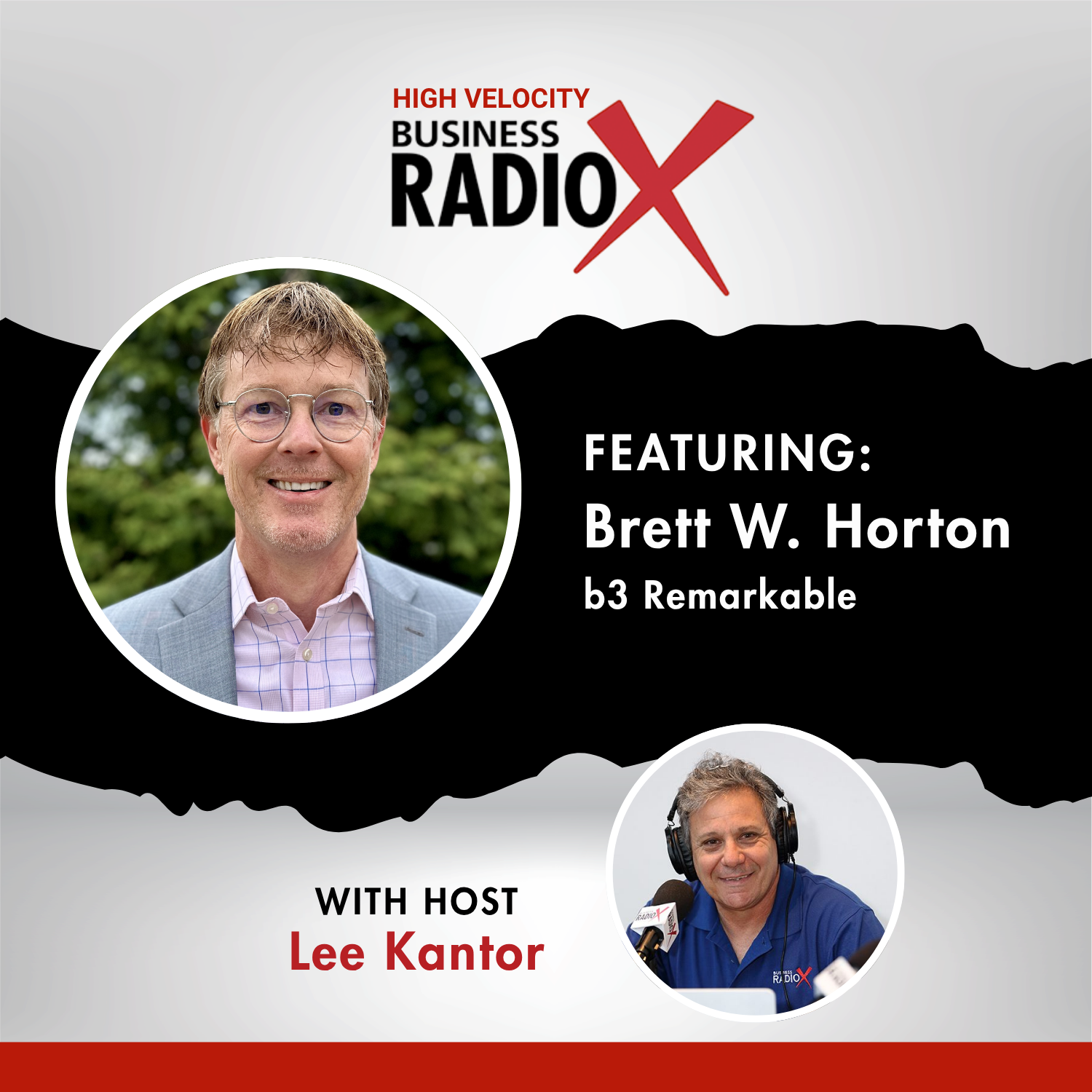

In this episode of High Velocity Radio, Lee Kantor interviews Brett Horton, founder of b3 Remarkable, about compassionate leadership, executive coaching, and helping individuals and organizations become better versions of themselves. Brett shares how empathy, trust, kindness, and intentional leadership can strengthen teams, improve engagement, and create meaningful business results. He also discusses the GROW coaching model, family business leadership, succession planning, and the five principles from his book, Five Words to Change the World.

 Brett Horton, PhD, is the CEO and founder of b3 Remarkable, a leadership development firm dedicated to empowering leaders who guide with compassion, kindness, humility, gentleness, and patience through customized coaching, speaking engagements, and leadership training sessions.
He draws on more than three decades of professional experience that span higher education, hospitality, executive coaching, and business strategy, aligning leaders with deeply held values and inspiring them to lead in ways that honor both people and profit.
Prior to founding b3 Remarkable, he served in a variety of professional roles, including as senior director of operations at the WinShape Retreat Center, founded by Truett Cathy, founder of fast-food restaurant chain Chick-fil-A. In higher education, he taught and mentored students at institutions such as Iowa State University, James Madison University, and Kansas State University, sharing his passion for service oriented leadership with emerging professionals.
Earlier in his career, he gained foundational experience in world class hospitality settings, working at The Greenbrier Hotel and Resort and The Broadmoor Hotel and Resort, and establishing his appreciation for service excellence.
Dr. Horton earned his doctorate in hospitality management at Purdue University, his Master of Business Administration at the University of Colorado, Colorado Springs, and his bachelors of science in hospitality administration from Kansas State University.
He lives with his family in the Kansas City area, where he enjoys being outside in all types of weather, running to clear his head, preparing food for his family and friends, and a wonderful bottle of wine with his amazing wife.
Connect with Brett on LinkedIn and follow b3 Remarkable on Facebook.
What You’ll Learn in This Episode
- Building stronger leadership through compassion, empathy, and emotional intelligence.
- Balancing people, planet, and profit for sustainable business growth.
- Creating trust as the foundation for effective teams and healthy conflict.
- Recognizing how employees prefer to receive appreciation and celebration.
- Using the GROW model to clarify goals, reality, options, and the will to move forward.
- Understanding the difference between coaching, consulting, and leadership development.
- Preparing organizations and family businesses for leadership transitions and succession.
- Leading with compassion, kindness, humility, gentleness, and patience.
 This transcript is machine transcribed by Sonix.
TRANSCRIPT
Intro: Broadcasting live from the Business RadioX Studios in Atlanta, Georgia. It’s time for High Velocity Radio.
Lee Kantor: Lee Kantor here. Another episode of High Velocity Radio and this is gonna be a good one. But before we get started, it’s important to recognize our sponsor, Business RadioX. If you are a business coach who’s tired of being a best kept secret, set up a call with Stone Payton at bookstonephone.com to unlock your perpetual prospect pipeline. Today on the show we have Brett Horton who is with b3 Remarkable, welcome.
Brett Horton: Thank you. I appreciate that, Lee.
Lee Kantor: Well, I am excited to learn what you are up to. Tell us about how you serving folks.
Brett Horton: We are a leadership development and executive coaching. So we help people become the best version of themselves by asking them questions and helping them and their teams grow. So we’re doing a little bit of both from the concept of if it’s an individual, I’ll start working with them and we’ll do coaching in a traditional sense. I like Sir John Whitmore’s grow model, and so we start with that and build around it. And if we’re working with teams, I always try to make sure that we walk away with something that they can implement in ten days or less. And then I check back with them and say, how did it go? And we have that relationship, and I think relationships are all that matter.
Lee Kantor: So what’s your backstory? How’d you get involved in this line of work?
Brett Horton: Well, I grew up on a family farm. If we start there. I had a wonderful mom and dad and some siblings that, uh, kept me humble and taught me a lot. My my dad taught me to ask questions. And that’s kind of where we started, went off to college, spent time in the high industry or high end industry of resorts. Working at the Broadmoor in Colorado Springs and the Greenbrier in West Virginia. Got into higher education for a while. I have an MBA in finance. Uh, got a PhD from Purdue University. Go Boilermakers. And then went off and taught at Iowa State and James Madison University. Had the opportunity to go work for chick fil A for about seven years, running a retreat center for them. So that was kind of fun. An 800 acre, 80 room marriage retreat taught me a whole lot about running, working with people and helping them become their best selves. And then we had a chance to come back to Kansas City, back to where I, uh, closer to where I grew up. I’m still seven hours from home, but back to Kansas City and my wife of 32 years and I have decided we love Kansas City. Taught a little bit here. And then we decided to launch be three remarkable and really help companies grow and become better. Had a fortunate opportunity to work with a former student who’s the chief Operating officer of what is now Lucky Strike Entertainment. And that contract and rewriting their training program really launched the B3. Remarkable. It made us that company that said, you know what? We can make it through that first 2 or 3 years when it’s usually pretty lean.
Lee Kantor: Now, from a background in hospitality, and especially at high levels of hospitality, people who are really trying to, you know, kind of be the best of the best. How does that inform your leadership coaching? Where do you see learning opportunities for leaders to lean into some of the tenets of some of the great hospitality brands?
Brett Horton: You know, growing up, um, I had the opportunity my first job out of school was at the Greenbrier Hotel and Resort. And my boss was a fine gentleman by the name of Rod Stoner, but he was like the third of the, um, major individuals who built their food and beverage program. And it was all around, ladies and gentlemen, serving ladies and gentlemen. And I think if we understand that we are all ladies and gentlemen, and we’re all serving, ladies and gentlemen, it becomes a much more compassionate world we live in. And so I really try to help people understand that, you know, we all have our different stories. We all come from a different place. And if we can just embrace the fact that we don’t know where people are at, but help them get to the next level, it becomes real powerful. So I try to help leaders find out where their employees are at, where their their peers are at, where their, um, supervisor is at, and then work with them to become better. And that becomes real powerful and arguably remarkable.
Lee Kantor: Now, how do you, um, help your clients kind of turn on that empathy gene if they don’t have it already in terms of looking at things through the lens of their people rather than the lens of what my company needs to be successful.
Brett Horton: And it’s interesting, I’m just working on a presentation right now and it’s, uh, my premise of our company has always been focusing on people, planet and profit. So you have to balance all three of them. We have to take care of our people. We have to take care of the bottom line. Otherwise we can’t take care of our people. Um, and then let’s be honest, we’ve only got one planet right now. No matter how hard we’re trying to get off of it and build another one, we are here on this amazing earth. And let’s, let’s take care of it as we go forward. Um, the first thing we have to do is think more about the other person than we think about ourselves. And that just, uh, was kind of revealed to me in some work I’m doing right now and, and reading some work by, uh, tick, not Han and, uh, the Dalai Lama and, um, another individual, uh, father Richard Rohr. And it’s like, you know, when I start thinking about others as opposed to thinking about myself, compassion and empathy and emotional intelligence becomes very, very possible. But when I’m only thinking about me, it becomes almost impossible. And so if we can begin to ask the question, what is the other person thinking at this time? What would an outcome look like in their world? It’s amazing that we can get into the other person’s head and we can go, oh, I see kind of where they’re coming from now.
Lee Kantor: Now when, uh, somebody hires you to do this kind of deep leadership work. Does it require them to kind of have that self-awareness that to even unlock some of the things you’re talking about or, or certain things happening within their organization, it’s almost forcing them to, to make some changes and to, to maybe, um, to have these kind of deeper conversations like, and if so, then what are some of those signals to a leader that maybe it is time for me to, to rethink some things.
Brett Horton: You know, an easy one is oftentimes their engagement scores, if they’re doing a, a employee engagement, uh, concept. Uh, so that’s a key performance indicator is, oh, my engagement scores are not great. And I don’t know what the problem is. Okay. Well, then we’re gonna have to do some discovery, some problem solving, see if we can figure that out. Uh, oftentimes is KPI, you know, your key performance indicators of revenue, sales, Profitability. Some of those types of things. Turnover is another easy one. It’s like, man, we’re just churning through people. That’s a classic example in the hospitality industry is we’re getting, you know, taking us so much time to train people. It’s like, well, have we thought about why that that’s actually the case? Um, and if we can begin to delve into that, I will say the one character that is necessary for somebody to work with me and, and I can work with them is a desire to get better. Uh, you don’t have to know how to get better. You just have to want to get better. So if, if the organization or the individual says, you know what, I want to get better, then we can make it happen. If they’re not invested in in wanting to improve, then probably they’re wasting their money on me.
Lee Kantor: Now, is there any advice you can give to that leader that wants to get better, like what’s low hanging fruit for a leader that wants to get better.
Brett Horton: Um, you know, one of the questions I ask people oftentimes is, um, we, we do a piece on celebration, I believe a strongly in the fact that we celebrate other individuals. And if we celebrate them, that helps, you know, people like to be celebrated. The difference is we like to be celebrated differently. So for example, one individual might want, uh, a, some additional time off. Somebody else wants pay, another person wants to be celebrated in front of their peers and, and rewarded with claps and, and a, a plaque. Another person just wants to kind of slink into the back and have somebody just say thank you. And so the first thing I always ask is, I want you to list all of your employees And right down beside them how they like to be celebrated. And nine times out of ten, the employee will go. I have no idea how they like to be celebrated. We just have a standard celebration concept. You know that the human resources says, you know, if somebody does a great job, you give them 50 bucks. Well, that may or may not be what they want. And most people will take the $50, but that may have very little meaning. And you could save yourself $50 by simply saying, you know what? You did a great job. Thank you. I appreciate you.
Lee Kantor: Now, is it that simple? Just ask them at the beginning of when they start with you, how you like to be celebrated. You know, that’s the start.
Brett Horton: We we have to have a trust. Um, Patrick Lencioni, uh, does a lot of work with, um, the In the advantage or his second book, The Five Dysfunctions of a team. And he says the foundation of any great organization is trust. You know what? What Michelle and I have is 32 years of trust. And we might run into a rough patch here and there, but we’ve got to trust and and building that trust. So rod Stone or that guy that hired me up 31 years ago, him and I still trust each other. And so we can have those open conversations. But you have to have a foundation of trust before we can get all the way up to making changes and creating great results and having, uh, good conflict with each other. Because again, there is a difference between bad conflict and good conflict. And we talk about that and we help people understand that, um, good conflict helps us get better. Bad conflict shuts us down.
Lee Kantor: Now, uh, you wrote a book, Five Words to Change the World, leading with compassion, kindness, humility, gentleness, and patience. What was the impetus of that? What what motivated you to get everything down and, and write about it?
Brett Horton: Well, one of the things I do to center myself every day is to wake up early when the house is still quiet and I read some devotions. Um, some of them are are Christian esque devotions, some of them are not. But I try to focus myself and I was reading the Bible at this time, and these are Paul’s words. So I totally, totally plagiarized his five words, but they really resonated with me. At one point, I, I mean, I’ve read the Bible multiple times, but this time these five words stuck. And so I just literally wrote on the word compassion until I had nothing else to say about it. And then I moved on to the next one. And it was all just longhand journaling. And then a prior super administrative assistant of mine said, Brett, I would be willing to type that up. And I’m thinking that’s a huge undertaking. But she was one of the only few people who could read my writing. And so, uh, Suzanne Mitchell typed it all up for me and it sat there for another 2 or 3 years. This probably took five years from writing until book. Um, then we found a company that was willing to help me and edit it. And Jamie Fleming with Bright Rays helped me throw this together and say, you know what, we can make this a great book.
Brett Horton: And, and I, I give all the credit to the other individuals because it was just my initial thoughts on how do I become more compassionate? How do I become kinder to myself and to the world? Um, how do I lead with humility? Um, I think that that word has, it needs to figure out a new way for us to understand humility because it’s not about being self-deprecating. I’m always an early Johnny Carson fan. And so Johnny Carson made his humor by making fun of himself. But. And it worked for Johnny. Uh, but, uh, you know, how do we do that? Humility. How do we treat the world and ourself gently? Uh, I don’t always do that well, but that’s, that’s a goal. And then ultimately realize that, uh, I’m a work in progress and I better be patient with myself. And so over the course of about three months, I just hand journaled those, uh, five words. We got them typed up. We worked with an editor. They made it, made make sense out of it. And lo and behold, we now have a book that’s, uh, available for purchase.
Lee Kantor: Now, does the book, um, obviously it was you were writing it from a place where you were heavily invested in those words at that time. Does it kind of Summarize kind of the be three remarkable foundational elements to your coaching.
Brett Horton: That’s a great question. And I think it is more and more every day. Um, in, in me trying to make sure that I’m compassionate, uh, that I’m trying to be kind as we go forward. But be honest, if somebody is, is totally out in left field, it’s like, hold it time out. I want to be kind, but I want to bring you back to reality. Uh, I want to, I want to make sure that you’re focused on what, what you can, where you can improve and be the best possible version of yourself. So it does. Those five words are part of our, uh, value statement. And so, uh, the other one is, uh, do small things with great love. And, uh, if, if I can just do the little things every day, then I’m a happy camper. Just like what you’re doing. You’re, you’re interviewing people, you’re doing small things with great love and you’re doing a great job of it.
Lee Kantor: Well thank you. Um, is there a story you can share that maybe illustrates what it’s like to work with you and your firm? Um. Don’t name the name of the company, but maybe share the challenge they came to you with and how you were able to help them get to a new level.
Brett Horton: Um, you know, it was interesting. The one that comes to mind off the top of my head is a, is a small company I started with, uh, about two years ago. And literally they were not profitable. And the individual I was working with said, I’m trying to get the company set up so I can sell it because this is just killing me. Uh, I have a beautiful grandchild and I want to spend time with them, but I can’t because I’m spending all this time with this operation and I can’t spend time there and, and, and take care of myself. And so it was all about Brett, can you help me get this company to the point at which we can sell it, and I can get out from under it and I can just move on. And so we started working together, uh, just the owner and I, and then we brought in some management individuals, but she got to the point where she was able to realize that she could make money as an, and be an owner. And it was a transition from being the manager on the floor every night to being the owner of this operation, being more profitable and being able to step back and have time for herself, her, and to build the, the operation itself.
Brett Horton: So that’s my, my one success story, uh, that I love because it’s so distinct. It’s what we as small businesses do. It’s how do we, how do we do our business really well? And I’ve worked with big companies as well, uh, developing training programs and, and those types of things, which are exciting, but you just don’t get to see the, the detail of, of the one individual growing and, and sooner or later she got to the point where, um, um, she said, you know what, I’ve made it this far. Um, let’s stop for a little bit and, and um, reap the rewards she has and, and I’m certain we’ll work together again at the future. But right now she’s in a pause. So that’s been really positive because the goal is to see us succeed. Honestly. You know, you don’t want to if you’re working with them forever, then you got to ask the question, well, are you really doing them a favor now?
Lee Kantor: Is your work primarily coaching or it sounds like some of this kind of could bleed into consulting? Is there is that a gray area for you?
Brett Horton: It it bleeds over between coaching and consulting and leadership development. Uh, I try to strongly start with a discovery plan of, hey, what, what is it that you need to establish? And then we’re, I’m happy to, to transition one way or the other. Uh, if it’s like, I just need to stay at the coaching level, then that’s what we’ll do. Uh, I’ll lean into my coaching accreditation and, and just ask questions. But at times somebody will say, you know what? I, I want your advice, Brett. And I said, okay, well, I’m going to give you my advice, but that’s, that’s a consultant, not a coach. And, and I try to help them understand the difference between that and the fact that when I become a consultant, you don’t have to take my advice. Um, I’m like, um, there’s a model I use called rasky, responsible, accountable, supportive, consulted and informed. And the consultant individual in that model are like the points on whose line is it that just don’t matter. You don’t have to listen to the consultant. You just have to say, here’s what they said, and then take it and internalize it and, and make it your own and, and take it forward. And so I try to help people understand that when I’m in the consulting mode, they should, uh, should take it as that.
Lee Kantor: It sounds like you’re very focused on whatever outcome they desire and just trying to make that happen for them.
Brett Horton: Absolutely, absolutely. Um. The goal is it’s not my, it’s not my journey to take. I, I’m on my journey. I’m working on that. But if I were working with you, it’d be, where do you want to go and how do you want to get there? That’s that goal, that grow model. What is your goal then? What’s your reality? Where are we at currently, uh, that we want to go, that we, we identify these are the challenges we have. Uh, if you look at my journey, it’s like reality was my daughter was out of high school so we could move from Georgia and move back to the Midwest, where we were closer to my family. So reality changed and we could change. And then what options do we have? Well, I had the opportunity to, to teach for a while and start to build my own consulting firm. And so I did that. Those were options. And we kept looking at them. And there’s other options coming at me right now. And it’s like, I have to decide which is that, which of those things that I want to embrace and which do I not? Uh, and I do the exact same thing with each and every client. We talk about what your goals, what’s reality, what options do you have? And then the hardest one is what is your will to move forward? Um, I happen to be, uh, I don’t know if it’s middle aged or at 57. Does that make me middle aged?
Lee Kantor: Well, how lucky are you that, uh. Yeah.
Brett Horton: Yeah, but that concept is what is my will to get up and go for a run? What is my will to go? To stretch, to lift weights, to eat right to. And so I have to have a strong, strong enough will to make some of that stuff happen. And if I’m not, then the goal, the reality, the options don’t matter unless I have the will to make it happen. And so we spend a lot of time on that because that’s the last step of the, of the grow model that I really like. And you can make it really complicated. There’s lots of things you can add to it, but I love the fact that the model is simple enough for everybody to, to really wrap their head around is what’s my goal, what’s reality? What options do I have and what do I have the will to, to make happen?
Lee Kantor: Now, in the past, you mentioned, uh, you’ve worked with some family owned businesses and your business is a family owned business. Can you share some of the insights that you’ve learned from being part of a family owned business and working with family businesses, they’re a little different than, um, maybe conventional businesses.
Brett Horton: I think they are. I think they’re, they’re very much different. I grew up on a family farm. Um, mom and dad built a great farm. Dad, um, grew up on a farm, but a, a very, uh, he was one of six brothers and sisters and, and so, and it was a small farm, lots of story there moved. Uh, when he was married, he was in higher education, had the opportunity to go back to my mom’s, uh, dad’s farm and, and co farm with his brother in law. So they, they farmed together for a while and then ultimately have the two farms individually. Um, and it worked really well. Now we’re in the stage of that next generation of, of mom’s still around, but dad’s not there kind of leading the farm. And so we as siblings are trying to figure out how do you how do you move to that next generation? And I think that’s real important. And that’s been a great learning environment that there’s a lot of emotions around that. And some of them are logical and some of them aren’t, but there’s still emotions.
Brett Horton: Um, so anytime you have a family business, um, you need to be thinking about how do you transition not just the business as a whole, but the leadership of that. Uh. We, we were talking about it within a family business I was working with. And there’s the strategic transition, but then there’s also organizational staff planning. I’m working with a company right now. And, uh, this is not a family business, but he says within two years, we’re going to lose three very, very key people and it’s going to make our lives very difficult. And I said, so what’s the plan? You know, you’re going to lose them within 2 to 3 years. Do you have a plan for that? And they go, we haven’t thought about it yet. And I’m just, you know, this is when I kind of hold my head and go, okay, how do we get to a plan so that it doesn’t become a dumpster fire in three years? Because if we work on it right now, it doesn’t have to be a dumpster fire.
Lee Kantor: Now is there when it comes to family businesses, this is something I for a while, I did a show on family businesses and something that’s always fascinated me. And I had the privilege to interview some of the folks from chick fil A during that time. It was here in Atlanta. Um, so the dynamic of a family business for folks who aren’t aware is different kind of from a structural standpoint in that the families, typically the leadership of the organization and that they’re, you know, sometimes the younger family member will get promoted to a high level faster than maybe somebody who had worked there a long time could have gotten there, or even if it was even possible. But from a family standpoint, just a family relationship dynamics in a family, the family is always trying to kind of protect the weakest member of the family, just as a kind of a core value. Typically, we’re in a team or in a business that isn’t family run. They tend to want to get rid of kind of the weak performers so that they only have the best, you know, a players on their team, the right people in the right seats on the bus and all that. How do you kind of, um, or what advice would you give to family businesses when they’re struggling with some of that?
Brett Horton: Yeah, I think the key is to figure out what is that skill that that person brings to the Organization and to the family because everybody brings a talent. The challenge is we often don’t spend enough time, uh, with that gentleness and kindness and maybe even compassion to discern what is that skill that they bring to that family business. Um, you know, I’m, I’m sitting back here in my, my head is just spinning and the fact that I had the opportunity when I, um, operated winshape retreat to, to have a very close relationship with the three, uh, gen two is what they called it with Truett and Jeanette being gen one. I, I met both Truett and Jeanette and had some brief conversations with them, but I really knew, uh, Dan and Bubba and Trudy. And they have a distinct difference in how they look at life. Uh, but they all bring such marvelous things to chick fil A. And I think what, uh, Truett and Jeanette and then ultimately, Dan as the CEO, kept leaning in to his brothers and sister, uh, to say, hey, what, what is it that you bring forward? And I hope that Andrew and I’m certain he has I don’t know Andrew well, but I’m certain Andrew has said, what is it that those. I think there’s 12 maybe Gen three individuals on that. Don’t quote me on that because I can’t remember how many kids they’ve got of each. But, you know, 10 or 12 individuals as they get around the table, what do they each bring as their, uh, talent? And if they bring that talent and we celebrate that talent. Then the organization is going to continue to get better. That doesn’t mean Andrew as as the head of the organization, isn’t charged with doing some different things, um, that are maybe different, but he still has to lean in on his cousins and his brother and say, you know, what is it that you, you can add to this organization and make a family business continue to grow and prosper and thrive? I mean, here’s a multibillion dollar company still family owned and operated.
Lee Kantor: Right? And in America, that’s the exception, not the rule. Uh, no.
Brett Horton: No.
Lee Kantor: I mean, in Europe, there’s, you know, family businesses that are hundreds of years old. Obviously, America is not that old, but the most family business in America barely make it to the second generation.
Brett Horton: Yeah, we grew up. It was a standing joke was the first generation makes the money. The money, the second generation holds the money and the third generation loses it. I don’t know if that’s necessarily the case, but there are a lot of small family businesses. I just don’t think we see them as large. I mean, I’m I’m here in the Midwest where family farms have have gone to multiple generations, and I haven’t done the research recently. And I understand that corporate farms are, are having an impact on different things, but there’s still a lot of small independent family farms that go back multiple generations. Um, our, our farm itself is over 100 years. And this is in southwest Kansas, which the state’s barely that old.
Lee Kantor: Well, Brett, uh, if somebody wants to learn more about your book or about your firm, get on your calendar, uh, what’s the website? What’s the best way to connect?
Brett Horton: Best way to connect is just go to the website, uh, b3remarkable.com. Uh, you’re welcome to email me at brett@b3remarkable.com. And, uh, I look forward to having a conversation, learning more about the person who’s reaching out. Uh, let’s have a discovery. Let’s have a conversation, and then let’s see if we can work together to make the world a better place because that’s ultimately what we want to do. Um, and hopefully in the, in the meantime, I’ll make enough money to pay the mortgage, but I really just want to make the world a better place.
Lee Kantor: Good stuff. Well, thank you again for sharing your story. You’re doing such important work and we appreciate you.
Brett Horton: I thank you for having me on.
Lee Kantor: All right. This is Lee Kantor. We will see you all next time on High Velocity Radio.















