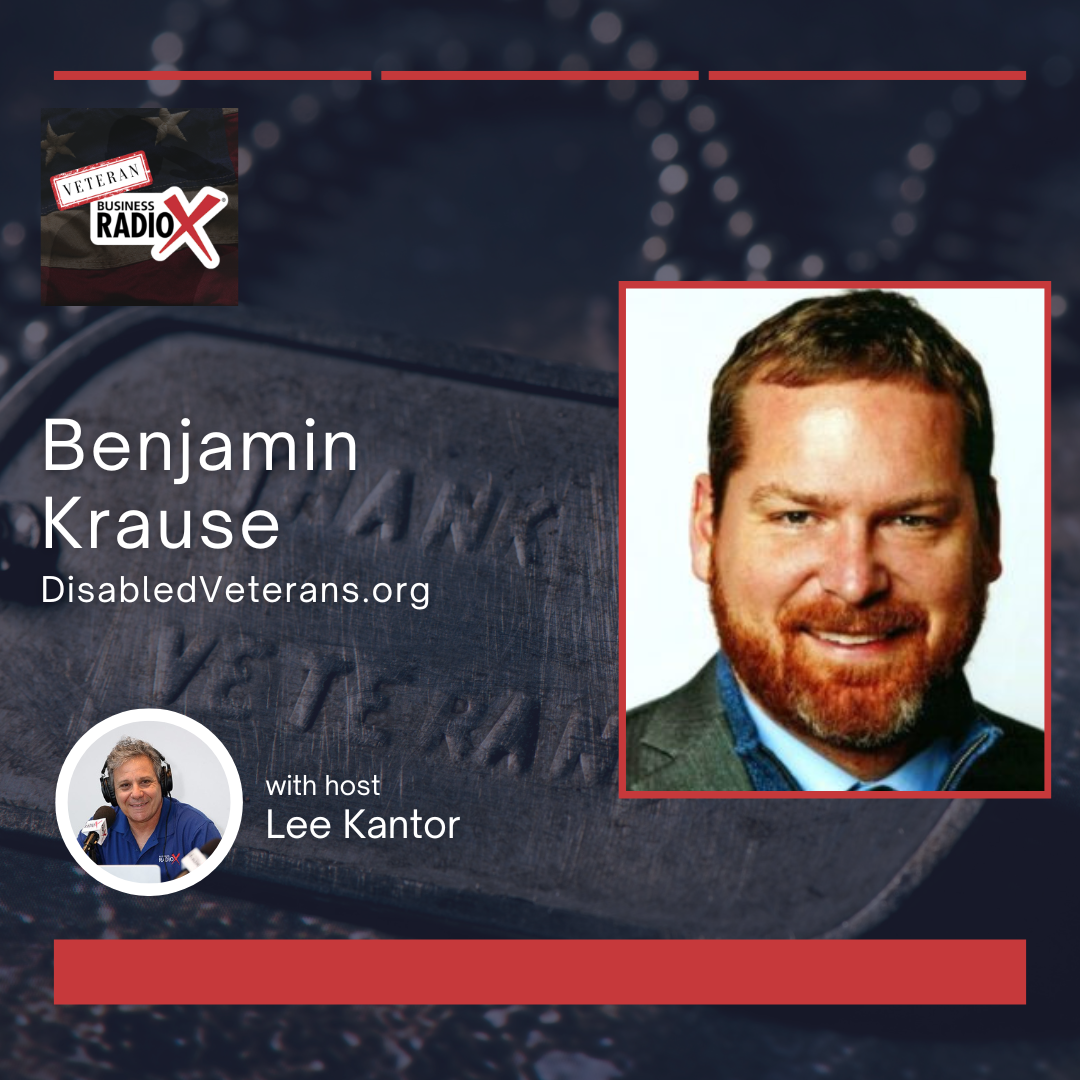

In this episode of Veterans Business Radio, Lee Kantor interviews Air Force veteran, VA-accredited attorney, and policy advocate Benjamin Krause, founder of DisabledVeterans.org. Benjamin shares how his own experience navigating the VA benefits system inspired him to become an advocate for veterans. He discusses the challenges veterans face when accessing benefits, the impact of bureaucracy and emerging AI technologies on the claims process, and why education, trusted guidance, and policy reform are essential to ensuring veterans receive the support they have earned.
 Benjamin Krause is a disabled U.S. Air Force veteran, VA-accredited attorney, and founder of DisabledVeterans.org. Through Krause Law, PLLC, he represents veterans nationwide in complex VA benefits and Veteran Readiness & Employment (VR&E) matters while advocating for systemic reform and accountability within the Department of Veterans Affairs.
His work on veterans policy and federal oversight has been featured by CBS Evening News, Newsweek, Bloomberg TV, Military.com, and congressional committees.
Connect with Benjamin on LinkedIn, Facebook and X.
Episode Highlights
- The mission behind DisabledVeterans.org and its role as an independent resource for veterans.
- How understanding the VA benefits process empowers veterans to become their own best advocates.
- The importance of working with VA-accredited representatives and attorneys when navigating complex claims.
- Why bureaucracy, outdated policies, and special interests continue to create barriers for veterans.
- The opportunities and limitations of artificial intelligence in improving the VA claims process.
- Practical guidance for veterans seeking disability benefits, healthcare, and legal support.
 This transcript is machine transcribed by Sonix.
TRANSCRIPT
Intro: Broadcasting live from the Business RadioX Studios in Atlanta, Georgia. It’s time for Veterans Business Radio, brought to you by ATL vets, providing the tools and support that help veteran owned businesses thrive. For more information, go to ATL vets.org. Now here’s your host.
Lee Kantor: Lee Kantor here another episode of Veterans Business Radio. And this is going to be a good one. But before we get started, it’s important to recognize our sponsor, ATL vets, inspiring veterans to build their foundation of success and empowering them to become the backbone of society after the uniform. For more information, go to ATL vets.org. Today on the show, we have Air Force veteran, VA accredited attorney and policy advocate with DisabledVeterans.org. Benjamin Krause, welcome.
Benjamin Krause: Hey, Lee, thanks for having me on.
Lee Kantor: Well, I am excited to have you here. Tell us about disabled veterans.org. How are you serving folks there?
Benjamin Krause: Absolutely. So Disabled veterans.org is an independent news resource for veterans that I created about a decade and a half ago, where we talk about kind of the unfiltered experience of veterans and also input and guidance about next steps. So examples would be how to get your benefits correctly the first time. You know, articles about that, how to win veteran readiness and employment benefits, which is a great resource for vets who are trying to go to school to become doctors or lawyers, or to get start up support for a new startup business, things like that. So the website is an advocacy resource. So we created a long time ago, and I’ve been publishing there for quite some time.
Lee Kantor: So what’s your backstory that made you the right person to advocate in this manner?
Benjamin Krause: Good question. So a little bit about me. I’m, uh, served in the US Air Force and the Mobility Command, as well as Special Forces Command, working on radar radio systems of the aircraft that I was assigned to and over the course of time got banged up. Like a lot of veterans who are working on planes and choppers and things. And so after getting out of the service, filed a claim like a ton of other vets and realized that the way that my benefits were being processed wasn’t correct. And through the course of time that included disability compensation benefits, as well as what is now called veteran readiness and employment, uh, program. And so in that process became self-educated about those programs as I develop that the programs funded my undergrad and also for me to become an attorney. And so I went to school through VRE, uh, at Northwestern University and then later at the University of Minnesota Law School, became an attorney and have since then been advocating for veterans as a licensed attorney and VA accredited attorney. Uh, since, uh, I got licensed in 2013 and then accredited in 2014 with the Department of Veterans Affairs federally.
Benjamin Krause: And so I’ve been working on that ever since. But before then, I was writing articles and talking about problems that veterans had, trying to get their benefits and usually, uh, problems of information and not being, uh, correctly educated about how to be your own best advocate. Uh, because nobody cares more about your claim than you do. And so it makes sense to try to educate veterans so that we know how to understand when things are going right and when things are going wrong. And so I have spent a lot of time, uh, not just working as an attorney, but also publicly as an advocate, trying to educate vets as well as the public members of Congress, uh, even the Department of Veterans Affairs about, uh, the effect of their, uh, program problems, uh, on veterans in a day to day basis. So that’s kind of the backstory of how I got to where I’m at today. And so now, of course, I provide direct legal representation to veterans and also still, uh, publish on disabled veterans.org and provide free and low cost resources to vets to help them win their own benefits.
Lee Kantor: So is the situation getting better?
Benjamin Krause: Well, I think, you know, it’s kind of like, uh, what are they? Uh, one step forward, two steps back, and sometimes two steps forward and one step back, you know? So, uh, each administration brings a new, uh, layer to bureaucratic problems and also new solutions. Uh, one of the things we’re seeing with President Trump is an advancement of a veteran’s right to get health care outside of the V.A. uh, that is VA funded so that veterans are able to get access to timely and appropriate health care when they need it, and not necessarily just whenever Department of Veterans Affairs decides to schedule you for appointments. Uh, but then on the other hand, uh, we’re seeing some challenges within VA getting access to benefits. So we’re seeing, uh, a, I would call it a pretty significant drawdown in the number of qualified VA officials who are competent to adjudicate or assist in adjudicating disability benefits. For example, uh, veteran readiness and employment benefits, uh, health care issues where, you know, the agency does is, has been for a long time understaffed. And I think that, uh, the current administration hasn’t been able to, to replace the bodies that are needed to help vets. And so, uh, so we’ve seen some progress in access. We’ve seen the disability benefits backlog go down, but on the other hand, the issuing bad decisions. And so the appeals backlog is going up. So it’s, uh, it’s, I guess more of a question of how you look at it. So there’s certainly, uh, some, some good things that have been going on and also some challenges that are, that are new now.
Lee Kantor: Is it realistic for a veteran on their own without kind of the background you have in education, you have to really go at this alone, or is this something that you’d be better served if you bring a kind of a trusted advisor alongside you?
Benjamin Krause: So I’ve always been a believer that most veterans should at least minimally be educated. Now, to your question about whether that’s sufficient and whether they, you know, can rely on themselves to do it, I know a lot of veterans, uh, are able to achieve success on their own. Other veterans can’t write, so it’s a case by case situation. There are free resources that exist that everyone’s heard of, right? The veteran service officers, the veterans service organizations, those are usually congressionally chartered organizations that help vets as well as county veteran service officers. That’s usually the first layer of defense, so to speak, when a veteran is trying to get help and then after they’re denied, if they do get denied or a decision is incorrect for whatever reason, then a veteran has the option to go hire a VA accredited attorney or VA accredited claims agent, or they can continue to use the same VSO they had used before to get help. So the resources are there. Whether a veteran needs that support or not is really dependent on that veteran’s ability or a willingness or, you know, uh, know how to really navigate that process themselves. A lot of veterans with traumatic brain injury, for example, or some severe mental illness challenges. You know, they won’t probably be able to do it themselves. And so having a trusted advisor is very, very important, unfortunately, in our country. A veteran doesn’t have a right to hire help, including hiring an attorney at the initial stage. So veteran either has to go with the free help that they get from a accredited representative at a VSO or really legally do it themselves.
Benjamin Krause: There are some unaccredited claims consulting companies that are involved in this process too, that do charge, uh, that’s not allowed under the federal laws. And so there’s presently some pretty serious litigation in the East Coast about whether, um, it’s, uh, essentially fraudulent to provide those services. I’m not going to get into particulars about who’s doing what, but, uh, but there’s a lot of push and pull about who can provide help to veterans and when. And so the, the dust is not yet settled on who can legally do it. And the present understanding is that if you’re accredited at the Department of Veterans Affairs, then you can legally help on a claim. But it’s important to know that a veteran cannot hire paid help until after they’ve received a decision they don’t agree with. And so only after the federal government essentially is allowed to build a case against the veteran or a case that builds adverse evidence against the veteran, can they then hire help? It’s one of the only groups in the country that don’t have an ability to hire an attorney whenever we want, for example. Uh, but to your original question, uh, can a veteran do it themselves? Some can and do. Uh, but that’s not true for everybody. And some degree of support is needed from a trusted advisor. And the only people presently allowed to, under the federal law are individuals that are VA accredited, whether it’s the free help from a VSO or the paid help from a claims agent or a VA accredited attorney.
Lee Kantor: Now, what’s your take on why this has turned into such a bureaucratic mess? I’m sure every every administration has been trying to help. At least I would imagine their heart’s in the right place. But how did it get to this point where it just. It seems like it’s a very difficult problem to solve. And, and the folks who need it the most are the ones who slip through the cracks the most often.
Benjamin Krause: I think we have a lot of special interests who are involved organizations, companies that are involved in making policies that may not be veteran centered. And so I think at the end of the day, it really comes back to special interests and whether they’re truly veteran centered, I think a lot of veterans that I represent for who are wrongly denied veteran readiness and employment benefits often, uh, feel like their personal story and experience is ignored by the VA officials who are supposed to adjudicate that. And it makes a veteran feel. And sometimes they’re literally treated in a way where the VA official acts as if the veteran is there to support the VA official maintain their job and not the other way around. And so I think that the agency has a culture problem, and they have had a culture problem for decades. Uh, so this isn’t new. Under President Trump. Uh, but certainly he does have the opportunity to fix it. Uh, but a lot of veterans feel like we’re kind of second class to the VA officials and other special interests that are involved in supporting, uh, VA’s mission. And so it’s almost as if the special interests are, you know, we as veterans are there to help them make their numbers and to support getting taxpayer dollars to support their companies or organizations or their salary, uh, and that they’re really not looking at it through the lens of how to serve veterans, uh, the best that they can with the limited tax dollars that are available.
Lee Kantor: Is it in parallel with kind of the general insurance industry where a lot of folks in that world, um, you know, feel like all of a sudden they have a claim and now the insurance, uh, world is out, you know, to, to not, uh, they’re out to deny the claim. Is it kind of the same type of bureaucracy where the veteran feels like, look, I’m, I’ve sacrificed everything and, and you’re going out of your way to not serve me at this stage when I need it the most.
Benjamin Krause: Well, Lee, I’ve been interviewed a lot. You’re the first person to ask me this specific question, and it’s one of the best questions I’ve had all year. So I’m going to send you an award after this. Um, so most people are not aware that the Department of Veterans Affairs used to be called the Bureau of War Risk Insurance, and I’ll repeat that again Bureau of War risk insurance. So what we see today that is called the Department of Veterans Affairs had a lot of its original kind of, uh, origin origin story. I guess if you were to borrow how Marvel explains how superheroes come to be. So the Department of Veterans Affairs today has part of its origin story as the Bureau of War risk insurance. Then it was the Veterans Administration in the 30s. And so the Bureau of War Risk Insurance is one of a few different agencies that came together to form the Department of Veterans Affairs. What we now see is Department of Veterans Affairs, and they very frequently are using and making use of of VA, like I would call it business insurance adjudication protocols. And that’s what we have today. And a lot of it dates back to the 40s and 30s and has its origin story with the Bureau of War risk insurance. So at the end of the day, when you’re looking at how benefits are adjudicated, you really need to look no further than what the agency was originally called. And then recognizing that, you know, in the 30s, FDR brought in insurance professionals. Uh, I believe they were insurance consultants to create the regulations that we have today, at least in part.
Benjamin Krause: And so the regulations that are being used as kind of the bedrock of our current system date back many, many, many decades. And they’re really used from the insurance industry to give us what we have today. So to your question about, you know, the involvement of, you know, insurance, you know, tangentially, I think that, uh, very, very real, it’s very real that veterans feel the way that they might when they’re going up against an insurance agency for a claim, because the Department of Veterans Affairs is essentially the workman’s comp of the Department of War. And when you’re injured and in, you know, a setting, when you’re in the military, you go to get your benefits from the VA. And essentially the process is quite similar to what you would go through to get worker’s compensation and to have a claim potentially against a former employer in that context. And so in some ways it’s super similar. So even though people think Department of Veterans Affairs is this benevolent agency and a benevolent organization there to serve vets, underneath that is a system that is heavily reliant on insurance adjudication, regulations, protocols, documents, as well as business insurance consultants. And I’ve had FOIA, Freedom of Information Act requests from VA that address these, you know, same or similar consultants that advise the agency on how to create the current system that we see, which still has a tremendous number of incorrect decisions and other kinds of bloat that have caused the system to not function efficiently.
Lee Kantor: Now, are there other, um, countries out there that do a better job, or is there things we can learn from elsewhere that can help our situation?
Benjamin Krause: I think sometimes we look to other countries and research that is, uh, funded elsewhere to support whether a veteran, uh, for example, whether their sleep apnea could be connected to a certain condition. Just one small example. Um, I think that our system is still, despite its, uh, warts and all, still better than practically every other country’s system. Uh, but there is still significant room for improvement improvement within what we currently have. I’m not aware of anywhere that’s better though, frankly, I think that maybe there may be some areas where, uh, there are room for improvement based on how other countries do it, but I think that our country is probably far more generous and supportive of veterans, by and large, than practically any other country that I’m aware of.
Lee Kantor: So you’re thinking in order to solve this for real, we have to kind of start fresh with fresh eyes and not use policies that have been around for almost a hundred years.
Benjamin Krause: Well, I think that there is there’s a degree of that. Right. But on the other hand. The claims have to be adjudicated a certain way. I think part of what we’re seeing now is with the advent of artificial intelligence and how the Department of Veterans Affairs has been automating its systems, there’s a degree of, uh, kind of gray area, if not like completely opaque, where we don’t know exactly how Department of Veterans Affairs is implementing its, uh, artificial intelligence or automation systems. The agency sometimes conflates the two terms and sometimes it doesn’t. So it’s hard on the outside to kind of know what they’re doing. But what I mean by that is if you were to take a. We don’t know how the system is weighting evidence or development of evidence, things like that. So in the modern area era, we don’t just have kind of the issue of maybe flawed, um, policies and regulations from before, but we also now have the advent of artificial intelligence and how that influences the decision makers who are relied on to approve adverse decisions. And then in some instances, favorable decisions depending on how it goes. But we don’t have transparency into that process too. So, um, to your question, um, on looking at this anew, I don’t know if we can really get away from having, you know, regulations and policies and that’s important. But I think we need to look very carefully at how the internal systems are being developed on the back of those systems. So the the existing insurance adjudication protocols may appear to be fine on the surface, but underneath we have like disability benefits questionnaires that may not be including all factors for a particular condition, but selectively indicating factors that may coincidentally result in a lower rating every single time a veteran goes in for a particular assessment for that type of condition.
Benjamin Krause: And so when it comes to artificial intelligence, so that’s the forms question. And, you know, the government contractors that were relied on to create the forms that are internal to how VA does it. And some of the forms are also external, but then you have artificial intelligence as an additional layer on top of that, and how it is interpreting the information that’s provided, evidence that’s provided when it’s requesting exams and what records it’s providing to the VA examiners who are government contractors providing the exams, what evidence that they’re looking at. And so what we’re seeing in the field as, as, um, uh, private attorneys and claims agents and also the VSO community are instances where veterans are going in for exams. The examiner doesn’t have all the evidence, but the veterans, it’s not disclosed to the veteran that that happened or to their representative that that happened. And you have to investigate further. And sometimes you can’t even get to the bottom of it. Then there are questions about how VA is using artificial intelligence to make some of these preliminary decisions. Uh, or I guess I would call it like subordinate decisions before it comes to an actual decision from a decision maker. So there’s a lot of challenges there. In addition to that, we have, uh, a lot of positions that were eliminated through the dosage process, or at least employees that were eliminated through the dosage process in 2025 after VA already had a hiring problem before, and now we’re using AI to kind of augment that lack of human touch.
Benjamin Krause: But is that enough? I think the question is, is that enough? Can we really replace humans with AI the way that the Department of Veterans Affairs has been doing? And we can’t really get to the answer for that question because we don’t fully understand, uh, and VA hasn’t been transparent in exactly how they’re implementing AI and what, uh, algorithms and wait systems the AI contractors are using when they are providing those systems to the Department of Veterans Affairs. So in addition to the problem we had before, which was government contractors who were insurance, uh, consultants from the business insurance consultant community. Now, on top of that, we also have AI consultants that are layering on top of the regulations that sometimes would result in bad outcomes. In a way that should have been avoided. Now we have AI on top of that, creating a new layer of bureaucratic bloat that we still need to sift through. So that doesn’t fully answer your question, but I don’t know that there really is a way to answer it, because we have kind of a compounding of layers upon layers of each generation and each decade and each administration creating new policies that layer on top of the old policies that have never been fully, uh, gutted for their inefficiencies, if that makes sense.
Lee Kantor: And then also each person’s individual situation is bespoke. I mean, it could look like someone else’s, but they’re going to have their own kind of unique kind of idiosyncrasies that, I mean, I guess we’re relying now on AI to kind of sift through that and make assessments.
Benjamin Krause: Right? And so in 2024, there was a case, I believe it was called Williams v McDonough in 2024. And part of that case related to how an individual’s case is unique and you can’t apply kind of a template of approach to everybody. And just because a few components may be similar between that veteran X and then veteran Y, that doesn’t mean you can apply it exactly the same way. And so the VA was, you know, through the court system, kind of, I guess I would call it reprimanded, even though that’s not the right term, but the, you know, the VA was corrected by how the court interpreted that case. So within compensation and also veteran readiness and employment and how there are supposed to be applying that is through a more nuanced assessment for each veterans facts. Well, I don’t know how you’re going to do that, even with the current state of AI without having enough con, without having enough counselors within a veteran readiness and deployment, and also enough, you know, veteran, uh, Adjudicators within the regional office context for disability compensation. So they really need to bone up on the number of employees. They can’t get away from that. But I think the agency has been heavily relying on automation as kind of a silver bullet for over a decade. And we’re learning now, after spending billions of dollars on these government, it contracts, that replacing the human touch is still not really feasible. We’re still not there yet. And yet veterans have been kind of forced to pay the price, uh, by waiting for these, you know, it fixes the VA has promised to materialize and they just haven’t they haven’t materialized yet.
Benjamin Krause: Back in the day, like over a decade ago, the big promise was how going digital was going to make VA faster and better. And all the decisions were going to come out quickly and this and that. Well, yeah, sometimes the decisions are coming out more, more. They’re more quick, But they’re wrong. And so getting and getting copies of your records now takes more time and not less. If you’re a veteran trying to get access to your record through the Privacy Act. And so some of these promises just didn’t materialize. And the agency is still making a lot of the same mistakes they used to over a decade ago. And, uh, taxpayers have paid billions of dollars for these systems that really haven’t fully addressed what the issue was. And the core issue is the Department of Veterans Affairs need to be needs to be more veteran centric and focused on veterans and less focused on special interests. And they still unfortunately haven’t, uh, haven’t fully put that together. You know, we’re still fighting over veteran access to private sector care when federal VA can’t, you know, get their act together in time to provide the veteran with competent access to health care in a timely way. We still haven’t figured that out since the wait list scandal in 2014. And I can’t even tell you how much money we paid on that system. We’ve also spent, you know, I want to say it’s $6 billion on the new VA, uh, examiner system since 2016, where, uh, the VA allocated billions of dollars to these private sector examiners, uh, companies that were then providing, uh, private sector, uh, exams.
Benjamin Krause: And the Department of Veterans Affairs still hasn’t fully fixed that system either. So veterans are not getting proper exams in a timely way either. And these examiners have to come back to the table multiple times and redo exams and the taxpayers on the hook, you know, so there’s, uh, we seem to be caught in a loop. And the loop is that whoever’s making decisions within VA is not fully agnostic when it comes to who is providing the best service to vets. It seems to be almost always steered in a direction that is driven by special interests. And that special interest is not truly the veteran. It is somebody else. Uh, whether it’s a veteran organization, perhaps that isn’t truly advocating for veterans, but maybe pushing for something else, whether it’s, you know, a private company that has the ear through its lobbyists to expand its reach within the VA coffers, you know, whatever it is, uh, the veteran is still not at the center, even though, uh, publicly VA says they’re there to, to, to provide this type of service. But I think when you peel back the layers, uh, what you’re going to see is a system that’s really dominated by lobbyists that are operating on behalf of special interests, and that sometimes there is a divergence between the special interests and what the veterans truly need. And we’ve been dealing with this type of system for many decades.
Lee Kantor: Yeah. When the true North stops being the veteran and care for the veteran, now you have the system we have.
Benjamin Krause: Exactly.
Lee Kantor: Um, so what’s some advice you can give a veteran right now that’s suffering and is frustrated. What’s the the first moves that a veteran should be making?
Benjamin Krause: That’s a great question. So the answer depends on what it is. Kind of going back to your bespoke comment about each veteran being unique. It depends on what what it is that they’re having a hard time with. So, uh, example one veteran X is having a hard time getting access or getting a decision from VA on their claim. And they haven’t heard from VA for over a year. Well, that person, because it’s a delay issue should talk to their, uh, US representative or US senator and file what’s called a congressional inquiry. That’s that’s so if you’re dealing with delays on a claim or delays when it comes to health care, that’s the best spot. But don’t go to them. If you have if you’re upset about a decision on a claim or something like that, then the next layer is if you’re a veteran and you’re trying to just find out what to claim and you have no idea what’s going on. Uh, upside down or sideways. Your first step could be to a county veteran service officer or to a veteran service officer, depending on who you trust. Oftentimes, you can find them at the nearest regional office in your area that is operated by the US Department of Veterans Affairs. Uh, they’re usually a good first step because they can get instantaneous or near instantaneous access to your file and look at your claim in real time and provide almost instantaneous feedback. Then if you’re a veteran who is denied a condition or something like that, and there’s a bigger issue, like let’s say you have traumatic brain injury or you’re a veteran, uh, who’s dealing with the unfortunate side effects of military sexual trauma or something like that.
Benjamin Krause: And you have just a really unique situation that’s already been denied, or you got a rating that’s lower than you should have. Well, then you may want to talk to a VA claims agent or VA accredited attorney. Those are the folks that are paid, that have the ability to, uh, navigate the process using independent experts and other tools that are not available to the veteran service community. A big component of that is when you hire a, for example, like myself, I’m a VA accredited attorney. When you hire me, I work for you. I don’t have a dual fiduciary relationship like a VSO with the Department of Veterans Affairs. And my client. My client is my client, and there is client confidentiality that comes with that, as well as advocacy to an extent that a VSO can’t provide. So when a veteran comes to me on a peel at the agency, we can think about that in the context of of it going up through the court system, where I am also admitted to the US Court of Appeals for veterans claims. Uh, attorneys can represent veterans up to the Supreme Court if they need to. If they’re admitted there. And so each veterans situation is nuanced. Now, if you’re a veteran that had a medical malpractice situation, unfortunately, well, then you need to talk to a attorney in your area that specializes in federal tort claims act litigation against. I mean, that’s big boy stuff where you’re dealing with court and you need to go to court, uh, immediately.
Benjamin Krause: Uh, it’s a little different than, than benefits adjudications and a whole different process. So, um, so each veteran has a unique situation and getting information to them quickly is really where the system kind of falls apart, in my opinion. So a lot of veterans just don’t know where to go. They get bad advice. Maybe they get legal advice off of somebody named, you know, DD4 niner on Reddit or whatever. You know, not a real attorney, not a real doctor, but somebody that’s in a forum and they’re following legal advice, perhaps, you know, or they’re following medical advice, maybe from somebody that isn’t a doctor. So, uh. So the problem is that veterans do not have access to the best information right away that’s tailored to them. Now, ironically, I may talk about artificial intelligence having a lot of problems. On the other hand, artificial intelligence may be the best way to resolve that problem where, uh, veteran types into a particular dialog box, like in Claude or ChatGPT or even at the VA using AI that then helps them better understand their situation. Uh, but I don’t think, at least from a federal level, the VA has really embraced that yet. Uh, but I think that’s kind of where it’s going because each veteran has a unique situation and there’s, you know, however many like nearly around 20 million vets, give or take in the system and plus their dependents and everyone else. And there’s just no way you could staff that type of a call center, a 20 million person call center.
Benjamin Krause: Uh, that just isn’t reasonable. So artificial intelligence may be a bit of a fix there, where at least it is a way to tailor resources to veterans right when they need it, when they’re searching for it. And then from there they can take the veteran themselves, can take action on it and go get help. But but every veteran is unique. Part of what we do at disabled veterans.org is we try to provide and we do provide information that’s not necessarily government filtered. And so what you see on a lot of government websites and a lot of colleges and universities rely on, for example, our government resources that are written by the government for the government and to this these entities to colleges. And then they repeat that to the veteran. But a lot of times it’s incomplete. And so in my experience as a journalist and as an attorney, uh, part of how I got my start was helping veterans understand veteran readiness and deployment when they are denied, you know, the goal of lawyer or doctor and they just don’t understand where to go to get good information. And that’s why we created a Facebook group. That is the biggest of its kind right now. Uh, that’s been around for 15 years. And, uh, in that, in doing that, we created a place that is really unfiltered by at least bureaucratic special interests where veterans can go, can talk, can express their frustration and gripe about it if they want to, and then get real information that’s actionable.
Benjamin Krause: And so, uh, the problem has always been information to the veteran when they need it. And from there, you know, the resources and benefits are vast, but tailoring it to that veteran, uh, has always been the unique problem. And so the system has worked pretty well for probably 60% of the vets out there, but the other 40% need specialized help and the agency just can’t do it. And I don’t think any of the Vsos have really been equipped to do it either. And so the hope, the great hope here might be that that AI can at least facilitate that conversation. Initially, point the veteran in the right direction, whether it’s to a VSO, whether it’s to, you know, hire an attorney, whatever the issue is, and then get the get the ball rolling. But the first step is, you know, with the resources that we have today is probably go talk to a VSO. So veteran service organization or county veteran service officer that they trust. Talk about what’s going on and go from there. Uh, in addition to that, of course, we have, you know, online resources and social media can give good initial first step data, but veterans shouldn’t rely on that as legal advice or medical advice, because it usually is not either of those. But it is a good place to start when you’re doing your first research on what to do. Uh, and then try to find a trusted advisor like you had said earlier, Lee, that can really jump in and take the bull by the horns for them if necessary.
Lee Kantor: So if somebody wants to connect with you and your team, disabledveterans.org is a good jumping off point. Is there a way to connect with you if they want to engage with your legal services?
Benjamin Krause: Absolutely. So the best place, if they need legal help, then the best place to go is, is really it’s my name. So benjaminkrause.com is the URL for my law firm. A lot of times you can just type in Benjamin Kraus and that’ll come up, uh, as like veteran rights attorney or something like that. And, uh, that’s the easiest way to reach out to our team. Uh, the disabled veterans.org website is really a platform that’s got information on it, but it’s not a place to talk to a live human. You want to definitely reach out to a law firm so you could reach out to mine other law firms that are VA accredited. Uh, that’s a good place to go if you need some extra touch. Uh, that is legal in nature.
Lee Kantor: And VA accredited is a kind of a credential that’s a must have.
Benjamin Krause: It is if you want representation at the agency. So if you want somebody to help you prepare, uh, present and prosecute a claim or appeal at the Department of Veterans Affairs, that person must be VA accredited, whether the help is free or paid. Uh, it’s the person has to be VA accredited under the current law to provide that service. A veteran cannot hire an attorney until the agency is issued a decision, and only at that point can they actually hire an attorney.
Lee Kantor: Well, thank you so much for sharing your story today. You’re doing such important work and we appreciate you.
Benjamin Krause: Oh, thanks so much for having me on, Lee, I appreciate that.
Lee Kantor: All right. This is Lee Kantor. We’ll see you all next time on Veterans Business Radio.















